It’s official: The Dasadas.com YouTube channel youtube.com/@dasadascom is live! Discover what we’ve been collecting behind the scenes and subscribe today for an even more engaging way to be free through genuine spiritual growth.
We have some exciting news to share with our community today! After months of planning, filming, and editing behind the scenes, we are thrilled to announce the general availability of the official Dasadascom YouTube Channel!
For a long time, we’ve been sharing our thoughts, updates, and insights here on the blog. But as our community has grown, so has our desire to serve you you in new, more engaging ways. We realized that some things are just better shown rather, and that’s exactly where our new YouTube channel comes in.
What Can You Expect?
Our goal with the channel is to bring the spiritual knowledge you’ve come to expect from us to life through video. By subscribing, you’ll get front-row access to:
Recorded Classes: Classes that break down difficult topics into into easy-to-digest journeys.
Interviews & Q&As: Conversations with experts and direct answers to the questions you ask us the most.
Shorts: Bite sized spiritual wisdom you can apply right away.
Verses: Learn to memorize and easily recite sanskrit verses
Kirtans & Bhajans: Special videos where you can learn the context, meaning, and mood of various Vaishnava kirtans and bhajans.
Watch Our First Video!
We haven’t just launched an empty channel, the first few of our hundreds of videos is already up and waiting for you.
The best part of everything we do is the community we get to build with all of you. We would absolutely love your support as we embark on this new video journey.
Here is how you can help us start things off right:
Online classes are available at dasadas.com/courses. Special classes organized are announced via WhatsApp. To receive notifications, share your contact info with das@dasadas.com. A special class by Mahabhagavat Das will occur on April 30, 2026, at various times worldwide, focusing on “Selected Prayers of Sri Prahlad.”
On occasion, there are some special classes, organized by various spiritual groups, centres, temples, and other organizations.
I do inform by WhatsApp to those who want to be notified for those special classes. But for that, my WhatsApp number needs to be in your contacts list, and yours needs to be be in mine. If you want to be informed, please email your name and number to das@dasadas.com. You will not get the regular classes associated with the ongoing courses. And you can unsubscribe at any time by letting me know you don’t want to get those.
There is a special class by Mahabhagavat Das on the auspicious occasion of Sri Narasimha Chaturdashi.
Bhakti sanga Japa Conference Call Presents…
SPEAKER: HG Mahabhagavat Das.
TOPIC:”Selected Prayers of Sri Prahlad” DATE : Thursday, 30th April 2026 TIME: 7:20 AM. ET USA/ 6:20 AM. CT USA/ 4:20 AM PST USA/ 12:20 PM UK/ 7:20 PM MYT/ 4:50 PM IST https://tinyurl.com/85hntx44 Meeting ID: 681 873 6022 Password: 803604
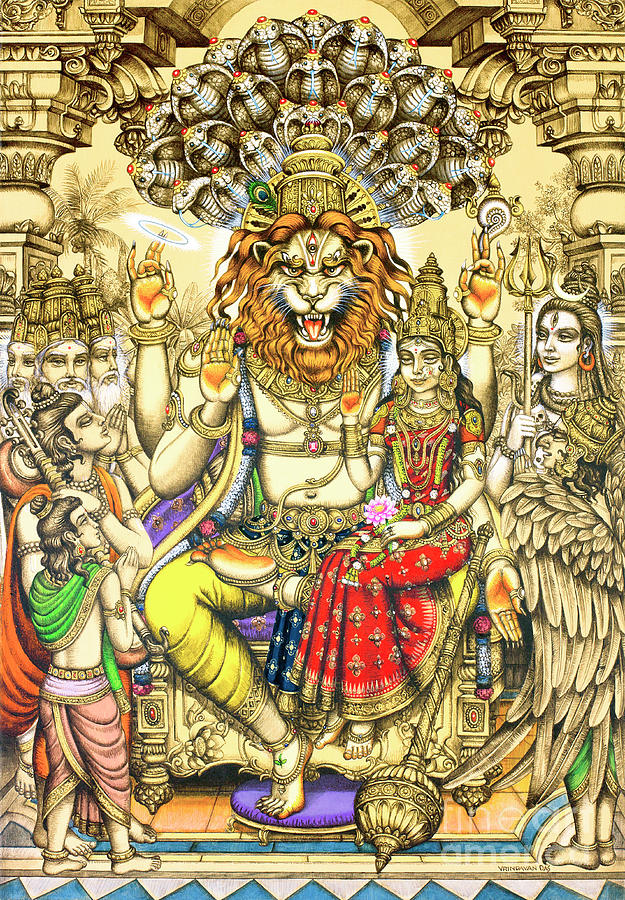
Sri Prahlad Narasihma, painting by Sri Vrindavan Dasa
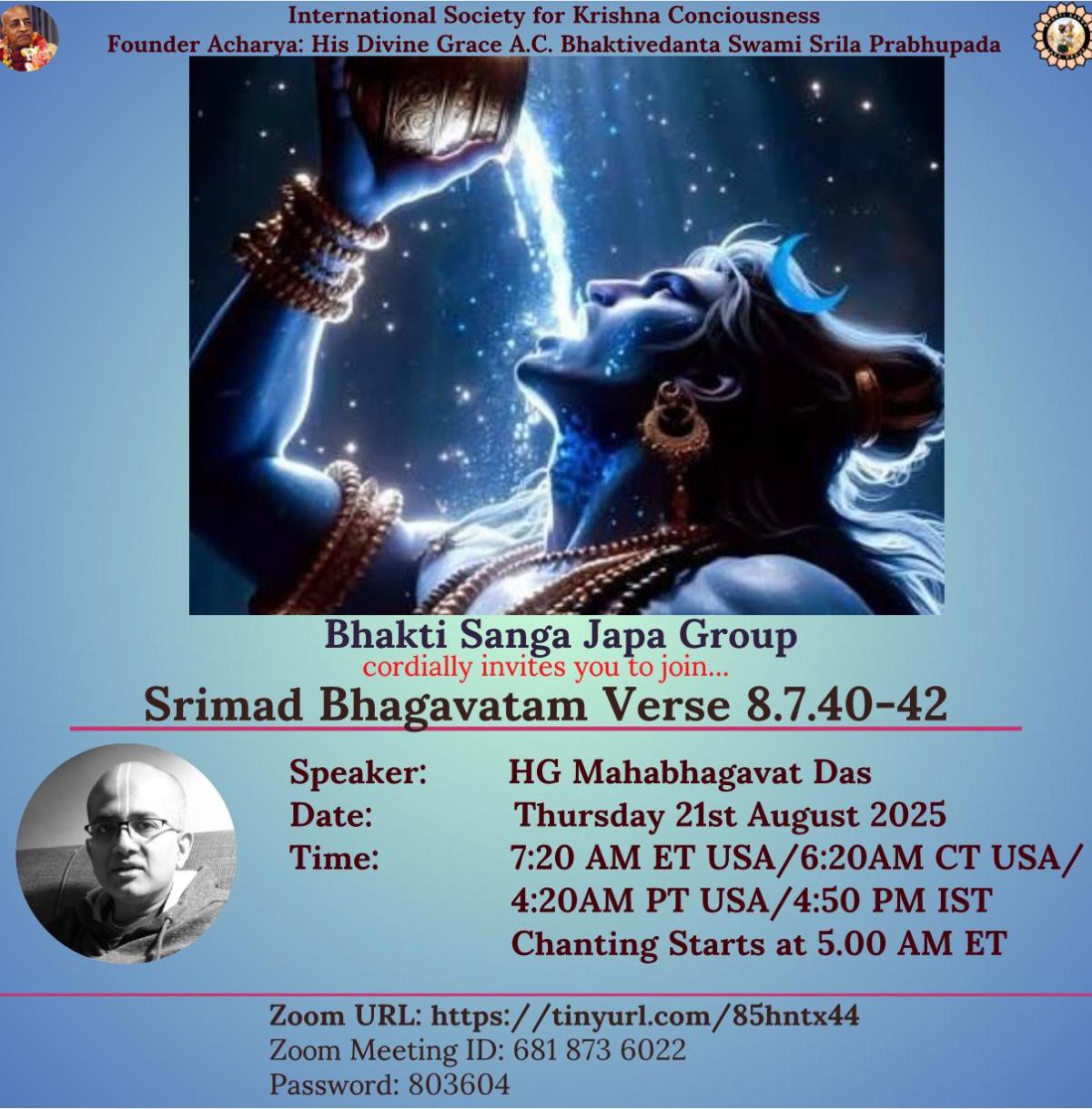
Join us for an enlightening session on Srimad Bhagavatam verses 8.7.40-42 with HG Mahabhagavat Das. This uplifting discussion highlights Lord Shiva’s selfless compassion and the importance of benevolence for all living entities. Don’t miss this opportunity to deepen your understanding on August 21, 2025, at 7:20 AM ET!
A class recording will be shared after.
Hare Krishna 🙏 Bhakti sanga Japa Conference Call Presents.
SPEAKER: HG Mahabhagavat Das
TOPIC:*Srimad Bhagavatam verse 8.7.40-42
DATE📆: Thursday, 21st August 2025
TIME⌚: 7:20 AM. ET USA/ 6:20 AM. CT USA/ 4:20 AM PST USA/ 12:20 PM UK/ 7:20 PM MYT/ 4:50 PM IST
puṁsaḥ — with a person; kṛpayataḥ — engaged in benevolent activities; bhadre — O most gentle Bhavānī; sarva–ātmā — the Supersoul; prīyate — becomes pleased; hariḥ — the Supreme Personality of Godhead; prīte — because of His pleasure; harau — the Supreme Lord, Hari; bhagavati — the Personality of Godhead; prīye — also become pleased; aham — I; sa–cara–acaraḥ — with all others, moving and nonmoving; tasmāt — therefore; idam — this; garam — poison; bhuñje — let me drink; prajānām — of the living entities; svastiḥ — welfare; astu — let there be; me — by me.
Translation
My dear gentle wife Bhavānī, when one performs benevolent activities for others, the Supreme Personality of Godhead, Hari, is very pleased. And when the Lord is pleased, I am also pleased, along with all other living creatures. Therefore, let me drink this poison, for all the living entities may thus become happy because of me.
Śrīla Śukadeva Gosvāmī continued: After informing Bhavānī in this way, Lord Śiva began to drink the poison, and Bhavānī, who knew perfectly well the capabilities of Lord Śiva, gave him her permission to do so.
Thereafter, Lord Śiva, who is dedicated to auspicious, benevolent work for humanity, compassionately took the whole quantity of poison in his palm and drank it.
Purport
Although there was such a great quantity of poison that it spread all over the universe, Lord Śiva had such great power that he reduced the poison to a small quantity so that he could hold it in his palm. One should not try to imitate Lord Śiva. Lord Śiva can do whatever he likes, but those who try to imitate Lord Śiva by smoking ganja and other poisonous things will certainly be killed because of such activities.
A Brahmachari is like a spiritual athlete, dedicated to serving the Supreme Truth, while a Bhramachari chases illusions—basically like a spiritual couch potato, confusing the finish line for a mirage in a desert. We dive into how society’s roles, like Brahmanas and Shudras, fit into this divine quest, reminding us that serving God is the real goal, whether you’re a householder or a renounced sage. Remember, folks: always be a Brahmachari, not a Bhramachari—that’s the real spiritual workout!
A Brahmachari is a person who is dedicated to the pursuit and service of the Supreme Absolute Truth.
ब्रह्म आचरति इति ब्रह्मचारी
brahma ācarati iti brahmacāri
And a Bhramachari is a person is the exact opposite.
The Sanskrit word “bhrama” means “illusion”.
So, someone who chases after illusory happiness is the opposite of someone who dedicates themselves to the Absolute Truth.
What got me thinking was a typo. The person writing was referring to a gentleman who is solidly dedicated to the Supreme Absolute Truth. At first I chuckled, but then I started thinking about the difference between the two.
I concluded that I can be one or the other at any given time, either I am engaged in the service of the Supreme Absolute Truth, or I am engaged in something frivolous that is temporary at best, illusory in nature.
Human society is divided by God into 4 natural orders of spiritual life, and 4 social orders, according to the natural qualities and work performed by the various people. And Brahmacharis can exist in all spiritual and social orders. This natural division is clearly visible in the nature and activities of people, it’s not the birth-based caste system as it has degenerated to.
According to the three modes of material nature and the work associated with them, the four divisions of human society are created by Me. And although I am the creator of this system, you should know that I am yet the nondoer, being unchangeable. https://vedabase.io/en/library/bg/4/13/
The 4 Social Orders are:
Brahmanas: The intelligent class, the “head” of society
Kshatriyas: The administrator class, the “arms” of society
Vaishyas: The mercantile community, merchants, traders, farmers, the “belly” of society
Shudras: The worker class, the “legs” of society
And then there are the 4 spiritual orders:
Brahmachari: The celibate student
Grihastha: The householder family man
Vanaprastha: The former householder, retired from family life
Sannyasa: The fully renounced order of life
However, no matter which social or spiritual order one may be situated in…
अत: पुम्भिर्द्विजश्रेष्ठा वर्णाश्रमविभागश: । स्वनुष्ठितस्य धर्मस्य संसिद्धिर्हरितोषणम् ॥ १३ ॥
O best among the twice-born, it is therefore concluded that the highest perfection one can achieve by discharging the duties prescribed for one’s own occupation according to caste divisions and orders of life is to please the Personality of Godhead. https://vedabase.io/en/library/sb/1/2/13/
All these 4 orders of society are meant to serve God in their own way, just like the different parts of the body serves the whole – the hand feeds the stomach, the leg moves the body, and the brain regulates the hand, stomach, and legs. One without the others is a handicapped body, not very effective. Neither is one more or less important than others.
By following the activities according to one’s own nature, and offering that in the service of God, one can indeed attain perfection.
By worship of the Lord, who is the source of all beings and who is all-pervading, a man can attain perfection through performing his own work. https://vedabase.io/en/library/bg/18/46/
Which now brings us to the main topic of our discussion…
No matter where we might fit into society, we are all meant to serve God with all our faculties, with all our gifts, with all our abilities, and all our resources.
This is how one may remain a Brahmachari, no matter where one may be situated in…
Brahmacharis in the Brahmachari Ashrama – these are either students or those dedicated to spiritual life without deviation, and/or preparing themselves for the renounced order, usually younger men, but also many older men. Being in young bodies or being inexperienced does not mean they can pursue unrestricted sense enjoyment.
Grihastha Brahmacharis, or those who pursue spiritual life even while accepting the responsibilities of householder or family life. It’s not that taking on family responsibilities give the person to pursue illusion in an unrestricted manner.
Vanaprastha Brahmacharis, or those who have retired from family life, or decided to marry a like-minded person dedicated to spiritual life – even while living as a married couple, they have no family responsibilities. However, just because they are not directly responsible for their family doesn’t mean they don’t accept responsibility for other Grihasthas and Brahmacharis. The dedicate themselves to being on “constant pilgrimage” and leveraging their life experience and spiritual knowledge to benefit others.
Sannyasa Brahmacharis, or those who are in the renounced order of life, with no family or social connections. But just because someone is in the renounced order of life doesn’t mean they don’t do anything. In fact, they adopt the whole world as their family, meeting others just so they can convey God Consciousness, Krishna Consciousness to them, and staying just long enough to deliver the message and keep moving on.
Importantly, one needs to remain focused on the goal of life, which is to attain spiritual perfection. The way one expresses one’s Brahmacharya, or dedication to spiritual advancement, may look different depending on which Varna and Ashram one is in, but the principles of a regulated spiritually focused life remain.
No matter if you are a man or woman, young or old, whether you wear white, or saffron, or any other colour… If you’re serious about spiritual life, then you must be a Brahmachari, in every thought, word, and deed.
So we have a choice, no matter what our official social and spiritual status might be. At every moment, with every thought, word, and deed, we all need to be Brahmacharis, not Bhramacharis.