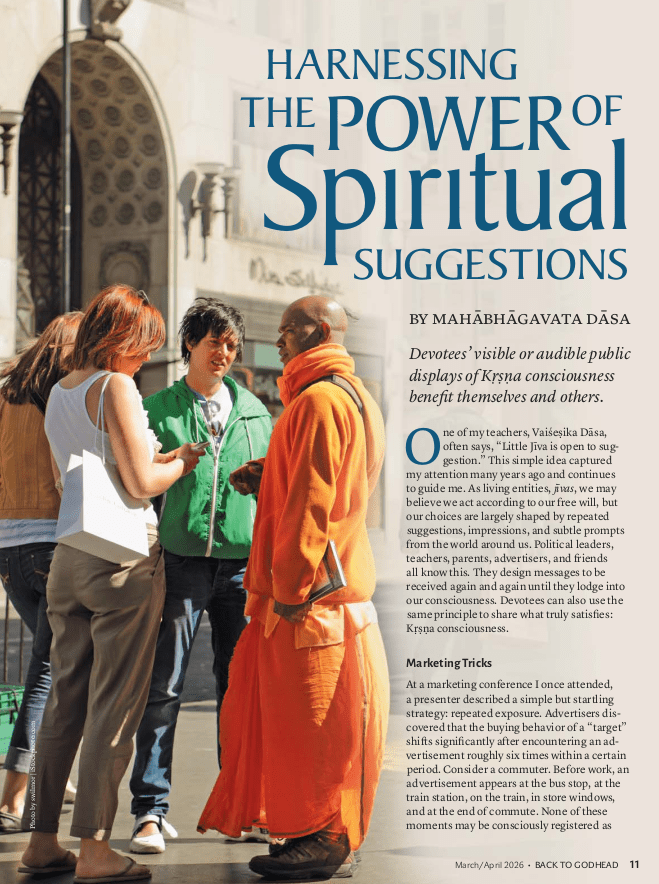
Devotees’ visible or audible public displays of Kṛṣṇa consciousness benefit themselves and others.
One of my teachers, Vaiśeṣika Dāsa, often says, “Little Jīva is open to suggestion.” This simple idea captured my attention many years ago and continues to guide me. As living entities, jīvas, we may believe we act according to our free will, but our choices are largely shaped by repeated suggestions, impressions, and subtle prompts from the world around us. Political leaders, teachers, parents, advertisers, and friends all know this. They design messages to be received again and again until they lodge into our consciousness. Devotees can also use the same principle to share what truly satisfies: Kṛṣṇa consciousness.
Marketing Tricks
At a marketing conference I once attended, a presenter described a simple but startling strategy: repeated exposure. Advertisers discovered that the buying behavior of a “target” shifts significantly after encountering an advertisement roughly six times within a certain period. Consider a commuter. Before work, an advertisement appears at the bus stop, at the train station, on the train, in store windows, and at the end of commute. None of these moments may be consciously registered as persuasion, yet the accumulated impressions nudge the person toward a purchase as if it were spontaneous.
We should recognize a simple fact: advertisers invest vast resources to plant suggestions to encourage materialistic consumption. Devotees should likewise invest in planting suggestions – liberating ones. The holy names of Kṛṣṇa, His instructions, and the spiritual sound vibrations that awaken the heart from its materialistic slumber should be carefully and repeatedly suggested to all jīvas.
A Personal Tale of Spiritual Sound
During the pandemic, I was asked to speak online to a group of intelligent, spiritually inclined young men. Many were anxious because of reduced income, deferred studies, separation from family, and the strange isolation that came with those times. Feeling the weight of the same troubles, I struggled to find inspiration. For days I tried different topics, but none rang true. Without being inspired myself, how could I inspire others?
On the morning of the talk, as I fretted in our kitchen, my octogenarian father, all the way in India, had called and was reading aloud from Śrīla Prabhupāda’s book Kṛṣṇa, the Supreme Personality of Godhead to my seven-year-old son in Toronto. I had many times read or heard the chapter he was reading, but on that morning the living sound of Śrīla Prabhupāda’s words, conveyed by my father’s sincere and loving voice, touched me like never before. Suddenly, I had the inspiration and clarity I needed. I prepared my presentation and spoke with a joyful heart.
That spiritual sound, the living recitation of śāstra, uplifted me, even across continents. That moment taught me about the efficacy of spiritual sound. My father and my son were doing what they did during the pandemic: my son read the children’s version of Kṛṣṇa to my father, and my father read Śrīla Prabhupāda’s original Kṛṣṇa to my son. It was something they did for themselves. But there was collateral impact.
Why Be Seen and Heard?
Many spiritual aspirants have a natural reticence. Śrīla Prabhupāda writes, “Sometimes in autumn the falls come down from the top of the hill to supply clean water, and sometimes they stop. Similarly, sometimes great saintly persons distribute clear knowledge, and sometimes they are silent.” (Kṛṣṇa, Chapter 20, “Description of Autumn”) The Bhagavad-gītā (18.67) warns that confidential knowledge should not be given to the envious or the unreceptive. Similarly, Śrī Caitanya Mahāprabhu discussed the intimate pastimes of Śrī Rādhā-Kṛṣṇa and the gopīs only with His closest associates.
There are two kinds of advanced devotees. The bhajanānandī is inwardly absorbed, and the goṣṭhyānandī delights in attracting others to the Lord by song, speech, dance, and other outward acts. We may not be in either category, and may feel unqualified to share. But the practical question for us is this: Given that any time we appear in public or are with friends or acquaintances, we are always in some way making suggestions – by our dress, our behavior, our speech, and so on. So why not point our suggestions toward Kṛṣṇa?
Śrīla Prabhupāda elaborates:
Sāṅketya. Just like sometimes on the street some outsider, seeing you, they chant Hare Kṛṣṇa only by the symbolic, sāṅketya. Because they see: “They have got tilaka, kaṇṭhī [neck beads].” Therefore these things are required. Don’t become immediately paramahaṁsa – no tilaka, no kaṇṭhī, and no bead bag. This is not good. Sāṅketya, so that others may understand, “Here is a Vaiṣṇava. Here is a Kṛṣṇa devotee.” And if he is simple, he’ll chant “Hare Kṛṣṇa.” This chance should be given. Therefore it is necessary, how people can utter. That chanting may save him from the greatest danger.
Therefore it is said, sāṅketyaṁ pārihāsyam. If somebody jokes . . . Sometimes they do that. “Hare Kṛṣṇa.” He is not seriously chanting, but he is trying to joke the other party who is engaged in chanting. And that is also good, pārihāsya. During Caitanya Mahāprabhu’s time, the Muslims, they used to joke [about] the Hindus, “Hare Kṛṣṇa, Hare Kṛṣṇa.” So the practice made them chanting Hare Kṛṣṇa. And the police officer was informed by the constables that “These Hindus are chanting ‘Hare Kṛṣṇa, Hare Kṛṣṇa.’” The police officer asked him, “Then why are you chanting Hare Kṛṣṇa?” By imitating, they became practiced to chant Hare Kṛṣṇa. It is so nice. Even joking, symbolic, sāṅketyaṁ pārihāsyaṁ stobham. Or prema. Helanam eva vā. Without any care, “Hare Kṛṣṇa.” Any way if you chant Hare Kṛṣṇa, then vaikuṇṭha-nāma grahaṇam aśeṣa agha-haram. Agha. Agha means sinful activities.” [They are destroyed.] (Lecture on Śrīmad-Bhāgavatam 6.2.13, September 15, 1975)
Win-Win: Benefits All Around
There are direct benefits to the practitioner who chooses to be seen and heard in regard to Kṛṣṇa consciousness. The very act of externalizing devotion by such things as dressing in devotional clothes, wearing tilaka and neck beads, chanting aloud, and reading scripture aloud fortifies one’s inner state. And there are benefits to others as well.
Haridāsa Ṭhākura was elevated by Śrī Caitanya Mahāprabhu to the status of nāmācārya, the exemplar of chanting the Lord’s holy names. In Śrī Caitanya-bhāgavata (Ādi 16.279), Haridāsa Ṭhākura quotes Śrīmad-Bhāgavatam (10.34.17): “Anyone who chants Your name purifies all who hear His chanting, as well as himself.”
Haridāsa Ṭhākura further instructs: “Animals, birds, insects and other creatures are unable to speak, but if they just hear the holy name, they can all cross over [material existence]. If you chant the holy names silently, then you yourself will be saved, but if you chant aloud, then you will benefit others. Therefore, all the scriptures state that by the loud chanting of the name, a hundred times greater result can be obtained.” (Caitanya-bhāgavata, Ādī 16.280–282). He substantiated this point with evidence from the Nāradīya Purāṇa: “One who loudly chants the holy names of the Lord is a hundred times greater than one who silently chants, because those who chant silently purify only themselves, while those who chant loudly purify themselves as well as those who hear them.” (Ādī 16.283)
A Lingering Contradiction?
How do we reconcile Kṛṣṇa’s order to avoid sharing confidential instructions with the undeserving with Mahāprabhu’s clarion call to convey Kṛṣṇa consciousness to all whom we come across? The solution is that we should first act in such a way that inspires a positive impression in others, creating some faith, and then share Kṛṣṇa consciousness with them. If we wish to emanate genuine spiritual vibrations outwardly, we must first absorb them inwardly. An orange, when squeezed, yields orange juice. Similarly, a sincere devotee of Kṛṣṇa cannot avoid emanating Kṛṣṇa consciousness.
My spiritual master, Saṅkarṣaṇa Dāsa, advises, “From four to nine in the morning, save yourself; then from nine to nine, save the world.” This captures the balance. When our inner spiritual reservoir overflows, we naturally share, and our sharing carries the sweetness of our personal realization. Śrīla Rūpa Gosvāmī’s words exemplify this: “I do not know how much nectar the two syllables ‘Kṛṣ-ṇa’ have produced. When the holy name of Kṛṣṇa is chanted, it appears to dance within the mouth. We then desire many, many mouths. When that name enters the holes of the ears, we desire many millions of ears. And when the holy name dances in the courtyard of the heart, it conquers the activities of the mind, and therefore all the senses become inert.” (Vidagdha-mādhava 1.15)
Prahlāda Mahārāja, a standard-bearer of sharing Kṛṣṇa consciousness, said:
My dear Lord Nṛsiṁhadeva, I see that there are many saintly persons indeed, but they are interested only in their own deliverance. Not caring for the big cities and towns, they go to the Himālayas or the forest to meditate with vows of silence [mauna-vrata]. They are not interested in delivering others. As for me, however, I do not wish to be liberated alone, leaving aside all these poor fools and rascals. I know that without Kṛṣṇa consciousness, without taking shelter of Your lotus feet, one cannot be happy. Therefore I wish to bring them back to shelter at Your lotus feet. (Bhāgavatam 7.9.44)
The fruit of sincere practice in bhakti-yoga is an irresistible urge to distribute Kṛṣṇa’s mercy.
Addressing Objections and Fears
Some devotees fear that public devotion will expose them to ridicule, social ostracism, or misunderstanding. This fear is understandable. Yet it can be tempered by reason and awareness of precedent. Historically, many great devotees endured scorn and turned it into an instrument of profound spiritual change in others. Furthermore, not all public expressions have to be loud or overt. Subtle signaling is often sufficient to awaken curiosity. Tilaka on the forehead, visible śāstra, or a neighborly word of praise can precipitate spiritual interest.
A Few Words of Caution
While advocating for Kṛṣṇa, we should be careful about timing and audience. Lord Kṛṣṇa’s instruction in Bhagavad-gītā 18.67, which warns against revealing confidential knowledge to those lacking devotion or austerity, remains valuable. We should not forcibly proselytize or engage antagonists who are determinedly hostile. We need to use discretion, be courteous, and prefer invitation to confrontation. Leaving a good impression is important. In all cases, honesty, sincerity and humility should temper zeal.
Practical Methods
For devotees who hesitate to teach formally, many subtle and practical means are available for sharing suggestions about Kṛṣṇa consciousness. Here are some simple methods:
1. Personal Symbols: Wear tilaka, wear neck beads (kaṇṭhī-mālā), carry a bead bag – let our clothing and appearance be a gentle sign that we belong to a spiritual tradition. Such visible tokens function as sāṅketya, or signals that invite others to inquire or imitate.
2. Personal Conduct: Strive to behave in ways befitting a Vaiṣṇava, including such things as being gentle, speaking truthfully, avoiding intoxication, and being willing to serve the Lord. Our manner of living is an implicit instruction. People appreciate behavioral integrity more than theological erudition.
3. Group Practice: Form or join reading groups, Bhāgavatam study circles, or phone-based reading partnerships. Shared reading amplifies the vibrational effect and strengthens our personal discipline and devotional relationships.
4. Public Reading: Keep a Bhagavad-gītā As It Is, Śrīmad-Bhāgavatam, or other book on Kṛṣṇa consciousness on your desk at work or read it in public spaces where others might notice the cover and be drawn to ask questions. My own reading of the Bhāgavatam on planes has resulted in many Bhāgavatam sets being distributed.
5. Sharing Spiritual Sound: Record readings, kīrtanas, and lectures and share them with others. Participate in or organize harināma-saṅkīrtana and book distribution whenever possible. Even singing softly while walking in a park is an option.
6. Digital Outreach: Write blog posts, answer spiritual queries in forums, participate in online reading groups, or maintain a website offering reliable devotional resources. Screenshots of your readings, short video clips of kīrtana, and links to books enlarge the reach of spiritual sound in an age of digital noise.
7. Hospitality and Example: Invite neighbors to a simple bhajana, share prasādam, or encourage interested persons to see how devotional practice is organized in your home. Hospitality can reduce the distance between curiosity and participation.
The Wider Ripples of Spiritual Sound
When pure sound goes out, its effects are not limited to human listeners. The bhakti tradition teaches that Kṛṣṇa’s names purify the atmosphere. A devotee’s sincere vibrations can elevate even germs and render the environment congenial for devotional life. Thus, what may seem a small act, such as reading aloud for a few minutes or chanting quietly in the garden, may quietly transform the inner climate of a household, a workplace, or a neighborhood.
Share the Overflow
There is a certainly a scarcity of Kṛṣṇa consciousness in the world. The remedies are simple and practical. We need not be perfect or fully qualified as pure devotees. The sincere attempt to vibrate the holy name pleases Kṛṣṇa and increases our own potency. As Śrīla Prabhupāda said, “Every one of us [can be a] messiah. Anyone Kṛṣṇa conscious, he’s the messiah. Every one. Why one? All of us. . . . The devotee of Lord Caitanya – every one has such immense power that every one can deliver the whole universe.” (Room Conversation, Bombay, April 15, 1977)
Whether we chant in private or walk openly with beads and tilaka, our vibrations travel farther than we can imagine. Someone, somewhere will be uplifted by what we may consider a small effort. Spiritual transmission is subtle and cumulative. Over months and years, these simple investments compound.
We need not remain passive recipients of materialistic messages. We can strive to be active transmitters of Kṛṣṇa consciousness ourselves. When we consciously choose to transmit Kṛṣṇa’s vibration, we join a chain of mercy that stretches back through our ācārya-paramparā and into the hearts of those we may never meet.
Going back to the marketing analogy, advertisers never rely on a single exposure. They invest fortunes to ensure their message meets the eyes and ears of the consumer many times a day. They understand the mechanics of the subconscious: a repeatedly planted suggestion becomes a personal choice. In the same way, the transcendental holy name, when repeatedly encountered in various ways – heard from a devotee on the street, glimpsed on a book cover, recalled from a melody – gradually transforms the heart. Each spiritual encounter, even if seemingly casual, is a drop of spiritual nectar in the desert of material life. This is why book distribution, regular kīrtana, and small acts of public devotion are not mere rituals or personal preferences; they are spiritual technologies aimed at awakening dormant love of Kṛṣṇa.
You may or may not feel qualified. You may or may not feel empowered. You may or may not be fully pure at heart. Regardless, consider vibrating the holy name aloud for your own benefit and the benefit of others. Someone, somewhere could be inspired and uplifted, and you could be seen as a savior. But that is not so important. What’s most important is that if you vibrate spiritual sound sincerely, you will surely be recognized by Kṛṣṇa as His dear servitor. And what can be better than that?
Mahābhāgavata Dāsa is a disciple of Saṅkarṣaṇa Dāsa Adhikārī. He serves alongside his wife and son in the Toronto area while working as a chief technology officer in the corporate world. He shares his writings online at www.dasadas.com.
This article was originally published in the March-April 2026 Issue of the Back to Godhead Magazine. It was inspired by this blog post. I benefited greatly from the feedback of the anonymous BTG reviewers. This article is a lot better also due to the direct editing by His Grace Nagaraja Dasa (ACBSP), the Editor of the Back to Godhead Magazine.