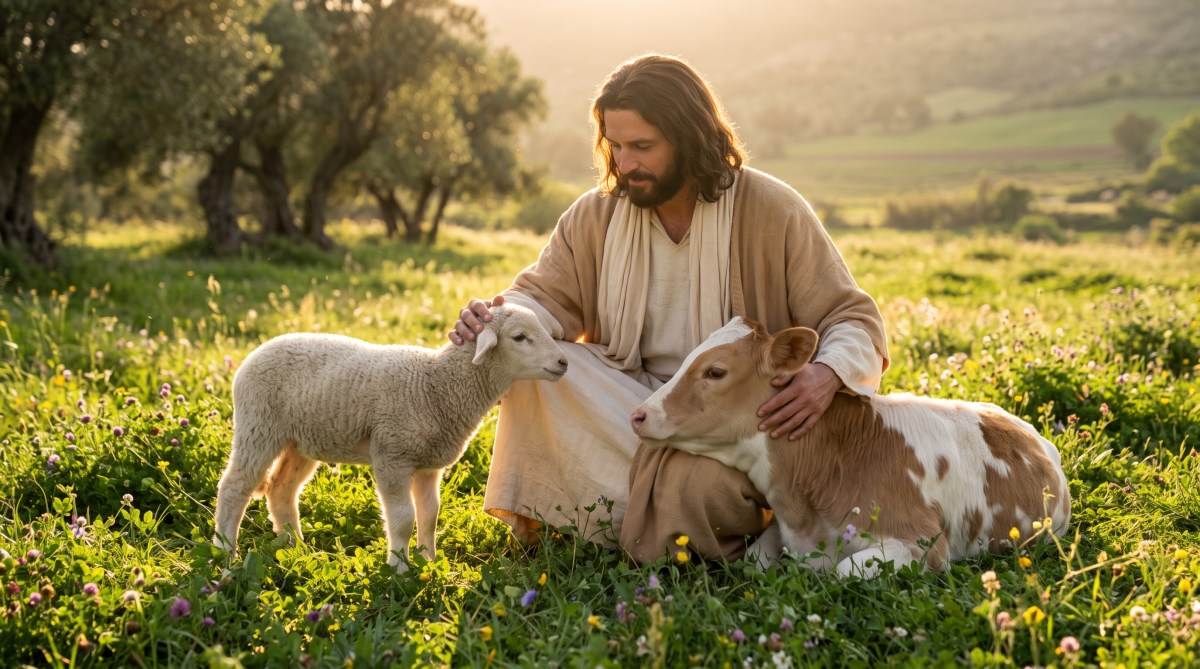
Jesus Christ Is No Fool: Why Genuine Faith Demands True Compassion

Can we repeatedly indulge in harmful habits, ask for forgiveness, and assume grace erases every consequence without any effort to change? To expect endless absolution while willfully causing harm treats divine mercy as a loophole and treats Jesus Christ as a fool. Real faith demands genuine repentance and character transformation, not passive lip service. By examining wisdom from the Bible, the Bhagavad Gita, and the Srimad Bhagavatam, this article explores why true spiritual progress requires universal compassion, an end to animal slaughter, and an active commitment to living in harmony with divine law in thought, word, and deed.

If a friend makes an honest mistake and asks for forgiveness, a charitable heart readily offers pardon. If they repeat the mistake, mercy may still extend a second or third chance. But if that person commits the exact same act repeatedly, with full intentionality, expecting forgiveness on demand without making any effort to change, common sense tells us that forgiveness is being taken for granted. To assume that one can continually exploit mercy without consequence is not faith; it is naive.

Yet, a pervasive idea exists among many believers today: that one can indulge in a lifestyle of perpetual wrongdoing, hand over the tab to Lord Jesus Christ, and be completely cleared of all consequences simply by professing belief.

Does this not treat Jesus Christ as a fool?

Jesus Christ is certainly no fool. Genuine spiritual life requires more than lip service; it demands authentic repentance, self-discipline, and a transformation of character.

The Illusion of “Elephant Bathing”

In the Srimad Bhagavatam (6.1.9–6.9.10), King Pariksit raises this exact dilemma to the sage Sukadeva Gosvami. He questions the value of ritualistic atonement when a person immediately returns to sinful habits:

“If a person who knows the adverse results of sinful activity commits sin again and again, of what value is his counteracting method? Such atonement is like the bathing of an elephant, which takes a bath in the water but immediately upon coming onto dry land throws dust all over its body.”

Atoning for a sin only to repeat it deliberately is known in Vedic wisdom as hasti-snana, the elephant’s bath. Cleaning oneself only to roll in the dirt again solves nothing.

The Christian scriptures share this exact warning. Saint Paul writes directly to believers who assume grace excuses ongoing sin:

“What shall we say then? Shall we continue in sin that grace may abound? Certainly not! How shall we who died to sin live any longer in it?”

— Romans 6:1–2

“Do not be deceived, God is not mocked; for whatever a man sows, that he will also reap.”

— Galatians 6:7

To presume that Jesus’s sacrifice gives us a blank check to sin with impunity is to mock the Savior. Forgiveness clears the heart of honest seekers, but divine law ensures that willful hypocrisy brings its own severe consequences.

Action, Reaction, and the Laws of Nature

In the Bhagavad Gita, Lord Krishna explains that actions performed in ignorance and self-indulgence, without regard for consequences or harm inflicted on others, bind the soul to suffering:

“That action which is undertaken out of delusion, without considering consequences, loss, injury to others, or one’s own capacity, is declared to be in the mode of ignorance.”

— Bhagavad Gita 18.25

Forgiveness frees the spirit from malice, but it does not suspend the physical and spiritual laws of cause and effect (karma). Fire burns whether you are forgiven for touching it or not. Expecting divine grace to shield us from the natural reactions of intentional harm, while continuing to cause that harm, ignores how God’s creation functions.

Reclaiming “Thou Shalt Not Kill”

How, then, can a true follower of Christ honor His teachings in thought, word, and deed? A crucial place to begin is with one of the most fundamental commandments: “Thou shalt not kill” (Exodus 20:13).

True spiritual progress expands our circle of compassion. Can we truly claim to follow a God of love while participating in the unnecessary suffering and slaughter of innocent creatures who feel fear, pain, and affection?

Furthermore, many spiritual scholars and early Christian traditions emphasize that a central point of conflict between Jesus and the established Temple authorities of His time was His firm stance against ritual animal sacrifice. When Jesus famously cleansed the Jerusalem Temple, driving out those selling oxen, sheep, and doves (John 2:14–15), He directly confronted an institution reliant on the blood of innocent animals. By quoting the Old Testament prophet Hosea and declaring, “I desire mercy, not sacrifice” (Matthew 9:13), Jesus signaled a departure from blood rituals toward a higher path of compassion and spiritual purity.

As explored in depth in the article “Eating Meat is not for Spiritualists”, genuine spiritual advancement requires stepping away from violence and recognizing that unnecessary slaughter is contrary to spiritual growth.

In original biblical creation, humanity was given a compassionate, plant-based diet:

“And God said, ‘See, I have given you every herb that yields seed which is on the face of all the earth, and every tree whose fruit yields seed; to you it shall be for food.'”

— Genesis 1:29

Similarly, the Srimad Bhagavatam (1.17.24) identifies daya (mercy/compassion) as one of the essential pillars of spiritual life, warning that cruelty toward animals destroys this principle at its root.

In the Bhagavad Gita (3.13), Lord Krishna further underscores the spiritual responsibility tied to what we consume:

“The devotees of the Lord are released from all kinds of sins because they eat food which is offered first for sacrifice. Others, who prepare food for personal sense enjoyment, verily eat only sin.”

When we support slaughterhouses, commercial fisheries, and factory farming, we actively participate in an industry built on violence against innocent living beings. To claim we cannot stop causing this harm, yet expect Jesus to absolve us while we continue doing it, misinterprets the very nature of Christ’s mercy.

A Call to Align Faith with Action

Jesus Christ called His followers to a higher standard of love, mercy, and righteousness. True faith is not a passive insurance policy; it is an active commitment to live in harmony with divine law.

When abundant, wholesome, plant-based alternatives exist to fully nourish us, choosing to eat meat or fish in the presence of other food is a deliberate preference for sensory gratification over the life of an innocent creature. If someone knowingly chooses violence over peaceful, compassionate food, how can they genuinely be accepted as a Christian? To truly follow Christ is to embody His divine mercy; choosing unnecessary bloodshed when other nourishment is readily available directly contradicts the heart of His teachings.

We urgently call upon church leaders, pastors, and clergy to rise to their sacred duty. Stop turning a blind eye to slaughter and appeasing congregations to fill seats and coffers; lead by example and teach what souls need rather than what they crave. It is time to end the abomination of meat eating in churches, church functions, and community halls once and for all. A pulpit that preaches love while serving the flesh of slaughtered innocents is a tragic contradiction of Christ’s message.

Let us stop treating grace as a license for cruelty or compla.cency. If we profess love for Jesus Christ, let us reflect His mercy in every choice we make, starting with what we put on our plates.

Say no to slaughterhouses, meat, fish, and the exploitation of innocent animals. Choose a path of universal compassion and harmlessness (ahimsa).

Hare Krishna.

The Milk Controversy – should we give it up?

Should spiritualists consume milk or should they be vegan? The Vedic texts enjoin us to develop solid intelligence through milk consumption, but yet modern milk production is fraught with violence. So what is the spiritualist to do?

Partha Das, 26 April 2020

Hare Krsna,

I was surprised to see many articles and interviews by modern day doctors saying milk is white poison.

As a Hare Krsna devotee, I have given up tea, coffee, alcohol smoking etc . My only source of pleasure is daily cups of hot milk . I also enjoy all the milk byproducts such as yogurt, paneer, cheese, milk, sweets etc.

I tried to be a vegan for 3 months , on advice of a doctor who is against milk. But the result was that my bones and tooth became weak and brittle. I was forced to restart milk immediately.

Could you enlighten me a little on this matter. It is not possible to get milk from an ISKCON farm , which doesn’t use injections on cows, or is not cruel to animals.

What is the ISKCON stand on this matter, as our source of milk is the Govt dairy farm and it’s not possible to keep a cow in a city.

Dandavats,

Partha Das

Paramahamsa Das, 28 April 2020

Hare Krishna, 

Please accept my obeisances 

All Glories to Srila Prabhupada 

All Glories to Srila Gurudev, 

I would like to thank you for your wonderful question and also appreciate that you have worked your way to avoid Tea, coffee, and nasty habits like smoking. It indeed shows your dedication to imbibe a proper lifestyle that will bring you closer to Krishna by at least reaching to the mode of goodness. 

As far as Milk and milk products are concerned or in that case, any foodstuff you enjoy if you do so without making an offering to Krishna then you are verily eating sin as mentioned in the Bhagavad Gita 3.13 

yajña-śiṣṭāśinaḥ santo

mucyante sarva-kilbiṣaiḥ

bhuñjate te tv aghaṁ pāpā

ye pacanty ātma-kāraṇāt

And if you enjoy the foodstuff after they are offered to Krishna then you can rest assured that you are not eating white poison as you point out modern doctors referring to milk. Of course given the fact that your body is able to digest milk and you don’t have some intolerance which might be the case for some individuals and they need to be consulting proper medical care. 

But, from the perspective of Sastra, Srila Prabhupada has very clearly mentioned in many different places that one can maintain ones’ body with any kind of foodstuffs but special emphasis is on Cow milk. It is very essential for the development of finer tissues of the human brain so that they can understand the intricacies of Transcendental knowledge.

Now as far as the milk you are referring to (from ISKCON Farm ) is called Ahimsa milk. This is very rare for people like us living in a city to get but in this matter, Srila Gurudev gives an analogy of a thorn to remove another thorn.

If you are not able to protect or participate in any way to directly protect Mother Cow then at least the milk you get from commercial dairy farms could be used to offer it to Krishna so that at least that particular Cow’s life is successful and you are getting the needed nourishment to developed your brain’s fine tissue to understand the Transcendental knowledge and who knows in the near future with that intelligence you might be able to come up with some scheme for Cow protection! 

your servant, 

Paramahamsa Das

Rahul Prasad, 28 April 2020

Hare Krishna …

Dandavat Pranam…

Please accept my obeisances 

All Glories to Srila Prabhupada 

All Glories to Srila Gurudev, 

How can milk (commercial) be considered in goodness? In the current scenario, cows have to suffer a lot to produce milk (commercial). For the production of commercial milk, the cow needs to undergo various known sufferings.

Then how can the milk produced commercially be considered in goodness?

I request you to please advise.

your servant

Rahul

Paramahamsa Das, 28 April 2020

Hare Krishna Rahul, 

Please accept my humble obeisances 

All Glories to Srila Prabhupada 

All Glories to Srila Gurudev

The milk that has been offered to Krishna and then accepted as prasadam is transcendental i.e above 3 modes of material nature. 

The milk of the cow even though derived by commercial means when offered to Krishna could be seen as service rendered by the Go (cow/cows) to Govinda  ( the Supreme Personality of Godhead) so it is similar to us working in the commercial world going under so much trouble and collecting little Laksmi and then we utilize it i in the service of Guru and Krishna( Narayan ).

Does this help?

your servant, 

Paramahamsa das.  

Partha Das, 28 April 2020

Hare Krsna Rahul Prabhu,

If we see the way plants are treated nowadays with pesticides, DDT, chemical fertilizers etc , I am sure such vegetables are not suitable for offering to Krsna. They will fall in the same category as milk produced in modern farms by torturing cows.

Hence I feel offering milk and vegetables to Krsna , before consumption is the only option left for us.

Nothing in this modern world is pure.

Dandavats,

Partha Das

Partha Das, 28 April 2020

Hare Krsna Paramhamsa Prabhu,

Thanks for your guidance. I am already offering the milk to Krsna before consumption. 

Hope to be part of the Ahimsa farm community in the near future.

Dandavats,

Partha Das

Priya Sundari devi dasi, 28 April 2020

Hare Krishna Prabhus. 

Please accept my humble obeisances. 

All glories to Srila Prabhupada. 

In my recent years of doing some research and talking to farm devotees as well as non-devotees, this is what I have concluded with the help of some senior Vaishnava inputs: 

1. If you have access to ahimsa milk then that is best. Drinking even 1 cup of ahimsa milk is better than loads of non ahimsa milk. Some devotees get raw milk delivered in bulk and freeze this and use this as needed. 

There are different degrees to the meaning of Ahimsa in this context. 

a. Where a cow is left free to graze and the calf is allowed to freely feed and then what remains is consumed….to…. 

b. Where cows are tied in a farm and allowed to graze for a bit and calves are allowed to feed limited. 

c. Of course the idea is that at the end of Mother Cow’s life, she is not slaughtered and the male calves are not sent away to be killed. 

2. If you don’t have access to ahimsa milk, then the next best option is Raw + Organic whole Milk. You can check with your local farm suppliers. 

a. This ensures that we are not ingested the various antibiotics and other medications that mother cow is subject to 

b. Also organic milk = mother cow is fed a better diet 

c. Raw because is it best to not have milk that has been treated (pasteurized and homogenized) 

*** Please note raw milk will need to be gently boiled before consuming to ensure that any other harmful bacteria have been eliminated***

3. If you don’t have access to raw milk, then the next option is Pasteurized + Organic + Unhomogenized Whole Milk. 

This can be bought locally in many supermarket chains. 

This follows the order of best, better and good. If you are able to afford / have access to ahimsa milk then that’s best. If that’s not an option then the next so on and so forth. 

In the least, the milk that we consume should be Organic and unhomogenized and always whole milk. 

Dr. Marianne Teitlebaum who is a renowned Ayurvedic practitioner talks more about that in her book: 

The demonization of milk

— Dr Marianne Teitelbaum

“Almost every blog or nutritional book I read calls milk a poison. Ayurveda considers milk a nectar and perhaps the most important food we can give to our body. Why the disconnect? There are several factors to consider here, all of which I discuss in my new book “Healing the Thyroid With Ayurveda.”

When you milk a cow and let the milk sit, the cream will rise to the top. This is called unhomogenized milk. Nowadays most of the milk is homogenized so you don’t see that layer of cream at the top anymore. But homogenized milk isn’t as nourishing and can contribute to heart disease and clogged arteries due to this processing of the fat molecules. So strive to get unhomogenized milk.

Get the full fat milk as it is the fat in the milk which delivers the calcium into your bones. If the milk is low-fat your bones will suffer as the calcium is now excreted out of your body contributing to the epidemic levels of osteoporosis we are currently experiencing. 

Many people cannot digest milk due to faulty digestion so it is imperative that you fix your digestion in order to receive milk’s health benefits. 

Some people cannot digest the protein in A1 milk, however numerous small dairies are springing up around the country which supply A2 milk which is lacking that hard to digest protein (see my book or previous posts about A2 milk). 

You must boil the milk to melt down the fat globules for best absorption into your cells, otherwise it will clog your throat and sinuses. 

If cow’s milk bothers you, try goat’s milk which is much lighter and easier to digest, and is similar to Mother’s milk. It is good for losing weight, congestion in the lungs and infections in the gut. 

Simmering the milk for a few minutes with 2-3 cardamom pods helps you digest the protein in the milk. And add a cinnamon stick to help you digest the sugar in the milk. Always add a few pinches of turmeric when simmering milk as the fat will deliver the turmeric into your cells. 

Milk is the only food that instantly absorbs into your cells to nourish all 7 tissues (blood plasma, blood, muscle, fat, bone, bone marrow and reproductive fluids). within one day of ingesting whereas any other food can take up to a month to assimilate into the body. 

And boiling the milk forms tryptophan which helps you make more serotonin which makes you both happy and calm. 

This is why drinking warm milk before bed can contribute to a deep restful sleep. 

Many of our thousands of patients have reincorporated milk back into their diets and have experienced the strength, stamina and radiant health that warm whole milk can bring back to our depleted bodies. 

Don’t buy into the argument that we should avoid milk. It’s one of THE most nourishing foods if taken in the correct way.”

follow Dr Teitelbaum’s posts on Facebook. 

If there’s a large group of devotees in your area OR you have consumers who are favorable to not slaughtering cows / calves then you can talk to local farmers and request milk to be delivered for a higher price so that the cow is not harmed and to help the farmer not sell the cow at the end of her life to a slaughter house.  This has worked in some communities in the past. This also means that if people are interested then there is scope for preaching. 

I hope this has helped shed some light on the milk topic. 

your servant 

Priya Sundari devi dasi.

*Kṛṣṇe matir astu*

Partha Das, 29 April 2020

Hare Krsna Mataji,

Thanks for your elaborate explanation.

Partha Das

Rahul Prasad, 30 April 2020

Hare Krishna

Dandvat Pranam

Please accept my obeisances 

All Glories to Srila Prabhupada 

All Glories to Srila Gurudev, 

I do agree that if we offer the Milk (commercial or other type) it will be freed from all 3 modes.

But if we/vegetarian people will avoid consumption of Milk and Milk products then the demand of Milk will fall and the Milk industry will not (will reduce) production of new cows.

As most of the cows are first subjected to the Milk industry and later on moved to Meat industry.

So for the benefit of cows we can move to a (no milk product) vegetarian diet.

I request you to please advise me.

your servant

Rahul

Dr.Reena bhardwaj, 30 April 2020

Hare Krishna    

Milk products like curd are good for health , increase immunity, and provide relief for gastrointestinal infections. So, milk in moderate amounts is good for health. 

Dr.Reena Bhardwaj 

Sailesh, 30 April 2020

Hare Krishna:

With my limited knowledge, I share the following facts that I am aware of:

 Milk bearing cows are slaughtered once their calf bearing days and milk giving days are done.  It is better in my humble opinion that we be intellectually honest with ourselves, that by supporting milk industry we support the beef industry as well. PETA has a campaign about it as well ( Are you drinking beef?)

 Yes, we can say offer the milk to Krishna , by saying “Krishna Arpana” and then all consequences including the slaughter of the Cows go to Lords feet. But let us be very clear that there is a direct connect between us drinking milk and the end result of what happens to the Cow.

This happens in India as well. The moment a Cow stops giving milk and cannot produce calves, they are released on to the streets. The Cows eat from garbage bins for a while, eventually they are captured and slaughtered . No doubt many are taken to Gau Rakshak sheds, but that is not always the case.

If I have offended anyone, I beg forgiveness. If any feel these are not the facts, I would be grateful if I could be corrected.

Sincerely,

Sailesh

Kumar shivam, 30 April 2020

Hare Krishna Prabhujis and matajis.

Is there any evidence that if we stop consuming milk then that cow will not yet be slaughtered? Maybe,it might then be used solely for meat purposes and get cultivated as a meat machine as the economic value of milk will go down..

Can’t we promote cow dung for biogas plants, manure and it’s urine for medicinal purposes(as many brands are marketing now itself) so that slaughtering becomes a less viable option.

your servant,

Shivam

Harold Meier, 1 May 2020

Hare Krishna

The only real solution to this matter is to have your own farm and your own cow.  Not very practical.  However you decide to act, act for the sake of Krishna.  If you decide to give up drinking milk, do that for Krishna.  If you decide to continue drinking milk, do that for Krishna.  Either way, don’t be attached to the result and be grateful for each step you take towards Him.

Hare Krishna

Please subscribe to daily inspirational emails from His Grace Sriman Sankarshan Das Adhikari (Writings and lectures archived at www.ecstaticmedia.com ), written fresh every day from his travels around the world sharing the highest spiritual knowledge with everyone. Sign up now at www.joincourse.com