

Picture this…
A wealthy, handsome young man in full armour on horseback. A hot day in South Central India, where temperatures routinely exceed 40 Celsius or 104 Fahrenheit. They’re thirsty, parched, both the warrior and the horse.

Dhondo Pant Raghunath, our dashing warrior, suddenly chances upon a river. It’s cool waters were irresistible on the searing hot day. So, the young man rides his horse straight into the cool refreshing waters of the river, and both horse and man eagerly quench their thirst.
A sage sitting on the bank remarks “kim pashuh purva dehe? / किं पशुः पूर्व देहे?” or “why, were you an animal in your previous body?”.
Hearing this question instantly brought back a flood of past life memories in our young Dhondo Pant.
तत्र तं बुद्धिसंयोगं लभते पौर्वदेहिकम् ।
यतते च ततो भूय: संसिद्धौ कुरुनन्दन ॥ ४३ ॥tatra taṁ buddhi-saṁyogaṁ
labhate paurva-dehikam
yatate ca tato bhūyaḥ
saṁsiddhau kuru-nandanaOn taking such a birth, he revives the divine consciousness of his previous life, and he again tries to make further progress in order to achieve complete success, O son of Kuru.
https://vedabase.io/en/library/bg/6/43/
In his former lifetime, Dhondo Pant had been a bull.
Yes, four-legged bovine with horns, used as a beast of burden. He was in the service of the great Ananda Tirtha, or Sripad Madhvacharya. The bull was engaged in carrying the manuscripts of various scriptural texts and commentaries.

Madhvacharya is famous for having written commentaries, “bhashya / भाष्य” on the various fundamental texts of Vedic literature. If you have come across the commentaries of Sripad Madhvacharya, you may have noticed that they are not very easy to understand, even for a well-educated reader. Many of his disciples therefore requested permission to write commentaries on the commentaries “teeka / टीका”… but Madhvacharya refused them all.
He said “This bull here shall write the commentaries on my works“.

And the great sage on the riverbank recognized the soul, he saw the soul who wore the body of a bull, now wearing the body of this rich young man. The sage was the great Akshobhya Tirtha, a spiritual descendent of Sripad Madhvacharya. Such is the mercy of the spiritual master, who appears at the right time, at the right place, to claim a soul on behalf of God.
I am fortunate to be initiated in the same line of discplic succession.
By the mercy of my eternal spiritual master His Grace Sriman Sankarshan Das Adhikari and his divine spiritual master His Divine Grace A. C Bhaktivedanta Swami Prabhupada. In a similar way, my spiritual master approached me through the Internet, and answered my questions patiently, writing over 600 replies, before I recognized him as my spiritual master. I offer my respectful obeisances to my spiritual master for helping me recognize who I am and be myself. However, I am still unworthy, to be honest.
In any case, our bull-turned-young man immediately decided…
To renounce his materialistic life in a rich family, and take Sannyasa, the monastic order of pure devotion to Sri Krishna. He was now known as Jayatirtha. His father, Raghunath Deshpande, like any rich father, tried his best to stop his son, but in the end had to acquiesce to the divine destiny that was unfolding before his eyes.

Sri Jayateertha is famous as “Teekacharyaru / ಟೀಕಾಚಾರ್ಯರು”, or “The Master of the Commentaries. The word Acharya means one who teaches purely the instructions of God and personally lives those teachings. “Teeka” means commentary upon a commentary.
So, by the grace of Sri Jayatirtha…
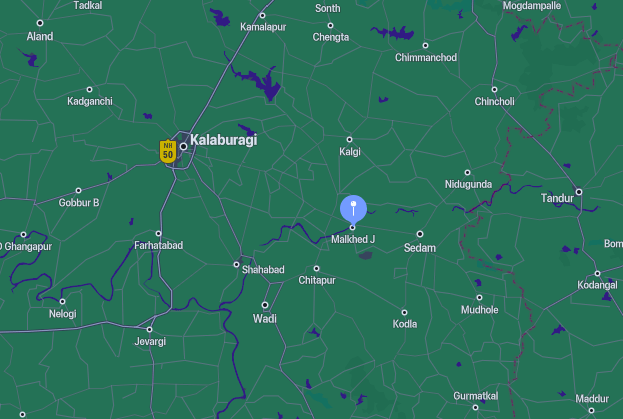
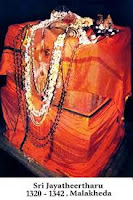
the complex instructions of the Vedic literature of Madhvacharya was revealed to us, to study, understand, discuss, teach, and follow ourselves. His Samadhi still exists in Southern India, in Malkhed, Kalaburgi District, Karnataka. A saint who has entered Samadhi is not “dead”, one can go and receive their blessings just as one can receive blessings from a saint who still walks the earth amongst us. Near the Samadhi of Jayatirtha is the Samadhi of his spiritual master, Sri Akshobhya Tirtha.
What can we learn from this incident…
Of the warrior turned sage who was a bull in his former lifetime? That no matter how we engage in the service of God, it is always beneficial. What is more, no matter how small a thing someone does for God, that soul benefits beyond our comprehension.
नेहाभिक्रमनाशोऽस्ति प्रत्यवायो न विद्यते ।
स्वल्पमप्यस्य धर्मस्य त्रायते महतो भयात् ॥ ४० ॥nehābhikrama-nāśo ’sti
pratyavāyo na vidyate
sv-alpam apy asya dharmasya
trāyate mahato bhayātIn this endeavor there is no loss or diminution, and a little advancement on this path can protect one from the most dangerous type of fear.
https://vedabase.io/en/library/bg/2/40/
What are some examples?
The great Jayananda Prabhu is a perfect example… he would often call out to a passerby, “Hey can you just hold this nail for me?”, and before you know it, by service to Krishna, the dull, unclean passerby has transformed into a bright-faced Vaishnava devotee!
In a similar way, we request donations from everyone we speak to. The donations are not for us, we don’t need anyone’s money. Krishna has given us enough. But anyone who gives, they benefit.
दातव्यमिति यद्दानं दीयतेऽनुपकारिणे ।
देशे काले च पात्रे च तद्दानं सात्त्विकं स्मृतम् ॥ २० ॥dātavyam iti yad dānaṁ
dīyate ’nupakāriṇe
deśe kāle ca pātre ca
tad dānaṁ sāttvikaṁ smṛtamCharity given out of duty, without expectation of return, at the proper time and place, and to a worthy person is considered to be in the mode of goodness.
https://vedabase.io/en/library/bg/17/20/
Sometimes we get a ride from someone, sometimes, we ask someone to help move some boxes or hold open a door… sometimes, we give an animal Krishna Prasada, or chant the Holy Name of Krishna loudly so they hear it.
प्रसादे सर्वदुःखानां हानिरस्योपजायते ।
प्रसन्नचेतसो ह्याशु बुद्धिः पर्यवतिष्ठते ॥ ६५ ॥prasāde sarva-duḥkhānāṁ
hānir asyopajāyate
prasanna-cetaso hy āśu
buddhiḥ paryavatiṣṭhateFor one thus satisfied [in Kṛṣṇa consciousness], the threefold miseries of material existence exist no longer; in such satisfied consciousness, one’s intelligence is soon well established.
https://vedabase.io/en/library/bg/2/65/
Anyone who comes in contact with someone engaged in devotional service is benefited. Whether it is the ant who comes in contact with the dust from the altar, or the bee who was intoxicated on some leftover nectar offered to Krishna, or the cockroach who lives in Radharani’s kitchen and feeds on leftover Prasadam.
When I got out on Harinam, pigeons and seagulls sometimes surround me. I am 100% certain that all those souls will come back as devotees, and Krishna will help me serve them again. I can’t wait to see them again, as bright-faced Vaishnavas!

There is also eyewitness evidence to the power of Prasada… food offered to the Lord, but more on that another day.
It doesn’t matter what your present condition is. Just engage somehow or other in Bhakti, pure devotional service. You will benefit beyond your wildest imagination! As one of my teachers, Vaisesika Prabhu, likes to say “do what you can, with what you have”
P.S: I found the writeup by His Grace Toshan Nimai Prabhu very helpful… please read it here if you’re interested in more details. https://flowers-of-grace.blogspot.com/2012/06/sri-jayatirtha.html
P.P.S: This is the disciplic succession with which I have received my spiritual knowledge and impetus to share this knowledge. Many branches and sub-branches of this disciplic succession have helped me, not to mention souls from so many other traditions from around the world. I am grateful to them all, too numerous to mention.
- Kṛṣṇa
- Brahmā
- Nārada
- Vyāsa
- Madhva
- Padmanābha
- Nṛhari
- Mādhava
- Akṣobhya
- Jaya Tīrtha
- Jñānasindhu
- Dayānidhi
- Vidyānidhi
- Rājendra
- Jayadharma
- Puruṣottama
- Brahmaṇya Tīrtha
- Vyāsa Tīrtha
- Lakṣmīpati
- Mādhavendra Purī
- Īśvara Purī, (Nityānanda, Advaita)
- Lord Caitanya
- Rūpa, (Svarūpa, Sanātana)
- Raghunātha, Jīva
- Kṛṣṇadāsa
- Narottama
- Viśvanātha
- (Baladeva), Jagannātha
- Bhaktivinoda
- Gaurakiśora
- Bhaktisiddhānta Sarasvatī
- A. C. Bhaktivedanta Swami Prabhupāda
- Sankarshan Das Adhikari





 Freedom through Genuine Spiritual Progress