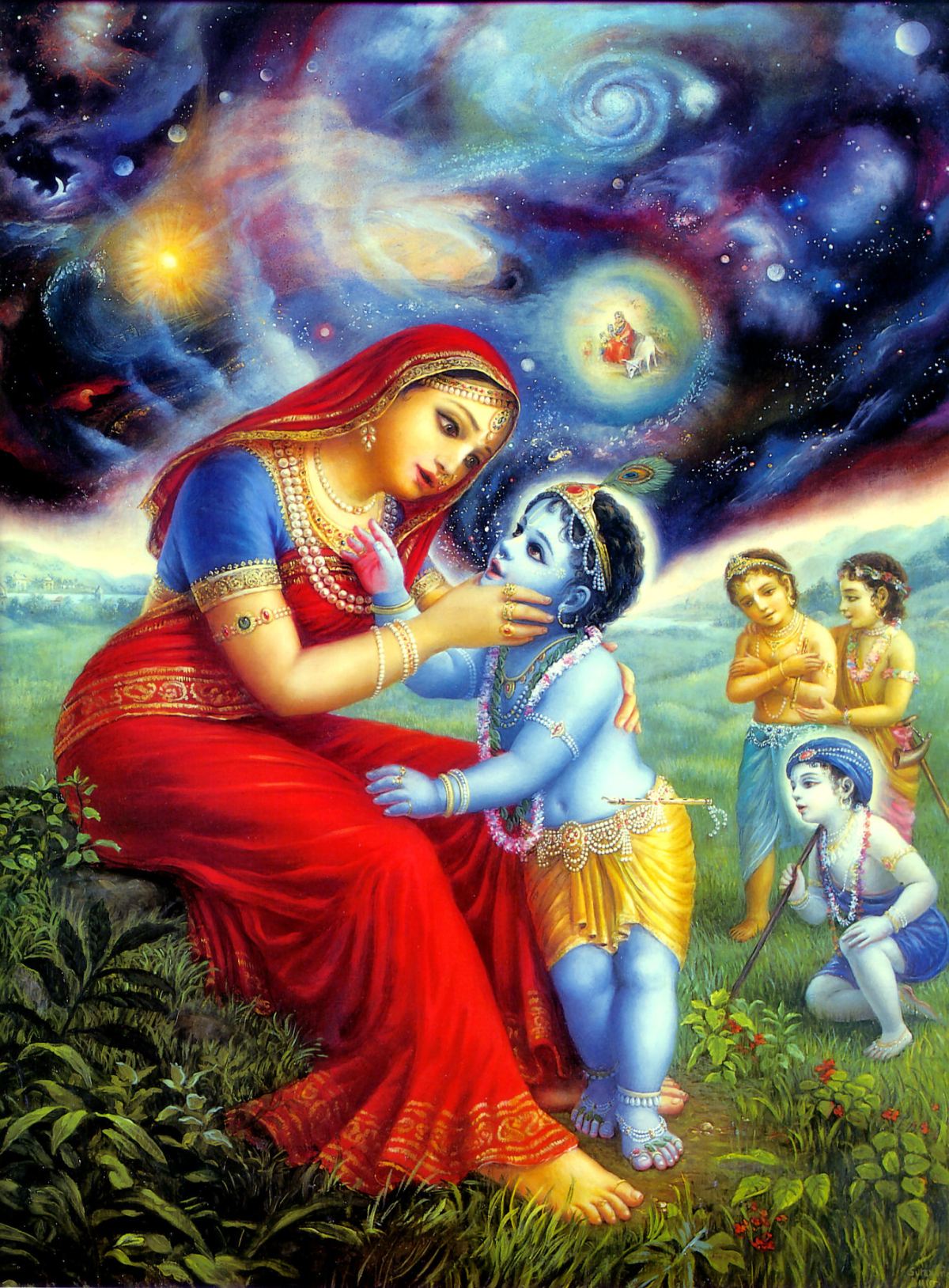
Lord Ganesha’s topmost blessing

It’s the Festival of Lord Ganesha! Millions of people are praying for all sorts of benedictions. Do you know what Lord Ganesha’s highest blessing is? What will you ask for?

As I write this, today is an auspicious day known as Ganesh Chaturthi. It’s the 4th day of the month of Bhadra, according to the Luni-Solar Vedic calendar.

On this day, millions of people in India and other parts of the world worship Lord Ganesha, known by many names like Ganapati, Lambodara, Vakratunda, Mahakaya, Vighneshwara, Vinayaka, etc.

Lord Ganesha is a universal favourite, even among those who don’t follow the Vedic tradition. His rotund figure, his elephant head with big ears, tusks, long trunk and cheerful disposition makes him a very lovable deity.

Lord Ganesha, pictured with his Mother Parvati Devi, and Father Lord Shiva.

Lord Ganesha, pictured with his Mother Parvati Devi, and Father Lord Shiva.

Lord Ganesha is the son of Mother Parvati and Lord Shiva, who are practically the parents of the material world. He is a very special deity, in charge of elimination of obstacles. Obstacles may be in many forms, and he is tasked with the service of removing them. And this is how Lord Ganesha is empowered…

yat-pāda-pallava-yugaṁ vinidhāya kumbha-
dvandve praṇāma-samaye sa gaṇādhirājaḥ
vighnān vihantum alam asya jagat-trayasya
govindam ādi-puruṣaṁ tam ahaṁ bhajāmi

Synonyms
yat — whose; pāda-pallava — lotus feet; yugam — two; vinidhāya — having held; kumbha-dvandve — upon the pair of tumuli; praṇāma-samaye — at the time of offering obeisances; saḥ — he; gaṇa-adhirājaḥ — Gaṇeśa; vighnān — obstacles; vihantum — to destroy; alam — capable; asya — of these; jagat-trayasya — three worlds; govindam — Govinda; ādi-puruṣam — the original person; tam — Him; aham — I; bhajāmi — worship.

Translation
I adore the primeval Lord Govinda, whose lotus feet are always held by Gaṇeśa upon the pair of tumuli protruding from his elephant head in order to obtain power for his function of destroying all the obstacles on the path of progress of the three worlds.

Śrī brahma-saṁhitā 5.50

There are very grand celebrations all over… attracting millions of souls. The opulence of these celebrations is hard to describe in words.
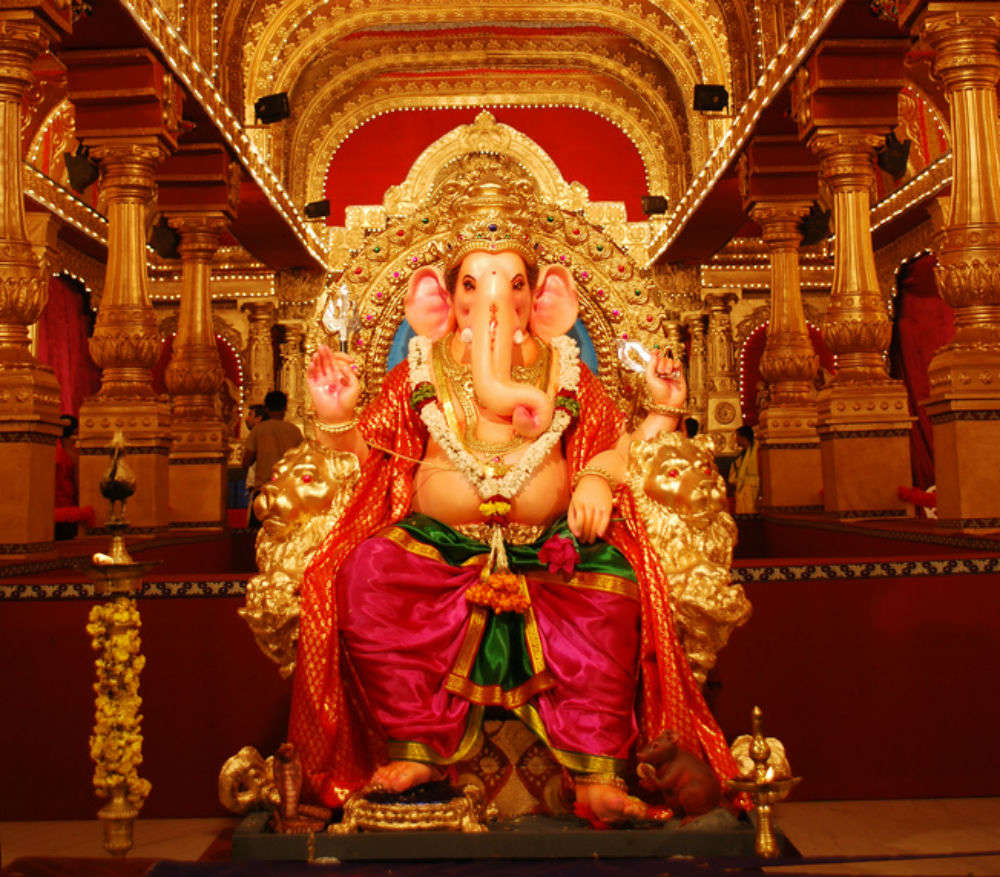
A temporary Opulent Ganesh Pandal setup in India.

A temporary Opulent Ganesh Pandal setup in India.

Many souls undergo tremendous austerities and penances during this festival, which can span from 1 to 12 days. In return for these efforts, they ask for blessings which are often granted, depending on whether a person deserves those or not.

However, most of these blessings are temporary, like someone asking for more money, offspring, a better home, health, and so on…
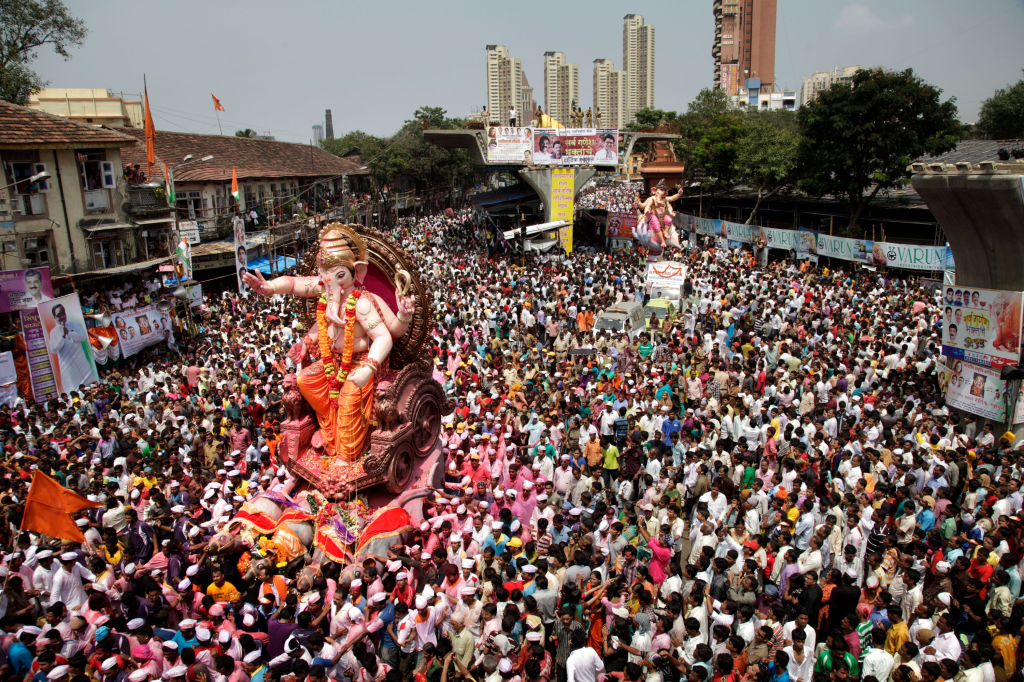
Lord Ganesha accompanied by thousands of devotees, in procession

Lord Ganesha accompanied by thousands of devotees, in procession

However, many of the “worshipers” also degrade themselves by indulging in low class activities like materialistic movie songs, partaking of meat, and intoxicants like tobacco, alcohol, and in these modern days, even hard drugs.

Then, in that intoxicated state, they dance for hours and hours, part of long processions.

What really saddens me though, is that most people don’t realize that the greatest blessing of Lord Ganesha are contained within the great magnum opus Mahabharata, as the 700-verse Bhagavad Gita.

Veda Vyasa recited the Mahabharata, all of 100,000 verses, and Lord Ganesha acted as His scribe… and in this way, the treatise became available to us, unfortunate conditioned souls.

Veda Vyasa Recites the Mahabharata, containing the Bhagavad Gita and Lord Ganesha serves as the scribe.

Veda Vyasa Recites the Mahabharata, containing the Bhagavad Gita and Lord Ganesha serves as the scribe.

Within those 700 verses, one can learn about:

  • One’s own spiritual identity
  • The purpose of human life
  • The cause of one’s material bondage in the cycle of birth, death, old age, disease
  • The identity of the Supreme Absolute Truth, Krishna
  • One’s relationship with Krishna, and
  • The way to end this material tribulation once and for all

In fact, the Bhagavad Gita covers these main topics, covered in my Introduction to Bhagavad Gita series of classes, contact me to join:

  • Jiva – the spirit soul
  • Karma – the cycle of action and reaction
  • Prakriti – this material nature we currently inhabit
  • Kala – The Time Factor that moves everything
  • Bhagavan – the Supreme Absolute Truth, Krishna

Anyone who carefully studies and acts on the instructions of the Bhagavad Gita will not have any more obstacles… not just temporarily, but for all of eternity!

मत्कर्मकृन्मत्परमो मद्भ‍क्त: सङ्गवर्जित: ।
निर्वैर: सर्वभूतेषु य: स मामेति पाण्डव ॥ ५५ ॥

mat-karma-kṛn mat-paramo
mad-bhaktaḥ saṅga-varjitaḥ
nirvairaḥ sarva-bhūteṣu
yaḥ sa mām eti pāṇḍava

My dear Arjuna, he who engages in My pure devotional service, free from the contaminations of fruitive activities and mental speculation, he who works for Me, who makes Me the supreme goal of his life, and who is friendly to every living being – he certainly comes to Me.

Bg. 11.55

As I pass by the various installations of Lord Ganesha during my travels in the Holy Land of India, what I will be praying for? That all the obstacles in my pathway to understanding the Bhagavad Gita may be removed, and that I may serve Lord Ganesha in propagating the Bhagavad Gita all over the world, in every town and village.

What will you pray for?
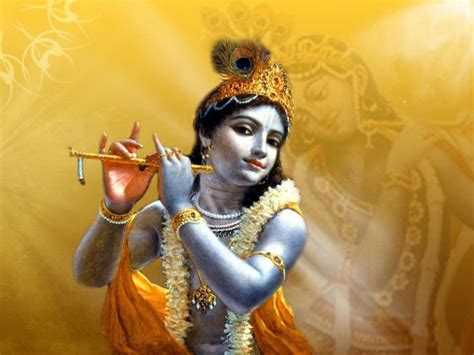
Krishna – Duality Confusion – One And Many?

Is the Supreme Absolute Truth One or Many? Is Krishna One or Many? How is it that Krishna is One without a Second? How about Love? How about Relationships? How to understand this?

Jyoti Gupta, 27 April 2020

Hare Krishna 

If you could explain Chapter 5, Text 17 of Bhagavad Gita, where it has been told that there is duality in Krishna-simultaneous identity and individuality.

One more thing I would like to know – He is one without a second.. kindly explain .

Thank you 

🙏

Hare Krishna 

Jyoti Gupta

Mahabhagavat Das, 28 April 2020

Dear Mother Jyoti,

Hare Krishna!

You are referring to BG 5.17, where in the purport Srila Prabhupada writes: “A Kṛṣṇa conscious person can thoroughly understand that there is duality (simultaneous identity and individuality) in Kṛṣṇa, and, equipped with such transcendental knowledge, one can make steady progress on the path of liberation.”

What this means is that Krishna is a person originally, and that He has impersonal aspects.

Before we go to Krishna, let us look at ourselves…

You are a person, but if you completely ignore someone, then that is your own impersonal aspect. Also, when you are angry, then anyone who comes in your way will experience your anger, whether they did something to deserve your anger or not, so in this way, your anger can be said to be impersonal, even though you are a person yourself.

Similarly, Krishna, has His own impersonal aspects. The primary impersonal aspect is His Brahman feature. In the Brahman feature, which is His bodily effulgence, there is no individuality. Another one of Krishna’s impersonal features is time, time does not care for any person, it is impersonal, time just moves on and forces the world to keep moving along with it.

In addition to Krishna’s impersonal features, there is also the “localized Supersoul” or Paramatma feature, where Krishna expands into unlimited expansions, enters into the heart of every living entity along with the Atma, and also enters into the atoms and the space within the atoms. Even though Krishna expands in this way, Krishna still remains Krishna individually.

His closest, most intimate feature is Himself, His personal form, name, and identity.

Another crude example is – you may get a letter from the Government… inside the Government there is a department, and that department has a head, and that head has a boss, that boss has another boss, and ultimately it is the President or the Prime Minister who is the top power of the government. But when we see a policeman on the street enforcing the order of the government, then that policeman has the combined force of the entire government, and if necessary, through that policeman, the entire government can act. So, the government can be seen as some sort of “Brahman” – the government is impersonal, but inside that Brahman, there are so many little government representatives… Of course all of this cannot compare to SrI Krishna because Krishna is inconceivable by material means.

Krishna is one without a second because when you rank someone #1, #2, #3, etc., then it implies that there is some measure by which #1 is superior to #2, and #2 is superior to #3… so if #3 tries a bit harder, then they can overtake #1 and become the new #1… but in the case of Krishna, there is no comparison whatsoever, no one else can compare or match up to Krishna!

There may be occasionally some delay in answering questions sometimes, but rest assured that we are here to serve you on your spiritual journey.

I hope this helps.

Sincerely,

Mahabhagavat Das

dasadas.com

Jyoti Gupta, 29 April 2020

Hare Krishna !

Thank you so much for the kind response, and for bringing clarity to my mind.

Regards

Jyoti Gupta

Please subscribe to daily inspirational emails from His Grace Sriman Sankarshan Das Adhikari (Writings and lectures archived at www.ecstaticmedia.com), written fresh every day from his travels around the world sharing the highest spiritual knowledge with everyone. Sign up now at www.joincourse.com

What or Who is God?

What is this concept of God? Is God an impersonal force? Is God a person? Reminds me of  Shakespeare’s “to be or not to be”. We know there are many myths about God.

My spiritual master writes…

Just as a goldless gold mine cannot produce gold, an impersonal existential mine cannot produce persons. Therefore since we exist as persons our original source must necessarily also possess personality. Some people have called that person God. There are many other names for that person as well. In Sanskrit He is also called Adi, which means the source.

Sankarshan Das Adhikari, 11th March 2014

In the Vedic tradition, a great sage named Parashara Muni, the father of the great Veda Vyasa, carefully analyzed this, and reached this conclusion…

Bhaga means opulence, and when the Sanskrit affix is there, vat-pratyaya, one who possesses opulence, he’s called bhagavān. So it is described by Parāśara Muni that

aiśvaryasya samagrasya
vīryasya yaśasaḥ śriyaḥ
jñāna-vairāgyayoś caiva
ṣaṇṇāṁ bhagam itīṅganā
(Viṣṇu Purāṇa 6.5.47)


“Bhagavān means who possesses these six opulences in full: all riches, all strength, all influence, all wisdom, all beauty, all renunciation.”

A. C. Bhaktivedanta Swami Prabhupada, BG 4.5 lecture, Bombay Mar 25, 1974

In other words, this existential gold mine we call Gd is necessarily personal and must be full of the above six opulences. Anyone who claims to be God must demonstrate those opulences. Anyone who wants to find God must not stop until they find that Person who is full in all these six opulences.

Anything that is impersonal, such as time, or effulgence, must then necessarily be features of that personal source of all existence.

In this world, we can already see how people are mad after wealth, after strength, after influence, wisdom, beauty and especially among the spiritually advanced, the quality of being unattached is also greatly valued.

It stands to reason that the source of all existence, has, at minimum, all these in full.

Enter your email address to subscribe to this blog and receive notifications of new posts by email.