25 May 2024 Prahlada, the Boy Saint Son of an Atheist, Who Attracted God to Appear From a Pillar

Prahlada was a boy saint, all of 5 years old when his loving devotion attracted the Lord, known as Narasimha, to appear in His half-man half-lion incarnation. We will discuss the life, character, and instructions of Prahlada…

Hare Krishna!

ISKCON Kitchener-Waterloo-Cambridge is hosting a program on the occasion of Sri Narasimha Chaturdashi, the appearance of the half-man half-lion incarnation of God.
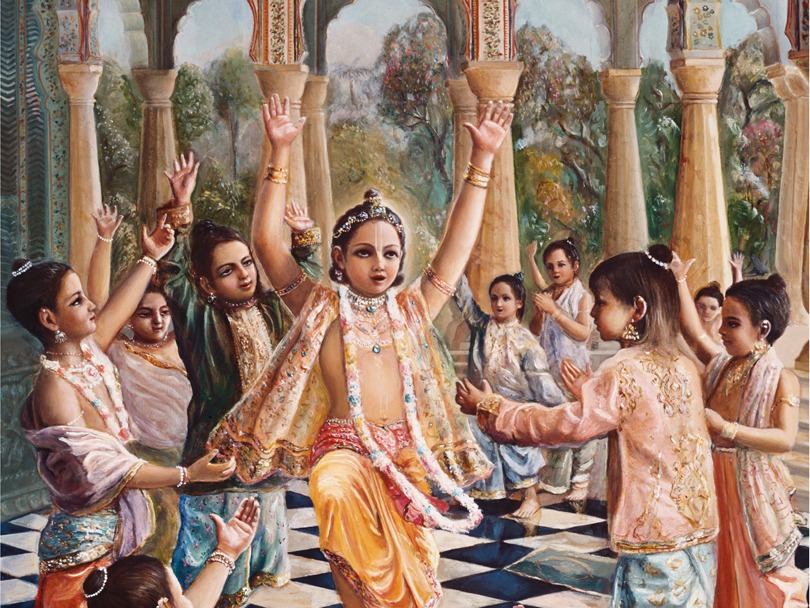
Prahlada dancing and chanting and instructing his classmates

DATE📆: Saturday, 25th May 2024

TIME⌚: 12:30 PM ET USA/ 11:30 AM CT USA/ 9:30 AM PST USA/ 6:00 PM UK/ 10:00 PM IST

PLACE: 405 King St N Waterloo, Ontario, Canada

The class will be available in person, broadcast online, and later as a recording. If you don’t know how to access the online broadcast, please contact.

Please join in person or online if you’re interested in joining this class, or let me know if you want to get a link to the recording.

Please read this summary from Srimad Bhagavatam Canto 7 (The Science of God), Chapters 5-10, for more information about the subject matter of the class.

These summaries are also available online from https://vedabase.io/en/library/sb/7/

Thank you! Hare Krishna
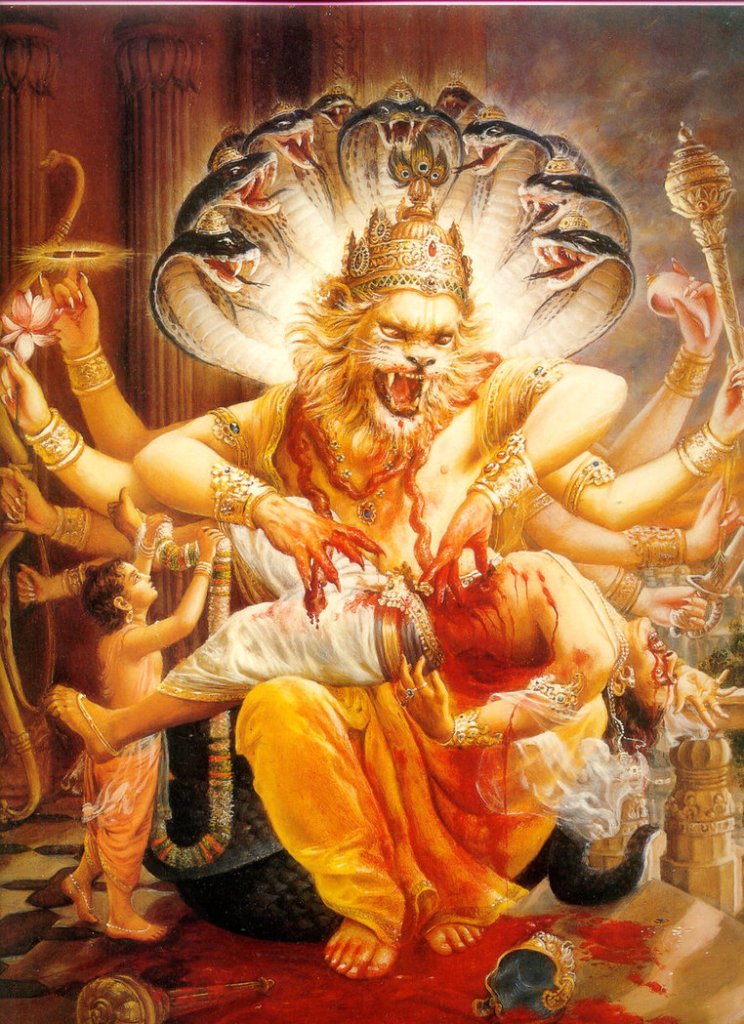
Lord Narasimha liberates The King od the Demons Hiranyakasipu

Prahlāda Mahārāja, the Saintly Son of Hiraṇyakaśipu

Prahlāda Mahārāja did not carry out the orders of his teachers, for he was always engaged in worshiping Lord Viṣṇu. As described in this chapter, Hiraṇyakaśipu tried to kill Prahlāda Mahārāja, even by having a snake bite him and by putting him under the feet of elephants, yet he was unsuccessful.

Hiraṇyakaśipu’s spiritual master, Śukrācārya, had two sons named Ṣaṇḍa and Amarka, to whom Prahlāda Mahārāja was entrusted for education. Although the teachers tried to educate the boy Prahlāda in politics, economics and other material activities, he did not care for their instructions. Instead, he continued to be a pure devotee. Prahlāda Mahārāja never liked the idea of discriminating between one’s friends and enemies. Because he was spiritually inclined, he was equal toward everyone.

Once upon a time, Hiraṇyakaśipu inquired from his son what the best thing was that he had learned from his teachers. Prahlāda Mahārāja replied that a man engrossed in the material consciousness of duality, thinking, “This is mine, and that belongs to my enemy,” should give up his householder life and go to the forest to worship the Supreme Lord.

When Hiraṇyakaśipu heard from his son about devotional service, he decided that this small boy had been polluted by some friend in school. Thus he advised the teachers to take care of the boy so that he would not become a Kṛṣṇa conscious devotee. However, when the teachers inquired from Prahlāda Mahārāja why he was going against their teachings, Prahlāda Mahārāja taught the teachers that the mentality of ownership is false and that he was therefore trying to become an unalloyed devotee of Lord Viṣṇu. The teachers, being very angry at this answer, chastised and threatened the boy with many fearful conditions. They taught him to the best of their ability and then brought him before his father.

Hiraṇyakaśipu affectionately took his son Prahlāda on his lap and then inquired from him what the best thing was that he had learned from his teachers. As usual, Prahlāda Mahārāja began praising the nine processes of devotional service, such as śravaṇam and kīrtanam. Thus the King of the demons, Hiraṇyakaśipu, being extremely angry, chastised the teachers, Ṣaṇḍa and Amarka, for having wrongly trained Prahlāda Mahārāja. The so-called teachers informed the King that Prahlāda Mahārāja was automatically a devotee and did not listen to their instructions. When they proved themselves innocent, Hiraṇyakaśipu inquired from Prahlāda where he had learned viṣṇu-bhakti. Prahlāda Mahārāja replied that those who are attached to family life do not develop Kṛṣṇa consciousness, either personally or collectively. Instead, they suffer repeated birth and death in this material world and continue simply chewing the chewed. Prahlāda explained that the duty of every man is to take shelter of a pure devotee and thus become eligible to understand Kṛṣṇa consciousness.

Enraged at this answer, Hiraṇyakaśipu threw Prahlāda Mahārāja from his lap. Since Prahlāda was so treacherous that he had become a devotee of Viṣṇu, who had killed his uncle Hiraṇyākṣa, Hiraṇyakaśipu asked his assistants to kill him. The assistants of Hiraṇyakaśipu struck Prahlāda with sharp weapons, threw him under the feet of elephants, subjected him to hellish conditions, threw him from the peak of a mountain and tried to kill him in thousands of other ways, but they were unsuccessful. Hiraṇyakaśipu therefore became increasingly afraid of his son Prahlāda Mahārāja and arrested him. The sons of Hiraṇyakaśipu’s spiritual master, Śukrācārya, began teaching Prahlāda in their own way, but Prahlāda Mahārāja did not accept their instructions. While the teachers were absent from the classroom, Prahlāda Mahārāja began to preach Kṛṣṇa consciousness in the school, and by his instructions all his class friends, the sons of the demons, became devotees like him.

Prahlāda Instructs His Demoniac Schoolmates

This chapter describes Prahlāda Mahārāja’s instructions to his class friends. In speaking to his friends, who were all sons of demons, Prahlāda Mahārāja stressed that every living entity, especially in human society, must be interested in spiritual realization from the very beginning of life. When human beings are children, they should be taught that the Supreme Personality of Godhead is the worshipable Deity for everyone. One should not be very much interested in material enjoyment; instead, one should be satisfied with whatever material profits are easily obtainable, and because the duration of one’s life is very short, one should utilize every moment for spiritual advancement. One may wrongly think, “In the beginning of our lives let us enjoy material facilities, and in old age we may become Kṛṣṇa conscious.” Such materialistic thoughts are always useless because in old age one cannot be trained in the spiritual way of life. Therefore, from the very beginning of life, one should engage in devotional service (śravaṇaṁ kīrtanaṁ viṣṇoḥ). This is the duty of all living entities. Material education is infected by the three modes of nature, but spiritual education, for which there is a great need in human society, is transcendental. Prahlāda Mahārāja disclosed the secret of how he had received instructions from Nārada Muni. By accepting the lotus feet of Prahlāda Mahārāja, who is in the paramparā succession, one will be able to understand the mode of spiritual life. In accepting this mode of activity, there is no need for material qualifications.

After Prahlāda Mahārāja’s class friends had listened to Prahlāda Mahārāja, they inquired how he had become so learned and advanced. In this way the chapter ends.

What Prahlāda Learned in the Womb

In this chapter, to dissipate the doubts of his class friends, the sons of the demons, Prahlāda Mahārāja states how, within the womb of his mother, he had heard from the mouth of Nārada Muni, who had instructed him in bhāgavata-dharma.

When Hiraṇyakaśipu left his kingdom and went to the mountain known as Mandarācala to execute severe austerities, all the demons scattered. Hiraṇyakaśipu’s wife, Kayādhu, was pregnant at that time, and the demigods, mistakenly thinking that she carried another demon in her womb, arrested her. Their plan was that as soon as the child took birth they would kill him. While they were taking Kayādhu to the heavenly planets, they met Nārada Muni, who stopped them from taking her away and took her to his āśrama until Hiraṇyakaśipu’s return. In Nārada Muni’s āśrama, Kayādhu prayed for the protection of the baby in her womb, and Nārada Muni reassured her and gave her instructions on spiritual knowledge. Taking advantage of those instructions, Prahlāda Mahārāja, although a small baby within the womb, listened very carefully. The spirit soul is always apart from the material body. There is no change in the spiritual form of the living entity. Any person above the bodily conception of life is pure and can receive transcendental knowledge. This transcendental knowledge is devotional service, and Prahlāda Mahārāja, while living in the womb of his mother, received instructions in devotional service from Nārada Muni. Any person engaged in the service of the Lord through the instructions of a bona fide spiritual master is immediately liberated, and being free from the clutches of māyā, he is relieved of all ignorance and material desires. The duty of everyone is to take shelter of the Supreme Lord and thus become free from all material desires. Regardless of the material condition in which one is situated, one can achieve this perfection. Devotional service is not dependent on the material activities of austerity, penance, mystic yoga or piety. Even without such assets, one can achieve devotional service through the mercy of a pure devotee.Text 1: Nārada Muni said: Although Prahlāda Mahārāja was born in a family of asuras, he was the greatest of all devotees. Having thus been questioned by his class friends, the sons of the asuras, he remembered the words spoken to him by me and replied to his friends as follows.

Lord Nṛsiṁhadeva Slays the King of the Demons

As described in this chapter, Hiraṇyakaśipu was ready to kill his own son Prahlāda Mahārāja, but the Supreme Personality of Godhead appeared in front of the demon as Śrī Nṛkeśarī, half lion and half man, and killed him.

Following the instructions of Prahlāda Mahārāja, all the sons of the demons became attached to Lord Viṣṇu, the Supreme Personality of Godhead. When this attachment became pronounced, their teachers, Ṣaṇḍa and Amarka, were very much afraid that the boys would become more and more devoted to the Lord. In a helpless condition, they approached Hiraṇyakaśipu and described in detail the effect of Prahlāda’s preaching. After hearing of this, Hiraṇyakaśipu decided to kill his son Prahlāda. Hiraṇyakaśipu was so angry that Prahlāda Mahārāja fell down at his feet and said many things just to pacify him, but he was unsuccessful in satisfying his demoniac father. Hiraṇyakaśipu, as a typical demon, began to advertise himself as being greater than the Supreme Personality of Godhead, but Prahlāda Mahārāja challenged him, saying that Hiraṇyakaśipu was not God, and began to glorify the Supreme Personality of Godhead, declaring that the Lord is all-pervading, that everything is under Him, and that no one is equal to or greater than Him. Thus he requested his father to be submissive to the omnipotent Supreme Lord.

The more Prahlāda Mahārāja glorified the Supreme Personality of Godhead, the more angry and agitated the demon became. Hiraṇyakaśipu asked his Vaiṣṇava son whether his God existed within the columns of the palace, and Prahlāda Mahārāja immediately accepted that since the Lord is present everywhere, He was also present within the columns. When Hiraṇyakaśipu heard this philosophy from his young son, he derided the boy’s statement as just the talk of a child and forcefully struck the pillar with his fist.

As soon as Hiraṇyakaśipu struck the column, there issued forth a tumultuous sound. At first Hiraṇyakaśipu, the King of the demons, could not see anything but the pillar, but to substantiate Prahlāda’s statements, the Lord came out of the pillar in His wonderful incarnation as Narasiṁha, half lion and half man. Hiraṇyakaśipu could immediately understand that the extraordinarily wonderful form of the Lord was surely meant for his death, and thus he prepared to fight with the form of half lion and half man. The Lord performed His pastimes by fighting with the demon for some time, and in the evening, on the border between day and night, the Lord captured the demon, threw him on His lap, and killed him by piercing his abdomen with His nails. The Lord not only killed Hiraṇyakaśipu, the King of the demons, but also killed many of his followers. When there was no one else to fight, the Lord, roaring with anger, sat down on Hiraṇyakaśipu’s throne.

The entire universe was thus relieved of the rule of Hiraṇyakaśipu, and everyone was jubilant in transcendental bliss. Then all the demigods, headed by Lord Brahmā, approached the Lord. These included the great saintly persons, the Pitās, the Siddhas, the Vidyādharas, the Nāgas, the Manus, the prajāpatis, the Gandharvas, the Cāraṇas, the Yakṣas, the Kimpuruṣas, the Vaitālikas, the Kinnaras and also many other varieties of beings in human form. All of them stood not far from the Supreme Personality of Godhead and began offering their prayers unto the Lord, whose spiritual effulgence was brilliant as He sat on the throne.

Prahlāda Pacifies Lord Nṛsiṁhadeva with Prayers

As related in this chapter, Prahlāda Mahārāja, following the order of Lord Brahmā, pacified the Lord when the Lord was extremely angry after having killed Hiraṇyakaśipu.

After Hiraṇyakaśipu was killed, the Lord continued to be very angry, and the demigods, headed by Lord Brahmā, could not pacify Him. Even mother Lakṣmī, the goddess of fortune, the constant companion of Nārāyaṇa, could not dare come before Lord Nṛsiṁhadeva. Then Lord Brahmā asked Prahlāda Mahārāja to go forward and pacify the Lord’s anger. Prahlāda Mahārāja, being confident of the affection of his master, Lord Nṛsiṁhadeva, was not afraid at all. He very gravely appeared before the Lord’s lotus feet and offered Him respectful obeisances. Lord Nṛsiṁhadeva, being very much affectionate toward Prahlāda Mahārāja, put His hand on Prahlāda’s head, and because of being personally touched by the Lord, Prahlāda Mahārāja immediately achieved brahma-jñāna, spiritual knowledge. Thus he offered his prayers to the Lord in full spiritual knowledge and full devotional ecstasy. The instructions given by Prahlāda Mahārāja in the form of his prayers are as follows.

Prahlāda said, “I am not proud of being able to offer prayers to the Supreme Personality of Godhead. I simply take shelter of the mercy of the Lord, for without devotion one cannot appease Him. One cannot please the Supreme Personality of Godhead simply by dint of high parentage or great opulence, learning, austerity, penance or mystic power. Indeed, these are never pleasing to the Supreme Lord, for nothing can please Him but pure devotional service. Even if a nondevotee is a brāhmaṇa qualified with the twelve brahminical symptoms, he cannot be very dear to the Lord, whereas if a person born in a family of dog-eaters is a devotee, the Lord can accept his prayers. The Lord does not need anyone’s prayers, but if a devotee offers his prayers to the Lord, the devotee benefits greatly. Ignorant persons born in low families, therefore, can sincerely offer heartfelt prayers to the Lord, and the Lord will accept them. As soon as one offers his prayers to the Lord, he is immediately situated on the Brahman platform.”

Lord Nṛsiṁhadeva appeared for the benefit of all human society, not only for Prahlāda’s personal benefit. The fierce form of Lord Nṛsiṁhadeva may appear most awful to a nondevotee, but to the devotee the Lord is always affectionate as He is in other forms. Conditioned life in the material world is actually extremely fearful; indeed, a devotee is not afraid of anything else. Fear of material existence is due to false ego. Therefore the ultimate goal of life for every living entity is to attain the position of being servant of the servant of the Lord. The miserable condition of the living entities in the material world can be remedied only by the mercy of the Lord. Although there are so-called material protectors like Lord Brahmā and the other demigods, or even one’s own father, they are unable to do anything if one is neglected by the Supreme Personality of Godhead. However, one who has fully taken shelter of the Lord’s lotus feet can be saved from the onslaught of material nature. Therefore every living entity should be unattracted by material so-called happiness and should take shelter of the Lord by all means. That is the mission of human life. To be attracted by sense gratification is simply foolish. Whether one is a devotee of the Lord or is a nondevotee does not depend upon one’s birth in a high or low family. Even Lord Brahmā and the goddess of fortune cannot achieve the full favor of the Lord, whereas a devotee can very easily attain such devotional service. The Lord’s mercy is bestowed equally upon everyone, regardless of whether one is high or low. Because Prahlāda Mahārāja was blessed by Nārada Muni, Prahlāda became a great devotee. The Lord always saves the devotee from impersonalists and voidists. The Lord is present in everyone’s heart as the Supersoul to give the living being protection and all benefits. Thus the Lord acts sometimes as the killer and sometimes as the protector. One should not accuse the Lord for any discrepancies. It is His plan that we see varieties of life within this material world. All of them are ultimately His mercy.

Although the entire cosmic manifestation is nondifferent, the material world is nonetheless different from the spiritual world. Only by the mercy of the Supreme Lord can one understand how the wonderful material nature acts. For example, although Lord Brahmā appeared from the lotus seat that had grown from the abdomen of Garbhodakaśāyī Viṣṇu, he could not understand what to do after his appearance. He was attacked by two demons, Madhu and Kaiṭabha, who took away Vedic knowledge, but the Lord killed them and entrusted to Lord Brahmā the Vedic knowledge. Thus the Lord appears in every millennium in the societies of demigods, human beings, animals, saints and aquatics. All such incarnations are meant to protect the devotees and kill the demons, but this killing and protecting does not reflect any sense of partiality on the part of the Supreme Lord. The conditioned soul is always attracted by the external energy. Therefore he is subjected to lust and greed, and he suffers under the conditions of material nature. The Lord’s causeless mercy toward His devotee is the only means by which to get out of material existence. Anyone engaged in glorifying the Lord’s activities is always unafraid of this material world, whereas one who cannot glorify the Lord in that way is subjected to all lamentation.

Those interested in silently worshiping the Lord in solitary places may be eligible for liberation themselves, but a pure devotee is always aggrieved to see others suffering. Therefore, not caring for his own liberation, he always engages in preaching by glorifying the Lord. Prahlāda Mahārāja, therefore, had tried to deliver his class friends by preaching and had never remained silent. Although being silent, observing austerities and penances, learning the Vedic literature, undergoing ritualistic ceremonies, living in a solitary place and performing japa and transcendental meditation are approved means of liberation, they are meant for nondevotees or for cheaters who want to live at the expense of others. A pure devotee, however, being freed from all such deceptive activities, is able to see the Lord face to face.

The atomic theory of the composition of the cosmic manifestation is not factual. The Lord is the cause of everything, and therefore He is the cause of this creation. One should therefore always engage in devotional service by offering respectful obeisances to the Lord, offering prayers, working for the Lord, worshiping the Lord in the temple, always remembering the Lord and always hearing about His transcendental activities. Without these six kinds of activity, one cannot attain to devotional service.

Prahlāda Mahārāja thus offered his prayers to the Supreme Lord, begging His mercy at every step. Lord Nṛsiṁhadeva was pacified by Prahlāda Mahārāja’s prayers and wanted to give him benedictions by which Prahlāda could procure all kinds of material facilities. Prahlāda Mahārāja, however, was not misled by material facilities. Rather, he wanted to remain always a servant of the servant of the Lord.

Prahlāda, the Best Among Exalted Devotees

This chapter describes how the Supreme Personality of Godhead Nṛsiṁhadeva disappeared, after pleasing Prahlāda Mahārāja. It also describes a benediction given by Lord Śiva.

Lord Nṛsiṁhadeva wanted to bestow benedictions upon Prahlāda Mahārāja, one after another, but Prahlāda Mahārāja, thinking them impediments on the path of spiritual progress, did not accept any of them. Instead, he fully surrendered at the Lord’s lotus feet. He said: “If anyone engaged in the devotional service of the Lord prays for personal sense gratification, he cannot be called a pure devotee or even a devotee. He may be called only a merchant engaged in the business of give and take. Similarly, a master who wants to please his servant after taking service from him is also not a real master.” Prahlāda Mahārāja, therefore, did not ask anything from the Supreme Personality of Godhead. Rather, he said that if the Lord wanted to give him a benediction, he wanted the Lord to assure him that he would never be induced to take any benedictions for the sake of material desires. Exchanges of devotional service for lusty desires are always very prominent. As soon as lusty desires awaken, one’s senses, mind, life, soul, religious principles, patience, intelligence, shyness, beauty, strength, memory and truthfulness are all vanquished. One can render unalloyed devotional service only when there are no material desires in one’s mind.

The Supreme Personality of Godhead was greatly pleased with Prahlāda Mahārāja for his unalloyed devotion, yet the Lord provided him one material benediction — that he would be perfectly happy in this world and live his next life in Vaikuṇṭha. The Lord gave him the benediction that he would be the king of this material world until the end of the manvantara millennium and that although in this material world, he would have the facility to hear the glories of the Lord and depend fully on the Lord, performing service to Him in uncontaminated bhakti-yoga. The Lord advised Prahlāda to perform sacrifices through bhakti-yoga, for this is the duty of a king.

Prahlāda Mahārāja accepted whatever the Lord had offered him, and he prayed for the Lord to deliver his father. In response to this prayer, the Lord assured him that in the family of such a pure devotee as he, not only the devotee’s father but his forefathers for twenty-one generations are liberated. The Lord also asked Prahlāda to perform the ritualistic ceremonies appropriate after his father’s death.

Then Lord Brahmā, who was also present, offered many prayers to the Lord, expressing his obligation to the Lord for having offered benedictions to Prahlāda Mahārāja. The Lord advised Lord Brahmā not to offer benedictions to asuras as he had to Hiraṇyakaśipu, for such benedictions indulge them. Then Lord Nṛsiṁhadeva disappeared. On that day, Prahlāda Mahārāja was installed on the throne of the world by Lord Brahmā and Śukrācārya.

Thus Nārada Muni described the character of Prahlāda Mahārāja for Yudhiṣṭhira Mahārāja, and he further described the killing of Rāvaṇa by Lord Rāmacandra and the killing of Śiśupāla and Dantavakra in Dvāpara-yuga. Śiśupāla, of course, had merged into the existence of the Lord and thus achieved sāyujya-mukti. Nārada Muni praised Yudhiṣṭhira Mahārāja because the Supreme Lord, Kṛṣṇa, was the greatest well-wisher and friend of the Pāṇḍavas and almost always stayed in their house. Thus the fortune of the Pāṇḍavas was greater than that of Prahlāda Mahārāja.

Later, Nārada Muni described how the demon Maya Dānava constructed Tripura for the demons, who became very powerful and defeated the demigods. Because of this defeat, Lord Rudra, Śiva, dismantled Tripura; thus he became famous as Tripurāri. For this, Rudra is very much appreciated and worshiped by the demigods. This narration occurs at the end of the chapter.
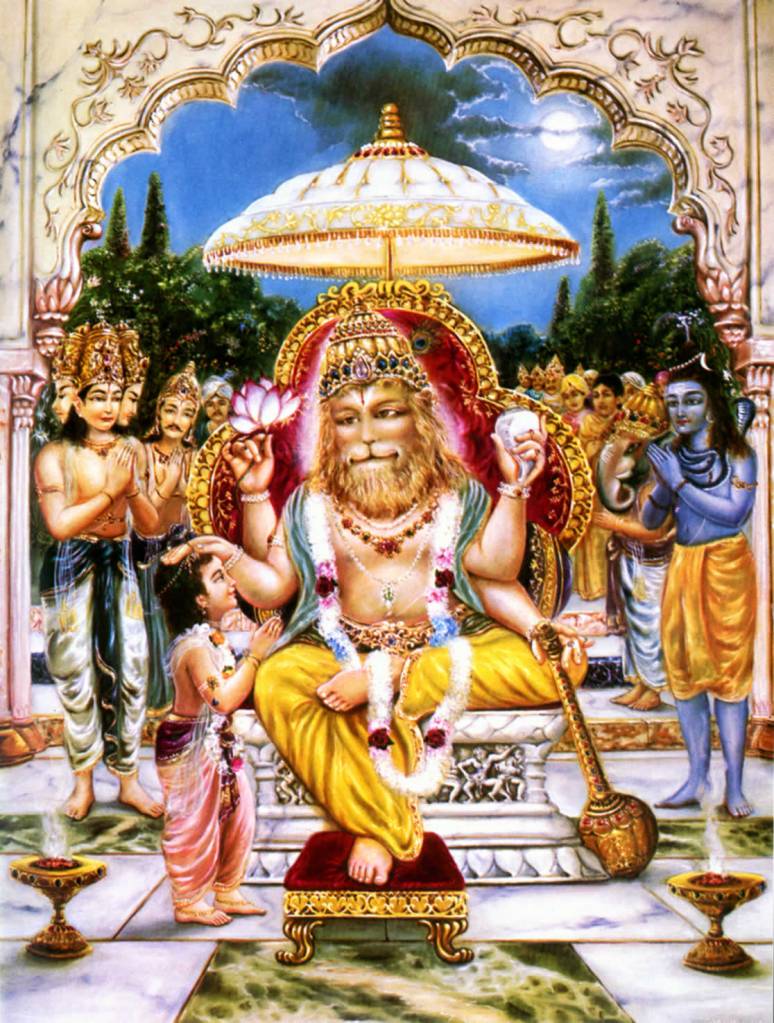
Peaceful Lord Narasimha, pacified by the prayers of the Boy Saint Prahlada

Next Class: Bhagavad Gita Chapter 2 Summary – Part 2 May 3/4 2024

In this exciting journey through Chapter 2 of the Bhagavad Gita, we delve into the essence of spiritual wisdom. Krishna compassionately guides Arjuna as he unveils profound truths about spirit, duty, devotion, and enlightenment. This immersive course offers a transformative experience, with online classes and accessible recordings. Join us for an enlightening exploration!

Hare Krishna!

We explored an introduction to the first part of Chapter 2, and now part 2 coming up.

Chapter 2 of the Bhagavad Gita is called “सांख्ययोग” / “Saankhya Yoga” – Contents of the Gita Summarized.

Krishna, the Perfect Teacher, summarizes the subject matter of the Bhagavad Gita in this course.

Arjuna, paralyzed by his material compassion, accepts Krishna as his spiritual master. Krishna first berates Arjuna, and then masterfully begins to instruct Arjuna.

Actually, Arjuna, as Krishna’s eternal associate, needs no instruction, but Arjuna is playing the part of the rest of us materially entangled souls so that Krishna can mercifully delivery the knowledge of the Bhagavad Gita to us, those whose need is great.

We explore how Krishna explains this knowledge from different perspectives… Krishna appeals to Arjuna’s sense of honour and chivalry as a warrior, then explains the fundamental spiritual truths regarding the soul, and in terms of the duty of the embodied soul, the art of work without attachment – karma yoga.

Krishna goes on to explain working in devotion, working in Love for the Supreme, Bhakti Yoga, with permanent and ever-increasing bliss beyond the short-lived results from the Vedic rituals.

Arjuna asks intelligent questions, and then Krishna describes the fully enlightened Bhakti Yogi, the perfect Jiva.

The topics introduced in this second chapter will be explained in detail in later chapters, and Chapter 2 serves as a key to the rest of the Gita.

We rely on the Bhagavad Gita As It Is with translations and purports by His Divine Grace A. C. Bhaktivedanta Swami Prabhupada, published by the Bhaktivedanta Book Trust, as our textbook.

Please contact if you’re interested in joining this course.

Next Class is online, on Friday May 3 / Saturday May 4, depending on your timezone. The class is online and recordings are available to everyone registered.

Thank you for engaging me in the study of Bhagavad Gita.

Marriage and Celibacy

What is Celibacy? Is it mutually exclusive with Marriage? What is Celibacy in Marriage? Is there something higher than sex pleasure?

Filip Misic, 19 November 2017

Hare Krishna everyone, please accept my humble obeisances.

I was wondering, why are there so many married people in ISKCON temples? Is celibacy good if one feels like it is not a huge difficulty for him? Please enlighten me.

your humble servant, 

Filip

Rakesh, 20 November 2017

Hare Krsna Filip prabhu

Please accept my humble obeisances

That is a wonderful question. As far as I know, Srila Prabhupada said something like that if one can stay a celibate, one should stay like that. Can’t say if it is good or not  because your question has a conditional answer.

Celibate life is blissful and those who can stay like that are very fortunate because of the wonderful opportunity of service and association that they get. 

Coming to the first question, it is not easy to stay Brahmachari. I heard from one senior brahmachari that it is not easy even to decide to join Brahmachari ashram, what to stay of staying a celibate lifelong. Also, even if one joins brahmachari ashram, Maya Devi is always trying to lure him somehow or the other. As I heard from one another devotee, the envy of the jeeva against Krsna is Why Krsna is the enjoyer and the desire is that s/he wants to be Krsna. So that envy and desire is there in living entities’ hearts unless they are pure. Since living entities’ have been in this material world since millions of lifetimes, the conditionings are strong. 

Many brahmacharis change their ashram for many different reasons. It is difficult to say what exactly may be the reason. 

Hope I have been able to answer in some way.

your insignificant servant

Rakesh roshan

Filip Misic, 20 November 2017

Hare Krishna Rakesh Roshan prabhu,

Please accept my humble obeisances

Thank you for your answer, especially for enlightening me about how I should not let my guard down. As a university student I can say that I feel Maya breathing down my neck every day. Therefore I would like to humbly ask you to please pray for me so that I get more strength. 

your humble servant, 

Filip

Nikhil Mishra, 20 November 2017

Hare Krsna

I heard in one of the audios of Srila Prabhupada lecture that if one can live a celibate life easily then he should live else he should marry.

He says that Marriage is not prohibited in our movement but hypocrisy is !

Rest, personally, with experience i have understood that to overcome maya , one’s efforts are just not sufficient, grace of Krsna is also required.

My philosophy has been to eat well, stay healthy, do prayers, avoid extremes and keep exploring truths behind words said by Guru and shastras. Thankfully I am getting helped. God seems to listen to my prayers.

wishing you best

not so advanced in krsna Consciousness –

Nikhil

Filip Misic, 20 November 2017

Hare Krishna Nikhil

Thank you for your great advice. 

Even less advanced in Krishna consciousness, 

Filip

Mahabhagavat Das SDA, 27 November 2017

Thank you for a great conversation everyone!

Hare Krishna!

Would like to bring to your attention that marital status and celibate status are not mutually exclusive.

Srila Gurudeva is married for over 30 years, but celibate for over 47 years.

I am married, but celibate also. The Krishna consciousness movement is full of such people who are married but also celibate. Of course, not all married couples within ISKCON are celibate, but if at least one of the couple is formally initiated as a disciple of a spiritual master, then celibacy is required.

The essence of the matter is this, from the Thought For the Day 26th Nov 2017:

Question: Sex Outside of Procreation?

My husband and I have been married for many years. Because of health problems, I can’t have any children. Is it illicit if we have sex?

Your student

 Answer: It is Illicit

In this case, you must practice celibacy. Don’t sleep together. Sleep in separate rooms, if possible, or at least in separate beds. Non-procreational sex is illicit. It is a waste of valuable energy that should be engaged in Krishna service, where you will get unlimited benefit instead of temporary titillation of the gross material senses.

Sankarshan Das Adhikari

In Vedic society, marriage is for a gentle society… most men can’t go through life alone, they need the kind of support and encouragement that only members of the female gender can provide. And most women need protection, at the very least to stave off unwanted attention from animal-like men. When a man and woman work together, they can do much more together than the man or woman individually.

In Vedic society, there are 4 Ashramas, or “positions of shelter” – Brahmacharya or unmarried life, Grihastha, or householder life, Vanaprastha, which could be single or married, but focused on spiritual advancement, and Sannyas, or the renounced order of life. In all the orders of life, one is expected to remain Brahmachari, or celibate, except that the householders have a license to engage in sex for procreation and also some more facility for somewhat luxurious life – because the Grihasthas technically work hard to support the other 3 orders – none of the other orders work for a living, the Grihastha is meant to support them all.

The married householder who lives for the sake of sense gratification is not known as a Grihastha, such persons are known as Grihamedhi, or a person who meditates on sense gratification.

Regardless of external status, one is meant to be internally always in Krishna consciousness, where celibacy is a natural by-product.

Srila Prabhupada quotes this verse in many places, but here it is from the purport to SB 9.19.16:

Therefore, by the practice of bhakti-yoga, one should give up his lusty desires. As explained by Śrī Yāmunācārya:

yadavadhi mama cetaḥ kṛṣṇa-pādāravinde

 nava-nava-rasa-dhāmany udyataṁ rantum āsīt

tadavadhi bata nārī-saṅgame smaryamāne

 bhavati mukha-vikāraḥ suṣṭhu-niṣṭhīvanaṁ ca

When one is Kṛṣṇa conscious, he gets more and more happiness by discharging duties for Kṛṣṇa. Such a person spits on sense gratification, especially that of sexual enjoyment. An experienced, advanced devotee is no longer interested in sex life. The strong desire for sex can be subdued only by advancement in Kṛṣṇa consciousness.

https://vedabase.io/en/library/sb/9/19/16/

And he repeats that verse here too, in the purport to BG 2.60

quote

Without engaging the mind in Kṛṣṇa, one cannot cease such material engagements. A practical example is given by Śrī Yāmunācārya, a great saint and devotee, who says:

yad-avadhi mama cetaḥ kṛṣṇa-pādāravinde

nava-nava-rasa-dhāmany udyataṁ rantum āsīt

tad-avadhi bata nārī-saṅgame smaryamāne

bhavati mukha-vikāraḥ suṣṭhu niṣṭhīvanaṁ ca

“Since my mind has been engaged in the service of the lotus feet of Lord Kṛṣṇa, and I have been enjoying an ever new transcendental humor, whenever I think of sex life with a woman, my face at once turns from it, and I spit at the thought.”

Kṛṣṇa consciousness is such a transcendentally nice thing that automatically material enjoyment becomes distasteful. It is as if a hungry man had satisfied his hunger by a sufficient quantity of nutritious eatables.

https://vedabase.io/en/library/bg/2/60

Please note that sometimes that quote is misunderstood as a misogynist view that Yamunacharya is spitting at women an Srila Prabhupada is endorsing such a thought, no, Srila Yamunacharya is spitting at the thought of sex indulgence because of his deep Krishna consciousness which provides him with the highest pleasure, and Srila Prabhupada is encouraging us to be fully Krishna conscious.

I hope this helps.

Sincerely,

Mahabhagavat Das

Filip Misic, 27 November 2017

Hare Krishna Mahabhagavat Prabhu,

Thank you for your answer. Although I am sure all these answers do not only help me, but others as well. 

your humble servant, 

Filip

Please subscribe to daily inspirational emails from His Grace Sriman Sankarshan Das Adhikari, written fresh every day sharing the highest spiritual knowledge with everyone. Sign up now at www.joincourse.com

What is difference between Karmi and Karma Yogi?

Bhakta Sunil, 22nd November 2013

Hare Krishna everyone!

Please accept my humble obeisances
All Glories to Srila Prabhupada

Please tell what is the difference between karmi and karmayogi?

Regards,
Sunil

Shreyas, 22nd November 2013

Hare Krishna to all the devotees,
Dandavat Pranam!
Jaya Srila Gurudev!

This is my understanding:

Karmi is one who acts for his own sense gratification. One who is attached to the results

Karma yogi is one who acts with detachment to the results. This is the first step to the ladder of yoga which leads to Bhakti Yoga, the ultimate goal.

However Bhakta is one who acts for gratifying the senses of the Lord. This is Bhakti yoga, perfection of Karma yoga. Karma yoga as the ultimate. The actual destination.

I wish to be corrected if my understanding is incorrect.

your servant.

Hare Krishna 🙂
Shreyas

Jagannatha dasa, 23rd November 2013

Please accept my humble obeisances.
All glories to Srila Gurudeva!
All glories to Srila Prabhupada!

Karma is the execution of activites recommended in the sastra as pious.  The result of such action is pious reactions which can lead one to higher planets in this material world for a superior standard of material enjoyment.  If one neglects to act according to sastric injunctions and instead acts whimsically, that is known as vikarma, and it results in sinful reactions which can drive one down to lower births to experience severe restriction of enjoyment.

Akarma, or bhakti is when one engages in devotional service of the Lord.

When that devotional service is performed with ones activites directly, like walking to the temple, cooking for the Lord, embracing the devotees, or indirectly by offering the money one earns to Krishna for example, that manifestation of bhakti is called karma-yoga, or activity linking one to Krishna.  It is akarma.

Similarly when one who is eager to please Krishna, and therefore studies sastra to know what Krishna wants, under the guidance of the Lord’s devotees, such engagement of the intelligence in Krishna’s service is called jnana-yoga.  It is also bhakti, or akarma.  The result of akarma is that one’s pious and sinful reactions, everything binding us to this material world, are all destroyed (karmani nirdahati kintu ca bhakti bhajam), and one transcends repeated birth and death by going back to home, back to Godhead.

I hope it’s clear.

your servant,
Jagannatha Dasa Brahmacari

Shreyas, 23rd November 2013

Hare Krishna Prabhuji.

It is very clear now. Thank you for providing a nice explanation including jnana yoga as well and again making realize that as akarma Prabhuji.

your servant

Hare Krishna
Gusti Nyoman Ambara, 23rd November 2013

Hare Krishna Prabhuji

Please accept my humble obeisances,
All glories to Srila Gurudeva and Srimati Gurumataji,
All glories to Srila Prabhupada.

Thank you very much for sharing this clear explanation. Please also kindly enlighten me, what is raja-yoga (in relationship with Krishna consciousness)? Thank you.

your insignificant servant
Gusti Nyoman Ambara
Bhakta Sunil, 24th November 2013

Hare Krishna everyone!

Thank you very much Shreyas ji and Jagannatha Prabhu ji for reply to question

I was very pleased to read your replies and my confusion got cleared

Regards,
Sunil

Rathin Mandal, 26th November 2013

Hare Krishna,

Please accept my humble obeisances,
All glories to Your Lotus Feet and Srimati Gurumataji,

All glories to Srila Prabhupada.

Can we say that a karma yogi is in higher position then a jnana yogi and dhyana yogi.
I am taking verse “BG 12.12: If you cannot take to this practice, then engage yourself in the cultivation of knowledge. Better than knowledge, however, is meditation, and better than meditation is renunciation of the fruits of action, for by such renunciation one can attain peace of mind.”

Whatever time I have spend with devotees, all I can understand the ‘renunciation of the fruits of action’ is very difficult. Until one is in knowledge of Supreme Personality of Godhead Sri Krishna and one is not engrossed in thougths of Sri Krishna. He cannot give up the results of his work neither in tangible form nor in intangible form.

your Servant
Rathin

Shreyas, 26th February 2014

Hare Krsna!

That’s a good question. But what I understood was that jnana yogi is below dhyana yogi. [Dhyana yogi should be those in astanga yoga,meditation ]. Jnana yogi must lead to Brahman realization and Dhyana yoga must lead to Paramatma realization.

Coming back to your question:
Karma yogi however is below jnana yogi. “Renunciation of the fruits of action”, shouldn’t that be above a karma-yogi? Because karma yogi means that one is attached to either the fruits or the work (I am also understanding it currently). So meditation surely is above renunciation of the fruits of action (karma yoga)

The following should also help us from the Bhagavad Gita 6.46 purport:

The culmination of all kinds of yoga practices lies in bhakti yoga. All other yogas are but means to come to the point of bhakti in bhakti-yoga. Yoga actually means bhakti-yoga; all other yogas are progressions toward the destination of bhakti-yoga. From the beginning of karma-yoga to the end of bhakti-yoga is a long way to self-realization. Karma-yoga, without fruitive results, is the beginning of this path. When karma-yoga increases in knowledge and renunciation, the stage is called jñāna-yoga. When jñāna-yoga increases in meditation on the Supersoul by different physical processes, and the mind is on Him, it is called aṣṭāṅga-yoga. And when one surpasses the aṣṭāṅga-yoga and comes to the point of the Supreme Personality of Godhead Kṛṣṇa, it is calledbhakti-yoga, the culmination. Factually, bhakti-yoga is the ultimate goal, but to analyze bhakti-yoga minutely one has to understand these other yogas. The yogī who is progressive is therefore on the true path of eternal good fortune. One who sticks to a particular point and does not make further progress is called by that particular name:karma-yogī, jñāna-yogī or dhyāna-yogī, rāja-yogī, haṭha-yogī, etc. If one is fortunate enough to come to the point of bhakti-yoga, it is to be understood that he has surpassed all other yogas. Therefore, to become Kṛṣṇa conscious is the highest stage of yoga, just as, when we speak of Himālayan, we refer to the world’s highest mountains, of which the highest peak, Mount Everest, is considered to be the culmination.

So Rathin prabhu, karma yoga has to be below jnana yoga according to the purport. Awaiting for more enlightenment on this from others 🙂

your servant

Shreyas

Please subscribe to daily inspirational emails from His Grace Sriman Sankarshan Das Adhikari (Writings and lectures archived at sda-archives.com), written fresh every day from his travels around the world sharing the highest spiritual knowledge with everyone. Sign up now at www.backtohome.com

Karma kanda and bhakti

Sanil Kumar, Sep 14 2011

Dear devotees,

 Hare Krishna

Kindly accept my humble obeisances

All glories to Srila Gurudeva.

 I am a little confused about Karma Kanda and bhakti.  In BG, Lord Krishna asks Arjuna to continue his occupational duty as a Kshatriya and fight with Kauravas for Krishna with mind fixed on Him.

In line with recent Thought of the Day by Srila Gurudeva, If we do our normal occupational duties (with detachment) for Krishna with targeting 100% perfection to please Krishna 100%, and spending the opulence thus obtained in Krishna conscious way, does it not a bhakti yoga?

Is doing occupational duty karma yoga?

Kindly guide me.

Your humble servant,

Sanil kumar

Mahabhagavat Das SDA, Sep 15 2011

Hare Krishna Sanil Kumar Prabhu,

 Please accept my humble obeisances.

All glories to Srila Prabhupada and his glorious disciples.

 Thank you for your question Prabhu. You do bring up an important point, what is the difference between Bhakti and Karma Kanda.

Yes, we all must perform our occupational duties, for a Grihastha, of working, maintaining family, and supporting Krishna conscious projects. Even Srila Prabhupada himself did this. My spiritual master did this also. Ideally, this means to get sufficient money ethically to advance Krishna Consciousness in ourselves, our family, friends, and society at large, according to our capacity.

But Karma Kanda sections of the Vedic literature are not really an occupational duty for most of us. Karma Kanda means those Vedic sacrifices which result in elevated birth, life in heavenly planet, etc. There are thousands of them, and if you try to perform them, it will be impossible to perform them perfectly, the required circumstances just don’t exist on this planet currently. Yes, Krishna asked Arjuna to perform his duty, and fight. But in the present day and age, even the so-called Brahmanas by birth are actually Shudras and lower than Shudras. Why is this? What is the occupational duty of a Shudra “paricharyatmakam”, means service to others in exchange for money. Practically the whole world population is doing this, simply serving someone else, and that someone else is serving someone else, and so on. There are practically no Kshatriyas left. Yes, there are some Brahmanas left, they don’t depend on anyone but the Lord for their livelihood, and they don’t do anything for the sake of earning money, if money comes they accept but they don’t avoid something just because there is/is not money involved. They don’t treat a money-giver separate from a no-money-giver. There are also some Vaishyas left, especially those who engage in cow protection. But otherwise, 99.9999% of population is pursuing Shudra occupations. So, most people in general are not even qualified to follow or lead the Vedic Karma Kanda sections which are very elaborate.

Bhakti is the bonus for this day and age, thanks to Chaitanya Mahaprabhu’s mercy upon us. Anyone can practice it. No qualifications needed, except the greed to serve the devotees Prabhu. Laulyam. Greed. Also for the Holy Name, for Krishna, to please the spiritual master.

The main difference between Karma Kanda and Bhakti, is that Karma Kanda is for the satisfaction of the material senses, whether present or future, even though there is some purification.

However, Bhakti is 100% for the pleasure of Krishna, and there is natural transcendental pleasure in it, but it is not obtained by trying to get pleasure, rather by trying to give pleasure to Krishna and the devotees.

So if we are engaging in the occupational duty solely with the desire to please Krishna, then it is Bhakti, otherwise, it is just Karma.

And if we are using the proceeds of the activities for Krishna Conscious activities, then it is Karma Yoga. In fact, the perfection of Karma Yoga is Bhakti Yoga… in other words if someone is completely pure, then there is no question of anything other than pure 100% Bhakti. But if there is a tinge of tendency to mentally speculate, then it if jnana-mishra bhakti, not pure, and if there is a tinge of desire to enjoy the results, then it is karma-mishra bhakti, not pure Bhakti.

I am not pure by any stretch of the imagination; all sorts of contaminations are there. But I am not disheartened, because I see that by following the process of chanting, following the regulative principles, and obeying the orders of the Guru, some more attraction for Krishna and the Holy Name and service to the devotees and service to all the living entities is developing, even if it is 0.00001%, it was 0.0% before, so the process is working.

Your servant,

Mahabhagavat Das

 Premal, Sep 15 2011

Hare Krishna Prabhu

All glories to Swami Prabhupada

Please accept my humble obeisances

Prabhu what does tinge of mental speculation and material desires by example if you could kindly give?

Ys servant

Premal

Mahabhagavat Das SDA, Sep 15 2011

Hare Krishna Prabhu,

Please accept my humble obeisances.

All glories to Srila Gurudeva.

All glories to Srila Prabhupada.

 We must understand that pure bhakti is much higher than jnana which is higher than karma.

A pure devotee is very simple; they are not interested in philosophical speculation or any kind of opulence. They have a relationship with Krishna, and they will do whatever is needed in that relationship, but they are not interested in anything outside. Mother Yashoda is a pure devotee. If anyone tells her that her son is God, she will think they have lost their marbles. She thinks that Krishna will die if she does not feed Him milk sweets… their devotion is completely untinged. They want nothing from Krishna except to serve Him.

Example for the most advanced devotees with material desires, or “karma mishra Bhakta” are the “suras” or the demigods, like Indra, Chandra, Vivaswan (king of Sun planet), even Lord Brahma, etc. They are definitely devotees, but they have the desire to control, create, and enjoy, so therefore, according to their natures and according to their pious credits or “punya”, they are given the respective posts, a long life, etc. But after that life, if they have not become fully purified, then they must come back to material world in a lower position… this is an endless process of going up and down the ladder unless one regains pure devotional service.

Krishna says:

te tam bhuktva svarga-lokam visalam

ksine punye martya-lokam visanti

evam trayi-dharmam anuprapanna

gatagatam kama-kama labhante

“When they have thus enjoyed vast heavenly sense pleasure and the results of their pious activities are exhausted, they return to this mortal planet again. Thus those who seek sense enjoyment by adhering to the principles of the three Vedas achieve only repeated birth and death.” BG 9.21.

In a lecture dated Feb 5, 2010, His Holiness Bhanu Swami is explaining this very nicely.

http://iskcon-transcriptions.com/transcriptions/mayapur_lectures/hh-bhanu-swami-sb-3-32-22/

Especially, see this section:

“The karmi goes to Svargaloka or Brahmaloka. So what does the karma misra bhakta get? He must get better than that. So yes he does. He can actually get sarupya, salokya, and sarsti in the spiritual world. That much he can get. What about the jnana misra bhakta? He is a little bit of jnana. Next to it is bhakti. Little bit of desire to escape from the material world and get peace and all that. He gets more than the jnani gets. The jnani has mostly jnana and a little bit bhakti. He gets liberation, impersonal liberation – merges in Brahman, sayuja. One who has bhakti with a little bit of jnana must go beyond that. So yes of course – spiritual world, develops a little relationship with the Lord, santa rasa.


Why santa rasa? Because he wants to be peaceful! That jnana mixture is there in his bhakti. So he wants peace. So he gets that in the spiritual world. This type of person will not appreciate the gopis. The gopis are not peaceful at all. They are always in anxiety. “Where is Krishna?” If they are separated from Krishna for one second they are disturbed. They pray that Brahma made a fault because he made eyelids. When we blink our eyelids we cannot see Krishna for a second so they curse Brahma because that one second when their eyelids close they cannot see Krishna causes separation. And they become very disturbed.


So the devotees of the spiritual world are subject to that especially when you go higher and higher in the rasas. So the people that want to be peaceful will not be very attracted to that. So they are very content with the santa rasa, a very peaceful relationship in the spiritual world. This is what happens when you get mixed bhakti. It is better than karma yoga, jnana yoga, astanga yoga with a little bhakti and of course if you do just without bhakti you get nothing.  If you do karma yoga and astanga yoga with bhakti you get a result. If you do this you get better. All bhakti and no mixture then we get these develop relationships with the Supreme Lord, which is very satisfying.”

 Your servant,

Mahabhagavat Das