
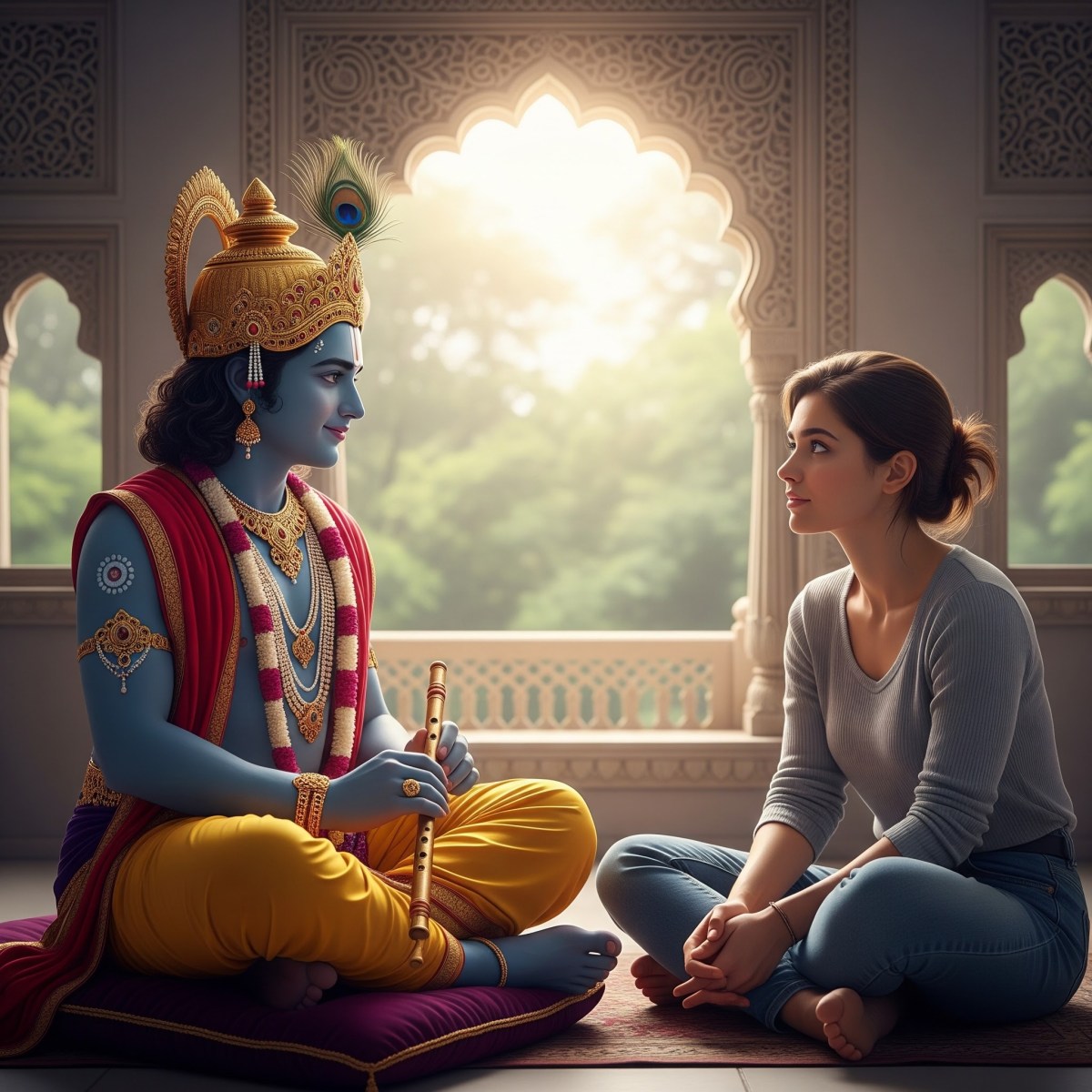
This article outlines a discussion between Mahabhagavat Das and a sincere seeker. It focuses on the nature of the Supreme Lord Krishna’s love. This discussion is based on an email thread.
The Initial Question and Doubt
Q: Why does it seem that Krishna’s love is conditional, requiring our complete surrender first?
The doubt arose from specific teachings and anecdotes:
- Conditions for Protection: A discourse by H.H. Sri Sri 1008 Sugunendra Theertha Swamiji cited the Bhagavad Gita verse (9.22), “ananyāś cintayanto māṁ ye janāḥ paryupāsate teṣāṁ nityābhiyuktānāṁ yoga-kṣemaṁ vahāmy aham.” He explained that Krishna offers protection when two conditions are met:
- 1) We worship and surrender utterly to Him only, and
- 2) We do this eternally.
- The Draupadi Example: In the pastime where Draupadi was being disrobed, Krishna did not immediately rescue her. He only supplied endless cloth when she let go of her own saree and surrendered completely. This suggested to the questioner that Krishna was being conditional.
- The Argument for Conditional Love: A discussion with another devotee led to the idea that love, even God’s, is conditional. This is similar to how human relationships can end when one partner does something the other dislikes. Srila Prabhupada once mentioned “rascaldom” existing in Krishna. This raised the question of whether “conditional love” could also exist in the Supreme Lord.
The Core Question: Is Krishna’s love conditional? Will He not provide for us protection, etc., if we don’t love Him? The Response: Unconditional Love and Conditional Surrender
Q: How is this understanding of conditional love a misunderstanding?
A: The essential truth is that Krishna’s love is not conditional; it is our surrender that is conditional. In real, transcendental love, the lover never stops loving. The notion that a relationship can end is a trait of lust. It is like saying, “I’ll scratch your back if you scratch mine,” and not pure love.
- The Conditional Factor: It is not Krishna withholding His mercy, but rather us not accepting it.
- The Role of Free Will: Krishna is a true Lover and does not force Himself upon us. If we are trying to help ourselves through other means, why should Krishna interfere? He respects our free will.
- The Purpose of Experience: Krishna allows us to experience whatever we need to experience. This is also a form of mercy:
- Parent/Child Analogy: A parent might let a child get slightly burned by a flame. This prevents greater harm in the future. The parent does not want the child to be hurt, but the momentary experience is for a higher protection.
- Karmic Reactions as Mercy: Even when facing karmic reactions, we are experiencing Krishna’s mercy through those reactions. This is like a university and a prison. Both are funded by the government. One is a mercy for law-abiding citizens. The other is a mercy for those who chose not to be.
Resolution and Affirmation
Q: After consideration, what was the realization about Krishna’s love?
A: The questioner realized that Krishna’s love is indeed unconditional, citing the following observations:
- Beauty of Creation: Krishna made the world beautiful with colors, flowers, and many beautiful things.
- Incarnations: He mercifully incarnates so many times to guide us back to Him or to save us.
- Telling the Secret of Secrets: He bothers to tell the secret of all secrets, demonstrating His care.
- Steadfast Love: He never stops giving us His love. He continues to do so even when people insult or ridicule Him. Some fools even call Him a “False God”, but Krishna loves them too.
Q: Are such difficult questions considered offensive?
A: No. Questions asked in good faith to understand and deepen one’s Krishna Consciousness are not an offense. This is part of the principle of “guhyam aakhyaati prchhati” (confiding in and inquiring from a spiritual well-wisher). The questioner was encouraged to continue asking questions. One is always welcome to ask questions from one’s teachers. We are also encouraged to ask mentors and peers who are sincere in their approach to Krishna Consciousness.
Original Email Exchange (anonymized)
Email 1
Dear prabhuji,
Please accept my humble obeisances
All glories to Srila Prabhupada
I was listening to a short lecture by HH Sri Sri 1008 Sugunendra Theertha swamiji. He is the Mathadhipati of Sri Puthige matha and the current paryaya of Udupi Krishna matha. He was explaining about Krishna’s protection.
In Bhagavad Gita, there is the verse ananyāś cintayanto māṁ ye janāḥ paryupāsate teṣāṁ nityābhiyuktānāṁ yoga-kṣemaṁ vahāmy aham (9.22).
He said that Krishna will offer protection to us, provided we fulfill two conditions –
- We worship Him and Him only. We surrender utterly to Him only and worship only Him. We cannot do this for whichever devata we want, only Krishna
- We do this eternally. No just the bad days or the good days, but for all days.
Swamiji also recounted the pastime where Krishna told the Pandavas something meaningful. Krishna said He liked Draupadi the most among all Pandavas. This was in response to being asked who He liked. Draupadi got angry. She asked Krishna why He didn’t immediately rescue her when getting disrobed by Dushasan in the sabha. It happened in front of everyone. She had even called His many names. Krishna told her that while she was doing that, one hand was raised up. The other was clinging onto her saree. But when she realized even she couldn’t save herself, she let go completely. She surrendered utterly. As a result, He saved her by supplying endless cloth.
Later, I pondered over this and realized that Krishna was being conditional. He isn’t going to protect us just like that. He wants our surrender first. I then asked for an explanation from someone, also a devotee of Lord Vishnu, why Krishna was setting such conditions. She said that even love is conditional. If you do something I don’t like, won’t I not like you and stop loving you? It felt a bit unfair, especially in terms of God’s love. But then I remember hearing stories. In those stories, lovers stopped loving each other. They did so because they were doing something the other didn’t like. If that can happen between lovers, why can’t it happen between us and God?
Srila Prabhupada, on 27 February 1972, recounted how Krishna used to act around with Radharani. This behavior superficially made Him the greatest rascal. He then said “Unless rascaldom is in Krishna, how could rascaldom exist in the world?”. Rascaldom can exist in us as it is in Krishna. Therefore, conditional love can exist in Krishna too. It feels like a bitter pill to swallow for me, if it is true, but it is what it is.
My question is: Is Krishna’s love conditional? Will he not provide for us things protection etc if we don’t love Him?
Sorry for the long message. Forgive me if I have offended you in any way.
Hari bol
Your servant
A
Response 1
Dear A,
Hare Krishna!
Please accept my humble obeisances.
All glories to Srila Prabhupada.
I don’t know how you got into this grave misunderstanding that Krishna’s love is conditional. I don’t know why this other devotee is spreading their misunderstandings to you as well.
You have no understanding of love. In real love, the lover never stops loving. That is what Chaitanya Mahaprabhu prays “mat praana naathas tu sa eva na parah”. But in lust, the relationship can end. It can happen if the relationship is based on “I’ll scratch your back if you scratch mine”.
What Sugunendra Teertha Swami was saying is 100% correct. What Srila Prabhupada is saying is 100% correct. Your understanding, though, is 100% wrong.
It is not that Krishna’s love is conditional, but that our surrender is conditional. It is not Krishna withholding His mercy, but us not accepting Krishna’s mercy. Should Krishna force Himself upon us and intervene when we really don’t want Him to?
Consider this…
- We have free will
- Krishna does not force Himself upon us as a true Lover
- So, if we are trying to help ourselves through other means, then why should Krishna interfere?
Krishna will let us experience whatever it is that we need to experience! Just like a parent, a child might get a little burned by the flame. This is to protect the child from greater harm in the future. The parent does not want the child to get hurt!
It is the same in modern life. We get vaccinated against certain diseases so we can avoid the actual disease. However, the vaccine itself can cause some side effects. It can even cause a fever sometimes.
Finally, if we are doing something and facing karmic reactions, then through those karmic reactions we are experiencing Krishna’s mercy…
It is just like a university and a prison. Both are funded by the government. A university is a mercy towards law abiding citizens. A prison is a mercy for those who chose not to be law abiding.
Does this make sense to you?
Sincerely,
Mahabhagavat Das
dasadas.com
Response 2
Hare krishna prabhuji!
Thanks for taking the time out to respond to my question. I was in a bad headspace that time and having very negative thoughts on Krishna. Forgive me for any offences caused.
I saw a video related to this and realized krishna does love us. He made this world so beautiful with colours, flowers and many beautiful things. He incarnates mercifully to guide us back to Him or to save us. Even when people insult Him or ridicule, He never stops giving us his love. If He really never loved us, why would this world be beautiful? Why would he bother to incarnate more than 10 times? Why would He bother to tell the secret of all secrets?
Thanks for making me understand!
Hare Krishna
Response 3
Hare Krishna A,
We all go through difficult moments.
Questions asked in good faith are meant to understand and deepen our Krishna Consciousness. In this context, there is no offense. That is one of the meanings of the “guhyam aakhyaati prchhati”.
My prayer to Sri Krishna and you is that you may receive His full shelter…. He is giving all shelter, and that you may fully accept His shelter.
You are welcome to ask questions. I am always welcome to ask questions from my spiritual masters, mentors, and peers.

 Freedom through Genuine Spiritual Progress