
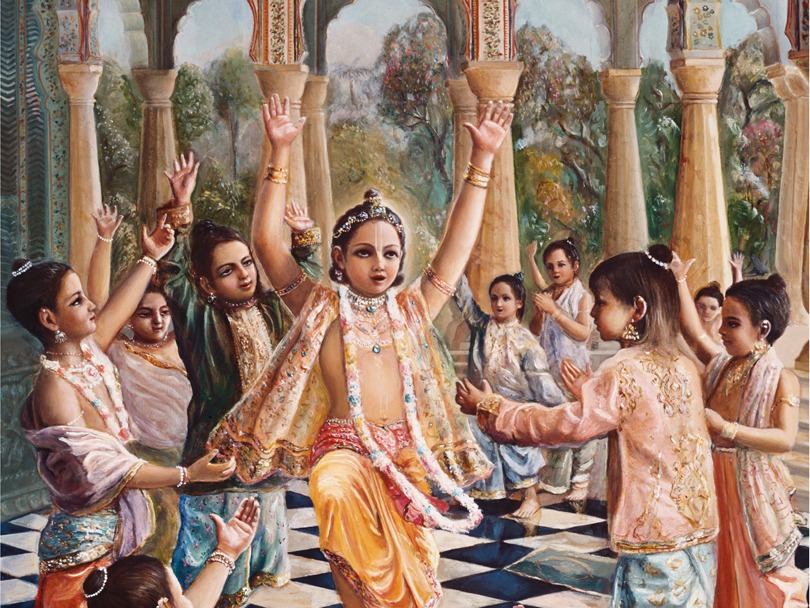
Hare Krishna!
ISKCON Kitchener-Waterloo-Cambridge is hosting a program on the occasion of Sri Narasimha Chaturdashi, the appearance of the half-man half-lion incarnation of God.
DATE📆: Saturday, 25th May 2024
TIME⌚: 12:30 PM ET USA/ 11:30 AM CT USA/ 9:30 AM PST USA/ 6:00 PM UK/ 10:00 PM IST
PLACE: 405 King St N Waterloo, Ontario, Canada
The class will be available in person, broadcast online, and later as a recording. If you don’t know how to access the online broadcast, please contact.
Please join in person or online if you’re interested in joining this class, or let me know if you want to get a link to the recording.
Please read this summary from Srimad Bhagavatam Canto 7 (The Science of God), Chapters 5-10, for more information about the subject matter of the class.
These summaries are also available online from https://vedabase.io/en/library/sb/7/
Thank you! Hare Krishna
Prahlāda Mahārāja, the Saintly Son of Hiraṇyakaśipu
Prahlāda Mahārāja did not carry out the orders of his teachers, for he was always engaged in worshiping Lord Viṣṇu. As described in this chapter, Hiraṇyakaśipu tried to kill Prahlāda Mahārāja, even by having a snake bite him and by putting him under the feet of elephants, yet he was unsuccessful.
Hiraṇyakaśipu’s spiritual master, Śukrācārya, had two sons named Ṣaṇḍa and Amarka, to whom Prahlāda Mahārāja was entrusted for education. Although the teachers tried to educate the boy Prahlāda in politics, economics and other material activities, he did not care for their instructions. Instead, he continued to be a pure devotee. Prahlāda Mahārāja never liked the idea of discriminating between one’s friends and enemies. Because he was spiritually inclined, he was equal toward everyone.
Once upon a time, Hiraṇyakaśipu inquired from his son what the best thing was that he had learned from his teachers. Prahlāda Mahārāja replied that a man engrossed in the material consciousness of duality, thinking, “This is mine, and that belongs to my enemy,” should give up his householder life and go to the forest to worship the Supreme Lord.
When Hiraṇyakaśipu heard from his son about devotional service, he decided that this small boy had been polluted by some friend in school. Thus he advised the teachers to take care of the boy so that he would not become a Kṛṣṇa conscious devotee. However, when the teachers inquired from Prahlāda Mahārāja why he was going against their teachings, Prahlāda Mahārāja taught the teachers that the mentality of ownership is false and that he was therefore trying to become an unalloyed devotee of Lord Viṣṇu. The teachers, being very angry at this answer, chastised and threatened the boy with many fearful conditions. They taught him to the best of their ability and then brought him before his father.
Hiraṇyakaśipu affectionately took his son Prahlāda on his lap and then inquired from him what the best thing was that he had learned from his teachers. As usual, Prahlāda Mahārāja began praising the nine processes of devotional service, such as śravaṇam and kīrtanam. Thus the King of the demons, Hiraṇyakaśipu, being extremely angry, chastised the teachers, Ṣaṇḍa and Amarka, for having wrongly trained Prahlāda Mahārāja. The so-called teachers informed the King that Prahlāda Mahārāja was automatically a devotee and did not listen to their instructions. When they proved themselves innocent, Hiraṇyakaśipu inquired from Prahlāda where he had learned viṣṇu-bhakti. Prahlāda Mahārāja replied that those who are attached to family life do not develop Kṛṣṇa consciousness, either personally or collectively. Instead, they suffer repeated birth and death in this material world and continue simply chewing the chewed. Prahlāda explained that the duty of every man is to take shelter of a pure devotee and thus become eligible to understand Kṛṣṇa consciousness.
Enraged at this answer, Hiraṇyakaśipu threw Prahlāda Mahārāja from his lap. Since Prahlāda was so treacherous that he had become a devotee of Viṣṇu, who had killed his uncle Hiraṇyākṣa, Hiraṇyakaśipu asked his assistants to kill him. The assistants of Hiraṇyakaśipu struck Prahlāda with sharp weapons, threw him under the feet of elephants, subjected him to hellish conditions, threw him from the peak of a mountain and tried to kill him in thousands of other ways, but they were unsuccessful. Hiraṇyakaśipu therefore became increasingly afraid of his son Prahlāda Mahārāja and arrested him. The sons of Hiraṇyakaśipu’s spiritual master, Śukrācārya, began teaching Prahlāda in their own way, but Prahlāda Mahārāja did not accept their instructions. While the teachers were absent from the classroom, Prahlāda Mahārāja began to preach Kṛṣṇa consciousness in the school, and by his instructions all his class friends, the sons of the demons, became devotees like him.
Prahlāda Instructs His Demoniac Schoolmates
This chapter describes Prahlāda Mahārāja’s instructions to his class friends. In speaking to his friends, who were all sons of demons, Prahlāda Mahārāja stressed that every living entity, especially in human society, must be interested in spiritual realization from the very beginning of life. When human beings are children, they should be taught that the Supreme Personality of Godhead is the worshipable Deity for everyone. One should not be very much interested in material enjoyment; instead, one should be satisfied with whatever material profits are easily obtainable, and because the duration of one’s life is very short, one should utilize every moment for spiritual advancement. One may wrongly think, “In the beginning of our lives let us enjoy material facilities, and in old age we may become Kṛṣṇa conscious.” Such materialistic thoughts are always useless because in old age one cannot be trained in the spiritual way of life. Therefore, from the very beginning of life, one should engage in devotional service (śravaṇaṁ kīrtanaṁ viṣṇoḥ). This is the duty of all living entities. Material education is infected by the three modes of nature, but spiritual education, for which there is a great need in human society, is transcendental. Prahlāda Mahārāja disclosed the secret of how he had received instructions from Nārada Muni. By accepting the lotus feet of Prahlāda Mahārāja, who is in the paramparā succession, one will be able to understand the mode of spiritual life. In accepting this mode of activity, there is no need for material qualifications.
After Prahlāda Mahārāja’s class friends had listened to Prahlāda Mahārāja, they inquired how he had become so learned and advanced. In this way the chapter ends.
What Prahlāda Learned in the Womb
In this chapter, to dissipate the doubts of his class friends, the sons of the demons, Prahlāda Mahārāja states how, within the womb of his mother, he had heard from the mouth of Nārada Muni, who had instructed him in bhāgavata-dharma.
When Hiraṇyakaśipu left his kingdom and went to the mountain known as Mandarācala to execute severe austerities, all the demons scattered. Hiraṇyakaśipu’s wife, Kayādhu, was pregnant at that time, and the demigods, mistakenly thinking that she carried another demon in her womb, arrested her. Their plan was that as soon as the child took birth they would kill him. While they were taking Kayādhu to the heavenly planets, they met Nārada Muni, who stopped them from taking her away and took her to his āśrama until Hiraṇyakaśipu’s return. In Nārada Muni’s āśrama, Kayādhu prayed for the protection of the baby in her womb, and Nārada Muni reassured her and gave her instructions on spiritual knowledge. Taking advantage of those instructions, Prahlāda Mahārāja, although a small baby within the womb, listened very carefully. The spirit soul is always apart from the material body. There is no change in the spiritual form of the living entity. Any person above the bodily conception of life is pure and can receive transcendental knowledge. This transcendental knowledge is devotional service, and Prahlāda Mahārāja, while living in the womb of his mother, received instructions in devotional service from Nārada Muni. Any person engaged in the service of the Lord through the instructions of a bona fide spiritual master is immediately liberated, and being free from the clutches of māyā, he is relieved of all ignorance and material desires. The duty of everyone is to take shelter of the Supreme Lord and thus become free from all material desires. Regardless of the material condition in which one is situated, one can achieve this perfection. Devotional service is not dependent on the material activities of austerity, penance, mystic yoga or piety. Even without such assets, one can achieve devotional service through the mercy of a pure devotee.Text 1: Nārada Muni said: Although Prahlāda Mahārāja was born in a family of asuras, he was the greatest of all devotees. Having thus been questioned by his class friends, the sons of the asuras, he remembered the words spoken to him by me and replied to his friends as follows.
Lord Nṛsiṁhadeva Slays the King of the Demons
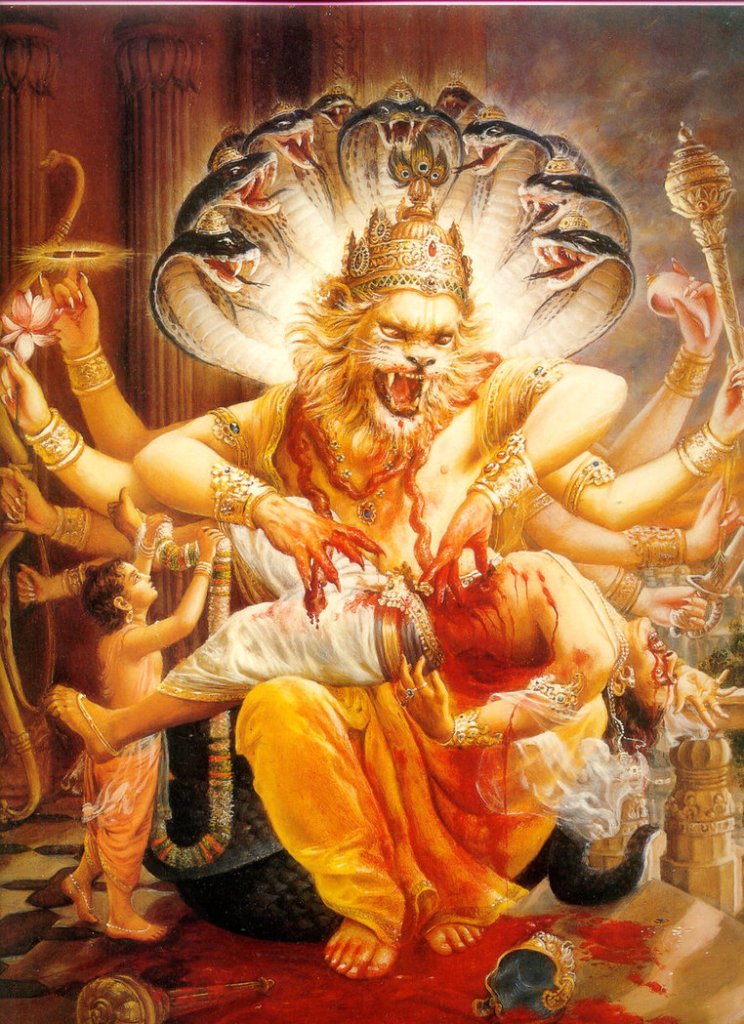
As described in this chapter, Hiraṇyakaśipu was ready to kill his own son Prahlāda Mahārāja, but the Supreme Personality of Godhead appeared in front of the demon as Śrī Nṛkeśarī, half lion and half man, and killed him.
Following the instructions of Prahlāda Mahārāja, all the sons of the demons became attached to Lord Viṣṇu, the Supreme Personality of Godhead. When this attachment became pronounced, their teachers, Ṣaṇḍa and Amarka, were very much afraid that the boys would become more and more devoted to the Lord. In a helpless condition, they approached Hiraṇyakaśipu and described in detail the effect of Prahlāda’s preaching. After hearing of this, Hiraṇyakaśipu decided to kill his son Prahlāda. Hiraṇyakaśipu was so angry that Prahlāda Mahārāja fell down at his feet and said many things just to pacify him, but he was unsuccessful in satisfying his demoniac father. Hiraṇyakaśipu, as a typical demon, began to advertise himself as being greater than the Supreme Personality of Godhead, but Prahlāda Mahārāja challenged him, saying that Hiraṇyakaśipu was not God, and began to glorify the Supreme Personality of Godhead, declaring that the Lord is all-pervading, that everything is under Him, and that no one is equal to or greater than Him. Thus he requested his father to be submissive to the omnipotent Supreme Lord.
The more Prahlāda Mahārāja glorified the Supreme Personality of Godhead, the more angry and agitated the demon became. Hiraṇyakaśipu asked his Vaiṣṇava son whether his God existed within the columns of the palace, and Prahlāda Mahārāja immediately accepted that since the Lord is present everywhere, He was also present within the columns. When Hiraṇyakaśipu heard this philosophy from his young son, he derided the boy’s statement as just the talk of a child and forcefully struck the pillar with his fist.
As soon as Hiraṇyakaśipu struck the column, there issued forth a tumultuous sound. At first Hiraṇyakaśipu, the King of the demons, could not see anything but the pillar, but to substantiate Prahlāda’s statements, the Lord came out of the pillar in His wonderful incarnation as Narasiṁha, half lion and half man. Hiraṇyakaśipu could immediately understand that the extraordinarily wonderful form of the Lord was surely meant for his death, and thus he prepared to fight with the form of half lion and half man. The Lord performed His pastimes by fighting with the demon for some time, and in the evening, on the border between day and night, the Lord captured the demon, threw him on His lap, and killed him by piercing his abdomen with His nails. The Lord not only killed Hiraṇyakaśipu, the King of the demons, but also killed many of his followers. When there was no one else to fight, the Lord, roaring with anger, sat down on Hiraṇyakaśipu’s throne.
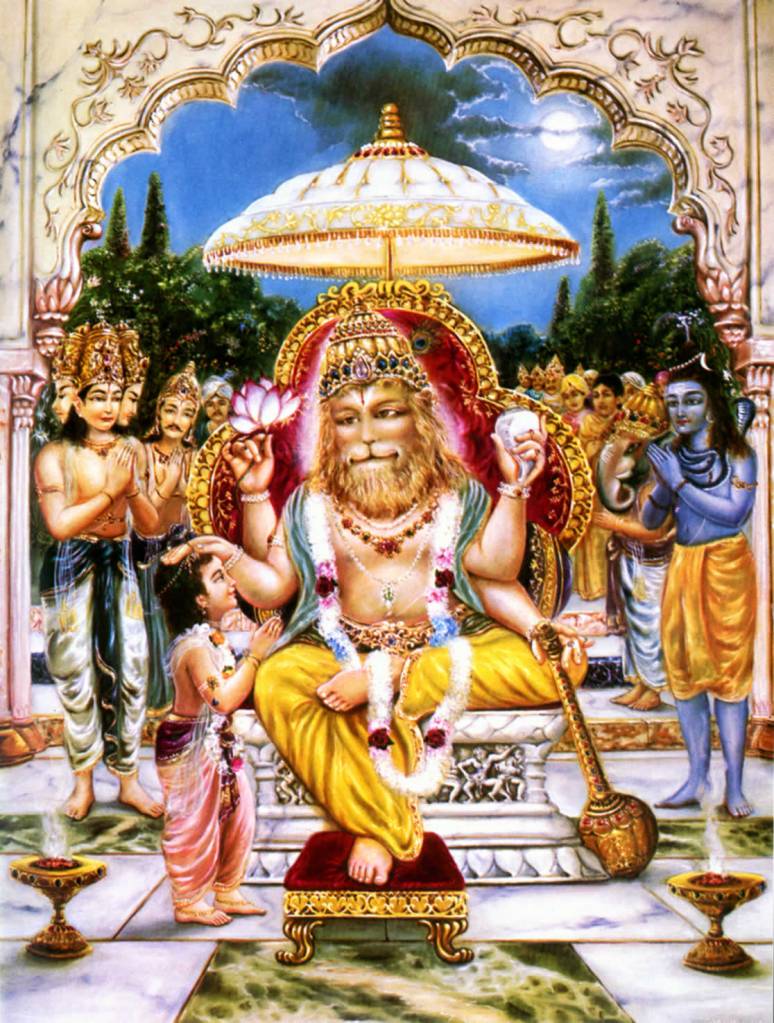
The entire universe was thus relieved of the rule of Hiraṇyakaśipu, and everyone was jubilant in transcendental bliss. Then all the demigods, headed by Lord Brahmā, approached the Lord. These included the great saintly persons, the Pitās, the Siddhas, the Vidyādharas, the Nāgas, the Manus, the prajāpatis, the Gandharvas, the Cāraṇas, the Yakṣas, the Kimpuruṣas, the Vaitālikas, the Kinnaras and also many other varieties of beings in human form. All of them stood not far from the Supreme Personality of Godhead and began offering their prayers unto the Lord, whose spiritual effulgence was brilliant as He sat on the throne.
Prahlāda Pacifies Lord Nṛsiṁhadeva with Prayers
As related in this chapter, Prahlāda Mahārāja, following the order of Lord Brahmā, pacified the Lord when the Lord was extremely angry after having killed Hiraṇyakaśipu.
After Hiraṇyakaśipu was killed, the Lord continued to be very angry, and the demigods, headed by Lord Brahmā, could not pacify Him. Even mother Lakṣmī, the goddess of fortune, the constant companion of Nārāyaṇa, could not dare come before Lord Nṛsiṁhadeva. Then Lord Brahmā asked Prahlāda Mahārāja to go forward and pacify the Lord’s anger. Prahlāda Mahārāja, being confident of the affection of his master, Lord Nṛsiṁhadeva, was not afraid at all. He very gravely appeared before the Lord’s lotus feet and offered Him respectful obeisances. Lord Nṛsiṁhadeva, being very much affectionate toward Prahlāda Mahārāja, put His hand on Prahlāda’s head, and because of being personally touched by the Lord, Prahlāda Mahārāja immediately achieved brahma-jñāna, spiritual knowledge. Thus he offered his prayers to the Lord in full spiritual knowledge and full devotional ecstasy. The instructions given by Prahlāda Mahārāja in the form of his prayers are as follows.
Prahlāda said, “I am not proud of being able to offer prayers to the Supreme Personality of Godhead. I simply take shelter of the mercy of the Lord, for without devotion one cannot appease Him. One cannot please the Supreme Personality of Godhead simply by dint of high parentage or great opulence, learning, austerity, penance or mystic power. Indeed, these are never pleasing to the Supreme Lord, for nothing can please Him but pure devotional service. Even if a nondevotee is a brāhmaṇa qualified with the twelve brahminical symptoms, he cannot be very dear to the Lord, whereas if a person born in a family of dog-eaters is a devotee, the Lord can accept his prayers. The Lord does not need anyone’s prayers, but if a devotee offers his prayers to the Lord, the devotee benefits greatly. Ignorant persons born in low families, therefore, can sincerely offer heartfelt prayers to the Lord, and the Lord will accept them. As soon as one offers his prayers to the Lord, he is immediately situated on the Brahman platform.”
Lord Nṛsiṁhadeva appeared for the benefit of all human society, not only for Prahlāda’s personal benefit. The fierce form of Lord Nṛsiṁhadeva may appear most awful to a nondevotee, but to the devotee the Lord is always affectionate as He is in other forms. Conditioned life in the material world is actually extremely fearful; indeed, a devotee is not afraid of anything else. Fear of material existence is due to false ego. Therefore the ultimate goal of life for every living entity is to attain the position of being servant of the servant of the Lord. The miserable condition of the living entities in the material world can be remedied only by the mercy of the Lord. Although there are so-called material protectors like Lord Brahmā and the other demigods, or even one’s own father, they are unable to do anything if one is neglected by the Supreme Personality of Godhead. However, one who has fully taken shelter of the Lord’s lotus feet can be saved from the onslaught of material nature. Therefore every living entity should be unattracted by material so-called happiness and should take shelter of the Lord by all means. That is the mission of human life. To be attracted by sense gratification is simply foolish. Whether one is a devotee of the Lord or is a nondevotee does not depend upon one’s birth in a high or low family. Even Lord Brahmā and the goddess of fortune cannot achieve the full favor of the Lord, whereas a devotee can very easily attain such devotional service. The Lord’s mercy is bestowed equally upon everyone, regardless of whether one is high or low. Because Prahlāda Mahārāja was blessed by Nārada Muni, Prahlāda became a great devotee. The Lord always saves the devotee from impersonalists and voidists. The Lord is present in everyone’s heart as the Supersoul to give the living being protection and all benefits. Thus the Lord acts sometimes as the killer and sometimes as the protector. One should not accuse the Lord for any discrepancies. It is His plan that we see varieties of life within this material world. All of them are ultimately His mercy.
Although the entire cosmic manifestation is nondifferent, the material world is nonetheless different from the spiritual world. Only by the mercy of the Supreme Lord can one understand how the wonderful material nature acts. For example, although Lord Brahmā appeared from the lotus seat that had grown from the abdomen of Garbhodakaśāyī Viṣṇu, he could not understand what to do after his appearance. He was attacked by two demons, Madhu and Kaiṭabha, who took away Vedic knowledge, but the Lord killed them and entrusted to Lord Brahmā the Vedic knowledge. Thus the Lord appears in every millennium in the societies of demigods, human beings, animals, saints and aquatics. All such incarnations are meant to protect the devotees and kill the demons, but this killing and protecting does not reflect any sense of partiality on the part of the Supreme Lord. The conditioned soul is always attracted by the external energy. Therefore he is subjected to lust and greed, and he suffers under the conditions of material nature. The Lord’s causeless mercy toward His devotee is the only means by which to get out of material existence. Anyone engaged in glorifying the Lord’s activities is always unafraid of this material world, whereas one who cannot glorify the Lord in that way is subjected to all lamentation.
Those interested in silently worshiping the Lord in solitary places may be eligible for liberation themselves, but a pure devotee is always aggrieved to see others suffering. Therefore, not caring for his own liberation, he always engages in preaching by glorifying the Lord. Prahlāda Mahārāja, therefore, had tried to deliver his class friends by preaching and had never remained silent. Although being silent, observing austerities and penances, learning the Vedic literature, undergoing ritualistic ceremonies, living in a solitary place and performing japa and transcendental meditation are approved means of liberation, they are meant for nondevotees or for cheaters who want to live at the expense of others. A pure devotee, however, being freed from all such deceptive activities, is able to see the Lord face to face.
The atomic theory of the composition of the cosmic manifestation is not factual. The Lord is the cause of everything, and therefore He is the cause of this creation. One should therefore always engage in devotional service by offering respectful obeisances to the Lord, offering prayers, working for the Lord, worshiping the Lord in the temple, always remembering the Lord and always hearing about His transcendental activities. Without these six kinds of activity, one cannot attain to devotional service.
Prahlāda Mahārāja thus offered his prayers to the Supreme Lord, begging His mercy at every step. Lord Nṛsiṁhadeva was pacified by Prahlāda Mahārāja’s prayers and wanted to give him benedictions by which Prahlāda could procure all kinds of material facilities. Prahlāda Mahārāja, however, was not misled by material facilities. Rather, he wanted to remain always a servant of the servant of the Lord.
Prahlāda, the Best Among Exalted Devotees
This chapter describes how the Supreme Personality of Godhead Nṛsiṁhadeva disappeared, after pleasing Prahlāda Mahārāja. It also describes a benediction given by Lord Śiva.
Lord Nṛsiṁhadeva wanted to bestow benedictions upon Prahlāda Mahārāja, one after another, but Prahlāda Mahārāja, thinking them impediments on the path of spiritual progress, did not accept any of them. Instead, he fully surrendered at the Lord’s lotus feet. He said: “If anyone engaged in the devotional service of the Lord prays for personal sense gratification, he cannot be called a pure devotee or even a devotee. He may be called only a merchant engaged in the business of give and take. Similarly, a master who wants to please his servant after taking service from him is also not a real master.” Prahlāda Mahārāja, therefore, did not ask anything from the Supreme Personality of Godhead. Rather, he said that if the Lord wanted to give him a benediction, he wanted the Lord to assure him that he would never be induced to take any benedictions for the sake of material desires. Exchanges of devotional service for lusty desires are always very prominent. As soon as lusty desires awaken, one’s senses, mind, life, soul, religious principles, patience, intelligence, shyness, beauty, strength, memory and truthfulness are all vanquished. One can render unalloyed devotional service only when there are no material desires in one’s mind.
The Supreme Personality of Godhead was greatly pleased with Prahlāda Mahārāja for his unalloyed devotion, yet the Lord provided him one material benediction — that he would be perfectly happy in this world and live his next life in Vaikuṇṭha. The Lord gave him the benediction that he would be the king of this material world until the end of the manvantara millennium and that although in this material world, he would have the facility to hear the glories of the Lord and depend fully on the Lord, performing service to Him in uncontaminated bhakti-yoga. The Lord advised Prahlāda to perform sacrifices through bhakti-yoga, for this is the duty of a king.
Prahlāda Mahārāja accepted whatever the Lord had offered him, and he prayed for the Lord to deliver his father. In response to this prayer, the Lord assured him that in the family of such a pure devotee as he, not only the devotee’s father but his forefathers for twenty-one generations are liberated. The Lord also asked Prahlāda to perform the ritualistic ceremonies appropriate after his father’s death.
Then Lord Brahmā, who was also present, offered many prayers to the Lord, expressing his obligation to the Lord for having offered benedictions to Prahlāda Mahārāja. The Lord advised Lord Brahmā not to offer benedictions to asuras as he had to Hiraṇyakaśipu, for such benedictions indulge them. Then Lord Nṛsiṁhadeva disappeared. On that day, Prahlāda Mahārāja was installed on the throne of the world by Lord Brahmā and Śukrācārya.
Thus Nārada Muni described the character of Prahlāda Mahārāja for Yudhiṣṭhira Mahārāja, and he further described the killing of Rāvaṇa by Lord Rāmacandra and the killing of Śiśupāla and Dantavakra in Dvāpara-yuga. Śiśupāla, of course, had merged into the existence of the Lord and thus achieved sāyujya-mukti. Nārada Muni praised Yudhiṣṭhira Mahārāja because the Supreme Lord, Kṛṣṇa, was the greatest well-wisher and friend of the Pāṇḍavas and almost always stayed in their house. Thus the fortune of the Pāṇḍavas was greater than that of Prahlāda Mahārāja.
Later, Nārada Muni described how the demon Maya Dānava constructed Tripura for the demons, who became very powerful and defeated the demigods. Because of this defeat, Lord Rudra, Śiva, dismantled Tripura; thus he became famous as Tripurāri. For this, Rudra is very much appreciated and worshiped by the demigods. This narration occurs at the end of the chapter.

 Freedom through Genuine Spiritual Progress