
Why all the rules? Love, Rules, and Devotional Service. Understanding Bhakti.

Bhakti means loving devotional service to Krishna. Newcomers often raise questions about the necessity of rules. While there are numerous rules and guidelines, such as chanting sixteen rounds of the Hare Krishna mantra daily, these rules serve a vital purpose. They help those who have not yet cultivated pure love for God. Like caring for a loved one, these instructions are given out of deep love and knowledge, ensuring careful devotion. Ultimately, rules are like the handrails and supports, they guide us toward achieving the highest spiritual goal of love for God. Do you have a problem with rules in spirituality?

I get this question a lot… Bhakti means loving devotional service to Krishna, the Supreme Personality of Godhead. Bhakti means Individual, Spontaneous, Loving Devotional Service… So why all the rules?

Some people say “I love spirituality, but I hate organized religion”. And I get their sentiment. They want to love God and serve God. However, they hate the bureaucracy, the politics, and the behind-the-scenes ugliness that may lurk inside religious organizations.

Spiritual life is supposed to be free, and yet the rules!

There are so many rules. There is the chanting of sixteen rounds of the Hare Krishna Maha Mantra every day – 1728 Mantras minimum. Here’s the mantra.

Hare Krishna Hare Krishna

Krishna Krishna Hare Hare

Hare Rama Hare Rama

Rama Rama Hare Hare
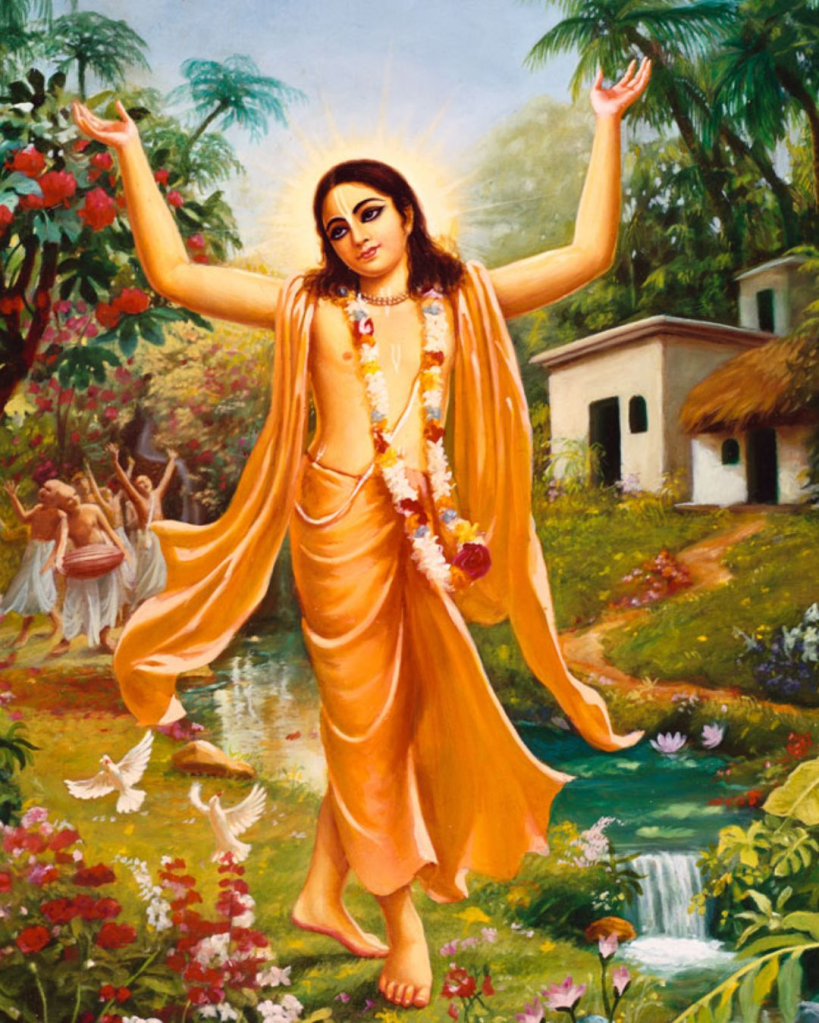
Sri Chaitanya Mahaprabhu inaugurated the Sankirtan movement, the congregational chanting of the names of God. This movement has spread all over the world in the last 500 years.

Sri Krishna Chaitanya Mahaprabhu even says that there are no rules…

CC Antya 20.16

নাম্নামকারি বহুধা নিজসর্বশক্তি- স্তত্রার্পিতা নিয়মিতঃ স্মরণে ন কালঃ ।
এতাদৃশী তব কৃপা ভগবন্মমাপি দুর্দৈবমীদৃশমিহাজনি নানুরাগঃ ॥ ১৬ ॥

nāmnām akāri bahudhā nija-sarva-śaktis
tatrārpitā niyamitaḥ smaraṇe na kālaḥ
etādṛśī tava kṛpā bhagavan mamāpi
durdaivam īdṛśam ihājani nānurāgaḥ
Synonyms

“ ‘My Lord, O Supreme Personality of Godhead, in Your holy name there is all good fortune for the living entity, and therefore You have many names, such as “Kṛṣṇa” and “Govinda,” by which You expand Yourself. You have invested all Your potencies in those names, and there are no hard and fast rules for remembering them. My dear Lord, although You bestow such mercy upon the fallen, conditioned souls by liberally teaching Your holy names, I am so unfortunate that I commit offenses while chanting the holy name, and therefore I do not achieve attachment for chanting.’

https://vedabase.io/en/library/cc/antya/20/16/

It’s clear, Mahaprabhu says “there are no hard and fast rules“. Yet in the same verse, Sri Krishna Chaitanya Mahaprabhu also mentions “offenses” to be avoided. What are those?

When we chant Hare Krishna or any other authorized names of God, we should strive to avoid all offenses. There are 10 specific offenses to be mindful of.

1) To blaspheme the devotees who have dedicated their lives for propagating the holy name of the Lord.

2) To consider the names of demigods like Lord Shiva or Lord Brahma to be equal to or independent of the name of the Lord Vishnu.

3) To disobey the orders of the spiritual master.

4) To blaspheme the vedic scriptures or scriptures in pursuance to the vedic version.

5) To consider the glories of chanting Hare Krishna to be an imagination.

6) To give some interpretations to the holy name of the Lord.

7) To commit sinful activities on the strength of the holy name.

8) To consider the chanting of Hare Krishna as one of the auspicious ritualistic activities which are offered in the Vedas as frutive activities (Karma kanda).

9) To instruct a faithless person about the glories of the holy name

10) To not have complete faith in the chanting of the holy name and to maintain material attachments, even after understanding so many instructions on this matter. It is also an offense to be inattentive while chanting.


Every devotee who claims to be Vaishnava must guard against these offenses in order to quickly achieve the desired success KRISHNA PREMA!!!

Padma Purana (Section: Brahma Khanda 25.15–18)

There are so many rules and regulations! This applies whether it is with cooking for Krishna, or worship of Krishna in Deity form. This applies to fasting, or ending one’s fast. This applies to reading or explaining scripture. In every aspect of Bhakti there are rules.

There are rules and regulations in the other religious traditions also. There is hardly a tradition without rules and regulations. And without rules and regulations, what is tradition anyways?

But the highest spiritual principle is pure love of God, so why all the rules?

After all, there are no rules and regulations in love, no?

But here’s the catch… We presently do not have any love for God!

We have only a blind, slavish servitude of our senses and mind!

The rules are meant for those who are not yet pure lovers of God. For the pure Lover of God, there are no rules.

Still, why any rules on the path of love of God?

Think of this situation…

Let us say you are responsible for caring for someone. Let’s say, a dear parent, or grandparent, a child, or even a pet…

Now, let’s say you need to entrust that loved one to me, a stranger. Let us say I can be trusted to be reliable with my care, but I don’t know your loved one. I don’t know what they need.

When you love someone, and you entrust them to someone else' care, you do give a lot of rules and regulations and guidelines!

How many rules and regulations will you give me? How many guidelines? How much advice?

She doesn’t like this food… He is allergic to that medicine. She sleeps at this time. He gets agitated when someone does that! She loves it when you serve this food with that condiment… Here is the clothing. Here is the extra blanket. Here is the toy. Wake him up for his appointment. Take him to this place. Don’t leave her alone… Here is the medicine, and this is the right dosage, by the way. Here is this, and don’t forget that. Here is my phone number, call me if you need anything. Please be careful. Thank you soooo much!

Then, when I am alone with your loved one, will you call? Will you check up on how they are doing?

That is the intent of the rules and regulations in Bhakti also.

The rules are regulations are given to us by someone who loves God very very much. The spiritual master, who gives us the rules, is a confidential servitor of God, and knows God better than us. The saintly souls hand us the rules, for our own growth.

So, out of their love for us, and for God, they give us the rules.

The rules and regulations are simply a manifestation of the saints’ love for Krishna. When we adhere to them precisely, we can reach the same stage of love. Of course, we can’t remain only on the platform of rules and regulations. By the blessings of the spiritual master, we can develop the same individual, spontaneous, loving attraction to Krishna. We can exceed the standard of the minimum rules by their grace.

So, who will be so foolish as to not pay attention to the rules and regulations of the scripture?

Bg. 16.23

य: शास्त्रविधिमुत्सृज्य वर्तते कामकारत: ।
न स सिद्धिमवाप्‍नोति न सुखं न परां गतिम् ॥ २३ ॥

yaḥ śāstra-vidhim utsṛjya vartate kāma-kārataḥ
na sa siddhim avāpnoti na sukhaṁ na parāṁ gatim

He who discards scriptural injunctions and acts according to his own whims attains neither perfection, nor happiness, nor the supreme destination.

https://vedabase.io/en/library/bg/16/23/

Bg. 16.24

तस्माच्छास्त्रं प्रमाणं ते कार्याकार्यव्यवस्थितौ ।
ज्ञात्वा शास्त्रविधानोक्तं कर्म कर्तुमिहार्हसि ॥ २४ ॥

tasmāc chāstraṁ pramāṇaṁ te
kāryākārya-vyavasthitau
jñātvā śāstra-vidhānoktaṁ
karma kartum ihārhasi

One should therefore understand what is duty and what is not duty by the regulations of the scriptures. Knowing such rules and regulations, one should act so that he may gradually be elevated.

https://vedabase.io/en/library/bg/16/24/

What do you think about rules and regulations in spiritual life? Let me know!

A Moment of Reflection: Mantras and Unexpected Friendships

During a serene lunch break by Lake Ontario, a spontaneous encounter with a young man named George transformed a potentially uneasy moment into a thoughtful exchange about spirituality. Embracing the opportunity, I conveyed some nuggets of spiritual knowledge, fostering connection and understanding. Then I chanted my mantras. Ultimately, I left the encounter gratefully, having made a new friend.

I sat at one end of the bench and prepared to chant my Gayatri mantras. This big burly young man came and plonked himself right on the other end. The whole bench shook with the force of his landing. All other benches were empty, and this man chose to sit on the same one I was on.

The unkempt, untidy, muscular fellow was looking at me with some unusual interest… I wondered if I should move… was it going to be trouble? But I decided to stay there and chant my Gayatri mantras there anyways. After all, Krishna is non-different from His Names. I was in safe hands, come what may.

To make matters worse, this young man lit a cigarette. Oh no, I thought, how can I chant here amidst all the smoke? But still I resisted the urge to move. There was after all a reason why the Paramatma, the Supersoul in his heart inspired him to sit there. On the lone occupied bench on the entire pier.

All this happened one afternoon earlier this week, on my lunch break. Mantras on the pier that looks onto Lake Ontario – a typical lunch time routine for me. I took a slow walk, beads in hand, softly chanting the Hare Krishna Mahamantra. Then I chose an empty bench, which was not hard to do. Even though it was bright and sunny, it was still cold, about plus two degrees Celsius. So I had the pier all to myself, or so I thought. Krishna clearly had other plans!

Thus the intelligent person who places his faith in the Paramātmā or the Supreme Personality of Godhead begins to advance toward a blissful eternal life of knowledge.

https://vedabase.io/en/library/bg/13/23/

Suddenly he asked me, interrupting, “Are you praying to the the Buddha?”. I said I was chanting the Hare Krishna Mahamantra. He said “I believe it all, the cross, Buddha, all”.

So then George, who is from Greece, and I had a nice little chat. We spoke about how there is only one God and we know the same God by different names. I chanted peacefully. George just sat there, taking a puff, looking at me, taking a puff…

As he smoked, I was hoping the smoke didn’t blow my way, and it didn’t, for the most part. Except for the last puff – the wind changed directions that moment. But then, he threw away the cigarette, and with a “be well, my friend” got up walked away.

Why had I wanted to avoid the interaction? What was the difference between this brief interaction and the ones that we view as more significant? Yes, the time span was different. This one was a few minutes, the others, a few hours, days, weeks, months, years, or even decades.

But no matter what, we have to part ways, is it not? We sometimes meet each other again, our paths cross again… but is it guaranteed that they will? So why did I want to get away from George? It was the mind that was playing tricks, that’s all!

Thereafter, Devayānī, the daughter of Śukrācārya, understood that the materialistic association of husband, friends and relatives is like the association in a hotel full of tourists. The relationships of society, friendship and love are created by the māyā of the Supreme Personality of Godhead, exactly as in a dream. By the grace of Kṛṣṇa, Devayānī gave up her imaginary position in the material world. Completely fixing her mind upon Kṛṣṇa, she achieved liberation from the gross and subtle bodies.

सा सन्निवासं सुहृदां प्रपायामिव गच्छताम् ।
विज्ञायेश्वरतन्त्राणां मायाविरचितं प्रभो: ॥ २७ ॥
सर्वत्र सङ्गमुत्सृज्य स्वप्नौपम्येन भार्गवी ।
कृष्णे मन: समावेश्य व्यधुनोल्लिङ्गमात्मन: ॥ २८ ॥

sā sannivāsaṁ suhṛdāṁ
prapāyām iva gacchatām
vijñāyeśvara-tantrāṇāṁ
māyā-viracitaṁ prabhoḥ

sarvatra saṅgam utsṛjya
svapnaupamyena bhārgavī
kṛṣṇe manaḥ samāveśya
vyadhunol liṅgam ātmanaḥ

https://vedabase.io/en/library/sb/9/19/27-28/

It is best to serve another soul whenever we get a chance. No postponing. After all, who knows if and when our paths will cross again?

I don’t know why George chose to sit next to me. I wonder if he just wanted to have an interaction with another human. But I feel that Krishna, God, inspired George. I hope I served the soul passing for George for the brief length of our interaction! I hope that the few nuggets of spiritual knowledge was pleasing to the soul in the body called George. I pray that my effort was pleasing to Krishna, who sits in my heart as well as George’s as Paramatma, the Supersoul.

I am glad I overcame my preconceived notions about this young man. It was by Krishna’s grace. Otherwise I would have missed the service opportunity, maybe even conveyed some misunderstanding to George. It is not very pleasant when someone tries to avoid you, especially if you don’t know why.

Too often, spiritual people end up pushing others away. This is because we are not in tune with the dictations of God sitting within our heart. It is because we fall prey to the urges of the mind.

Chanting Mantras with meditation beads...

I then chanted my Gayatri in peace. I continued chanting the Mahamantra after. Finally, it was time to get back to the office for a quick lunch and my next meeting.

It all ended well. I made a new friend, George from Greece. I prayed that he also experience Krishna in the form of His His Names, some day.

Hare Krishna Hare Krishna 
Krishna Krishna Hare Hare 
Hare Rama Hare Rama 
Rama Rama Hare Hare
The Hare Krishna Mahamantra

What is “reflective” chanting?

What are the stages in chanting the Hare Krishna Maha Mantra? Especially, what is reflecting chanting? What are the benefits experienced by someone at the various levels of chanting?

Madumitha, 11 November 2014

Hare Krishna!

Please accept my humble obeisances.

All glories to Srila Prabhupada!

All glories to Guru and Gauranga!

Could you please elaborate on what is meant by ‘reflective chanting’. I understand that the offensive chanting stage is when a neophyte devotee commits offenses while chanting and the offenseless chanting stage is when one does not commit any offenses towards the Holy Name, but I am unable to understand what happens in this intermediate stage. It is also mentioned that it is in the reflective chanting stage that one attains a stage of emancipation. What does this mean? Doesn’t one become liberated at the offenseless chanting stage?  

Thanks, 

Madumitha

Srivatsa Das, 13 November 2014

Hare Krishna

Please accept my humble obeisances

All glories to Srila Gurudeva

 In previous yugas, the devotees attained purified goodness mode by training of yoga by a Brahmana or a bona fide spiritual master away from the devotee’s home under brahmacharya asrama.  In the present age,  it is not possible to have this,  but still, we can attain the same purified goodness or Vasudeva sattva stage by the easy process of chanting the mahamantra offencelessly and reading regularly Srimad Bhagavad gita and Srimad Bhagavatam along with other devotees. In both the cases we can see that the seed of bhakti has to be planted into the heart of the devotee by a bonafide spiritual master.

As the chanting continues along with other devotional services, purification starts.  The three stages of chanting as I understood are as follows:

1. offensive chanting –  In this stage purification starts

2.  intermediate stage of chanting – Attains liberation

3. in the offence-less chanting – in this stage one attains Vasudeva sattva stage by real love and devotion towards the Lord.  In this stage, the devotee might be present in this material world physically, but he is already in the Goloka Vrindavana serving the Lord at His lotus feet.

Waiting to read others understanding about the question

your servant

Srivatsa Das

Bhakta Sunil, 13 November 2014

Hare Krishna

Please accept my humble obeisances

All Glories to Srila Prabhupada

All Glories to the assembled devotees , in this group

Regarding your query about “Thought For the Day” of 10th November 2014 : 

—————————

Today’s Thought–Broadcast daily to over 16,000 subscriber in over 100 countries listed at: http://www.backtohome.com/countries 

The Offenseless Chanter Lives in God’s Kingdom

uploaded from ISKCON Austin, Texas USA

We read in Srila Prabhupada’s purport to Srimad Bhagavatam 2.2.30:

“There are three stages in chanting the holy name of the Lord. The first stage is the offensive chanting of the holy name, and the second is the reflective stage of chanting the holy name. The third stage is the offenseless chanting of the holy name of the Lord. In the second stage only, the stage of reflection, between the offensive and offenseless stages, one automatically attains the stage of emancipation. And in the offenseless stage, one actually enters into the kingdom of God, although physically he may apparently be within the material world.”

This is truly amazing! Even while apparently being situated in his material body the offenseless chanter of Krishna’s holy names is actually situated in Krishna’s pastimes in the spiritual world. What this means is that the devotee does not have to wait for the demise of his material body to go back to Godhead. He can gradually attain the perfection of going back to Godhead even while he is in his present body simply by becoming an offenseless chanter of the Hare Krishna mahamantra. At this perfectional stage while associating within his heart with Krishna, he will be externally engaged on this planet for bringing about a spiritual revolution and thus the influence of the age of Kali to go into remission.

Sankarshan Das Adhikari

www.joincourse.com

———————– 

On researching for your query , I understand that reflective chanting refers to the ‘clearing of offenses leading to liberation’. At this stage of chanting , one gets taste of the Holy Names or ‘namabhasa’

The following references ( courtesy webpage )  may help further clarify your doubts :

The three stages of chanting the holy name:

The simple process of offenselessly chanting and hearing the holy name of the Lord will gradually promote one very soon to the stage of emancipation. There are three stages in chanting the holy name of the Lord. The first stage is the offensive chanting of the holy name, and the second is the reflective stage of chanting the holy name. The third stage is the offenseless chanting of the holy name of the Lord. In the second stage only, the stage of reflection, between the offensive and offenseless stages, one automatically attains the stage of emancipation. And in the offenseless stage, one actually enters into the kingdom of God, although physically he may apparently be within the material world.

Srimad Bhagavatam 2.2.30

There are three stages in chanting the holy name of the Lord−the offensive stage, the stage of lessening offenses, and the pure stage. When a neophyte takes to the chanting of the Hare Krsna mantra, he generally commits many offenses. There are ten basic offenses, and if the devotee avoids these, he can glimpse the next stage, which is situated between offensive chanting and pure chanting. When one attains the pure stage, he is immediately liberated. This is called bhava−mahadavagni−nirvapanam. As soon as one is liberated from the blazing fire of material existence, he can relish the taste of transcendental life.

The Nectar of Instruction Text 7

There are three stages in chanting the holy name of the Lord. In the first stage, one commits ten kinds of offenses while chanting. In the next stage, namabhasa, the offenses have almost stopped, and one is coming to the platform of pure chanting. In the third stage, when one chants the Hare Krsna mantra without offenses, his dormant love for Krsna immediately awakens. This is the perfection.

Srimad Bhagavatam 5.24.20

________________________________

The namabhasa stage of chanting elevates one to the position of offenseless chanting:

[Chand Kazi to his orderlies]: “‘The Hindus chant the name Hari because that is the name of their God. But you are Muhammadan meat−eaters. Why do you chant the name of the Hindus’ God?’ The meat−eater replied, ‘Sometimes I joke with the Hindus. Some of them are called Krsnadasa, and some are called Ramadasa. Some of them are called Haridasa. They always chant “Hari, Hari,” and thus I thought they would steal the riches from someone’s house. Since that time, my tongue always vibrates the sound “Hari, Hari.” I have no desire to say it, but still my tongue says it. I do not know what to do.’ Another meat−eater said, ‘Sir, please hear me. Since the day I joked with some Hindus in this way, my tongue chants the Hare Krsna hymn and cannot give it up. I do not know what mystic hymns and herbal potions these Hindus know.'”

Sometimes demoniac nonbelievers, not understanding the potency of the holy name, make fun of the Vaisnavas when the Vaisnavas chant the Hare Krsna maha−mantra. This joking is also beneficial for such persons. Srimad−Bhagavatam, Sixth Canto, Second Chapter, verse 14, indicates that the chanting of the Hare Krsna maha−mantra, even in joking, in the course of ordinary discussion, in indicating something extraneous, or in negligence, is called namabhasa, which is chanting that is almost on the transcendental stage. This namabhasa stage is better than namaparadha. Namabhasa awakens the supreme remembrance of Lord Visnu. When one remembers Lord Visnu, he becomes free from material enjoyment. Thus he gradually comes forward toward the transcendental service of the Lord and becomes eligible to chant the holy name of the Lord in the transcendental position.

Sri Caitanya caritamrta Adi−lila 17.197−202

__

Hope this helps,

Sincerely,

Bhakta Sunil

Guru Vandana devi dasi, 13 November 2014

Hare Krishna!

When the mirror is covered by dust it does not reflect our image clearly. But when it is polished a clear picture is reflected from the impressions on it.Similarly when our minds are covered with material contamination our reflections on holy name are not clear.

Gradually as the transcendental sound of the holy names cleanses the dust of our heart and leads to the reflective stage where one is able to reflect the names or remember the Lord.The stage is when one is free from material anxieties, lamentation, hankering and is elevated to brahma bhutah stage.

your servant

Guru Vandana devi dasi

Sulakshana devi dasi, 14 November 2014

Hare Krishna

Please accept my humble obeisances

All glories to Srila Gurudeva and Smt Gurumataji!

All Glories to Srila Prabhupada!

Thank you Guru Vandana mataji for such a nice explanation.

Your humble servant,

Sulakshana devi dasi

Mahabhagavat Das SDA, 22 November 2014

Hare Krishna!

Answer from Srila Gurudeva below. Note the specific meaning of the word “reflective/reflection” in this context coming to us from Srila Prabhupada. I hope this clears all doubts.

Sincerely,

Mahabhagavat Das

———- Forwarded message ———-

From: Sankarshan Das Adhikari

Date: Fri, Nov 14, 2014 at 7:41 AM

Subject: Re: [sda_students:4624] Question regarding thought for the day Nov 10,2014

To: Mahabhagavat Das SDA

From: ISKCON Austin, Texas USA

My Dear Mahabhagavat,  

Please accept my blessings.

All glories to Srila Prabhupada.

Srila Prabhupada has used this term for the clearing stage:

The first stage is the offensive chanting of the holy name, and the second is the reflective stage of chanting the holy name. The third stage is the offenseless chanting of the holy name of the Lord. In the second stage only, the stage of reflection, between the offensive and offenseless stages, one automatically attains the stage of emancipation. And in the offenseless stage, one actually enters into the kingdom of God, although physically he may apparently be within the material world. 

purport to  SB 2.2.30

Reflection means  serious thought or consideration.  So in the clearing stage one is deeply thoughtful about his chanting.  In other words, he is carefully chanting and trying to avoid all of the offenses. 

I hope this meets you in the best of health and in an ecstatic mood.

Your ever well-wisher,

Sankarshan Das Adhikari

kṛṣṇe matir astu (“May you become Krishna conscious”).

From: Mahabhagavata Das <mahabhag…@gmail.com>

Date: Wednesday, November 12, 2014 at 3:55 PM

To: Sankarshan Das Adhikari <s…@backtohome.com>

Subject: Fwd: [sda_students:4624] Question regarding thought for the day Nov 10,2014

Dear Srila Gurudeva,

Please accept my humble obeisances.

All glories unto your divine grace.

The following question was asked on your students’ group. I cannot understand exactly why you used the specific word “reflective” to mention the intermediate “clearing” stage. Instead of speculating, it is better you answer the question, will post it to the entire group.

your servant,

Mahabhagavat Das

Madhumitha, 22 November 2014

Hare Krishna!

Please accept my humble obeisances.

All glories to Srila Prabhupada!

All glories to Guru and Gauranga!

Thank you very much Prabhus and Matajis for clarifying this for me. I understand it now.

Thanks,

Madumitha

Please subscribe to daily inspirational emails from His Grace Sriman Sankarshan Das Adhikari ( Writings and lectures archived at www.ecstaticmedia.com ), written fresh every day from his travels around the world sharing the highest spiritual knowledge with everyone. Sign up now at www.joincourse.com