
Hare Krishna!
The Bhakti Sanga Japa Group connects Krishna conscious devotees from across the world, be it a neophyte, serious sadhaka, or just someone with a casual interest in spirituality, through online conference calls! Bhakti Sanga group facilitates devotee association with several classes and japa sessions during the day. Classes include lectures on Srimad Bhagavatam, Sri Caitanya Caritamrta, Children’s sessions on scriptures, festival/holy days and assorted spiritual topics. The Bhakti Sanga group provides an informal setting where devotees can seek answers regarding their sadhana, spiritual topics and practices. Come experience Krishna consciousness in the association of devotees, from the very convenience of your home, just a phone call away!
TOPIC: Srimad Bhagavatam verse 7.8.14-15
DATE📆: Tuesday, 11th June 2024
TIME⌚: 7:20 AM. ET USA/ 6:20 AM. CT USA/ 4:20 AM PST USA/ 12:20 PM UK/ 8:20 PM MYT/ 4:50 PM IST
The class will be available on Zoom and later uploaded online on their Youtube Channel.
ZOOM Meeting ID: 681 873 6022 Password: 803604
https://www.youtube.com/channel/UCHty1ZkyTvzn_vTTfiYqwTA
Please join online if you’re interested in joining this class, or let me know if you want to get a link to the recording.
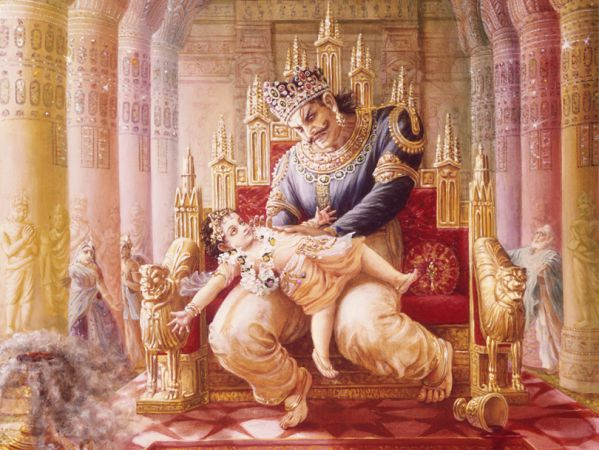
Lord Nṛsiṁhadeva Slays the King of the Demons
As described in this chapter, Hiraṇyakaśipu was ready to kill his own son Prahlāda Mahārāja, but the Supreme Personality of Godhead appeared in front of the demon as Śrī Nṛkeśarī, half lion and half man, and killed him.
Following the instructions of Prahlāda Mahārāja, all the sons of the demons became attached to Lord Viṣṇu, the Supreme Personality of Godhead. When this attachment became pronounced, their teachers, Ṣaṇḍa and Amarka, were very much afraid that the boys would become more and more devoted to the Lord. In a helpless condition, they approached Hiraṇyakaśipu and described in detail the effect of Prahlāda’s preaching. After hearing of this, Hiraṇyakaśipu decided to kill his son Prahlāda. Hiraṇyakaśipu was so angry that Prahlāda Mahārāja fell down at his feet and said many things just to pacify him, but he was unsuccessful in satisfying his demoniac father. Hiraṇyakaśipu, as a typical demon, began to advertise himself as being greater than the Supreme Personality of Godhead, but Prahlāda Mahārāja challenged him, saying that Hiraṇyakaśipu was not God, and began to glorify the Supreme Personality of Godhead, declaring that the Lord is all-pervading, that everything is under Him, and that no one is equal to or greater than Him. Thus he requested his father to be submissive to the omnipotent Supreme Lord.
The more Prahlāda Mahārāja glorified the Supreme Personality of Godhead, the more angry and agitated the demon became. Hiraṇyakaśipu asked his Vaiṣṇava son whether his God existed within the columns of the palace, and Prahlāda Mahārāja immediately accepted that since the Lord is present everywhere, He was also present within the columns. When Hiraṇyakaśipu heard this philosophy from his young son, he derided the boy’s statement as just the talk of a child and forcefully struck the pillar with his fist.
As soon as Hiraṇyakaśipu struck the column, there issued forth a tumultuous sound. At first Hiraṇyakaśipu, the King of the demons, could not see anything but the pillar, but to substantiate Prahlāda’s statements, the Lord came out of the pillar in His wonderful incarnation as Narasiṁha, half lion and half man. Hiraṇyakaśipu could immediately understand that the extraordinarily wonderful form of the Lord was surely meant for his death, and thus he prepared to fight with the form of half lion and half man. The Lord performed His pastimes by fighting with the demon for some time, and in the evening, on the border between day and night, the Lord captured the demon, threw him on His lap, and killed him by piercing his abdomen with His nails. The Lord not only killed Hiraṇyakaśipu, the King of the demons, but also killed many of his followers. When there was no one else to fight, the Lord, roaring with anger, sat down on Hiraṇyakaśipu’s throne.
The entire universe was thus relieved of the rule of Hiraṇyakaśipu, and everyone was jubilant in transcendental bliss. Then all the demigods, headed by Lord Brahmā, approached the Lord. These included the great saintly persons, the Pitās, the Siddhas, the Vidyādharas, the Nāgas, the Manus, the prajāpatis, the Gandharvas, the Cāraṇas, the Yakṣas, the Kimpuruṣas, the Vaitālikas, the Kinnaras and also many other varieties of beings in human form. All of them stood not far from the Supreme Personality of Godhead and began offering their prayers unto the Lord, whose spiritual effulgence was brilliant as He sat on the throne.
ŚB 7.8.14
एवं दुरुक्तैर्मुहुरर्दयन् रुषा
सुतं महाभागवतं महासुर: ।
खड्गं प्रगृह्योत्पतितो वरासनात्
स्तम्भं तताडातिबल: स्वमुष्टिना ॥ १४ ॥
evaṁ duruktair muhur ardayan ruṣā
sutaṁ mahā-bhāgavataṁ mahāsuraḥ
khaḍgaṁ pragṛhyotpatito varāsanāt
stambhaṁ tatāḍātibalaḥ sva-muṣṭinā
Synonyms
evam — thus; duruktaiḥ — by harsh words; muhuḥ — constantly; ardayan — chastising; ruṣā — with unnecessary anger; sutam — his son; mahā-bhāgavatam — who was a most exalted devotee; mahā-asuraḥ — Hiraṇyakaśipu, the great demon; khaḍgam — sword; pragṛhya — taking up; utpatitaḥ — having gotten up; vara-āsanāt — from his exalted throne; stambham — the column; tatāḍa — struck; ati-balaḥ — very strong; sva-muṣṭinā — by his fist.
Translation
Being obsessed with anger, Hiraṇyakaśipu, who was very great in bodily strength, thus chastised his exalted devotee-son Prahlāda with harsh words. Cursing him again and again, Hiraṇyakaśipu took up his sword, got up from his royal throne, and with great anger struck his fist against the column.
https://vedabase.io/en/library/sb/7/8/14/
ŚB 7.8.15
तदैव तस्मिन्निनदोऽतिभीषणो
बभूव येनाण्डकटाहमस्फुटत् ।
यं वै स्वधिष्ण्योपगतं त्वजादय:
श्रुत्वा स्वधामात्ययमङ्ग मेनिरे ॥ १५ ॥
tadaiva tasmin ninado ’tibhīṣaṇo
babhūva yenāṇḍa-kaṭāham asphuṭat
yaṁ vai sva-dhiṣṇyopagataṁ tv ajādayaḥ
śrutvā sva-dhāmātyayam aṅga menire
Synonyms
tadā — at that time; eva — just; tasmin — within (the pillar); ninadaḥ — a sound; ati-bhīṣaṇaḥ — very fearful; babhūva — there was; yena — by which; aṇḍa-kaṭāham — the covering of the universe; asphuṭat — appeared to crack; yam — which; vai — indeed; sva-dhiṣṇya-upagatam — reaching their respective abodes; tu — but; aja-ādayaḥ — the demigods, headed by Lord Brahmā; śrutvā — hearing; sva-dhāma-atyayam — the destruction of their abodes; aṅga — my dear Yudhiṣṭhira; menire — thought.
Translation
Then from within the pillar came a fearful sound, which appeared to crack the covering of the universe. O my dear Yudhiṣṭhira, this sound reached even the abodes of the demigods like Lord Brahmā, and when the demigods heard it, they thought, “Oh, now our planets are being destroyed!”
Purport
As we sometimes become very much afraid at the sound of a thunderbolt, perhaps thinking that our houses will be destroyed, the great demigods like Lord Brahmā feared the thundering sound that came from the pillar in front of Hiraṇyakaśipu.
 Freedom through Genuine Spiritual Progress