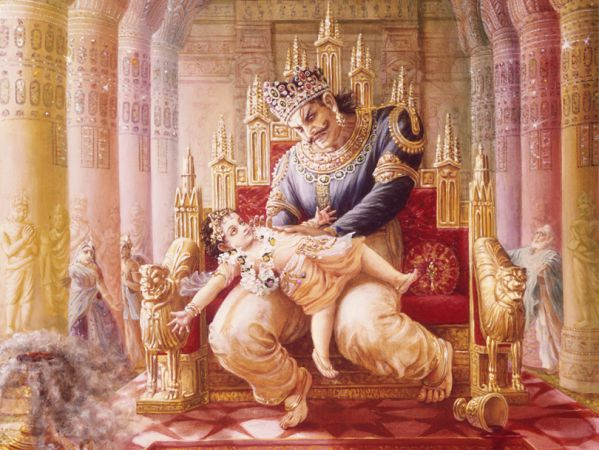
When one tries to offer wisdom to an envious fool, the fool only becomes angry just as feeding a poisonous snake only increases his venom. Hiranyakashipu, the world’s topmost atheist was furious with his saintly son Prahlada, and prepared to kill his five year old son with his own sword. What happened at that time?
Hare Krishna!
The Bhakti Sanga Japa Group connects Krishna conscious devotees from across the world, be it a neophyte, serious sadhaka, or just someone with a casual interest in spirituality, through online conference calls! Bhakti Sanga group facilitates devotee association with several classes and japa sessions during the day. Classes include lectures on Srimad Bhagavatam, Sri Caitanya Caritamrta, Children’s sessions on scriptures, festival/holy days and assorted spiritual topics. The Bhakti Sanga group provides an informal setting where devotees can seek answers regarding their sadhana, spiritual topics and practices. Come experience Krishna consciousness in the association of devotees, from the very convenience of your home, just a phone call away!
TOPIC: Srimad Bhagavatam verse 7.8.14-15
DATE📆: Tuesday, 11th June 2024
TIME⌚: 7:20 AM. ET USA/ 6:20 AM. CT USA/ 4:20 AM PST USA/ 12:20 PM UK/ 8:20 PM MYT/ 4:50 PM IST
The class will be available on Zoom and later uploaded online on their Youtube Channel.
Please join online if you’re interested in joining this class, or let me know if you want to get a link to the recording.
Lord Nṛsiṁhadeva Slays the King of the Demons
As described in this chapter, Hiraṇyakaśipu was ready to kill his own son Prahlāda Mahārāja, but the Supreme Personality of Godhead appeared in front of the demon as Śrī Nṛkeśarī, half lion and half man, and killed him.
Following the instructions of Prahlāda Mahārāja, all the sons of the demons became attached to Lord Viṣṇu, the Supreme Personality of Godhead. When this attachment became pronounced, their teachers, Ṣaṇḍa and Amarka, were very much afraid that the boys would become more and more devoted to the Lord. In a helpless condition, they approached Hiraṇyakaśipu and described in detail the effect of Prahlāda’s preaching. After hearing of this, Hiraṇyakaśipu decided to kill his son Prahlāda. Hiraṇyakaśipu was so angry that Prahlāda Mahārāja fell down at his feet and said many things just to pacify him, but he was unsuccessful in satisfying his demoniac father. Hiraṇyakaśipu, as a typical demon, began to advertise himself as being greater than the Supreme Personality of Godhead, but Prahlāda Mahārāja challenged him, saying that Hiraṇyakaśipu was not God, and began to glorify the Supreme Personality of Godhead, declaring that the Lord is all-pervading, that everything is under Him, and that no one is equal to or greater than Him. Thus he requested his father to be submissive to the omnipotent Supreme Lord.
The more Prahlāda Mahārāja glorified the Supreme Personality of Godhead, the more angry and agitated the demon became. Hiraṇyakaśipu asked his Vaiṣṇava son whether his God existed within the columns of the palace, and Prahlāda Mahārāja immediately accepted that since the Lord is present everywhere, He was also present within the columns. When Hiraṇyakaśipu heard this philosophy from his young son, he derided the boy’s statement as just the talk of a child and forcefully struck the pillar with his fist.
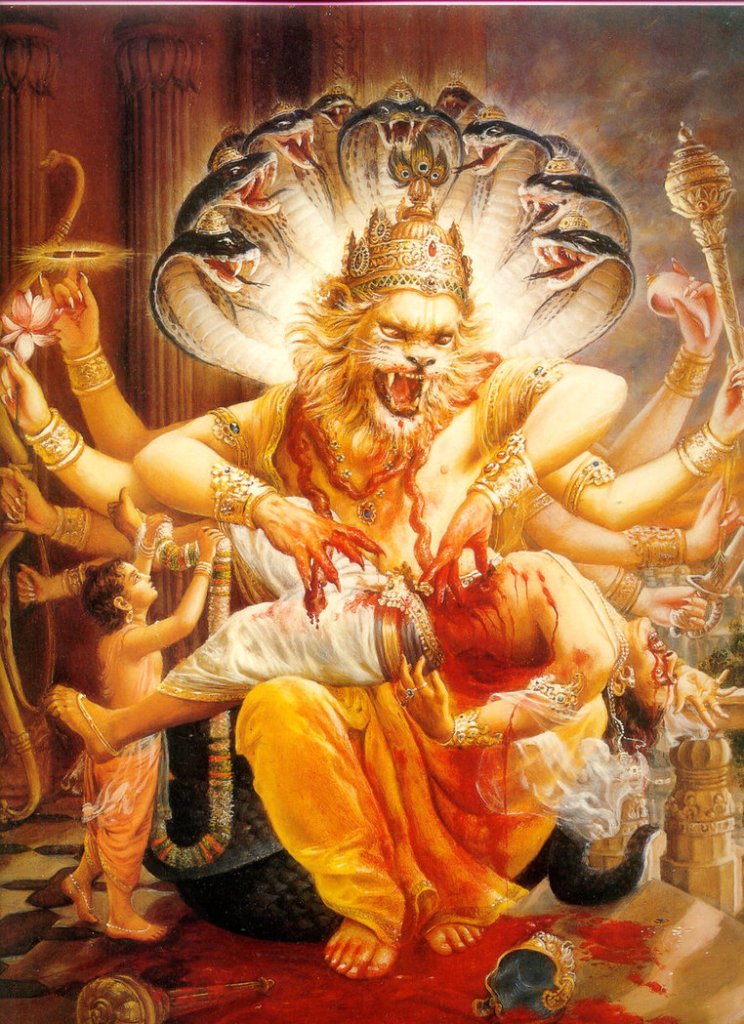
As soon as Hiraṇyakaśipu struck the column, there issued forth a tumultuous sound. At first Hiraṇyakaśipu, the King of the demons, could not see anything but the pillar, but to substantiate Prahlāda’s statements, the Lord came out of the pillar in His wonderful incarnation as Narasiṁha, half lion and half man. Hiraṇyakaśipu could immediately understand that the extraordinarily wonderful form of the Lord was surely meant for his death, and thus he prepared to fight with the form of half lion and half man. The Lord performed His pastimes by fighting with the demon for some time, and in the evening, on the border between day and night, the Lord captured the demon, threw him on His lap, and killed him by piercing his abdomen with His nails. The Lord not only killed Hiraṇyakaśipu, the King of the demons, but also killed many of his followers. When there was no one else to fight, the Lord, roaring with anger, sat down on Hiraṇyakaśipu’s throne.
The entire universe was thus relieved of the rule of Hiraṇyakaśipu, and everyone was jubilant in transcendental bliss. Then all the demigods, headed by Lord Brahmā, approached the Lord. These included the great saintly persons, the Pitās, the Siddhas, the Vidyādharas, the Nāgas, the Manus, the prajāpatis, the Gandharvas, the Cāraṇas, the Yakṣas, the Kimpuruṣas, the Vaitālikas, the Kinnaras and also many other varieties of beings in human form. All of them stood not far from the Supreme Personality of Godhead and began offering their prayers unto the Lord, whose spiritual effulgence was brilliant as He sat on the throne.
ŚB 7.8.14
एवं दुरुक्तैर्मुहुरर्दयन् रुषा सुतं महाभागवतं महासुर: । खड्गं प्रगृह्योत्पतितो वरासनात् स्तम्भं तताडातिबल: स्वमुष्टिना ॥ १४ ॥ evaṁ duruktair muhur ardayan ruṣā sutaṁ mahā-bhāgavataṁ mahāsuraḥ khaḍgaṁ pragṛhyotpatito varāsanāt stambhaṁ tatāḍātibalaḥ sva-muṣṭinā Synonyms evam — thus; duruktaiḥ — by harsh words; muhuḥ — constantly; ardayan — chastising; ruṣā — with unnecessary anger; sutam — his son; mahā-bhāgavatam — who was a most exalted devotee; mahā-asuraḥ — Hiraṇyakaśipu, the great demon; khaḍgam — sword; pragṛhya — taking up; utpatitaḥ — having gotten up; vara-āsanāt — from his exalted throne; stambham — the column; tatāḍa — struck; ati-balaḥ — very strong; sva-muṣṭinā — by his fist.
Translation Being obsessed with anger, Hiraṇyakaśipu, who was very great in bodily strength, thus chastised his exalted devotee-son Prahlāda with harsh words. Cursing him again and again, Hiraṇyakaśipu took up his sword, got up from his royal throne, and with great anger struck his fist against the column.
तदैव तस्मिन्निनदोऽतिभीषणो बभूव येनाण्डकटाहमस्फुटत् । यं वै स्वधिष्ण्योपगतं त्वजादय: श्रुत्वा स्वधामात्ययमङ्ग मेनिरे ॥ १५ ॥ tadaiva tasmin ninado ’tibhīṣaṇo babhūva yenāṇḍa-kaṭāham asphuṭat yaṁ vai sva-dhiṣṇyopagataṁ tv ajādayaḥ śrutvā sva-dhāmātyayam aṅga menire Synonyms tadā — at that time; eva — just; tasmin — within (the pillar); ninadaḥ — a sound; ati-bhīṣaṇaḥ — very fearful; babhūva — there was; yena — by which; aṇḍa-kaṭāham — the covering of the universe; asphuṭat — appeared to crack; yam — which; vai — indeed; sva-dhiṣṇya-upagatam — reaching their respective abodes; tu — but; aja-ādayaḥ — the demigods, headed by Lord Brahmā; śrutvā — hearing; sva-dhāma-atyayam — the destruction of their abodes; aṅga — my dear Yudhiṣṭhira; menire — thought.
Translation Then from within the pillar came a fearful sound, which appeared to crack the covering of the universe. O my dear Yudhiṣṭhira, this sound reached even the abodes of the demigods like Lord Brahmā, and when the demigods heard it, they thought, “Oh, now our planets are being destroyed!”
Purport As we sometimes become very much afraid at the sound of a thunderbolt, perhaps thinking that our houses will be destroyed, the great demigods like Lord Brahmā feared the thundering sound that came from the pillar in front of Hiraṇyakaśipu.
Prahlada was a boy saint, all of 5 years old when his loving devotion attracted the Lord, known as Narasimha, to appear in His half-man half-lion incarnation. We will discuss the life, character, and instructions of Prahlada…
Hare Krishna!
ISKCON Kitchener-Waterloo-Cambridge is hosting a program on the occasion of Sri Narasimha Chaturdashi, the appearance of the half-man half-lion incarnation of God.
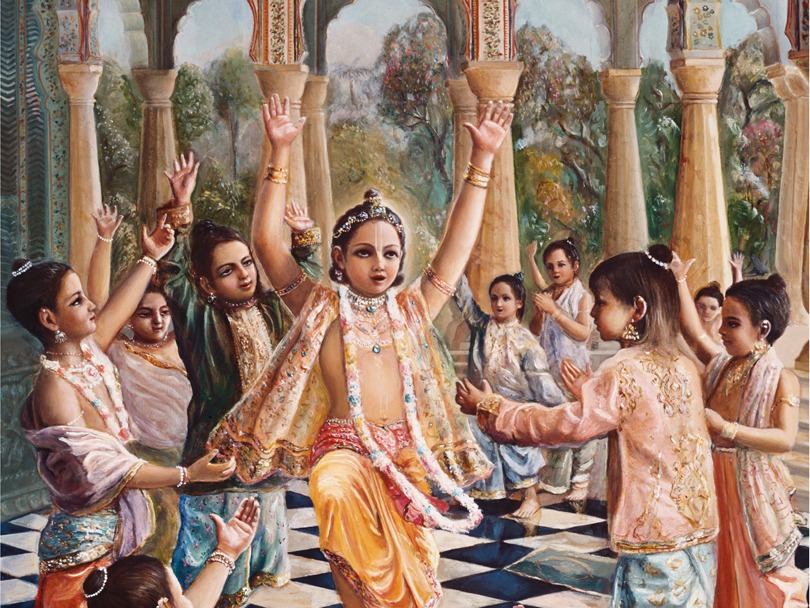
Prahlada dancing and chanting and instructing his classmates
DATE📆: Saturday, 25th May 2024
TIME⌚: 12:30 PM ET USA/ 11:30 AM CT USA/ 9:30 AM PST USA/ 6:00 PM UK/ 10:00 PM IST
PLACE: 405 King St N Waterloo, Ontario, Canada
The class will be available in person, broadcast online, and later as a recording. If you don’t know how to access the online broadcast, please contact.
Please join in person or online if you’re interested in joining this class, or let me know if you want to get a link to the recording.
Please read this summary from Srimad Bhagavatam Canto 7 (The Science of God), Chapters 5-10, for more information about the subject matter of the class.
Prahlāda Mahārāja, the Saintly Son of Hiraṇyakaśipu
Prahlāda Mahārāja did not carry out the orders of his teachers, for he was always engaged in worshiping Lord Viṣṇu. As described in this chapter, Hiraṇyakaśipu tried to kill Prahlāda Mahārāja, even by having a snake bite him and by putting him under the feet of elephants, yet he was unsuccessful.
Hiraṇyakaśipu’s spiritual master, Śukrācārya, had two sons named Ṣaṇḍa and Amarka, to whom Prahlāda Mahārāja was entrusted for education. Although the teachers tried to educate the boy Prahlāda in politics, economics and other material activities, he did not care for their instructions. Instead, he continued to be a pure devotee. Prahlāda Mahārāja never liked the idea of discriminating between one’s friends and enemies. Because he was spiritually inclined, he was equal toward everyone.
Once upon a time, Hiraṇyakaśipu inquired from his son what the best thing was that he had learned from his teachers. Prahlāda Mahārāja replied that a man engrossed in the material consciousness of duality, thinking, “This is mine, and that belongs to my enemy,” should give up his householder life and go to the forest to worship the Supreme Lord.
When Hiraṇyakaśipu heard from his son about devotional service, he decided that this small boy had been polluted by some friend in school. Thus he advised the teachers to take care of the boy so that he would not become a Kṛṣṇa conscious devotee. However, when the teachers inquired from Prahlāda Mahārāja why he was going against their teachings, Prahlāda Mahārāja taught the teachers that the mentality of ownership is false and that he was therefore trying to become an unalloyed devotee of Lord Viṣṇu. The teachers, being very angry at this answer, chastised and threatened the boy with many fearful conditions. They taught him to the best of their ability and then brought him before his father.
Hiraṇyakaśipu affectionately took his son Prahlāda on his lap and then inquired from him what the best thing was that he had learned from his teachers. As usual, Prahlāda Mahārāja began praising the nine processes of devotional service, such as śravaṇam and kīrtanam. Thus the King of the demons, Hiraṇyakaśipu, being extremely angry, chastised the teachers, Ṣaṇḍa and Amarka, for having wrongly trained Prahlāda Mahārāja. The so-called teachers informed the King that Prahlāda Mahārāja was automatically a devotee and did not listen to their instructions. When they proved themselves innocent, Hiraṇyakaśipu inquired from Prahlāda where he had learned viṣṇu-bhakti. Prahlāda Mahārāja replied that those who are attached to family life do not develop Kṛṣṇa consciousness, either personally or collectively. Instead, they suffer repeated birth and death in this material world and continue simply chewing the chewed. Prahlāda explained that the duty of every man is to take shelter of a pure devotee and thus become eligible to understand Kṛṣṇa consciousness.
Enraged at this answer, Hiraṇyakaśipu threw Prahlāda Mahārāja from his lap. Since Prahlāda was so treacherous that he had become a devotee of Viṣṇu, who had killed his uncle Hiraṇyākṣa, Hiraṇyakaśipu asked his assistants to kill him. The assistants of Hiraṇyakaśipu struck Prahlāda with sharp weapons, threw him under the feet of elephants, subjected him to hellish conditions, threw him from the peak of a mountain and tried to kill him in thousands of other ways, but they were unsuccessful. Hiraṇyakaśipu therefore became increasingly afraid of his son Prahlāda Mahārāja and arrested him. The sons of Hiraṇyakaśipu’s spiritual master, Śukrācārya, began teaching Prahlāda in their own way, but Prahlāda Mahārāja did not accept their instructions. While the teachers were absent from the classroom, Prahlāda Mahārāja began to preach Kṛṣṇa consciousness in the school, and by his instructions all his class friends, the sons of the demons, became devotees like him.
Prahlāda Instructs His Demoniac Schoolmates
This chapter describes Prahlāda Mahārāja’s instructions to his class friends. In speaking to his friends, who were all sons of demons, Prahlāda Mahārāja stressed that every living entity, especially in human society, must be interested in spiritual realization from the very beginning of life. When human beings are children, they should be taught that the Supreme Personality of Godhead is the worshipable Deity for everyone. One should not be very much interested in material enjoyment; instead, one should be satisfied with whatever material profits are easily obtainable, and because the duration of one’s life is very short, one should utilize every moment for spiritual advancement. One may wrongly think, “In the beginning of our lives let us enjoy material facilities, and in old age we may become Kṛṣṇa conscious.” Such materialistic thoughts are always useless because in old age one cannot be trained in the spiritual way of life. Therefore, from the very beginning of life, one should engage in devotional service (śravaṇaṁ kīrtanaṁ viṣṇoḥ). This is the duty of all living entities. Material education is infected by the three modes of nature, but spiritual education, for which there is a great need in human society, is transcendental. Prahlāda Mahārāja disclosed the secret of how he had received instructions from Nārada Muni. By accepting the lotus feet of Prahlāda Mahārāja, who is in the paramparā succession, one will be able to understand the mode of spiritual life. In accepting this mode of activity, there is no need for material qualifications.
After Prahlāda Mahārāja’s class friends had listened to Prahlāda Mahārāja, they inquired how he had become so learned and advanced. In this way the chapter ends.
What Prahlāda Learned in the Womb
In this chapter, to dissipate the doubts of his class friends, the sons of the demons, Prahlāda Mahārāja states how, within the womb of his mother, he had heard from the mouth of Nārada Muni, who had instructed him in bhāgavata-dharma.
When Hiraṇyakaśipu left his kingdom and went to the mountain known as Mandarācala to execute severe austerities, all the demons scattered. Hiraṇyakaśipu’s wife, Kayādhu, was pregnant at that time, and the demigods, mistakenly thinking that she carried another demon in her womb, arrested her. Their plan was that as soon as the child took birth they would kill him. While they were taking Kayādhu to the heavenly planets, they met Nārada Muni, who stopped them from taking her away and took her to his āśrama until Hiraṇyakaśipu’s return. In Nārada Muni’s āśrama, Kayādhu prayed for the protection of the baby in her womb, and Nārada Muni reassured her and gave her instructions on spiritual knowledge. Taking advantage of those instructions, Prahlāda Mahārāja, although a small baby within the womb, listened very carefully. The spirit soul is always apart from the material body. There is no change in the spiritual form of the living entity. Any person above the bodily conception of life is pure and can receive transcendental knowledge. This transcendental knowledge is devotional service, and Prahlāda Mahārāja, while living in the womb of his mother, received instructions in devotional service from Nārada Muni. Any person engaged in the service of the Lord through the instructions of a bona fide spiritual master is immediately liberated, and being free from the clutches of māyā, he is relieved of all ignorance and material desires. The duty of everyone is to take shelter of the Supreme Lord and thus become free from all material desires. Regardless of the material condition in which one is situated, one can achieve this perfection. Devotional service is not dependent on the material activities of austerity, penance, mystic yoga or piety. Even without such assets, one can achieve devotional service through the mercy of a pure devotee.Text 1: Nārada Muni said: Although Prahlāda Mahārāja was born in a family of asuras, he was the greatest of all devotees. Having thus been questioned by his class friends, the sons of the asuras, he remembered the words spoken to him by me and replied to his friends as follows.
Lord Nṛsiṁhadeva Slays the King of the Demons
As described in this chapter, Hiraṇyakaśipu was ready to kill his own son Prahlāda Mahārāja, but the Supreme Personality of Godhead appeared in front of the demon as Śrī Nṛkeśarī, half lion and half man, and killed him.
Following the instructions of Prahlāda Mahārāja, all the sons of the demons became attached to Lord Viṣṇu, the Supreme Personality of Godhead. When this attachment became pronounced, their teachers, Ṣaṇḍa and Amarka, were very much afraid that the boys would become more and more devoted to the Lord. In a helpless condition, they approached Hiraṇyakaśipu and described in detail the effect of Prahlāda’s preaching. After hearing of this, Hiraṇyakaśipu decided to kill his son Prahlāda. Hiraṇyakaśipu was so angry that Prahlāda Mahārāja fell down at his feet and said many things just to pacify him, but he was unsuccessful in satisfying his demoniac father. Hiraṇyakaśipu, as a typical demon, began to advertise himself as being greater than the Supreme Personality of Godhead, but Prahlāda Mahārāja challenged him, saying that Hiraṇyakaśipu was not God, and began to glorify the Supreme Personality of Godhead, declaring that the Lord is all-pervading, that everything is under Him, and that no one is equal to or greater than Him. Thus he requested his father to be submissive to the omnipotent Supreme Lord.
The more Prahlāda Mahārāja glorified the Supreme Personality of Godhead, the more angry and agitated the demon became. Hiraṇyakaśipu asked his Vaiṣṇava son whether his God existed within the columns of the palace, and Prahlāda Mahārāja immediately accepted that since the Lord is present everywhere, He was also present within the columns. When Hiraṇyakaśipu heard this philosophy from his young son, he derided the boy’s statement as just the talk of a child and forcefully struck the pillar with his fist.
As soon as Hiraṇyakaśipu struck the column, there issued forth a tumultuous sound. At first Hiraṇyakaśipu, the King of the demons, could not see anything but the pillar, but to substantiate Prahlāda’s statements, the Lord came out of the pillar in His wonderful incarnation as Narasiṁha, half lion and half man. Hiraṇyakaśipu could immediately understand that the extraordinarily wonderful form of the Lord was surely meant for his death, and thus he prepared to fight with the form of half lion and half man. The Lord performed His pastimes by fighting with the demon for some time, and in the evening, on the border between day and night, the Lord captured the demon, threw him on His lap, and killed him by piercing his abdomen with His nails. The Lord not only killed Hiraṇyakaśipu, the King of the demons, but also killed many of his followers. When there was no one else to fight, the Lord, roaring with anger, sat down on Hiraṇyakaśipu’s throne.
The entire universe was thus relieved of the rule of Hiraṇyakaśipu, and everyone was jubilant in transcendental bliss. Then all the demigods, headed by Lord Brahmā, approached the Lord. These included the great saintly persons, the Pitās, the Siddhas, the Vidyādharas, the Nāgas, the Manus, the prajāpatis, the Gandharvas, the Cāraṇas, the Yakṣas, the Kimpuruṣas, the Vaitālikas, the Kinnaras and also many other varieties of beings in human form. All of them stood not far from the Supreme Personality of Godhead and began offering their prayers unto the Lord, whose spiritual effulgence was brilliant as He sat on the throne.
Prahlāda Pacifies Lord Nṛsiṁhadeva with Prayers
As related in this chapter, Prahlāda Mahārāja, following the order of Lord Brahmā, pacified the Lord when the Lord was extremely angry after having killed Hiraṇyakaśipu.
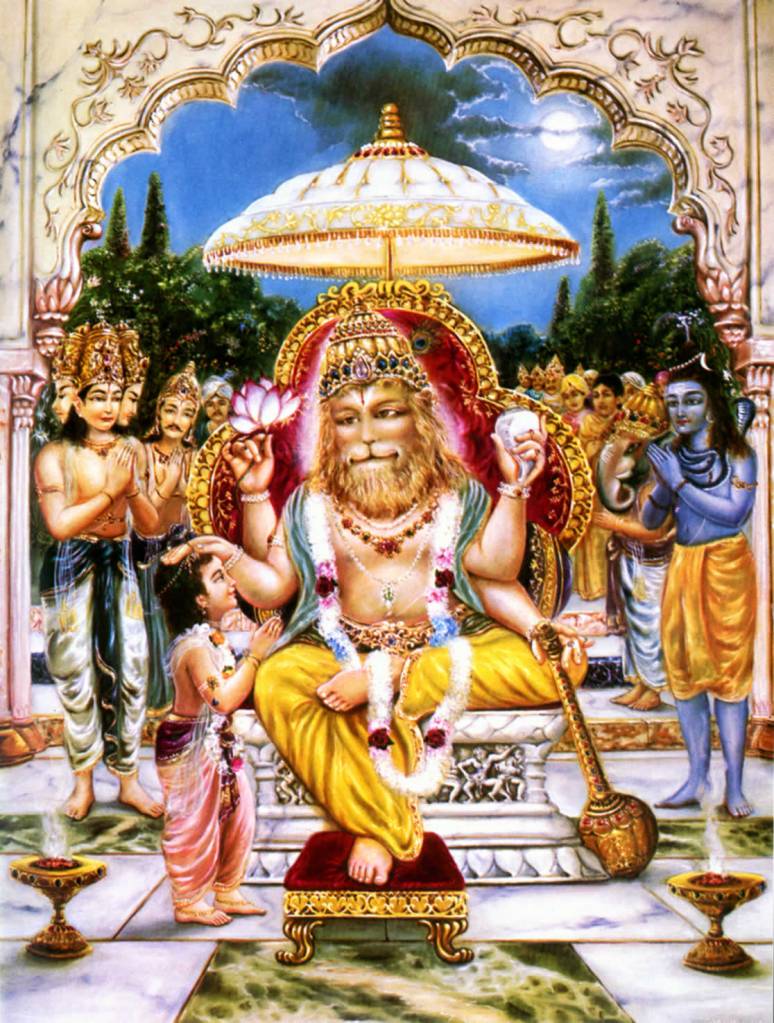
After Hiraṇyakaśipu was killed, the Lord continued to be very angry, and the demigods, headed by Lord Brahmā, could not pacify Him. Even mother Lakṣmī, the goddess of fortune, the constant companion of Nārāyaṇa, could not dare come before Lord Nṛsiṁhadeva. Then Lord Brahmā asked Prahlāda Mahārāja to go forward and pacify the Lord’s anger. Prahlāda Mahārāja, being confident of the affection of his master, Lord Nṛsiṁhadeva, was not afraid at all. He very gravely appeared before the Lord’s lotus feet and offered Him respectful obeisances. Lord Nṛsiṁhadeva, being very much affectionate toward Prahlāda Mahārāja, put His hand on Prahlāda’s head, and because of being personally touched by the Lord, Prahlāda Mahārāja immediately achieved brahma-jñāna, spiritual knowledge. Thus he offered his prayers to the Lord in full spiritual knowledge and full devotional ecstasy. The instructions given by Prahlāda Mahārāja in the form of his prayers are as follows.
Prahlāda said, “I am not proud of being able to offer prayers to the Supreme Personality of Godhead. I simply take shelter of the mercy of the Lord, for without devotion one cannot appease Him. One cannot please the Supreme Personality of Godhead simply by dint of high parentage or great opulence, learning, austerity, penance or mystic power. Indeed, these are never pleasing to the Supreme Lord, for nothing can please Him but pure devotional service. Even if a nondevotee is a brāhmaṇa qualified with the twelve brahminical symptoms, he cannot be very dear to the Lord, whereas if a person born in a family of dog-eaters is a devotee, the Lord can accept his prayers. The Lord does not need anyone’s prayers, but if a devotee offers his prayers to the Lord, the devotee benefits greatly. Ignorant persons born in low families, therefore, can sincerely offer heartfelt prayers to the Lord, and the Lord will accept them. As soon as one offers his prayers to the Lord, he is immediately situated on the Brahman platform.”
Lord Nṛsiṁhadeva appeared for the benefit of all human society, not only for Prahlāda’s personal benefit. The fierce form of Lord Nṛsiṁhadeva may appear most awful to a nondevotee, but to the devotee the Lord is always affectionate as He is in other forms. Conditioned life in the material world is actually extremely fearful; indeed, a devotee is not afraid of anything else. Fear of material existence is due to false ego. Therefore the ultimate goal of life for every living entity is to attain the position of being servant of the servant of the Lord. The miserable condition of the living entities in the material world can be remedied only by the mercy of the Lord. Although there are so-called material protectors like Lord Brahmā and the other demigods, or even one’s own father, they are unable to do anything if one is neglected by the Supreme Personality of Godhead. However, one who has fully taken shelter of the Lord’s lotus feet can be saved from the onslaught of material nature. Therefore every living entity should be unattracted by material so-called happiness and should take shelter of the Lord by all means. That is the mission of human life. To be attracted by sense gratification is simply foolish. Whether one is a devotee of the Lord or is a nondevotee does not depend upon one’s birth in a high or low family. Even Lord Brahmā and the goddess of fortune cannot achieve the full favor of the Lord, whereas a devotee can very easily attain such devotional service. The Lord’s mercy is bestowed equally upon everyone, regardless of whether one is high or low. Because Prahlāda Mahārāja was blessed by Nārada Muni, Prahlāda became a great devotee. The Lord always saves the devotee from impersonalists and voidists. The Lord is present in everyone’s heart as the Supersoul to give the living being protection and all benefits. Thus the Lord acts sometimes as the killer and sometimes as the protector. One should not accuse the Lord for any discrepancies. It is His plan that we see varieties of life within this material world. All of them are ultimately His mercy.
Although the entire cosmic manifestation is nondifferent, the material world is nonetheless different from the spiritual world. Only by the mercy of the Supreme Lord can one understand how the wonderful material nature acts. For example, although Lord Brahmā appeared from the lotus seat that had grown from the abdomen of Garbhodakaśāyī Viṣṇu, he could not understand what to do after his appearance. He was attacked by two demons, Madhu and Kaiṭabha, who took away Vedic knowledge, but the Lord killed them and entrusted to Lord Brahmā the Vedic knowledge. Thus the Lord appears in every millennium in the societies of demigods, human beings, animals, saints and aquatics. All such incarnations are meant to protect the devotees and kill the demons, but this killing and protecting does not reflect any sense of partiality on the part of the Supreme Lord. The conditioned soul is always attracted by the external energy. Therefore he is subjected to lust and greed, and he suffers under the conditions of material nature. The Lord’s causeless mercy toward His devotee is the only means by which to get out of material existence. Anyone engaged in glorifying the Lord’s activities is always unafraid of this material world, whereas one who cannot glorify the Lord in that way is subjected to all lamentation.
Those interested in silently worshiping the Lord in solitary places may be eligible for liberation themselves, but a pure devotee is always aggrieved to see others suffering. Therefore, not caring for his own liberation, he always engages in preaching by glorifying the Lord. Prahlāda Mahārāja, therefore, had tried to deliver his class friends by preaching and had never remained silent. Although being silent, observing austerities and penances, learning the Vedic literature, undergoing ritualistic ceremonies, living in a solitary place and performing japa and transcendental meditation are approved means of liberation, they are meant for nondevotees or for cheaters who want to live at the expense of others. A pure devotee, however, being freed from all such deceptive activities, is able to see the Lord face to face.
The atomic theory of the composition of the cosmic manifestation is not factual. The Lord is the cause of everything, and therefore He is the cause of this creation. One should therefore always engage in devotional service by offering respectful obeisances to the Lord, offering prayers, working for the Lord, worshiping the Lord in the temple, always remembering the Lord and always hearing about His transcendental activities. Without these six kinds of activity, one cannot attain to devotional service.
Prahlāda Mahārāja thus offered his prayers to the Supreme Lord, begging His mercy at every step. Lord Nṛsiṁhadeva was pacified by Prahlāda Mahārāja’s prayers and wanted to give him benedictions by which Prahlāda could procure all kinds of material facilities. Prahlāda Mahārāja, however, was not misled by material facilities. Rather, he wanted to remain always a servant of the servant of the Lord.
Prahlāda, the Best Among Exalted Devotees
This chapter describes how the Supreme Personality of Godhead Nṛsiṁhadeva disappeared, after pleasing Prahlāda Mahārāja. It also describes a benediction given by Lord Śiva.
Lord Nṛsiṁhadeva wanted to bestow benedictions upon Prahlāda Mahārāja, one after another, but Prahlāda Mahārāja, thinking them impediments on the path of spiritual progress, did not accept any of them. Instead, he fully surrendered at the Lord’s lotus feet. He said: “If anyone engaged in the devotional service of the Lord prays for personal sense gratification, he cannot be called a pure devotee or even a devotee. He may be called only a merchant engaged in the business of give and take. Similarly, a master who wants to please his servant after taking service from him is also not a real master.” Prahlāda Mahārāja, therefore, did not ask anything from the Supreme Personality of Godhead. Rather, he said that if the Lord wanted to give him a benediction, he wanted the Lord to assure him that he would never be induced to take any benedictions for the sake of material desires. Exchanges of devotional service for lusty desires are always very prominent. As soon as lusty desires awaken, one’s senses, mind, life, soul, religious principles, patience, intelligence, shyness, beauty, strength, memory and truthfulness are all vanquished. One can render unalloyed devotional service only when there are no material desires in one’s mind.
The Supreme Personality of Godhead was greatly pleased with Prahlāda Mahārāja for his unalloyed devotion, yet the Lord provided him one material benediction — that he would be perfectly happy in this world and live his next life in Vaikuṇṭha. The Lord gave him the benediction that he would be the king of this material world until the end of the manvantara millennium and that although in this material world, he would have the facility to hear the glories of the Lord and depend fully on the Lord, performing service to Him in uncontaminated bhakti-yoga. The Lord advised Prahlāda to perform sacrifices through bhakti-yoga, for this is the duty of a king.
Prahlāda Mahārāja accepted whatever the Lord had offered him, and he prayed for the Lord to deliver his father. In response to this prayer, the Lord assured him that in the family of such a pure devotee as he, not only the devotee’s father but his forefathers for twenty-one generations are liberated. The Lord also asked Prahlāda to perform the ritualistic ceremonies appropriate after his father’s death.
Then Lord Brahmā, who was also present, offered many prayers to the Lord, expressing his obligation to the Lord for having offered benedictions to Prahlāda Mahārāja. The Lord advised Lord Brahmā not to offer benedictions to asuras as he had to Hiraṇyakaśipu, for such benedictions indulge them. Then Lord Nṛsiṁhadeva disappeared. On that day, Prahlāda Mahārāja was installed on the throne of the world by Lord Brahmā and Śukrācārya.
Thus Nārada Muni described the character of Prahlāda Mahārāja for Yudhiṣṭhira Mahārāja, and he further described the killing of Rāvaṇa by Lord Rāmacandra and the killing of Śiśupāla and Dantavakra in Dvāpara-yuga. Śiśupāla, of course, had merged into the existence of the Lord and thus achieved sāyujya-mukti. Nārada Muni praised Yudhiṣṭhira Mahārāja because the Supreme Lord, Kṛṣṇa, was the greatest well-wisher and friend of the Pāṇḍavas and almost always stayed in their house. Thus the fortune of the Pāṇḍavas was greater than that of Prahlāda Mahārāja.
Later, Nārada Muni described how the demon Maya Dānava constructed Tripura for the demons, who became very powerful and defeated the demigods. Because of this defeat, Lord Rudra, Śiva, dismantled Tripura; thus he became famous as Tripurāri. For this, Rudra is very much appreciated and worshiped by the demigods. This narration occurs at the end of the chapter.
Prahlada is a great saint. He learned everything he knew while he was still in the womb of his mother Kayadhu, from Narada Muni, the great spiritual master. And his devotion manifested when he was a small child… so much so that Prahlada is known as one of the great Mahajanas, the great pure teachers of the Science of God.
In this SB 7.7.37, Prahlada instructs that the real problem of life is birth and death. Do you want to know how to stop this continuously whirling wheel of birth and death?
Attend this class to find out, watch the recording, or if you are pressed for time, just read this article!
Hare Krishna!
The Bhakti Sanga Japa Group connects Krishna conscious devotees from across the world, be it a neophyte, serious sadhaka, or just someone with a casual interest in spirituality, through online conference calls! Bhakti Sanga group facilitates devotee association with several classes and japa sessions during the day. Classes include lectures on Srimad Bhagavatam, Sri Caitanya Caritamrta, Children’s sessions on scriptures, festival/holy days and assorted spiritual topics. The Bhakti Sanga group provides an informal setting where devotees can seek answers regarding their sadhana, spiritual topics and practices. Come experience Krishna consciousness in the association of devotees, from the very convenience of your home, just a phone call away!
DATE📆: Tuesday, 14th May 2024
TIME⌚: 7:20 AM. ET USA/ 6:20 AM. CT USA/ 4:20 AM PST USA/ 12:20 PM UK/ 8:20 PM MYT/ 4:50 PM IST
The class will be available on Zoom and later uploaded online on their Youtube Channel.
Please join online if you’re interested in joining this class, or let me know if you want to get a link to the recording.
Chapter SB 7.7 What Prahlāda Learned in the Womb – Summary
In this chapter, to dissipate the doubts of his class friends, the sons of the demons, Prahlāda Mahārāja states how, within the womb of his mother, he had heard from the mouth of Nārada Muni, who had instructed him in bhāgavata-dharma.
When Hiraṇyakaśipu left his kingdom and went to the mountain known as Mandarācala to execute severe austerities, all the demons scattered. Hiraṇyakaśipu’s wife, Kayādhu, was pregnant at that time, and the demigods, mistakenly thinking that she carried another demon in her womb, arrested her. Their plan was that as soon as the child took birth they would kill him. While they were taking Kayādhu to the heavenly planets, they met Nārada Muni, who stopped them from taking her away and took her to his āśrama until Hiraṇyakaśipu’s return. In Nārada Muni’s āśrama, Kayādhu prayed for the protection of the baby in her womb, and Nārada Muni reassured her and gave her instructions on spiritual knowledge. Taking advantage of those instructions, Prahlāda Mahārāja, although a small baby within the womb, listened very carefully. The spirit soul is always apart from the material body. There is no change in the spiritual form of the living entity. Any person above the bodily conception of life is pure and can receive transcendental knowledge. This transcendental knowledge is devotional service, and Prahlāda Mahārāja, while living in the womb of his mother, received instructions in devotional service from Nārada Muni. Any person engaged in the service of the Lord through the instructions of a bona fide spiritual master is immediately liberated, and being free from the clutches of māyā, he is relieved of all ignorance and material desires. The duty of everyone is to take shelter of the Supreme Lord and thus become free from all material desires. Regardless of the material condition in which one is situated, one can achieve this perfection. Devotional service is not dependent on the material activities of austerity, penance, mystic yoga or piety. Even without such assets, one can achieve devotional service through the mercy of a pure devotee.
adhokṣajālambham ihāśubhātmanaḥ śarīriṇaḥ saṁsṛti-cakra-śātanam tad brahma-nirvāṇa-sukhaṁ vidur budhās tato bhajadhvaṁ hṛdaye hṛd-īśvaram
Synonyms
adhokṣaja — with the Supreme Personality of Godhead, who is beyond the reach of the materialistic mind or experimental knowledge; ālambham — being constantly in contact; iha — in this material world; aśubha–ātmanaḥ — whose mind is materially contaminated; śarīriṇaḥ — of a living entity who has accepted a material body; saṁsṛti — of material existence; cakra — the cycle; śātanam — completely stopping; tat — that; brahma–nirvāṇa — connected with the Supreme Brahman, the Absolute Truth; sukham — transcendental happiness; viduḥ — understand; budhāḥ — those who are spiritually advanced; tataḥ — therefore; bhajadhvam — engage in devotional service; hṛdaye — within the core of the heart; hṛt–īśvaram — to the Supreme Personality of Godhead, the Supersoul within the heart.
Translation
The real problem of life is the repetition of birth and death, which is like a wheel rolling repeatedly up and down. This wheel, however, completely stops when one is in touch with the Supreme Personality of Godhead. In other words, by the transcendental bliss realized from constant engagement in devotional service, one is completely liberated from material existence. All learned men know this. Therefore, my dear friends, O sons of the asuras, immediately begin meditating upon and worshiping the Supersoul within everyone’s heart.
Purport
Generally it is understood that by merging into the existence of Brahman, the impersonal feature of the Absolute Truth, one becomes completely happy. The words brahma-nirvāṇa refer to connecting with the Absolute Truth, who is realized in three features: brahmeti paramātmeti bhagavān iti śabdyate. One feels brahma-sukha, spiritual happiness, by merging into the impersonal Brahman because the brahmajyoti is the effulgence of the Supreme Personality of Godhead. Yasya prabhā prabhavato jagad-aṇḍa-koṭi. Yasya prabhā, the impersonal Brahman, consists of the rays of Kṛṣṇa’s transcendental body. Therefore whatever transcendental bliss one feels from merging in Brahman is due to contact with Kṛṣṇa. Contact with Kṛṣṇa is perfect brahma-sukha. When the mind is in touch with the impersonal Brahman one becomes satisfied, but one must advance further to render service to the Supreme Personality of Godhead, for one’s remaining merged in the Brahman effulgence is not always assured. As it is said, āruhya kṛcchreṇa paraṁ padaṁ tataḥ patanty adho ’nādṛta-yuṣmad-aṅghrayaḥ: one may merge in the Brahman feature of the Absolute Truth, but there is a chance that one may fall because of not being acquainted with Adhokṣaja, or Vāsudeva. Of course, such brahma-sukha undoubtedly eliminates material happiness, but when one advances through impersonal Brahman and localized Paramātmā to approach the Supreme Personality of Godhead in relationship with Him as a servant, friend, parent or conjugal lover, one’s happiness becomes all-pervading. Then one automatically feels transcendental bliss, just as one becomes happy seeing the shining of the moon. One acquires natural happiness upon seeing the moon, but when one can see the Supreme Personality of Godhead, one’s transcendental happiness increases hundreds and thousands of times. As soon as one is very intimately connected with the Supreme Personality of Godhead, one surely becomes free from all material contamination. Yā nirvṛtis tanu-bhṛtām. This cessation of all material happiness is called nirvṛti or nirvāṇa. Śrīla Rūpa Gosvāmī says in Bhakti-rasāmṛta-sindhu (1.1.38):
brahmānando bhaved eṣa cet parārdha-guṇīkṛtaḥ naiti bhakti-sukhāmbhodheḥ paramāṇu-tulām api
“If brahmānanda, the bliss of merging in the Brahman effulgence, were multiplied one hundred trillion times, it would still not equal even an atomic fragment of the ocean of transcendental bliss felt in devotional service.”
brahma-bhūtaḥ prasannātmā na śocati na kāṅkṣati samaḥ sarveṣu bhūteṣu mad-bhaktiṁ labhate parām
“One who is transcendentally situated at once realizes the Supreme Brahman and becomes fully joyful. He never laments or desires to have anything; he is equally disposed toward all living entities. In that state he attains pure devotional service unto the Lord.” (Bg. 18.54) If one advances further from the brahma-nirvāṇa platform, one enters the stage of devotional service (mad-bhaktiṁ labhate parām). The word adhokṣajālambham refers to keeping the mind always engaged in the Absolute Truth, who is beyond the mind and material speculation. Sa vai manaḥ kṛṣṇa-padāravindayoḥ. This is the result of Deity worship. By constantly engaging in the service of the Lord and thinking of His lotus feet, one is automatically freed from all material contamination. Thus the word brahma-nirvāṇa-sukham indicates that when one is in touch with the Absolute Truth, material sense gratification is completely nullified.
A poem written by a devotee for Bhakta Prahlada & Lord Narasimha
Poetic Service
Saritha Devi, 06/06/2019
Dear Devotees,
Hare Krishna to all.
Just a small poetic service to Lord Nṛsiṁhadeva and Prahlada Maharaja :-
Supreme Conviction and Reciprocation:
When great pure soul Prahlada Maharaj
Was tormented by demonic nature
offered to bodily agony and hellish setting
and subjected to fatality with sharp arms,
dumped under giant beings, the elephants and thrown from mountains
strived to kill the great soul in thousands other ways,
still the great soul proved his purity and stable in his conviction for Lord
demonic efforts were in vain due to Lord’s compassion to his servant.
One grand evening, Lord Nṛsiṁhadeva incarnated from a pillar
in His violent form with fire eyes, sharp tongue, fearful face, with terrible teeth,
His body expanded till sky like a moon with His opulence
to dawn the demonic aura in this world
And to bring sunshine of peace and assurance in devotees’ lives
to answer His servants’ prayers with His great mercy by laying His kind hands
—
your servant,
Saritha
Vishwajit Bhadrashetty, 06 June 2019
Wonderful poem Sarita mataji
May God bless you
Sincerely,
Vishwajit
Please subscribe to daily inspirational emails from His Grace Sriman Sankarshan Das Adhikari (Writings and lectures archived at www.ecstaticmedia.com ), written fresh every day from his travels around the world sharing the highest spiritual knowledge with everyone. Sign up now at www.joincourse.com
When we visit the great saints, and when we pray to them, are our prayers heard? Is there any reciprocation? How do we know it was not our imagination?
In various pilgrimages to visit saintly persons, I have had the good fortune to get much reciprocation.
With a saintly person who is yet in flesh, reciprocation is easy to get, they will convey that to you in word and deed, sometimes they will put that in writing too.
But what about the saintly persons in “samadhi” or trance, who are physically entombed (sometimes while still alive, at their instruction), but who are clearly not dead and gone.
What to speak of death for a saintly spiritually perfected being, there is no death even for all of us – we don’t die, we just carry on in some other guise. For someone like me, there may be positive and negative consequences of our actions in a future lifetime… but for a genuinely saintly person, they are eternal residents of the Kingdom of God, while still being available by prayer to the likes of me.
But in prayer and meditation, how to know if what we have received is actually from that saintly person and not a concoction of the mind? After all there are so many who claim to “speak to God” and yet do despicable things. I am personally not comfortable sharing my inner feelings here in this article, but I do have one recent experience with a great saintly soul which was a very sweet interaction, if somewhat painful for me! 🙂
Recently, I visited Mantralayam, in South Central India, the place where Sri Raghavendra Swami, a great 17th century saint, resides in samadhi. Thousands of pilgrims throng his shrine, and ask for all sorts of things. In my previous visit in 2019, I had asked “How may I serve you” and the inspiration came “Help people understand what to ask of me”… so I dedicated my time there to distributing spiritual literature from the 20th century saint Srila A. C. Bhaktivedanta Swami Prabhupada. I was summoned to the administrator’s office, interrogated, and then the administrator, satisfied with my responses, took some books for himself and gave me permission to distribute books there anytime… More about those experiences at another time.
Raghavendra Swami is a great saint who taught about Krishna and in order to attract attention and seriousness to his teachings, he performed some miracles… a lot of people have forgotten his actual instructions and are fully enamored of the miracles, and go asking for mundane temporary blessings that are surely taken away by all-devouring death. But such a great saint can give complete relief from all material misery by granting the ultimate spiritual perfection!
I have had many other interactions with him, but I will keep that private for now… here is one, where I got a gentle fatherly slap from him!
The day we arrived, I was very hungry, having fasted all day during the long bumpy journey, but the Prasada (sanctified food) served in the temple was somewhat scanty and I went to bed hungry… in my childish impudence on my way back from the temple, I happened to “complain” silently in my mind to Raghavendra Swami that his assistants didn’t ask me if I wanted more, rushed me out, and so I went hungry. I was like, how is it that someone, one of your servitors, comes to your place and goes hungry.
The next day, I rose early well before sunrise, took my bath, meditated at the temple doors before they opened, then performed my mantra meditation right at the shrine, and later that morning, went again to obtain more Prasada (literally food received as Krishna’s mercy)… and was secretly worried that I might go hungry once again! So, in the second course, I rushed to asked for more. The serving priest took one look at me, and gave me a MASSIVE glob of rice, and I was satisfied that this time I would be just fine, my quota was met, and I had enough.
But poor little me, I had not factored in the remaining courses coming, all different varieties of very delicious rice preparations with sides! One course, two courses, three, four… a total of 8 courses were served, and each one was a fresh surprise to me, and before I could react, the item was served on my banana leaf plate with great speed, the next course arriving while I was heads down, before I could finish what was on my plate.
I have a vow of never wasting any Krishna Prasada I have been served on my plate, so I put it all away somehow, with great difficulty, laughing to myself at the same time at the transcendental trick that was played on me.
I was barely able to stand up and walk on my way to washing my hands and mouth! Needless to say, I didn’t need anything to eat for a long time to come!
It was almost as if “Oh, you say you went hungry yesterday, so let’s see how much you can eat!” a light-hearted challenge from Raghavendra Swami! And I must happily say that he won, and I lost. He could, that powerful personality, from his Samadhi, arrange to supply me with more than I could possibly eat, not a word said to anyone!
After all, what does it matter a little less to eat once in a while, I did get food enough to survive, did I not? So clearly even though my original complaint was quite childish, Sri Raghavendra Swami did hear it, and acted on it, if only to give me a gentle slap in my face. And miraculously enough, even though I had eaten probably 5-6 times of my usual quota, I did not suffer from a stomach upset that day!
This was just one of many experiences I have had with the great saints, and thanks to their causeless mercy, I carry on in spiritual life. I am grateful for all the mercy I have received undeservedly, whether it was encouragement, or chastisement, and often, slaps in my face to set me straight.
So, when you’re around a saintly person, be careful of what you think, you might just get way more than you bargained for!
My spiritual master quoted above, does not despise Hindus or any group of people, and neither does he hate or deride anyone.
In the original satiric song above, he captures the essence of the majority of the followers of every possible religious tradition, be it Hindu, Muslim, Christian, Jew, Buddhist or any other tradition or denomination.
gimme gimme gimme! Gimme this! Gimme that! What a tiresome litany of requests God fields every moment of the day!
Religion (re-ligio – Latin) means to reconnect to our Source. We don’t reconnect by asking God for anything except for His service.
नान्यथा तेऽखिलगुरो घटेत करुणात्मन: । यस्त आशिष आशास्ते न स भृत्य: स वै वणिक् ॥ ४ ॥ nānyathā te ’khila-guro ghaṭeta karuṇātmanaḥ yas ta āśiṣa āśāste na sa bhṛtyaḥ sa vai vaṇik
Otherwise, O my Lord, O supreme instructor of the entire world, You are so kind to Your devotee that You could not induce him to do something unbeneficial for him. On the other hand, one who desires some material benefit in exchange for devotional service cannot be Your pure devotee. Indeed, he is no better than a merchant who wants profit in exchange for service.
Indeed, prayer is meant for one purpose, and one purpose only, to beg for more service from the Supreme Lord, service to the Lord, and the Lord’s loved ones. Any other use of prayer is simply a waste.
Still, anyone who has any kind of desire, spiritual or not, is advised to approach God…
A person who has broader intelligence, whether he be full of all material desire, without any material desire, or desiring liberation, must by all means worship the supreme whole, the Personality of Godhead.
The Supreme Personality of Godhead fulfills the material desires of a devotee who approaches Him with such motives, but He does not bestow benedictions upon the devotee that will cause him to demand more benedictions again. However, the Lord willingly gives the devotee shelter at His own lotus feet, even though such a person does not aspire for it, and that shelter satisfies all his desires. That is the Supreme Personality’s special mercy.
Please accept my humble obeisances!
All glories to Sri Caitanya Mahaprabhu!
All glories to Srila Prabhupada!
All glories to your devotional service!
Please help me to understand this quote with examples: “misery begins when we endeavor for happiness” .
your servant,
Rao
nuria.k, 31st August 2015
Hare Krishna!
Please accept my humble obeisances,
All Glories to Srila Prabhupada
Do you mean material happiness?
aruni
Shreyas, 03 September 2015
Hare Krishna revered K.V Rao ji,
Please accept my humble obeisances and consider the below answer,
All Glories to His Divine Grace Srila Prabhupada!
I am sharing what I recently heard while hearing a lecture from His Divine Grace Srila Prabhupada, delivered on 9th Oct ’76, Aligarh, India (SB 1.2.5):
Solution:
When mind is engaged at the lotus feet of the Lord… As it is stated in the Śrīmad-Bha…, sa vai manaḥ kṛṣṇa-padāravindayor (SB 9.4.18). When the mind is fixed up in the lotus feet of the Lord, then the words are used, the vibration of the tongue used… Vacāṁsi vaikuṇṭha-guṇānuvarṇane. Then the words are utilized for describing about the spiritual world. (coughs) The spiritual world is called Vaikuṇṭha. There is no kuṇṭha, anxiety. That is spiritual world. When you become spiritualized, brahma-bhutaḥ prasannātmā (BG 18.54), there is no more kuṇṭha. This is the sign of becoming brahma-bhūtaḥ. At the present moment we are jīva-bhūtaḥ. Manaḥ saṣṭhānīndriyāṇi prakṛti-sthāni karṣati (BG 15.7). Therefore our struggle for existence is with the mind and the six senses. But when your existence is spiritualized, then brahma-bhūtaḥ, you have no more anxieties. That is the sign. Brahma-bhūtaḥ prasannātmā na śocati na… Prasannātmā means na śocati na kāṅkṣati (BG 18.54).
Problem (here’s the answer):
We have got two diseases in the material world. One is śocati and the other is kāṅkṣati. The things which we haven’t got, we desire to possess, kāṅkṣati. And the things which we possess, it will be spoiled, it will be lost. Cāṇakya Paṇḍita says that everything in this material world is temporary: smaro nityam anityatam. So when we engage our mind in these temporary things, that is śocana and akāṅkṣa. And when we are elevated to the spiritual platform, then there is no more śocana and akāṅkṣa. This is the symptom. Brahma-bhūtaḥ prasannātmā na śocati na kāṅkṣati, samaḥ sarveṣu bhūteṣu (BG 18.54). At that time it is possible to re-establish samatā. We are very much anxious to re-establish our universal brotherhood, but from the material platform it is not possible. Unless we come to the platform of brahma-bhūtaḥ, we cannot expect samaḥ sarveṣu bhūteṣu. Paṇḍitāḥ sama-darśinaḥ (BG 5.18). These things are there in the Bhagavad-gītā.
So there’s no harm to endeavour for happiness, as long as the source and sink is Krishna Himself. Devotional Service is satisfying upto the degree it is selfless and uninterrupted. So if my happiness is based on something other than Krishna (selfish), then that means I am putting myself in the position of “I am the enjoyer”. This naturally isolates me from Krishna whereas the natural state is we are all parts and parcels of Krishna (mamaivamso jiva loke jiva bhutah sanatanah). Misery enters here and as my spiritual master states the word misery comes from the word miser. Examples are common. My phone gets lost or cracked I feel depressed and next day I blame Krishna for it and then I feel disinclined towards chanting my 16 rounds or instead of dancing with devotees in a kirtan or arati I remain spaced out. Or maybe skip the program too. This is because my happiness was based on that phone/car/person/job/glorification, etc. and whenever I wanted to feel happy, I depended on them.
And if Krishna is my source of happiness then I would have thanked that at least my bhakti is not lost or stolen.
Of course, it’s a matter of practice as we are daily doing but as we keep getting attached to derive happiness from Krishna, misery is reduced to that degree because we are being servants not misers. It’s all about channelizing our endeavours. We can rather hanker/lament for pushing forward the movement of Srila Prabhupada than for getting promoted in a job or getting a better salary, car or material circumstances.
However, the topmost state is when our only desire is to please guru, vaishnava and Krishna. Then our only misery is how can I please them and this misery is rather source of happiness at the same time, strengthening our Krishna Consciousness.
The Thought of the day at www.backtohome.com from Sept 1 2015, stating –
“If you are not tasting unlimited bliss at every moment, you are doing something wrong because to be constantly relishing unlimited nectar is your natural constitutional position”
helps a lot as a barometer.
Other thoughts at http://www.backtohome.com from Aug 28, Aug 22 2015 and other days are also good on misery/anxiety.
your servant
Bhakta Shreyas
Bhakta Sunil, 03 September 2015
Great answer Shreyas Prabhu
Shivani Saxena, 05th September, 2015
Very delightful representation Shreyas Prabhu.
Shivani
Mahabhagavat Das SDA, 10th September 2015
Dear Bhakta Rao,
Hare Krishna!
Thank you for your really insightful questions. In addition to the delightful answer by Shreyas, here is something from Srimad Bhagavatam, part of several verses from Prahlada Maharaja, speaking directly to Sri Narasihmadeva, along with translation and very apt purport by Srila Prabhupada…
(BTW, that entire chapter, SB 7.9 is highly nectarean, among my favorite sections from the Bhagavatam)
SB 7.9.20: “O great one, O Supreme Lord, because of combination with pleasing and displeasing circumstances and because of separation from them, one is placed in a most regrettable position, within heavenly or hellish planets, as if burning in a fire of lamentation. Although there are many remedies by which to get out of miserable life, any such remedies in the material world are more miserable than the miseries themselves. Therefore I think that the only remedy is to engage in Your service. Kindly instruct me in such service. ”
SB 7.9.24 “My dear Lord, now I have complete experience concerning the worldly opulence, mystic power, longevity and other material pleasures enjoyed by all living entities, from Lord Brahmā down to the ant. As powerful time, You destroy them all. Therefore, because of my experience, I do not wish to possess them. My dear Lord, I request You to place me in touch with Your pure devotee and let me serve him as a sincere servant. ”
SB 7.9.25
kutrāśiṣaḥ śruti-sukhā mṛgatṛṣṇi-rūpāḥ
kvedaṁ kalevaram aśeṣa-rujāṁ virohaḥ
nirvidyate na tu jano yad apīti vidvān
kāmānalaṁ madhu-lavaiḥ śamayan durāpaiḥ
Translation:
In this material world, every living entity desires some future happiness, which is exactly like a mirage in the desert. Where is water in the desert, or, in other words, where is happiness in this material world? As for this body, what is its value? It is merely a source of various diseases. The so-called philosophers, scientists and politicians know this very well, but nonetheless they aspire for temporary happiness. Happiness is very difficult to obtain, but because they are unable to control their senses, they run after the so-called happiness of the material world and never come to the right conclusion.
Purport:
There is a song in the Bengali language which states, “I constructed this home for happiness, but unfortunately there was a fire, and everything has now been burnt to ashes.” This illustrates the nature of material happiness. Everyone knows it, but nonetheless one plans to hear or think something very pleasing. Unfortunately, all of one’s plans are annihilated in due course of time. There were many politicians who planned empires, supremacy and control of the world, but in due time all their plans and empires — and even the politicians themselves — were vanquished. Everyone should take lessons from Prahlāda Mahārāja about how we are engaged in so-called temporary happiness through bodily exercises for sense enjoyment. All of us repeatedly make plans, which are all repeatedly frustrated. Therefore one should stop such planmaking.
As one cannot stop a blazing fire by constantly pouring ghee upon it, one cannot satisfy oneself by increasing plans for sense enjoyment. The blazing fire is bhava-mahā-dāvāgni, the forest fire of material existence. This forest fire occurs automatically, without endeavor. We want to be happy in the material world, but this will never be possible; we shall simply increase the blazing fire of desires. Our desires cannot be satisfied by illusory thoughts and plans; rather, we have to follow the instructions of Lord Kṛṣṇa: sarva-dharmān parityajya mām ekaṁ śaraṇaṁ vraja. Then we shall be happy. Otherwise, in the name of happiness, we shall continue to suffer miserable conditions.
I hope this helps!
your servant,
Mahabhagavat Das
Please subscribe to daily inspirational emails from His Grace Sriman Sankarshan Das Adhikari (Writings and lectures archived at sda-archives.com), written fresh every day from his travels around the world sharing the highest spiritual knowledge with everyone. Sign up now at www.backtohome.com
is God present everywhere? If yes, why can’t we find God? Why can atheists even argue that God does not exist? What is the qualification to see God personally?
Lipsa, 17th March 2013
Hare Krishna
Please accept my humble obeisances
Glories to all the Devotees
All glories to Srila Gurudev and Srimati Gurumataji
All glories to Srila Prabhupada
Kindly clarify my doubt,
When Prahlada Maharaj replied his father that God resides everywhere, the father angrily asked whether his God was within one of the pillars of the palace, and the child said yes. At once the atheist king
shattered the pillar in front of him to pieces, and the Lord instantly appeared as Narasimha!
So does this mean that the Lord is within non-living objects also in the form of His material energy and He appears to favor His pure devotees? If it is true then is He in every object we see around us,
good or bad (like is He present in books, in the walls, in the things we use, etc…) ?
your unworthy servant,
Lipsa
Rathin Mandal, 18th March 2013
Hare Krishna,
Please accept my humble obeisances,
All glories to Srila Gurudeva and Srimati Gurumataji,
All glories to Srila Prabhupada.
This entire manifestation is created by Sri Krishna. Energies of Krishna are of three types internal potency, marginal potency and inferior potency. In the spiritual world everything is created by internal potency. While this material world is created by inferior energy and we are part of the marginal potency. All this potencies come from Sri Krishna hence everything is part and parcel of him just like we are.
Something may appear non-living to us, but it is actually not. The Deities in temple are manifestation of Krishna in material world. Deities form is Krishna’s expansion as ‘archa vigraha’. You can read pastime of Lord as ‘Saksi Gopal’. Same is true with picture also. One should know that when he looks at the picture of Krishna, Krishna is also looking back at him. The book of Krishna is non-different from Krishna. Because all the words contained in the book emanate from Krishna. That is way we worship Bhagavat Gita, because it is a gift given by Krishna.
BG 7.5: Besides these, O mighty-armed Arjuna, there is another, superior energy of Mine, which comprises the living entities who are exploiting the resources of this material, inferior nature.
In the above verse Sri Krishna said that we being part of the superior energy have control over the inferior energy and hence we can use it to an extend. And we are using it to make building, aeroplane and weapons to kill. This clearly proves we have some control over the material energy.
This material is also created by Krishna, so He can use this energy to manifest Himself at any place He likes. But one should remember that the material energy cannot touch Sri Krishna because it is inferior to Him. This is confirmed in the following verse:
BG 4.13: According to the three modes of material nature and the work associated with them, the four divisions of human society are created by Me. And although I am the creator of this system, you should know that I am yet the nondoer, being unchangeable.
your Servant
Rathin
Mahabhagavat Das SDA, 18th March 2013
Dear Lipsa Mataji,
Hare Krishna!
Please kindly accept my humble obeisances.
All glories to Srila Gurudeva.
All glories to Srila Prabhupada.
Yes, Krishna is present in non-living objects, inside every atom and within the space between the smallest particle (which is unknown as yet to the material scientists). As Rathin Mandal said, when it comes to the transcendental name, fame, pastimes, form, image, etc., of Krishna, then He is personally present, not just in the particles.
But if you take items such as laptops, electric cables, tables, chairs. mud, stones, toothbrush, toothpaste, walls, paper, etc.,
Here is what is said in the Bhagavad Gita As It Is:
Verse BG 7.7
mattaḥ parataraḿ nānyat
kiñcid asti dhanañjaya
mayi sarvam idaḿ protaḿ
sūtre maṇi-gaṇā iva
O conqueror of wealth, there is no truth superior to Me. Everything rests upon Me, as pearls are strung on a thread.
From the purport etc., it is to be understood that while everything comes from God, everything is not to be taken as God, though it is a manifestation of God’s energy.
From purport to BG 7.4:
quote
The science of God analyzes the constitutional position of God and His diverse energies. Material nature is called prakṛti, or the energy of the Lord in His different puruṣa incarnations (expansions) as described in the Sātvata-tantra:
viṣṇos tu trīṇi rūpāṇi puruṣākhyāny atho viduḥ
ekaḿ tu mahataḥ sraṣṭṛ dvitīyaḿ tv aṇḍa-saḿsthitam
“For material creation, Lord Kṛṣṇa’s plenary expansion assumes three Viṣṇus. The first one, Mahā-Viṣṇu, creates the total material energy, known as the mahat-tattva. The second, Garbhodakaśāyī Viṣṇu, enters into all the universes to create diversities in each of them. The third, Kṣīrodakaśāyī Viṣṇu, is diffused as the all-pervading Supersoul in all the universes and is known as Paramātmā. He is present even within the atoms. Anyone who knows these three Viṣṇus can be liberated from material entanglement.”
unuote
From purport to BG 7.25:
quote
Also in the Srimad-Bhagavatam (10.14.7) there is this prayer by Brahma: “O Supreme Personality of Godhead, O Supersoul, O master of all mystery, who can calculate Your potency and pastimes in this world? You are always expanding Your internal potency, and therefore no one can understand You. Learned scientists and learned scholars can examine the atomic constitution of the material world or even the planets, but still they are unable to calculate Your energy and potency, although You are present before them.” The Supreme Personality of Godhead, Lord Krishna, is not only unborn but also avyaya, inexhaustible. His eternal form is bliss and knowledge, and His energies are all inexhaustible.
unquote
Srila Sankarshan Das Adhikari, Srila Gurudeva wrote on 11 June 2012:
“It is God in the form of Ksirodakashayi Vishnu who dwells within every atom, not Garbhodakashayi Vishnu. The scientists have not been able to find Him through their gigantic atom smashing machine. The real God particle, Ksirodakashayi Vishnu, is so small that no matter how much they smash atoms to get smaller and smaller particles of matter they will still not be able to find Him. However, the Supreme Lord can easily be found within one’s heart and within every atom by one who has awakened his love for God. Therefore there is no need for a gigantic atom smashing machine to find God. All you need is love.”
I hope this helps.
Sincerely,
Mahabhagavat Das
Lipsa, 20th March 2013
Hare Krishna
Please accept my humblest obeisances
Glories to all devotees
All glories to Srila Gurudev and Srimati Gurumataji
All glories to Srila Prabhupada
Thank You Rathin Mandal Prabhuji, Mahabhagavat Das Prabhuji for the answers with references.
your unworthy servant,
Lipsa
Bhakta David, 22nd March 2013
Please accept my humble obeisances.
All glories to Srila Prabhupada.
All glories to Srila Acaryadev and Srimati Guru Mataji.
All glories to Sri Sri Nitai Gauracandraji.
Hare Krishna
How do you top those answers? Perfect explanation supported by sastra and Gurudev.
Thank you to Lipsa Tripathy for asking this question. And thank you to Rathin Prabhuji and Mahabhagavat Prabhuji for their wonderful answers. I have learned a lot from the responses.
your servant,
Bhakta David
Please subscribe to daily inspirational emails from His Grace Sriman Sankarshan Das Adhikari (Writings and lectures archived at sda-archives.com), written fresh every day from his travels around the world sharing the highest spiritual knowledge with everyone. Sign up now at www.backtohome.com. com



 Freedom through Genuine Spiritual Progress