The Form of God

God has a form. There are specific descriptions of His form. Meditation of His Lotus Feet, for example, dispels all the thick gloom of the heart.

Sometimes spiritualists imagine that since a material form is a limitation, therefore God cannot possibly have a form.

In some religious tradition, the form of God is not at all described.

Some imagine some form of God according to their own concoctions.

It is not that God does not have a form or that His form is imaginary. But it is that one needs to approach the form of God properly.

God’s form is called “saccidananda vigraha”, or that which is composed of sat (eternality), chit(purely conscious knowledge), and ananda(unmitigated bliss). This form of God is unlimited, not constrained by space or time, neither does God’s form deteriorate like material forms.

In a beautiful section of the Srimad Bhagavatam, Lord Kapila, an incarnation of the Supreme Personality of Godhead, describes the process of devotional service.

Here is one beautiful text, an example for you to relish.

सञ्चिन्तयेद्भगवतश्चरणारविन्दं
वज्राङ्कुशध्वजसरोरुहलाञ्छनाढ्यम् ।
उत्तुङ्गरक्तविलसन्नखचक्रवाल-
ज्योत्‍स्‍नाभिराहतमहद्‍धृदयान्धकारम् ॥ २१ ॥

sañcintayed bhagavataś caraṇāravindaṁ
vajrāṅkuśa-dhvaja-saroruha-lāñchanāḍhyam
uttuṅga-rakta-vilasan-nakha-cakravāla-
jyotsnābhir āhata-mahad-dhṛdayāndhakāram

The devotee should first concentrate his mind on the Lord’s lotus feet, which are adorned with the marks of a thunderbolt, a goad, a banner and a lotus. The splendor of their beautiful ruby nails resembles the orb of the moon and dispels the thick gloom of one’s heart.

https://vedabase.io/en/library/sb/3/28/21/
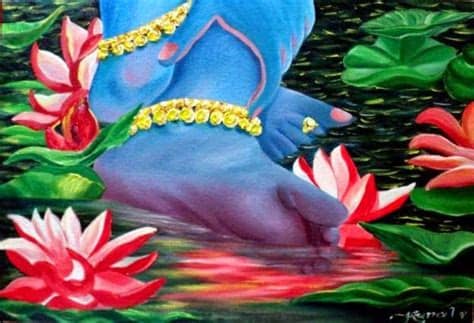
Krishna’s lotus feet

God has feet, which defeat the splendour of a lotus in full bloom. The soles of His lotus feet are adorned with specific marks.

Each and every mark has specific significance. Just the lustre of His beautiful red toenail can be compared to a full moon.

Meditating on the lotus feet of God dispels all gloom.
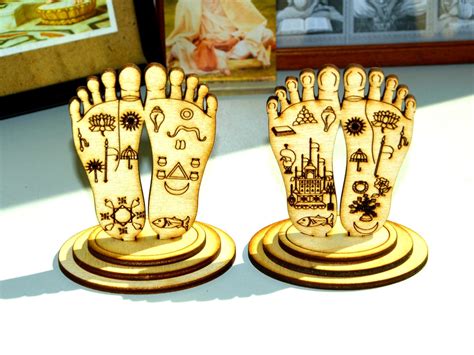
The sole of Sri Radha(right) Krishna(left)

Why can we not meditate on the lotus feet of the Lord?

I spend most of my time meditating on all sorts of things. I pray that all these useless meditations may be replaced by unbroken meditation on the lotus feet of Sri Radha Krishna.

What is the colour of God

In some traditions, God could be seen as nameless, formless… How could God be lacking in something at all? The Vedic scriptures provide very detailed information about God, for example, “Krishna” means “The all-attractive one”. What is the colour of Krishna? One colour or many colours?

Nikhil Mishra, 23rd November 2018

Hare Krishna devotees
My humble obeisances

I read that during naming ceremony ( “naam- karan sanskar” ) of Krsna, Garg Muni told His father Nand Maharaj that there had also been other incarnations of this same divine infant in which His colors were white, red and yellow.

So what were those incarnations?

I guess red color refers to Varah avtaar and Yellow color to Sri Narsingh avatar. Am I right?

White color I am unable to guess ( because that was of Sri Chaitanya in Kaliyuga which is post Dwaparyuga).

Would be grateful if someone here can guide and explain?

Hari bol
Nikhil

Nashvin, 24th November 2018
Hare Krsna Nikhil Prabhu

Below are some references about this:

https://www.vedabase.com/en/cc/madhya/20/246 Purport:
“The four yuga-avatāras are (1) śukla (white) in Satya-yuga (Bhāg. 11.5.21), (2) rakta (red) in Tretā-yuga (Bhāg. 11.5.24), (3) śyāma (dark blue) in Dvāpara-yuga (Bhāg. 11.5.27) and (4) generally kṛṣṇa (black) but in special cases pīta (yellow) as Caitanya Mahāprabhu in Kali-yuga (Bhāg. 11.5.32 and 10.8.13).”

https://www.vedabase.com/en/sb/11/5 Summary:
“The Supreme Personality of Godhead, Śrī Hari, accepts in each of the different yugas various colors, names and forms and is worshiped by various prescribed processes. In Satya-yuga the Supreme Lord is white in complexion, has four arms, dresses as a brahmacārī, is known by such names as Haṁsa and is served by the practice of meditational yoga. In Tretā-yuga He is red in color and four-armed, is the personification of sacrifice, is characterized by the symbols of the sacrificial spoon, ladle, etc., is called by such names as Yajña and is worshiped by Vedic sacrifices. In Dvāpara-yuga He is of dark blue complexion, wears a yellow garment, is marked by Śrīvatsa and other signs, has such names as Vāsudeva and is worshiped in His Deity form by the regulations of the Vedas and tantras. In Kali-yuga He is golden in color, is accompanied by associates who are His primary and secondary limbs and His weapons, is absorbed in kṛṣṇa-kīrtana and is worshiped by the performance of saṅkīrtana-yajña. Since in Kali-yuga all the goals of human life can be achieved simply by the glorification of the holy name of Lord Śrī Hari, those who can appreciate the real essence of things praise Kali-yuga.”

your servant,
Nashvin


Please subscribe to daily inspirational emails from His Grace Sriman Sankarshan Das Adhikari (Writings and lectures archived at www.sda-archives.com), written fresh every day from his travels around the world sharing the highest spiritual knowledge with everyone. Sign up now at www.joincourse.com.