Slaughtered in moments on the 401

Death can come at any moment. We experience death regularly, whether of a fish that just got caught, or a person who died in a car accident, or someone who had a heart attack. Animals, birds, fish and insects can’t do anything about their death. But as humans, how can we prepare for death? How can we transcend it altogether?

My current office is near the waterfront. Some days when I can take a walk along the waterfront, especially in summer, I see these birds diving into the water. They look like Cormorants, but I’m not a bird expert.

The birds dive into the water and surface after a little while. Sometimes, they have a writhing fish in their beaks, which they then promptly swallow.
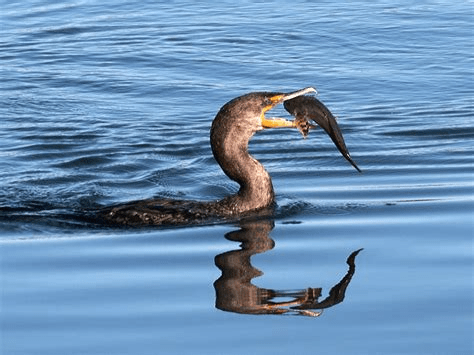
Cormorant with a fish in it’s beak

The fish was probably happily swimming around enjoying its fish life, until, out of the blue comes death. Of course, the fish can’t really do much about this, when death comes, death comes.

One summer day a couple of years ago, early into the pandemic, we were driving west on what is one of the busiest highways in the world, the Ontario 401. Suddenly, my map instructed me to take the next exit and took me a detour, which I followed… as we re-entered the highway at another point, I saw some vehicles on the empty stretch of highway behind me, they were stopped, and covered with tarpaulins.

Later in the afternoon, on my way back, I saw the vehicles still at the same spot, still covered with tarps. Clearly it had been a bad collision.

I continued to follow the incident, and found out it was an incident involving three cars. One eastbound car, for some reason, lost control and hit another eastbound one in the fast lane, which caused this second car to jump the barrier and land in the westbound lane – resulting in a head-on collision with a westbound car travelling in the fast lane.

Three people lost their lives in that collision, and death was almost immediate. The first responders had no chance, and had to cut open the cars to extract the mortal remains. It was surely gruesome.

I read about the people, a man in his forties in one car, and a woman in her thirties and her father-in-law in his sixties in the other car. I cannot imagine any of them expected to lose their lives on the 401 that morning.

Do we think any meal could be our last meal?

I wondered how their mornings were… did they have their breakfast their morning and say bye to their loved ones? What did they go through during those fatal moments? Did they feel a lot of pain? Did they have family members who were grieving for them? Did they have unfinished business? Maybe an incomplete project?

Death can come at any moment. No ordinary soul can predict the exact moment of their death. And when death comes, everything that was so important until the moment before ceases to matter. It’s just like when I live in an apartment with noisy neighbours and then move to another apartment, the noise in my previous apartment ceases to matter. What happens after death?

Death can come at any moment

Some say that we are just a bunch of chemicals, and nothing more significant than a halt of the electrochemical reactions in the body. Or in other words, after death, there is nothingness. But that logic is faulty on so many levels, after all, a bottle of chemicals doesn’t care about itself and other bottles of chemicals don’t lament it’s loss.

The logic that some combination of material elements somehow develops consciousness is faulty, as I wrote about Descartes’ ignorance about consciousness. His “cogito ergo sum” (I think, therefore I am) should have been something like “sum ergo cogito” (I am, therefore I think).

Actually, the law of momentum applies to us all – just like my baby body is “dead”, my child body is gone too. I still have memories of when I was a baby or a child, even though every single cell of my body back then is dead, this means that I transcend my body, more about that in detail another time.

Beyond Birth and Death. I am not this body.

But anyways, while the fish cannot do anything about their death, us, as human beings, with our highly developed sense of consciousness, can. We can inquire into our true nature, we can inquire into the Supreme Absolute Truth, indeed, human life begins only when we reach that stage of inquiring beyond eating, sleeping, mating, and defending, or rise above the animal propensities.

This stage is called “athāto brahma-jijñāsā“.

The human form is meant for the understanding of Kṛṣṇa consciousness (athāto brahma-jijñāsā), for inquiring about the Supreme Brahman. In the human form, everyone has a chance to understand the Supreme Brahman. The so-called leaders of human society do not know the real aim of human life and are therefore busy with economic development. This is misleading. Every state and every society is busy trying to improve the quality of eating, sleeping, mating and defending. This human form of life is meant for more than these four animal principles. Eating, sleeping, mating and defending are problems found in the animal kingdom, and the animals have solved these problems without difficulty. Why should human society be so busy trying to solve these problems? The difficulty is that people are not educated to understand this simple philosophy. They think that advancement of civilization means increasing sense gratification.

https://vedabase.io/en/library/cc/madhya/19/159/ purport

In fact, accidental or not, death awaits everyone who has taken birth… so, if we are sure to die, then we can at least prepare for it. How?

आयुर्हरति वै पुंसामुद्यन्नस्तं च यन्नसौ ।
तस्यर्ते यत्क्षणो नीत उत्तमश्लोकवार्तया ॥ १७ ॥

āyur harati vai puṁsām
udyann astaṁ ca yann asau
tasyarte yat-kṣaṇo nīta
uttama-śloka-vārtayā

Both by rising and by setting, the sun decreases the duration of life of everyone, except one who utilizes the time by discussing topics of the all-good Personality of Godhead.

https://vedabase.io/en/library/sb/2/3/17/

The moment of death, in fact, is quite significant. We can reach any destination by adjusting our consciousness at the moment of death.

यं यं वापि स्मरन्भावं त्यजत्यन्ते कलेवरम् ।
तं तमेवैति कौन्तेय सदा तद्भ‍ावभावित: ॥ ६ ॥

yaṁ yaṁ vāpi smaran bhāvaṁ
tyajaty ante kalevaram
taṁ tam evaiti kaunteya
sadā tad-bhāva-bhāvitaḥ

Whatever state of being one remembers when he quits his body, O son of Kuntī, that state he will attain without fail.

https://vedabase.io/en/library/bg/8/6/

The moment of death is actually a great opportunity, a rare portal through which we can escape birth and death altogether!

अन्तकाले च मामेव स्मरन्मुक्त्वा कलेवरम् ।
य: प्रयाति स मद्भ‍ावं याति नास्त्यत्र संशय: ॥ ५ ॥

anta-kāle ca mām eva
smaran muktvā kalevaram
yaḥ prayāti sa mad-bhāvaṁ
yāti nāsty atra saṁśayaḥ

And whoever, at the end of his life, quits his body remembering Me alone at once attains My nature. Of this there is no doubt.

https://vedabase.io/en/library/bg/8/5/

If I were to live every moment thinking that it could be my last, then certain longer-term things could not reasonably be done, but on the other hand if I don’t think about death then it will surely take me by surprise.

So how to live? My spiritual master gave me the perfect instruction in this regard.

My spiritual master
His Grace Sriman Sankarshan Das Adhikari

He said, live as if you could die in the next 80 seconds or live for the next 80 years. And his life is a living proof of his instructions, so I choose to follow in his footsteps.

I remind myself that this life of mine can end at any moment, but I work diligently in Krishna Consciousness as if I have another 80 years to go.

Would you like to learn how? Drop me a line!

What does it mean “uttama sloka vartaya”? What is Sloka?

What is the meaning of “uttama-sloka-vartaya”? What does “sloka” mean?

Raul, 23 January 2020

Hare Krishna!!

What is the meaning of uttama-sloka-vartaya?

Is this reference to the eight slokas the Lord Caitanya left in writing known as the Siksastaka?

What exactly is the meaning of the word sloka?

Best regards,

Raul

Haladhar Das, 27 January 2020

Hare Krsna prabhu

All glories to Srila Gurudeva

All glories to Srila Prabhupada

What is the meaning of uttama-sloka-vartaya?

Lord Krsna is known as uttama sloka as He is glorified in the transcendental literatures by the choicest poetry or perfect transcendental words. The demigods and devotees worship Lord Krsna to the best of their God given ability in the most profound words. So He is known as uttam sloka. 

Similarly pure devotees of the Lord are known as punya sloka, being in constant association of the Lord by way of chanting His holy names or serving Him in various prescribed methods, they are so purified, that even by coming in their contact or taking their names, one can be purified too or delivered from the kuntha jagat.

Is this reference to the eight slokas the Lord Caintanya left in writing known as the Siksastaka?

What exactly is the meaning of the word sloka?

Yes Lord Chaitanya also glorifying the holy names of Lord as non-different from Him and being manifested with full potency of the Lord. 

I don’t know the Sanskrit language, but my understanding is, a verse or combination of words in Sanskrit is known as sloka like Bhagavad Gita 700 verses.

Thank you.

your servant

Haladhar Das

Mahabhagavat Das SDA, 28 January 2020

Dear Sriman Raul – thank you for two nice questions!

Dear Haladhar Prabhu, thank you for your wonderful answers.

Requesting all the devotees on this group to come closer together by asking and answering questions about spiritual life, about Krishna, about helping ourselves and each other. Simply by asking and answering questions according to our disciplic succession the Brahma Madhva Gaudiya Sampradaya, under guidance and shelter from Srila Prabhupaa and Srila Gurudeva, we will make all advancement in spiritual life and make the world a better place…

Sincerely,

Mahabhagavat Das

Please subscribe to daily inspirational emails from His Grace Sriman Sankarshan Das Adhikari (Writings and lectures archived at www.ecstaticmedia.com ), written fresh every day from his travels around the world sharing the highest spiritual knowledge with everyone. Sign up now at www.joincourse.com

What “the great” took with him

Alexander “the great” took nothing of his conquests with him, or did he!

Alexander the great was a great conqueror, great emperor, and is still famous.

His empire extended across large swathes of Asia, Europe, and Africa.

But time, inexorable time, took away his life one day, while away from home, in a camp, surrounded by his doctors and generals.

As Alexander the Great lay on his deathbed, waiting to breathe his last, he told his generals that he had three last wishes.

  1. That his physicians should bear his coffin
  2. That the path leading to the grave should be strewn with the treasures he had in his treasury
  3. That his hands were to be left dangling out of the coffin.

His generals tearfully agreed, but asked why the emperor made such strange last wishes.

Alexander explained that no one was able to stop death, not even the best physicians of the most powerful emperor on earth.

He then explained that all that he had accumulated, all his treasures, were left behind.

Finally, he explained that he was taking nothing with him, that he was going empty handed.

Those were profound realisations, but there is something he did not realize.

The soul who was called “Alexander the Great” came with a lot of pious credits, the karmic credits needed to become an emperor of the world. While fulfilling his karmic destiny, he accumulated a lot of karmic reactions too.

Think of all the soldiers who died fighting for him.

Think of all the soldiers who died fighting against him.

He also took with him the results of any acts of kindness.

All for what? Just so Alexander could be a great conqueror? What did Alexander really accomplish? As he fortunately realized, better late than never, he took nothing of his achievements with him. But yes, his karmic reactions, he will carry with him.

Soon after his death, the mighty empire that he had put together after all those battles in which he was unconquered, crumbled. His once mighty body, also disintegrated.

After all, there is no endurance of the body.

नासतो विद्यते भावो नाभावो विद्यते सतः ।
उभयोरपि दृष्टोऽन्तस्त्वनयोस्तत्त्वदर्शिभिः ॥ १६ ॥

nāsato vidyate bhāvo
nābhāvo vidyate sataḥ
ubhayor api dṛṣṭo ’ntas
tv anayos tattva-darśibhiḥ

Those who are seers of the truth have concluded that of the nonexistent [the material body] there is no endurance and of the eternal [the soul] there is no change. This they have concluded by studying the nature of both.

https://vedabase.io/en/library/bg/2/16/

While Alexander had some realizations on his deathbed, he did not have anyone to instruct him on this important truth…

आयुर्हरति वै पुंसामुद्यन्नस्तं च यन्नसौ ।
तस्यर्ते यत्क्षणो नीत उत्तमश्लोकवार्तया ॥ १७ ॥

āyur harati vai puṁsām
udyann astaṁ ca yann asau
tasyarte yat-kṣaṇo nīta
uttama-śloka-vārtayā

Both by rising and by setting, the sun decreases the duration of life of everyone, except one who utilizes the time by discussing topics of the all-good Personality of Godhead.

https://vedabase.io/en/library/sb/2/3/17/

There is something else he could have taken with him. Anything spiritual he may have done. Alexander was tutored by Aristotle, the illustrious student of Plato, who is widely regarded as one of the primary contributors to Western Religion.

You may feel blessed with many gifts, or you may feel impoverished. Whether you have been given a lot or you have somehow acquired a lot, please know that you will take none of it with you.

You will however take your spiritual assets with you eternally.

नेहाभिक्रमनाशोऽस्ति प्रत्यवायो न विद्यते ।
स्वल्पमप्यस्य धर्मस्य त्रायते महतो भयात् ॥ ४० ॥

nehābhikrama-nāśo ’sti
pratyavāyo na vidyate
sv-alpam apy asya dharmasya
trāyate mahato bhayāt

In this endeavor there is no loss or diminution, and a little advancement on this path can protect one from the most dangerous type of fear.

https://vedabase.io/en/library/bg/2/40/

And what is this endeavor?

As Srila Prabhupada writes…

Activity in Kṛṣṇa consciousness, or acting for the benefit of Kṛṣṇa without expectation of sense gratification, is the highest transcendental quality of work. Even a small beginning of such activity finds no impediment, nor can that small beginning be lost at any stage. Any work begun on the material plane has to be completed, otherwise the whole attempt becomes a failure.

https://vedabase.io/en/library/bg/2/40/

"Momentum" is made up of many Moments

Feeling discourged? Are you struggling to build momentum in spiritual life? Are you failing to recognize the progress you have made? You have made progress! Just look back on yourself!

Spiritualists of all paths have one obstacle in common – the difficulty in building up momentum.

You know, that momentum, when you are humming along, making progress, learning and discovering more and more, having those experiences that brought us to the spiritual path in the first place!

But quite often, we see ourselves or others struggling. Struggling with the basic principles of spiritual life, struggling to keep up with the practice, struggling to maintain enthusiasm. Some obstacles are momentary, like a lapse in judgment, and some others are persistent, like the craving to satisfy those old, material itches… we may keep scratching, and scratching, and scratching, and we may lose momentum.

It’s really important to remember that “momentum” can be seen to be made of many Moments.

How do we know if we are making progress?

आयुर्हरति वै पुंसामुद्यन्नस्तं च यन्नसौ ।
तस्यर्ते यत्क्षणो नीत उत्तमश्लोकवार्तया ॥ १७ ॥

āyur harati vai puṁsām
udyann astaṁ ca yann asau
tasyarte yat-kṣaṇo nīta
uttama-śloka-vārtayā

Both by rising and by setting, the sun decreases the duration of life of everyone, except one who utilizes the time by discussing topics of the all-good Personality of Godhead.

https://vedabase.io/en/library/sb/2/3/17/

All of us know that with every passing moment, every day, every night, as the sun and the moon move in the sky, we are getting old. But when we look at ourselves in the mirror, say, now, do we see ourselves getting old? No. We see that our bodies have gotten old when we see a picture from say 5, 10, or 20 years ago.

We don’t notice ourselves getting old in the present, even though we clearly are… but we get discouraged when we don’t see ourselves making spiritual progress in the present moment?

My dear spiritualist, look back. Look back to say 10 years or 20 years, or less, depending on how long you have been on a spiritual path. Look back and compare your life then with your life now. Are you following your principles more now than back then? Are those old materialistic places, habits, people even a part of your life today? Have you moved in the right direction? I’ll hazard to say yes, you have moved forward.

When you look back, you will see how far you have come. And when you see that you have come thus far, you can easily find the motivation to keep moving forward.

Sure, there may be some missteps, there may be some false starts – maybe you’re not where you’d like to be, comparing yourself to some great saint, for example.

Look at a little child learning to walk… the child falls many many times and is unsteady for many days, weeks, months. But the child doesn’t give up.

And so you should not give up.

Every moment is a moment we can choose to choose, to “flex our choice muscles” as one of my teachers Devamrita Swami says. We can choose to act according to our conditioned instinct, or we can choose to act differently, on a higher spiritual plane.

And when you make that choice, take a moment to reflect that you did make the right choice, and rejoice. Momentum is made of many moments, and you just made this moment count.

In spiritual life, we often struggle with gaining momentum, when a spiritual lifestyle becomes easy… but it is important to remember that many moments make momentum. Each and every choice, however small, propels us further… don’t be discouraged. Make a choice, flex that choice muscle now, and do something that will help you advance spiritually, right here, right now.