11 Jun 2024 Atheist Father Tries to Kill Saintly Son… Srimad Bhagavatam Class with Bhakti Sanga Japa Group SB 7.8.14-15

When one tries to offer wisdom to an envious fool, the fool only becomes angry just as feeding a poisonous snake only increases his venom. Hiranyakashipu, the world’s topmost atheist was furious with his saintly son Prahlada, and prepared to kill his five year old son with his own sword. What happened at that time?

Hare Krishna!

The Bhakti Sanga Japa Group connects Krishna conscious devotees from across the world, be it a neophyte, serious sadhaka, or just someone with a casual interest in spirituality, through online conference calls! Bhakti Sanga group facilitates devotee association with several classes and japa sessions during the day. Classes include lectures on Srimad Bhagavatam, Sri Caitanya Caritamrta, Children’s sessions on scriptures, festival/holy days and assorted spiritual topics. The Bhakti Sanga group provides an informal setting where devotees can seek answers regarding their sadhana, spiritual topics and practices. Come experience Krishna consciousness in the association of devotees, from the very convenience of your home, just a phone call away!

TOPIC: Srimad Bhagavatam verse 7.8.14-15

DATE📆: Tuesday, 11th June 2024

TIME⌚: 7:20 AM. ET USA/ 6:20 AM. CT USA/ 4:20 AM PST USA/ 12:20 PM UK/ 8:20 PM MYT/ 4:50 PM IST

The class will be available on Zoom and later uploaded online on their Youtube Channel.

ZOOM Meeting ID: 681 873 6022 Password: 803604

https://www.youtube.com/channel/UCHty1ZkyTvzn_vTTfiYqwTA

Please join online if you’re interested in joining this class, or let me know if you want to get a link to the recording.
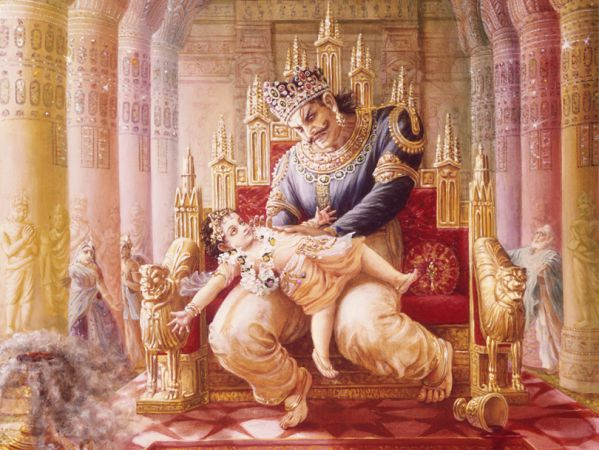
Lord Nṛsiṁhadeva Slays the King of the Demons


As described in this chapter, Hiraṇyakaśipu was ready to kill his own son Prahlāda Mahārāja, but the Supreme Personality of Godhead appeared in front of the demon as Śrī Nṛkeśarī, half lion and half man, and killed him.

Following the instructions of Prahlāda Mahārāja, all the sons of the demons became attached to Lord Viṣṇu, the Supreme Personality of Godhead. When this attachment became pronounced, their teachers, Ṣaṇḍa and Amarka, were very much afraid that the boys would become more and more devoted to the Lord. In a helpless condition, they approached Hiraṇyakaśipu and described in detail the effect of Prahlāda’s preaching. After hearing of this, Hiraṇyakaśipu decided to kill his son Prahlāda. Hiraṇyakaśipu was so angry that Prahlāda Mahārāja fell down at his feet and said many things just to pacify him, but he was unsuccessful in satisfying his demoniac father. Hiraṇyakaśipu, as a typical demon, began to advertise himself as being greater than the Supreme Personality of Godhead, but Prahlāda Mahārāja challenged him, saying that Hiraṇyakaśipu was not God, and began to glorify the Supreme Personality of Godhead, declaring that the Lord is all-pervading, that everything is under Him, and that no one is equal to or greater than Him. Thus he requested his father to be submissive to the omnipotent Supreme Lord.

The more Prahlāda Mahārāja glorified the Supreme Personality of Godhead, the more angry and agitated the demon became. Hiraṇyakaśipu asked his Vaiṣṇava son whether his God existed within the columns of the palace, and Prahlāda Mahārāja immediately accepted that since the Lord is present everywhere, He was also present within the columns. When Hiraṇyakaśipu heard this philosophy from his young son, he derided the boy’s statement as just the talk of a child and forcefully struck the pillar with his fist.

As soon as Hiraṇyakaśipu struck the column, there issued forth a tumultuous sound. At first Hiraṇyakaśipu, the King of the demons, could not see anything but the pillar, but to substantiate Prahlāda’s statements, the Lord came out of the pillar in His wonderful incarnation as Narasiṁha, half lion and half man. Hiraṇyakaśipu could immediately understand that the extraordinarily wonderful form of the Lord was surely meant for his death, and thus he prepared to fight with the form of half lion and half man. The Lord performed His pastimes by fighting with the demon for some time, and in the evening, on the border between day and night, the Lord captured the demon, threw him on His lap, and killed him by piercing his abdomen with His nails. The Lord not only killed Hiraṇyakaśipu, the King of the demons, but also killed many of his followers. When there was no one else to fight, the Lord, roaring with anger, sat down on Hiraṇyakaśipu’s throne.

The entire universe was thus relieved of the rule of Hiraṇyakaśipu, and everyone was jubilant in transcendental bliss. Then all the demigods, headed by Lord Brahmā, approached the Lord. These included the great saintly persons, the Pitās, the Siddhas, the Vidyādharas, the Nāgas, the Manus, the prajāpatis, the Gandharvas, the Cāraṇas, the Yakṣas, the Kimpuruṣas, the Vaitālikas, the Kinnaras and also many other varieties of beings in human form. All of them stood not far from the Supreme Personality of Godhead and began offering their prayers unto the Lord, whose spiritual effulgence was brilliant as He sat on the throne.

ŚB 7.8.14


एवं दुरुक्तैर्मुहुरर्दयन् रुषा
सुतं महाभागवतं महासुर: ।
खड्‌गं प्रगृह्योत्पतितो वरासनात्
स्तम्भं तताडातिबल: स्वमुष्टिना ॥ १४ ॥
evaṁ duruktair muhur ardayan ruṣā
sutaṁ mahā-bhāgavataṁ mahāsuraḥ
khaḍgaṁ pragṛhyotpatito varāsanāt
stambhaṁ tatāḍātibalaḥ sva-muṣṭinā
Synonyms
evam — thus; duruktaiḥ — by harsh words; muhuḥ — constantly; ardayan — chastising; ruṣā — with unnecessary anger; sutam — his son; mahā-bhāgavatam — who was a most exalted devotee; mahā-asuraḥ — Hiraṇyakaśipu, the great demon; khaḍgam — sword; pragṛhya — taking up; utpatitaḥ — having gotten up; vara-āsanāt — from his exalted throne; stambham — the column; tatāḍa — struck; ati-balaḥ — very strong; sva-muṣṭinā — by his fist.

Translation
Being obsessed with anger, Hiraṇyakaśipu, who was very great in bodily strength, thus chastised his exalted devotee-son Prahlāda with harsh words. Cursing him again and again, Hiraṇyakaśipu took up his sword, got up from his royal throne, and with great anger struck his fist against the column.

https://vedabase.io/en/library/sb/7/8/14/

ŚB 7.8.15


तदैव तस्मिन्निनदोऽतिभीषणो
बभूव येनाण्डकटाहमस्फुटत् ।
यं वै स्वधिष्ण्योपगतं त्वजादय:
श्रुत्वा स्वधामात्ययमङ्ग मेनिरे ॥ १५ ॥
tadaiva tasmin ninado ’tibhīṣaṇo
babhūva yenāṇḍa-kaṭāham asphuṭat
yaṁ vai sva-dhiṣṇyopagataṁ tv ajādayaḥ
śrutvā sva-dhāmātyayam aṅga menire
Synonyms
tadā — at that time; eva — just; tasmin — within (the pillar); ninadaḥ — a sound; ati-bhīṣaṇaḥ — very fearful; babhūva — there was; yena — by which; aṇḍa-kaṭāham — the covering of the universe; asphuṭat — appeared to crack; yam — which; vai — indeed; sva-dhiṣṇya-upagatam — reaching their respective abodes; tu — but; aja-ādayaḥ — the demigods, headed by Lord Brahmā; śrutvā — hearing; sva-dhāma-atyayam — the destruction of their abodes; aṅga — my dear Yudhiṣṭhira; menire — thought.

Translation
Then from within the pillar came a fearful sound, which appeared to crack the covering of the universe. O my dear Yudhiṣṭhira, this sound reached even the abodes of the demigods like Lord Brahmā, and when the demigods heard it, they thought, “Oh, now our planets are being destroyed!”

Purport
As we sometimes become very much afraid at the sound of a thunderbolt, perhaps thinking that our houses will be destroyed, the great demigods like Lord Brahmā feared the thundering sound that came from the pillar in front of Hiraṇyakaśipu.
https://vedabase.io/en/library/sb/7/8/15/

Bhakti Philosophy for the mind and Krishna’s Pastimes for the Heart?

How does Bhakti/Devotional Service deal with the intellectual / logical / analytical side of us as well as the emotional/feeling side of us? Does catering to one mean neglecting the other?

Brajanath Das, 02 November 2016

Hare Krishna Dear Devotees,

Please accept my humble obeisances!

All glories to Sri Caitanya Mahaprabhu!

All glories to Srila Prabhupada!

Please help me to understand the following phrase – 

“Pastimes of the Lord are for the heart and philosophy is for the mind.”

your servant,

Brajanath Das

Bhakta Sunil, 09 November 2016

Hare Krishna Prabhu

Dandavats!

The pastimes of the Lord help to easily realize the impurities in hearts by direct perception in story formats and reading philosophy engages the mind

Inversely , the reading of philosophy purifies the heart too and pastimes of the Lord engage the mind too

For example if we read this pastime of Lord Nrsimhadeva , not only we get moral by mind but also purifies our Hearts irrespective of how many times we read this, this transcendental literature is ever fresh contrary to mundane literature in news media and magazines :

THE PASTIMES OF LORD NRSIMHADEVA

There was once a great demon who was overwhelmed with rage: his brother Hiranyaksa had just been killed by the incarnation of Vishnu known as Lord Varaha. Thus he became very determined to become the emperor of the entire universe. In order to increase his power, he performed very powerful austerities. This penance was so severe that it disturbed the demigods. In fact, the demigods requested Lord Brahma to stop him. The chief of the demigods, Lord Brahma, therefore descended to pacify him by granting him a wish.

“Please grant that I not be killed by any created living being,” commanded Hiranyakasipu, “that I not die inside or outside any residence, during the daytime or night, nor on the ground or in the sky; that I not be killed by any being created by you, nor by any weapon, nor by any human being or animal indeed that I not meet death from any entity, either living or non-living; that I have no competitor; that I have sole lordship over all living entities and presiding deities, and that I acquire all mystic powers.”

After Brahma had granted him all these requests, Hiranyakasipu very swiftly conquered all the planets in the universe, took up residence in the lavish palace of King Indra, and forced the demigods to bow down to his feet. He even stole the sacrificial oblations meant for the demigods. Intoxicated physically by wine and mentally by power, Hiranyakasipu ruled the universe very severely.

During this time his queen, Kayadhu, returned to the palace of her husband and bore him a son, Prahlada. He was a reservoir of all transcendental qualities because he was a pure devotee of Lord Visnu. Determined to understand the Absolute Truth, he had full control over his senses and mind. He was kind to all living creatures and the best friend of everyone. Toward respectable persons he behaved just like a menial servant, to the poor he was like a father, and to his equals he was always like a sympathetic brother. Always very humble, he considered his teachers and spiritual masters to be as good as the Lord Himself. Indeed, he was completely free of any pride that might have arisen from his good education, riches, beauty, and aristocratic birth.

Hiranyakasipu wanted to raise his son to be a powerful demon, but Prahlada only wanted to learn about devotional service to Lord Visnu. After Prahlada attended school for some time, Hiranyakasipu took him on his lap and affectionately inquired, “My dear son, please tell me about your favorite subject in school.”

Fearlessly, Prahlada said, “Hearing (sravanam) and chanting (kirtanam) about the holy name, form, qualities, paraphernalia, and pastimes of the Supreme Lord; remembering (smaranam) them; serving the lotus feet of the Lord (pada-sevanam); offering the Lord respectful worship with sixteen types of paraphernalia (arcanam); offering prayers to the Lord (vandanam); becoming His servant (dasyam); considering the Lord one’s best friend (sakhyam); and surrendering to Him (atma-nivedanam, in other words, serving Him with body, mind and words); these nine processes are known as pure devotional service, and I consider anyone who has dedicated his life to service of Lord Visnu through these nine methods to be the most learned person, for he has acquired complete knowledge.”

Blinded by anger, Hiranyakasipu threw Prahlada from his lap onto the ground. “Servants! Take him away and kill him at once!” he screamed. However, Prahlada just sat silently and meditated on the Personality of Godhead, and the demons’ weapons had no effect on him. Seeing this Hiranyakasipu became fearful and contrived various ways to kill his son. His servants threw Prahlada beneath an elephant’s feet; they cast him into the midst of huge, fearful snakes; they cursed him with destructive spells; they hurled him from a hilltop; they gave him poison; they starved him; they exposed him to severe cold, winds, fire and water; they threw heavy stones to crush him. Hiranyakasipu even sent his sister Holika to burn him, but instead she herself was burned. But throughout these trials Prahlada was simply absorbed in thoughts of Lord Visnu, and thus he remained unharmed. Hiranyakasipu became very anxious about what to do next.

“You say there is a being superior to me,” said Hiranyakasipu, “but where is He? If He is present everywhere, then why is He not present in this pillar you see before you? Do you think He is in this pillar?” “Yes,” Prahlada answered, “He is there.”

Hiranyakasipu’s rage flared more and more. “Because you are speaking so much nonsense, I shall now sever your head from your body. Now let me see your most worshipable God come to protect you. I want to see it.” Cursing him again and again, Hiranyakasipu took up his sword, got up from his royal throne, and with great anger struck his fist against the column.

Then from within the very pillar that he had singled out came a wonderful half-man, half-lion form never before seen. The Lord’s form was extremely fearsome because of His angry eyes, which resembled molten gold; His shining mane, which expanded the dimensions of His fearful face; His deadly teeth; and His razor-sharp tongue. Lord Nrsimha then proceeded to battle with the wasp-like Hiranyakasipu.

Finally at twilight, Lord Nrsimha captured Hiranyakasipu and placed him in His lap on the doorway of the assembly hall. As He began ripping the demon to pieces with His many, many hands, Lord Nrsimha’s mouth and mane became sprinkled with drops of blood, and His fierce eyes, full of anger, were impossible to look at. Licking the edge of His mouth with His tongue, the Supreme Lord decorated Himself with a garland of intestines taken from Hiranyakasipu’s abdomen. Lord Nrsimha uprooted Hiranyakasipu’s heart and finally threw him aside and destroyed an army of Hiranyakasipu’s faithful followers.

By His transcendental cleverness, Lord Nrsimhadeva was able to kill Hiranyakasipu without contradicting any of Lord Brahma’s benedictions. The execution took place neither inside nor outside, but in the doorway; neither on land nor in sky, but on the Lord’s lap; neither during the day nor during the night, but at twilight; neither by man, beast, or demigod nor by any created being, but by the Personality of Godhead; and not by any weapon, but by the Lord’s own lotus hand, relieving the whole universe of Hiranyakasipu’s demonic activities.

Having been protected by the Lord, Prahlada Maharaja offered many prayers in a voice that faltered with love:

“My dear Lord Nrsimhadeva, please, therefore, allow Your angry feature to diminish, now that my evil father Hiranyakasipu has been killed . . . [The saintly persons] will always remember Your auspicious and fearsome incarnation, for it frees them from fear. In this way, my Lord, You appear in various incarnations as a human being, an animal, a great saint, a demigod, a fish or a tortoise, thus maintaining the entire creation in different planetary systems and killing the demoniac principles.”

Adapted from Srimad Bhagavatam, 7th Canto

Bhaktivedanta Book Trust. HDG A.C. Bhaktivedanta Swami Srila Prabhupada.

Hope this helps with your query

your insignificant servant,

Bhakta Sunil

Mahabhagavat Das, 11 November 2016

Dear Brajanath Prabhu,

Please accept my humble obeisances.

All glories to Sri Guru and Gauranga.

All glories to Srila Prabhupada.

“Pastimes of the Lord are for the heart and philosophy is for the mind.”

Such questions would greatly benefit from inclusion of context. Please do this going forward. A statement out of context is a perfect recipe for misunderstanding and confusion. Who said it, who was it said to, and in what specific context was that statement made? Without context, our answers may be insufficient or cause more misunderstandings.

Bhakti Yoga is a perfect synthesis of “heart” and “mind”. Thinking, feeling, willing, words, deeds, body, and mind, fully engaged in concert in harmoniously pleasing Krishna.

Generally, Bhakti means loving devotional service, there is no intellectual analysis needed or done in such pure devotional service, pure devotees simply love Krishna and act accordingly very naturally, doing whatever is needed for Krishna’s pleasure. They know “in their heart” what pleases Krishna. In this regard, hearing or chanting the pastimes of the Lord are devotional service.

Often, arguments and logic are undesirable in relishing Krishna’s sweetness.

Srila Rupa Goswami says, and Srila Prabhupada summarizes in the Introduction to his Nectar of Devotion

“Śrīla Rūpa Gosvāmī prays to his spiritual master, Śrīla Sanātana Gosvāmī, for the protection of Bhakti-rasāmṛta-sindhu—”The Ocean of the Pure Nectar of Devotional Service”—from the argumentative logicians who unnecessarily meddle in the science of service to the Lord. He compares their arguments and logic to volcanic eruptions in the midst of the ocean. In the midst of the ocean, volcanic eruptions can do very little harm, and similarly, those who are against devotional service to the Lord and who put forward many philosophical theses about the ultimate transcendental realization cannot disturb this great ocean of devotional service.”

But for someone who is conditioned by material energy, the mind and intelligence generally stands in the way of what is simply a matter of natural course of being true to our spiritual self. Such conditioned souls require philosophy and intellectual analysis to convince them to not do material nonsense but to render some devotional service, which, when done sincerely, gradually reawakens love of Krishna within the heart.

A pure devotee often engages in philosophizing on the pastimes, as our Acharyas, Srila Prabhupada and his disciples and grand-disciples do, but this is for our benefit, the benefit of the conditioned souls.

I hope this helps.

your servant,

Mahabhagavat Das

Dra Varni, 12 November 2016

Hare Krsna!!   This is a supreme question. While I am not a devotee I have had this experience. There are many answers, but “pastimes” and “theory” are not two separate things in this case. By this I mean one could not be without the other. And the outcome is not synthesis.  Elevation, in my experience, came from reading “pastimes” and “hearing” pastimes. Primarily, reading of Sri Caitanya Caritamrta, not all 17

Dra Varni

Dra Varni, 02 December 2016

All glories to Srila Prabhupada!, Dhruva Maharaja!

Hare Krsna!

“Bhakti Yoga is a perfect synthesis of  “heart” and “mind”. Thinking, feeling, willing, words, deeds, body, and mind, fully engaged in concert in harmoniously pleasing Krishna.”

I have taken time to respond to the above statement because its components are complicated and fragile . Above is the context of the message I received . I have a problem with the word “synthesis”. Below is my rendering to screen of why. I am sure too be only person with such thinking.

It is important to remember that the heart and mind are a continuum, not two distinct and separate energies. Given the age of Cali there is a compartmentalized effort to split everything. Objects for synthesis must be in direct opposition. Other look-a-likes are called “binary-oppositions” they just have the appearance of opposition. Used as a metaphor “Synthesis”would be fine depending on genre. And Bhakti Yoga would be the perfect synthesis of “heart”and “mind” if they were in opposition. 

Dra

Please subscribe to daily inspirational emails from His Grace Sriman Sankarshan Das Adhikari (Writings and lectures archived at www.ecstaticmedia.com ), written fresh every day from his travels around the world sharing the highest spiritual knowledge with everyone. Sign up now at www.joincourse.com