
Compassion, this word is used very often. Someone wants us to have compassion upon the downtrodden and poor. Someone else wants us to have compassion upon the rich and powerful. Some want to be compassionate towards people with black skin. Others want to be compassionate upon the war veterans. Someone is working intently upon manifesting compassion towards those battling cancer.
This is part 1 of a 3 series of articles. Part 2 is here, and Part 3 is here.
I agree with them all. We should be compassionate with everyone in the whole world.
Do you agree that all those living entities mentioned above deserve to be treated with compassion? What about those not mentioned above? Do they deserve to be treated with compassion?
But for example, suppose I dedicate my life to, say, feeding hungry people. Now, all of my efforts are spent in finding the hungry, acquiring food and feeding them… how would I help the sick children, the war veterans, the people with black skin, and the cancer patients?
Or, if I invest all my time in trying to find a cure for Cancer… now how would I feed the hungry, take care of the sick children, the war veterans, the people with black skin?
Or maybe I do a little bit to help them all… donate to feed a few hungry people, donate to a charity helping war veterans, volunteer for a hospital that treats people with cancer… but then I notice that there are many more hungry, many more war veterans, many with cancer and many disadvantaged people with black skin!
What’s more, I find that the charity feeding the hungry is slaughtering innocent animals… the war veterans who are injured actually committed atrocities upon other people who are left in worse shape than them, some of the the people with cancer happened to be those who smoked all their lives, and some of the people with black skin are of poor character and have harmed many others…
Now what do I do?
Do I prioritize the “innocent” disadvantaged over those with a criminal background? Do I overlook Diabetes or Hypertension in my obsession over cancer? Do I ignore the elderly in my quest to help the children?
It appears that being compassionate is more difficult than it sounds at first!
It’s all extremely confusing and difficult to sort through!
I am just one teeny little soul, a tiny jiva, one little spirit soul among unlimited spirit souls. I have limited energy, limited time in this life, and very limited resources, power and influence in the world. And yet I want to be compassionate to all.
I don’t want to be compassionate to one group of living entities, say, sick children, and not be compassionate, say, to poor children who are not sick but lack education. I don’t want to be compassionate upon the hungry people of the world, and end up slaughtering animals to help temporarily prevent their hunger.
Do I have any hope of attaining my goal of being compassionate towards everyone then?
Can I be compassionate towards ALL souls?
Yes, in the Bhagavad Gita, Krishna speaks about compassion for all souls.
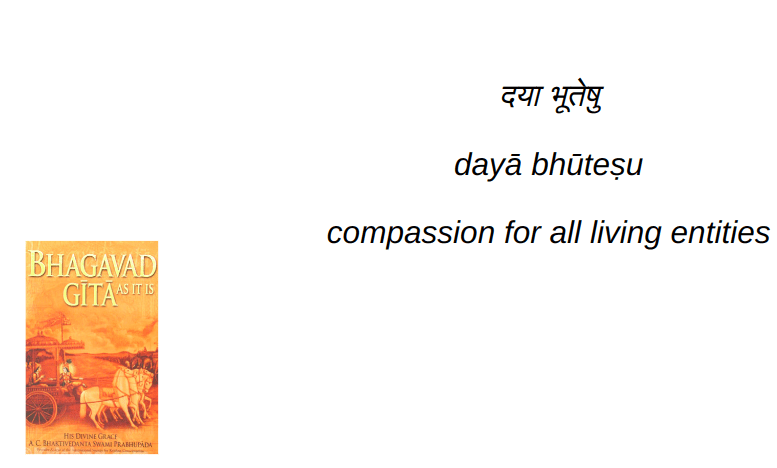
दया भूतेषु – dayā bhūteṣu – compassion for all living entities
More specifically, Krishna stresses that this quality, among a total of twenty size qualities, belong to those godly souls endowed with a divine nature.
So, clearly it is not hopeless to strive to be compassionate towards one and all.
In our present context though, we may not be “godly souls”, and we may not (yet) be endowed with a “divine nature”… what can we do?
First and foremost, we need to understand what compassion is not!
Yes, if we understand what is not compassion, then we should be able to steer our thoughts, words, and deeds in the direction of compassion.
Let’s look at the most obvious example of what is NOT compassion.

The American Heritage Dictionary Defines Schadenfreude as follows:
schadenfreude /shäd′n-froi″də/
noun
- Pleasure derived from the misfortunes of others.
- Malicious enjoyment derived from observing someone else’s misfortune.
- Delight in another person’s misfortune.
We can safely say that someone who is feeling schadenfreude is not being compassionate!
Hey, I’m not like that!
So we may think. But here are just a few examples when we indulge in Schadenfreude…
- Sports – what happens when a team you support wins, and a team you oppose loses? Do you feel happy?
- Exams/Competition/Contests – what happens when you beat other competitors in an exam or competition? Do you feel elated?
- Business – what happens when you defeat a competitor, win a contract from an opponent, or put another company out of business? Do you celebrate?
- War – say the country you live in is at war with another country… no matter whose “fault” it was… if your army scores a “win”, does that not mean that someone on the other end is mourning a loved one?
- Politics – say the party you support wins an election and comes to power… does that mean that the defeated parties had nothing good to offer to the world at all?
When we examine our world, we find that…
In fact, our whole world, our society is built on top of deriving pleasure from the misfortunes of others.
Where does it all come from, one would wonder…
Schadenfreude comes from envy… “I wish that you don’t have what you have, I wish I have it instead, and you don’t”… it originally begins with Envy of God, but that is a discussion for another article.
Where there is envy, there can never be true co-operation, there can only be competition, sometimes, cut-throat.
Countries, communities, clubs, societies, networks, organizations are formed on the basis of envy against others. The envy may be based on race, religion, nationality, language, education, political, cultural or economic factors. It does not matter what the criteria separating the “us” and “them” are. And all of them engage wholesale in this schadenfreude.
We’re all members of such propagators of schadenfreude whether unwillingly or not!
So we can think about how to live in a world where competition is the name of the game!
Compassion means the exact opposite of Schadenfreude… to feel pain at the sufferings of others.
OK, let’s say we do somehow get past the most obvious schadenfreude. How to act with compassion?
For example, what if I’m trying to “help” someone, but I only end up hurting the person I’m trying to help?
How do we know if something we are thinking, feeling, willing, saying, or doing is helping or hurting?
Watch out for Part 2 of this series of articles…
In that post, we will go deeper into understanding how our intent to help can actually hurt.
Discover more from Freedom through Genuine Spiritual Progress
Subscribe to get the latest posts sent to your email.

 Freedom through Genuine Spiritual Progress
2 thoughts on “From Schadenfreude to Compassion: A Journey (part 1)”