
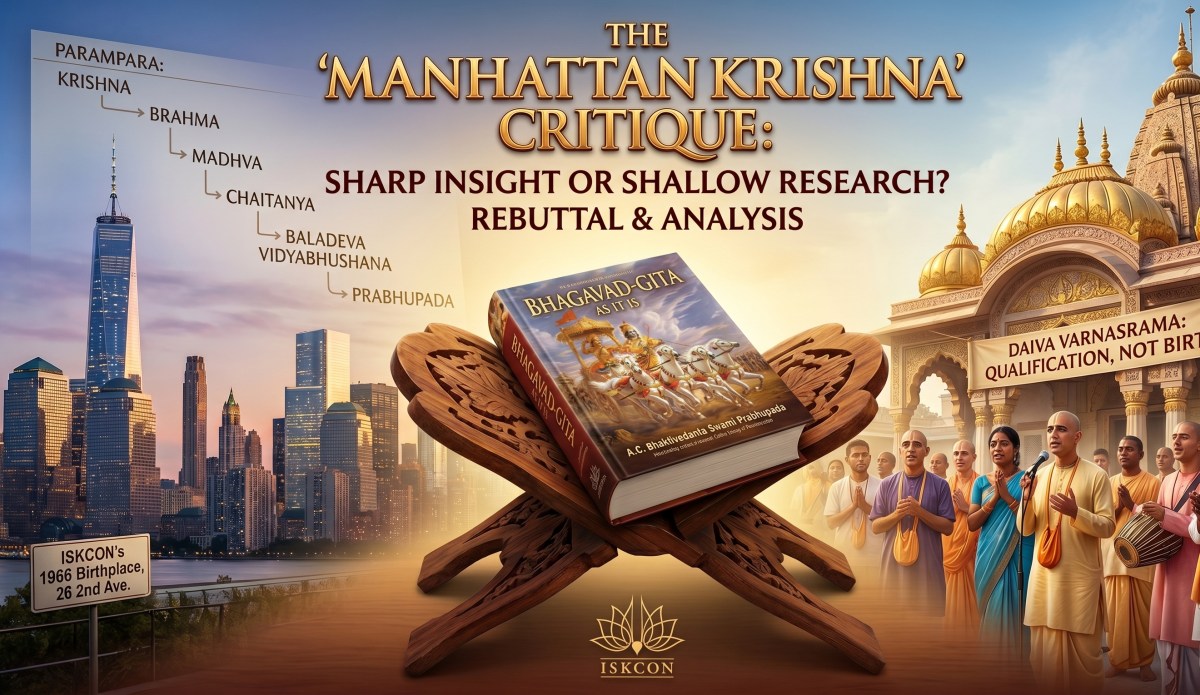
A provocative critique of ISKCON was published recently, painting the movement as a corporate, “Abrahamized” version of Indian spirituality born in the heart of New York. It’s a compelling narrative, one that taps into our collective anxiety about globalization and the “branding” of the sacred.
However, when we move past the shock value, we have to ask: Does the critique actually stand up to historical, legal, and theological scrutiny? Or is it a case of “digging” just deep enough to find some dust, while missing the core foundation?
1. The “New York” Myth: Geography vs. Lineage
The original text presents a “shocker”: Krishna was born in Mathura; ISKCON was born in New York. This frames the movement as a 1966 invention. In reality, any deep dive into the history of the Brahma-Madhva-Gaudiya Sampradaya reveals that Prabhupada didn’t invent a new philosophy in Manhattan; he transplanted a centuries-old Bengali lineage that itself owes its fundamentals to a 5,000-year-old Vaishnava tradition.
Legal reality also tells a different story. ISKCON has no “central ownership.” In every country and geography where it operates, ISKCON is registered locally under local laws as an independent legal entity. For example, the vast network of temples across India is not “owned” by a Manhattan office; they are branches of ISKCON India (legally registered under the Bureau of Charity in Mumbai/Juhu). The GBC acts as a spiritual and managerial oversight committee, but it has no legal “holding company” status.
I have written before about the delicate nature of an effective “spiritual organization”, can such a thing actually exist. Read it here.
I have also written about Madhvacharya’s genius, which is not yet implemented by organizations like ISKCON yet, mainly due to practical reasons. Read that here.
2. A Mission Forged in Failure and Sacrifice
The critique paints the 1966 Manhattan registration as a “corporate launch,” ignoring the decades of grueling hardship and political betrayal that preceded it.
- The 40-Year Struggle: Following the fracture of the original Gaudiya Matha into personal fiefdoms, Prabhupada spent nearly 40 years in India struggling alone. He lived in poverty, scrounging for money for paper and printing costs for his Back to Godhead magazine, receiving almost no support from established religious authorities.
- The Jhansi Betrayal: In 1953, Srila Prabhupada attempted to establish the League of Devotees in Jhansi. It was a vision for a global headquarters rooted in India, but it collapsed due to local political intrigue. He was outmaneuvered by a local elite that reclaimed the property for secular purposes, leaving him essentially evicted.
- The Western Pioneers: When he arrived in New York at age 70, success came only because his first Western disciples gave themselves fully to the mission. These young men and women showed the way, enduring hardship to build the foundation that today benefits millions of Indians and others worldwide. We are indebted to their sacrifice. Indians did follow after, but the westerners were the first to surrender completely to Srila Prabhupada.
- Srila Prabhupada’s vision was “the lame man rides on the shoulders of the blind man“. In this metaphor, Vedic culture is the lame man with spiritual vision, unable to organize efficiently, and the western ability and ingenuity is the blind man, with no spiritual vision. Together they can do great things if they co-operate. This is found in all ISKCON projects.
3. “As It Is” vs. “As You Like It”: The Unbroken Chain
The critique suggests the “As It Is” title is a marketing gimmick. In reality, it refers to the Siddhanta (philosophical conclusion) that Krishna is the Supreme Personality of Godhead, rather than a metaphorical dilution.
Yes, there is debate between equal scholars, but no one debates against God. Anyone who tries to compete against God, like Ravana, Kamsa, Hiranyakashipu, etc., is defeated profoundly. Questions to a superior are asked in a mood of humility, not challenge. As such, Srila Prabhupada is a superior to the author of the critique, having inspired profound spiritual transformation in millions of people all over the world. The critics’ inability to understand Srila Prabhupada’s instructions is a reflection of their own impurity and should be acknowledged as such.
Krishna is not a “Hindu god”. Krishna is the Supreme Personality of Godhead. “Bharat” is this entire planet. Krishna is the same God that others know as Allah, Jehovah, and Yahweh. From that perspective, Krishna Consciousness is Universal. Krishna claims all races, and all species as His in the Bhagavad Gita. Anyone who knows about Krishna perfectly from Parampara and is fully surrendered to Krishna must be accepted as a messenger of Krishna.
Srila Prabhupada functions as a “transparent via medium,” relying on authorized commentaries of the previous acharyas. His version is deeply rooted in the work of Baladeva Vidyabhushana, the 18th-century scholar. In turn, Baladeva Vidyabhushana’s work was a masterful synthesis of previous giants, drawing from the rigorous logic of Madhvacharya, the devotion of Ramanujacharya, and the profound insights of Vishvanatha Chakravarti Thakur.
Today, the Bhaktivedanta Book Trust (BBT) is a decentralized force with independent regional divisions like BBT India and BBT Africa, publishing in over 100 languages and ensuring the Gita remains affordable for everyone globally.
4. Sovereignty and Social Reform: Breaking the Birth-Based Monopoly
The critique claims ISKCON is “unapproved by any Indian religious authority.” This misses the core of the movement: ISKCON seeks to correct the social ills resulting from the corruption of Vedic traditions.
For example, ISKCON revived the authentic Vedic standard of Daiva Varnasrama, where a person’s status is determined by Guna (qualities) and Karma (actions), not merely birth. In ISKCON, anyone can be qualified as a Brahmin through study and purification. To suggest ISKCON needs “approval” from the narrow-minded, birth-focused orthodoxy is to suggest that a reform movement needs permission from the very system it is trying to heal.
5. The “Corporate” Fallacy: A Pure Non-Profit
The BBT is one of the most transparent non-profit models in religious history. Every cent generated from book distribution goes directly into pushing the movement forward, printing more books and building temples. Srila Prabhupada never took a royalty, nor do the volunteer trustees. The copyright exists solely as stewardship to prevent the dilution of the message and to ensure funds are used as Laxmi (sacred energy) in the service of the mission of Krishna Consciousness.
6. Global Representation and Volunteer Leadership
The GBC is not a “New York power center.” Today, every geography in the world is represented by a GBC member who serves on the ground in that specific region. Crucially, these are entirely unpaid, volunteer roles. GBC members do not receive salaries; they are dedicated practitioners who offer their time out of a sense of duty. Furthermore, the movement successfully self-corrected and dismantled the “Zonal Acharya” system of the late 70s to return to this collective, representative model.
7. The Pedigree of Error: A Failure in Scholarship
The sheer volume of factual errors in the original critique, from legal misunderstandings to gross historical omissions reveals that the author is fundamentally unschooled in both Vedic culture and academic research methodology. To present “shockers” that are easily debunked by a cursory glance at public legal records is not “digging”; it is an exercise in superficiality or worse, treachery and trickery.
In an academic context, such a lack of rigor would be unacceptable. This critique does not possess the depth expected of a high school project, let alone a PhD. Furthermore, given that India consistently ranks among the most corrupt countries in the world regarding institutional transparency, one must question whether the author’s PhD was actually earned through rigorous effort or obtained through compromised systems. To claim doctoral-level authority while failing to grasp the fundamental distinction between a sampradaya and a corporation is a profound failure of scholarship that renders the entire argument moot.
But, if this is the caliber of what this education system has produced, then we question the system that awarded a PhD to a person who acts with this much incompetence.
8. A Demand for Transparency and Accountability
We formally demand the following from the author of the critique:
- Verification of Credentials: Public disclosure of the institution and guide that granted their PhD and a copy of their thesis, including past records of academic achievements.
- Legal Proof: Specific legal citations supporting the claim that ISKCON India is “owned by an American entity.”
- Theological Citations: A verse-by-verse comparison demonstrating how the “As It Is” commentary departs from the established conclusions of Baladeva Vidyabhushana.
- Methodological Disclosure: The bibliography used for this “digging,” as internet rumors do not constitute research.
9. A Path to Atonement
Even if all the above in Section 8 are furnished and found to be satisfactory, we demand atonement from the writer of the critique, for his own benefit. To atone for these frivolous claims and gain the “inner awakening” he claims to seek, the author should:
- Offer an unconditional apology, for creating unnecessary discord.
- Study the Bhagavad-Gita As It Is under supervision at least 10 times until at least the basics are understood.
- Serve at an ISKCON temple for a minimum of one year as a volunteer, performing any and all assigned menial duties.
- Distribute a minimum of 1,000 copies of the Bhagavad-Gita As It Is and present evidence of this service.
10. The Feudal Trap of Internal Discord
Finally, we must address the underlying motive. Often, these attacks are born from envy or political agendas to weaken Sanatana Dharma from within. History warns us: the success of Muslim and European Colonial takeovers in India was due to feudal kings fighting each other over personal egos while the threat was at the gates. When we attack our own global movements for being “too organized,” we hand the keys of our civilization back to those who seek to dismantle it.
Five Thousand Years ago, this entire planet was known as “Bharat Varsha”, and was under one flag of Hastinapura. As Kaliyuga progressed, Bharat split up into smaller and smaller chunks. Less than eighty years ago, Bharat was split up into “Hindustan” and “Pakistan”. This is the effect of such narratives as that of the critic.
Myth vs. Reality Summary
| The Myth | The Reality |
| “Owned” by an American entity. | Locally registered in every country (e.g., ISKCON India/Juhu). |
| A “corporate” profit-making machine. | Pure non-profit; every cent reinvested. Zero royalties for the founder. |
| Prabhupada’s “personal” interpretation. | Synthesized from a lineage including Baladeva Vidyabhushana, Madhva, and Ramanuja. |
| An “Abrahamic” distortion. | Based on the ancient Bhakti tradition of total surrender (Sharanagati). |
| Unapproved by “Orthodox” authorities. | Rejects birth-based caste systems in favor of qualification-based Brahminhood. |
| Run by a shadow group in New York. | Governed by unpaid volunteers representing every global geography. |
| Rigorous scholarly research. | Riddled with errors; fails basic high school standards of academic rigor. |
The Verdict: True Sanatan Dharma involves the pursuit of the whole truth, the kind of truth that withstands scrutiny, respects sacrifice, and honors the unbroken chain of the great acharyas. There is also the question of etiquette, which the author of the critique has breached most egregiously and this reflects his poor values, inadequate upbringing, and spurious education.
Ref: BG 4.1, BG 4.2, BG 4.13, BG 4.34, BG 7.7, BG 9.32, BG 10.8, BG 18.42, BG 18.65, BG 18.66, BG 18.68, BG 18.69
Discover more from Freedom through Genuine Spiritual Progress
Subscribe to get the latest posts sent to your email.


Thanks for email
LikeLike
Can you sends this to Dandavats ? Sent from my iPhone
LikeLike
Done. I was not sure if it was relevant to the dandavats.com readership, but sent it for the editor’s consideration anyways.
LikeLike