
The “Manhattan Krishna” Critique: Sharp Insight or Shallow Research?

Sharp Insight or Shallow Research? Deconstructing the “Manhattan Krishna” Myth. 🚩

Recently, a critique has been circulating that paints ISKCON as an “American corporate brand” that has hijacked the Bhagavad Gita. But does this claim hold up to scrutiny?

Our latest high-level rebuttal exposes the factual errors and lack of academic rigor in these claims:
✅ Myth: ISKCON is owned by an American entity. Reality: ISKCON is legally independent in every country; ISKCON India is managed locally, not from New York.
✅ Myth: The Gita “As It Is” is a corporate product. Reality: It is a synthesized commentary based on acharyas like Baladeva Vidyabhushana.
✅ Myth: ISKCON follows an “Abrahamic” structure. Reality: It is a reformative movement that rejects birth-based caste in favor of Vedic qualification.

Sanatan Dharma has always been weakened by internal discord and “feudal” infighting. Let’s choose scholarship over sensationalism.

Read the full analysis.

#ISKCON #BhagavadGita #SanatanDharma #VedicCulture #SrilaPrabhupada #DharmaDefense

A provocative critique of ISKCON was published recently, painting the movement as a corporate, “Abrahamized” version of Indian spirituality born in the heart of New York. It’s a compelling narrative, one that taps into our collective anxiety about globalization and the “branding” of the sacred.

However, when we move past the shock value, we have to ask: Does the critique actually stand up to historical, legal, and theological scrutiny? Or is it a case of “digging” just deep enough to find some dust, while missing the core foundation?

1. The “New York” Myth: Geography vs. Lineage

The original text presents a “shocker”: Krishna was born in Mathura; ISKCON was born in New York. This frames the movement as a 1966 invention. In reality, any deep dive into the history of the Brahma-Madhva-Gaudiya Sampradaya reveals that Prabhupada didn’t invent a new philosophy in Manhattan; he transplanted a centuries-old Bengali lineage that itself owes its fundamentals to a 5,000-year-old Vaishnava tradition.

Legal reality also tells a different story. ISKCON has no “central ownership.” In every country and geography where it operates, ISKCON is registered locally under local laws as an independent legal entity. For example, the vast network of temples across India is not “owned” by a Manhattan office; they are branches of ISKCON India (legally registered under the Bureau of Charity in Mumbai/Juhu). The GBC acts as a spiritual and managerial oversight committee, but it has no legal “holding company” status.

I have written before about the delicate nature of an effective “spiritual organization”, can such a thing actually exist. Read it here.

I have also written about Madhvacharya’s genius, which is not yet implemented by organizations like ISKCON yet, mainly due to practical reasons. Read that here.

2. A Mission Forged in Failure and Sacrifice

The critique paints the 1966 Manhattan registration as a “corporate launch,” ignoring the decades of grueling hardship and political betrayal that preceded it.

  • The 40-Year Struggle: Following the fracture of the original Gaudiya Matha into personal fiefdoms, Prabhupada spent nearly 40 years in India struggling alone. He lived in poverty, scrounging for money for paper and printing costs for his Back to Godhead magazine, receiving almost no support from established religious authorities.
  • The Jhansi Betrayal: In 1953, Srila Prabhupada attempted to establish the League of Devotees in Jhansi. It was a vision for a global headquarters rooted in India, but it collapsed due to local political intrigue. He was outmaneuvered by a local elite that reclaimed the property for secular purposes, leaving him essentially evicted.
  • The Western Pioneers: When he arrived in New York at age 70, success came only because his first Western disciples gave themselves fully to the mission. These young men and women showed the way, enduring hardship to build the foundation that today benefits millions of Indians and others worldwide. We are indebted to their sacrifice. Indians did follow after, but the westerners were the first to surrender completely to Srila Prabhupada.
  • Srila Prabhupada’s vision was “the lame man rides on the shoulders of the blind man“. In this metaphor, Vedic culture is the lame man with spiritual vision, unable to organize efficiently, and the western ability and ingenuity is the blind man, with no spiritual vision. Together they can do great things if they co-operate. This is found in all ISKCON projects.

3. “As It Is” vs. “As You Like It”: The Unbroken Chain

The critique suggests the “As It Is” title is a marketing gimmick. In reality, it refers to the Siddhanta (philosophical conclusion) that Krishna is the Supreme Personality of Godhead, rather than a metaphorical dilution.

Yes, there is debate between equal scholars, but no one debates against God. Anyone who tries to compete against God, like Ravana, Kamsa, Hiranyakashipu, etc., is defeated profoundly. Questions to a superior are asked in a mood of humility, not challenge. As such, Srila Prabhupada is a superior to the author of the critique, having inspired profound spiritual transformation in millions of people all over the world. The critics’ inability to understand Srila Prabhupada’s instructions is a reflection of their own impurity and should be acknowledged as such.

Krishna is not a “Hindu god”. Krishna is the Supreme Personality of Godhead. “Bharat” is this entire planet. Krishna is the same God that others know as Allah, Jehovah, and Yahweh. From that perspective, Krishna Consciousness is Universal. Krishna claims all races, and all species as His in the Bhagavad Gita. Anyone who knows about Krishna perfectly from Parampara and is fully surrendered to Krishna must be accepted as a messenger of Krishna.

Srila Prabhupada functions as a “transparent via medium,” relying on authorized commentaries of the previous acharyas. His version is deeply rooted in the work of Baladeva Vidyabhushana, the 18th-century scholar. In turn, Baladeva Vidyabhushana’s work was a masterful synthesis of previous giants, drawing from the rigorous logic of Madhvacharya, the devotion of Ramanujacharya, and the profound insights of Vishvanatha Chakravarti Thakur.

Today, the Bhaktivedanta Book Trust (BBT) is a decentralized force with independent regional divisions like BBT India and BBT Africa, publishing in over 100 languages and ensuring the Gita remains affordable for everyone globally.

4. Sovereignty and Social Reform: Breaking the Birth-Based Monopoly

The critique claims ISKCON is “unapproved by any Indian religious authority.” This misses the core of the movement: ISKCON seeks to correct the social ills resulting from the corruption of Vedic traditions.

For example, ISKCON revived the authentic Vedic standard of Daiva Varnasrama, where a person’s status is determined by Guna (qualities) and Karma (actions), not merely birth. In ISKCON, anyone can be qualified as a Brahmin through study and purification. To suggest ISKCON needs “approval” from the narrow-minded, birth-focused orthodoxy is to suggest that a reform movement needs permission from the very system it is trying to heal.

5. The “Corporate” Fallacy: A Pure Non-Profit

The BBT is one of the most transparent non-profit models in religious history. Every cent generated from book distribution goes directly into pushing the movement forward, printing more books and building temples. Srila Prabhupada never took a royalty, nor do the volunteer trustees. The copyright exists solely as stewardship to prevent the dilution of the message and to ensure funds are used as Laxmi (sacred energy) in the service of the mission of Krishna Consciousness.

6. Global Representation and Volunteer Leadership

The GBC is not a “New York power center.” Today, every geography in the world is represented by a GBC member who serves on the ground in that specific region. Crucially, these are entirely unpaid, volunteer roles. GBC members do not receive salaries; they are dedicated practitioners who offer their time out of a sense of duty. Furthermore, the movement successfully self-corrected and dismantled the “Zonal Acharya” system of the late 70s to return to this collective, representative model.

7. The Pedigree of Error: A Failure in Scholarship

The sheer volume of factual errors in the original critique, from legal misunderstandings to gross historical omissions reveals that the author is fundamentally unschooled in both Vedic culture and academic research methodology. To present “shockers” that are easily debunked by a cursory glance at public legal records is not “digging”; it is an exercise in superficiality or worse, treachery and trickery.

In an academic context, such a lack of rigor would be unacceptable. This critique does not possess the depth expected of a high school project, let alone a PhD. Furthermore, given that India consistently ranks among the most corrupt countries in the world regarding institutional transparency, one must question whether the author’s PhD was actually earned through rigorous effort or obtained through compromised systems. To claim doctoral-level authority while failing to grasp the fundamental distinction between a sampradaya and a corporation is a profound failure of scholarship that renders the entire argument moot.

But, if this is the caliber of what this education system has produced, then we question the system that awarded a PhD to a person who acts with this much incompetence.

8. A Demand for Transparency and Accountability

We formally demand the following from the author of the critique:

  1. Verification of Credentials: Public disclosure of the institution and guide that granted their PhD and a copy of their thesis, including past records of academic achievements.
  2. Legal Proof: Specific legal citations supporting the claim that ISKCON India is “owned by an American entity.”
  3. Theological Citations: A verse-by-verse comparison demonstrating how the “As It Is” commentary departs from the established conclusions of Baladeva Vidyabhushana.
  4. Methodological Disclosure: The bibliography used for this “digging,” as internet rumors do not constitute research.

9. A Path to Atonement

Even if all the above in Section 8 are furnished and found to be satisfactory, we demand atonement from the writer of the critique, for his own benefit. To atone for these frivolous claims and gain the “inner awakening” he claims to seek, the author should:

  1. Offer an unconditional apology, for creating unnecessary discord.
  2. Study the Bhagavad-Gita As It Is under supervision at least 10 times until at least the basics are understood.
  3. Serve at an ISKCON temple for a minimum of one year as a volunteer, performing any and all assigned menial duties.
  4. Distribute a minimum of 1,000 copies of the Bhagavad-Gita As It Is and present evidence of this service.

10. The Feudal Trap of Internal Discord

Finally, we must address the underlying motive. Often, these attacks are born from envy or political agendas to weaken Sanatana Dharma from within. History warns us: the success of Muslim and European Colonial takeovers in India was due to feudal kings fighting each other over personal egos while the threat was at the gates. When we attack our own global movements for being “too organized,” we hand the keys of our civilization back to those who seek to dismantle it.

Five Thousand Years ago, this entire planet was known as “Bharat Varsha”, and was under one flag of Hastinapura. As Kaliyuga progressed, Bharat split up into smaller and smaller chunks. Less than eighty years ago, Bharat was split up into “Hindustan” and “Pakistan”. This is the effect of such narratives as that of the critic.

Myth vs. Reality Summary

The MythThe Reality
“Owned” by an American entity.Locally registered in every country (e.g., ISKCON India/Juhu).
A “corporate” profit-making machine.Pure non-profit; every cent reinvested. Zero royalties for the founder.
Prabhupada’s “personal” interpretation.Synthesized from a lineage including Baladeva Vidyabhushana, Madhva, and Ramanuja.
An “Abrahamic” distortion.Based on the ancient Bhakti tradition of total surrender (Sharanagati).
Unapproved by “Orthodox” authorities.Rejects birth-based caste systems in favor of qualification-based Brahminhood.
Run by a shadow group in New York.Governed by unpaid volunteers representing every global geography.
Rigorous scholarly research.Riddled with errors; fails basic high school standards of academic rigor.

The Verdict: True Sanatan Dharma involves the pursuit of the whole truth, the kind of truth that withstands scrutiny, respects sacrifice, and honors the unbroken chain of the great acharyas. There is also the question of etiquette, which the author of the critique has breached most egregiously and this reflects his poor values, inadequate upbringing, and spurious education.

Ref: BG 4.1, BG 4.2, BG 4.13, BG 4.34, BG 7.7, BG 9.32, BG 10.8, BG 18.42, BG 18.65, BG 18.66, BG 18.68, BG 18.69

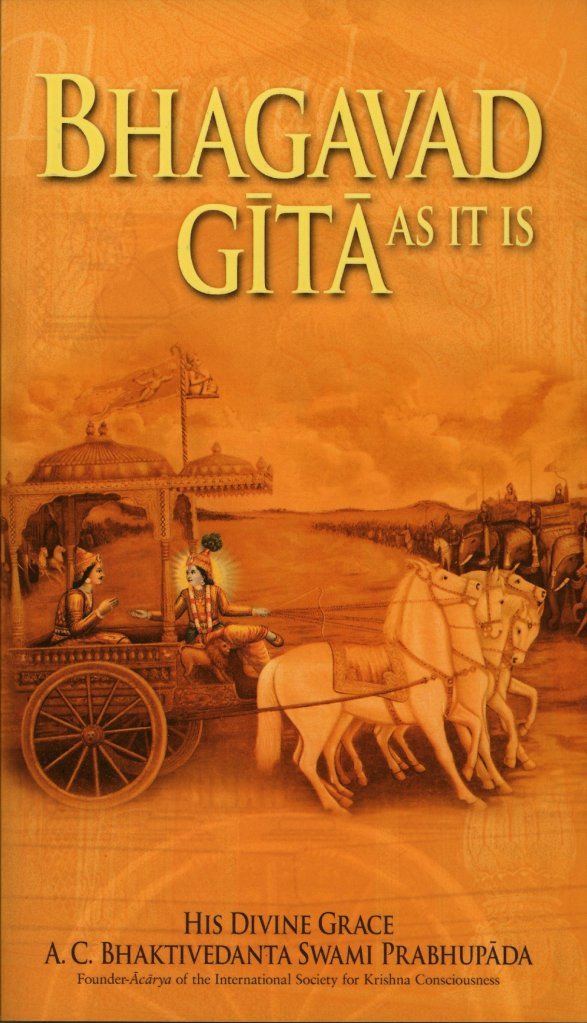
Join the Mission: Distribute 100,000 Bhagavad Gitas Worldwide

I reflect on a transformative spiritual journey that began 25+ years ago with the Bhagavad Gita As It Is, from a monk in Mumbai. Initially skeptical, I engaged, allowing the Gita to purify my heart through countless readings. Inspired by my benefactor, I set a goal to distribute 100,000 copies of the Gita. Through persistent outreach, I have successfully shared over 10,000 copies worldwide but I recognize the challenge ahead. I invite you to join in this great mission. Can you see the potential for worldwide transformational change as each inspired individual can significantly impact countless lives? Will you help?

Approximately twenty five years ago, I was a young, haughty engineer. I was also an atheist then. I got my copy of the Bhagavad Gita As It Is from a monk in Mumbai (then Bombay). He gave it to me free of charge. The story of my early spiritual journey is here.

The Perfect Escape Manual

Bhagavad Gita As It Is
Bhagavad Gita As It Is is the perfect escape manual for those trapped in the material realm.

I had read many editions of the Gita before, but they were more or less useless. I had discarded them. I had concluded that the Bhagavad Gita was complete nonsense. I planned to read and discard this one too. So I began to try and find the faults. This book ended up finding my faults, honestly.

My Journey with the Gita

As I travelled all over the world, my Gita went with me. Reflecting on the pure instructions of Krishna cleansed my consciousness. Reading the Bhagavad Gita hundreds of times, the clear writings of His Divine Grace A. C. Bhaktivedanta Swami Prabhupada purified my heart. I wasn’t speaking to anyone about spiritual life during those years. It was just me and the book…It was many years until I actually came into the association of the devotees. It was not just philosophy, but also a full manual to living life in a joyful spiritual way.

That interaction with our unknown hero, the Hare Krishna monk, has been the single most transformational one in my life.

Paying It Forward: The 100,000 Gita Goal

I began to gratefully consider how to respond… I didn’t know by benefactor by name or by face. I didn’t have any contact information for him. While I couldn’t do anything for him, I decided to pay it forward .

Impulsively, I think, at first, but with great conviction after, I picked a target to distribute 100,000 of those Bhagavad Gita As It Is, or equivalent. I don’t know how I came up with the number. But now it’s ingrained. I have committed this to myself. I have committed this to God. I have given my word to my Guru. I have asserted it to so many others. I’ve got to do it, or die trying.

It’s got to be done, the 100,000 Gitas or equivalent. And after 18 years of trying, I’m finally past the 10,000 mark. So 10% there. It’s not totally hopeless.

Testing a New Approach

But recently, I began to have a sneaking suspicion that I couldn’t do it alone. So I decided to test it out.

I continued to distribute Srila Prabhupada’s books as I did, hand-to-hand, person-to-person. I went into apartment buildings. I went to street corners. I went to busy intersections with a lot of people milling about. I approached strangers late at night. I distributed books on buses, trains, planes. I called people. I wrote online. I mailed books to people I’d met. Sometimes they gave me a donation. At other times I covered the cost of the books myself.

As I approach the end of my corporate career, I realized something important. I can’t continue to cover the costs myself for much longer!

The Reality of Spiritual Book Distribution

I quickly discovered that it’s almost impossible to even give spiritual books away. People who are uninterested or against the ideas in the books just do not want them. And to someone who is interested, they will gladly donate generously. There are the friends and family who have donated so much. There is the lady who emptied her bank account on a late night for a book that cost $1. Recently an auto mechanic did the “give you everything in my account right now” thing.

I also compared my hand-to-hand distribution score with the score I got from others’ help. And in the last few years, others have helped me distribute more books than I have distributed myself!

So this boils down the book distribution project down to finding interested people. An interested person wants a book for themselves. Or someone interested wants to help me distribute them to others.

I can only hit the 100,000 goal with others’ help!

The Numbers Don’t Lie

On average, whenever I go out to distribute books, very few people interact with me. Usually, about one in a hundred people will engage with me in any way. The interactions are on a wide spectrum. Some are quite positive. Some are nasty. Of those who do interact in any way, about one out of ten will take a book. Mostly it’s a small book. Rarely it is a Bhagavad Gita. And even more rarely, someone will get a full set of books, like the Srimad Bhagavatam, or the Chaitanya Charitamrita. All in all, it takes me about 10,000 attempts to distribute the equivalent of a single Bhagavad Gita.

My lifetime total is 100,000 Gitas. The last time I counted, I had about 90,000 to go.

The Impossible Math

Simple Math tells me that it will take me about 900,000,000 attempts. That is 900 Million. The human population of our planet is 8.2 Billion. I will need to approach 1 out of every 9 people on this planet. All this to distribute the equivalent of 90,000 Bhagavad Gitas hand-to-hand! This still sounds possible somehow, through my website, through my various outings all over the world.

But, given that a successful book distribution takes around 10 minutes on average including the unsuccessful interactions… that is 900,000 minutes, or 15,000 hours. I can presently go out 108 times a year. If each of my outings were to last just 2 hours, I’d need to go out 7,500 times. And at my current rate, that would take me another 70 years. I’m already over fifty years of bodily age in my current lifetime… It is unlikely I will live to be 120 years old! And even if I were to live that long, my “useful lifespan” would be much shorter than that.

Long story short. I really can’t do this alone. I need help.

Why can’t everyone just get the Gita for themselves?

That’s a valid question. After all, God helps those who helps themselves, right?Why should I or anyone else go through all this trouble? There are some key reasons why someone can’t get the Gita themselves:

  1. They don’t know about it yet – that’s why we reach out relentlessly
  2. They haven’t found a genuine edition of the Gita yet – most versions are full of motivated concoctions – I had read so many editions before, but that monk helped me get the pure message of the Gita, so can we help others
  3. They just can’t afford it – I know many souls who just can’t afford to buy the book, in India, in Africa, in South America, and elsewhere
  4. They don’t realize the value of the Gita – there are many who can very well afford to buy a copy, but don’t know the value – giving them a taste of the Gita will help them tremendously, and they will support the cause themselves

A donated copy of the Bhagavad Gita removes those barriers. Distributors can freely distribute to anyone who is interested.

That monk gave me a copy of the Bhagavad Gita As It Is free of charge. Someone sponsored that copy. So I have yet another unknown benefactor!

Being an Instrument

So how to do it?

It is not that I have to personally distribute the Bhagavad Gitas myself. I just need to be an instrument in the distribution of the Gitas. We know that Krishna advised Arjuna “nimitta-mātraṁ bhava“, “be but an instrument” (BG 11.33). Since the instructions of the Gita apply to all of humanity, they also apply to me, and to you. We can all choose to be instruments in the hands of God.

How can we be an instrument?

I can be an instrument if I can inspire a lot of people, each doing a little bit! And you can be an instrument if you choose to help.

We can be like a scalpel in the hands of the expert surgeon. We can work to remove the cancer of a Godless society together.

An Invitation for you to Join

य इदं परमं गुह्यं मद्भ‍क्तेष्वभिधास्यति ।
भक्तिं मयि परां कृत्वा मामेवैष्यत्यसंशय: ॥ ६८ ॥

ya idaṁ paramaṁ guhyaṁ
mad-bhakteṣv abhidhāsyati
bhaktiṁ mayi parāṁ kṛtvā
mām evaiṣyaty asaṁśayaḥ

For one who explains this supreme secret to the devotees, pure devotional service is guaranteed, and at the end he will come back to Me.

https://vedabase.io/en/library/bg/18/68/

न च तस्मान्मनुष्येषु कश्चिन्मे प्रियकृत्तम: ।
भविता न च मे तस्मादन्य: प्रियतरो भुवि ॥ ६९ ॥

na ca tasmān manuṣyeṣu
kaścin me priya-kṛttamaḥ
bhavitā na ca me tasmād
anyaḥ priya-taro bhuvi

There is no servant in this world more dear to Me than he, nor will there ever be one more dear.

https://vedabase.io/en/library/bg/18/69/

You, my dear reader, can surely help. If you help me, then together, we can change another 90,000 lives at least. The collateral improvement from this can be much bigger. Each of those lives can impact another 90,000, and each of those another 90,000… Don’t you want to save the world with Krishna’s wisdom from the Bhagavad Gita?

We can distribute Bhagavad Gitas anywhere on the planet. Whether it is Africa, or North America, or South America, Europe, Australia, or Asia. Any country in the world. Any of the 90+ languages the Bhagavad Gita is now available in.

Will you please help? das@dasadas.com

So you want to serve the needy?

Would you like to help others? How do you know you are actually helping them and not prolonging their misery? How do you know you are not getting entangled in an endless web of actions and reactions?

Some say “manava seve madhava seva“, which means “by serving the needy man, you serve God”. Let us examine this… if you feed the hungry, or clothe the naked, or try to heal the sick… will that actually help them? Sure, there is some temporary relief from the pangs of material suffering. If temporary relief is your goal, sure, but what if you want to really help them out of this mess they are in? You surely cannot feed, clothe, or shelter someone forever. Even if you did, you cannot protect them from old age, disease, and eventually death.

They are suffering primarily because they are spirit souls masquerading as material bodies. The material body gets hungry, gets sick, gets old, and dies, and this is the main cause of problems.

So yes, we can serve God by serving the souls, but how we serve them determines if we become the cause of their emancipation or the cause of their (and our own!) continued bondage.

The law of karma is very complicated, and impossible to trace out fully due to the immense complexity, but it is very very precise. It will surely pay back in just measure every single reaction to every single action.

So yes, eye for an eye, tooth for a tooth. Not to be administered by us, but we do become instruments of that, mostly unwittingly. What personal enmity did the soldiers from Nazi Germany have against the soldiers from America in the Second World War? Why did Guenter kill Billy? Why did Tommy kill Thorsten? They owed a debt to each other, one to kill, and one to be killed, and in that particular lifetime, one soul was born in Nazi Germany, and the other was born in America. Both were enlisted, and many souls’ karmic reactions came together and manifested as the Second World War.

Every single occurence in the world is simply an example of karmic debts… someone becomes a father, someone becomes a daughter, someone becomes the slaughtherer, someone becomes the slaughtered, and in this way, ad nauseum, someone becomes an exploiter, someone becomes the exploited.

Don’t believe me? OK, let us see, what could be the karmic reward for feeding a hungry man? To be fed yourself, maybe many times over, but being fed yourself primarily. And what does the person who was fed need to do? They need to repay their debt to you. This means that both to enjoy the benefit and to get paid back, both you and the person you fed need to take birth again. Birth again, old again, sick again, and surely death again.

Don’t forget that whatever you fed someone was also a living entity – whether seed, vegetable or animal. So, who pays the debt to that living entity. You both, benefactor and beneficiary.

Same with opening up hospitals – you will one day get free medical treatment yourself.

Opening up orphanages? You will be taken care of by benevolent strangers when you become an orphan yourself.

Any philanthropic activity on the material platform results in such karmic bondage, subtle or gross.

All this sounds depressing, no?

How to actually help someone? It is commonly understood that teaching someone to farm is far better than just feeding them a few meals. Knowing that each living entity is actually spiritual in nature wearing a material covering. It then stands to reason that teaching them to shed the material covering, or in other words, helping them be purely spiritual, that is the way to actually help someone.

Want to help someone? Help them be truly spiritual through your help, let them begin their journey back home. This starts with being purely spiritual yourself. If you cannot do this, then you can continue your philanthropy, don’t stop it, because one day you may progress further…

श्रेयो हि ज्ञानमभ्यासाज्ज्ञानाद्ध्यानं विशिष्यते ।
ध्यानात्कर्मफलत्यागस्त्यागाच्छान्तिरनन्तरम् ॥ १२ ॥

śreyo hi jñānam abhyāsāj
jñānād dhyānaṁ viśiṣyate
dhyānāt karma-phala-tyāgas
tyāgāc chāntir anantaram

If you cannot take to this practice, then engage yourself in the cultivation of knowledge. Better than knowledge, however, is meditation, and better than meditation is renunciation of the fruits of action, for by such renunciation one can attain peace of mind.

https://vedabase.io/en/library/bg/12/12/

So if you want to renounce the fruits of action, that is OK, but know that there is more, such as cultivation of knowedge, but the real deal – realized knowledge, you need to live your knowledge. Even better than the cultivation of knowledge is meditation, and what is the highest?

Being purely conscious of Krishna is higher.

What is even still higher?

And even higher?

And the highest?

मय्येव मन आधत्स्व मयि बुद्धिं निवेशय ।
निवसिष्यसि मय्येव अत ऊर्ध्वं न संशय: ॥ ८ ॥

mayy eva mana ādhatsva
mayi buddhiṁ niveśaya
nivasiṣyasi mayy eva
ata ūrdhvaṁ na saṁśayaḥ

Just fix your mind upon Me, the Supreme Personality of Godhead, and engage all your intelligence in Me. Thus you will live in Me always, without a doubt.

https://vedabase.io/en/library/bg/12/8/

Ultimately however, this the way to please God the most…

Generally it is advised that Bhagavad-gītā be discussed amongst the devotees only, for those who are not devotees will understand neither Kṛṣṇa nor Bhagavad-gītā. Those who do not accept Kṛṣṇa as He is and Bhagavad-gītā as it is should not try to explain Bhagavad-gītā whimsically and become offenders. Bhagavad-gītā should be explained to persons who are ready to accept Kṛṣṇa as the Supreme Personality of Godhead. It is a subject matter for the devotees only and not for philosophical speculators. Anyone, however, who tries sincerely to present Bhagavad-gītā as it is will advance in devotional activities and reach the pure devotional state of life. As a result of such pure devotion, he is sure to go back home, back to Godhead.

https://vedabase.io/en/library/bg/18/68/

Want to read more? Try this.

Help others, truly help them, start by helping yourself first.

You can start by chanting this purely spiritual mantra, even if just once:

Hare Krishna Hare Krishna

Krishna Krishna Hare Hare

Hare Rama Hare Rama

Rama Rama Hare Hare

The Maha Mantra, the Great Mantra for Deliverance from Material Bondage and Development of Pure Spiritual Nature

Try it out. Help me help others. Please let me know I may serve you on your spiritual journey.