Beyond the Gates of Puri: The True Meaning of Jagannath
Lord Jagannath is the Lord of the Universe. He is not merely a regional deity, nor is He just Panda nath (the Lord of the priests), Orissa Nath (the Lord of Odisha), Hindu Nath, or even Bharat Nath (the Lord of India). His very name declares His eternal identity: Jagannath! The Lord of the entire cosmos.
This universal parenthood is confirmed by the Lord Himself in the Bhagavad Gita (9.17), where He declares:
pitāham asya jagato mātā dhātā pitāmahaḥ
“I am the father of this universe, the mother, the support and the grandsire.”
Because He is the Supreme Parent of the entire creation, His love cannot be boxed in. For centuries, however, His presence seemed restricted to the holy city of Puri. The local priests (Pandas) enforced rigid rules, limiting entry into His ancient temple strictly to those born into Hindu families.
But this restriction completely contradicts the very essence of the Lord’s teachings. In the Bhagavad Gita (14.4), Krishna states:
sarva-yoniṣu kaunteya mūrtayaḥ sambhavanti yāḥ / tāsāṁ brahma mahad yonir ahaṁ bīja-pradaḥ pitā
“It should be understood that all species of life, O son of Kuntī, are made possible by birth in this material nature, and that I am the seed-giving father.”
If He is the seed-giving father of all living entities, how can His mercy be determined by the temporary body one is born into? This bodily designation unfortunately excluded millions of spiritual seekers worldwide, even those who look like they are from other races, or those who have sincerely adopted Sanatana Dharma and the Vedic way of life.
But the Father of the Universe cannot be contained forever behind stone walls or inside closed hearts.
A Note of Gratitude: Obeisances to the Guardians of Puri
While we celebrate the global expansion of this mercy, we must do so with a heart full of humility and profound gratitude.
Though the external rules of the temple may seem restrictive to the outside world, we cannot overlook the unimaginable debt we owe to the Pandas of Jagannath Puri. For thousands of years, through brutal foreign invasions, political upheavals, and the decaying influence of the age of Kali, they have meticulously, flawlessly preserved the purity of this ancient tradition.
They have guarded the standards of worship, the secret recipes of the Chappan Bhog, and the sacred rituals of the Lord with their very lives. Many of these priests are genuine, deep oceans of Lord Jagannatha’s causeless mercy, carrying a lineage of pure devotion that spans generations. It is because they kept the flame burning so bright in Puri that the rest of the world was eventually able to catch its spark.
To their lotus feet, I offer my most humble, prostrated obeisances.

The 1967 San Francisco Miracle
Everything changed in 1967, thousands of miles away from Puri, in the heart of San Francisco. Lord Jagannath chose an extraordinary way to break His geographical confinement.
He appeared to Malati Devi, a young American disciple of His Divine Grace A.C. Bhaktivedanta Swami Prabhupada, as a small wooden figurine in a local import store. Recognizing the Lord, Srila Prabhupada immediately set a global revolution of grace into motion. He commissioned his disciple Shyamsundar Prabhu to carve large, beautiful Deities of Lord Jagannath, Baladeva, and Subhadra.
That same year, Srila Prabhupada organized the very first Ratha Yatra festival outside of India. Because of this historic event, San Francisco shall forever be known as New Jagannatha Puri, the sacred launchpad for the Lord’s global journey.
The Architects of Grace: A Tribute to the Pioneers
We owe an eternal debt of gratitude to the pure souls who built the tracks for this chariot of mercy to roll across the earth:
- Srila Prabhupada: The visionary commander who carried the Lord of the Universe across the ocean in his heart, shattering centuries of geographic confinement.
- Malati Devi: The pure, simple-hearted instrument whose curiosity brought the Lord to light in the Western world.
- Shyamsundar Prabhu: The master craftsman whose hands tirelessly carved the very first forms of the Lord out of logs of wood outside India.
- Jayananda Prabhu: The “King of Ratha Yatra,” whose absolute humility, infectious joy, and tireless manual labor built the very first carts in San Francisco and established the blueprint for how the Lord enters the streets of the world.
Furthermore, we offer our deepest respects to every single soul around the world who has ever helped organize a Ratha Yatra. Whether you are cutting vegetables in the kitchen, sweeping the roads before the cart, pulling the heavy ropes, navigating city permits, or financing the festival, you are a direct instrument in the hands of the Lord.

From a “Recovering Atheist” to a Servitor: A Personal Witness
If you need living proof of this causeless, boundary-breaking mercy, you don’t have to look far. You can look at me.
By all traditional rules of lineage, orthodoxy, and past karma, I should have no place near the chariot of Lord Jagannatha. I am a wretched, recovering atheist. I wasn’t born into a traditional Panda family, nor did I have any strong cultural claim to this ancient tradition.
Yet, far removed from Puri, right here in Toronto, the Lord of the Universe claimed me anyway. Because He is pitāham asya jagato, the father of the universe, He doesn’t care about my disqualifications.
Since 2004, year after year, I have found myself drawn to the ropes of His chariot. Over the decades, something completely miraculous happened: instead of just being kept at a distance, I was embraced, accepted, and trained up to be one of His actual personal servitors.
Since Lord Jagannath is transcendental no matter where He is, He has welcomed me, an undeserving fool into the family of His Pandas! Of course, I understand that the hereditary descendants may not accept me as such. I do not wish to impose upon them.
Regardless, the expansion is happening right now, right in our backyards. This year alone, I will be attending and serving at six different Ratha Yatras, watching the Lord flood the streets of cities that the priests could never have imagined:
- Toronto
- Ottawa
- Waterloo
- Scarborough
- Brampton
- …and more.
36 Ratha Yatras in Canada alone, in 2026! How many can a tiny little jiva attend?
The Inconceivable Benefits of the Chariot Festival
Why do we exhaust ourselves putting these massive festivals together year after year? Because Ratha Yatra is a undeserved gift of spiritual merit. It is a public distribution of the highest benedictions, accessible to anyone who interacts with the festival in even the slightest way:
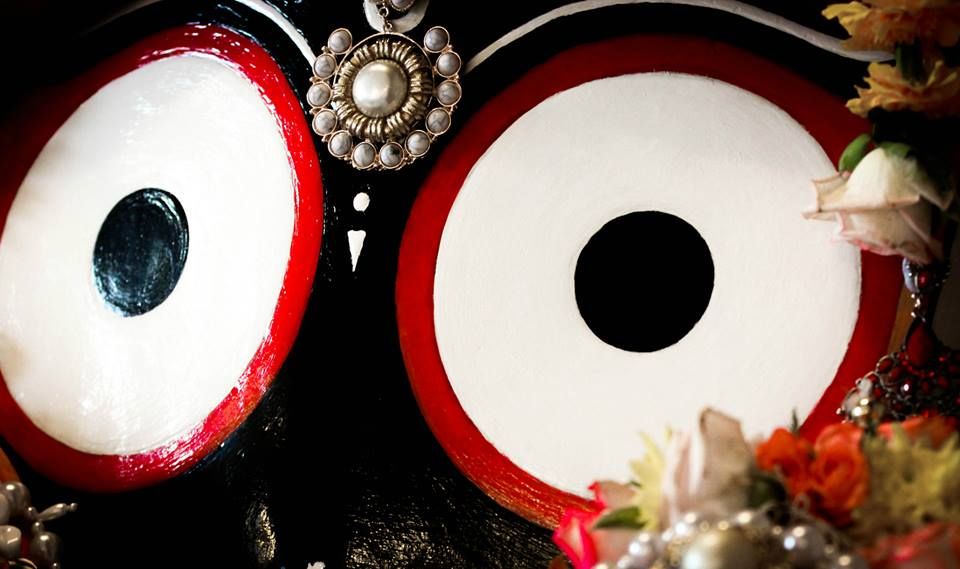
- Beholding the Lord on His Chariot: The scriptures declare, “Rathe tu vamanam drstva punar janma na vidyate”. Simply by seeing the Lord upon His chariot, a person is freed from the painful cycle of repeated birth and death. Even a momentary glance at His large, lotus eyes washes away lifetimes of karma.
- Pulling the Ropes: To pull the ropes of Lord Jagannath’s chariot is to pull the Lord directly into your own heart. This intimate act of service breaks the heavy chains of material attachment, eradicates past sins, and awakens dormant love of God.
- The Dust of the Wheels: The very ground the chariot rolls upon becomes a transcendental sacred space. Anyone who is touched by the dust raised by the massive wheels of the chariot is instantly purified of material contamination.
- Dancing and Chanting: Taking steps in the procession, dancing wildly, and chanting the holy names before the cart is considered the pinnacle of spiritual execution. Every step taken alongside the Lord’s chariot equals the merit of performing countless sacred pilgrimages.
- Honoring His Mahaprasadam: The sanctified remnants of Lord Jagannath’s feast are non-different from the Lord Himself. To taste even a single morsel of this spiritual nectar instantly purifies the senses, liberates the consciousness, and destroys the material disease. Jagannath Prasadam is so incredibly potent that it transcends all mundane rules of caste, time, space, or external cleanliness.
A Global Flood of Causeless Mercy
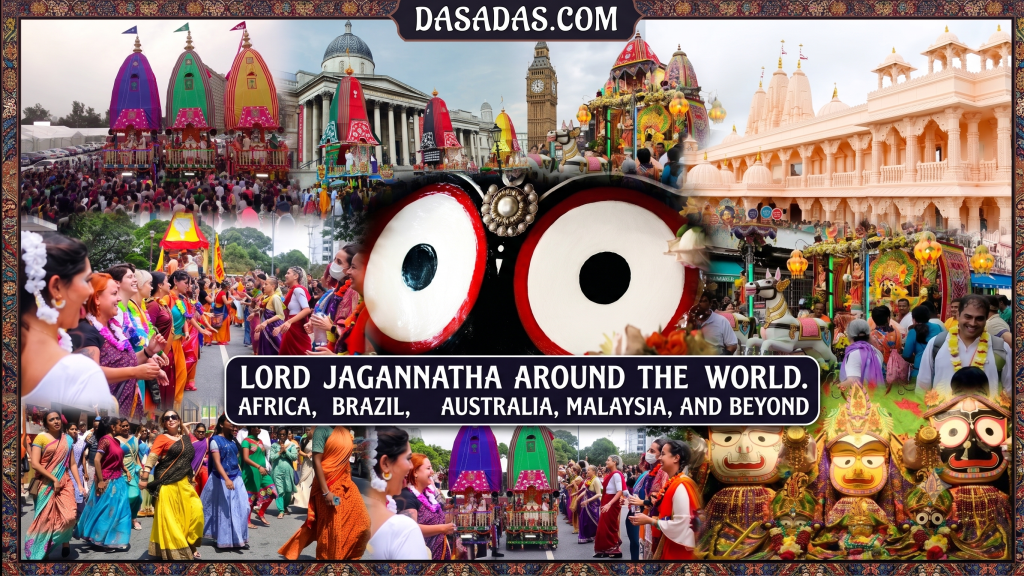
Following that initial 1967 breakthrough, Lord Jagannath’s mercy spread like wildfire across every inhabited continent… from North and South America to Europe, Australia, Asia, and deeply into Africa.
The true beauty of Jagannath’s Ratha Yatra is that His mercy completely defeats the analytical mind and penetrates straight to the soul.
People from the villages of Africa to the bustling metropolises of the West will catch a glimpse of His large, lotus eyes, take a morsel of His maha maha prasadam, or hear the echoing chant of His holy names. They will be showered with a torrent of spiritual advancement and eternal benefit completely oblivious to just how much causeless mercy they have received.
We are marching toward a day when the mercy of Jagannath will extend to every single town and village on Earth. Even before that day fully arrives, the restrictions of the Puri temple no longer matter. Lord Jagannath has expanded Himself dynamically across the globe; every soul, no matter how unqualified, how downfallen, or how deeply buried in skepticism, can receive His grace.
This phenomenon is a magnificent, undeniable glimpse into the predicted 10,000-year Golden Age of Sri Chaitanya Mahaprabhu on our planet.
A Humble Appeal to the Guardians of the Dham
With these global realities in front of us, we look back toward the root of our tradition, the sacred soil of Puri. With the utmost respect, humility, and reverence for the ancient systems of worship, we make a heartfelt appeal to the revered temple authorities, the senior Pandas, and the administrators of the Lord Jagannath Temple in Odisha.
Please, open the doors of the temple to all of Lord Jagannath’s children.
The Lord has explicitly declared in the Gita that He is the seed-giving father of every living being. Millions of souls across the globe, in Africa, Europe, the Americas, and beyond have given up the habits of the West, embraced Sanatana Dharma, and dedicated their lives, their families, and their wealth to the service of Jagannath. They are His children in spirit, in truth, and in deep love.
When these sincere devotees travel across oceans to the holy dham, only to be stopped at the gate because of the color of their skin or the geography of their birth, it breaks the heart of the global Vaishnava community. More importantly, we must ask: does it not restrict the universal magnanimity of Jagannath Himself?
The Lord already breaks His own rules once a year during Ratha Yatra, stepping out onto the dusty roads to embrace the “untouchable”, the foreigner, and the uninitiated. We humbly pray that the doors of His earthly home may finally reflect the boundless, infinite architecture of His heart. Let the world witness the ultimate glory of Sanatana Dharma by welcoming every sincere seeker into the presence of the Lord of the Universe.
Jaya Jagannath! All glories to the Lord of the Universe!