

In the last Christmas/New Year’s holiday season, we went up to Huntsville, a town further north from Toronto. I was scheduled to deliver a class there. We decided to make a mini-holiday in the winter wonderland that is Muskoka.

During a snowstorm, I decided to take a short walk around the cottage. Big snow! I was practically wading through it. Out of nowhere, this fierce barking dog started chasing me! I kept walking along the road, the dog ran towards me and then started running parallel to me! He was barely 3 feet from me. The fellow kept barking fiercely, teeth bared. Something, almost magical, kept the dog away from me. I was thinking at least I had winter gear on – it won’t be as painful… Later I realized it was an “invisible fence” that saved me.

The dog barked and barked until I left it’s “territory”, continuing on my walk, quietly chanting the names of God.
What made the dog behave like that? What had I done to it? Did I not look right to him? Did I not smell right? But I was just a harmless tourist, renting a cottage a few doors down. I’d be gone in a couple of days.
People behave just like that… especially at the border. Bow-wow, where are your papers? Do you have your passport? Do you have a visa? Do you have enough money to spend while you’re here? When will you leave? Why are you here? What are you bringing with you?

But ordinary people also behave like that. Decades ago, when I was a young software engineer in Germany for a project, nice old ladies on the train would ask me questions. Hallo, ver do you come from? Vot verk do you make hier? Ent, ven you go beck? Almost every person would ask me that, first three questions. Some continued to speak further, but most people would stop after those three questions.

Nationalism is seeing a surge around the world these days. It is not a very spiritual thing.
nationalism /năsh′ə-nə-lĭz″əm, năsh′nə-/
noun
- Devotion, especially excessive or undiscriminating devotion, to the interests or culture of a particular nation-state.
- The belief that nations will benefit from acting independently rather than collectively, emphasizing national rather than international goals.
- The belief that a particular cultural or ethnic group constitutes a distinct people deserving of political self-determination.
If someone is not a nationalist, they are looked down upon.
Now, I will say something that is unpopular…
What is the difference betweeen the behavior of a nationalist, and a dog?
Let’s say a new dog or cat or a person came into the “territory” of the dog. What would the dog do?

Bow-Wow! Grrrooowwwl! Teeth bared. What are you doing here? This is MINE! GO away!
Maybe the dog goes on the attack! Tries to rip the intruder apart!
Let’s say the dog’s master comes into the “territory” of the dog. What would the dog do?

Wag tail. Jump high. Happy little barks, squeals too. Lick, lick. Welcome home sir, what can I do for you?
Now, if I ask you again, what is the difference between a nationalist, and a dog?
I have nothing against dogs! Dogs will be dogs. They have no choice in the matter as long as they are in the body of a dog. But us, humans? Why do we have to be like dogs?
But the thing is, nothing “belongs” to the dog! In fact, the dog, as an animal, belongs to his human owner.
We are exactly the same. We “belong” to God!
क्षेत्रज्ञं चापि मां विद्धि सर्वक्षेत्रेषु भारत ।
क्षेत्रक्षेत्रज्ञयोर्ज्ञानं यत्तज्ज्ञानं मतं मम ॥ ३ ॥
kṣetra-jñaṁ cāpi māṁ viddhi
sarva-kṣetreṣu bhārata
kṣetra-kṣetrajñayor jñānaṁ
yat taj jñānaṁ mataṁ mamaO scion of Bharata, you should understand that I am also the knower in all bodies, and to understand this body and its knower is called knowledge. That is My opinion.
Srila Prabhupada writes in the purport…
Because each individual soul has his individual capacity for lording it over material nature, there are different bodies. But the Supreme also is present in them as the controller. The word ca is significant, for it indicates the total number of bodies. That is the opinion of Śrīla Baladeva Vidyābhūṣaṇa. Kṛṣṇa is the Supersoul present in each and every body apart from the individual soul. And Kṛṣṇa explicitly says here that real knowledge is to know that the Supersoul is the controller of both the field of activities and the finite enjoyer. – A. C. Bhaktivedanta Swami Prabhupada in purport to https://vedabase.io/en/library/bg/13/3/
Lest someone thinks that they “own” something, they do not. God, Krishna is the owner of everything, and only a small portion is assigned as our “quota”. We have no right to claim something that belongs to God, like the nationalists do.
Now, let’s say a friendly dog comes to the dog’s area… again, a similar welcome.
ईशावास्यमिदँ सर्वं यत्किञ्च जगत्यां जगत् ।
तेन त्यक्तेन भुञ्जीथा मा गृधः कस्य स्विद्धनम् ॥ १॥īśāvāsyam idaḿ sarvaṁ
yat kiñca jagatyāṁ jagat
tena tyaktena bhuñjīthā
mā gṛdhaḥ kasya svid dhanamEverything animate or inanimate that is within the universe is controlled and owned by the Lord. One should therefore accept only those things necessary for himself, which are set aside as his quota, and one should not accept other things, knowing well to whom they belong.
A nationalist competes fiercely against those of other nations. A nationalist is so entrapped in the material identity that they cannot see others as spiritual beings, even if they are in human bodies!
But what is this “devotion” and “love” based on? It is simply based on a bodily identity. I am Indian, I am Pakistani, I am Chinese, Russian, American, you name it!

How are you, dear Indian, different from the Pakistani? You eat practically the same food, you talk practically about the same things, you even speak the same languages sometimes. You follow the same type of religion. You worry about the same things. You have brown skins, both Indians and Pakistanis. Yes, there are some differences. One of you bears a Pakistani Passport, and the other bears an Indian passport. Yes, those pieces of paper are different. But when you come to America you will be treated the same, whether you are Indian or Pakistani. And thanks to the different papers, bow wow, how dare you.

- Same with the Russians and the Ukranians.
- Same with the Israelis and the Palestinians.
- Same with the Dinka and the Nuer in South Sudan.



The problem? Bodily Consciousness.
The thinking that I am this body and everything related to this body is mine.
यस्यात्मबुद्धि: कुणपे त्रिधातुके
स्वधी: कलत्रादिषु भौम इज्यधी: ।
यत्तीर्थबुद्धि: सलिले न कर्हिचि-
ज्जनेष्वभिज्ञेषु स एव गोखर: ॥ १३ ॥
yasyātma-buddhiḥ kuṇape tri-dhātuke
sva-dhīḥ kalatrādiṣu bhauma ijya-dhīḥ
yat-tīrtha-buddhiḥ salile na karhicij
janeṣv abhijñeṣu sa eva go-kharaḥOne who identifies his self as the inert body composed of mucus, bile and air, who assumes his wife and family are permanently his own, who thinks an earthen image or the land of his birth is worshipable, or who sees a place of pilgrimage as merely the water there, but who never identifies himself with, feels kinship with, worships or even visits those who are wise in spiritual truth — such a person is no better than a cow or an ass.
To be a nationalist, is, really, to be an animal in human form.
We can rise above this, and see each other as spirit souls. Each of us is a part-and-parcel of God.
ममैवांशो जीवलोके जीवभूत: सनातन: ।
मन:षष्ठानीन्द्रियाणि प्रकृतिस्थानि कर्षति ॥ ७ ॥mamaivāṁśo jīva-loke
jīva-bhūtaḥ sanātanaḥ
manaḥ-ṣaṣṭhānīndriyāṇi
prakṛti-sthāni karṣatiThe living entities in this conditioned world are My eternal fragmental parts. Due to conditioned life, they are struggling very hard with the six senses, which include the mind.
Not just human beings, but all species are descended from the same seed-giving Father, God!
सर्वयोनिषु कौन्तेय मूर्तय: सम्भवन्ति या: ।
तासां ब्रह्म महद्योनिरहं बीजप्रद: पिता ॥ ४ ॥sarva-yoniṣu kaunteya
mūrtayaḥ sambhavanti yāḥ
tāsāṁ brahma mahad yonir
ahaṁ bīja-pradaḥ pitāIt should be understood that all species of life, O son of Kuntī, are made possible by birth in this material nature, and that I am the seed-giving father.
How to see each other?
विद्याविनयसम्पन्ने ब्राह्मणे गवि हस्तिनि ।
शुनि चैव श्वपाके च पण्डिता: समदर्शिन: ॥ १८ ॥vidyā-vinaya-sampanne
brāhmaṇe gavi hastini
śuni caiva śva-pāke ca
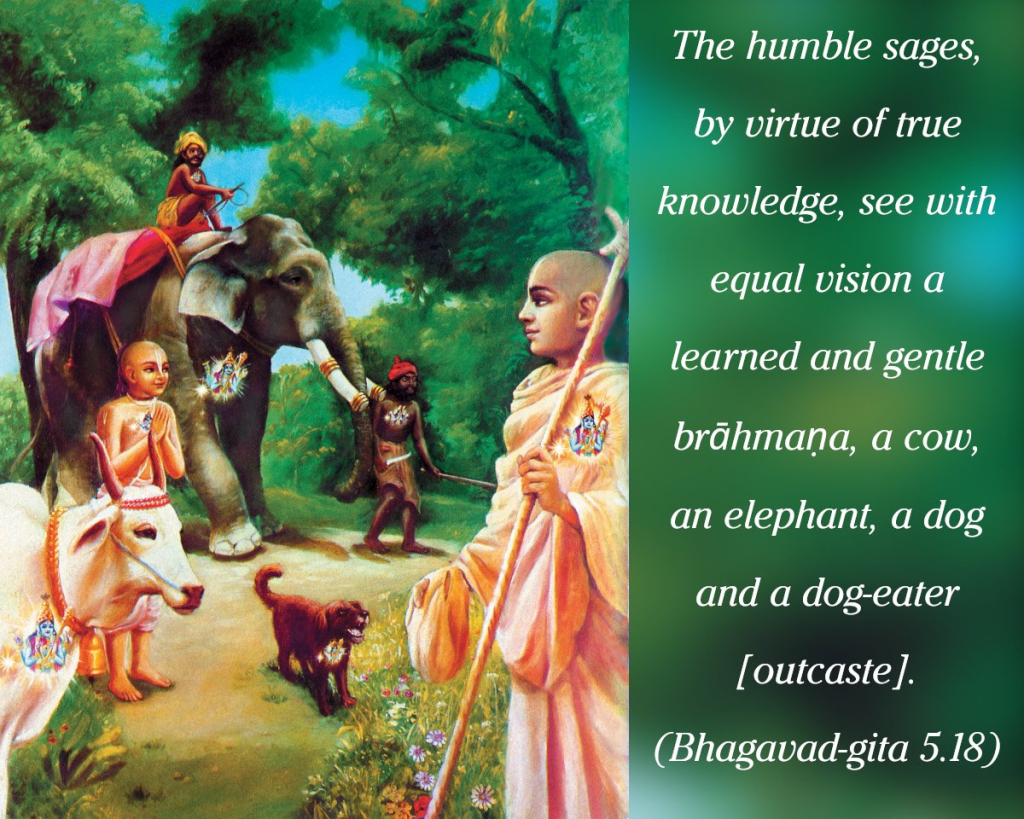
paṇḍitāḥ sama-darśinaḥThe humble sages, by virtue of true knowledge, see with equal vision a learned and gentle brāhmaṇa, a cow, an elephant, a dog and a dog-eater [outcaste].
And this is the only way to be happy and peaceful…
ब्रह्मभूत: प्रसन्नात्मा न शोचति न काङ्क्षति ।
सम: सर्वेषु भूतेषु मद्भक्तिं लभते पराम् ॥ ५४ ॥brahma-bhūtaḥ prasannātmā
na śocati na kāṅkṣati
samaḥ sarveṣu bhūteṣu
mad-bhaktiṁ labhate parāmOne who is thus transcendentally situated at once realizes the Supreme Brahman and becomes fully joyful. He never laments or desires to have anything. He is equally disposed toward every living entity. In that state he attains pure devotional service unto Me.
This article was inspired by the following excerpt of a conversation with Srila Prabhupada, the Guru of my Guru.
Prabhupāda: Ah. The bodily consciousness is also material. That is also one. And the soul consciousness, spiritual, that is also one. That is ekatvam. So for a learned person there is no defect. Vidyā-vinaya-sampanne brāhmaṇe gavi hastini, paṇḍitaḥ samaḥ (BG 5.18). This is the . . . so anyone who is under the bodily conception of life, either human being or dog, they are the same. But that upādhi amongst human being is stronger than the cats and dogs. The human being, being advanced in consciousness, they are making this nationalism. But it is nothing but dogism. Is it not? That’s all. The so-called national people are sacrificing so many lives, so many politicians, Napoleon and these big, big leaders. But what is their business? Business is that doggish mentality, “I am this body.” So it is very difficult to give up this doggish mentality that, “I am this body.” Very, very difficult.
Dr. Patel: That is ahaṅkāra.
Prabhupāda: False ahaṅkāra. Because he is not body, it is false ahaṅkāra. So śāstra therefore says, bhagavad-bhakti hīnasya jātiḥ japas tapaḥ kriya (Hari-bhakti-sudhodaya 3.11). A person who has not developed Kṛṣṇa consciousness, for him this advancement of nationality, big work, industry, so on, so on, so on, jati japas tapaḥ kriya . . . Kriya, these act . . .
Dr. Patel: Activities.
Prabhupāda: What are these? Aprāṇasya hi dehasya maṇḍanaṁ loka-rañjanam. It has no value. It has no value. But people are enamored by these things, “I belong to great nation. I am American. We have got so many industries. We have got so many cars.” Attachment. So it is very difficult. Sarvopādhi-vinirmuktaṁ (CC Madhya 19.170). One, after becoming completely freed from all these false designations, to become a devotee is very, very difficult. There is no education. https://vanisource.org/wiki/751112_-_Morning_Walk_-_Bombay?hl=dogism
Dear Reader, please be who you are, an eternal, blissful and knowledgeable Spirit Soul, a part-and-parcel of God.
Hare Krishna!
 Freedom through Genuine Spiritual Progress