Why a Dog? And Why Blind? Unpacking Purandara Dasa’s Master Metaphor

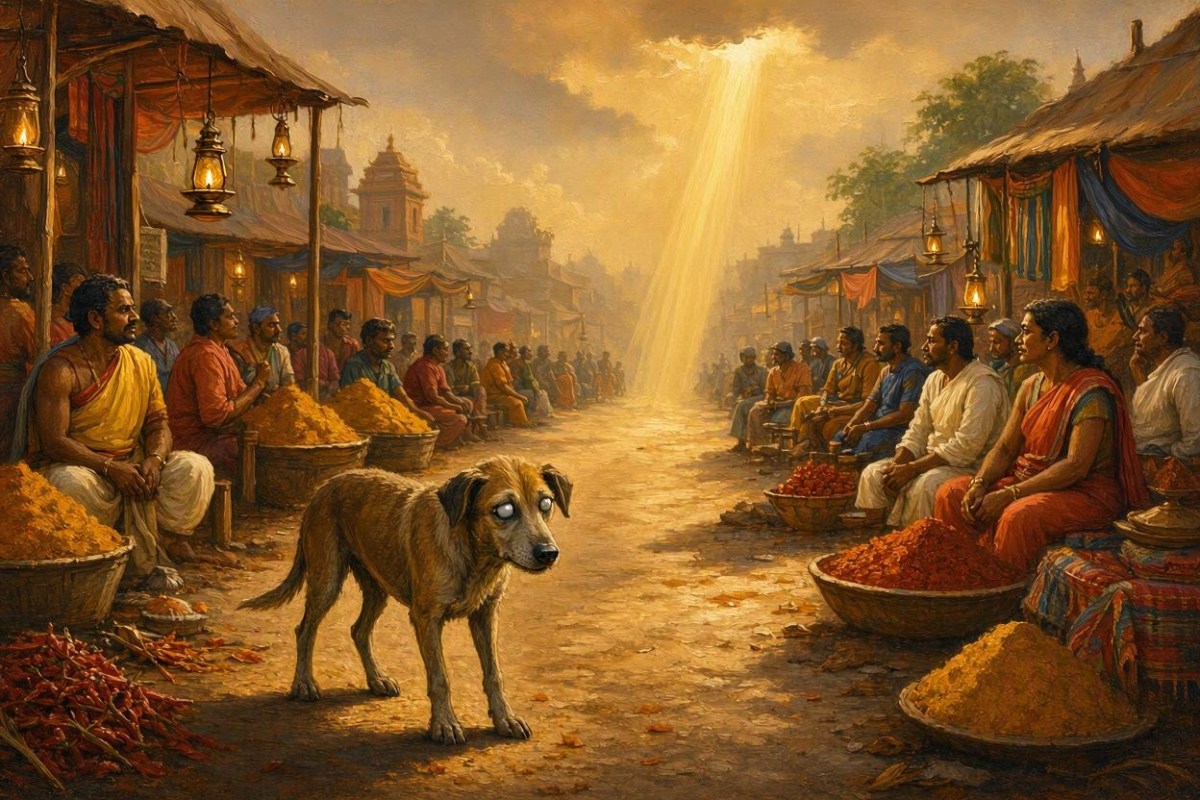
Why would a 16th-century saint-poet choose a blind street dog wandering into a crowded village market to describe the human condition? In my previous post, we explored Purandara Dasa’s masterclass in spiritual psychology, Kurudu Naayi Santege Bantante. But behind this allegory lies a deeper question: out of 8.4 million species of life, why specifically a dog? And why blind?

Today, we peel back the layers of this brilliant metaphor. By examining raw animal behavior alongside timeless Vedic scriptures, we discover an uncomfortable truth: this sightless, wandering dog isn’t just poetry, it is a mirror holding up our own lives.

In a previous post, A blind dog comes to the fair, I promised you a more detailed exploration of the 16th-century saint-poet Purandara Dasa’s timeless song, “Kurudu Naayi Santege Bantante”.

In this article, we will focus on the sheer genius of his chosen imagery: Why did he specifically choose a “dog”? And why a “blind dog” at that? This is what we’re focusing on n this article.

ಕುರುಡು ನಾಯಿ ಸಂತೆಗೆ ಬಂತಂತೆ
ಅದು ಯಾತಕೆ (ಯಾಕೆ) ಬಂತೋ

kuruḍu nāyi santege bantante

adu yāke bantō

A blind dog stumbled to the bustling fair,

With sightless eyes and an aimless tread;

Ah, who can say what brought it to the market square,

Or by what strange desire it was led?

Though it is impossible to fully grasp the inner depth and complete import of a great saint like Purandara Dasa, we can make a humble attempt to understand the brilliant lessons hidden inside this poignant analogy, and see how it directly mirrors the wisdom of the Śrīmad-Bhāgavatam and Bhagavad-gītā.

Translating High Philosophy into Everyday Street Language

The profound truths contained in Sanskrit scriptures like the Bhagavad-gītā and Śrīmad-Bhāgavatam can sometimes feel distant or abstract to ordinary people busy navigating the struggles of daily life. This is where the compassionate genius of saint-poets like Purandara Dasa shines.

As a prominent leader of the Haridasa movement and the father of Carnatic music, Purandara Dasa made it his mission to take high Vedantic philosophy out of exclusive scholastic circles and bring it straight to the streets. Instead of overwhelming everyday listeners with dense technical terminology, he wrapped timeless spiritual psychology in raw, unforgettable, real-world imagery.

By recasting Samsara (the endless cycle of material birth and death) as a noisy, chaotic village fair (sante), and the illusioned spirit soul as a blind dog wandering through it, Purandara Dasa transformed complex theology into a vivid wake-up call that anyone, from a scholar to a street vendor could immediately grasp and feel in their heart.

Out of 8,400,000 Species of Life, Why a “Dog”?

According to Vedic knowledge, the soul travels through 8.4 million species of life across endless cosmic cycles. So why did Purandara Dasa select a dog to represent the soul adrift in the material world?

A dog possesses a psychological profile that uncannily reflects conditioned human nature. In fact, in the commentary to Śrīmad-Bhāgavatam 2.3.19, the acharyas detail these exact traits: a dog wags its tail for anyone who offers a scrap of bread, barks fiercely at strangers, submits completely to a stronger opponent by rolling on its back, yet fights bitterly over a bone with its equals, and mercilessly subdues the weak.

Purandara Dasa draws on these precise characteristics to hold up a mirror to our own lives:

  1. Very Relatable: Dogs have lived alongside human society since antiquity, making their behavior instantly recognizable to all of us.
  2. Fickle Faithfulness: A dog exhibits intense devotion, but primarily to whoever provides it with immediate sensory gratification or food.
  3. Hostile to Strangers: It barks at, mistrusts, and attacks anyone outside its familiar circle.
  4. Unpredictable Loyalty: Despite its reputation for loyalty, a dog can unexpectedly turn on and bite the very master who feeds it.
  5. Fiercely Territorial: It is especially inimical to competitors, viciously guarding its small patch of dirty pavement or territory.
  6. Flattering to the Strong: It knows how to be submissive, rolling over and flattering a proven stronger opponent to avoid a thrashing.
  7. A Dog-Eat-Dog World: When survival is on the line, dogs can be ruthless. Take Jack London’s The Call of the Wild, when sled dogs fight, the loser, even if stronger than the rest, ends up torn to shreds and eaten by the rest of the pack.
  8. Endless Sensory Greed: A dog is perpetually greedy, sniffing around for new sensory experiences, pacing endlessly with its tongue hanging out.

We Are Like That Dog

When we examine this list honestly, a sobering realization hits home: we are like that dog.

(If my use of the word “we” throughout this article felt presumptuous or brought any offense, please forgive me. I speak first and foremost of myself and those who share in my struggles.)

In our material conditioning, we are experts at making high-minded resolutions, but terrible at living up to them.

Imagine a dog sitting on a foul heap of garbage, quietly pondering, seemingly reconsidering its life choices after finding nothing of value. The very moment someone throws a fresh bag of new garbage onto the heap, off the dog runs to investigate.

We do the exact same thing. We recognize the emptiness of worldly pursuits, vow to pursue a higher spiritual life, and then abandon our resolve the instant a shiny new distraction is tossed into our path.

Lord Kapila describes this tragic loop of worldly attachment in Śrīmad-Bhāgavatam 3.30.20:

तत्राप्यनाथवत् क्षेत्रे गृहेत्ताभिरुपेक्षितः ।

यथा गृहे शुनाहारमुपानीतमश्नन् भूङ्क्ते ॥

tatrāpy anāthavat kṣetre gṛhe tābhir upekṣitaḥ

yathā gṛhe śunāhāram upānītam aśnan bhūṅkte

Translation: “In old age, neglected by the very family members he spent his entire life maintaining, he remains at home like a pet dog (śunā), eating whatever few scraps are reluctantly thrown to him.”

We slave our entire lives for material attachments, only to wind up like an old household dog, taking whatever scraps our illusory masters toss our way. From top dog to a nobody.

But Why Blind?

Purandara Dasa didn’t just choose a dog; he wrote about a blind dog wandering into the middle of a chaotic village fair.

A dog naturally relies heavily on its smell, but it uses vision to navigate safely. A blind dog can “smell” something delicious sitting inside a shop stall, but it cannot see the danger standing in its path, the heavy carts, the narrow traps, or the vendor holding a stick. Driven purely by its nose, it marches straight into a beating.

This spiritual blindness is a central theme throughout Vedic literature. In Śrīmad-Bhāgavatam 7.5.31, Prahlāda Mahārāja poignantly describes the tragic state of souls who lack spiritual vision:

न ते विदुः स्वार्थगतिं हि विष्णुं दुराशया ये बहिरर्थमानिनः ।

अन्धा यथान्धैरुपनीयमानाः तेऽपीशतन्त्र्यामुरुदाम्नि बद्धाः ॥

na te viduḥ svārtha-gatiṁ hi viṣṇuṁ

durāśayā ye bahir-artha-māninaḥ

andhā yathāndhair upanīyamānāḥ

te ‘pīśa-tantryām uru-dāmni baddhāḥ

Translation: “Persons who are strongly entrapped by the consciousness of enjoying material life do not know that the ultimate goal of human life is Lord Viṣṇu. Like blind men led by another blind man (andhā yathāndhaiḥ), they fall off the path and remain tightly bound by the strong ropes of material nature.”

This loss of vision is described in Bhagavad-gītā 2.67:

इन्द्रियाणां हि चरतां यन्मनोऽनुविधीयते ।

तदस्य हरति प्रज्ञां वायुर्नावमिवाम्भसि ॥

indriyāṇāṁ hi caratāṁ yan mano ‘nuvidhīyate

tad asya harati prajñāṁ vāyur nāvam ivāmbhasi

Translation: “As a strong wind sweeps away a boat on the water, even one of the roaming senses on which the mind focuses can carry away a man’s intelligence.”

Just as scent sweeps away the blind dog’s caution, our untamed senses sweep away our intelligence (prajñā). We can “smell” the fleeting pleasures of the material world, and our desires pull us forward. But without the eyes of spiritual knowledge (jnana), we remain blind to the karmic traps and the inevitable blows of fate waiting at every stall.

Freedom from Illusory Masters

The great Vaishnava saint Śrī Rūpa Gosvāmī captured this exact plight in a prayer that is frequently cited throughout the Śrīmad-Bhāgavatam purports (Bhakti-rasāmṛta-sindhu 3.2.35):

कामौदीनां कति न कतिधा पालिता दुर्निदेशास्

तेषां जाता मयि न करुणा न त्रपा नोपशान्तिः ।

उत्सृज्यैतानथ यदुपते साम्प्रतं लब्धबुद्धिस्

त्वामायातः शरणमभयं मां नियुङ्क्ष्वात्मदास्ये ॥

kāmādīnāṁ kati na katidhā pālitā durnideśās

teṣāṁ jātā mayi na karuṇā na trapā nopaśāntiḥ

utsṛjyaitān atha yadu-pate sāmprataṁ labdha-buddhis

tvām āyātaḥ śaraṇam abhayaṁ māṁ niyuṅkṣvātma-dāsye

Translation: “O my Lord, there is no limit to the unwanted orders of my material masters such as lust, anger, and greed. Although I have served them so faithfully for so long, they have shown no mercy to me, nor have I felt any shame, nor any peace. O Lord of the Yadus, now that my intelligence has finally awakened, I abandon them all. I come to You today to take shelter at Your fearless lotus feet. Please engage me in Your service.”

The underlying lesson here is profound: while we may appear to be serving various external masters in this world, we are actually serving only those who gratify our senses. In truth, no matter who the external master seems to be, we remain bound in servitude to our own ruthless, merciless material senses.

Returning to Our True Home

The tragic truth underlying Purandara Dasa’s poem is that the soul’s aimless wandering through this chaotic marketplace is entirely unnecessary. We are not native to this world of birth, disease, old age, and death; our true home is in the eternal spiritual realm (Vaikuntha). As eternal fragmental parts of the Supreme Lord, we have simply strayed away, mistaking the noisy, temporary stalls of Samsara for our permanent residence. We can end this grueling cycle of wandering the moment we stop surrendering to ruthless, illusory masters and accept our original, true Master, Śrī Kṛṣṇa.

In Bhagavad-gītā 15.6 & 15.7, Lord Kṛṣṇa reminds us of our real identity and our true home:

न तद्भासयते सूर्यो न शशाङ्को न पावकः ।

यद्गत्वा न निवर्तन्ते तद्धाम परमं मम ॥

ममैवांशो जीवलोके जीवभूतः सनातनः ।

मनःषष्ठानीन्द्रियाणि प्रकृतिस्थानि कर्षति ॥

na tad bhāsayate sūryo na śaśāṅko na pāvakaḥ

yad gatvā na nivartante tad dhāma paramaṁ mama

mamaivāṁśo jīva-loke jīva-bhūtaḥ sanātanaḥ

manaḥ-ṣaṣṭhānīndriyāṇi prakṛti-sthāni karṣati

Translation: “That supreme abode of Mine is not illumined by the sun or moon, nor by fire or electricity. Those who reach it never return to this material world.. The living entities in this conditioned world are My eternal fragmental parts. Due to conditioned life, they are struggling very hard with the six senses, which include the mind.”

Echoing this, Śrīmad-Bhāgavatam 10.14.58 confirms that once we surrender to our true Master, the vast, dangerous ocean of material existence shrinks to nothing:

समाश्रिता ये पदपल्लवप्लवं महत्पदं पुण्ययशोमुरारेः ।

भवाम्बुधिर्वत्सपदं परं पदं पदं पदं यद्विपदां न तेषाम् ॥

samāśritā ye pada-pallava-plavaṁ mahat-padaṁ puṇya-yaśo-murāreḥ

bhavāmbudhir vatsa-padaṁ paraṁ padaṁ padaṁ padaṁ yad vipadāṁ na teṣām

Translation: “For those who have accepted the boat of the lotus feet of the Supreme Lord, the ocean of the material world is like the water contained in a calf’s footprint. Their destination is paraṁ padam, the spiritual realm where there are no miseries, rather than this world where there is danger at every step.”

A Humble Prayer

Purandara Dasa’s metaphor is not an insult; it is a merciful wake-up call to help us open our spiritual eyes. In that spirit, let us pray together:

O my dear Śrī Kṛṣṇa, You are the most merciful benevolent ever-merciful Master, and yet I am chasing all sorts of illusory masters who abuse me more than anything else.

Please kindly release me from the bondage of these illusory masters and let me take shelter at Your lotus feet.

Please allow me to bring other such blind dogs like myself into Your eternal shelter.

Hare Krishna Hare Krishna

Krishna Krishna Hare Hare

Hare Rama Hare Rama

Rama Rama Hare Hare
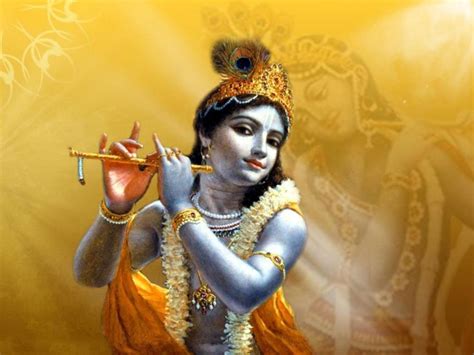
Lord Krishna, the Supreme Personality of Godhead

In the next post we will explore the next two lines of the song.

ಖಂಡ ಸಕ್ಕರೆ ಹಿತವಿಲ್ಲವಂತೆ ಖಂಡ ಎಲುಬು ಕಡಿದಿತಂತೆ
ಹೆಂಡಿರ ಮಕ್ಕಳ ನೆಚ್ಚಿತಂತೆ ಕೊಂಡು ಹೋಗುವಾಗ ಯಾರಿಲ್ಲವಂತೆ || 1 ||

khaṇḍa sakkare hitavillavante khaṇḍa elubu kaḍiditante

heṇḍira makkaḷa neccitante koṇḍu hōguvāga yārillavante || 1 ||

Translation:

Pure rock sugar held no sweetness to his taste,

Yet on dry and splintered bones his teeth he placed.

He spurned the honeyed bliss that sets the spirit free,

To crunch on sharp despair in blind captivity.

He doted on his wife and children day and night,

And anchored all his love within their changing sight.

Yet when the final hour called his breath away,

Not one could join his soul upon that lonely way.

What Dogs Teach Us About Nationalism and Identity… Nationalism is Dogism

Our society is plagued by rampant nationalism. The behavior of humans mirrors that of barking dogs. Dogs are fiercely protective of their perceived territories, and humans are behaving just like dogs. This disturbing behavior reveals a mindset rooted in bodily identity. This has overshadowed our shared spiritual essence. We are all spirit souls. We share the same heavenly father. But we are just focused on temporary external designations. Dogs will be dogs, but humans do not have to be dogs. Rejecting these divisive instincts will surely bring true unity among us all.

In the last Christmas/New Year’s holiday season, we went up to Huntsville, a town further north from Toronto. I was scheduled to deliver a class there. We decided to make a mini-holiday in the winter wonderland that is Muskoka.

Winter Wonderland in Muskoka, Canada

During a snowstorm, I decided to take a short walk around the cottage. Big snow! I was practically wading through it. Out of nowhere, this fierce barking dog started chasing me! I kept walking along the road, the dog ran towards me and then started running parallel to me! He was barely 3 feet from me. The fellow kept barking fiercely, teeth bared. Something, almost magical, kept the dog away from me. I was thinking at least I had winter gear on – it won’t be as painful… Later I realized it was an “invisible fence” that saved me.

Dangerous Barking Dog, almost attacked me.

The dog barked and barked until I left it’s “territory”, continuing on my walk, quietly chanting the names of God.

What made the dog behave like that? What had I done to it? Did I not look right to him? Did I not smell right? But I was just a harmless tourist, renting a cottage a few doors down. I’d be gone in a couple of days.

People behave just like that… especially at the border. Bow-wow, where are your papers? Do you have your passport? Do you have a visa? Do you have enough money to spend while you’re here? When will you leave? Why are you here? What are you bringing with you?

Passport Control - what is it really?

But ordinary people also behave like that. Decades ago, when I was a young software engineer in Germany for a project, nice old ladies on the train would ask me questions. Hallo, ver do you come from? Vot verk do you make hier? Ent, ven you go beck? Almost every person would ask me that, first three questions. Some continued to speak further, but most people would stop after those three questions.

Nice Old Lady, still concerned with unnecessary questions.

Nationalism is seeing a surge around the world these days. It is not a very spiritual thing.

nationalism /năsh′ə-nə-lĭz″əm, năsh′nə-/
noun

  1. Devotion, especially excessive or undiscriminating devotion, to the interests or culture of a particular nation-state.
  2. The belief that nations will benefit from acting independently rather than collectively, emphasizing national rather than international goals.
  3. The belief that a particular cultural or ethnic group constitutes a distinct people deserving of political self-determination.

If someone is not a nationalist, they are looked down upon.

Now, I will say something that is unpopular…

What is the difference betweeen the behavior of a nationalist, and a dog?

Let’s say a new dog or cat or a person came into the “territory” of the dog. What would the dog do?

What do dogs do when a n unfamiliar dog or cat of person enters their territory? They bark and attack!

Bow-Wow! Grrrooowwwl! Teeth bared. What are you doing here? This is MINE! GO away!

Maybe the dog goes on the attack! Tries to rip the intruder apart!

Let’s say the dog’s master comes into the “territory” of the dog. What would the dog do?

The same dog will welcome their owner or a "known" entity.

Wag tail. Jump high. Happy little barks, squeals too. Lick, lick. Welcome home sir, what can I do for you?

Now, if I ask you again, what is the difference between a nationalist, and a dog?

I have nothing against dogs! Dogs will be dogs. They have no choice in the matter as long as they are in the body of a dog. But us, humans? Why do we have to be like dogs?

But the thing is, nothing “belongs” to the dog! In fact, the dog, as an animal, belongs to his human owner.

We are exactly the same. We “belong” to God!

क्षेत्रज्ञं चापि मां विद्धि सर्वक्षेत्रेषु भारत ।
क्षेत्रक्षेत्रज्ञयोर्ज्ञानं यत्तज्ज्ञानं मतं मम ॥ ३ ॥


kṣetra-jñaṁ cāpi māṁ viddhi
sarva-kṣetreṣu bhārata
kṣetra-kṣetrajñayor jñānaṁ
yat taj jñānaṁ mataṁ mama

O scion of Bharata, you should understand that I am also the knower in all bodies, and to understand this body and its knower is called knowledge. That is My opinion.

https://vedabase.io/en/library/bg/13/3/

Srila Prabhupada writes in the purport…

Because each individual soul has his individual capacity for lording it over material nature, there are different bodies. But the Supreme also is present in them as the controller. The word ca is significant, for it indicates the total number of bodies. That is the opinion of Śrīla Baladeva Vidyābhūṣaṇa. Kṛṣṇa is the Supersoul present in each and every body apart from the individual soul. And Kṛṣṇa explicitly says here that real knowledge is to know that the Supersoul is the controller of both the field of activities and the finite enjoyer. – A. C. Bhaktivedanta Swami Prabhupada in purport to https://vedabase.io/en/library/bg/13/3/

Lest someone thinks that they “own” something, they do not. God, Krishna is the owner of everything, and only a small portion is assigned as our “quota”. We have no right to claim something that belongs to God, like the nationalists do.

Now, let’s say a friendly dog comes to the dog’s area… again, a similar welcome.

ईशावास्यमिदँ सर्वं यत्किञ्च जगत्यां जगत् ।
तेन त्यक्तेन भुञ्जीथा मा गृधः कस्य स्विद्धनम् ॥ १॥

īśāvāsyam idaḿ sarvaṁ
yat kiñca jagatyāṁ jagat
tena tyaktena bhuñjīthā
mā gṛdhaḥ kasya svid dhanam

Everything animate or inanimate that is within the universe is controlled and owned by the Lord. One should therefore accept only those things necessary for himself, which are set aside as his quota, and one should not accept other things, knowing well to whom they belong.

https://vedabase.io/en/library/iso/1/

A nationalist competes fiercely against those of other nations. A nationalist is so entrapped in the material identity that they cannot see others as spiritual beings, even if they are in human bodies!

But what is this “devotion” and “love” based on? It is simply based on a bodily identity. I am Indian, I am Pakistani, I am Chinese, Russian, American, you name it!

Souls are souls, no matter what their external coverings look like, just like clothes.

How are you, dear Indian, different from the Pakistani? You eat practically the same food, you talk practically about the same things, you even speak the same languages sometimes. You follow the same type of religion. You worry about the same things. You have brown skins, both Indians and Pakistanis. Yes, there are some differences. One of you bears a Pakistani Passport, and the other bears an Indian passport. Yes, those pieces of paper are different. But when you come to America you will be treated the same, whether you are Indian or Pakistani. And thanks to the different papers, bow wow, how dare you.

India, Pakistan, Bangladesh, what is different about them really?
  • Same with the Russians and the Ukranians.
  • Same with the Israelis and the Palestinians.
  • Same with the Dinka and the Nuer in South Sudan.
Are Ukranians and Russians not very similar to each other?
What is so different about the Israelis and Palestinians?
In South Sudan, the Dinka and Nuer tribes are killing each other relentlessly. Why?

The problem? Bodily Consciousness.

The thinking that I am this body and everything related to this body is mine.

यस्यात्मबुद्धि: कुणपे त्रिधातुके
स्वधी: कलत्रादिषु भौम इज्यधी: ।
यत्तीर्थबुद्धि: सलिले न कर्हिचि-
ज्जनेष्वभिज्ञेषु स एव गोखर: ॥ १३ ॥


yasyātma-buddhiḥ kuṇape tri-dhātuke
sva-dhīḥ kalatrādiṣu bhauma ijya-dhīḥ
yat-tīrtha-buddhiḥ salile na karhicij
janeṣv abhijñeṣu sa eva go-kharaḥ

One who identifies his self as the inert body composed of mucus, bile and air, who assumes his wife and family are permanently his own, who thinks an earthen image or the land of his birth is worshipable, or who sees a place of pilgrimage as merely the water there, but who never identifies himself with, feels kinship with, worships or even visits those who are wise in spiritual truth — such a person is no better than a cow or an ass.

https://vedabase.io/en/library/sb/10/84/13/

To be a nationalist, is, really, to be an animal in human form.

We can rise above this, and see each other as spirit souls. Each of us is a part-and-parcel of God.

ममैवांशो जीवलोके जीवभूत: सनातन: ।
मन:षष्ठानीन्द्रियाणि प्रकृतिस्थानि कर्षति ॥ ७ ॥

mamaivāṁśo jīva-loke
jīva-bhūtaḥ sanātanaḥ
manaḥ-ṣaṣṭhānīndriyāṇi
prakṛti-sthāni karṣati

The living entities in this conditioned world are My eternal fragmental parts. Due to conditioned life, they are struggling very hard with the six senses, which include the mind.

https://vedabase.io/en/library/bg/15/7/

Not just human beings, but all species are descended from the same seed-giving Father, God!

सर्वयोनिषु कौन्तेय मूर्तय: सम्भवन्ति या: ।
तासां ब्रह्म महद्योनिरहं बीजप्रद: पिता ॥ ४ ॥

sarva-yoniṣu kaunteya
mūrtayaḥ sambhavanti yāḥ
tāsāṁ brahma mahad yonir
ahaṁ bīja-pradaḥ pitā

It should be understood that all species of life, O son of Kuntī, are made possible by birth in this material nature, and that I am the seed-giving father.

https://vedabase.io/en/library/bg/14/4/

How to see each other?

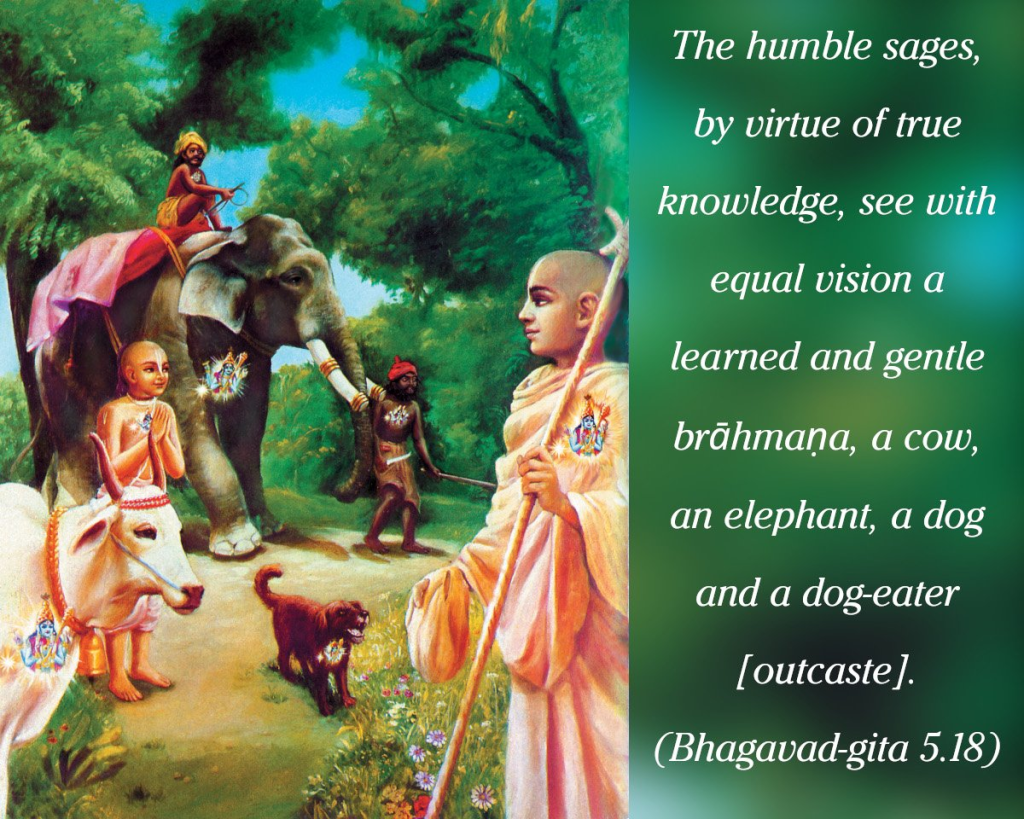
विद्याविनयसम्पन्ने ब्राह्मणे गवि हस्तिनि ।
श‍ुनि चैव श्वपाके च पण्डिता: समदर्शिन: ॥ १८ ॥

vidyā-vinaya-sampanne
brāhmaṇe gavi hastini
śuni caiva śva-pāke ca
paṇḍitāḥ sama-darśinaḥ

The humble sages, by virtue of true knowledge, see with equal vision a learned and gentle brāhmaṇa, a cow, an elephant, a dog and a dog-eater [outcaste].

https://vedabase.io/en/library/bg/5/18/

And this is the only way to be happy and peaceful…

ब्रह्मभूत: प्रसन्नात्मा न शोचति न काङ्क्षति ।
सम: सर्वेषु भूतेषु मद्भ‍‍क्तिं लभते पराम् ॥ ५४ ॥

brahma-bhūtaḥ prasannātmā
na śocati na kāṅkṣati
samaḥ sarveṣu bhūteṣu
mad-bhaktiṁ labhate parām

One who is thus transcendentally situated at once realizes the Supreme Brahman and becomes fully joyful. He never laments or desires to have anything. He is equally disposed toward every living entity. In that state he attains pure devotional service unto Me.

https://vedabase.io/en/library/bg/18/54/

This article was inspired by the following excerpt of a conversation with Srila Prabhupada, the Guru of my Guru.

Prabhupāda: Ah. The bodily consciousness is also material. That is also one. And the soul consciousness, spiritual, that is also one. That is ekatvam. So for a learned person there is no defect. Vidyā-vinaya-sampanne brāhmaṇe gavi hastini, paṇḍitaḥ samaḥ (BG 5.18). This is the . . . so anyone who is under the bodily conception of life, either human being or dog, they are the same. But that upādhi amongst human being is stronger than the cats and dogs. The human being, being advanced in consciousness, they are making this nationalism. But it is nothing but dogism. Is it not? That’s all. The so-called national people are sacrificing so many lives, so many politicians, Napoleon and these big, big leaders. But what is their business? Business is that doggish mentality, “I am this body.” So it is very difficult to give up this doggish mentality that, “I am this body.” Very, very difficult.

Dr. Patel: That is ahaṅkāra.

Prabhupāda: False ahaṅkāra. Because he is not body, it is false ahaṅkāra. So śāstra therefore says, bhagavad-bhakti hīnasya jātiḥ japas tapaḥ kriya (Hari-bhakti-sudhodaya 3.11). A person who has not developed Kṛṣṇa consciousness, for him this advancement of nationality, big work, industry, so on, so on, so on, jati japas tapaḥ kriya . . . Kriya, these act . . .

Dr. Patel: Activities.

Prabhupāda: What are these? Aprāṇasya hi dehasya maṇḍanaṁ loka-rañjanam. It has no value. It has no value. But people are enamored by these things, “I belong to great nation. I am American. We have got so many industries. We have got so many cars.” Attachment. So it is very difficult. Sarvopādhi-vinirmuktaṁ (CC Madhya 19.170). One, after becoming completely freed from all these false designations, to become a devotee is very, very difficult. There is no education. https://vanisource.org/wiki/751112_-_Morning_Walk_-_Bombay?hl=dogism

Dear Reader, please be who you are, an eternal, blissful and knowledgeable Spirit Soul, a part-and-parcel of God.

Hare Krishna!

Love He who made all that

Why do we love someone? Why do we love dogs, cats, and things? What is it about them that we love them or lust for them or are attached to them?

Usually, all living entities have affection for some other living entities. Many living entities also have attachments to things.

If a human does not have other humans to associate with, or if they find those relationships unfulfilling, they often keep a dog or a cat or even fish or a lizard or something else.

Why do we love other living entities? Why are we attached to things?

instead of loving

a dog or a cat

why not love Krishna

who made all that

His Holiness Vishnujana Swami (quoted by His Grace Sriman Sankarshan Das Adhikari

Everything everyone likes is originally enabled by God. Everyone you love is being personally emanated by God.

Whether its your most precious possession, or your most treasured relationship, there is one source.

Simply recognizing God as the source of every single experience that gives you pleasure is the easiest way to develop love for God.

My spiritual master gives the example of a generous roommate, who keep the fridge full with all kinds of most delicious foods and you are free to use anything you like without any payment in return! What do we pay for the sunlight, the air, the water, the earth, and the life that enables to enjoy it all?

We love or are attached to anyone or anything only because Krishna is manifesting them. Actually our love is for Krishna.

अहं सर्वस्य प्रभवो मत्त: सर्वं प्रवर्तते ।
इति मत्वा भजन्ते मां बुधा भावसमन्विता: ॥ ८ ॥

ahaṁ sarvasya prabhavo
mattaḥ sarvaṁ pravartate
iti matvā bhajante māṁ
budhā bhāva-samanvitāḥ

I am the source of all spiritual and material worlds. Everything emanates from Me. The wise who perfectly know this engage in My devotional service and worship Me with all their hearts.

https://vedabase.io/en/library/bg/10/8/

If we recognize this, we will be fully satisfied, fully content, and blissful always.

Can animals, birds, insects, plants be liberated from material existence without attaining human form?

Lipsa, 27th November 2013

Hare Krishna
Please accept my humble obeisances
All glories to Srila Gurudev and Srimati Gurumataji
All glories to Srila Prabhupada

I have a doubt in Krishna Book. Kindly clarify…

Chapter 6:

“When flowers and fruits are offered to Krishna, the tree that bore them also receives much benefit, indirectly………

…… Undoubtedly all the gopis and cowherd boys and cows who served Krishna in Vrindavana with love and affection were liberated from the miserable condition of material existence.”

Can a tree or cow or any other animal be liberated by the mercy of the Lord without attaining a human form of life?

Thank you.
your unworthy servant,
Lipsa

Sudeep Manchanda, 27th November 2013

Hare Krishna,

Please accept our humble obeisances.

If I remember it correctly I have heard in a lecture that these trees and cows are not ordinary, there are very special and have Krishna’s special mercy.
And when one has Krishna’s mercy anything is not impossible.

For example the lila, where Gajendra who was in an elephant body was liberated, but he was an exalted devotee of the Lord and hence has his special mercy.

For an ordinary jiva who is conditioned and trapped in the cycle of birth and death, we can say that they need to first attain a human body to be able to practice bhakti.

Please correct if I am wrong.

your Servant,
Sudeep Manchanda

Mahabhagavat Das SDA, 28th November 2013

Dear Mother Lipsa and Bhakta Sudeep,

Can a tree or cow or any other animal be liberated by the mercy of the Lord without attaining a human form of life?

To be noted that Tulasi devi or Vrinda Devi is an eternally liberated pure devotee appearing in the material world in the form of a plant/tree so that ordinary persons may have something wonderful to offer to Krishna.

It is rare, but possible…

Yes, the example is a dog who was liberated by Lord Chaitanya Mahaprabhu by taking coconut scraps from His hand, this He did because His devotee Sivananda Sen was very much merciful to the Lord – the entire pastime is in Chaitanya Charitamrita Antya Lila Chapter 1, specifically CC Antya 1.17-1.33.

Sincerely,
Mahabhagavat Das

Lipsa, 28th November 2013

Hare Krishna Mahabhagavat Das Prabhuji and Sudeep Prabhuji
Please accept my humble obeisances
All glories to Srila Gurudev and Srimati Gurumataji
All glories to Srila Prabhupada

Thank you for enlightening me on this subject.

Reading the verses 1.17 – 1.33 from Chaitanya Charitamrita Antya Lila Chapter 1 was really ecstatic. Thank you Mahabhagavat Das Prabhuji for mentioning about it.

Every verse is full of spiritual knowledge. Whoever reads it immediately feels the need to develop an attachment to this sublime process. I am mentioning a few lines from the text that I liked the most.

Text 24:
…. He thus offers to become the dog of a Vaisnava. There are many other instances in which the pet animal of a Vaisnava was delivered back home to Vaikunthaloka, back to Godhead. Such is the benefit of somehow or other becoming the favorite of a Vaisnava. ….

Text 30:
Seeing the dog eating the green coconut pulp and chanting “Krishna, Krishna” again and again, all the devotees present were very much surprised.

Text 32:
This is the result of sadhu-sanga, consequent association with Sri Caitanya Mahaprabhu and promotion back home, back to Godhead. This result is possible even for a dog, by the mercy of the Vaisnava. Therefore, everyone in the human form of life should be induced to associate with devotees.

Thank you.
your unworthy servant,
Lipsa

Please subscribe to daily inspirational emails from His Grace Sriman Sankarshan Das Adhikari (Writings and lectures archived at sda-archives.com), written fresh every day from his travels around the world sharing the highest spiritual knowledge with everyone. Sign up now at www.backtohome.com