
Understanding Compassion: Actions That Truly Help (Part 2)

Suppose you want to help someone. Very noble! First do no harm. How can you tell if you are helping or hurting? Suppose we want to act with compassion… should we not understand what compassion is first? Here is a discussion about hte complexity of compassion and how well-intentioned actions in passion and ignorance cause harm. Effective compassion must be in the mode of goodness. But charity begins at home. If we are not compassionate with ourselves, we cannot be compassionate towards others. And how to be compassionate with ourselves?

This is part Two of a Series of Articles on Compassion. Part 1 is here. Part 3 is here

Let’s say we do somehow get past the most obvious schadenfreude for others. How to act with compassion?

How do we know if something is helping or hurting?

It is said, first, do no harm.

Take these situations… how would you “help” in these situations?

  • A crying, tantrum-throwing child is being firmly dealt with by a parent
  • A patient is on a very strict diet to allow their quick recovery
  • A homeless substance abuser is begging for money on the street

Would it be “compassion” to intervene in the first example of the child above? Should we stop the parent from being firm? No! The parent knows what the child needs. Maybe the child is hungry, maybe the child is tired and sleepy. The parent is being compassionate with that child, even if it’s not all kisses and hugs!

A child throws a tantrum

There is a second example of a sick friend on a strict diet. The patient asks you to sneak in a rich meal, they want to escape their bland, boring diet. You are his buddy. You really want your friend to have some great food! Would you be acting with compassion? No, you end up killing your friend with your “act of compassion”!

A patient is served hospital food

In the third example, the drug addict is on the street begging you for money. If you gave it to them, would that be compassionate? No, the person doesn’t know what is good for them! They will use your charity to hurt themselves, dig deeper into addiction! Maybe even die of an overdose!

Everything we experience in this world is composed of what is known as the modes of material nature. This includes substances, personalities, habits, and activities. It also encompasses the time of day or night, music, writing, and entertainment. Indeed, we can understand that these are the fundamental ingredients of material nature.

We can consider that trying to help someone is an intentional action. Being compassionate towards someone means acting to help that person. Being compassionate takes the form of charity.

Actions in the mode of passion give results that are sweet to start, but have a bitter end. Actions in the mode of ignorance bring results that are bitter in the beginning and bitter in the end.

The modes of material nature are three in number:

  • Goodness
  • Passion
  • Ignorance

Only actions in the mode of goodness produce a desirable result. They may taste bitter to start. This bitterness nevertheless, is only if someone is not situated in the mode of goodness.
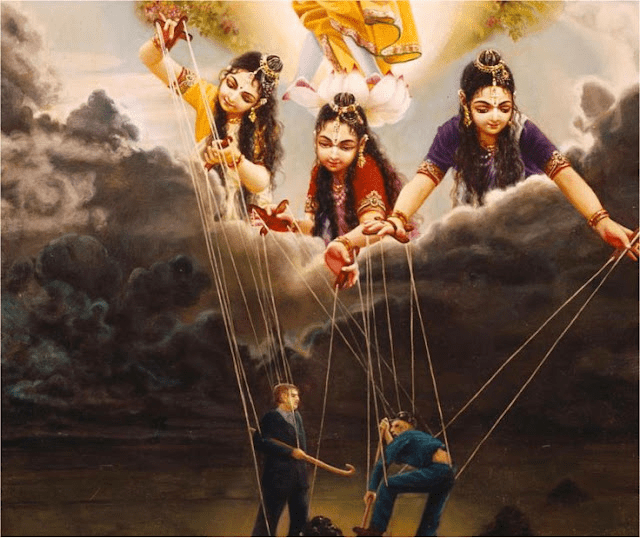
The modes of material nature act on everyone. Indeed they are the ropes that bind us.

The result of charity is highly misunderstood in our world. Not everything we consider charitable is actually beneficial! There are three kinds of charity defined by Krishna in the Bhagavad Gita.

  • Charity in the Mode of Goodness
  • Charity in the Mode of Passion
  • Charity in the Mode of Ignorance
Charity, thre's more to it than meets the eye.

Charity given out of duty, without expectation of return, at the proper time and place, and to a worthy person is considered to be in the mode of goodness.

But charity performed with the expectation of some return, or with a desire for fruitive results, or in a grudging mood is said to be charity in the mode of passion.

And charity performed at an impure place, at an improper time, to unworthy persons, or without proper attention and respect is said to be in the mode of ignorance.

https://vedabase.io/en/library/bg/17/

The mode of goodness way to deal with an upset child is to let a parent handle the situation. This parent knows what the child actually needs. Others should not interfere.

The mode of goodness way to deal with a patient is to follow the physician’s prescription with food and medicine. This is true no matter how dissatisfied the patient is with a bland diet.

The mode of goodness way to deal with a drug addict on the street is to get them professional help. Seek assistance from those who are trained and qualified to help them.

How to “help” someone and not push them deeper into a hole?

Charity begins at home! To be compassionate with anyone else, I need to be compassionate with myself first!

What is that compassion? First, I must know the difference between what is compassion and what is not!

In a desert, say there is a mirage. If someone races towards that mirage, should I let them just run? Or should I stop them?

A mirage in the desert looks like water, but there is no water there.

trushna” is a Sanskrit word that indicates extreme thirst. This is a thirst that can never be quenched. An animal in the desert, running towards a mirage can never quench it’s thirst. In fact it will run to its death.

Similarly, conditioned souls in the material world are running, running running… Running with their tongues out, trying to get some taste, to quench their thirst. This they’re trying to do by pursuing sense gratification.

The conditioned living entities try to satisfy themselves by trying to satisfy the senses. At the extreme, this is hedonism. Everyone is on that trip, more or less.

Compassion is definitely not about gratifying the senses of a suffering soul.

The senses are like a fire! They can never be satisfied by giving them more gratification!

Think of it this way. If there’s a blazing fire, can it be put out by adding more fuel to it? No! A fire can be put out by cutting the supply of fuel and oxygen. But only an expert firefighter knows how to put out a really bad fire.

The senses are like fire, and sense gratification is like fuel. The senses can’t be satisfied, no matter how much we try to gratify them. They must be controlled for the soul to be satisfied.

Just like the expert firefighter, there are great souls who manifest compassion. They know actually what it means to “help” someone. We can learn from them and follow the process they have given us.

निवृत्ततर्षैरुपगीयमानाद्भवौषधाच्छ्रोत्रमनोऽभिरामात् ।

क उत्तमश्लोकगुणानुवादात्पुमान् विरज्येत विना पशुघ्नात् ॥ ४ ॥

nivṛtta-tarṣair upagīyamānād
bhavauṣadhāc chrotra-mano-’bhirāmāt
ka uttamaśloka-guṇānuvādāt
pumān virajyeta vinā paśughnāt

Glorification of the Supreme Personality of Godhead is performed in the paramparā system, that is, it is conveyed from the spiritual master to disciple. Such glorification is relished by those no longer interested in the false, temporary glorification of this cosmic manifestation. Descriptions of the Lord are the right medicine for the conditioned soul undergoing repeated birth and death. Therefore, who will cease hearing such glorification of the Lord except a butcher or one who is killing his own self?

https://vedabase.io/en/library/sb/10/1/4/

This is what is needed. Not sense gratification, but a clear understanding of what is helpful and what is not.

Do you want a specific suggestion on how to be compassionate with yourself and others?

तद्विद्धि प्रणिपातेन परिप्रश्न‍ेन सेवया ।
उपदेक्ष्यन्ति ते ज्ञानं ज्ञानिनस्तत्त्वदर्शिनः ॥ ३४ ॥

tad viddhi praṇipātena
paripraśnena sevayā
upadekṣyanti te jñānaṁ
jñāninas tattva-darśinaḥ

Just try to learn the truth by approaching a spiritual master. Inquire from him submissively and render service unto him. The self-realized souls can impart knowledge unto you because they have seen the truth.

https://vedabase.io/en/library/bg/4/34/

Want to act with compassion?

Be compassionate with yourself.

Approach a genuine spiritual master.

Sankarshan Das Adhikari, the author's spiritual master

What is the difference between a Brahmavadi and Mayavadi?

What is the difference between a Brahmavaadi and a Mayavadi? Is one better than the other? Should we interact with one but leave the other alone? How to know which is which?

Brajanath Das, 26 December 2015

Hare Krishna!

Please accept my humble obeisances!

All glories to Sri Caitanya Mahaprabhu!

All glories to Srila Prabhupada!

While reading three stages of realization I got following  doubts – 

What is the difference between a Brahmavadi and a Mayavadi? What is their destination?

Different stages of Yogis realizations (in Paramatma realization)?

Please help me to understand.

your servant,

Brajanath Das

Amala-Purana Das, 28 December 2015

Hare Krsna Prabhuji,

Please accept my humble obeisances!

All Glories to Srila Gurudeva and Srimati Gurumata!

All Glories to Srila Prabhupada!!

Brahmavadis are those who are attracted to the impersonal Brahman but they are not offensive to the Lord’s personal form or consider the Lord’s form as material; it’s just they are either ignorant of the personal conception or they are indifferent towards personal conception i.e. not attracted towards they personal form of the Supreme Lord.

Mayavadis on the other hand are so deeply rooted in their impersonal conception that they blaspheme the transcendental form of Supreme Lord, consider it material and temporary and as a tool to go “something beyond” hence they are condemned.

Srimad Bhagavatam gives us two examples, four kumaras and Srila Sukadeva Goswami who were Brahmavadis and later became devotees.

Four Kumaras already knew about Lord Visnu. They heard about Visnu from Brahmaji and so they wanted to explore and they came to Vaikuntha. Thus, they knew about Lord Visnu, had no offensive attitude towards Visnu; it was just that they were not attracted towards Visnu. But when the fragrance of Tulsi offered on Lord’s lotus feet entered their nostrils, it agitated their impersonal conception and they became devotees.

Similarly, when Srila Sukadeva Goswami heard about Krishna from one of the disciples of Srila Vyasadeva, he became attracted and came to Vyasadeva and learned further from him.

People today in pursue of their spiritual goals can become attracted to Impersonal Brahman. This could be because of culture or natural course of spiritual evolution: one can move from form to formless i.e. from matter to spirit. In this way many people can acquire impersonal conception of the ultimate realty. Now that impersonal conception can:

– translate to offensive mentality towards personal conception

– translate to ignorance of the personal conception

– be indifferent towards personal conception (i.e. not attracted). For example, Four Kumaras

Out of above three first category is Mayavadis and other two are Brahmavadis. Brahmavadis can be elevated to the personal conception and become devotees when they associate with the devotees. So we should also not put every “Impersonal Brahaman seeker” in the category of Mayavadis. We should try to understand their conception of ultimate reality and if they are Mayavadis then we should stay away from them else we should try to inform them about the personal conception of the Absolute truth and bring them in contact with devotees.

Hope it helps

your servant,

Amala-Purana Das

Bhakta Sunil, 29 December 2015

Hare Krishna

Please accept my humble obeisances

All Glories to Vaishnavas

In reply to your question regarding difference between Brahmavadi and Mayavadi, the following conversation should help

——-

Conversations and Morning Walks

1975 Conversations and Morning Walks

Brahmavādī means those who are aspiring to merge into the impersonal Brahman effulgence. Māyāvādīs remain fools forever. They have no knowledge. Aviśuddha-buddhayaḥ, always impure.

Morning Walk — July 2, 1975, Denver:

Harikeśa: Śrīla Prabhupāda, what’s the difference between a Brahmavādī and a Māyāvādī?

Prabhupāda: That you already questioned. We answered.

Harikeśa: I did?

Prabhupāda: Yes. (break) …vādī means those who are aspiring to merge into the impersonal Brahman effulgence.

Harikeśa: And Māyāvādīs, they do not attain that impersonal realization?

Prabhupāda: Māyāvādīs remain fools forever.

Harikeśa: They never leave this material platform.

Prabhupāda: They do not know. They have no knowledge. Aviśuddha-buddhayaḥ (SB 10.2.32), always impure. Otherwise how they are thinking, so ‘ham: “I am same. I am God. I am moving the sun, I am…” Such rascals, they remain always in ignorance. (break) …no sense that “If I am the same, then why I have fallen down in this māyā?” They say, “It is my līlā. I have become dog. So it is my līlā. I have become hog. It is my līlā.” (laughs) This is their philosophy. Hare Kṛṣṇa. (break) Māyāvāda. They are fools, mūḍha. Māyayāpahṛta-jñānā. They are described in the Bhagavad-gītā. Māyāvādī means māyayāpahṛta-jñānā: “Their knowledge has been taken away by māyā.” Fools. Either you call them fool or call them lowest of the mankind or the most sinful, whatever way you can call, they are like that. All good qualifications. Therefore Caitanya Mahāprabhu has warned, māyāvādī-bhāṣya śunile haya sarva-nāśa: (CC Madhya 6.169) “If you hear from Māyāvādī, then your spiritual life is finished.” It’s so dangerous.

Harikeśa: The Brahmavādīs have some possibility of advancement?

Prabhupāda: Oh, yes.

Harikeśa: What is that thing that enables them to advance?

Prabhupāda: That you will know later on. First of all try to understand this. Don’t try to understand everything in a moment. That is foolishness.

——-

Regarding second question, the following lectures should help :

—–

Lecture on BG 4.24-34 — New York, August 12, 1966: 

So anyway, either the Brahmavādī or Paramātmavādī or the bhakta, they are all tattva-vit. They are all transcendentalists. There is no difference. But as there are three classes in every sphere, so there are three classes in the transcendental field also. So here Bhagavad-gītā, the Lord recommends that jñāninas tattva-darśinaḥ (BG 4.34). You have to find out a person who is tattva-darśī, who has realized the Absolute Truth, either in Brahman conception or in Paramātmā conception or in Personality of Godhead conception because we have got different tastes. So the Paramātmā or the Supreme Absolute Truth is also manifested in three phases: Brahman, Paramātmā, Bhagavān. So anyway, either you select the impersonal Brahman conception of the Absolute Truth, either you select the localized supreme soul, Supersoul conception of the Absolute Truth, or you accept the highest, the Supreme Personality of Godhead Śrī Kṛṣṇa. Mattaḥ parataraṁ nānyat kiñcid asti dhanañjaya (BG 7.7). The Lord says that “This is the last phase of Absolute Truth, what I am, Kṛṣṇa.”

Lecture on BG 4.34 — New York, August 14, 1966: 

And even in that knowledge field also… Of course, transcendental knowledge, as we have discussed already, they are viewed in different, three different angles of vision: the knowledge of Brahmavāda, or impersonal, impersonal Absolute Truth, and the knowledge of Paramātmā, the localized Supersoul, and the knowledge of Bhagavān, or the Supreme Personality of Godhead. There are different stages of development of knowledge. But the first beginning knowledge is that we must understand that “I am not this body. I am spirit soul, and my aim of life should be how to get out of this material entanglement.” That is knowledge. That is the beginning of knowledge.

—-

Sincerely,

Bhakta Sunil

Dra Varni, 04 January 2016

thank you  Hare Krsna!!

Dra Varni

Please subscribe to daily inspirational emails from His Grace Sriman Sankarshan Das Adhikari (Writings and lectures archived at https://ecstaticmedia.com/ ), written fresh every day from his travels around the world sharing the highest spiritual knowledge with everyone. Sign up now at www.joincourse.com