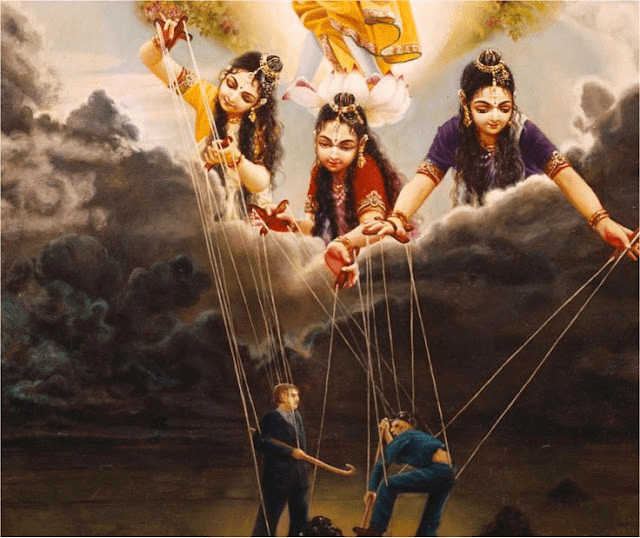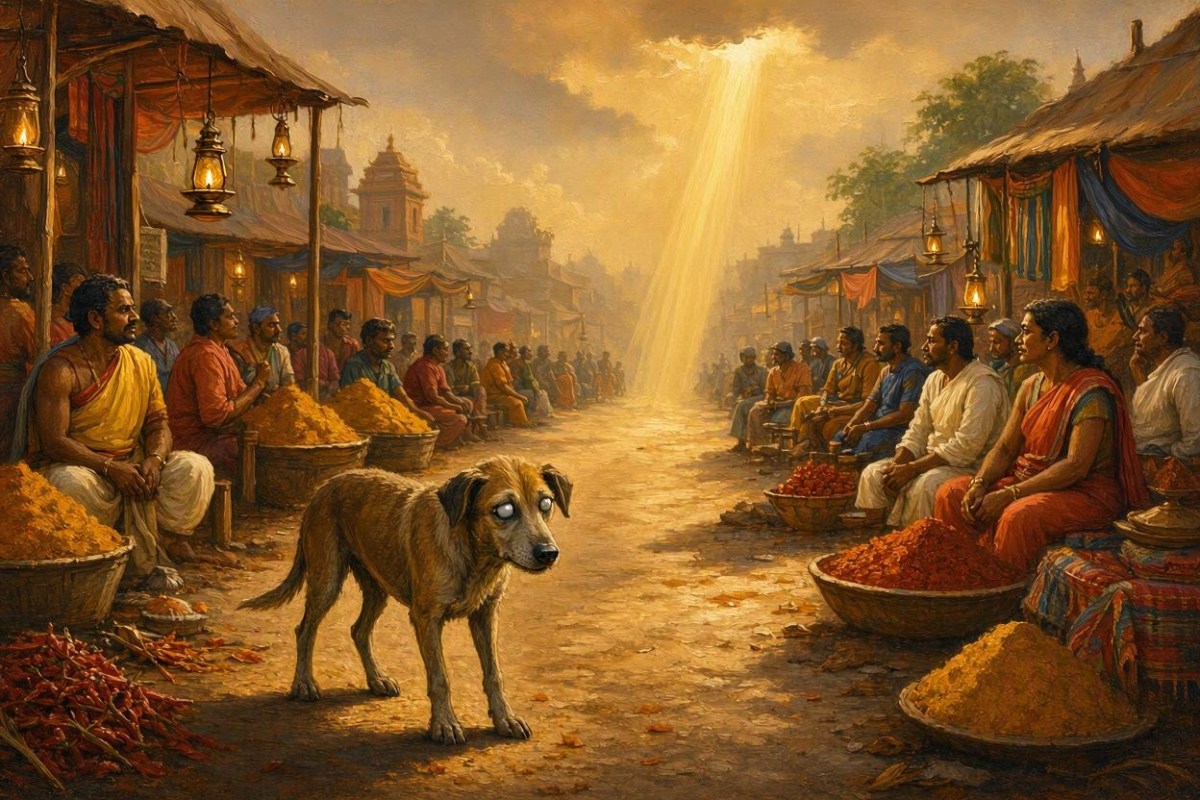
Why a Dog? And Why Blind? Unpacking Purandara Dasa’s Master Metaphor

Why would a 16th-century saint-poet choose a blind street dog wandering into a crowded village market to describe the human condition? In my previous post, we explored Purandara Dasa’s masterclass in spiritual psychology, Kurudu Naayi Santege Bantante. But behind this allegory lies a deeper question: out of 8.4 million species of life, why specifically a dog? And why blind?

Today, we peel back the layers of this brilliant metaphor. By examining raw animal behavior alongside timeless Vedic scriptures, we discover an uncomfortable truth: this sightless, wandering dog isn’t just poetry, it is a mirror holding up our own lives.

In a previous post, A blind dog comes to the fair, I promised you a more detailed exploration of the 16th-century saint-poet Purandara Dasa’s timeless song, “Kurudu Naayi Santege Bantante”.

In this article, we will focus on the sheer genius of his chosen imagery: Why did he specifically choose a “dog”? And why a “blind dog” at that? This is what we’re focusing on n this article.

ಕುರುಡು ನಾಯಿ ಸಂತೆಗೆ ಬಂತಂತೆ
ಅದು ಯಾತಕೆ (ಯಾಕೆ) ಬಂತೋ

kuruḍu nāyi santege bantante

adu yāke bantō

A blind dog stumbled to the bustling fair,

With sightless eyes and an aimless tread;

Ah, who can say what brought it to the market square,

Or by what strange desire it was led?

Though it is impossible to fully grasp the inner depth and complete import of a great saint like Purandara Dasa, we can make a humble attempt to understand the brilliant lessons hidden inside this poignant analogy, and see how it directly mirrors the wisdom of the Śrīmad-Bhāgavatam and Bhagavad-gītā.

Translating High Philosophy into Everyday Street Language

The profound truths contained in Sanskrit scriptures like the Bhagavad-gītā and Śrīmad-Bhāgavatam can sometimes feel distant or abstract to ordinary people busy navigating the struggles of daily life. This is where the compassionate genius of saint-poets like Purandara Dasa shines.

As a prominent leader of the Haridasa movement and the father of Carnatic music, Purandara Dasa made it his mission to take high Vedantic philosophy out of exclusive scholastic circles and bring it straight to the streets. Instead of overwhelming everyday listeners with dense technical terminology, he wrapped timeless spiritual psychology in raw, unforgettable, real-world imagery.

By recasting Samsara (the endless cycle of material birth and death) as a noisy, chaotic village fair (sante), and the illusioned spirit soul as a blind dog wandering through it, Purandara Dasa transformed complex theology into a vivid wake-up call that anyone, from a scholar to a street vendor could immediately grasp and feel in their heart.

Out of 8,400,000 Species of Life, Why a “Dog”?

According to Vedic knowledge, the soul travels through 8.4 million species of life across endless cosmic cycles. So why did Purandara Dasa select a dog to represent the soul adrift in the material world?

A dog possesses a psychological profile that uncannily reflects conditioned human nature. In fact, in the commentary to Śrīmad-Bhāgavatam 2.3.19, the acharyas detail these exact traits: a dog wags its tail for anyone who offers a scrap of bread, barks fiercely at strangers, submits completely to a stronger opponent by rolling on its back, yet fights bitterly over a bone with its equals, and mercilessly subdues the weak.

Purandara Dasa draws on these precise characteristics to hold up a mirror to our own lives:

  1. Very Relatable: Dogs have lived alongside human society since antiquity, making their behavior instantly recognizable to all of us.
  2. Fickle Faithfulness: A dog exhibits intense devotion, but primarily to whoever provides it with immediate sensory gratification or food.
  3. Hostile to Strangers: It barks at, mistrusts, and attacks anyone outside its familiar circle.
  4. Unpredictable Loyalty: Despite its reputation for loyalty, a dog can unexpectedly turn on and bite the very master who feeds it.
  5. Fiercely Territorial: It is especially inimical to competitors, viciously guarding its small patch of dirty pavement or territory.
  6. Flattering to the Strong: It knows how to be submissive, rolling over and flattering a proven stronger opponent to avoid a thrashing.
  7. A Dog-Eat-Dog World: When survival is on the line, dogs can be ruthless. Take Jack London’s The Call of the Wild, when sled dogs fight, the loser, even if stronger than the rest, ends up torn to shreds and eaten by the rest of the pack.
  8. Endless Sensory Greed: A dog is perpetually greedy, sniffing around for new sensory experiences, pacing endlessly with its tongue hanging out.

We Are Like That Dog

When we examine this list honestly, a sobering realization hits home: we are like that dog.

(If my use of the word “we” throughout this article felt presumptuous or brought any offense, please forgive me. I speak first and foremost of myself and those who share in my struggles.)

In our material conditioning, we are experts at making high-minded resolutions, but terrible at living up to them.

Imagine a dog sitting on a foul heap of garbage, quietly pondering, seemingly reconsidering its life choices after finding nothing of value. The very moment someone throws a fresh bag of new garbage onto the heap, off the dog runs to investigate.

We do the exact same thing. We recognize the emptiness of worldly pursuits, vow to pursue a higher spiritual life, and then abandon our resolve the instant a shiny new distraction is tossed into our path.

Lord Kapila describes this tragic loop of worldly attachment in Śrīmad-Bhāgavatam 3.30.20:

तत्राप्यनाथवत् क्षेत्रे गृहेत्ताभिरुपेक्षितः ।

यथा गृहे शुनाहारमुपानीतमश्नन् भूङ्क्ते ॥

tatrāpy anāthavat kṣetre gṛhe tābhir upekṣitaḥ

yathā gṛhe śunāhāram upānītam aśnan bhūṅkte

Translation: “In old age, neglected by the very family members he spent his entire life maintaining, he remains at home like a pet dog (śunā), eating whatever few scraps are reluctantly thrown to him.”

We slave our entire lives for material attachments, only to wind up like an old household dog, taking whatever scraps our illusory masters toss our way. From top dog to a nobody.

But Why Blind?

Purandara Dasa didn’t just choose a dog; he wrote about a blind dog wandering into the middle of a chaotic village fair.

A dog naturally relies heavily on its smell, but it uses vision to navigate safely. A blind dog can “smell” something delicious sitting inside a shop stall, but it cannot see the danger standing in its path, the heavy carts, the narrow traps, or the vendor holding a stick. Driven purely by its nose, it marches straight into a beating.

This spiritual blindness is a central theme throughout Vedic literature. In Śrīmad-Bhāgavatam 7.5.31, Prahlāda Mahārāja poignantly describes the tragic state of souls who lack spiritual vision:

न ते विदुः स्वार्थगतिं हि विष्णुं दुराशया ये बहिरर्थमानिनः ।

अन्धा यथान्धैरुपनीयमानाः तेऽपीशतन्त्र्यामुरुदाम्नि बद्धाः ॥

na te viduḥ svārtha-gatiṁ hi viṣṇuṁ

durāśayā ye bahir-artha-māninaḥ

andhā yathāndhair upanīyamānāḥ

te ‘pīśa-tantryām uru-dāmni baddhāḥ

Translation: “Persons who are strongly entrapped by the consciousness of enjoying material life do not know that the ultimate goal of human life is Lord Viṣṇu. Like blind men led by another blind man (andhā yathāndhaiḥ), they fall off the path and remain tightly bound by the strong ropes of material nature.”

This loss of vision is described in Bhagavad-gītā 2.67:

इन्द्रियाणां हि चरतां यन्मनोऽनुविधीयते ।

तदस्य हरति प्रज्ञां वायुर्नावमिवाम्भसि ॥

indriyāṇāṁ hi caratāṁ yan mano ‘nuvidhīyate

tad asya harati prajñāṁ vāyur nāvam ivāmbhasi

Translation: “As a strong wind sweeps away a boat on the water, even one of the roaming senses on which the mind focuses can carry away a man’s intelligence.”

Just as scent sweeps away the blind dog’s caution, our untamed senses sweep away our intelligence (prajñā). We can “smell” the fleeting pleasures of the material world, and our desires pull us forward. But without the eyes of spiritual knowledge (jnana), we remain blind to the karmic traps and the inevitable blows of fate waiting at every stall.

Freedom from Illusory Masters

The great Vaishnava saint Śrī Rūpa Gosvāmī captured this exact plight in a prayer that is frequently cited throughout the Śrīmad-Bhāgavatam purports (Bhakti-rasāmṛta-sindhu 3.2.35):

कामौदीनां कति न कतिधा पालिता दुर्निदेशास्

तेषां जाता मयि न करुणा न त्रपा नोपशान्तिः ।

उत्सृज्यैतानथ यदुपते साम्प्रतं लब्धबुद्धिस्

त्वामायातः शरणमभयं मां नियुङ्क्ष्वात्मदास्ये ॥

kāmādīnāṁ kati na katidhā pālitā durnideśās

teṣāṁ jātā mayi na karuṇā na trapā nopaśāntiḥ

utsṛjyaitān atha yadu-pate sāmprataṁ labdha-buddhis

tvām āyātaḥ śaraṇam abhayaṁ māṁ niyuṅkṣvātma-dāsye

Translation: “O my Lord, there is no limit to the unwanted orders of my material masters such as lust, anger, and greed. Although I have served them so faithfully for so long, they have shown no mercy to me, nor have I felt any shame, nor any peace. O Lord of the Yadus, now that my intelligence has finally awakened, I abandon them all. I come to You today to take shelter at Your fearless lotus feet. Please engage me in Your service.”

The underlying lesson here is profound: while we may appear to be serving various external masters in this world, we are actually serving only those who gratify our senses. In truth, no matter who the external master seems to be, we remain bound in servitude to our own ruthless, merciless material senses.

Returning to Our True Home

The tragic truth underlying Purandara Dasa’s poem is that the soul’s aimless wandering through this chaotic marketplace is entirely unnecessary. We are not native to this world of birth, disease, old age, and death; our true home is in the eternal spiritual realm (Vaikuntha). As eternal fragmental parts of the Supreme Lord, we have simply strayed away, mistaking the noisy, temporary stalls of Samsara for our permanent residence. We can end this grueling cycle of wandering the moment we stop surrendering to ruthless, illusory masters and accept our original, true Master, Śrī Kṛṣṇa.

In Bhagavad-gītā 15.6 & 15.7, Lord Kṛṣṇa reminds us of our real identity and our true home:

न तद्भासयते सूर्यो न शशाङ्को न पावकः ।

यद्गत्वा न निवर्तन्ते तद्धाम परमं मम ॥

ममैवांशो जीवलोके जीवभूतः सनातनः ।

मनःषष्ठानीन्द्रियाणि प्रकृतिस्थानि कर्षति ॥

na tad bhāsayate sūryo na śaśāṅko na pāvakaḥ

yad gatvā na nivartante tad dhāma paramaṁ mama

mamaivāṁśo jīva-loke jīva-bhūtaḥ sanātanaḥ

manaḥ-ṣaṣṭhānīndriyāṇi prakṛti-sthāni karṣati

Translation: “That supreme abode of Mine is not illumined by the sun or moon, nor by fire or electricity. Those who reach it never return to this material world.. The living entities in this conditioned world are My eternal fragmental parts. Due to conditioned life, they are struggling very hard with the six senses, which include the mind.”

Echoing this, Śrīmad-Bhāgavatam 10.14.58 confirms that once we surrender to our true Master, the vast, dangerous ocean of material existence shrinks to nothing:

समाश्रिता ये पदपल्लवप्लवं महत्पदं पुण्ययशोमुरारेः ।

भवाम्बुधिर्वत्सपदं परं पदं पदं पदं यद्विपदां न तेषाम् ॥

samāśritā ye pada-pallava-plavaṁ mahat-padaṁ puṇya-yaśo-murāreḥ

bhavāmbudhir vatsa-padaṁ paraṁ padaṁ padaṁ padaṁ yad vipadāṁ na teṣām

Translation: “For those who have accepted the boat of the lotus feet of the Supreme Lord, the ocean of the material world is like the water contained in a calf’s footprint. Their destination is paraṁ padam, the spiritual realm where there are no miseries, rather than this world where there is danger at every step.”

A Humble Prayer

Purandara Dasa’s metaphor is not an insult; it is a merciful wake-up call to help us open our spiritual eyes. In that spirit, let us pray together:

O my dear Śrī Kṛṣṇa, You are the most merciful benevolent ever-merciful Master, and yet I am chasing all sorts of illusory masters who abuse me more than anything else.

Please kindly release me from the bondage of these illusory masters and let me take shelter at Your lotus feet.

Please allow me to bring other such blind dogs like myself into Your eternal shelter.

Hare Krishna Hare Krishna

Krishna Krishna Hare Hare

Hare Rama Hare Rama

Rama Rama Hare Hare
Lord Krishna, the Supreme Personality of Godhead

In the next post we will explore the next two lines of the song.

ಖಂಡ ಸಕ್ಕರೆ ಹಿತವಿಲ್ಲವಂತೆ ಖಂಡ ಎಲುಬು ಕಡಿದಿತಂತೆ
ಹೆಂಡಿರ ಮಕ್ಕಳ ನೆಚ್ಚಿತಂತೆ ಕೊಂಡು ಹೋಗುವಾಗ ಯಾರಿಲ್ಲವಂತೆ || 1 ||

khaṇḍa sakkare hitavillavante khaṇḍa elubu kaḍiditante

heṇḍira makkaḷa neccitante koṇḍu hōguvāga yārillavante || 1 ||

Translation:

Pure rock sugar held no sweetness to his taste,

Yet on dry and splintered bones his teeth he placed.

He spurned the honeyed bliss that sets the spirit free,

To crunch on sharp despair in blind captivity.

He doted on his wife and children day and night,

And anchored all his love within their changing sight.

Yet when the final hour called his breath away,

Not one could join his soul upon that lonely way.

Understanding Compassion: Actions That Truly Help (Part 2)

Suppose you want to help someone. Very noble! First do no harm. How can you tell if you are helping or hurting? Suppose we want to act with compassion… should we not understand what compassion is first? Here is a discussion about hte complexity of compassion and how well-intentioned actions in passion and ignorance cause harm. Effective compassion must be in the mode of goodness. But charity begins at home. If we are not compassionate with ourselves, we cannot be compassionate towards others. And how to be compassionate with ourselves?

This is part Two of a Series of Articles on Compassion. Part 1 is here. Part 3 is here

Let’s say we do somehow get past the most obvious schadenfreude for others. How to act with compassion?

How do we know if something is helping or hurting?

It is said, first, do no harm.

Take these situations… how would you “help” in these situations?

  • A crying, tantrum-throwing child is being firmly dealt with by a parent
  • A patient is on a very strict diet to allow their quick recovery
  • A homeless substance abuser is begging for money on the street

Would it be “compassion” to intervene in the first example of the child above? Should we stop the parent from being firm? No! The parent knows what the child needs. Maybe the child is hungry, maybe the child is tired and sleepy. The parent is being compassionate with that child, even if it’s not all kisses and hugs!

A child throws a tantrum

There is a second example of a sick friend on a strict diet. The patient asks you to sneak in a rich meal, they want to escape their bland, boring diet. You are his buddy. You really want your friend to have some great food! Would you be acting with compassion? No, you end up killing your friend with your “act of compassion”!

A patient is served hospital food

In the third example, the drug addict is on the street begging you for money. If you gave it to them, would that be compassionate? No, the person doesn’t know what is good for them! They will use your charity to hurt themselves, dig deeper into addiction! Maybe even die of an overdose!

Everything we experience in this world is composed of what is known as the modes of material nature. This includes substances, personalities, habits, and activities. It also encompasses the time of day or night, music, writing, and entertainment. Indeed, we can understand that these are the fundamental ingredients of material nature.

We can consider that trying to help someone is an intentional action. Being compassionate towards someone means acting to help that person. Being compassionate takes the form of charity.

Actions in the mode of passion give results that are sweet to start, but have a bitter end. Actions in the mode of ignorance bring results that are bitter in the beginning and bitter in the end.

The modes of material nature are three in number:

  • Goodness
  • Passion
  • Ignorance

Only actions in the mode of goodness produce a desirable result. They may taste bitter to start. This bitterness nevertheless, is only if someone is not situated in the mode of goodness.

The modes of material nature act on everyone. Indeed they are the ropes that bind us.

The result of charity is highly misunderstood in our world. Not everything we consider charitable is actually beneficial! There are three kinds of charity defined by Krishna in the Bhagavad Gita.

  • Charity in the Mode of Goodness
  • Charity in the Mode of Passion
  • Charity in the Mode of Ignorance
Charity, thre's more to it than meets the eye.

Charity given out of duty, without expectation of return, at the proper time and place, and to a worthy person is considered to be in the mode of goodness.

But charity performed with the expectation of some return, or with a desire for fruitive results, or in a grudging mood is said to be charity in the mode of passion.

And charity performed at an impure place, at an improper time, to unworthy persons, or without proper attention and respect is said to be in the mode of ignorance.

https://vedabase.io/en/library/bg/17/

The mode of goodness way to deal with an upset child is to let a parent handle the situation. This parent knows what the child actually needs. Others should not interfere.

The mode of goodness way to deal with a patient is to follow the physician’s prescription with food and medicine. This is true no matter how dissatisfied the patient is with a bland diet.

The mode of goodness way to deal with a drug addict on the street is to get them professional help. Seek assistance from those who are trained and qualified to help them.

How to “help” someone and not push them deeper into a hole?

Charity begins at home! To be compassionate with anyone else, I need to be compassionate with myself first!

What is that compassion? First, I must know the difference between what is compassion and what is not!

In a desert, say there is a mirage. If someone races towards that mirage, should I let them just run? Or should I stop them?

A mirage in the desert looks like water, but there is no water there.

“trushna” is a Sanskrit word that indicates extreme thirst. This is a thirst that can never be quenched. An animal in the desert, running towards a mirage can never quench it’s thirst. In fact it will run to its death.

Similarly, conditioned souls in the material world are running, running running… Running with their tongues out, trying to get some taste, to quench their thirst. This they’re trying to do by pursuing sense gratification.

The conditioned living entities try to satisfy themselves by trying to satisfy the senses. At the extreme, this is hedonism. Everyone is on that trip, more or less.

Compassion is definitely not about gratifying the senses of a suffering soul.

The senses are like a fire! They can never be satisfied by giving them more gratification!

Think of it this way. If there’s a blazing fire, can it be put out by adding more fuel to it? No! A fire can be put out by cutting the supply of fuel and oxygen. But only an expert firefighter knows how to put out a really bad fire.

The senses are like fire, and sense gratification is like fuel. The senses can’t be satisfied, no matter how much we try to gratify them. They must be controlled for the soul to be satisfied.

Just like the expert firefighter, there are great souls who manifest compassion. They know actually what it means to “help” someone. We can learn from them and follow the process they have given us.

निवृत्ततर्षैरुपगीयमानाद्भवौषधाच्छ्रोत्रमनोऽभिरामात् ।

क उत्तमश्लोकगुणानुवादात्पुमान् विरज्येत विना पशुघ्नात् ॥ ४ ॥

nivṛtta-tarṣair upagīyamānād
bhavauṣadhāc chrotra-mano-’bhirāmāt
ka uttamaśloka-guṇānuvādāt
pumān virajyeta vinā paśughnāt

Glorification of the Supreme Personality of Godhead is performed in the paramparā system, that is, it is conveyed from the spiritual master to disciple. Such glorification is relished by those no longer interested in the false, temporary glorification of this cosmic manifestation. Descriptions of the Lord are the right medicine for the conditioned soul undergoing repeated birth and death. Therefore, who will cease hearing such glorification of the Lord except a butcher or one who is killing his own self?

https://vedabase.io/en/library/sb/10/1/4/

This is what is needed. Not sense gratification, but a clear understanding of what is helpful and what is not.

Do you want a specific suggestion on how to be compassionate with yourself and others?

तद्विद्धि प्रणिपातेन परिप्रश्न‍ेन सेवया ।
उपदेक्ष्यन्ति ते ज्ञानं ज्ञानिनस्तत्त्वदर्शिनः ॥ ३४ ॥

tad viddhi praṇipātena
paripraśnena sevayā
upadekṣyanti te jñānaṁ
jñāninas tattva-darśinaḥ

Just try to learn the truth by approaching a spiritual master. Inquire from him submissively and render service unto him. The self-realized souls can impart knowledge unto you because they have seen the truth.

https://vedabase.io/en/library/bg/4/34/

Want to act with compassion?

Be compassionate with yourself.

Approach a genuine spiritual master.

Sankarshan Das Adhikari, the author's spiritual master

Understanding the Struggle with Material Desires

If you’re trapped in a cycle of self-sabotage, fully aware of your weaknesses, fully aware of what needs to be done, yet indulging in meaningless distractions. The remedy? Consistent dedication to Krishna through disciplined practice. Just like a sick person must stick to their medicine, embrace the struggle. Transformation may not be instantaneous, but it’s inevitable for those who truly commit.

Question

Hare Krsna Prabhu I have a question. I know what is good for me, what is right and wrong and the ISKCON philosophy. But i give in to my sense gratification. Instead of reading the Gita I read other novels for entertainment or be on my phone. Not able to put my 100% free time into reading Prabhupada’s books. Why is this. I find more ruci (taste) in mundane material temporary things even though i know the truth. How can I change my self. I am not able to control my mind. Its very much spiritual suicide my actions.

Answer

Hare Krishna!

Congratulations! Do you know that if you know the problem then that is half the solution? It is also like “well begun is half done”.

Most people don’t even know the problem. But you do! That is very fortunate!

Thank you for your nice question. The answer will benefit many more also. Of course, your identity will never be disclosed whenever you ask a question, especially if the question is sensitive…

All of us who are in the material realm in material consciousness have one thing in common. Those in the spiritual realm, or in spiritual consciousness do not have this problem.

We have tried for a very long time to forget Krishna, the Supreme Personality of Godhead. So, over these millions of lifetimes, we have developed our false sense of identity… that we are this mind or body that covers us. So, we feel that satisfying the mind or satisfying the senses will actually give us pleasure.

If this were true, then all of us in the material world would be extremely ecstatic… After all, so many of us of us are able to fulfill so many of our material desires on a daily basis!

Srila Rupa Goswami, in the Nectar of Instruction, compares our condition to that of a jaundiced person… I had jaundice once, everything sweet tasted bitter. When I was feeling unwell recently, even the sweetest of drinking water tasted bitter! But in a healthy condition of life, we know that water is not bitter. We also know that sweet things are not bitter. When the illness subsides, then we begin to taste everything as it is.

Similarly, Srila Rupa Goswami Prabhupada advises us…

The holy name, character, pastimes and activities of Kṛṣṇa are all transcendentally sweet like sugar candy. Although the tongue of one afflicted by the jaundice of avidyā [ignorance] cannot taste anything sweet, it is wonderful that simply by carefully chanting these sweet names every day, a natural relish awakens within his tongue, and his disease is gradually destroyed at the root. – https://vedabase.io/en/library/noi/7/

Please read that verse, translation, and purport before you continue further… Please read the verse and purport. The following will make sense only if you have done this now 🙂

So, now what is to be done?

Just as a sick person needs to take their medicine and follow a strict diet, we need to carefully follow the rules of Sadhana Bhakti.

  • Daily chant a minimum of 16 rounds attentively or as best as possible
  • Follow the regulative principles carefully
  • Read Srila Prabhupada’s books prayerfully
  • Sing the songs of the Vaishnava Acharyas regularly
  • Memorize chant the verses of the Bhagavad Gita and Srimad Bhagavatam as much as possible
  • Serve Krishna and His devotees as much as possible

On a practical level, “where attention goes, energy flows”… so when we pay attention to Krishna, then our energy also flows to Krishna. When we pay attention to Maya’s toys, then our attention also goes there.

The weight of our spiritual practices sinks into our consciousness… if I am less conditioned, then it happens very quickly… like those disciples of Srila Prabhupada who started chanting 16 rounds from one day to the next… or who surrendered immediately… but if I am more heavily conditioned, then it may take some time.

But rest assured, like millions of souls have attested and continue to profess, the process of Bhakti Yoga works unfailingly on everyone who sincerely tries. It is a scientific process, which means that when the process is followed without deviation, the result is sure. Srila Prabhupada says “Success is certain for the rigid practitioner.”

So, my request to you is not to get discouraged… sincerely try, just as a child learning to walk does not give up trying to walk.

Next Class: Why does someone act against their own self interest? Srimad Bhagavatam Class ISKCON Toronto Sunday 5 May 2024

The ISKCON Toronto Srimad Bhagavatam Class on 05 May 2024 at 7:30 AM (Eastern Time) will address the guidance of Lord Rishabhadeva on understanding our actions, the motivation behind them, and their consequences. The class will be recorded and shared. Join in person or online to explore how to avoid long-term pain for short-term gain, and how to find lasting happiness devoid of undesirable reactions.

Hare Krishna!

ISKCON Toronto Srimad Bhagavatam Class on 05 May 2024 7:30 AM (Eastern Time)

ISKCON Toronto Youtube

ISKCON Toronto, 243 Avenue Road, Toronto, ON, M5R 2J6

I will also record this class. Later on, I will send out a link of the recording to those who have expressed interest.

Please contact if you’re interested in this class.

Class Overview

Despite knowing that certain actions are not in one’s own best self-interest, why do people still act in that way? What impels them to hurt themselves?

This is one of the instructions spoken by Lord Rishabhadeva, an incarnation of Krishna, the Supreme Personality of Godhead. These instructions were given to his sons.

ŚB 5.5.4


नूनं प्रमत्त: कुरुते विकर्म
यदिन्द्रियप्रीतय आपृणोति ।
न साधु मन्ये यत आत्मनोऽय-
मसन्नपि क्लेशद आस देह: ॥ ४ ॥


nūnaṁ pramattaḥ kurute vikarma
yad indriya-prītaya āpṛṇoti
na sādhu manye yata ātmano ’yam
asann api kleśada āsa dehaḥ

Synonyms
nūnam — indeed; pramattaḥ — mad; kurute — performs; vikarma — sinful activities forbidden in the scriptures; yat — when; indriya-prītaye — for sense gratification; āpṛṇoti — engages; na — not; sādhu — befitting; manye — I think; yataḥ — by which; ātmanaḥ — of the soul; ayam — this; asan — being temporary; api — although; kleśa-daḥ — giving misery; āsa — became possible; dehaḥ — the body.

Translation
When a person considers sense gratification the aim of life, he certainly becomes mad after materialistic living and engages in all kinds of sinful activity. He does not know that due to his past misdeeds he has already received a body which, although temporary, is the cause of his misery. Actually the living entity should not have taken on a material body, but he has been awarded the material body for sense gratification. Therefore I think it not befitting an intelligent man to involve himself again in the activities of sense gratification by which he perpetually gets material bodies one after another.

Purport
Begging, borrowing and stealing to live for sense gratification is condemned in this verse because such consciousness leads one to a dark, hellish condition. The four sinful activities are illicit sex, meat-eating, intoxication and gambling. These are the means by which one gets another material body that is full of miseries. In the Vedas it is said: asaṅgo hy ayaṁ puruṣaḥ. The living entity is not really connected with this material world, but due to his tendency to enjoy the material senses he is put into the material condition. One should perfect his life by associating with devotees. He should not become further implicated in the material body.

Love or Lust, take your pick

Radha Krishna, our Best Friend and Supreme Well-Wisher

Love, Love, Love!

Who doesn’t want to love and who doesn’t want to be loved!

Much desired, much discussed, fantasized about, hankered for, in songs, literature, poetry, even science.

Here is what a great saint says about Love:

ātmendriya-prīti-vāñchā — tāre bali ‘kāma’
kṛṣṇendriya-prīti-icchā dhare ‘prema’ nāma

The desire to gratify one’s own senses is kāma [lust], but the desire to please the senses of Lord Kṛṣṇa is prema [love].https://vedabase.io/en/library/cc/adi/4/165/

Looking at it deeper, it means that whenever one desires someone or something for one’s own pleasure, that is not Love, that is Lust.

When we reflect on everything that has been given to us, air, water, this body, the ability to reflect, consciousness, the freedom to act, sunshine, food, and relationships… everything under the sun and beyond, we see that the source of it all deserves gratitude, and Love.

Krishna is the name for that Supreme Source, and Allah, Jehovah, Buddha, Rama, Yahweh, all refer to that one Supreme Soul, the Source of Everything that exists.

It is alright if you take exception to the above statement and disagree with me there. No matter what your own nomenclature for the Single Supreme Source of All is, whether it be Allah, Christ, Jehovah, Buddha, or some other name… When you try to gratify that Supreme Being’s senses, that is Love, and everything else is merely Lust.

All those love songs, all of those poems and ballads, dramas and theatre, perfumes and fantasies, they are actually of Love only when directed to the Supreme Divine, and lust otherwise.

I had a wonderful experience of this, traveling once with a sincere, loving, generous and humble saint, His Holiness Amala Bhakta Swami, from Toronto to Los Angeles, and he was clearly in ecstasy about something he was listening to. When I looked at him inquiringly, he took out one of his ear buds connected to his phone, and gave it to me… and he pressed play, I heard this song for the very first time in my life…

Unforgettable, that’s what you are
Unforgettable though near or far
Like a song of love that clings to me
How the thought of you does things to me
Never before has someone been more

Unforgettable in every way
And forever more, that’s how you’ll stay
That’s why, darling, it’s incredible
That someone so unforgettable
Thinks that I am unforgettable too

Unforgettable in every way
And forever more, that’s how you’ll stay
That’s why, darling, it’s incredible
That someone so unforgettable
Thinks that I am unforgettable too

-Nat King Cole (also performed by Barbara Streisand and others)

Think about this. While one can be forgiven for being carried away by temporary waves of emotion for our “TSO” – “temporary significant other” (phrase courtesy His Holiness Devamrita Swami), that song only consistently and forever makes sense when in relation to God. Because God stays in our heart and keeps us alive, gives us consciousness, even if we may have chosen to forget. Even though we may forget God, God never ever forgets us. I will never forget Amala Bhakta Swami Maharaja’s gift to me, in being able to relate everything wonderful and unforgettable back to the Supreme Divine, Krishna.

In fact, life after life, God travels in our heart, in His expansion as “Super Soul” or “Paramatma”

ईश्वरः सर्वभूतानां हृद्देशेऽर्जुन तिष्ठति । भ्रामयन्सर्वभूतानि यन्त्रारूढानि मायया ॥ १८.६१ ॥ īśvaraḥ sarva-bhūtānāṁ
hṛd-deśe ’rjuna tiṣṭhati
bhrāmayan sarva-bhūtāni
yantrārūḍhāni māyayā

The Supreme Lord is situated in everyone’s heart, O Arjuna, and is directing the wanderings of all living entities, who are seated as on a machine, made of the material energy. –https://vedabase.io/en/library/bg/18/61/

No matter if a soul is in the body of a worm, an ant, a fish, a vulture, a hog, a dog, a camel, or an ass… or a human being, the Supreme Divine accompanies us all.

That is Love.

And to express affection back, and to render service to He who has never abandoned me, despicable me, who let my Best Friend and Well-Wisher down originally, and over and over again, but not again now, is worthy of my Love. Not “gimme this gimme that gimme gimme gimme” but “What can I do for you my dearest friend?”

Love or Lust, what will it be for you?

Love is what I seek to give, so please help me God.

Enter your email address to subscribe to this blog and receive notifications of new posts by email.

“Real Life” past the present one?

Jaanvi, 21st December 2014

Dear all,

Hare Krsna

What to tell to people who are living the present life with complete material enjoyment, and do not see the need to change to spiritual path?

They believe only in present life and even if after life all will be forgotten so they do not care?

Sincerely,
Jaanvi


Jagannatha Dasa, 21st December 2014

Please accept my humble obeisances.
All glories to Srila Gurudeva!
All glories to Srila Prabhupada!

Thanks for the nice question! To begin our discussion on this important topic here are some ideas:

Establish a relationship of trust:
– Does this person know you, and vice versa? Are they a student, a professional. What are their interests? What are their fears?

Understand their interest:

– How many interests, hobbies or fields of knowledge are there in the world? There are countless ways to attract people to Krishna!

The easiest way for someone to begin Krishna consciousness is from the point that piques their interest the most. After establishing a friendly or polite relationship, gradually it becomes clear what level of interest a person lives on. Everyone has some burning interest, which is a strategy they employ in order to get a need met.

What few realize is that these needs are only actually met within the culture of Krishna consiousness, and its up to devotees to help people progressively realize this. (For a detailed analysis of levels of interest, see Krishna Book chapter 87, paragraphs 29-31 in the discussion of the four coverings of the materially conditioned living entity, and the fifth transcendent state where all one’s needs are fully met in devotional service of the Lord.)

Start the journey:

People are interested mainly in eating nicely and having some fun, so a nice foretaste of Krishna consciousness can be had by inviting them for prasadam and kirtan, (you might try “homemade dinner” and “musical meditation” if they aren’t from India). Drawing them in by the tongue can be a fun and non-confrontational way to break the ice.

Once they come over, test the waters, so to speak until they’re curious to get a book. It may not be the first day, but who knows? I had a friend who used to say “This is Krishna’s magic!”

Looking forward to hearing others’ thoughts.

your servant,
Jagannatha dasa


Shahvir Balaporia, 22nd December 2014

Please accept my humble obeisances.
All glories to Srila Gurudeva!
All glories to Srila Prabhupada!

Very resourceful reply. I believe the Lord chooses His devotees by inspiring them from within, we are just his instruments. Whoever the Lord chooses will automatically be attracted to Krishna consciousness just as bees are attracted to honey 🙂

your humble servant,
Shahvir


Lalit, 23rd December 2014

Hare krishna!

Let the love for krishna rise from within.

Without the hunger within even the tastiest food appears to be tasteless.

Let the hunger arise, let the desire to connect with the source arise and let the curiosity to know krishna arise.

Don’t get carried away to share your learning without the presence of a deserving patra, as this too is a dosha “maan”.

Because if one tries to explain krishna swaroop to one who is too busy with materialistic pleasures and not interested in knowing Krishna then the one sharing learning is responsible for the displeasure showered upon krishna.

He is known only by his kripa (blessings).

Hare krishna!


Mahabhagavat Das SDA, 23rd December 2014

Hare Krishna!

Sorry, the hunger to be Krishna conscious is there in everyone, but it is manifesting as a desire for sense gratification… like the jaundiced man who tastes even sugar as bitter. Material desires are a perverted reflection of spiritual desires… no amount of sense gratification ever satisfies the spirit soul.

The devotee has been instructed by Sri Chaitanya Mahaprabhu to be humbler than a blade of grass, lower than a straw in the street. Once I asked Srila Gurudeva how to approach a person who was particularly argumentative, and practically offensive, Srila Gurudeva answered “with a straw in your teeth”, which is an expression that denotes deep humility… I did so and the mood of the conversation changed.

Of course, as Bhakta Lalit said, nothing can take place without Krishna’s mercy, so our business is to beg for His mercy, because Krishna does want everyone to be back in the spiritual world, that is why He comes, that is why He sends His representatives.

Sincerely,
Mahabhagavat Das


ratika arora, 23rd December 2014

Hare Krishna.
Dandvat Pranam to all. My humble obeisances unto all the devotees.
All Glories to Srila Gurudeva.
All Glories to Srila Prabhupada.
I just read the question and the wonderful answers given to this questions. Thank you so Matajis and Prabhujis. Even I had a same question to ask. For this I have got two point of views. The one presented here and the other is that a devotee must have lot of patience so he or she must keep on trying to convey this message of Krishna and one fine day they will definitely understand. I am a lecturer and my colleagues are very much into material entanglements they give such stupid comments when I speak to them about Krishna. So I was confused what should I do so I asked senior devotees and they told me to go for the second way which I just mentioned. And here I read this that we should see first if they are deserving or not. By asking this question I don’t mean to comment on these wonderful answers. I am asking this because now I am confused again because both the answers given to me are by such wonderful devotees. So kindly guide me what exactly I need to do. As of now I keep serving them little prasadam daily.
Pls forgive me if I said anything wrong. I am just an initial stage devotee and I am trying to do the best I can do. Hope so I represented my doubt in a correct way.

your servent
Ratika Arora


Nirmala Devaki Devi Dasi, 23rd December 2014

HARE KRISHNA
Please accept my humble obeisances..

Worship the Lord, whose name is like the sun, for (because) just as slight appearance of the sun dissipates the darkness of night, so a slight appearance of the holy name of Krishna can drive away all the darkness of ignorance that arises in the heart due to greatly sinful activities performed in previous lives.

Please tell me what is darkness of ignorance here??

your servant,
Nishima


Bhakta Sunil, 28th December 2014

Hare Krishna Nishima Mataji

All Glories to Srila Prabhupada

Your query is important and shows you are trying to understand this ‘king of education’ which is purest of pure and most secret

I hope the following references help in answering your query :

From “Bhagavad Gita As It Is” 10.11 : Due to the contamination of material association, through many, many millions of births, one’s heart is always covered with the dust of materialism, but when one engages in devotional service and constantly chants Hare Kṛṣṇa, the dust quickly clears, and one is elevated to the platform of pure knowledge. The ultimate goal, Viṣṇu, can be attained only by this chant and by devotional service, and not by mental speculation or argument. The pure devotee does not have to worry about the material necessities of life; he need not be anxious, because when he removes the darkness from his heart, everything is provided automatically by the Supreme Lord, who is pleased by the loving devotional service of the devotee. This is the essence of the teachings of Bhagavad-gītā. By studying Bhagavad-gītā, one can become a soul completely surrendered to the Supreme Lord and engage himself in pure devotional service. As the Lord takes charge, one becomes completely free from all kinds of materialistic endeavors.

From Srimad Bhagavatam 1.7.4 Purport : The external energy is compared to darkness because it keeps the living entities in the darkness of ignorance. The word apāśrayam suggests that this energy of the Lord is under full control. The internal potency or superior energy is also called māyā, but it is spiritual māyā, or energy exhibited in the absolute realm. When one is under the shelter of this internal potency, the darkness of material ignorance is at once dissipated.

One homework for you Mataji : Please read Gita As It Is Chapter 14 Verse 8

Hope this helps,

Sincerely,
Bhakta Sunil

Mahabhagavat Das SDA, 28th December 2014

Mother Ratika,

Hare Krishna!

Your question is relevant.

To this, I can only say that we can answer in principle, but the practical application of the principles is dependent on the specific time, place, and circumstances.

In other words, your own intelligence comes into play in how to share Krishna consciousness others, there is no single hard-and-fast-rule for this, different approaches work in different circumstances. The principles remain the details vary.

Even if someone is unqualified, the devotee’s mercy can make them qualified, this is why the devotee is actually understood as more powerful than Krishna, because Krishna considers Himself the property of the sincere devotee.

Please keep trying your best in an intelligent way – in due course of time you will gain valuable experience and insights into the art of sharing Krishna consciousness with others.

Sincerely,
Mahabhagavat Das

Please subscribe to daily inspirational emails from His Grace Sriman Sankarshan Das Adhikari (Writings and lectures archived at sda-archives.com), written fresh every day from his travels around the world sharing the highest spiritual knowledge with everyone. Sign up now at www.backtohome.com