
Why all the rules? Love, Rules, and Devotional Service. Understanding Bhakti.

Bhakti means loving devotional service to Krishna. Newcomers often raise questions about the necessity of rules. While there are numerous rules and guidelines, such as chanting sixteen rounds of the Hare Krishna mantra daily, these rules serve a vital purpose. They help those who have not yet cultivated pure love for God. Like caring for a loved one, these instructions are given out of deep love and knowledge, ensuring careful devotion. Ultimately, rules are like the handrails and supports, they guide us toward achieving the highest spiritual goal of love for God. Do you have a problem with rules in spirituality?

I get this question a lot… Bhakti means loving devotional service to Krishna, the Supreme Personality of Godhead. Bhakti means Individual, Spontaneous, Loving Devotional Service… So why all the rules?

Some people say “I love spirituality, but I hate organized religion”. And I get their sentiment. They want to love God and serve God. However, they hate the bureaucracy, the politics, and the behind-the-scenes ugliness that may lurk inside religious organizations.

Spiritual life is supposed to be free, and yet the rules!

There are so many rules. There is the chanting of sixteen rounds of the Hare Krishna Maha Mantra every day – 1728 Mantras minimum. Here’s the mantra.

Hare Krishna Hare Krishna

Krishna Krishna Hare Hare

Hare Rama Hare Rama

Rama Rama Hare Hare
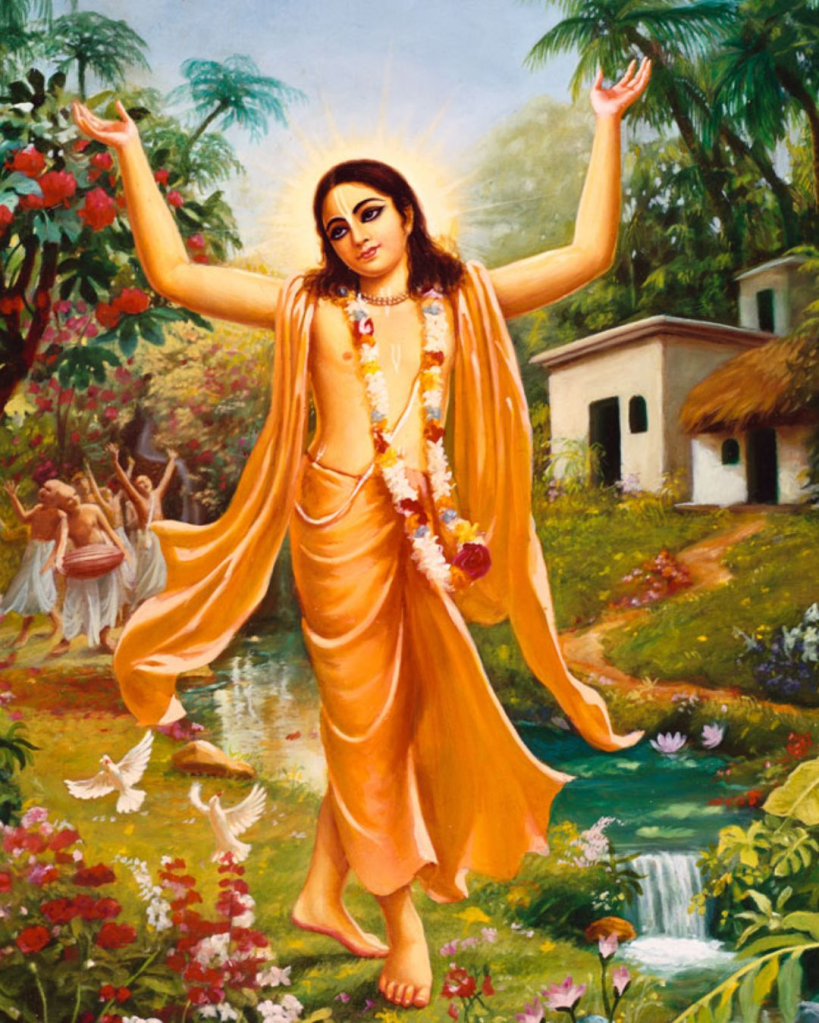
Sri Chaitanya Mahaprabhu inaugurated the Sankirtan movement, the congregational chanting of the names of God. This movement has spread all over the world in the last 500 years.

Sri Krishna Chaitanya Mahaprabhu even says that there are no rules…

CC Antya 20.16

নাম্নামকারি বহুধা নিজসর্বশক্তি- স্তত্রার্পিতা নিয়মিতঃ স্মরণে ন কালঃ ।
এতাদৃশী তব কৃপা ভগবন্মমাপি দুর্দৈবমীদৃশমিহাজনি নানুরাগঃ ॥ ১৬ ॥

nāmnām akāri bahudhā nija-sarva-śaktis
tatrārpitā niyamitaḥ smaraṇe na kālaḥ
etādṛśī tava kṛpā bhagavan mamāpi
durdaivam īdṛśam ihājani nānurāgaḥ
Synonyms

“ ‘My Lord, O Supreme Personality of Godhead, in Your holy name there is all good fortune for the living entity, and therefore You have many names, such as “Kṛṣṇa” and “Govinda,” by which You expand Yourself. You have invested all Your potencies in those names, and there are no hard and fast rules for remembering them. My dear Lord, although You bestow such mercy upon the fallen, conditioned souls by liberally teaching Your holy names, I am so unfortunate that I commit offenses while chanting the holy name, and therefore I do not achieve attachment for chanting.’

https://vedabase.io/en/library/cc/antya/20/16/

It’s clear, Mahaprabhu says “there are no hard and fast rules“. Yet in the same verse, Sri Krishna Chaitanya Mahaprabhu also mentions “offenses” to be avoided. What are those?

When we chant Hare Krishna or any other authorized names of God, we should strive to avoid all offenses. There are 10 specific offenses to be mindful of.

1) To blaspheme the devotees who have dedicated their lives for propagating the holy name of the Lord.

2) To consider the names of demigods like Lord Shiva or Lord Brahma to be equal to or independent of the name of the Lord Vishnu.

3) To disobey the orders of the spiritual master.

4) To blaspheme the vedic scriptures or scriptures in pursuance to the vedic version.

5) To consider the glories of chanting Hare Krishna to be an imagination.

6) To give some interpretations to the holy name of the Lord.

7) To commit sinful activities on the strength of the holy name.

8) To consider the chanting of Hare Krishna as one of the auspicious ritualistic activities which are offered in the Vedas as frutive activities (Karma kanda).

9) To instruct a faithless person about the glories of the holy name

10) To not have complete faith in the chanting of the holy name and to maintain material attachments, even after understanding so many instructions on this matter. It is also an offense to be inattentive while chanting.


Every devotee who claims to be Vaishnava must guard against these offenses in order to quickly achieve the desired success KRISHNA PREMA!!!

Padma Purana (Section: Brahma Khanda 25.15–18)

There are so many rules and regulations! This applies whether it is with cooking for Krishna, or worship of Krishna in Deity form. This applies to fasting, or ending one’s fast. This applies to reading or explaining scripture. In every aspect of Bhakti there are rules.

There are rules and regulations in the other religious traditions also. There is hardly a tradition without rules and regulations. And without rules and regulations, what is tradition anyways?

But the highest spiritual principle is pure love of God, so why all the rules?

After all, there are no rules and regulations in love, no?

But here’s the catch… We presently do not have any love for God!

We have only a blind, slavish servitude of our senses and mind!

The rules are meant for those who are not yet pure lovers of God. For the pure Lover of God, there are no rules.

Still, why any rules on the path of love of God?

Think of this situation…

Let us say you are responsible for caring for someone. Let’s say, a dear parent, or grandparent, a child, or even a pet…

Now, let’s say you need to entrust that loved one to me, a stranger. Let us say I can be trusted to be reliable with my care, but I don’t know your loved one. I don’t know what they need.

When you love someone, and you entrust them to someone else' care, you do give a lot of rules and regulations and guidelines!

How many rules and regulations will you give me? How many guidelines? How much advice?

She doesn’t like this food… He is allergic to that medicine. She sleeps at this time. He gets agitated when someone does that! She loves it when you serve this food with that condiment… Here is the clothing. Here is the extra blanket. Here is the toy. Wake him up for his appointment. Take him to this place. Don’t leave her alone… Here is the medicine, and this is the right dosage, by the way. Here is this, and don’t forget that. Here is my phone number, call me if you need anything. Please be careful. Thank you soooo much!

Then, when I am alone with your loved one, will you call? Will you check up on how they are doing?

That is the intent of the rules and regulations in Bhakti also.

The rules are regulations are given to us by someone who loves God very very much. The spiritual master, who gives us the rules, is a confidential servitor of God, and knows God better than us. The saintly souls hand us the rules, for our own growth.

So, out of their love for us, and for God, they give us the rules.

The rules and regulations are simply a manifestation of the saints’ love for Krishna. When we adhere to them precisely, we can reach the same stage of love. Of course, we can’t remain only on the platform of rules and regulations. By the blessings of the spiritual master, we can develop the same individual, spontaneous, loving attraction to Krishna. We can exceed the standard of the minimum rules by their grace.

So, who will be so foolish as to not pay attention to the rules and regulations of the scripture?

Bg. 16.23

य: शास्त्रविधिमुत्सृज्य वर्तते कामकारत: ।
न स सिद्धिमवाप्‍नोति न सुखं न परां गतिम् ॥ २३ ॥

yaḥ śāstra-vidhim utsṛjya vartate kāma-kārataḥ
na sa siddhim avāpnoti na sukhaṁ na parāṁ gatim

He who discards scriptural injunctions and acts according to his own whims attains neither perfection, nor happiness, nor the supreme destination.

https://vedabase.io/en/library/bg/16/23/

Bg. 16.24

तस्माच्छास्त्रं प्रमाणं ते कार्याकार्यव्यवस्थितौ ।
ज्ञात्वा शास्त्रविधानोक्तं कर्म कर्तुमिहार्हसि ॥ २४ ॥

tasmāc chāstraṁ pramāṇaṁ te
kāryākārya-vyavasthitau
jñātvā śāstra-vidhānoktaṁ
karma kartum ihārhasi

One should therefore understand what is duty and what is not duty by the regulations of the scriptures. Knowing such rules and regulations, one should act so that he may gradually be elevated.

https://vedabase.io/en/library/bg/16/24/

What do you think about rules and regulations in spiritual life? Let me know!

Satan as Competitor to God, what an absurdity!

On Easter Friday, reflecting on Jesus’ sacrifice, compassion, and forgiveness fills us with hope. While beliefs about Satan vary, turning inward reveals our own role in turning away from God – the cause of all problems. Instead of blaming external forces, let’s embrace personal responsibility and reconnect with God’s boundless love and grace. No one else can thwart our journey to knowledge and bliss. Hare Krishna!

I write this on Easter Friday. I reflect on the great sacrifice of Jesus Christ. I reflect on his deep compassion, humility, and grace. I reflect on his wonderful quality of forgiveness. I reflect on his instructions in the Bible.

Specifically, I reflect on this prayer of Jesus Christ, while he was being crucified, and the men in charge of this ghastly deed were gambling to divide his clothes amongst themselves… “Father, forgive them; for they know not what they do”.

One of my spiritual master’s favourite prayers is “not my will, but thine, be done.”.

Jesus is the Son of God, and we are all meant to be sons and daughters of God.

In the Abrahamic traditions, Judaism, Christianity, and Islam, there is the idea of Satan.

Wikipedia says this about Satan… “”Satan, also known as the Devil, and sometimes also called Lucifer in Christianity, is an entity in Abrahamic religions that seduces humans into sin or falsehood. In Judaism, Satan is seen as an agent subservient to God, typically regarded as a metaphor for the yetzer hara, or “evil inclination”. In Christianity and Islam, he is usually seen as a fallen angel or jinn who has rebelled against God, who nevertheless allows him temporary power over the fallen world and a host of demons. In the Quran, Shaitan, also known as Iblis, is an entity made of fire who was cast out of Heaven because he refused to bow before the newly created Adam and incites humans to sin by infecting their minds with waswās (“evil suggestions”).

The most accurate Abrahamic idea about the concept of Satan is the one accepted in Judaism.

However, too many people around the world actually believe that Satan is some sort of a competitor to God. This is quite foolish.

Christians routinely denounce anyone who does not accept their particular sectarian view of God and His creation as “Satanic”. One intelligent agnostic lady, after asking uncomfortable questions sincerely, was labeled by some Christians as Satan!

It is not that asking questions and being inquisitive is bad! When one does not know things as they are, then one feels threatened by any question or idea that is not covered in one’s limited understanding.

But rest assured, God has absolutely NO competition!

God is known as “asamaurdhva” which is a combination or “asama” and “urdhva” which means He who has neither equal nor superior.

In the Bhagavad Gita, the Song of God, Krishna, the Supreme Personality of Godhead, describes His own opulences in great detail. But even Krishna acknowledges that it is impossible for us to understand all of His opulences because they are limitless.

अथवा बहुनैतेन किं ज्ञातेन तवार्जुन ।
विष्टभ्याहमिदं कृत्स्नमेकांशेन स्थितो जगत् ॥ ४२ ॥

atha vā bahunaitena
kiṁ jñātena tavārjuna
viṣṭabhyāham idaṁ kṛtsnam
ekāṁśena sthito jagat

But what need is there, Arjuna, for all this detailed knowledge? With a single fragment of Myself I pervade and support this entire universe.

https://vedabase.io/en/library/bg/10/42/

Then why does this idea of Satan exist?

It is tempting to blame some other personality for all the ills in the world, all the troubles we face. It is quite convenient to concoct the idea that somehow Satan is the cause of our ills.

But really, we have to look inward, and look at ourselves.

কৃষ্ণ ভুলি’ সেই জীব অনাদি-বহির্মুখ ।
অতএব মায়া তারে দেয় সংসার-দুঃখ ॥ ১১৭ ॥

kṛṣṇa bhuli’ sei jīva anādi-bahirmukha
ataeva māyā tāre deya saṁsāra-duḥkha

“Forgetting Kṛṣṇa, the living entity has been attracted by the external feature from time immemorial. Therefore the illusory energy [māyā] gives him all kinds of misery in his material existence.

https://vedabase.io/en/library/cc/madhya/20/117/

It is us, with our own free will, who have chosen to turn away from God. It is not that someone else has incited or influenced us, it is our own individual personal decision.

When we decide to turn towards God again, and gradually purify our consciousness, we will see that God has absolutely no competitors.

The closest parallel from the Vedic tradition to the idea of Satan is “Maya”.

Maya is the illusory energy of God. And this energy does not affect anyone who is turned towards God in every thought, word, and deed. In fact, the very same Maya, who is acting as “Mahamaya” in the illusory aspect, now transforms into “Yogamaya”, or one who is diligently engaged in connecting the living entity and God’s energies in harmony with God.

The energy of the Lord called avidyā is the bewildering factor of the conditioned souls. The material nature is called avidyā, or ignorance, but to the devotees of the Lord engaged in pure devotional service, this energy becomes vidyā, or pure knowledge. This is confirmed in Bhagavad-gītā. The energy of the Lord transforms from mahā-māyā to yoga-māyā and appears to pure devotees in her real feature. The material nature therefore appears to function in three phases: as the creative principle of the material world, as ignorance and as knowledge.

https://vedabase.io/en/library/sb/3/10/17/

But Maya is not any kind of competitor… she is a most dear servitor of God…

sṛṣṭi-sthiti-pralaya-sādhana-śaktir ekā
chāyeva yasya bhuvanāni bibharti durgā
icchānurūpam api yasya ca ceṣṭate sā
govindam ādi-puruṣaṁ tam ahaṁ bhajāmi


The external potency Māyā who is of the nature of the shadow of the cit potency, is worshiped by all people as Durgā, the creating, preserving and destroying agency of this mundane world. I adore the primeval Lord Govinda in accordance with whose will Durgā conducts herself.

https://vedabase.io/en/library/bs/5/44/

So, dear souls, there is absolutely no one else holding us back from an eternity in full knowledge and bliss, except ourselves. Questions?

Hare Krishna!