From Schadenfreude to Compassion: A Journey (part 1)

Compassion is a complex and often misunderstood concept, as it calls for empathy towards all individuals, regardless of their circumstances. Balancing compassion for various groups can present challenges, especially when faced with conflicting needs and situations. Ultimately, striving for universal compassion is essential, despite the inherent difficulties in this pursuit. However, if we want to act with universal compassion, we should start with understanding what compassion is not! Schadenfreude, certainly not. Alas, it is more common than we think!

Compassion, this word is used very often. Someone wants us to have compassion upon the downtrodden and poor. Someone else wants us to have compassion upon the rich and powerful. Some want to be compassionate towards people with black skin. Others want to be compassionate upon the war veterans. Someone is working intently upon manifesting compassion towards those battling cancer.

This is part 1 of a 3 series of articles. Part 2 is here, and Part 3 is here.

I agree with them all. We should be compassionate with everyone in the whole world.

Do you agree that all those living entities mentioned above deserve to be treated with compassion? What about those not mentioned above? Do they deserve to be treated with compassion?

But for example, suppose I dedicate my life to, say, feeding hungry people. Now, all of my efforts are spent in finding the hungry, acquiring food and feeding them… how would I help the sick children, the war veterans, the people with black skin, and the cancer patients?

Or, if I invest all my time in trying to find a cure for Cancer… now how would I feed the hungry, take care of the sick children, the war veterans, the people with black skin?

Or maybe I do a little bit to help them all… donate to feed a few hungry people, donate to a charity helping war veterans, volunteer for a hospital that treats people with cancer… but then I notice that there are many more hungry, many more war veterans, many with cancer and many disadvantaged people with black skin!

What’s more, I find that the charity feeding the hungry is slaughtering innocent animals… the war veterans who are injured actually committed atrocities upon other people who are left in worse shape than them, some of the the people with cancer happened to be those who smoked all their lives, and some of the people with black skin are of poor character and have harmed many others…

Now what do I do?

Do I prioritize the “innocent” disadvantaged over those with a criminal background? Do I overlook Diabetes or Hypertension in my obsession over cancer? Do I ignore the elderly in my quest to help the children?

It appears that being compassionate is more difficult than it sounds at first!

It’s all extremely confusing and difficult to sort through!

I am just one teeny little soul, a tiny jiva, one little spirit soul among unlimited spirit souls. I have limited energy, limited time in this life, and very limited resources, power and influence in the world. And yet I want to be compassionate to all.

I don’t want to be compassionate to one group of living entities, say, sick children, and not be compassionate, say, to poor children who are not sick but lack education. I don’t want to be compassionate upon the hungry people of the world, and end up slaughtering animals to help temporarily prevent their hunger.

Do I have any hope of attaining my goal of being compassionate towards everyone then?

Can I be compassionate towards ALL souls?

Yes, in the Bhagavad Gita, Krishna speaks about compassion for all souls.
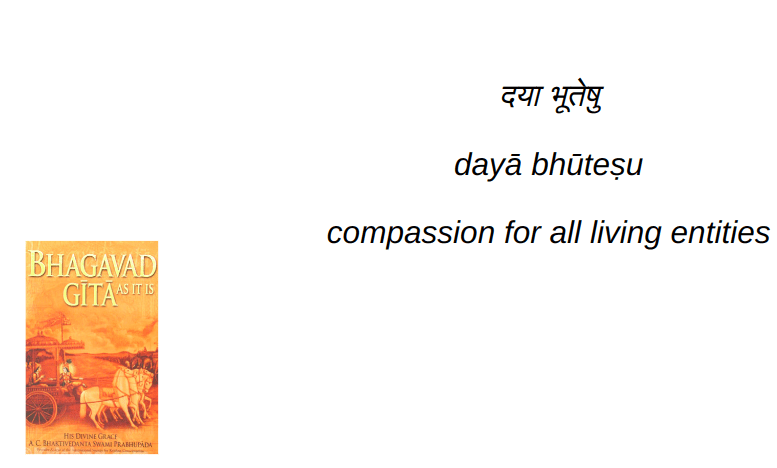
daya bhuteshu - compassion for all living entities, a quote from the Bhagavad Gita Chapter 16, Verse 2

दया भूतेषु – dayā bhūteṣu – compassion for all living entities

https://vedabase.io/en/library/bg/16/1-3/

More specifically, Krishna stresses that this quality, among a total of twenty size qualities, belong to those godly souls endowed with a divine nature.

So, clearly it is not hopeless to strive to be compassionate towards one and all.

In our present context though, we may not be “godly souls”, and we may not (yet) be endowed with a “divine nature”… what can we do?

First and foremost, we need to understand what compassion is not!

Yes, if we understand what is not compassion, then we should be able to steer our thoughts, words, and deeds in the direction of compassion.

Let’s look at the most obvious example of what is NOT compassion.

Schadenfreude (German) - pleasure derived from the misfortune of others.

The American Heritage Dictionary Defines Schadenfreude as follows:

schadenfreude /shäd′n-froi″də/

noun

  1. Pleasure derived from the misfortunes of others.
  2. Malicious enjoyment derived from observing someone else’s misfortune.
  3. Delight in another person’s misfortune.

We can safely say that someone who is feeling schadenfreude is not being compassionate!

Hey, I’m not like that!

So we may think. But here are just a few examples when we indulge in Schadenfreude…

  1. Sports – what happens when a team you support wins, and a team you oppose loses? Do you feel happy?
  2. Exams/Competition/Contests – what happens when you beat other competitors in an exam or competition? Do you feel elated?
  3. Business – what happens when you defeat a competitor, win a contract from an opponent, or put another company out of business? Do you celebrate?
  4. War – say the country you live in is at war with another country… no matter whose “fault” it was… if your army scores a “win”, does that not mean that someone on the other end is mourning a loved one?
  5. Politics – say the party you support wins an election and comes to power… does that mean that the defeated parties had nothing good to offer to the world at all?

When we examine our world, we find that…

In fact, our whole world, our society is built on top of deriving pleasure from the misfortunes of others.

Where does it all come from, one would wonder…

Schadenfreude comes from envy… “I wish that you don’t have what you have, I wish I have it instead, and you don’t”… it originally begins with Envy of God, but that is a discussion for another article.

Where there is envy, there can never be true co-operation, there can only be competition, sometimes, cut-throat.

Countries, communities, clubs, societies, networks, organizations are formed on the basis of envy against others. The envy may be based on race, religion, nationality, language, education, political, cultural or economic factors. It does not matter what the criteria separating the “us” and “them” are. And all of them engage wholesale in this schadenfreude.

We’re all members of such propagators of schadenfreude whether unwillingly or not!

So we can think about how to live in a world where competition is the name of the game!

Compassion means the exact opposite of Schadenfreude… to feel pain at the sufferings of others.

OK, let’s say we do somehow get past the most obvious schadenfreude. How to act with compassion?

For example, what if I’m trying to “help” someone, but I only end up hurting the person I’m trying to help?

How do we know if something we are thinking, feeling, willing, saying, or doing is helping or hurting?

Watch out for Part 2 of this series of articles…

In that post, we will go deeper into understanding how our intent to help can actually hurt.

Why Religious Conversion Does Not Equal True Transformation

A reflection on the nature of religious conversion… does it often lack genuine transformation? What is religious conversion driven by? Let us not ignore the importance of personal development and the cultivation of qualities such as compassion, truthfulness, and humility, rather than merely changing religious labels!

A Hindu can convert to Islam or Christianity. A Christian can convert to Hinduism or Islam. And of course, a Muslim can give up his faith to become an agnostic or Hindu or Christian. Replace any label with any other label, an “X” can convert to “Y”.

When someone converts, then some rejoice, and others fret and fume. One lady once said to me, after revealing to me her previous background “don’t reveal this to anyone, those people, they will kill me if they find out.”. I was quite saddened to hear that someone could be so barbaric as to try and kill her.

Neither is religious conversion of any value, nor should we worry about it. Rest assured, it will have no effect whatsoever. Religious conversion is a farce. It is a political move at best. Why is that?

The work we do inside a trligious tradition matters, not just professing some faith!

What is The Purpose of Religious Tradition?

Because, religious traditions, are like universities or other educational institutions. You don’t “convert” from Stanford to Yale, for example. Neither do you “convert” from computer science to mathematics.

Yes, you can transfer credits from one program to another, you can even switch from one university to another, but it is laughable to say that you have “converted” from studying to be, say, a doctor, to studying to be a medical researcher.

No matter if you are a doctor, or a lawyer, or a medical researcher or a mathematician or a software engineer or whatever… ultimately the result of your work is an income, which you use to meet your needs and wants. A religious tradition is similar, in it that you are meant to use your religious tradition to get closer to God! So don’t use your religious tradition for political purposes or any other lesser purpose!

Now, after an academic transfer, if you actually complete the requirements of your new program and put your acquired knowledge and experience to do better than before, then maybe the transfer was worthwhile, otherwise, it is like the farce of enrolling into a program, and doing nothing to actually fulfill the requirements!

Conversions Galore, and Re-Conversions Too!

I come from India, and throughout my history lessons, I studied how, starting about 2,500 years ago, “Hindus” were converting to Buddhism. Then, I read how, as the philosophy of Buddhism was defeated by great Acharyas such as Adi Shankaracharya, Sripad Ramanujacharya, and Sri Madhvacharya… all those former Buddhists reconverted to “Hinduism”.

Then later on, the Muslims invaded India from Central Asia, the Middle East, and those parts of the world… and they “converted” many of the “Hindus” into “Muslims”. Some of those “Muslims” later reconverted to being called “Hindus” while others adopted their new identities.

After a few hundred years, the Christian missionaries came to India, and began to “convert” Hindus, Muslims, and even the remaining Buddhists, into “Christians”. Some convert back, or to something else!

And this conversion roulette continues to be played today.

It is a farce. A person who professes some label, now claiming to profess some other label doesn’t change anything!

rotten fruit juice is no nectar

Labels Labels Everywhere

If you took some rotten fruit juice and put it into a different bottle labeled something… will the rotten fruit juice be transformed into nectar? No, rotten will remain rotten, maybe even become more so!

You can take an animal, let’s say, a dog, and you can label him a cat, but does he change to being a cat? Can you label a bird as a fish and now the “bird-labeled-fish” will be able to breathe under water and swim around like a fish?

Yes, you could try to indoctrinate the dog all you want… you could tell him “ok, now you are a cat… cats are ‘yours’ and dogs are the enemy”… will it work? No, the next time that dog sees a cat, he will be after it, barking away.

a dog is a dog, in any dress or conditioniong

Similarly, if you take a person who is unable to, say, practice the high Brahminical standards… and you convert that person into, say, a Christian. Will there be any transformation in the person based on this conversion? No, that person will still not be able to follow the highest tenets of Christianity!

In this case, the religious conversion was just to avoid following higher standards. In this way, conversion for the sake of some temporary economic benefit, or social pressure, or frustration with the community – these are the signs of a farcical conversion!

Someone may convert to Christianity because of promise of money or a job or some gifts, like a blanket or a pot or a stove… some convert to Christianity to get access to an addiction recovery service.

After all, how many Christians can follow the ten commandments? In fact, most of the Christians were so incapable of following the ten commandments that they had to water them down! And still they are hard to follow for most people who profess Christianity.

Embodying the Essence!

But to a dedicated follower of the Vedic Principles, the ten commandments are nothing, merely common sense, not even some great philosophical revelation! They have no trouble naturally following the ten commandments!

So what is the real deal? The real deal is when a person’s consciousness is transformed, taking it from animal-like consciousness to a divine state of consciousness!

That is the test. When someone tells me “I am X” or “I am Y”… I look at whether the person has actually developed a love for God, a love for their fellow beings, and not just humans of a certain label. I look for qualities like compassion, cleanliness, truthfulness, punctuality, honesty, and so on. In fact, these are the qualities I try and cultivate within myself…

kṛpālu, akṛta-droha, satya-sāra, sama
nidoṣa, vadānya, mṛdu, śuci, akiñcana
sarvopakāraka, śānta, kṛṣṇaika-śaraṇa
akāma, anīha, sthira, vijita-ṣaḍ-guṇa
mita-bhuk, apramatta, mānada, amānī
gambhīra, karuṇa, maitra, kavi, dakṣa, maunī

SYNONYMS
kṛpālu—merciful; akṛta-droha—not defiant; satya-sāra—thoroughly truthful; sama—equal; nidoṣa—faultless; vadānya—magnanimous; mṛdu—mild; śuci—clean; akiñcana—without material possessions; sarva-upakāraka—working for the welfare of everyone; śānta—peaceful; kṛṣṇa-eka-śaraṇa—exclusively surrendered to Kṛṣṇa; akāma—desireless; anīha—indifferent to material acquisitions; sthira—fixed; vijita-ṣaṭ-guṇa—completely controlling the six bad qualities (lust, anger, greed, etc.); mita-bhuk—eating only as much as required; apramatta—without inebriation; māna-da—respectful; amānī—without false prestige; gambhīra—grave; karuṇa—compassionate; maitra—a friend; kavi—a poet; dakṣa—expert; maunī—silent.

TRANSLATION
”Devotees are always merciful, humble, truthful, equal to all, faultless, magnanimous, mild and clean. They are without material possessions, and they perform welfare work for everyone. They are peaceful, surrendered to Kṛṣṇa and desireless. They are indifferent to material acquisitions and are fixed in devotional service. They completely control the six bad qualities—lust, anger, greed and so forth. They eat only as much as required, and they are not inebriated. They are respectful, grave, compassionate and without false prestige. They are friendly, poetic, expert and silent.

https://vedabase.io/en/library/cc/madhya/22/78-80/

In fact, the Bhagavatam goes on to say this…

ŚB 5.18.12
यस्यास्ति भक्तिर्भगवत्यकिञ्चना
सर्वैर्गुणैस्तत्र समासते सुरा: ।
हरावभक्तस्य कुतो महद्गुणा
मनोरथेनासति धावतो बहि: ॥ १२ ॥

yasyāsti bhaktir bhagavaty akiñcanā
sarvair guṇais tatra samāsate surāḥ
harāv abhaktasya kuto mahad-guṇā
manorathenāsati dhāvato bahiḥ

Synonyms
yasya — of whom; asti — there is; bhaktiḥ — devotional service; bhagavati — to the Supreme Personality of Godhead; akiñcanā — without any motive; sarvaiḥ — with all; guṇaiḥ — good qualities; tatra — there (in that person); samāsate — reside; surāḥ — all the demigods; harau — unto the Supreme Personality of Godhead; abhaktasya — of a person who is not devoted; kutaḥ — where; mahat-guṇāḥ — good qualities; manorathena — by mental speculation; asati — in the temporary material world; dhāvataḥ — who is running; bahiḥ — outside.

Translation
All the demigods and their exalted qualities, such as religion, knowledge and renunciation, become manifest in the body of one who has developed unalloyed devotion for the Supreme Personality of Godhead, Vāsudeva. On the other hand, a person devoid of devotional service and engaged in material activities has no good qualities. Even if he is adept at the practice of mystic yoga or the honest endeavor of maintaining his family and relatives, he must be driven by his own mental speculations and must engage in the service of the Lord’s external energy. How can there be any good qualities in such a man?

https://vedabase.io/en/library/sb/5/18/12/

In the purport, Srila Prabhupada clarifies more…

The Qualities of an Advanced Spiritualist

In the Ādi-līlā of Caitanya-caritāmṛta, Chapter Eight, there is a description of some of the qualities of devotees. For example, Śrī Paṇḍita Haridāsa is described as being very well-behaved, tolerant, peaceful, magnanimous and grave. In addition, he spoke very sweetly, his endeavors were very pleasing, he was always patient, he respected everyone, he always worked for everyone’s benefit, his mind was free of duplicity, and he was completely devoid of all malicious activities. These are all originally qualities of Kṛṣṇa, and when one becomes a devotee they automatically become manifest. Śrī Kṛṣṇadāsa Kavirāja, the author of Caitanya-caritāmṛta, says that all good qualities become manifest in the body of a Vaiṣṇava and that only by the presence of these good qualities can one distinguish a Vaiṣṇava from a non-Vaiṣṇava. Kṛṣṇadāsa Kavirāja lists the following twenty-six good qualities of a Vaiṣṇava:

(1) He is very kind to everyone.

(2) He does not make anyone his enemy.

(3) He is truthful.

(4) He is equal to everyone.

(5) No one can find any fault in him.

(6) He is magnanimous.

(7) He is mild.

(8) He is always clean.

(9) He is without possessions.

(10) He works for everyone’s benefit.

(11) He is very peaceful.

(12) He is always surrendered to Kṛṣṇa.

(13) He has no material desires.

(14) He is very meek.

(15) He is steady.

(16) He controls his senses.

(17) He does not eat more than required.

(18) He is not influenced by the Lord’s illusory energy.

(19) He offers respect to everyone.

(20) He does not desire any respect for himself.

(21) He is very grave.

(22) He is merciful.

(23) He is friendly.

(24) He is poetic.

(25) He is expert.

(26) He is silent.

So let us all, with every means offered to us by our own religious tradition, strive to inculcate these qualities.

Let us not be a disgrace to our teachers, prophets, saints, philosophers, Gurus, Acharyas, Rabbis, Mullahs, Imams, Priests, Mentors, Pastors, Sangomas, and so on.

Let us not be a disgrace to our leaders. And it will be worse if we ourselves are the leaders!

In fact, it will be an even bigger disgrace if we ourselves are in such a respectable position as to advise others, and we ourselves have none of the transformation, none of the qualities mentioned above.

Let us all be converted in the only way that matters, develop pure Love for God.

Srila Prabhupada, a pure lover of God.

Hare Krishna!

Which religion do you belong to?

We are not these bodies. To think we are these bodies, or to treat someone else as if they are a body is idiotic.

I often get asked that question, especially when dressed in traditional Vaishnava attire, the answer in the words of my spiritual master Sankarshan Das Adhikari, “Religion is one, to know yourself, and be yourself. To know God and to love God”, and he continues “Religion, singular, is one. Religions, plural, is politics.”.

Indeed, it is true that religion in its form as politics has been used for all sorts of terrible goals, subjugation, division, domination, control, politics, and so much more. But then, again, in the words of my spiritual master’s spiritual master, Srila Prabhupada, “It is something like that, that a man in the market, he has been cheated simply by counterfeit currency. He is disappointed that there is no real money. But actually that is not a fact. The government is there, and the currency is there, the real currency.”

So yes, there is real religion, and that real religion is beyond all material designations.

I often say “I’m past the labels, I’m all about – Do you knwo who God is? Do you really love God, or do you just want God to be your order supplier? Do you serve God’s creation or do you hanker for the Universe to serve you?”

Religion, the word, comes from the Latin “re-ligio”, to reconnect. “re-connect”, that means we were once connected and are now disconnected. And for a connection, there must be two connection points and some sort of mechanism to connect. And this is the essence of religion, and these are some tests I use to determine if I am on the right path or if I got side-tracked…

  • Do I care about material sense gratification less or more than before?
  • Do I feel upset that someone doesn’t agree with me?
  • Am I equipoised in honour, dishonour, wealth, poverty, health, sickness, happiness, distress?
  • When I discuss God with someone, is it about serving them or is it about feeding my own ego?
  • Do I know better now than before who I am? Do I act accordingly?
  • Do I know more about the identity and nature of God than before?
  • Do I really love God? I mean, do I really LOVE God?
  • Am I serving more or better than before?

In the Bhagavad Gita, the divisions of faith are clearly discussed, and there are different means of attaining to pure Love of God according to one’s current position. But no matter which genuine tradition of religion you pursue, the effects of the Pure Love of God are the same.

From Bhagavad Gita, Chapter 12, Bhakti Yoga
TEXTS 6-7:
But those who worship Me, giving up all their activities unto Me and being devoted to Me without deviation, engaged in devotional service and always meditating upon Me, having fixed their minds upon Me, O son of Pṛthā – for them I am the swift deliverer from the ocean of birth and death.
TEXT 8:
Just fix your mind upon Me, the Supreme Personality of Godhead, and engage all your intelligence in Me. Thus you will live in Me always, without a doubt.
TEXT 9:
My dear Arjuna, O winner of wealth, if you cannot fix your mind upon Me without deviation, then follow the regulative principles of bhakti-yoga. In this way develop a desire to attain Me.
TEXT 10:
If you cannot practice the regulations of bhakti-yoga, then just try to work for Me, because by working for Me you will come to the perfect stage.
TEXT 11:
If, however, you are unable to work in this consciousness of Me, then try to act giving up all results of your work and try to be self-situated.
TEXT 12:
If you cannot take to this practice, then engage yourself in the cultivation of knowledge. Better than knowledge, however, is meditation, and better than meditation is renunciation of the fruits of action, for by such renunciation one can attain peace of mind.
TEXTS 13-14:
One who is not envious but is a kind friend to all living entities, who does not think himself a proprietor and is free from false ego, who is equal in both happiness and distress, who is tolerant, always satisfied, self-controlled, and engaged in devotional service with determination, his mind and intelligence fixed on Me – such a devotee of Mine is very dear to Me.
TEXT 15:
He by whom no one is put into difficulty and who is not disturbed by anyone, who is equipoised in happiness and distress, fear and anxiety, is very dear to Me.
TEXT 16:
My devotee who is not dependent on the ordinary course of activities, who is pure, expert, without cares, free from all pains, and not striving for some result, is very dear to Me.
TEXT 17:
One who neither rejoices nor grieves, who neither laments nor desires, and who renounces both auspicious and inauspicious things – such a devotee is very dear to Me.
TEXTS 18-19:
One who is equal to friends and enemies, who is equipoised in honor and dishonor, heat and cold, happiness and distress, fame and infamy, who is always free from contaminating association, always silent and satisfied with anything, who doesn’t care for any residence, who is fixed in knowledge and who is engaged in devotional service – such a person is very dear to Me.
TEXT 20:
Those who follow this imperishable path of devotional service and who completely engage themselves with faith, making Me the supreme goal, are very, very dear to Me.

Enter your email address to subscribe to this blog and receive notifications of new posts by email.