The standard of education

We wake up to horrible headlines every day. People in leadership roles, people who are “highly educated” act in terrible ways.

We come up with band-aid solutions every day, whack-a-mole style. But have we examined the root cause of the problems we face in our world?

Could there be a problem with our education system?

What does it mean to be “educated”? What is the standard of education? What is the bar? How do we know if someone is educated or not?

I was shocked and disgusted to see news like this in the media…

  • Bengaluru student raped, blackmailed by college professors; three arrested
  • Former professor charged with raping multiple victims from El Salvador
  • Two women say Stanford and UC Berkeley professors raped them
  • UP professor booked for raping female students
  • Muslim Schoolteacher rapes and marries 12-year old student
  • Mumbai Teacher Gave Student Anti-Anxiety Meds, Sexually Assaulted Him

How is it that teachers and professors did this to their own students?

We are very proud of our education system in the modern world.

We gush about our kindergarten, primary, secondary, tertiary education… about Montessori and Waldorf, and other types of education.

We talk about degrees, undergraduate, graduate, PhDs.

We talk about vocational training, we laud the trades.

And yet, on a daily basis, we see scandals in the world around us. They occur in the corporate world, the medical profession, business, and government…

There are many band-aid solutions floating around, but do we know the real cause?

Our education system is a failure

Why do I say that?

Because education is meant to produce cultured individuals of high character. Someone objects that this is a subjective thing. Who can define what is a “cultured” individual with “high character”?

That is yet another failure of our education system. We don’t even know what the definition of simple things is.

The definition of “well educated” has been known for millions of years.

If someone does not trust the pedigree of Vedic culture, there is more recent definition. More than 1,500 years ago, the great thinker Chanakya Pandit wrote:

mātṛvat para-dāreṣu
para-dravyeṣu loṣṭravat
ātmavat sarva-bhūteṣu
yaḥ paśyati sa paṇḍitaḥ

“One who considers another’s wife as his mother, another’s possessions as a lump of dirt and treats all other living beings as he would himself, is considered to be learned.”

quoted by Srila A. C. Bhaktivedanta Swami Prabhupada in https://vedabase.io/en/library/sb/9/10/27/

But there is hardly such a person trained by the modern education system… And if you can actually find such a person, that is in spite of their education. It is not because of their education.

We don’t teach such things in our education system. What do we teach?

We teach how to compete, how to defeat, how to win at any cost. We teach how to beg, borrow, or steal. We teach how to be passionate or ignorant, but never how to be “good”. We simply teach people how to make a dollar, or a rupee, or a pound or euro. That is not education!

Education means to raise a student above their low class impulses, to be good in the face of temptation! But it is impossible for our education system today to do any better.

The very definition of “goodness” is unknown in the modern world!

Here are a few definitions of “goodness” from the Vedic scriptures…

  • nityasattvasthaḥ — in a pure state of spiritual existence BG 2.45
  • ūrdhvaṁ gacchanti sattva-sthā – Those situated in the mode of goodness gradually go upward to the higher planets BG 14.18
  • sattvasaṁśuddhiḥ — purification of one’s existence BG 16.1
  • sāttvika – that which increases the duration of life, purify one’s existence and give strength, health, happiness and satisfaction BG 17.8
  • na dveṣṭy akuśalaṁ karma kuśale nānuṣajjate
    tyāgī sattva-samāviṣṭo medhāvī chinna-saṁśayaḥ

The intelligent renouncer situated in the mode of goodness, neither hateful of inauspicious work nor attached to auspicious work, has no doubts about work. BG 18.10

There are many many wonderful definitions of what it means to be “good” in Vedic literature. When we look at the few definitions of “goodness” above, we see that our education system does not touch these at all:

  1. Spirituality
  2. Understanding of the evolution of the qualities of life
  3. Purification of our very existence
  4. Renunciation, Contentment, etc.

As a result, no matter how educated someone is, they inevitably indulge in this:

  1. Look upon other women (or men) as objects of their own gratification
  2. Covet others’ wealth and try to make it their own
  3. Emphasize and amplify the differences between others and oneself, treat others differently from how one would like to be treated

There is plenty of evidence to support the above claims.

Do you not see how things are in this world? Everyone is searching after one sexual experience after another… constantly, in real life, in the media, on social media, on the Internet… our society has become a cesspool of illicit sexual indulgence.

The men do not see other women as mothers. Nor do the women hold themselves in high enough regard to act and behave as mothers should. In fact, there is hardly any understanding of the exalted nature of mothers in our world! Some women, even elderly women, balk at being called “mother”, preferring to remain sex objects or identify with other designations.

With wealth, it is a free-for-all, “finders keepers losers weepers” goes the saying taught to tiny tots these days! No one sees others’ possessions as good as worthless. They are constantly envious of what others have, and how to take it from them, by hook or by crook. This goes all the way from individuals to corporations to countries!

And almost everyone treats everyone else differently from how they would like to be treated… There is widespread harassment, racism, sexism, ageism, nationalism, ableism, classism, and so much more.

The education sytem does not teach that we are all spirit souls, equal spiritually!

So, dear reader, our education system has failed.

We need to bring it back to this standard of education.

“One who considers another’s wife as his mother, another’s possessions as a lump of dirt and treats all other living beings as he would himself, is considered to be learned.”

All teachers, lecturers, instructors, professors, and other educators who can’t uphold this principle must be educated. They must reach the right standard before being trusted to educate anyone.

Until then, the education system will stay broken… and we will continually experience fresh horrors from the “products” of this demonic education system we push.

Anyone who can’t uphold the above principles must be seen as uneducated. They should not be given any position of leadership in any part of society.

Most of the modern leaders, including are uneducated, unfortunately. This includes this representative sample of those who lead our society today.

  • Teachers
  • Professors
  • Politicians
  • Business leaders
  • Government leaders
  • Scientists
  • Researchers
  • Doctors
  • Military Leaders
  • Engineers
  • Architects
  • Judges
  • Lawyers
  • Police Officers
  • Accountants
  • IT Professionals
  • Corporate Leaders
  • Social Workers
  • Economists
  • Religious Leaders

Can we wake up to the real standard of education?

What Dogs Teach Us About Nationalism and Identity… Nationalism is Dogism

Our society is plagued by rampant nationalism. The behavior of humans mirrors that of barking dogs. Dogs are fiercely protective of their perceived territories, and humans are behaving just like dogs. This disturbing behavior reveals a mindset rooted in bodily identity. This has overshadowed our shared spiritual essence. We are all spirit souls. We share the same heavenly father. But we are just focused on temporary external designations. Dogs will be dogs, but humans do not have to be dogs. Rejecting these divisive instincts will surely bring true unity among us all.

In the last Christmas/New Year’s holiday season, we went up to Huntsville, a town further north from Toronto. I was scheduled to deliver a class there. We decided to make a mini-holiday in the winter wonderland that is Muskoka.

Winter Wonderland in Muskoka, Canada

During a snowstorm, I decided to take a short walk around the cottage. Big snow! I was practically wading through it. Out of nowhere, this fierce barking dog started chasing me! I kept walking along the road, the dog ran towards me and then started running parallel to me! He was barely 3 feet from me. The fellow kept barking fiercely, teeth bared. Something, almost magical, kept the dog away from me. I was thinking at least I had winter gear on – it won’t be as painful… Later I realized it was an “invisible fence” that saved me.

Dangerous Barking Dog, almost attacked me.

The dog barked and barked until I left it’s “territory”, continuing on my walk, quietly chanting the names of God.

What made the dog behave like that? What had I done to it? Did I not look right to him? Did I not smell right? But I was just a harmless tourist, renting a cottage a few doors down. I’d be gone in a couple of days.

People behave just like that… especially at the border. Bow-wow, where are your papers? Do you have your passport? Do you have a visa? Do you have enough money to spend while you’re here? When will you leave? Why are you here? What are you bringing with you?

Passport Control - what is it really?

But ordinary people also behave like that. Decades ago, when I was a young software engineer in Germany for a project, nice old ladies on the train would ask me questions. Hallo, ver do you come from? Vot verk do you make hier? Ent, ven you go beck? Almost every person would ask me that, first three questions. Some continued to speak further, but most people would stop after those three questions.

Nice Old Lady, still concerned with unnecessary questions.

Nationalism is seeing a surge around the world these days. It is not a very spiritual thing.

nationalism /năsh′ə-nə-lĭz″əm, năsh′nə-/
noun

  1. Devotion, especially excessive or undiscriminating devotion, to the interests or culture of a particular nation-state.
  2. The belief that nations will benefit from acting independently rather than collectively, emphasizing national rather than international goals.
  3. The belief that a particular cultural or ethnic group constitutes a distinct people deserving of political self-determination.

If someone is not a nationalist, they are looked down upon.

Now, I will say something that is unpopular…

What is the difference betweeen the behavior of a nationalist, and a dog?

Let’s say a new dog or cat or a person came into the “territory” of the dog. What would the dog do?

What do dogs do when a n unfamiliar dog or cat of person enters their territory? They bark and attack!

Bow-Wow! Grrrooowwwl! Teeth bared. What are you doing here? This is MINE! GO away!

Maybe the dog goes on the attack! Tries to rip the intruder apart!

Let’s say the dog’s master comes into the “territory” of the dog. What would the dog do?

The same dog will welcome their owner or a "known" entity.

Wag tail. Jump high. Happy little barks, squeals too. Lick, lick. Welcome home sir, what can I do for you?

Now, if I ask you again, what is the difference between a nationalist, and a dog?

I have nothing against dogs! Dogs will be dogs. They have no choice in the matter as long as they are in the body of a dog. But us, humans? Why do we have to be like dogs?

But the thing is, nothing “belongs” to the dog! In fact, the dog, as an animal, belongs to his human owner.

We are exactly the same. We “belong” to God!

क्षेत्रज्ञं चापि मां विद्धि सर्वक्षेत्रेषु भारत ।
क्षेत्रक्षेत्रज्ञयोर्ज्ञानं यत्तज्ज्ञानं मतं मम ॥ ३ ॥


kṣetra-jñaṁ cāpi māṁ viddhi
sarva-kṣetreṣu bhārata
kṣetra-kṣetrajñayor jñānaṁ
yat taj jñānaṁ mataṁ mama

O scion of Bharata, you should understand that I am also the knower in all bodies, and to understand this body and its knower is called knowledge. That is My opinion.

https://vedabase.io/en/library/bg/13/3/

Srila Prabhupada writes in the purport…

Because each individual soul has his individual capacity for lording it over material nature, there are different bodies. But the Supreme also is present in them as the controller. The word ca is significant, for it indicates the total number of bodies. That is the opinion of Śrīla Baladeva Vidyābhūṣaṇa. Kṛṣṇa is the Supersoul present in each and every body apart from the individual soul. And Kṛṣṇa explicitly says here that real knowledge is to know that the Supersoul is the controller of both the field of activities and the finite enjoyer. – A. C. Bhaktivedanta Swami Prabhupada in purport to https://vedabase.io/en/library/bg/13/3/

Lest someone thinks that they “own” something, they do not. God, Krishna is the owner of everything, and only a small portion is assigned as our “quota”. We have no right to claim something that belongs to God, like the nationalists do.

Now, let’s say a friendly dog comes to the dog’s area… again, a similar welcome.

ईशावास्यमिदँ सर्वं यत्किञ्च जगत्यां जगत् ।
तेन त्यक्तेन भुञ्जीथा मा गृधः कस्य स्विद्धनम् ॥ १॥

īśāvāsyam idaḿ sarvaṁ
yat kiñca jagatyāṁ jagat
tena tyaktena bhuñjīthā
mā gṛdhaḥ kasya svid dhanam

Everything animate or inanimate that is within the universe is controlled and owned by the Lord. One should therefore accept only those things necessary for himself, which are set aside as his quota, and one should not accept other things, knowing well to whom they belong.

https://vedabase.io/en/library/iso/1/

A nationalist competes fiercely against those of other nations. A nationalist is so entrapped in the material identity that they cannot see others as spiritual beings, even if they are in human bodies!

But what is this “devotion” and “love” based on? It is simply based on a bodily identity. I am Indian, I am Pakistani, I am Chinese, Russian, American, you name it!

Souls are souls, no matter what their external coverings look like, just like clothes.

How are you, dear Indian, different from the Pakistani? You eat practically the same food, you talk practically about the same things, you even speak the same languages sometimes. You follow the same type of religion. You worry about the same things. You have brown skins, both Indians and Pakistanis. Yes, there are some differences. One of you bears a Pakistani Passport, and the other bears an Indian passport. Yes, those pieces of paper are different. But when you come to America you will be treated the same, whether you are Indian or Pakistani. And thanks to the different papers, bow wow, how dare you.

India, Pakistan, Bangladesh, what is different about them really?
  • Same with the Russians and the Ukranians.
  • Same with the Israelis and the Palestinians.
  • Same with the Dinka and the Nuer in South Sudan.
Are Ukranians and Russians not very similar to each other?
What is so different about the Israelis and Palestinians?
In South Sudan, the Dinka and Nuer tribes are killing each other relentlessly. Why?

The problem? Bodily Consciousness.

The thinking that I am this body and everything related to this body is mine.

यस्यात्मबुद्धि: कुणपे त्रिधातुके
स्वधी: कलत्रादिषु भौम इज्यधी: ।
यत्तीर्थबुद्धि: सलिले न कर्हिचि-
ज्जनेष्वभिज्ञेषु स एव गोखर: ॥ १३ ॥


yasyātma-buddhiḥ kuṇape tri-dhātuke
sva-dhīḥ kalatrādiṣu bhauma ijya-dhīḥ
yat-tīrtha-buddhiḥ salile na karhicij
janeṣv abhijñeṣu sa eva go-kharaḥ

One who identifies his self as the inert body composed of mucus, bile and air, who assumes his wife and family are permanently his own, who thinks an earthen image or the land of his birth is worshipable, or who sees a place of pilgrimage as merely the water there, but who never identifies himself with, feels kinship with, worships or even visits those who are wise in spiritual truth — such a person is no better than a cow or an ass.

https://vedabase.io/en/library/sb/10/84/13/

To be a nationalist, is, really, to be an animal in human form.

We can rise above this, and see each other as spirit souls. Each of us is a part-and-parcel of God.

ममैवांशो जीवलोके जीवभूत: सनातन: ।
मन:षष्ठानीन्द्रियाणि प्रकृतिस्थानि कर्षति ॥ ७ ॥

mamaivāṁśo jīva-loke
jīva-bhūtaḥ sanātanaḥ
manaḥ-ṣaṣṭhānīndriyāṇi
prakṛti-sthāni karṣati

The living entities in this conditioned world are My eternal fragmental parts. Due to conditioned life, they are struggling very hard with the six senses, which include the mind.

https://vedabase.io/en/library/bg/15/7/

Not just human beings, but all species are descended from the same seed-giving Father, God!

सर्वयोनिषु कौन्तेय मूर्तय: सम्भवन्ति या: ।
तासां ब्रह्म महद्योनिरहं बीजप्रद: पिता ॥ ४ ॥

sarva-yoniṣu kaunteya
mūrtayaḥ sambhavanti yāḥ
tāsāṁ brahma mahad yonir
ahaṁ bīja-pradaḥ pitā

It should be understood that all species of life, O son of Kuntī, are made possible by birth in this material nature, and that I am the seed-giving father.

https://vedabase.io/en/library/bg/14/4/

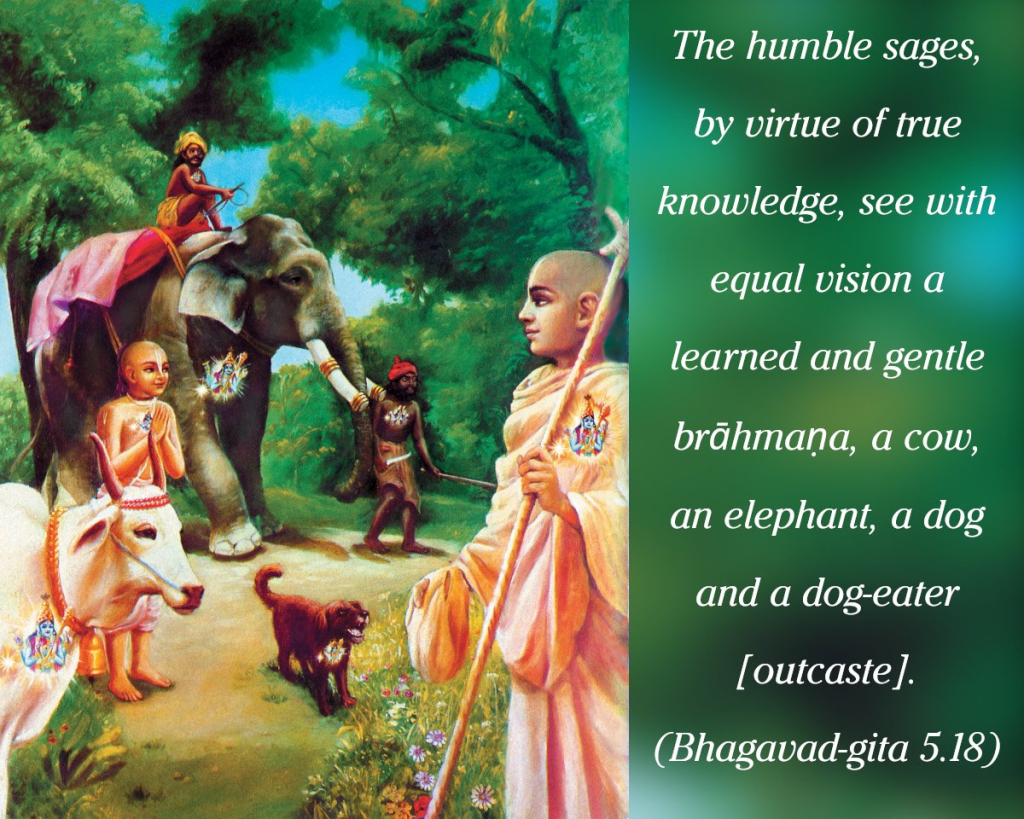
How to see each other?

विद्याविनयसम्पन्ने ब्राह्मणे गवि हस्तिनि ।
श‍ुनि चैव श्वपाके च पण्डिता: समदर्शिन: ॥ १८ ॥

vidyā-vinaya-sampanne
brāhmaṇe gavi hastini
śuni caiva śva-pāke ca
paṇḍitāḥ sama-darśinaḥ

The humble sages, by virtue of true knowledge, see with equal vision a learned and gentle brāhmaṇa, a cow, an elephant, a dog and a dog-eater [outcaste].

https://vedabase.io/en/library/bg/5/18/

And this is the only way to be happy and peaceful…

ब्रह्मभूत: प्रसन्नात्मा न शोचति न काङ्क्षति ।
सम: सर्वेषु भूतेषु मद्भ‍‍क्तिं लभते पराम् ॥ ५४ ॥

brahma-bhūtaḥ prasannātmā
na śocati na kāṅkṣati
samaḥ sarveṣu bhūteṣu
mad-bhaktiṁ labhate parām

One who is thus transcendentally situated at once realizes the Supreme Brahman and becomes fully joyful. He never laments or desires to have anything. He is equally disposed toward every living entity. In that state he attains pure devotional service unto Me.

https://vedabase.io/en/library/bg/18/54/

This article was inspired by the following excerpt of a conversation with Srila Prabhupada, the Guru of my Guru.

Prabhupāda: Ah. The bodily consciousness is also material. That is also one. And the soul consciousness, spiritual, that is also one. That is ekatvam. So for a learned person there is no defect. Vidyā-vinaya-sampanne brāhmaṇe gavi hastinipaṇḍitaḥ samaḥ (BG 5.18). This is the . . . so anyone who is under the bodily conception of life, either human being or dog, they are the same. But that upādhi amongst human being is stronger than the cats and dogs. The human being, being advanced in consciousness, they are making this nationalism. But it is nothing but dogism. Is it not? That’s all. The so-called national people are sacrificing so many lives, so many politicians, Napoleon and these big, big leaders. But what is their business? Business is that doggish mentality, “I am this body.” So it is very difficult to give up this doggish mentality that, “I am this body.” Very, very difficult.

Dr. Patel: That is ahaṅkāra.

Prabhupāda: False ahaṅkāra. Because he is not body, it is false ahaṅkāra. So śāstra therefore says, bhagavad-bhakti hīnasya jātiḥ japas tapaḥ kriya (Hari-bhakti-sudhodaya 3.11). A person who has not developed Kṛṣṇa consciousness, for him this advancement of nationality, big work, industry, so on, so on, so on, jati japas tapaḥ kriya . . . Kriya, these act . . .

Dr. Patel: Activities.

Prabhupāda: What are these? Aprāṇasya hi dehasya maṇḍanaṁ loka-rañjanam. It has no value. It has no value. But people are enamored by these things, “I belong to great nation. I am American. We have got so many industries. We have got so many cars.” Attachment. So it is very difficult. Sarvopādhi-vinirmuktaṁ (CC Madhya 19.170). One, after becoming completely freed from all these false designations, to become a devotee is very, very difficult. There is no education. https://vanisource.org/wiki/751112_-_Morning_Walk_-_Bombay?hl=dogism

Dear Reader, please be who you are, an eternal, blissful and knowledgeable Spirit Soul, a part-and-parcel of God.

Hare Krishna!

Rapid fire questions… selfless service, amanina mana dena in marriage, Krishna Consciousness in a calamity, karma vs. compassion, free will, our anchor…

This article contains a series of questions and answers… it explores the essence of selfless service, emphasizing that true selfless action arises from a pure devotee’s desire to please Krishna, devoid of personal gain. It highlights how harmonious relationships are built on mutual respect. It also discusses how the Internal process of chanting Hare Krishna mbrings peace in challenging times. Understanding the difference between karmic reactions and divine mercy (kripa) allows devotees to perceive their experiences as opportunities for growth. Ultimately, it reinforces the concept of humility and service, reminding individuals of their role as servants of the lowliest servants in devotion to Krishna.

QUESTION 1) We talk a lot about selfless service, but can you pls tell one action devoid of gain in return?


MBD: Selfless service is not possible unless for a pure devotee, who does service for service sake. In all lower states of Bhakti, all service benefits the performer, even if it may benefit others. The higher the stage of the performer’s advancement, the more it benefits others. It benefits the performer less than it benefits others. Take any service. Krishna’s service to the living entities is always selfless. He does not need anything from anyone in return. Same with the spiritual master. He only seeks Krishna’s pleasure.

1.1) Can there be an action without result?


MBD: When you say result, do you mean “karmic” result? All action that is not purely transcendental has karmic reactions… everything in the modes. Devotional service has no karmic results. Still, there are devotional results. These start with the pleasure of Krishna and the purification of the heart of the devotee, etc.

(The question above is from before our discussion today.)

From what I have learned/heard: Anand/ Sukh (Bliss / Pleasure) is the ultimate goal of every action. So if the action is intended for the pleasure of the Lord, it is selfless. But if it is directed towards sense gratification or tries to satisfy sego, then it is selfish action.


MBD: Yes, you have the right understanding.

QUESTION 2) Does the phrase “amanina man dena…” apply in a husband/wife relationship?


MBD: Yes, it applies to all relationships. If 2 souls are perfectly in amanina (not expecting any respect), they experience a state of harmony. When they are in manadena (giving all respect), they are also in perfect harmony with the will of Krishna. They are thus very happy. Easier said than done.

QUESTION 3) In the most unbeatable calamity, what is your internal process in terms of Krishna Consciousness? What is the first thing that comes to your mind?


MBD: I chant Hare Krishna, if I can chant at all. In general, we are in good shape if we can make chanting the Lord’s name a reflex action. This should apply to anything that happens, whether good or bad. We can test how far we have come when something unexpected happens, good or bad.

QUESTION 4) How do we distinguish between the reactions of Karma from Kripa?


MBD: Kripa is undeserved, no one in material consciousness deserves it. For example getting Krishna Prasadam is a great privilege. You may have the karmic credits to be able to eat, digest, etc., but there is no karmic action that can “earn” you Krishna Prasasdam. Whatever our prarabdha is must be experienced without fail. Even pure devotees apparently enjoy or suffer karmic reactions. But Krishna gives them whatever is needed for others’ sake. This is to teach others by personal example. For devotees in the middle, Krishna can use karmic reactions to pat us on the back. He can also kick us in the butt, through maya or yogamaya. All devotional experiences, in general, are purely Kripa.

From what I have learned/heard: If something is happening to me/happened with me, it MUST be my prarabdh karma. But interpreting it as the mercy of the Lord helps. He is “kartum akartum anyatha kartum.” This helps to remain Krishna conscious in the moment. It erases the distinguishing line between karma and kripa.


MBD: That is where the attitude comes in. Whatever happened is by Krishna’s sanction. The devotee will see Krishna’s hand and understand the takeaway. The nondevotee will only try to adjust the situation to “avoid/improve/prevent/etc.” You are on the right track.

QUESTION 5) Do we really have freewill? (If Lord is the enjoyer/doer of all actions, and we are but a medium) So whatever “we think” has been done by us has actually been done by Him, no?


MBD: Knowing what you will do, and forcing you to do it are two different things. It’s like a parent. The parent knows what the child will do in a given situation. Nonetheless, they leave the child free in a limited way. This freedom allows the child to learn. In the material sense, Krishna is a non-doer. The 3 modes of material nature are set in motion by Krishna. They are the doer. In the devotional sense, Krishna does not know how exactly the devotee is going to serve Him. When Radharani cooks something, Krishna knows it will be amazing, but does not know what exactly it will be. He can know it if He wants, but Yogamaya overpowers His knowability. It is like Krishna’s Sarvajnata (all-knowing nature) and mugdhata (innocence) exist together. This would be a contradiction normally, but all contradictions converge and are resolved in Krishna.

QUESTION 6) What is that ONE anchor point to be aware of every time?


MBD: I am a servant of the servant of the servant. I serve at least as far as the extent of the current disciplic succession of Krishna. But I am a servant of all devotees, past, present, and future.

Is your wealth safe?

Not long ago, Silicon Valley Bank collapsed. With over $209B in assets, it still collapsed. Where is your wealth? What is your wealth really? Who or what can protect your wealth?

Not long ago, Silicon Valley Bank, a large American bank, with over Two Hundred and Nine Billion Dollars in assets experienced a meltdown situation, where depositors tried to withdraw forty two billion dollars in one day. This is called a “run on the bank” and resulted in the bank collapsing.

Silicon Valley Bank collapsed. The US Government eventually bailed them out. But if a $209B bank can collapse, how safe is your wealth anywhere you may try to stash it?

Why did the depositors of the bank scramble to withdraw their money so quickly? Banks take your money, and then they try to invest it, keeping some of your money in cash, but most of it locked away in various types of investments, making them (usually) handsome returns. The amount of money they keep as cash, divided by the amount of money they invest, is called a “liquidity ratio”. And that liquidity ratio is strictly regulated. Despite this regulation, clearly, sometimes, the bank may just not have enough money to pay out!

The external reason of why Silicon Valley Bank crashed is because they had their money invested in bonds, which were dropping in value as interest rates rose. So, the bank was selling their bonds at a loss, and they were short by a couple billion dollars. The news got out and it was mayhem after.

Now, to put all that into perspective you know how much US$209B is? That is more than the total wealth of 103 different countries… Belarus, Jordan, Serbia, Slovenia, 103 of them. And it is more than the collective wealth of the world’s 44 poorest countries.

Think about it. Silicon Valley Bank had more wealth than 44 countries put together!

Silicon Valley Bank had more wealth than 44 of the poorest countries in the world put together. The bank was richer than 103 of the world's poorest countries!

Ultimately the bank was bailed out by the US Government and purchased by another bank, but otherwise depositors would have lost a lot of money.

In this particular case, the US taxpayers were left holding the bill for the collapsed bank.

In general, people assume that such things, like banks, governments, police, armies, weapons, communities, families, wealth, and our own bodies and minds can be actually relied upon. But all of them are fallible soldiers, liable to fail at any moment without notice.

If a bank with that much wealth can collapse from one day to the next, what to speak of your wealth? Surely you don’t have US$209B to your name at a bank?

Where is your wealth? We read the Alexander the Great left all his material wealth behind. But even if death is not about to get you in the next little while, your wealth is not safe.

Will your family protect you? No one can save you, not your family, your money, your community, your strength, or your intelligence.

Neither will your wealth, nor your family, nor your community, society, country, your own personal strength or intelligence save you!

देहापत्यकलत्रादिष्वात्मसैन्येष्वसत्स्वपि ।
तेषां प्रमत्तो निधनं पश्यन्नपि न पश्यति ॥ ४ ॥

dehāpatya-kalatrādiṣv
ātma-sainyeṣv asatsv api
teṣāṁ pramatto nidhanaṁ
paśyann api na paśyati

Persons devoid of ātma-tattva do not inquire into the problems of life, being too attached to the fallible soldiers like the body, children and wife. Although sufficiently experienced, they still do not see their inevitable destruction.

https://vedabase.io/en/library/sb/2/1/4/

Further, on a related note, Srila Prabhupada writes this…

Such persons complacently believe that their nations, communities or families can protect them, unaware that all such fallible soldiers will be destroyed in due course of time. 

https://vedabase.io/en/library/sb/6/3/28/ purport
The strongest military in the world cannot protect you

In other words, nothing that we have anywhere in this world is safe.

So how to protect what is ours?

There is only one way.

In general, only that which we give away, we get to keep.

Give away money? You will get it back in your future lifetimes. Give love? You will receive much love. What you have today is a sum total of what you have given away in the past.

What do I mean by that? That the credit for giving something away is what we take with us. As in the case of Alexander the great, he left his wealth behind upon death, but the results of his activities – all his conquests – the karmic reactions for so many killed, hurt, etc., that he took with him to suffer afterwards. For every death, he had to suffer a death, for every maiming, he had to be maimed himself, for every bit of gold stolen from others, he had to be robbed himself, and so on.

A boatload of gold is nothing when compared to the force of insurmountable time.

What is your real wealth, anyways?

यं लब्ध्वा चापरं लाभं मन्यते नाधिकं तत: ।

yaṁ labdhvā cāparaṁ lābhaṁ
manyate nādhikaṁ tataḥ

upon gaining this he thinks there is no greater gain

BG 6.22

What is it that will satisfy you so much that you will think there is no greater gain? It cannot be money or any other possession, because with money, no matter how much someone has, they are never fully satisfied by it. It cannot be posessions, because the satisfaction one gets from one’s possessions is a continuous downward trend. It cannot be sensual experiences, because when one has some sensual pleasure, they only hanker for more.

There must be something more, something on a completely different dimension!

What is that greatest wealth?

It is the wealth of the soul, which is spiritual in nature. Not material.

The example that comes to mind is that of the six Goswamis of Vrindavan. When Rupa Goswami retired, his wealth equalled a boat full of gold coins. The Goswamis were exalted in every respect, born in rich, aristocratic families, hobnobbing with the rich and famous, and yet, it is said about them…

tyaktva turnam asesha-mandala-pati-srenim sada tuccha-vat

who kicked off all association of aristocracy as insignificant

https://iskcondesiretree.com/page/shad-goswamy-ashtakam

Why is that? Who gives up something as insignificant?

Only one who finds something greater!

In the same song, Srinivas Acharya sings:

gopi-bhava-rasamritabdhi-lahari-kallola-magnau muhur

but they are always merged in the ecstatic ocean of the gopis’ love for Krishna and bathe always and repeatedly in the waves of that ocean

https://iskcondesiretree.com/page/shad-goswamy-ashtakam

So there you go, any wealth in any bank or locker or any kind of wealth we rely upon in the material world, whether it be our family, society, community, country, or any institution… we will have to leave it all behind, insurmountable time will take it all away.

What you will keep eternally is this:

नेहाभिक्रमनाशोऽस्ति प्रत्यवायो न विद्यते ।
स्वल्पमप्यस्य धर्मस्य त्रायते महतो भयात् ॥ ४० ॥

nehābhikrama-nāśo ’sti
pratyavāyo na vidyate
sv-alpam apy asya dharmasya
trāyate mahato bhayāt

In this endeavor there is no loss or diminution, and a little advancement on this path can protect one from the most dangerous type of fear.

https://vedabase.io/en/library/bg/2/40/

Your spiritual advancement is your only wealth!

My dear spirit soul, please cultivate your spiritual wealth. Don’t waste a single moment! Act now. Ask me how!