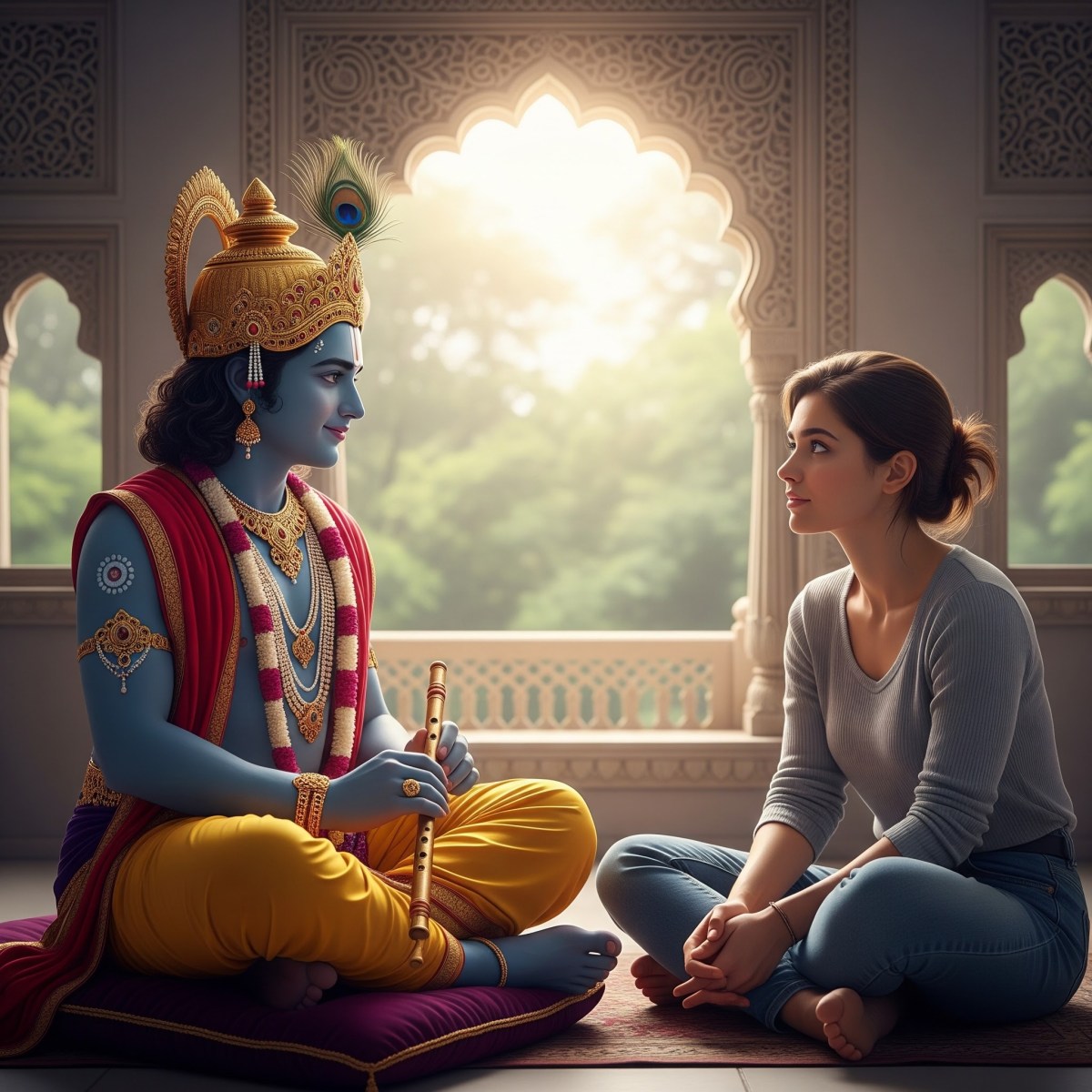
Is Krishna’s (God’s) love conditional or unconditional?

A heartfelt exchange between Mahabhagavat Das and a seeker wrestling with the notion of Krishna’s love. Initially perceiving it as conditional, the seeker grapples with doubts stemming from teachings and personal experiences. The response emphasizes that Krishna’s love is indeed unconditional, while our surrender can be conditional. The discussion highlights the importance of free will and the mercy found in life’s challenges. Ultimately, the seeker finds solace in recognizing Krishna’s unwavering love and encouragement to ask questions without fear.

This article outlines a discussion between Mahabhagavat Das and a sincere seeker. It focuses on the nature of the Supreme Lord Krishna’s love. This discussion is based on an email thread.

The Initial Question and Doubt

Q: Why does it seem that Krishna’s love is conditional, requiring our complete surrender first?

The doubt arose from specific teachings and anecdotes:

  • Conditions for Protection: A discourse by H.H. Sri Sri 1008 Sugunendra Theertha Swamiji cited the Bhagavad Gita verse (9.22), ananyāś cintayanto māṁ ye janāḥ paryupāsate teṣāṁ nityābhiyuktānāṁ yoga-kṣemaṁ vahāmy aham.” He explained that Krishna offers protection when two conditions are met:
  • 1) We worship and surrender utterly to Him only, and
    • 2) We do this eternally.
  • The Draupadi Example: In the pastime where Draupadi was being disrobed, Krishna did not immediately rescue her. He only supplied endless cloth when she let go of her own saree and surrendered completely. This suggested to the questioner that Krishna was being conditional.
  • The Argument for Conditional Love: A discussion with another devotee led to the idea that love, even God’s, is conditional. This is similar to how human relationships can end when one partner does something the other dislikes. Srila Prabhupada once mentioned “rascaldom” existing in Krishna. This raised the question of whether “conditional love” could also exist in the Supreme Lord.

The Core Question: Is Krishna’s love conditional? Will He not provide for us protection, etc., if we don’t love Him? The Response: Unconditional Love and Conditional Surrender

Q: How is this understanding of conditional love a misunderstanding?

A: The essential truth is that Krishna’s love is not conditional; it is our surrender that is conditional. In real, transcendental love, the lover never stops loving. The notion that a relationship can end is a trait of lust. It is like saying, “I’ll scratch your back if you scratch mine,” and not pure love.

  • The Conditional Factor: It is not Krishna withholding His mercy, but rather us not accepting it.
  • The Role of Free Will: Krishna is a true Lover and does not force Himself upon us. If we are trying to help ourselves through other means, why should Krishna interfere? He respects our free will.
  • The Purpose of Experience: Krishna allows us to experience whatever we need to experience. This is also a form of mercy:
    • Parent/Child Analogy: A parent might let a child get slightly burned by a flame. This prevents greater harm in the future. The parent does not want the child to be hurt, but the momentary experience is for a higher protection.
    • Karmic Reactions as Mercy: Even when facing karmic reactions, we are experiencing Krishna’s mercy through those reactions. This is like a university and a prison. Both are funded by the government. One is a mercy for law-abiding citizens. The other is a mercy for those who chose not to be.

Resolution and Affirmation

Q: After consideration, what was the realization about Krishna’s love?

A: The questioner realized that Krishna’s love is indeed unconditional, citing the following observations:

  • Beauty of Creation: Krishna made the world beautiful with colors, flowers, and many beautiful things.
  • Incarnations: He mercifully incarnates so many times to guide us back to Him or to save us.
  • Telling the Secret of Secrets: He bothers to tell the secret of all secrets, demonstrating His care.
  • Steadfast Love: He never stops giving us His love. He continues to do so even when people insult or ridicule Him. Some fools even call Him a “False God”, but Krishna loves them too.

Q: Are such difficult questions considered offensive?

A: No. Questions asked in good faith to understand and deepen one’s Krishna Consciousness are not an offense. This is part of the principle of “guhyam aakhyaati prchhati” (confiding in and inquiring from a spiritual well-wisher). The questioner was encouraged to continue asking questions. One is always welcome to ask questions from one’s teachers. We are also encouraged to ask mentors and peers who are sincere in their approach to Krishna Consciousness.

Original Email Exchange (anonymized)

Email 1

Dear prabhuji,
Please accept my humble obeisances
All glories to Srila Prabhupada

I was listening to a short lecture by HH Sri Sri 1008 Sugunendra Theertha swamiji. He is the Mathadhipati of Sri Puthige matha and the current paryaya of Udupi Krishna matha. He was explaining about Krishna’s protection.

In Bhagavad Gita, there is the verse ananyāś cintayanto māṁ ye janāḥ paryupāsate teṣāṁ nityābhiyuktānāṁ yoga-kṣemaṁ vahāmy aham (9.22).
He said that Krishna will offer protection to us, provided we fulfill two conditions –

  1. We worship Him and Him only. We surrender utterly to Him only and worship only Him. We cannot do this for whichever devata we want, only Krishna
  2. We do this eternally. No just the bad days or the good days, but for all days.

Swamiji also recounted the pastime where Krishna told the Pandavas something meaningful. Krishna said He liked Draupadi the most among all Pandavas. This was in response to being asked who He liked. Draupadi got angry. She asked Krishna why He didn’t immediately rescue her when getting disrobed by Dushasan in the sabha. It happened in front of everyone. She had even called His many names. Krishna told her that while she was doing that, one hand was raised up. The other was clinging onto her saree. But when she realized even she couldn’t save herself, she let go completely. She surrendered utterly. As a result, He saved her by supplying endless cloth.

Later, I pondered over this and realized that Krishna was being conditional. He isn’t going to protect us just like that. He wants our surrender first. I then asked for an explanation from someone, also a devotee of Lord Vishnu, why Krishna was setting such conditions. She said that even love is conditional. If you do something I don’t like, won’t I not like you and stop loving you? It felt a bit unfair, especially in terms of God’s love. But then I remember hearing stories. In those stories, lovers stopped loving each other. They did so because they were doing something the other didn’t like. If that can happen between lovers, why can’t it happen between us and God?

Srila Prabhupada, on 27 February 1972, recounted how Krishna used to act around with Radharani. This behavior superficially made Him the greatest rascal. He then said “Unless rascaldom is in Krishna, how could rascaldom exist in the world?”. Rascaldom can exist in us as it is in Krishna. Therefore, conditional love can exist in Krishna too. It feels like a bitter pill to swallow for me, if it is true, but it is what it is.

My question is: Is Krishna’s love conditional? Will he not provide for us things protection etc if we don’t love Him?

Sorry for the long message. Forgive me if I have offended you in any way.

Hari bol
Your servant
A

Response 1

Dear A,

Hare Krishna!

Please accept my humble obeisances.
All glories to Srila Prabhupada.

I don’t know how you got into this grave misunderstanding that Krishna’s love is conditional. I don’t know why this other devotee is spreading their misunderstandings to you as well.

You have no understanding of love. In real love, the lover never stops loving. That is what Chaitanya Mahaprabhu prays “mat praana naathas tu sa eva na parah”. But in lust, the relationship can end. It can happen if the relationship is based on “I’ll scratch your back if you scratch mine”.

What Sugunendra Teertha Swami was saying is 100% correct. What Srila Prabhupada is saying is 100% correct. Your understanding, though, is 100% wrong.

It is not that Krishna’s love is conditional, but that our surrender is conditional. It is not Krishna withholding His mercy, but us not accepting Krishna’s mercy. Should Krishna force Himself upon us and intervene when we really don’t want Him to?

Consider this…

  1. We have free will
  2. Krishna does not force Himself upon us as a true Lover
  3. So, if we are trying to help ourselves through other means, then why should Krishna interfere?

Krishna will let us experience whatever it is that we need to experience! Just like a parent, a child might get a little burned by the flame. This is to protect the child from greater harm in the future. The parent does not want the child to get hurt!

It is the same in modern life. We get vaccinated against certain diseases so we can avoid the actual disease. However, the vaccine itself can cause some side effects. It can even cause a fever sometimes.

Finally, if we are doing something and facing karmic reactions, then through those karmic reactions we are experiencing Krishna’s mercy…

It is just like a university and a prison. Both are funded by the government. A university is a mercy towards law abiding citizens. A prison is a mercy for those who chose not to be law abiding.

Does this make sense to you?

Sincerely,
Mahabhagavat Das
dasadas.com

Response 2


Hare krishna prabhuji!
Thanks for taking the time out to respond to my question. I was in a bad headspace that time and having very negative thoughts on Krishna. Forgive me for any offences caused.
I saw a video related to this and realized krishna does love us. He made this world so beautiful with colours, flowers and many beautiful things. He incarnates mercifully to guide us back to Him or to save us. Even when people insult Him or ridicule, He never stops giving us his love. If He really never loved us, why would this world be beautiful? Why would he bother to incarnate more than 10 times? Why would He bother to tell the secret of all secrets?
Thanks for making me understand!
Hare Krishna

Response 3

Hare Krishna A,

We all go through difficult moments.

Questions asked in good faith are meant to understand and deepen our Krishna Consciousness. In this context, there is no offense. That is one of the meanings of the “guhyam aakhyaati prchhati”.

My prayer to Sri Krishna and you is that you may receive His full shelter…. He is giving all shelter, and that you may fully accept His shelter.

You are welcome to ask questions. I am always welcome to ask questions from my spiritual masters, mentors, and peers.

Feasting on the Holy Name

Many spiritualists fast. Especially Vaishnavas on Ekadasi day… but Ekadasi is meant for feasting. So how is it that someone can be simultaneously fasting and feasting at the same time?

తెలుగు (Telugu) translation

In most religious traditions, there is a concept of fasting… whether it is fasting from vice, or fasting from food and water… For example, the Christians fast for 40 days during Lent. Muslims fast for a month during Ramadan/Ramzan… and many other traditions have similar fasts.

In the Vaishnava tradition which I practice, we fast once approximately every 14 days, on a day called Ekadasi or Ekadashi. Usually this is the eleventh day of the waxing or waning moon. Usually, because there are some details when the fasting is a day later, but we won’t get into all that right now.

However, some advanced Vaishnavas say that Ekadashi is meant to be a day of feasting, not fasting.

But…

One should fast on the two Ekādaśī days, which fall on the eleventh day of the waxing and waning moon, and on the birthdays of Lord Kṛṣṇa, Lord Rāma and Caitanya Mahāprabhu. There are many such fasting days.

https://vedabase.io/en/library/sb/3/27/22/

Huh?

If Vaishnavas are fasting from grains, beans, and in some cases from all food, and from all water too for some… then what are they feasting on?

Well, new practitioners may find it hard to fast from food, being how intricately attached we are to our bodies, minds, and serving them constantly. For such Vaishnavas, it is advised that they can eat as much as they need to, except no grains and beans… and all that they eat must be first offered to Krishna. This helps them regulate their senses at least on that level.

But many Vaishnavas often fast from much more than just grains and beans, so how is it that they can feast?

Let us take the example of Rupa Goswami and Sanatana Goswami, great Goswamis of Vrindavan… they had obtained exalted birth, a very sharp intelligence and tremendous knowledge, and were serving as the ministers of the Nawab of Bengal. Rupa Goswami’s life savings in gold coins filled up an entire boat with gold!

But these same two brothers, when in Vrindavan, had no fixed residence, spending each night under a different tree, with barely enough clothing to cover themselves, and austere food, spent all their time hearing and chanting about Krishna. How could they do that?

tyaktva turnam asesha-mandala-pati-srenim sada tuccha-vat
bhutva dina-ganesakau karunaya kaupina-kanthasritau
gopi-bhava-rasamritabdhi-lahari-kallola-magnau muhur
vande rupa-sanatanau raghu-yugau sri-jiva-gopalakau

I offer my respectful obeisances unto the six Gosvamis, namely Sri Rupa Gosvami, Sri Sanatana Gosvami,
Sri Raghunatha Bhatta Gosvami, Sri Raghunatha dasa Gosvami, Sri Jiva Gosvami, and Sri Gopala Bhatta
Gosvami, who kicked off all association of aristocracy as insignificant. In order to deliver the poor
conditioned souls, they accepted loincloths, treating themselves as mendicants, but they are always merged in
the ecstatic ocean of the gopis’ love for Krishna and bathe always and repeatedly in the waves of that ocean.

Verse 4 https://iskcondesiretree.com/page/shad-goswamy-ashtakam

How is it possible for such persons accustomed to royal pleasures to give them up?

It understand by spiritualists that the objects of the senses, the experiences we chase, the possessions we crave, the sensory satisfaction we seek, are compared to toys and children… the child is attached to the toy, but can be induced to give up the toy if offered a higher and better experience.

What could be a higher and better experience than all the pleasures of material life? Especially, how can one give up that most basic of bodily needs – food?

What does food do for us?

  • Food satisfies the tongue – this hankering of the tongue is practically unconquerable, no matter if we need the food or not, the tongue will never say no.
  • Food nourishes the body – we feel strength from the food.
  • Food produces renunciation from food – as we get full, we hanker for food less and less.

भक्ति: परेशानुभवो विरक्ति-
रन्यत्र चैष त्रिक एककाल: ।
प्रपद्यमानस्य यथाश्न‍त: स्यु-
स्तुष्टि: पुष्टि: क्षुदपायोऽनुघासम् ॥ ४२ ॥

bhaktiḥ pareśānubhavo viraktir
anyatra caiṣa trika eka-kālaḥ
prapadyamānasya yathāśnataḥ syus
tuṣṭiḥ puṣṭiḥ kṣud-apāyo ’nu-ghāsam

Devotion, direct experience of the Supreme Lord, and detachment from other things — these three occur simultaneously for one who has taken shelter of the Supreme Personality of Godhead, in the same way that pleasure, nourishment and relief from hunger come simultaneously and increasingly, with each bite, for a person engaged in eating.

So, if someone obtained an experience that fulfilled all three needs – satisifed the tongue, satisfied the bodily need for nourishment, and produced renunciation from the hankering for food, then that experience can replace food!

https://vedabase.io/en/library/sb/11/2/42/

Such is the chanting of the Holy Name of God.

This Hare Krishna Mahamantra

Hare Krishna Hare Krishna
Krishna Krishna Hare Hare
Hare Rama Hare Rama
Rama Rama Hare Hare

The Hare Krishna Mahamantra

This Mahamantra, when chanted purely, produces such an experience and beyond.

In fact, advanced spiritualists have tried to describe the experience of chanting Hare Krishna…

tuṇḍe tāṇḍavinī ratiṁ vitanute tuṇḍāvalī-labdhaye
karṇa-kroḍa-kaḍambinī ghaṭayate karṇārbudebhyaḥ spṛhām
cetaḥ-prāṅgaṇa-saṅginī vijayate sarvendriyāṇāṁ kṛtiṁ
no jāne janitā kiyadbhir amṛtaiḥ kṛṣṇeti varṇa-dvayī

“I do not know how much nectar the two syllables ‘Kṛṣ-ṇa’ have produced. When the holy name of Kṛṣṇa is chanted, it appears to dance within the mouth. We then desire many, many mouths. When that name enters the holes of the ears, we desire many millions of ears. And when the holy name dances in the courtyard of the heart, it conquers the activities of the mind, and therefore all the senses become inert.”

Rupa Goswami https://vedabase.io/en/library/cc/antya/1/99/

Is it any wonder that if a Vaishnava experiences even a tiny drop of a fraction of the ecstasy that the Holy Name generates, that they can abstain from food?

So should the rest of us go and imitate these Vaishnavas and fast from food and water willy nilly, even if the body is hurting?

अशास्त्रविहितं घोरं तप्यन्ते ये तपो जना: ।
दम्भाहङ्कारसंयुक्ता: कामरागबलान्विता: ॥ ५ ॥
कर्षयन्त: शरीरस्थं भूतग्राममचेतस: ।
मां चैवान्त: शरीरस्थं तान्विद्ध्यासुरनिश्चयान् ॥ ६ ॥

aśāstra-vihitaṁ ghoraṁ
tapyante ye tapo janāḥ
dambhāhaṅkāra-saṁyuktāḥ
kāma-rāga-balānvitāḥ

karṣayantaḥ śarīra-sthaṁ
bhūta-grāmam acetasaḥ
māṁ caivāntaḥ śarīra-sthaṁ
tān viddhy āsura-niścayān

Those who undergo severe austerities and penances not recommended in the scriptures, performing them out of pride and egoism, who are impelled by lust and attachment, who are foolish and who torture the material elements of the body as well as the Supersoul dwelling within, are to be known as demons.

https://vedabase.io/en/library/bg/17/5-6/

Of course, advanced Vaishnavas are not masochists or sadists, certainly not demons, and they don’t accept torturing their bodies, even if they have transcended the body… This is because the advanced Vaishnava sees the body as the property of Krishna.

In fact, when an advanced Vaishnava is seen by Krishna to be accepting too much austerity, Krishna gives that person more nourishment and opulence.

Take Krishna’s friend, the pure-hearted Brahmana named Sudama… Krishna gave him all opulence even though he didn’t ask for it!

This is one of Krishna’s most famous promises…

अनन्याश्चिन्तयन्तो मां ये जना: पर्युपासते ।
तेषां नित्याभियुक्तानां योगक्षेमं वहाम्यहम् ॥ २२ ॥

ananyāś cintayanto māṁ
ye janāḥ paryupāsate
teṣāṁ nityābhiyuktānāṁ
yoga-kṣemaṁ vahāmy aham

But those who always worship Me with exclusive devotion, meditating on My transcendental form – to them I carry what they lack, and I preserve what they have.

https://vedabase.io/en/library/bg/9/22/

So, coming back to our original question… when a Vaishnava fasts, how is it that they are still feasting while fasting?

Simple. They feast on the Holy Name of Krishna

(1)
Of sweet things, it’s the sweetest you will taste at any time;
Of things that bring good fortune, it’s good fortune’s paradigm;
Of things that purify, it purifies most powerf’lly;
The Holy Name of Sri Hari is surely all that be.
(2)
From Brahma’s realm atop the sky down to the lowly grass,
Illusion reigns in Maya-devi’s treacherous morass.
The truth, the truth, the only truth: the Name of Sri Hari.
The Holy Name of Sri Hari is surely all that be.
(3)
He’s the guru, he’s the father, he’s the friend most true,
And she’s the real mother who most kindly teaches you
To always chant and hear the Holy Name of Sri Hari.
The Holy Name of Sri Hari is surely all that be.
(4)
Remember that our final breath may come at any time,
No matter if we’re old and sick or in our youthful prime.
So young and old alike should chant the Name incessantly.
The Holy Name of Sri Hari is surely all that be.
(5)
Lord Sri Hari forever dwells wherever devotees
Whose hearts are fixed on Him and free of all impurities
Uplift their voices high and sing His Name in ecstasy.
The Holy Name of Sri Hari is surely all that be.
(6)
Alas! What sorrow! What great pain! The worst calamity-
For people to forget the Holy Name of Sri Hari!
Although the Name’s a priceless gem, mere broken glass they see.
The Holy Name of Sri Hari is surely all that be.
(7)
Just fill your ears, just fill them with the Name of Sri Hari!
Just chant the Name, just chant the Name with all sincerity!
Just sing the Name, just sing the Holy Name eternally!
The Holy Name of Sri Hari is surely all that be.
(8)
It makes this world appear like bits of straw upon the ground;
It splendorously reigns supreme-divinity in sound;
It’s filled with transcendental bliss and peerless purity;
The Holy Name of Sri Hari is surely all that be.
(9)
Inspired to glorify the Holy Name of Sri Hari,
A certain sage composed this hymn in Sanskrit poetry.
I pray that those who read this lowly version made by me
Will chant the Holy Name of Sri Hari in ecstasy.

His Grace Sriman Dravida Dasa ACBSP English rendering of Sri Kevalastakam of Sri Nilakanta Goswami

What to speak of food for a day, the advanced Vaishnava can give up this entire material world!