“Idol” and “Mythology” – Two words that are offensive to Vedic culture

Why should we avoid the terms “idol” and “mythology” when discussing Vedic culture? These terms undermine the Krishna and Vedic scriptures. Krishna is the Supreme Personality of Godhead. The Vedic scriptures expound the Supreme Absolute Truth and Universal history. The original misunderstanding stems from historical attacks on Vedic culture. What is actual idol worship? What is actual mythology? Read more to find out!

These two words “idol” and “mythology” should be avoided like the plague when speaking about Vedic Culture. Vedic Culture means the culture that increases our love for Krishna. Never use the words “idol” and “mythology” when speaking about Vedic culture, or Vishnu / Krishna.

Unfortunately, this happens a lot in India, which is sad.

I give dictionary meanings, before elaborating further.

Idol: /īd′l/ A false god. One that is adored, often blindly or excessively.

Mythology: /mĭ-thŏl′ə-jē/ A body or collection of myths belonging to a people and addressing their origin, history, deities, ancestors, and heroes. A body of myths associated with an event, individual, or institution.

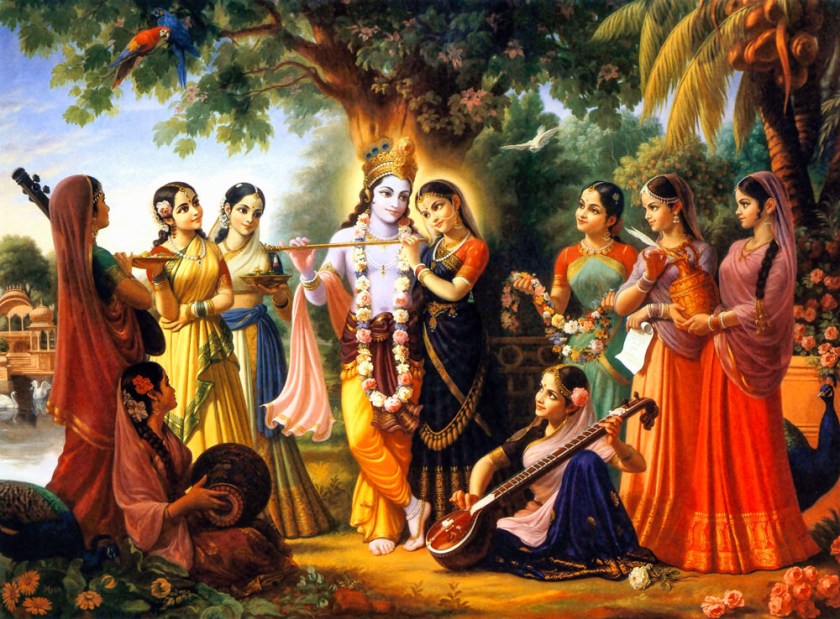
Radha Krishna and the 8 Topmost Gopis

Krishna is the Supreme Personality of Godhead. Krishna is known in other languages as Allah, Jehovah, Yahweh, and many other languages.

ईश्वरः परमः कृष्णः सच्चिदनन्द विग्रह:
अनदिरदिर् गोविन्दः सर्व कारण कारणं ।।१।।

īśvaraḥ paramaḥ kṛṣṇaḥ
sac-cid-ānanda-vigrahaḥ
anādir ādir govindaḥ
sarva-kāraṇa-kāraṇam

Kṛṣṇa who is known as Govinda is the Supreme Godhead. He has an eternal blissful spiritual body. He is the origin of all. He has no other origin and He is the prime cause of all causes. https://vedabase.io/en/library/bs/5/1/

Krishna is the Supreme Absolute Truth.

This means that Krishna’s name, form, pastimes, paraphernalia, abode, associates, etc., are all on the Absolute platform.

नाम चिन्तामणि कृष्णस्चैतन्य रस विग्रहः |
पूर्ण शुद्धो नित्य मुक्तो अभिन्नत्वं नाम नामिनोः ||

nāma cintāmaṇiḥ kṛṣṇaś
caitanya-rasa-vigrahaḥ
pūrṇaḥ śuddho nitya-mukto
’bhinnatvān nāma-nāminoḥ

“ ‘The holy name of Kṛṣṇa is transcendentally blissful. It bestows all spiritual benedictions, for it is Kṛṣṇa Himself, the reservoir of all pleasure. Kṛṣṇa’s name is complete, and it is the form of all transcendental mellows. It is not a material name under any condition, and it is no less powerful than Kṛṣṇa Himself. Since Kṛṣṇa’s name is not contaminated by the material qualities, there is no question of its being involved with māyā. Kṛṣṇa’s name is always liberated and spiritual; it is never conditioned by the laws of material nature. This is because the name of Kṛṣṇa and Kṛṣṇa Himself are identical.’ https://vedabase.io/en/library/cc/madhya/17/133/

Take a second look at the dictionary meaning of “idol”…

Idol: /īd′l/ A false god. One that is adored, often blindly or excessively.

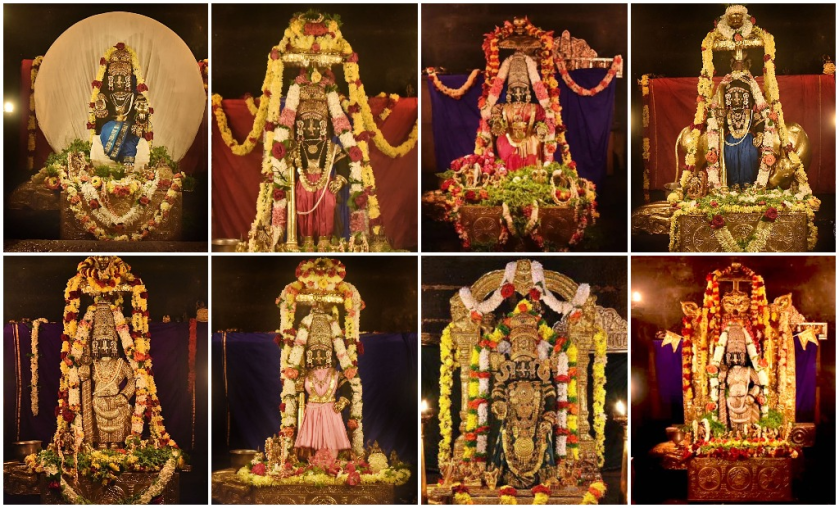
Udupi Sri Krishna
Udupi Sri Krishna

Nothing about Krishna is “false”. And there can be no such thing as “blind” or “excessive” adoration of Krishna. In fact, no matter how much we adore, it is always insufficient. Our problem is that we don’t adore Krishna enough. And we don’t adore Krishna sufficiently because we are blind. If we were not blind, we would be absolutely pure in our love of Krishna.

कृष्णे स्वधामोपगते धर्मज्ञानादिभि: सह ।
कलौ नष्टद‍ृशामेष पुराणार्कोऽधुनोदित: ॥ ४३ ॥

kṛṣṇe sva-dhāmopagate
dharma-jñānādibhiḥ saha
kalau naṣṭa-dṛśām eṣa
purāṇārko ’dhunoditaḥ

This Bhāgavata Purāṇa is as brilliant as the sun, and it has arisen just after the departure of Lord Kṛṣṇa to His own abode, accompanied by religion, knowledge, etc. Persons who have lost their vision due to the dense darkness of ignorance in the Age of Kali shall get light from this Purāṇa. https://vedabase.io/en/library/sb/1/3/43/

Now, to come back to the dictionary meaning of “mythology”…

Mythology: /mĭ-thŏl′ə-jē/ A body or collection of myths belonging to a people and addressing their origin, history, deities, ancestors, and heroes. A body of myths associated with an event, individual, or institution.

सर्वस्य चाहं हृदि सन्निविष्टो
मत्त: स्मृतिर्ज्ञानमपोहनं च ।
वेदैश्च सर्वैरहमेव वेद्यो
वेदान्तकृद्वेदविदेव चाहम् ॥ १५ ॥

sarvasya cāhaṁ hṛdi sanniviṣṭo
mattaḥ smṛtir jñānam apohanaṁ ca
vedaiś ca sarvair aham eva vedyo
vedānta-kṛd veda-vid eva cāham

I am seated in everyone’s heart, and from Me come remembrance, knowledge and forgetfulness. By all the Vedas, I am to be known. Indeed, I am the compiler of Vedānta, and I am the knower of the Vedas. https://vedabase.io/en/library/bg/15/15/

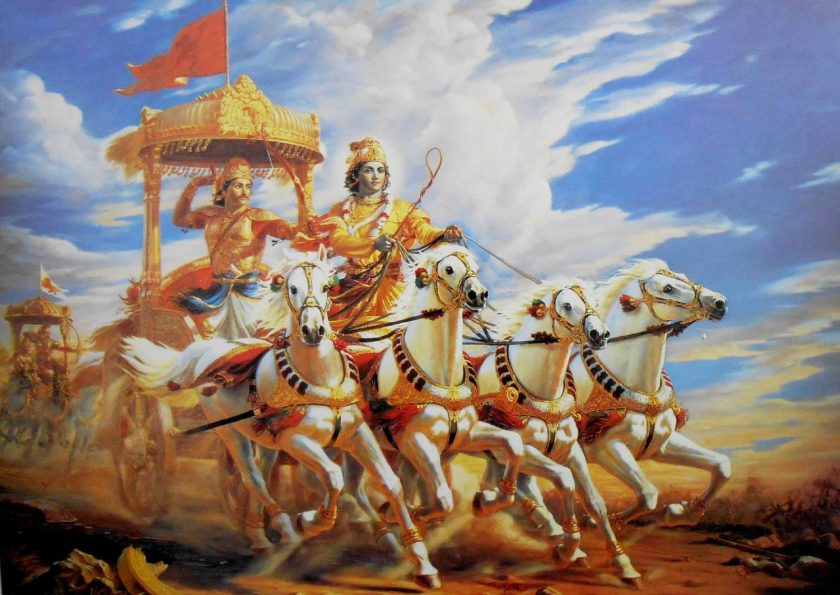
Krishna and Arjuna on the Battlefield of Kurukshetra

The Vedic Scriptures explain different aspects of Krishna. The Puranas are ancient history. So ancient and so broad that they encompass the entire Universe, and go back billions, even trillions of years. Who can comprehend that Universal range and time scale with our teeny little perspective?

Now, where did this misunderstanding come from?

Where did anyone get the idea to call images of Krishna as “idols” and the Vedic scriptures as “Mythology”?

The last surviving bastion of Vedic culture is what is current-day India, Pakistan, Nepal, Bangladesh, Sri Lanka, Thailand, Indonesia, etc.

Vedic culture has been under attack for well over 3000 years. It is natural, because we are in the kaliyuga, the age of quarrel and hypocrisy. Vedic culture i the opposite of quarrel and hypocrisy

First, it was the advent of Buddhism, and Jainism. These are essentially either impersonal, voidist, or both, depending on the specific flavor. Both twisted the Vedic scriptures in different ways. Both were philosophically defeated and Buddhism was mostly driven out to the far corners of the world, away from India.

Lord Buddha

Buddhism was advented by Lord Gautama Buddha to originally to drive out a corruption in Vedic culture.

तत: कलौ सम्प्रवृत्ते सम्मोहाय सुरद्विषाम् ।
बुद्धो नाम्नाञ्जनसुत: कीकटेषु भविष्यति ॥ २४ ॥

tataḥ kalau sampravṛtte
sammohāya sura-dviṣām
buddho nāmnāñjana-sutaḥ
kīkaṭeṣu bhaviṣyati

Then, in the beginning of Kali-yuga, the Lord will appear as Lord Buddha, the son of Añjanā, in the province of Gayā, just for the purpose of deluding those who are envious of the faithful theist.

https://vedabase.io/en/library/sb/1/3/24/

The origin of Jainism was a corruption of the pure teachings and example of Lord Rishbhadeva, an incarnation of Krishna.

Lord Rishabhadeva instructing His sons

यस्य किलानुचरितमुपाकर्ण्य कोङ्कवेङ्ककुटकानां राजार्हन्नामोपशिक्ष्य कलावधर्म उत्कृष्यमाणे भवितव्येन विमोहित: स्वधर्मपथमकुतोभयमपहाय कुपथपाखण्डमसमञ्जसं निजमनीषया मन्द: सम्प्रवर्तयिष्यते ॥ ९ ॥

yasya kilānucaritam upākarṇya koṅka-veṅka-kuṭakānāṁ rājārhan-nāmopaśikṣya kalāv adharma utkṛṣyamāṇe bhavitavyena vimohitaḥ sva-dharma-patham akuto-bhayam apahāya kupatha-pākhaṇḍam asamañjasaṁ nija-manīṣayā mandaḥ sampravartayiṣyate.

Śukadeva Gosvāmī continued speaking to Mahārāja Parīkṣit: My dear King, the King of Koṅka, Veṅka and Kuṭaka whose name was Arhat, heard of the activities of Ṛṣabhadeva and, imitating Ṛṣabhadeva’s principles, introduced a new system of religion. Taking advantage of Kali-yuga, the age of sinful activity, King Arhat, being bewildered, gave up the Vedic principles, which are free from risk, and concocted a new system of religion opposed to the Vedas. That was the beginning of the Jain dharma. Many other so-called religions followed this atheistic system. https://vedabase.io/en/library/sb/5/6/9/

Later invasions from the west

But then, there were the expansionist invasions by the zealots claiming to follow “Islam, the religion of peace”. Those invaders to the Holy Land of India were attracted by the wealth, the riches in the temples… But they were too uncivilized and uncultured to appreciate the nuances of Vedic culture.

So they started calling temple worship “idol worship” in their middle eastern languages, Arabic, Persian, etc. They started a systematic system of persecution, calling the followers of Vedic culture as “kafirs” or non-believers. They did not understand that Krishna is actually Allah Himself. This persecution conginues to this day, a thousand years on. For example in Pakistan and Bangladesh, followers of Vedic culture are still harshly persecuted.

The European powers made the most sophisticated attempts to culturally conquer the Vedic culture. They came to India about 600 years ago. They engaged in business and military conquest. They also sought to replace Vedic culture with barbarian European culture through an insidious system called “modern education”.

Indians have been conditioned to denigrate their own culture!

Indians began to speak Portuguese, Dutch, French, and English. They were made to forget their own languages, their own customs and refined practices. It was deeply rooted. The Europeans, especially the British, sought to vilify all Vedic practices through their Christian missionaries.

  1. Deity worship became “Idol Worship”.
  2. Krishna became a “tribal chieftain” or at best, a “Hindu god”.
  3. All the ancient historical texts like the Vedas, the Upanishads, the Puranas, became “Hindu myths”.

Vedic culture will rescue with world from its dense darkness. To revive the glorious Vedic culture, we must first reject this insulting word “idol” in relation to Krishna. We must also reject the derogatory “mythology” in relation to the Vedic scriptures.

What is idol worship then?

It is the worship of politicians, business people, actors, sports people, military leaders, etc. It is the worship of TV personalities and entertainers. The western world fully engages in idol worship daily. They do this through their thousands of TV channels, their movies, their books, newspapers, magazines, their marketplaces, and living spaces.

Sports fans indulging in Idol Worship

“Western Culture”, an oxymoron, means to worship the temporary bodies, through luxurious homes devoid of a culture of Krishna Consciousness. It means lavish bathrooms and swimming pools. It means arenas to celebrate war in disguise. It means a worship of their dogs and cats. It means the killing of cows and bulls, which are dear to Krishna.

Reject idol worship, by all means, but the form of Krishna is not an “idol”.

We can use the these words instead to describe images of Krishna:

  1. “Archa Vigraha” (अर्च विग्र:) – the Divine Worshipable Form of God
  2. Deity
  3. Divine Form of God

And what is mythology?

What is called “modern science” is mostly mythology. And the western version of “history” is mythology. Common uncultured rascals have been promoted as great personalities. Alexander “the great” was a looter and marauder. Napoleon was a low class murderer and looter. He conspired to become king of France after the French had executed their king and rejected the monarchy. Winston Churchill was a disgusting narrow minded bigot. He was a lying manipulator. He was not a great leader by any stretch of the imagination, because he was full of all vices.

False history propagated by the Europeans

Everything that opposes the pristine Vedic culture is mythology. This includes the spiritual texts of the Middle East, that were once great and pure. These texts like the Quran, Bible, etc., have been censored, edited and misinterpreted. They have lost spiritual value due to tampering. They are only good as political manifestos now. Even if the text is intact, the misinterpretation and misunderstanding of it has depleted its value.

So, yes, reject mythology also, but the Vedic scriptures are not mythology.

धर्म: प्रोज्झितकैतवोऽत्र परमो निर्मत्सराणां सतां
वेद्यं वास्तवमत्र वस्तु शिवदं तापत्रयोन्मूलनम् ।
श्रीमद्भागवते महामुनिकृते किं वा परैरीश्वर:
सद्यो हृद्यवरुध्यतेऽत्र कृतिभि: शुश्रूषुभिस्तत्क्षणात् ॥ २ ॥

dharmaḥ projjhita-kaitavo ’tra paramo nirmatsarāṇāṁ satāṁ
vedyaṁ vāstavam atra vastu śivadaṁ tāpa-trayonmūlanam
śrīmad-bhāgavate mahā-muni-kṛte kiṁ vā parair īśvaraḥ
sadyo hṛdy avarudhyate ’tra kṛtibhiḥ śuśrūṣubhis tat-kṣaṇāt

Completely rejecting all religious activities which are materially motivated, this Bhāgavata Purāṇa propounds the highest truth, which is understandable by those devotees who are fully pure in heart. The highest truth is reality distinguished from illusion for the welfare of all. Such truth uproots the threefold miseries. This beautiful Bhāgavatam, compiled by the great sage Vyāsadeva [in his maturity], is sufficient in itself for God realization. What is the need of any other scripture? As soon as one attentively and submissively hears the message of Bhāgavatam, by this culture of knowledge the Supreme Lord is established within his heart. https://vedabase.io/en/library/sb/1/1/2/

You can call the Vedic scriptures as:

  1. The Yoga texts of India
  2. Vedas or Puranas
  3. Vedic scriptures
  4. Vedic literature
  5. Vedic History

Please give up the use of the words “idol” and “mythology” in relation with Vedic Culture! Hare Krishna!

Life as a football is no fun

Are you living the football experience? Are you constantly driven by desires and impulses like lust and anger? Despite life’s turmoil, there’s hope for liberation through spiritual practice. By seeking connection with genuine spiritual guidance, you can experience true freedom and purpose, transcending the endless kicking in material existence. Want to try it out?

A football (soccer ball) is kicked around on a field, from one side to the other. Sometimes one team has the ball, sometimes another. Sometimes it’s thrown in from the sidelines, sometimes it’s kicked out of bounds. Rarely, it ends inside the net of the goalpost… Sometimes it’s held in the armpit of the referee… If a football match lasts ninety minutes, then football is constantly moving around, from here to there, to another place…

Now suppose the football claims that it is moving by it’s own free will. The football claims that it is bouncing around from here to there on it’s own accord. Would you agree with the football?

No, you would say to the football, you’re being kicked and thrown around by the players. You have no free will, some will add.

We are all like that football. We get kicked around all over the place. Yet we claim that our trajectory is by free will! Actually, we’re kicked around due a misuse of free will! More on that in a moment.

How am I being kicked around, do you ask?

`Well, we have the feelings of lust and anger. Lust means the intense greed to have or own something. Lust means the urge to please my senses and mind. That lust propels us to great lengths. So we can say that the lust is kicking us around. And if the lust is fulfilled? Then we want more, naturally. More and more. Stronger kicks. But if the lust is not fulfilled? Then anger takes over! More kicking!

We can also see that we have 6 senses, including the mind. The eyes, ears, tongue, skin, and nose… plus the most insistent of them all, the mind. The eye wants to see something? Kick. The tongue wants to taste something? Kiick. The skin wants to touch something? Kiiick! The nose wants to smell something? Kiiiick! The ears want to hear something? Kiiiiick! And of course, the most resounding kick comes from the mind! Of course, the biggest kicks are from the mind… Out of bounds!

Sometimes we are kicked by our own mind and body, but sometimes we are impelled by others… A swarm of mosquitoes? A bed full of bugs? Cockroaches or rats anyone? Teeming, jostling, pushing crowds of people? Black flies, bears, you name it!

Sometimes we’re impelled by the forces of nature. A kick from a flood, maybe. Or a kick from fire. Worse, a kick from a hurricane, or an earthquake even.

Sometimes we’re impelled by illusion, sometimes by envy. Sometimes we’re compelled greed or madness. And all of these kick us around, from one end of the world to another. From one lifetime to another sometimes. Again and again.

Being kicked for ever. Ad infinitum.

All of this kicking, and we say we’re doing everything “by my own sweet will”?

In the famous Frank Sinatra Song, a misguided protagonist foolishly croons…

And now, the end is near
And so I face the final curtain
My friend, I’ll say it…And more, much more than this clear… I did it my way

Regrets, I’ve had a few
…I did what I had to do
…And more, much more than this… I did it my way

Yes, there were times, I’m sure you knew
When I bit off more than I could chew… …And did it my way

I’ve loved, I’ve laughed and cried
I’ve had my fill, my share of losing
And now, as tears subside
…Oh, no, oh, no, not me…I did it my way

For what is a man, what has he got?
…The record shows I took the blows
And did it my way

Yes, it was my way – Frank Sinatra “My Way”

Does that sound familiar?

It’s the football, even though getting kicked around all over the place, claiming “I did it my way”. Poor football!

But, there is hope, for all of us footballs in the material world.

কাম-ক্রোধের দাস হঞা তার লাথি খায় ।
ভ্রমিতে ভ্রমিতে যদি সাধু-বৈদ্য পায় ॥ ১৪ ॥
তাঁর উপদেশ-মন্ত্রে পিশাচী পলায় ।
কৃষ্ণভক্তি পায়, তবে কৃষ্ণ-নিকট যায় ॥ ১৫ ॥

kāma-krodhera dāsa hañā tāra lāthi khāya
bhramite bhramite yadi sādhu-vaidya pāya
tāṅra upadeśa-mantre piśācī palāya
kṛṣṇa-bhakti pāya, tabe kṛṣṇa-nikaṭa yāya

“In this way the conditioned soul becomes the servant of lusty desires, and when these are not fulfilled, he becomes the servant of anger and continues to be kicked by the external energy, māyā. Wandering and wandering throughout the universe, he may by chance get the association of a devotee physician, whose instructions and hymns make the witch of the external energy flee. The conditioned soul thus gets into touch with devotional service to Lord Kṛṣṇa, and in this way he can approach nearer and nearer to the Lord.https://vedabase.io/en/library/cc/madhya/22/14-15/

Srila Prabhupada, the spiritual master of my spiritual master comments in a lecture on these verses…

Very nice. In this way we are being kicked up. The freedom of football. The football is kicked from this party and thrown to the other party. The other party kicks and it comes. The football thinks . . . if the football thinks that, “I am in freedom movement,” so what is that freedom? Kicked from this party to that party and that . . . so here the same thing is said, kāma-krodhera dāsa hañā tāra lāthi khāya.

Just like the football players—the football is under the kicking method of two parties—similarly, we are under the kicking method of two things, lust and anger. We are lusty, and when our lust is not fulfilled, then we become kicked by anger. Two things. Just like the football is kicked by this party and that party, similarly, our position is we are being kicked sometimes by lust and sometimes by anger. So we are going on leading our life in this way. – His Divine Grace A. C. Bhaktivedanta Swami Prabhupada https://vanisource.org/wiki/670109_-_Lecture_CC_Madhya_22.11-15_-_New_York?hl=football

I am a spirit soul. So are you, dear reader. As spirit souls, we’re not meant to be footballs of lust or anger. We are not meant to be subjected to the vagaries of the misuse of free will. As part-and-parcels of Krishna, we have free will. When used properly, it results in a loving harmonious life. This life is rich with ecstatic relationships with Krishna and with each other.

If we act genuinely as a spirit soul, then there is no more getting kicked around.

My dear reader, please pray with me… My dear Lord Sri Krishna, for ages, countless eons, and trillions of lifetimes I am kicked around. I have been struggling with my own lust and anger.

Please place me as one of the atoms at your lotus feet. Then, I can experience true free will in Your service.

Hare Krishna!

Satan as Competitor to God, what an absurdity!

On Easter Friday, reflecting on Jesus’ sacrifice, compassion, and forgiveness fills us with hope. While beliefs about Satan vary, turning inward reveals our own role in turning away from God – the cause of all problems. Instead of blaming external forces, let’s embrace personal responsibility and reconnect with God’s boundless love and grace. No one else can thwart our journey to knowledge and bliss. Hare Krishna!

I write this on Easter Friday. I reflect on the great sacrifice of Jesus Christ. I reflect on his deep compassion, humility, and grace. I reflect on his wonderful quality of forgiveness. I reflect on his instructions in the Bible.

Specifically, I reflect on this prayer of Jesus Christ, while he was being crucified, and the men in charge of this ghastly deed were gambling to divide his clothes amongst themselves… “Father, forgive them; for they know not what they do”.

One of my spiritual master’s favourite prayers is “not my will, but thine, be done.”.

Jesus is the Son of God, and we are all meant to be sons and daughters of God.

In the Abrahamic traditions, Judaism, Christianity, and Islam, there is the idea of Satan.

Wikipedia says this about Satan… “”Satan, also known as the Devil, and sometimes also called Lucifer in Christianity, is an entity in Abrahamic religions that seduces humans into sin or falsehood. In Judaism, Satan is seen as an agent subservient to God, typically regarded as a metaphor for the yetzer hara, or “evil inclination”. In Christianity and Islam, he is usually seen as a fallen angel or jinn who has rebelled against God, who nevertheless allows him temporary power over the fallen world and a host of demons. In the Quran, Shaitan, also known as Iblis, is an entity made of fire who was cast out of Heaven because he refused to bow before the newly created Adam and incites humans to sin by infecting their minds with waswās (“evil suggestions”).

The most accurate Abrahamic idea about the concept of Satan is the one accepted in Judaism.

However, too many people around the world actually believe that Satan is some sort of a competitor to God. This is quite foolish.

Christians routinely denounce anyone who does not accept their particular sectarian view of God and His creation as “Satanic”. One intelligent agnostic lady, after asking uncomfortable questions sincerely, was labeled by some Christians as Satan!

It is not that asking questions and being inquisitive is bad! When one does not know things as they are, then one feels threatened by any question or idea that is not covered in one’s limited understanding.

But rest assured, God has absolutely NO competition!

God is known as “asamaurdhva” which is a combination or “asama” and “urdhva” which means He who has neither equal nor superior.

In the Bhagavad Gita, the Song of God, Krishna, the Supreme Personality of Godhead, describes His own opulences in great detail. But even Krishna acknowledges that it is impossible for us to understand all of His opulences because they are limitless.

अथवा बहुनैतेन किं ज्ञातेन तवार्जुन ।
विष्टभ्याहमिदं कृत्स्नमेकांशेन स्थितो जगत् ॥ ४२ ॥

atha vā bahunaitena
kiṁ jñātena tavārjuna
viṣṭabhyāham idaṁ kṛtsnam
ekāṁśena sthito jagat

But what need is there, Arjuna, for all this detailed knowledge? With a single fragment of Myself I pervade and support this entire universe.

https://vedabase.io/en/library/bg/10/42/

Then why does this idea of Satan exist?

It is tempting to blame some other personality for all the ills in the world, all the troubles we face. It is quite convenient to concoct the idea that somehow Satan is the cause of our ills.

But really, we have to look inward, and look at ourselves.

কৃষ্ণ ভুলি’ সেই জীব অনাদি-বহির্মুখ ।
অতএব মায়া তারে দেয় সংসার-দুঃখ ॥ ১১৭ ॥

kṛṣṇa bhuli’ sei jīva anādi-bahirmukha
ataeva māyā tāre deya saṁsāra-duḥkha

“Forgetting Kṛṣṇa, the living entity has been attracted by the external feature from time immemorial. Therefore the illusory energy [māyā] gives him all kinds of misery in his material existence.

https://vedabase.io/en/library/cc/madhya/20/117/

It is us, with our own free will, who have chosen to turn away from God. It is not that someone else has incited or influenced us, it is our own individual personal decision.

When we decide to turn towards God again, and gradually purify our consciousness, we will see that God has absolutely no competitors.

The closest parallel from the Vedic tradition to the idea of Satan is “Maya”.

Maya is the illusory energy of God. And this energy does not affect anyone who is turned towards God in every thought, word, and deed. In fact, the very same Maya, who is acting as “Mahamaya” in the illusory aspect, now transforms into “Yogamaya”, or one who is diligently engaged in connecting the living entity and God’s energies in harmony with God.

The energy of the Lord called avidyā is the bewildering factor of the conditioned souls. The material nature is called avidyā, or ignorance, but to the devotees of the Lord engaged in pure devotional service, this energy becomes vidyā, or pure knowledge. This is confirmed in Bhagavad-gītā. The energy of the Lord transforms from mahā-māyā to yoga-māyā and appears to pure devotees in her real feature. The material nature therefore appears to function in three phases: as the creative principle of the material world, as ignorance and as knowledge.

https://vedabase.io/en/library/sb/3/10/17/

But Maya is not any kind of competitor… she is a most dear servitor of God…

sṛṣṭi-sthiti-pralaya-sādhana-śaktir ekā
chāyeva yasya bhuvanāni bibharti durgā
icchānurūpam api yasya ca ceṣṭate sā
govindam ādi-puruṣaṁ tam ahaṁ bhajāmi


The external potency Māyā who is of the nature of the shadow of the cit potency, is worshiped by all people as Durgā, the creating, preserving and destroying agency of this mundane world. I adore the primeval Lord Govinda in accordance with whose will Durgā conducts herself.

https://vedabase.io/en/library/bs/5/44/

So, dear souls, there is absolutely no one else holding us back from an eternity in full knowledge and bliss, except ourselves. Questions?

Hare Krishna!

Blessed are the poor in spirit, for theirs is the kingdom of heaven

What does it mean to say “Blessed are the poor in spirit, for theirs is the kingdom of heaven.”?

Annu bhatia, 7 November 2019

Hare Krishna Das,

I am writing to ask what the following means, “Blessed are the poor in spirit, for theirs is the kingdom of heaven.”

Could you also explain why Jesus asks us to declare spiritually bankruptcy and then find ourselves filled with the presence of the King and His Kingdom.

Thank you dear prabhu.

your humble servant,

Annu

Rebecca, 29 November 2019

Hare Krishna!

I am only a stumbling servant, but having been in the Christian faith, my understanding of the poor in spirit is one who is weary of this material world and who is humble and God conscious. Jesus is teaching humility and realization of our true position that we are Not God but are His children and that by realization of our true position and surrender to God we can be filled with His presence and return back home to His Kingdom.

I trust this will be of some clarification and  finds you well.

your humble God-sister servant and well-wisher

Rebecca

Rakesh, 29 November 2019

Hare Krsna Prabhu

I have read and heard few things from Christian scriptures. 

As per my understanding, the statement means that if a person has the understanding that nothing belongs to them(they are not the controllers, proprietors or enjoyer of anything) in this material world(indicated by poor in spirit), then Krsna(God) is pleased with them and they are on their path back to Godhead.

your aspiring servant

Rakesh Roshan

Please subscribe to daily inspirational emails from His Grace Sriman Sankarshan Das Adhikari (Writings and lectures archived at sda-archives.com), written fresh every day from his travels around the world sharing the highest spiritual knowledge with everyone. Sign up now at www.joincourse.com

Bible and Bhagavad-gita

A discussion on the similarities and differences between the Bhagavad Gita and the Holy Bible…

Kaspars, 06 August 2016

Dear devotees.
Please accept my humble obeisances.
All glories to Srila Prabhupada.
All glories to Srila Gurudeva and Gurumata.

Yesterday I was reading Bible and found an amazing similarity with Bhagavad gita. Every text of these quotes, goes in the same meanings and in the same order. Further in both scriptures, devotional service is explained. What do you think about it?

Bible Psalm 90

A prayer of Moses the man of God.
1 Lord, You have been our dwelling place in all generations. 2 Before the mountains were born Or You gave birth to the earth and the world, Even from everlasting to everlasting, You are God. 3 You turn man back into dust And say, “Return, O children of men.” 4 For a thousand years in Your sight Are like yesterday when it passes by, Or as a watch in the night. 5 You have swept them away like a flood, they fall asleep; In the morning they are like grass which sprouts anew. 6 In the morning it flourishes and sprouts anew; Toward evening it fades and withers away. 7 For we have been consumed by Your anger And by Your wrath we have been dismayed.

Bhagavad gita Chapter 8

8.15 — After attaining Me, the great souls, who are yogīs in devotion, never return to this temporary world, which is full of miseries, because they have attained the highest perfection.
8.16 — From the highest planet in the material world down to the lowest, all are places of misery wherein repeated birth and death take place. But one who attains to My abode, O son of Kuntī, never takes birth again.
8.17 — By human calculation, a thousand ages taken together form the duration of Brahmā’s one day. And such also is the duration of his night.
8.18 — At the beginning of Brahmā’s day, all living entities become manifest from the unmanifest state, and thereafter, when the night falls, they are merged into the unmanifest again.
8.19 — Again and again, when Brahmā’s day arrives, all living entities come into being, and with the arrival of Brahmā’s night they are helplessly annihilated.

Hare Krishna
Thank you.
Kaspars

Mahabhagavat Das SDA, 08 August 2016

Dear Kaspars,

Hare Krishna!

Please accept my humble obeisances.
All glories unto Srila Gurudeva.
All glories to Srila Prabhupada.

Thank you for this nice reflection.

There are some similarities and differences too, for example, the reference to thousand years in Moses’ prayer and thousand ages in Krishna’s precise instruction, are quite different in their meaning.

Once we read Srila Prabhupada’s books though, we begin to see all scriptures in the light of Srila Prabhupada’s purports.
I began studying The Holy Bible when I was 10 years of age, and I did a very detailed course with Q&A reviewed by teachers etc., and I have come across so many wonderful passages from the Bible over the years also.

But I understood more from all the scriptures (Vedic and otherwise) I had read after I read Srila Prabhupada’s books. And I got a very non-sectarian understanding of religion, so much so that I have begun to say whenever someone asks me which religion I follow, that “I am past the labels at this point”, which typically leads to a positive discussion in more togetherness.

Consequently now though, having seen that the Vedic scriptures are the source of all the scriptures in the world, I don’t spend time studying other scriptures, but focus my energies on studying Srila Prabhupada’s books in a deeper way.

Other devotees should contribute their reflections and perspectives to make this a rich and useful conversation.

your servant,
Mahabhagavat Das

Nikhil Mishra, 8 August 2016

Hare Krsna Kaspars Prabhu

Thats indeed a very nice comparison. And i am sure, you will end up finding many many other similarities if you research more.
Long time back, i read Paramhamsa Yogananda ji and he also compares Bible and Gita beautifully.

Srila prabhupada as well as Srila gurudeva says, essence of all religions is to know and love God .So you see , to a sincere seeker like you, lines of Holy Bible are making so much sense .

Wishing you more bhakti(devotion) and Gyan(knowledge) and begging the same for me..

Hari bol. Praise the Lord.

Nikhil

Kaspars Gulbis, 09 August 2016

Dear Mahabhagavat Prabhu.
Hare Krishna.
Athough there are difference between thousand years and thousand ages, still the way they are compared… like a one day to God, and then again, to night. Every text and meanings goes in the same order in both scriptures, and I understand from this, that Moses knew Bhagavad gita. Its obvious.

As Prabhupada said, Bible is like small pocket dictionary, Bhagavad gita and Srimad Bhagavatam is like big dictionary, where every smallest thing is explained. We now can actually understand Bible better. I think nothing bad reading Bible. With the mercy and help of our beloved Gurudev and Prabhupada, we can now understand the true meaning of scripture. As our Gurudev teaches, we can remain in our religions, and with the help of Krishna consciousness, we can be better Christians, better Muslims, better Buddhists. The universal principle of love of God still remains the same. In one of the recent Thought for The Day Gurudev declared, that he is actually a Christian, who is following the will of God, and that was especially important sign to me personally, because I want to remain close contact with Cristianity and Christians, and Jesus. Because was not Jesus, we would be nowhere. Mlechas would be nowhere. Jesus is the way. Christianity shows the way of holy life, they teach that there IS God. And from that we can ask, Who is God? I think many people then are curious, if there is God, how does He look like. And true Christians with open heart will deffinetely meet a devotee with Prabhupadas books. And I heard a story that one Cristian has actually seen Paramatma as we just know from our books. And now this Cristian would offer full dandavats if he sees Harinama party singing, even if it is raining, wet and dirty ground.

Please comment.
Everyone is welcome to say something.

Thank you
Kaspars

Chenthil Piruthu, 09 August 2016

Respected Kaspars Prabhu

Hare Krishna.

Thank you so much for your mail, your conviction is truly inspirational.

Thanks,
Chenthil.

Premananda das, 09 August 2016

Hare Krsna Bhakta Kaspars
Please accept my humble obeisances
All glories to Srila Gurudeva
All glories to Srila Prabhupada

Whether one is a Christian,Hindu,Muslim,Jain,Buddist etc the essence of religion is to become a lover of God.The original constitutional position of living entitiy is to be a servant of servant of servant of the servant of Krsna.Krsna has unlimited names and incarnates in many forms like Rama,Nrsimha,Vishnu,Vamana ,Varaha,etc but the original form is the beautiful form of Krsna a blusih boy with two -handed form and playing a flute.In Brahma-samhita Lord Brahma mentions that Krsna is original cause of all the causes and has an eternal body full of knowledge and bliss.He is unborn,original and maintainer of all living entities.
In Bhagavat Gita 8..14 it is mentioned Krsna has various plenary expansions and incarnations such as Rama,Nrisimha ,Varaha etc and a devotee can choose to fix his mind in loving service on any of his transcendental forms of the Supreme Lord ,such a devotee does not meet other problems that plague the practitioners of other yogas.Bhakti yoga is very simple,pure and easy to perform.It starts with simply chanting Hare Krsna.It is mentioned that the lord is merciful to all but one who serves Him with exclusive devotion without deviation is helped by Krsna.
A pure devotee can not forget Krsna for a moment and similarly the Supreme lord cannot forget His pure devotees for a moment.
This is the great blessings of Krsna conscious process that by chanting the Hare Krsna maha-mantra-Hare Krsna Hare Krsna Krsna Krsna Hare Hare Hare Rama Hare Rama Rama Rama Hare Hare one becomes freed from all material contamination and attains to his natural position as a servitor to Krsna.

your servant
Premananda Das

Kaspars Gulbis, 09 August 2016

Thank You, Chenthil Prabhu,
All Glories to Srila Prabhupada.

Yes lets try to share some inspiration when ever this is possible. May our Gurudev be pleased. I think every one of us has some story, lets share in this group and discuss..

With love
Kaspars

Kaspars Gulbis, 09 August 2016

Thank You Premananda Prabhu,

All glories to Srila Prabhupada.
This is wonderful short inspirational essence explained by you, to know who we are, to know who God is, original God Krishna, in His various forms, and wonderful process of chanting His names.

Thank you
Kaspars

Mahabhagavat Das SDA, 09 August 2016

Dear Kaspars,

Hare Krishna!

You are right about Lord Jesus Christ, if you recall, he helped me a lot and is helping me to this day 🙂 Srila Prabhupada mentions him as a Shaktyavesha Avataar, or empowered incarnation of God.

“Now, in the Śrīmad-Bhāgavatam, perhaps in the Third Chapter in the First Canto, you’ll find there is description of different incarnations, principal incarnations—not all the incarnations, principal, in different yugas. So in that list of incarnations you’ll find Lord Kṛṣṇa’s name also, Lord Rāma’s name also, Lord Buddha’s name also. Lord Buddha is mentioned in that list. So we, Vaiṣṇavite, we respect Lord Buddha as incarnation, incarnation. So do not think that the Hindus, they have got disregard for Lord Buddha or for Lord Jesus Christ. No. They have all regard. Anyone who comes as representative of God, or as God, as powerful incarnation, they are all welcome. According to time, according to place, according to the audience, they may speak, speak something which is, which may be different from the Vedic conclusion, but they are accepted as powerful incarnations. ” Lecture on CC Madhya-lila 20.154-157 — New York, December 7, 1966

Srila Prabhupada and the other Acharyas in disciplic succession from Sri Chaitanya Mahaprabhu are for everyone, including myself, who could easily be seen as worse than a mleccha (uncultured uncivilized person who does things like kill the mother cow).

I do agree with you in general, but there is no authoritative information to agree on the details at this point. For example, the 1000 ages Krishna mentions are not even a day of “God”, they are simply one day of Brahma, who is not God – God’s time scale has no days and no nights, simply the eternal ever-present. We do accept that all great prophets and teachers around the world across ages know the same Absolute Truth in varying degrees of understanding, realization, and detail.

Re “It is obvious”, we don’t argue on the basis of personal opinions in this tradition. We can certainly accept that certain devotees have certain realizations, and we don’t begrudge them their realizations, but that is not always accepted as the Parampara understanding of a particular situation.

I am not saying someone should not do this or that – you please do as your spiritual master instructs you. I was simply expressing my own situation. My spiritual master has instructed me to carefully study Srila Prabhupada’s books and share them with the whole world, and I feel that this one lifetime will not be enough for that purpose. If, during that attempt and process, I get to read certain other sacred texts, wonderful.

Sincerely,
Mahabhagavat Das

Jayendran C, 10 August 2016

Hare Krishna Kaspar prabhu
Dandavats Pranams

All glories to Srila Prabhupada
All glories to the assembled devotees
I have attached an excerpt from Bhaktisiddhanta Vaibhava which depicts Sri Bhaktisiddhanta Saraswati Thakuras, views on the Bible and Christianity . I hope this adds constructively to the discussion.

“Christ’s message in its pristine and fully blossomed form is included in Lord Caitanya’s philosophy, for Mahāprabhu’s gifts are of an altogether higher dimension than the acceptance of God’s existence, the promises of reward and threats of punishment, and the moral injunctions that form the basis of Christianity; and whereas Christianity expounds the fatherhood of Godhead, Gauḍīya Vaiṣṇava dharma goes further, to the transcendental son-hood and consort-hood of Godhead.

Śrīla Sarasvatī Ṭhākura described that to consider the Lord our parent entails “the rotten concept that He is our servitor and we the enjoyers.”. As he told the challenging Professor Suthers, “We claim to be greater and better Christians than Westerners.”While lauding Jesus as a śaktyāveśa-avatāra3who “did not teach the ‘eat, drink, and be merry’business,”
Śrīla Sarasvatī Ṭhākura clearly delineated the superior position of Gaura-bhaktas over that of Lord Jesus: In the Western countries, Christians believe that the magnanimous Lord Jesus Christ is the only guru, who appeared in this world to accept the burden of all sins of the jīvas. But associates of Śrī Gaura like Śrī Vāsudeva Datta Ṭhākura and Śrī Haridāsa Ṭhākura are unlimitedly millions of times more advanced and liberal than Jesus Christ, because they taught Vaiṣṇava prema-bhāva to benefit all people in the universe.

In Śrī Vāsudeva Datta Ṭhākura, selflessness by relinquishing mundane self-interest, and others’ and one’s own spiritual welfare in the form of serving Viṣṇu, are superbly harmonized. Recognizing Śrī Gaurasundara as the ultimate reality devoid of all illusion and the original Personality of Godhead, Vāsudeva Datta bore on his shoulders the burden of the material disease of all jīvas—their indifference to Kṛṣṇa—and not only their sins, but superlatively more formidable, their multitudinous terrible offenses. Thus he sincerely prayed with mind, body, and words to free the jīvas from the malady of material existence. This example of compassion is far beyond the imagination of the greatest karmīs and jñānīs, not only in this world, but in all the fourteen worlds. Since the jīvas, prone to violence because of seeing differences arising from false identity due to illusion, revere and idealize karma and jñāna in the world of duality, most of them become bad karmīs and bad jñānīs. On hearing of the desire of Vāsudeva Datta Ṭhākura, the servant of the spiritual world, to suffer in hell for these jīvas, such persons, who are impelled by innate malice and a dualistic outlook, give him great respect, seeing him as a regular pious karmī or jñānī. But Datta Ṭhākura’s compassion for the jīvas is unlimitedly millions of times greater than that conceivable by bad karmīs and bad jñānīs. This is not highly prejudiced exaggeration or interpretation, but straightforward elucidation of the truth. Verily, the world is blessed by the coming of such servants of Gaura, by whom not just this earth, but all jīvas everywhere, have become fortunate. Eloquent speakers’ tongues reach perfection by glorifying the qualities of such devotees of Lord Caitanya. And the pens of poets and historians who have forsaken mundane research attain their highest success in describing the qualities of these mahā-bhāgavatas imbued with selfless devotion to the Lord. Such is the “greatness among greats”and “gloriousness among the glorious”of the servants of the abundantly magnanimous Śrī Kṛṣṇa Caitanya.

Śrīla Bhaktisiddhānta Sarasvatī detected the flaw in philosophically attempting either to humanize God or deify man, which albeit present in perverted Hinduism in a conceptually quite different manner, was the very foundation of Christianity. When some Christian priests proposed to him that mādhurya-rasa is also an aspect of Christianity, as evidenced by those medieval mystics who sought unity with Christ as their bridegroom, Śrīla Bhaktisiddhānta Sarasvatī rejected that claim, for such esoteric endeavors were focused on the son of Godhead rather than directly on the Supreme Lord Himself. Śrīla Sarasvatī Ṭhākura shed the light of Gauḍīya siddhānta on certain Biblical teachings. He equated Jesus’ famous submission “Thy will be done,”spoken from the position of a devotee, to the similarly well-known conclusion of Bhagavad-gītā, sarva-dharmān parityajya mām ekaṁ śaraṇaṁ vraja (Abandon all varieties of dharma and just surrender unto Me), uttered from the standpoint of Godhead. He cited Biblical instructions to chant the names of God as being in accord with the saṅkīrtana movement, and stated that if offered in unmixed devotion, church prayers are also kīrtana. He deemed the supplication “Give us our daily bread”as being far from true devotion, for God should not be regarded as a servitor to be called upon to provide corporal demands; rather, one should request food for the soul. He would often quote the commandment “Do not take the name of the Lord in vain”and comment that it had been misinterpreted by “pseudo-teachers”; God should not be called upon for supplying temporal needs, and thus to not take His name in vain means to chant without anyābhilāṣa (motive other than pure devotion): Pure devotees do not chant the Lord’s names to counteract sinful reactions, accumulate piety, or attain supernal pleasures, nor to mitigate famine, pestilence, social unrest, civil insurrection, or disease, nor to obtain wealth, an earthly kingdom, or any other object of personal enjoyment.

Since the name of Bhagavān is directly the Supreme Personality of Godhead, to ask Him to fulfil our wishes is to consider Him, the supremely worshipable, our servant. This is an offense. Therefore, calling the Lord’s names for any reason other than to attain His devotional service is useless. Jesus Christ told us not to take the Lord’s name in vain, or uselessly. Yet this doesn’t mean that we do not need to chant the Lord’s names constantly—while sleeping, while dreaming, while eating, or when walking about. To chant the Lord’s name, begging for His service, is not a useless activity; it is our only duty. But to make a show of chanting for some other purpose, for actualizing our own desires, is useless. We should not take up chanting the Lord’s names in vain. We should not chant to attain dharma-artha-kāma-mokṣa. Instead, we should always chant to attain service to Bhagavān. Do not chant the name for elevation or salvation, whereby you will entangle yourself instead of attaining service to the Absolute.

In Christians’ emphasis on mundane charitable works, Śrīla Bhaktisiddhānta Sarasvatī perceived ignorance of the rudimentary spiritual principle of difference between body and soul. And he detected aversion to Godhead in the concept of a Beelzebub, or a rival of Godhead. He declared that hearing and chanting of Hari-kathā is the actual method for purgation of sins, and that the Western system of confession is hypocritical.He stated that through the misconceptions that there can be only one guru in the total course of history, and that the soul has only one birth, Semites had introduced many obstacles to legitimate spiritual understanding, and that such misunderstandings must be dispelled.* He also warned that if the semitic psychology, represented by the notion of an undefinable Supreme Being, was tantamount to asserting that God is formless, then it struck at the very root of all genuine spiritual activity.10 Similarly, he found a whiff of voidism in the Christian doctrine of creation ex nihilo. And in a letter sent to Saṁvidānanda Prabhu in London, Śrīla Bhaktisiddhānta Sarasvatī confided that because the outlook of Westerners was based one hundred percent on sense enjoyment, their belief in God was not solid, but tenuous and blurred.

The Harmonist analyzed Christianity and mundane empiricism as concordant, inasmuch as both “justify the life of refined eating and drinking,” and also deemed: “The Bible contains some indirect references to transcendence hopelessly mixed up with precepts of mundane ethical expediency.” Further: The questions that will require to be discussed in connection with the teaching of the Bible, as it is current among the Christians of our day, will be as follows: Nebulous conception of the Personality of Godhead. Mundane and numerically limited conception of saviorship (guru). Confusion between conditioned and free spiritual functions. Overvaluation of hollow mundane morality. Confusion between so-called moral and spiritual conduct. Mundane organization of the Christian church. Superstitious rituals and doctrines opposed to philosophical and scientific experience.

Circa 1903 Śrī Siddhānta Sarasvatī was traveling with Śrīla Bhaktivinoda Ṭhākura by train from Ranaghat to Krishnanagar when a Christian dignitary, Reverend Butler, entered their coach. Seeing the japa-mālās in their hands he inquired about their identity, to which Śrī Siddhānta Sarasvatī replied, “Like you, we are missionaries. We are preachers of Śrī Caitanya’s dharma.”Immediately the priest challenged that the dharma of Śrī Caitanya consisted of idol worship and taking the Lord’s name in vain. After hearing Śrī Siddhānta Sarasvatī’s protracted response, Reverend Butler declared that previously he had discussed the same topics with many reputed paṇḍitas and religious leaders of Navadvīpa, but unlike Śrī Siddhānta Sarasvatī, none had been able to give an intelligent response.When told that no one in Vṛndāvana could proffer a satisfactory rebuttal to a visiting Christian priest who had accused Kṛṣṇa of flouting Vedic principles by dancing with others’ wives, Śrīla Bhaktisiddhānta Sarasvatī commented that Vṛndāvana is inhabited by neophyte devotees. Christians who came in contact with Gauḍīya Vaiṣṇavism tended to become perplexed at how a doctrine so theistic and devotional could yet be founded on what they considered indelicate tales of the adulterous liaison between Rādhā and Kṛṣṇa. They invariably made the seminal miscalculation of ascribing the abysmal condition of contemporary Gauḍīya Vaiṣṇava dharma to an intrinsic amorality, an opinion that modern-thinking Hindus typically dittoed. Śrīla Sarasvatī Ṭhākura and his followers invested tremendous energy to refute such claims and establish Kṛṣṇa’s purity as far beyond that imaginable by mundane moralists, whose insistence that Godhead must conform to behavioral standards was actually an impertinent imposition on His absolute freedom. “

your servant,
Jayendran

Kaspars Gulbis, 11 August 2016

Dear Jayendran Prabhu

All glories to Srila Prabhupada.
Reading your wonderful explanation I got Perfect understanding of bad faults in so called Christianity, and understood, many good ideas how to improove in pure devotional motives, attitude, pure prayer, pure devotional actions, and many subtle details.

Thank you so much.
Kaspars

Jayendran C, 22 August 2016

Hare Krishna Kaspers prabhu,

This was one of the excerpts I distinctly remembered that we had read in our local center on the occassion of Bhaktisiddhanta Saraswat Thakur’s appearance day. All glories to HH Sri Bhaktisiddhanta Saraswati Thakura and HH Bhakti Vikasa Swami who compiled all this ! 🙂

your servant,
Jayendran

Kaspars Gulbis, 23 August 2016

Dear Nikhil

Hare Krishna

Thanks for your inspiring words, encouragement and blessings, your words means so much to me.

Thank you
Kaspars

Bhakta Sunil, 23 August 2016

Hare Krishna dear Kaspars Prabhu,

Please accept my humble respects,
All Glories to Vaishnavas,

Nice points you noticed and nice answers too,

Jesus Christ is a great Vaishnava, thus we notice so many similarities between the Scriptures,

In this connection , i would like to share a very recent “thought for the day” of 2nd August 2016, via http://www.backtohome.com which helps us to understand Jesus Christ’s teachings in it’s original pure form including the knowledge which Jesus has not revealed yet :

Which Path to Follow?
uploaded from ISKCON Austin, Texas USA

Often times people are baffled in their attempt to understand which path they should follow. But the answer is very simple. In which scriptures has God most fully revealed Himself? In the Bible Jesus says that there is more knowledge that he has not revealed yet. But in the Bhagavad-gita 7.2 Krishna says, “

jñānaṁ te ‘haṁ sa-vijñānam
idaṁ vakṣyāmy aśeṣataḥ
yaj jñātvā neha bhūyo ‘nyaj
jñātavyam avaśiṣyate

“I shall now declare unto you in full this knowledge, both phenomenal and numinous. This being known, nothing further shall remain for you to know.”

There are no scriptures in the world in which God is more fully revealed than in the Vedic wisdom. From the Vedas we learn about His names, His qualities, His pastimes, His abode, His associates, etc. No other scriptures give us such complete information. So considering this, it doesn’t take half a brain to understand that one should obviously follow the path of the Vedas, which culminate in understanding the Supreme Lord as Krishna, if he wants to have the highest level understanding and realization of God.

Sankarshan Das Adhikari


Sincerely,
Bhakta Sunil

Please subscribe to daily inspirational emails from His Grace Sriman Sankarshan Das Adhikari (Writings and lectures archived at www.sda-archives.com), written fresh every day from his travels around the world sharing the highest spiritual knowledge with everyone. Sign up now at www.joincourse.com