“Idol” and “Mythology” – Two words that are offensive to Vedic culture

Why should we avoid the terms “idol” and “mythology” when discussing Vedic culture? These terms undermine the Krishna and Vedic scriptures. Krishna is the Supreme Personality of Godhead. The Vedic scriptures expound the Supreme Absolute Truth and Universal history. The original misunderstanding stems from historical attacks on Vedic culture. What is actual idol worship? What is actual mythology? Read more to find out!

These two words “idol” and “mythology” should be avoided like the plague when speaking about Vedic Culture. Vedic Culture means the culture that increases our love for Krishna. Never use the words “idol” and “mythology” when speaking about Vedic culture, or Vishnu / Krishna.

Unfortunately, this happens a lot in India, which is sad.

I give dictionary meanings, before elaborating further.

Idol: /īd′l/ A false god. One that is adored, often blindly or excessively.

Mythology: /mĭ-thŏl′ə-jē/ A body or collection of myths belonging to a people and addressing their origin, history, deities, ancestors, and heroes. A body of myths associated with an event, individual, or institution.
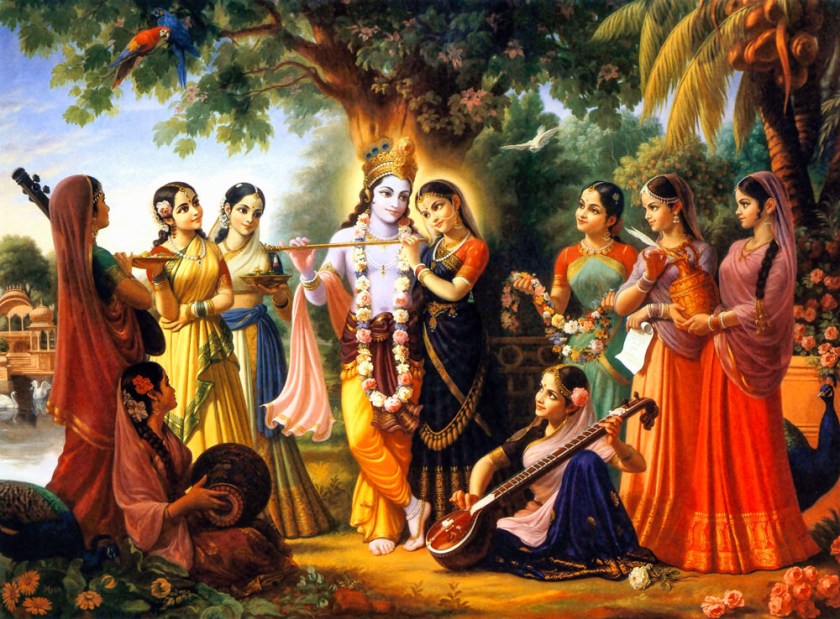
Radha Krishna and the 8 Topmost Gopis

Krishna is the Supreme Personality of Godhead. Krishna is known in other languages as Allah, Jehovah, Yahweh, and many other languages.

ईश्वरः परमः कृष्णः सच्चिदनन्द विग्रह:
अनदिरदिर् गोविन्दः सर्व कारण कारणं ।।१।।

īśvaraḥ paramaḥ kṛṣṇaḥ
sac-cid-ānanda-vigrahaḥ
anādir ādir govindaḥ
sarva-kāraṇa-kāraṇam

Kṛṣṇa who is known as Govinda is the Supreme Godhead. He has an eternal blissful spiritual body. He is the origin of all. He has no other origin and He is the prime cause of all causes. https://vedabase.io/en/library/bs/5/1/

Krishna is the Supreme Absolute Truth.

This means that Krishna’s name, form, pastimes, paraphernalia, abode, associates, etc., are all on the Absolute platform.

नाम चिन्तामणि कृष्णस्चैतन्य रस विग्रहः |
पूर्ण शुद्धो नित्य मुक्तो अभिन्नत्वं नाम नामिनोः ||

nāma cintāmaṇiḥ kṛṣṇaś
caitanya-rasa-vigrahaḥ
pūrṇaḥ śuddho nitya-mukto
’bhinnatvān nāma-nāminoḥ

“ ‘The holy name of Kṛṣṇa is transcendentally blissful. It bestows all spiritual benedictions, for it is Kṛṣṇa Himself, the reservoir of all pleasure. Kṛṣṇa’s name is complete, and it is the form of all transcendental mellows. It is not a material name under any condition, and it is no less powerful than Kṛṣṇa Himself. Since Kṛṣṇa’s name is not contaminated by the material qualities, there is no question of its being involved with māyā. Kṛṣṇa’s name is always liberated and spiritual; it is never conditioned by the laws of material nature. This is because the name of Kṛṣṇa and Kṛṣṇa Himself are identical.’ https://vedabase.io/en/library/cc/madhya/17/133/

Take a second look at the dictionary meaning of “idol”…

Idol: /īd′l/ A false god. One that is adored, often blindly or excessively.
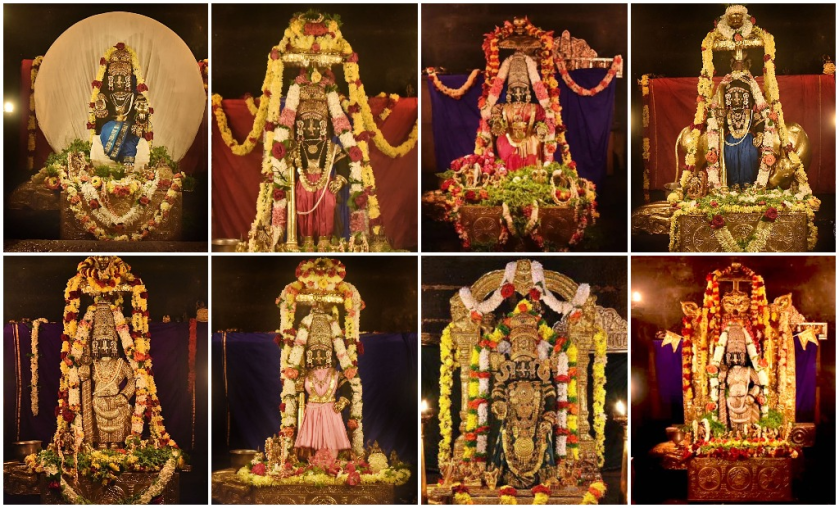
Udupi Sri Krishna
Udupi Sri Krishna

Nothing about Krishna is “false”. And there can be no such thing as “blind” or “excessive” adoration of Krishna. In fact, no matter how much we adore, it is always insufficient. Our problem is that we don’t adore Krishna enough. And we don’t adore Krishna sufficiently because we are blind. If we were not blind, we would be absolutely pure in our love of Krishna.

कृष्णे स्वधामोपगते धर्मज्ञानादिभि: सह ।
कलौ नष्टद‍ृशामेष पुराणार्कोऽधुनोदित: ॥ ४३ ॥

kṛṣṇe sva-dhāmopagate
dharma-jñānādibhiḥ saha
kalau naṣṭa-dṛśām eṣa
purāṇārko ’dhunoditaḥ

This Bhāgavata Purāṇa is as brilliant as the sun, and it has arisen just after the departure of Lord Kṛṣṇa to His own abode, accompanied by religion, knowledge, etc. Persons who have lost their vision due to the dense darkness of ignorance in the Age of Kali shall get light from this Purāṇa. https://vedabase.io/en/library/sb/1/3/43/

Now, to come back to the dictionary meaning of “mythology”…

Mythology: /mĭ-thŏl′ə-jē/ A body or collection of myths belonging to a people and addressing their origin, history, deities, ancestors, and heroes. A body of myths associated with an event, individual, or institution.

सर्वस्य चाहं हृदि सन्निविष्टो
मत्त: स्मृतिर्ज्ञानमपोहनं च ।
वेदैश्च सर्वैरहमेव वेद्यो
वेदान्तकृद्वेदविदेव चाहम् ॥ १५ ॥

sarvasya cāhaṁ hṛdi sanniviṣṭo
mattaḥ smṛtir jñānam apohanaṁ ca
vedaiś ca sarvair aham eva vedyo
vedānta-kṛd veda-vid eva cāham

I am seated in everyone’s heart, and from Me come remembrance, knowledge and forgetfulness. By all the Vedas, I am to be known. Indeed, I am the compiler of Vedānta, and I am the knower of the Vedas. https://vedabase.io/en/library/bg/15/15/
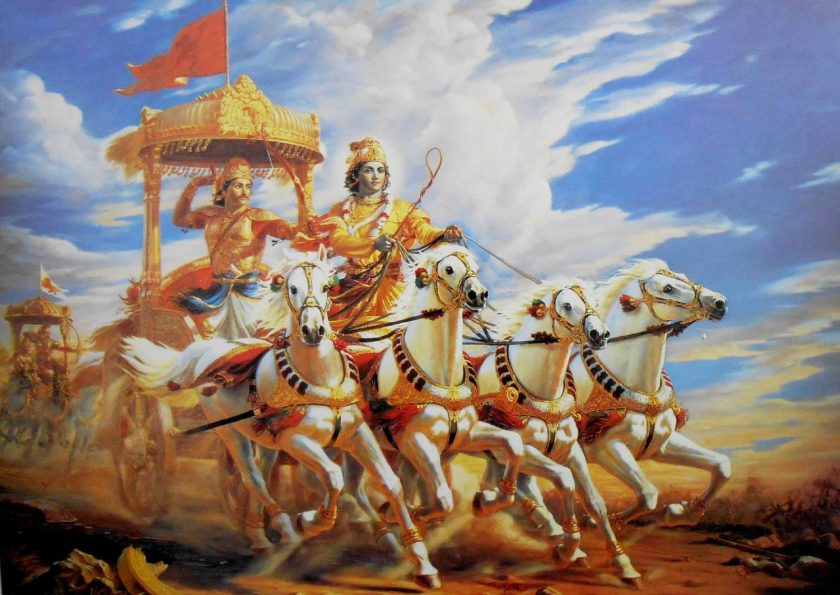
Krishna and Arjuna on the Battlefield of Kurukshetra

The Vedic Scriptures explain different aspects of Krishna. The Puranas are ancient history. So ancient and so broad that they encompass the entire Universe, and go back billions, even trillions of years. Who can comprehend that Universal range and time scale with our teeny little perspective?

Now, where did this misunderstanding come from?

Where did anyone get the idea to call images of Krishna as “idols” and the Vedic scriptures as “Mythology”?

The last surviving bastion of Vedic culture is what is current-day India, Pakistan, Nepal, Bangladesh, Sri Lanka, Thailand, Indonesia, etc.

Vedic culture has been under attack for well over 3000 years. It is natural, because we are in the kaliyuga, the age of quarrel and hypocrisy. Vedic culture i the opposite of quarrel and hypocrisy

First, it was the advent of Buddhism, and Jainism. These are essentially either impersonal, voidist, or both, depending on the specific flavor. Both twisted the Vedic scriptures in different ways. Both were philosophically defeated and Buddhism was mostly driven out to the far corners of the world, away from India.

Lord Buddha

Buddhism was advented by Lord Gautama Buddha to originally to drive out a corruption in Vedic culture.

तत: कलौ सम्प्रवृत्ते सम्मोहाय सुरद्विषाम् ।
बुद्धो नाम्नाञ्जनसुत: कीकटेषु भविष्यति ॥ २४ ॥

tataḥ kalau sampravṛtte
sammohāya sura-dviṣām
buddho nāmnāñjana-sutaḥ
kīkaṭeṣu bhaviṣyati

Then, in the beginning of Kali-yuga, the Lord will appear as Lord Buddha, the son of Añjanā, in the province of Gayā, just for the purpose of deluding those who are envious of the faithful theist.

https://vedabase.io/en/library/sb/1/3/24/

The origin of Jainism was a corruption of the pure teachings and example of Lord Rishbhadeva, an incarnation of Krishna.

Lord Rishabhadeva instructing His sons

यस्य किलानुचरितमुपाकर्ण्य कोङ्कवेङ्ककुटकानां राजार्हन्नामोपशिक्ष्य कलावधर्म उत्कृष्यमाणे भवितव्येन विमोहित: स्वधर्मपथमकुतोभयमपहाय कुपथपाखण्डमसमञ्जसं निजमनीषया मन्द: सम्प्रवर्तयिष्यते ॥ ९ ॥

yasya kilānucaritam upākarṇya koṅka-veṅka-kuṭakānāṁ rājārhan-nāmopaśikṣya kalāv adharma utkṛṣyamāṇe bhavitavyena vimohitaḥ sva-dharma-patham akuto-bhayam apahāya kupatha-pākhaṇḍam asamañjasaṁ nija-manīṣayā mandaḥ sampravartayiṣyate.

Śukadeva Gosvāmī continued speaking to Mahārāja Parīkṣit: My dear King, the King of Koṅka, Veṅka and Kuṭaka whose name was Arhat, heard of the activities of Ṛṣabhadeva and, imitating Ṛṣabhadeva’s principles, introduced a new system of religion. Taking advantage of Kali-yuga, the age of sinful activity, King Arhat, being bewildered, gave up the Vedic principles, which are free from risk, and concocted a new system of religion opposed to the Vedas. That was the beginning of the Jain dharma. Many other so-called religions followed this atheistic system. https://vedabase.io/en/library/sb/5/6/9/

Later invasions from the west

But then, there were the expansionist invasions by the zealots claiming to follow “Islam, the religion of peace”. Those invaders to the Holy Land of India were attracted by the wealth, the riches in the temples… But they were too uncivilized and uncultured to appreciate the nuances of Vedic culture.

So they started calling temple worship “idol worship” in their middle eastern languages, Arabic, Persian, etc. They started a systematic system of persecution, calling the followers of Vedic culture as “kafirs” or non-believers. They did not understand that Krishna is actually Allah Himself. This persecution conginues to this day, a thousand years on. For example in Pakistan and Bangladesh, followers of Vedic culture are still harshly persecuted.

The European powers made the most sophisticated attempts to culturally conquer the Vedic culture. They came to India about 600 years ago. They engaged in business and military conquest. They also sought to replace Vedic culture with barbarian European culture through an insidious system called “modern education”.

Indians have been conditioned to denigrate their own culture!

Indians began to speak Portuguese, Dutch, French, and English. They were made to forget their own languages, their own customs and refined practices. It was deeply rooted. The Europeans, especially the British, sought to vilify all Vedic practices through their Christian missionaries.

  1. Deity worship became “Idol Worship”.
  2. Krishna became a “tribal chieftain” or at best, a “Hindu god”.
  3. All the ancient historical texts like the Vedas, the Upanishads, the Puranas, became “Hindu myths”.

Vedic culture will rescue with world from its dense darkness. To revive the glorious Vedic culture, we must first reject this insulting word “idol” in relation to Krishna. We must also reject the derogatory “mythology” in relation to the Vedic scriptures.

What is idol worship then?

It is the worship of politicians, business people, actors, sports people, military leaders, etc. It is the worship of TV personalities and entertainers. The western world fully engages in idol worship daily. They do this through their thousands of TV channels, their movies, their books, newspapers, magazines, their marketplaces, and living spaces.

Sports fans indulging in Idol Worship

“Western Culture”, an oxymoron, means to worship the temporary bodies, through luxurious homes devoid of a culture of Krishna Consciousness. It means lavish bathrooms and swimming pools. It means arenas to celebrate war in disguise. It means a worship of their dogs and cats. It means the killing of cows and bulls, which are dear to Krishna.

Reject idol worship, by all means, but the form of Krishna is not an “idol”.

We can use the these words instead to describe images of Krishna:

  1. “Archa Vigraha” (अर्च विग्र:) – the Divine Worshipable Form of God
  2. Deity
  3. Divine Form of God

And what is mythology?

What is called “modern science” is mostly mythology. And the western version of “history” is mythology. Common uncultured rascals have been promoted as great personalities. Alexander “the great” was a looter and marauder. Napoleon was a low class murderer and looter. He conspired to become king of France after the French had executed their king and rejected the monarchy. Winston Churchill was a disgusting narrow minded bigot. He was a lying manipulator. He was not a great leader by any stretch of the imagination, because he was full of all vices.

False history propagated by the Europeans

Everything that opposes the pristine Vedic culture is mythology. This includes the spiritual texts of the Middle East, that were once great and pure. These texts like the Quran, Bible, etc., have been censored, edited and misinterpreted. They have lost spiritual value due to tampering. They are only good as political manifestos now. Even if the text is intact, the misinterpretation and misunderstanding of it has depleted its value.

So, yes, reject mythology also, but the Vedic scriptures are not mythology.

धर्म: प्रोज्झितकैतवोऽत्र परमो निर्मत्सराणां सतां
वेद्यं वास्तवमत्र वस्तु शिवदं तापत्रयोन्मूलनम् ।
श्रीमद्भागवते महामुनिकृते किं वा परैरीश्वर:
सद्यो हृद्यवरुध्यतेऽत्र कृतिभि: शुश्रूषुभिस्तत्क्षणात् ॥ २ ॥

dharmaḥ projjhita-kaitavo ’tra paramo nirmatsarāṇāṁ satāṁ
vedyaṁ vāstavam atra vastu śivadaṁ tāpa-trayonmūlanam
śrīmad-bhāgavate mahā-muni-kṛte kiṁ vā parair īśvaraḥ
sadyo hṛdy avarudhyate ’tra kṛtibhiḥ śuśrūṣubhis tat-kṣaṇāt

Completely rejecting all religious activities which are materially motivated, this Bhāgavata Purāṇa propounds the highest truth, which is understandable by those devotees who are fully pure in heart. The highest truth is reality distinguished from illusion for the welfare of all. Such truth uproots the threefold miseries. This beautiful Bhāgavatam, compiled by the great sage Vyāsadeva [in his maturity], is sufficient in itself for God realization. What is the need of any other scripture? As soon as one attentively and submissively hears the message of Bhāgavatam, by this culture of knowledge the Supreme Lord is established within his heart. https://vedabase.io/en/library/sb/1/1/2/

You can call the Vedic scriptures as:

  1. The Yoga texts of India
  2. Vedas or Puranas
  3. Vedic scriptures
  4. Vedic literature
  5. Vedic History

Please give up the use of the words “idol” and “mythology” in relation with Vedic Culture! Hare Krishna!

Why Religious Conversion Does Not Equal True Transformation

A reflection on the nature of religious conversion… does it often lack genuine transformation? What is religious conversion driven by? Let us not ignore the importance of personal development and the cultivation of qualities such as compassion, truthfulness, and humility, rather than merely changing religious labels!

A Hindu can convert to Islam or Christianity. A Christian can convert to Hinduism or Islam. And of course, a Muslim can give up his faith to become an agnostic or Hindu or Christian. Replace any label with any other label, an “X” can convert to “Y”.

When someone converts, then some rejoice, and others fret and fume. One lady once said to me, after revealing to me her previous background “don’t reveal this to anyone, those people, they will kill me if they find out.”. I was quite saddened to hear that someone could be so barbaric as to try and kill her.

Neither is religious conversion of any value, nor should we worry about it. Rest assured, it will have no effect whatsoever. Religious conversion is a farce. It is a political move at best. Why is that?

The work we do inside a trligious tradition matters, not just professing some faith!

What is The Purpose of Religious Tradition?

Because, religious traditions, are like universities or other educational institutions. You don’t “convert” from Stanford to Yale, for example. Neither do you “convert” from computer science to mathematics.

Yes, you can transfer credits from one program to another, you can even switch from one university to another, but it is laughable to say that you have “converted” from studying to be, say, a doctor, to studying to be a medical researcher.

No matter if you are a doctor, or a lawyer, or a medical researcher or a mathematician or a software engineer or whatever… ultimately the result of your work is an income, which you use to meet your needs and wants. A religious tradition is similar, in it that you are meant to use your religious tradition to get closer to God! So don’t use your religious tradition for political purposes or any other lesser purpose!

Now, after an academic transfer, if you actually complete the requirements of your new program and put your acquired knowledge and experience to do better than before, then maybe the transfer was worthwhile, otherwise, it is like the farce of enrolling into a program, and doing nothing to actually fulfill the requirements!

Conversions Galore, and Re-Conversions Too!

I come from India, and throughout my history lessons, I studied how, starting about 2,500 years ago, “Hindus” were converting to Buddhism. Then, I read how, as the philosophy of Buddhism was defeated by great Acharyas such as Adi Shankaracharya, Sripad Ramanujacharya, and Sri Madhvacharya… all those former Buddhists reconverted to “Hinduism”.

Then later on, the Muslims invaded India from Central Asia, the Middle East, and those parts of the world… and they “converted” many of the “Hindus” into “Muslims”. Some of those “Muslims” later reconverted to being called “Hindus” while others adopted their new identities.

After a few hundred years, the Christian missionaries came to India, and began to “convert” Hindus, Muslims, and even the remaining Buddhists, into “Christians”. Some convert back, or to something else!

And this conversion roulette continues to be played today.

It is a farce. A person who professes some label, now claiming to profess some other label doesn’t change anything!

rotten fruit juice is no nectar

Labels Labels Everywhere

If you took some rotten fruit juice and put it into a different bottle labeled something… will the rotten fruit juice be transformed into nectar? No, rotten will remain rotten, maybe even become more so!

You can take an animal, let’s say, a dog, and you can label him a cat, but does he change to being a cat? Can you label a bird as a fish and now the “bird-labeled-fish” will be able to breathe under water and swim around like a fish?

Yes, you could try to indoctrinate the dog all you want… you could tell him “ok, now you are a cat… cats are ‘yours’ and dogs are the enemy”… will it work? No, the next time that dog sees a cat, he will be after it, barking away.

a dog is a dog, in any dress or conditioniong

Similarly, if you take a person who is unable to, say, practice the high Brahminical standards… and you convert that person into, say, a Christian. Will there be any transformation in the person based on this conversion? No, that person will still not be able to follow the highest tenets of Christianity!

In this case, the religious conversion was just to avoid following higher standards. In this way, conversion for the sake of some temporary economic benefit, or social pressure, or frustration with the community – these are the signs of a farcical conversion!

Someone may convert to Christianity because of promise of money or a job or some gifts, like a blanket or a pot or a stove… some convert to Christianity to get access to an addiction recovery service.

After all, how many Christians can follow the ten commandments? In fact, most of the Christians were so incapable of following the ten commandments that they had to water them down! And still they are hard to follow for most people who profess Christianity.

Embodying the Essence!

But to a dedicated follower of the Vedic Principles, the ten commandments are nothing, merely common sense, not even some great philosophical revelation! They have no trouble naturally following the ten commandments!

So what is the real deal? The real deal is when a person’s consciousness is transformed, taking it from animal-like consciousness to a divine state of consciousness!

That is the test. When someone tells me “I am X” or “I am Y”… I look at whether the person has actually developed a love for God, a love for their fellow beings, and not just humans of a certain label. I look for qualities like compassion, cleanliness, truthfulness, punctuality, honesty, and so on. In fact, these are the qualities I try and cultivate within myself…

kṛpālu, akṛta-droha, satya-sāra, sama
nidoṣa, vadānya, mṛdu, śuci, akiñcana
sarvopakāraka, śānta, kṛṣṇaika-śaraṇa
akāma, anīha, sthira, vijita-ṣaḍ-guṇa
mita-bhuk, apramatta, mānada, amānī
gambhīra, karuṇa, maitra, kavi, dakṣa, maunī

SYNONYMS
kṛpālu—merciful; akṛta-droha—not defiant; satya-sāra—thoroughly truthful; sama—equal; nidoṣa—faultless; vadānya—magnanimous; mṛdu—mild; śuci—clean; akiñcana—without material possessions; sarva-upakāraka—working for the welfare of everyone; śānta—peaceful; kṛṣṇa-eka-śaraṇa—exclusively surrendered to Kṛṣṇa; akāma—desireless; anīha—indifferent to material acquisitions; sthira—fixed; vijita-ṣaṭ-guṇa—completely controlling the six bad qualities (lust, anger, greed, etc.); mita-bhuk—eating only as much as required; apramatta—without inebriation; māna-da—respectful; amānī—without false prestige; gambhīra—grave; karuṇa—compassionate; maitra—a friend; kavi—a poet; dakṣa—expert; maunī—silent.

TRANSLATION
”Devotees are always merciful, humble, truthful, equal to all, faultless, magnanimous, mild and clean. They are without material possessions, and they perform welfare work for everyone. They are peaceful, surrendered to Kṛṣṇa and desireless. They are indifferent to material acquisitions and are fixed in devotional service. They completely control the six bad qualities—lust, anger, greed and so forth. They eat only as much as required, and they are not inebriated. They are respectful, grave, compassionate and without false prestige. They are friendly, poetic, expert and silent.

https://vedabase.io/en/library/cc/madhya/22/78-80/

In fact, the Bhagavatam goes on to say this…

ŚB 5.18.12
यस्यास्ति भक्तिर्भगवत्यकिञ्चना
सर्वैर्गुणैस्तत्र समासते सुरा: ।
हरावभक्तस्य कुतो महद्गुणा
मनोरथेनासति धावतो बहि: ॥ १२ ॥

yasyāsti bhaktir bhagavaty akiñcanā
sarvair guṇais tatra samāsate surāḥ
harāv abhaktasya kuto mahad-guṇā
manorathenāsati dhāvato bahiḥ

Synonyms
yasya — of whom; asti — there is; bhaktiḥ — devotional service; bhagavati — to the Supreme Personality of Godhead; akiñcanā — without any motive; sarvaiḥ — with all; guṇaiḥ — good qualities; tatra — there (in that person); samāsate — reside; surāḥ — all the demigods; harau — unto the Supreme Personality of Godhead; abhaktasya — of a person who is not devoted; kutaḥ — where; mahat-guṇāḥ — good qualities; manorathena — by mental speculation; asati — in the temporary material world; dhāvataḥ — who is running; bahiḥ — outside.

Translation
All the demigods and their exalted qualities, such as religion, knowledge and renunciation, become manifest in the body of one who has developed unalloyed devotion for the Supreme Personality of Godhead, Vāsudeva. On the other hand, a person devoid of devotional service and engaged in material activities has no good qualities. Even if he is adept at the practice of mystic yoga or the honest endeavor of maintaining his family and relatives, he must be driven by his own mental speculations and must engage in the service of the Lord’s external energy. How can there be any good qualities in such a man?

https://vedabase.io/en/library/sb/5/18/12/

In the purport, Srila Prabhupada clarifies more…

The Qualities of an Advanced Spiritualist

In the Ādi-līlā of Caitanya-caritāmṛta, Chapter Eight, there is a description of some of the qualities of devotees. For example, Śrī Paṇḍita Haridāsa is described as being very well-behaved, tolerant, peaceful, magnanimous and grave. In addition, he spoke very sweetly, his endeavors were very pleasing, he was always patient, he respected everyone, he always worked for everyone’s benefit, his mind was free of duplicity, and he was completely devoid of all malicious activities. These are all originally qualities of Kṛṣṇa, and when one becomes a devotee they automatically become manifest. Śrī Kṛṣṇadāsa Kavirāja, the author of Caitanya-caritāmṛta, says that all good qualities become manifest in the body of a Vaiṣṇava and that only by the presence of these good qualities can one distinguish a Vaiṣṇava from a non-Vaiṣṇava. Kṛṣṇadāsa Kavirāja lists the following twenty-six good qualities of a Vaiṣṇava:

(1) He is very kind to everyone.

(2) He does not make anyone his enemy.

(3) He is truthful.

(4) He is equal to everyone.

(5) No one can find any fault in him.

(6) He is magnanimous.

(7) He is mild.

(8) He is always clean.

(9) He is without possessions.

(10) He works for everyone’s benefit.

(11) He is very peaceful.

(12) He is always surrendered to Kṛṣṇa.

(13) He has no material desires.

(14) He is very meek.

(15) He is steady.

(16) He controls his senses.

(17) He does not eat more than required.

(18) He is not influenced by the Lord’s illusory energy.

(19) He offers respect to everyone.

(20) He does not desire any respect for himself.

(21) He is very grave.

(22) He is merciful.

(23) He is friendly.

(24) He is poetic.

(25) He is expert.

(26) He is silent.

So let us all, with every means offered to us by our own religious tradition, strive to inculcate these qualities.

Let us not be a disgrace to our teachers, prophets, saints, philosophers, Gurus, Acharyas, Rabbis, Mullahs, Imams, Priests, Mentors, Pastors, Sangomas, and so on.

Let us not be a disgrace to our leaders. And it will be worse if we ourselves are the leaders!

In fact, it will be an even bigger disgrace if we ourselves are in such a respectable position as to advise others, and we ourselves have none of the transformation, none of the qualities mentioned above.

Let us all be converted in the only way that matters, develop pure Love for God.

Srila Prabhupada, a pure lover of God.

Hare Krishna!

Pursuing the Highest Instruction of your Scripture

Every scripture has higher and lower instruction. Pursue the highest instruction always. The lower instructions are for animal-like humans… we should strive to go deeper, higher.

I was out a couple of days ago, looking to meet people interested in spiritual life. I do this often, and especially in December every year, I’m in marathon mode.

It was in Kensington market in Toronto, I was out with my son.

We met a gentleman who introduced himself as Altaf. Altaf Bhai is from Pakistan and also has some Agra connections. He told me he is a yogi, even though he is a Muslim. I thought why not, yoga means to reconnect to God, so why can a Muslim not be a yogi. He started speaking some intricate philosophy. But I could see that there were many gaps in his knowledge. He was secretly trying to convince me to become a Muslim. I’m OK with that, but I’m not OK with ignorance.

As the conversation progressed, however, he began to say things that were insulting to another very very great personality, Lord Shiva. He said that Lord Shiva was actually satan. I had to stop him there. It is one thing to not know something, but for someone like me who knows better, it is a crime to stand there and listen to such things. According to the Vedic texts, the personality known as Satan in the Koran and Bible is actually the personality named Kalipurusha. Not to be confused with the goddess Kali devi, this personality is in charge of the current age of quarrel and hypocrisy. But I couldn’t get in a word edgewise with Altaf – he just didn’t want to hear anything.

He then mentioned sacrificing cows. He said that the Quran does permit sacrificing cows. He said that Allah gave us all the animals for our enjoyment.

A yogi who recommends cow slaughter? A yogi who does not know the basics of yoga? Hmmm… this was very fishy.

Every scripture has higher instructions and lower instructions. The lower instructions are meant so that humans who are on the level of animals may find something to adhere to, and rise higher, and when they do rise higher, then there are higher instructions to follow.

For example, there is also an instruction in the Quran that one should not have sexual relationships with one’s mother, or with the father’s wife. Why was this instruction present? Because at that time and in that place, there were men who did not hesitate to do so. So the Prophet had to include that instructions, just to civilize those animal-like men.

The highest instruction, of course, is to see every woman who is not your wife as your own mother. It does not matter if she is younger or older or what – if she is not your wife, she is as good as your own mother. Treat her with respect. That will resolve a lot of problems at one stroke, but that is another topic for another day.

Similarly, the instruction about ritual sacrifice of animals was in a place where food was hardly available – it was the barren desert after all. The instruction of ritual sacrifice and to cause the least amount of pain to the animal was there because there were people who took sadistic pleasure in torturing animals. This does not mean that the Quran encourages opening of slaughter-houses and killing of animals on a large scale. I couldn’t convince him, but this message is for him and other Altaf’s of the world.

It is not necessary to be a bloody thirsty animal killer to follow Islam, to be a Muslim. Meat is not for spiritualists, unless it is a question of absolute necessity.

I did not have the heart to tell Altaf about the hellish punishments given in the Vedic scripture for killing a cow. And I don’t want to shock my dear readers too. But it is not good, not in this world, nor in the next.

One of the greatest Muslims in the history of the world was Haridas Thakur. Born in Bengal, he is recognized as one of the greatest spiritual leaders of the world. He chanted the Hare Krishna Mahamantra constantly, and was able to convince Muslims with arguments from the Koran that he was doing the highest thing. If you want to read about Haridas Thakur, this book is highly recommended. http://torchlightinternational.com/shop/namacarya/.

Haridas Thakur was disliked by both the Muslims and the Hindus, because he knew both scriptures better than most and he personally followed both scriptures perfectly. Indeed, a Qazi had him whipped in 22 marketplaces, and while most people would die after 1-2 such beatings, Haridas Thakur felt no pain. He was praying for his assailants to be forgiven all the while!

In every scripture, including the Bhagavad Gita, there are higher and lower instructions, for example in the twelfth chapter of the Gita, Krishna says the following:

But those who worship Me, giving up all their activities unto Me and being devoted to Me without deviation, engaged in devotional service and always meditating upon Me, having fixed their minds upon Me, O son of Pṛthā – for them I am the swift deliverer from the ocean of birth and death.

Just fix your mind upon Me, the Supreme Personality of Godhead, and engage all your intelligence in Me. Thus you will live in Me always, without a doubt.

My dear Arjuna, O winner of wealth, if you cannot fix your mind upon Me without deviation, then follow the regulative principles of bhakti-yoga. In this way develop a desire to attain Me.

If you cannot practice the regulations of bhakti-yoga, then just try to work for Me, because by working for Me you will come to the perfect stage.

If, however, you are unable to work in this consciousness of Me, then try to act giving up all results of your work and try to be self-situated.

 If you cannot take to this practice, then engage yourself in the cultivation of knowledge. Better than knowledge, however, is meditation, and better than meditation is renunciation of the fruits of action, for by such renunciation one can attain peace of mind.

https://vedabase.io/en/library/bg/12/ texts 6-12

Do you see how the highest goal may be unattainable for most? So Krishna gives alternatives. But those alternatives are not the highest thing. The highest thing is what Krishna mentioned first.

Similarly, in the Quran also there are lower and higher instructions, meant for people of different kinds.

I have many Muslim friends who are both Muslim and Vegetarian. In fact, many are vegan. See https://veganmuslims.com/ for a more background on that.

As I told Altaf, I was neither rejecting him, nor was I rejecting Prophet Muhammad, and I certainly am not rejecting Allah. What I am emphatically rejecting is his ignorance, and I am even more strongly rejecting words that are supposedly sacred but are actually meant to spread ignorance around. This applies to anyone from any tradition. I could not give him anything else except a vibration of the Mahamantra – Hare Krishna Hare Krishna Krishna Krishna Hare Hare Hare Rama Hare Rama Rama Rama Hare Hare. May Altaf find peace in this life and the next.

My plea to all my Muslim brothers and sisters is this – please dear souls, please go higher in your knowledge and adherence of your own scripture. Follow the highest instruction of your scripture. Continuously chant the names of Allah with pure love and devotion, and you will find you will lose all taste for blood and flesh.

This is my prayer to everyone else, to Buddhists, to Christians, and to Jews. Thou Shalt Not Kill.

Should we worship the Demigods for Material Gains?

Manmohan, 19th January 2012

Dear Mahabhagavat Prabhu
 Please Accept My Humble Obeisances
 I have one query…
 We should worship Krishna for Spritual gains only can we pray the demigods for material benefits…
 What one should do if he is in needs of money to maintain his material and spiritual life…
 Manmohan.

Mahabhagavat Das, 26th January 2012

Dear Bhakta Manmohan,
Hare Krishna!
Please accept my humble obeisances.
All glories to Srila Gurudeva.
All glories to Srila Prabhupada.
Good question! Understandable also why someone may ask this question.
The demigods are to be respected, never disrespected, but there is no need to worship them for any reason whatsoever, especially if one is in devotional service. They are like the individual government servants – what is it called when someone pays a policeman or government official to expedite some job for them? It is called bribery, corruption, etc.
It is not unreasonable to desire facility for spiritual life, BUT, for a devotee, there is no such thing as material life. Even though a devotee may appear to be doing the same things as a materialist, and externally appears to have the same outcomes, the consciousness of the devotee is different – the results are offered back up to Krishna always. The home is a temple, free time is opportunity to learn more, read more, teach more, chant more, serve more, no material sense gratification involved, even subtly. Of course, this is the goal, in our neophyte stage we may not always be 100% spiritual in focus, but we should certainly try and remind ourselves. In this connection, I learned a lesson today from my wife. She is away in South Africa caring for her father who is ill, and supporting her mother and brother with spiritual strength. She said today to me in a phone call “I was thinking that I hadn’t remembered Krishna for 15 minutes, or 30 minutes, so it was time to remember something about Him now”. So she is trying very hard even though it may get difficult sometimes. I will seek to emulate that exemplary behavior.

Krishna says this in the Bhagavad Gita:
kāńkṣantaḥ karmaṇāḿ siddhiḿ
yajanta iha devatāḥ
kṣipraḿ hi mānuṣe loke
siddhir bhavati karma-jā

Men in this world desire success in fruitive activities, and therefore they worship the demigods. Quickly, of course, men get results from fruitive work in this world. BG 4.12
Please read the purport, Srila Prabhupada writes strongly.
kāmais tais tair hṛta-jñānāḥ
prapadyante ‘nya-devatāḥ
taḿ taḿ niyamam āsthāya
prakṛtyā niyatāḥ svayā
Those whose intelligence has been stolen by material desires surrender unto demigods and follow the particular rules and regulations of worship according to their own natures. BG 7.20
Srila Prabhupada writes in the purport (I have made some portions *bold* for emphasis):
Those who are freed from all material contaminations surrender unto the Supreme Lord and engage in His devotional service. As long as the material contamination is not completely washed off, they are by nature nondevotees. *But even those who have material desires and who resort to the Supreme Lord are not so much attracted by external nature; because of approaching the right goal, they soon become free from all material lust. In the Śrīmad-Bhāgavatam it is recommended that whether one is a pure devotee and is free from all material desires, or is full of material desires, or desires liberation from material contamination, he should in all cases surrender to Vāsudeva and worship Him.*
As stated in the Bhāgavatam (2.3.10):
akāmaḥ sarva-kāmo vā
mokṣa-kāma udāra-dhīḥ
tīvreṇa bhakti-yogena

yajeta puruṣaḿ param
Less intelligent people who have lost their spiritual sense take shelter of demigods for immediate fulfillment of material desires. Generally, such people do not go to the Supreme Personality of Godhead, because they are in the lower modes of nature (ignorance and passion) and therefore worship various demigods. Following the rules and regulations of worship, they are satisfied. *The worshipers of demigods are motivated by small desires and do not know how to reach the supreme goal, but a devotee of the Supreme Lord is not misguided. Because in Vedic literature there are recommendations for worshiping different gods for different purposes (e.g., a diseased man is recommended to worship the sun), those who are not devotees of the Lord think that for certain purposes demigods are better than the Supreme Lord.* But a pure devotee knows that the Supreme Lord Kṛṣṇa is the master of all. In the Caitanya-caritāmṛta (Ādi 5.142) it is said, ekaleīśvara kṛṣṇa, āra saba bhṛtya: only the Supreme Personality of Godhead, Kṛṣṇa, is master, and all others are servants. Therefore a pure devotee never goes to demigods for satisfaction of his material needs. He depends on the Supreme Lord. And the pure devotee is satisfied with whatever He gives.”
Therefore, simply depending on Krishna for everything is the best policy, even if we are not yet pure devotees…
Please let us know if there is any doubt. Bringing a doubt up against the light of the scripture extinguishes the doubt, just as light finishes darkness.
Sincerely,
Mahabhagavat Das

Bhavani devi dasi (SDA), 26th January 2012

Hare Krsna,
Please accept my humble obeisances.
All glories to Srila Prabhupada.
All glories to Sri Sri Guru & Gauranga
 
Thank you Mahabhagavat Prabhu for such a comprehensive answer to this most important question, that arises many times during discussions.  I greatly appreciate all the illuminating questions and answers here and want to thank everyone for their interaction.  Thank you.  Hare Krsna!  All glories to our beloved Srila Gurudeva.
Your servant,
Bhavani devi dasi (SDA)

Manmohan, 27th January 2012

Dear Mahabhagavat Prabhu
 Please accept my humble  obeisances
 bahot dhanyavad prabhu  ( Thank you very much Prabhu ) …
 Infact I was given a mantra by someone and i started chanting that…. but i was not feeling good from within and stopped chanting that mantra….
 Things are very clear now…
 Dandavat..
 Your Servant
 Manmohan

Mahabhagavat Das SDA, 27 January 2012

Very good Manmoham Prabhu, Hare Krishna Mahamantra includes all the Vedic mantras inside it, and by chanting you are in touch with the Boss of bosses of CEOs  of cosmic administration. 🙂 “krishna bhakti kaile sarva karma krita hoy” – Devotional service includes the benefits of all the other services.
Nothing else is necessary.

Premal, 05th February 2012

Hare Krishna Prabhuji
All glories to Swami Prabhupada
Please accept my humble obeisances
Prabhuji would impersonal liberation for people who want and worship different ways not knowing Krishna is the goal.

Example Jains,Buddha they think we ourselves are capable of God.
Are they lower than demigods worshippers?
Similarly nowadays Christians and Muslims and the Jews also feel differently like Christians have changed the scripture and the old scripture is not practised lately these people also are lower than the worshippers of demigods?
Jews I am not aware of their religion and Muslims have also majority now eat meat and worship impersonal Allah newly created by the people are they lower than demigod worshipers?
Ys servant
Premal

Mahabhagavat Das SDA, 06th February 2012

Hare Krishna Premal Prabhu,
Please kindly accept my humble obeisances.
All glories to Srila Gurudeva.
All glories to Srila Prabhupada.
As far as I understand, both the Jain and Buddhist traditions are impersonalist and voidist. But both of them are skilful ways to elevate persons gradually. For example, Srila Gurudeva often says in his lectures that Buddha, he played a trick. He attracted those who did not want to follow God, but he tricked them into following Him, an incarnation of God, so a little bit, their atheism was replaced by some little bit of faith.
Anyone who thinks that oneself is capable of being God, is in actuality, an atheist. This is according to Srila Prabhupada. We pray to him as someone who came to vanquish this nonsense “nirvishesha shunyavaadi” concepts.
Still, Srila Prabhupada respects the impersonalists also as transcendentalists, because at least they are above the level of animals in human form… even all genuine impersonalists strictly follow the 4 regulative principles of human life.
There is no point discussing too much who likes impersonal liberation, etc., it is sufficient for us to know that many of the demons who are killed by Krishna get impersonal liberation. So what is the value of this impersonal liberation if a demon can get it simply by being killed by Krishna? So why should I meditate and so on just to get the same destination as the demons liberated by Krishna? I have demoniac tendencies but I am not a demon by the mercy of Srila Gurudeva. So I shall simply serve Krishna and His devotees sincerely without worrying about ANY kind of liberation. One who serves 100% dedicated is factually liberated.
You have mixed some concepts…
The original teachings of Lord Jesus Christ are in line with the principles of pure Bhakti. Lord Jesus Christ is a pure devotee of Krishna. If someone has changed, that is their problem, not the problem with the faith as taught by Lord Jesus Christ. If someone is claiming to be following Lord Jesus Christ and is eating meat, as discussed on another thread, then they are simply still in the cycle of karma – karma chakra. They are simply getting good and bad reactions according to their activities, sometimes born as humans, then as animals until they exhaust their karmic debts to the souls they inconvenienced, plus any special treatments from Yamaraja’s department.
The Qu’ran teaches that God is a person, but the so-called scholars who claims that Allah is impersonal are not very well-versed with their own scripture. See this statement by Srila Gurudeva, answer to a question by a Muslim person “Why do you worship the form of God in the temple when God is formless?”
Srila Gurudeva wrote on 25th January 2012:
“If a Muslim asks such a question, he is not learned in his own scripture, the Qur’an clearly states as follows::
Wa lillaahil – Mashriqu wal-Magrib: Fa- ‘aynamaa
tu-walluu fa-samma Wajhul-laah
“To Allah belong the East and the West, and wherever you turn there is Allah’s face.”
–Qur’an 2.115
That Allah or God has a face means that He has a form because someone who is formless must also be faceless. God’s form-possessing nature is also confirmed in the Bible and in the Vedic scriptures.
Besides a wealth of scriptural evidence establishing that God has a form, we can also understand through logic that God must have a form. The logic is very simple: We cannot exceed God in any way. Therefore we cannot possess something that He does not possess. It’s not that we can have a form and He cannot. He must also have form. The difference is that His form is unlimited while our forms are limited. His form is the source of everything, and our forms come from His form.”
As to whether someone is lower or higher, we should know that everything other than Pure Bhakti, is “lower” and we should strive to raise ourselves to the platform of Pure Unmotivated Bhakti to Krishna in any of His names.
Hope this helps.
Questions for you, Bhakta Premal, in the spirit of helping you find answers to your own questions from inside, to be free from all doubts:

1. Are you chanting a minimum of 16 rounds per day of Hare Krishna Mahamantra? If not, what is your plan to get there?
2. Are you reading Srila Prabhupada’s books for minimum 30 minutes a day? If not, when can you start?
3. Are you following the 4 regulative principles of freedom? This is personal question for you, answer honestly in your heart.
4. Are you taking only Krishna Prasadam? If not, what is your plan to get there?

Sincerely,
Mahabhagavat Das
 
Premal, 07th February 2012

Hare Krishna Prabhuji
All glories to Swami Prabhupada
Please accept my humble obeisances
Prabhuji as you mentioned atheist is a person who thinks he can become god .
But does not impersonal and voidist claim to be becoming god these paths prabhuji are teachings to become god?
Ys servant
Premal

Mahabhagavat Das SDA, 07th February 2012

Hare Krishna Premal Prabhu,
Please accept my humble obeisances.
All glories to Srila Gurudeva.
All glories to Srila Prabhupada.
There is a subtle difference between impersonalism and voidism. Impersonalism means God is just energy, and to merge into that energy and lose our individuality.
Voidism means there is nothing, they claim that we think that something exists because we are in illusion, they want to make everything zero, become zero, end everything by becoming null, nil, void.
Both impersonalists and voidists, if they are even somewhat pious, can be rescued by Krishna consciousness from their ocean of ignorance.
So, are you asking these questions theoretically or do you have some impersonalists and voidists whom you want to attract to Krishna Bhakti? Every question, in order to personally realize the answer, must be followed by some action, to implement the answer. What is your action following these questions?
Sincerely,
Mahabhagavat Das

Premal, 07th February 2012

Hare Krishna Prabhuji
All glories to Swami Prabhupada
Please accept my humble obeisances
Prabhuji my actions are when impersonal path people take I was confused as impersonal was to merge with Krishna or the schools which say there is impersonal energy and they do not mention it as Krishna impersonal energy but just a formless energy and we can become god.
So the confusion was like this in my mind.
Ys servant
Premal