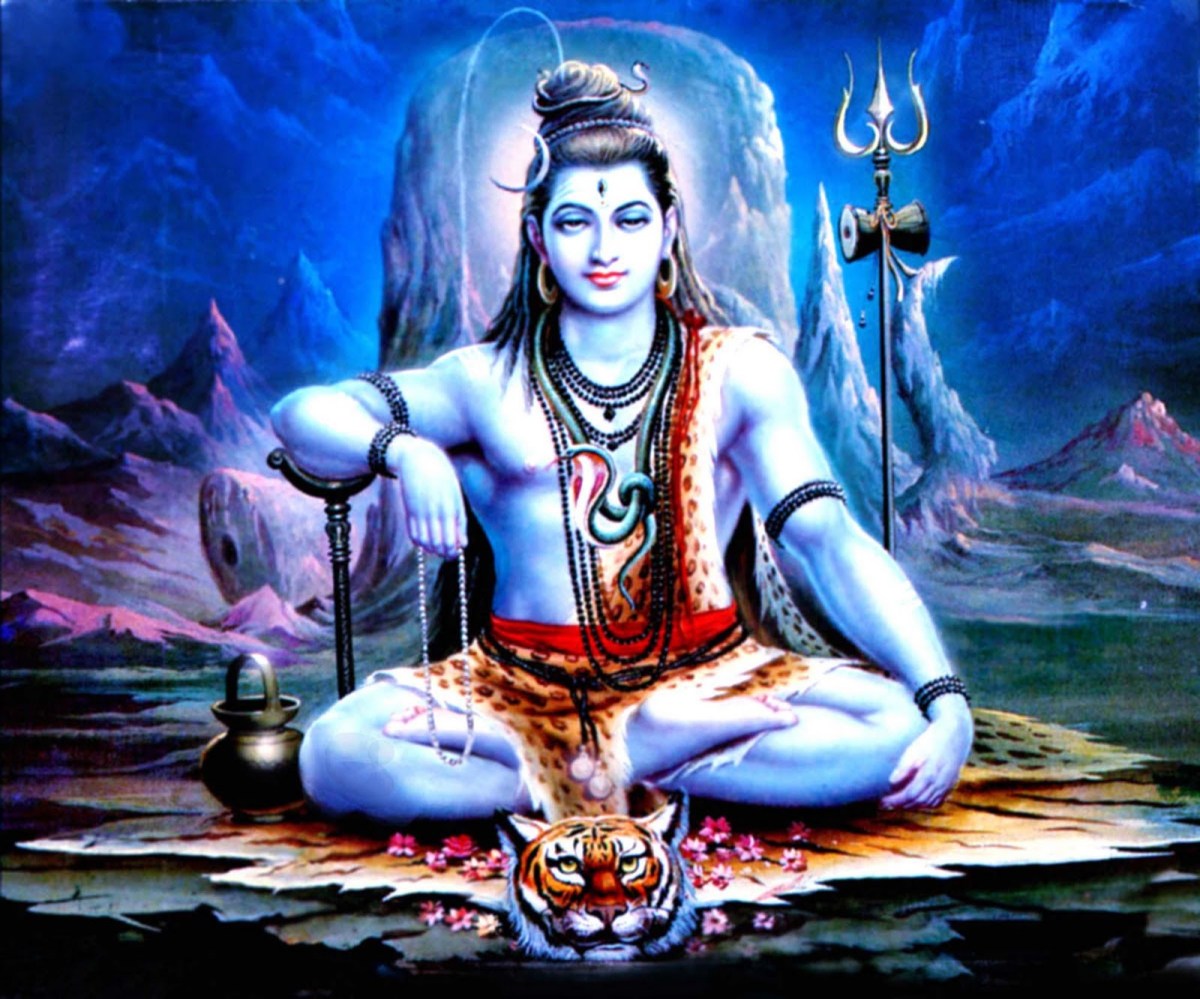
Is Srila Prabhupada insulting Lord Shiva?

Srila Prabhupada, a great teacher, wrote prolifically. Even though his works are lucid and clear, there are many misunderstandings about his writings. One is that he insulted Lord Shiva. Is this true?

Question:

A devotee who has been with ISKCON for 7 years has asked this question… he says he does not agree with Srila Prabhupada’s purport to BG 2.62.

Lord Śiva was deep in meditation, but when Pārvatī agitated him for sense pleasure, he agreed to the proposal, and as a result Kārtikeya was born.

https://vedabase.io/en/library/bg/2/62/

He says that this is not the real story also he doesn’t agree that Lord Shiva can be agitated.

Lord Shiva, Parvati Devi, and their children Kartikeya and Ganesha

Answer:

Thank you for writing to me about this. It is an important thing.

First and foremost we have to understand who is Srila Prabhupada. Srila Prabhupada is a pure devotee. As a pure devotee, Srila Prabhupada has no envy in his heart. Srila Prabhupada has no desire to criticize someone unnecessarily. He also has no tendency to try and pull someone down. In fact, Srila Prabhupada is on the Uttama Adhikari platform. As an Uttama Adhikari, he feels that everyone else is serving Krishna except himself. But Srila Prabhupada came down to the Madhyama Adhikari platform. On this platform, he suppressed his ecstatic emotions and took the role of a teacher of Krishna Consciousness. Thus he preached to us poor lost souls in the material world. Srila Prabhupada undertook an austerity for us. Just like Lord Shiva drank up the ocean of poison, Srila Prabhupada tolerated the poisonous nature of this material world. His sacrifice saves us all.

Great personalities accept voluntary suffering for the benefit of others

“tapyante loka taapena”, this is a verse from the Bhagavatam glorifying personalities like Lord Shiva and Srila Prabhupada.

तप्यन्ते लोकतापेन साधव: प्रायशो जना: ।
परमाराधनं तद्धि पुरुषस्याखिलात्मन: ॥ ४४ ॥

tapyante loka-tāpena
sādhavaḥ prāyaśo janāḥ
paramārādhanaṁ tad dhi
puruṣasyākhilātmanaḥ

It is said that great personalities almost always accept voluntary suffering because of the suffering of people in general. This is considered the highest method of worshiping the Supreme Personality of Godhead, who is present in everyone’s heart.
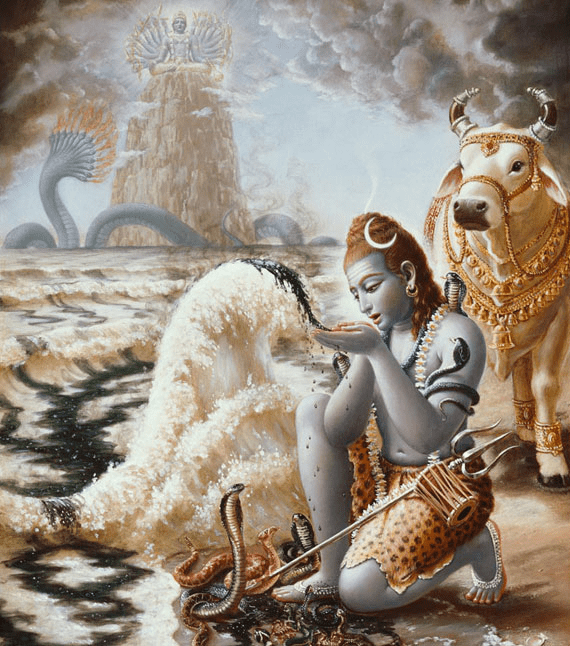
https://vedabase.io/en/library/sb/8/7/44/

Lord Shiva drinks up an ocean of deadly poison and keeps it suspended in his throat

On the Madhyama Adhikari platform…

A devotee behaves differently with different kinds of personalities. A Madhyama Adhikari is a teacher/preacher… and his mission is to guide souls to spiritual perfection.

  1. To Supreme Personality of Godhead or His plenary expansions, he offers prayers
  2. To the devotees of Krishna, he makes friendship
  3. To the innocent, he preaches Krishna Consciousness
  4. Those envious of Krishna, he avoids

ईश्वरे तदधीनेषु बालिशेषु द्विषत्सु च ।
प्रेममैत्रीकृपोपेक्षा य: करोति स मध्यम: ॥ ४६ ॥

īśvare tad-adhīneṣu
bāliśeṣu dviṣatsu ca
prema-maitrī-kṛpopekṣā
yaḥ karoti sa madhyamaḥ

An intermediate or second-class devotee, called madhyama-adhikārī, offers his love to the Supreme Personality of Godhead, is a sincere friend to all the devotees of the Lord, shows mercy to ignorant people who are innocent and disregards those who are envious of the Supreme Personality of Godhead.

https://vedabase.io/en/library/sb/11/2/46/

Srila Prabhupada, the great Vaishnava Acharya

Now, let us examine who is Lord Shiva.

Lord Shiva is the Topmost Vaishnava, “vaishnavaanaam yathaa shambhu” as stated in the Bhagavatam.

निम्नगानां यथा गङ्गा देवानामच्युतो यथा ।
वैष्णवानां यथा शम्भु: पुराणानामिदं तथा ॥ १६ ॥

nimna-gānāṁ yathā gaṅgā
devānām acyuto yathā
vaiṣṇavānāṁ yathā śambhuḥ
purāṇānām idam tathā

Just as the Gaṅgā is the greatest of all rivers, Lord Acyuta the supreme among deities and Lord Śambhu [Śiva] the greatest of Vaiṣṇavas, so Śrīmad-Bhāgavatam is the greatest of all Purāṇas.

https://vedabase.io/en/library/sb/12/13/16/

In the Brahma Samhita (kshiram yatha dadhi vikaaram) it is stated that Lord Vishnu transforms as Lord Shiva when Lord Vishnu is “in touch” with material energy. This is just like how milk turns to curds when touched with tamarind. In other words, Lord Vishnu and Lord Shiva have no difference of opinion. Krishna desires everyone to be His pure devotee. Similarly, Lord Shiva desires everyone to be Krishna’s pure devotee.

क्षीरं यथा दधि विकारविशेषयोगात्
सञ्जायते न हि ततः पृथगस्ति हेतोः ।
यः शम्भुतामपि तथा समुपैति कार्या-
-द्गोविन्दमादिपुरुषं तमहं भजामि ॥ ४५ ॥

kṣīraṁ yathā dadhi vikāra-viśeṣa-yogāt
sañjāyate na hi tataḥ pṛthag asti hetoḥ
yaḥ śambhutām api tathā samupaiti kāryād
govindam ādi-puruṣaṁ tam ahaṁ bhajāmi

Just as milk is transformed into curd by the action of acids, but yet the effect curd is neither same as, nor different from, its cause, viz., milk, so I adore the primeval Lord Govinda of whom the state of Śambhu is a transformation for the performance of the work of destruction.

https://vedabase.io/en/library/bs/5/45/

In fact, without the mercy of Lord Shiva, no one can become a Vaishnava. Lord Shiva and Parvati Devi are regarded as the father and mother of the material world. As you know, father and mother are the first teachers of every child.

As such, Lord Shiva is beyond all criticism. And as Lord Shiva is a pure devotee, Srila Prabhupada would never criticize Lord Shiva.

Srila Prabhupada is stating the fact.

Lord Kartikeya was born of Shiva and Parvati’s union. Lord Brahma, who is Lord Vishnu’s son is born directly from Himself without the help or assistance of Lakshmi Devi.

In the Valmiki Ramayana, Kartikeya is mentioned as the son of Rudra and Parvati. Agni and Ganga Devi aided in his birth. We accept Valmiki Muni as an utmost authority.

Valmiki, the author of the Original Ramayana

In the Mahabharata, Kartikeya is mentioned as the son of Shiva and Parvati. He emerged as a result of Lord Shiva’s sexual union with Parvati Devi. The details I will not mention here. Ganga Devi cultivated the seed of Lord Shiva. Agni Deva, the demigod in charge of fire, kept it warm.

Now, there is a third story, from the Shiva Purana… Lord Shiva was meditating. Parvati Devi was trying to attract him. Kamadeva tried to help but was burned to ashes by the wrath of Lord Shiva. Lord Shiva, being merciful, then paid attention to Parvati Devi. He married her, and Kartikeya was conceived.

There is additionally a Tamil version of the Skanda Purana in which another story is presented. I read that story in the Amar Chitra Katha comics as a child. Only later I learned where the story came from. The demigods prayed to Lord Shiva and pleased Him. As a result, Lord Shiva manifested 5 additional heads. From each head came one spark. Vayu Deva, the demigod in charge of the wind, carried these sparks and handed them to Agni Deva. Agni Deva then carried the sparks to Ganga Devi, who took them to Saravana lake. There, 6 boys were born. The 6 boys were merged into one by Krittika Devi. This marked the appearance of Kartikeya. He then defeated the demons Surapadma and Simhamukha. These demons surrendered to Kartikeya and became his assistant associates.

Valmiki Ramayana is the Absolute Truth. Mahabharata is also composed by Veda Vyasa. Therefore, we have 2 authoritative references to support Srila Prabhupada’s statement about Lord Shiva in BG 2.62.

Srila Prabhupada is a highly empowered Vaishnava Acharya who has presented Krishna Consciousness in the Brahma Madhva Gaudiya Sampradaya. Why should anyone accept an objection raised by an uncontrolled mind? Instead, whenever we hear the instruction of the Acharya, we should strive to understand how it is true. It’s not about whether it is true or not, but how it is true. This is called surrender. It may take time. It took me many years to surrender to my Guru Maharaja, but eventually I did. Whenever I had any doubts about Srila Prabhupada’s words, my spiritual masters helped me. They guided me with proper understanding to overcome that doubt.

To “disagree” with an Acharya, is simply immaturity.

Sometimes Acharyas disagree with each other. This is alright if they are of an equal stature. In that case, the rest of us must try to understand how they are right, all of them! Spiritual reality is truly wonderful. It is not one dimensional.

Puranic stories sometimes differ because they describe one kalpa (a day of Brahma) or another. On different days of Lord Brahma, there can be variations in some details.

Lord Shiva’s agitation by Parvati is not an insult to Lord Shiva.

Instead, it glorifies his great devotion to Sri Krishna. By personal example, Lord Shiva is showing how great Lord Krishna is. Lord Krishna remained without agitation even when surrounded by 3 Billion beautiful young gopis. The gopis were ready to do anything for Krishna. Krishna is an eternal Brahmachari, and the proof of this statement is Sri Bhishmadeva who has stated this personally!

Does this help?

Glossary – Personalities & Concepts mentioned in the article:

  • Acharya – A teacher in one of 4 authorized disciplic successions from God, who teaches by personal example
  • Agni Deva – The demigod in charge of fire
  • Bhagavatam – The topmost spiritual scripture, available online at https://vedabase.io/en/library/sb/
  • Bhishmadeva – Among the 12 greatest spiritual authorities of our universe, played a pivotal role in the Mahabharata, sometimes referred to as “grandsire” or “grandfather”
  • Brahma – The creator of this universe, son of Lord Vishnu
  • Brahma Samhita – The composition of Lord Brahma is a 100-chapter book. Only Chapter 5 is available. It can be found online at https://vedabase.io/en/library/bs
  • Deva – “Demigod”, also used as an honorific for divine personalities
  • Ganga – The most sacred river in our Universe, a liquid form of God
  • Gopis – The topmost saints, devotees of Krishna
  • Guru – Spiritual Master, also “heavy”
  • Kalpa – A day of Brahma, 4.32 Billion Years long
  • Kama – Literally “lust”, used to refer to the demigod in charge of love
  • Kartikeya – Son of Shiva and Parvati, the military commander of the demigods
  • Krishna – The Supreme Personality of Godhead, source of both spiritual and material realms, the One and Only appearing Himself in different forms and with different names
  • Krittika Devi – a demigoddess
  • Madhva Gaudiya Sampradaya – A current unbroken line of disciplic succession from God Himself, included below for reference
  • Madhyama Adhikari – defined above
  • Maharaja – King among men, used to refer to royalty and to renounced or exalted souls
  • Parvati – The consort of Lord Shiva, expanded as the material energy
  • Purana – Authorized history of the Universe, there are 18 such histories, 6 meant for those in the mode of goodness, 6 for those in the mode of passion, and 6 meant for those in the mode of passion
  • Ramayana – The pastimes of Lord Rama, the Personality of Godhead
  • Rudra – A son of Lord Brahma, born of his anger from his forehead
  • Simhamukha & Surapadma – Former demons who accepted the shelter of Kartikeya and became his assistants
  • Shiva – The auspicious one, also referred to as Rudra
  • Shiva Purana – The scripture describing the pastimes of Lord Shiva, meant for the benefit of those situated in the mode of ignorance
  • Sri – Opulence, refers to the Goddess of Fortune, or someone blessed with some extraordinary opulence
  • Uttama Adhikari – defined above
  • Valmiki – The author of the original Ramayana, disciple of Narada
  • Vayu Deva – The demigod in charge of the air and wind
  • Vishnu – An expansion of Krishna
  • Vyasa – The compiler of Vedic literature

The Brahma Madhva Gaudiya Sampradaya:

1. Kṛṣṇa
2. Brahmā
3. Nārada
4. Vyāsa
5. Madhva
6. Padmanābha
7. Nṛhari
8. Mādhava
9. Akṣobhya
10. Jaya Tīrtha
11. Jñānasindhu
12. Dayānidhi
13. Vidyānidhi
14. Rājendra
15. Jayadharma
16. Puruṣottama
17. Brahmaṇya Tīrtha
18. Vyāsa Tīrtha
19. Lakṣmīpati
20. Mādhavendra Purī
21. Īśvara Purī, (Nityānanda, Advaita)
22. Lord Caitanya
23. Rūpa, (Svarūpa, Sanātana)
24. Raghunātha, Jīva
25. Kṛṣṇadāsa
26. Narottama
27. Viśvanātha
28. (Baladeva), Jagannātha
29. Bhaktivinoda
30. Gaurakiśora
31. Bhaktisiddhānta Sarasvatī
32. A. C. Bhaktivedanta Swami Prabhupāda

The Author’s spiritual master, His Grace Sriman Sankarshan Das Adhikari, is a disciple of His Divine Grace A. C. Bhaktivedanta Swami Prabhupada.

Lord Ganesha’s topmost blessing

It’s the Festival of Lord Ganesha! Millions of people are praying for all sorts of benedictions. Do you know what Lord Ganesha’s highest blessing is? What will you ask for?

As I write this, today is an auspicious day known as Ganesh Chaturthi. It’s the 4th day of the month of Bhadra, according to the Luni-Solar Vedic calendar.

On this day, millions of people in India and other parts of the world worship Lord Ganesha, known by many names like Ganapati, Lambodara, Vakratunda, Mahakaya, Vighneshwara, Vinayaka, etc.

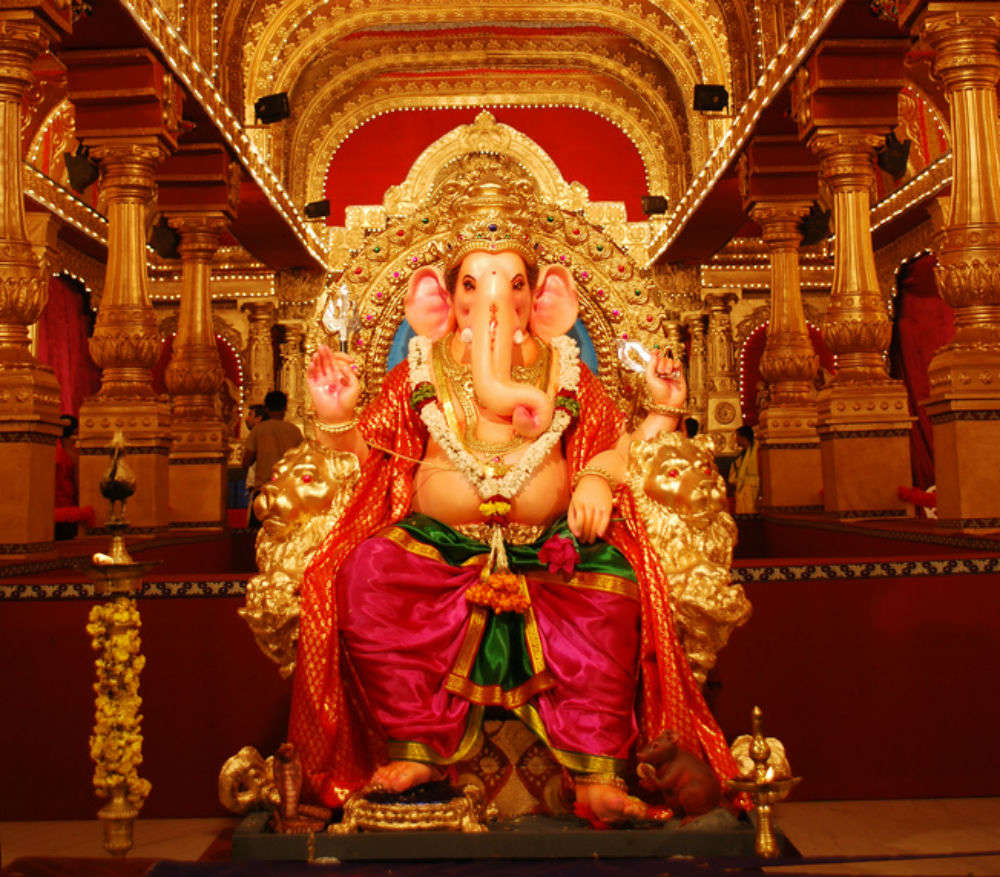
Lord Ganesha is a universal favourite, even among those who don’t follow the Vedic tradition. His rotund figure, his elephant head with big ears, tusks, long trunk and cheerful disposition makes him a very lovable deity.

Lord Ganesha, pictured with his Mother Parvati Devi, and Father Lord Shiva.

Lord Ganesha, pictured with his Mother Parvati Devi, and Father Lord Shiva.

Lord Ganesha is the son of Mother Parvati and Lord Shiva, who are practically the parents of the material world. He is a very special deity, in charge of elimination of obstacles. Obstacles may be in many forms, and he is tasked with the service of removing them. And this is how Lord Ganesha is empowered…

yat-pāda-pallava-yugaṁ vinidhāya kumbha-
dvandve praṇāma-samaye sa gaṇādhirājaḥ
vighnān vihantum alam asya jagat-trayasya
govindam ādi-puruṣaṁ tam ahaṁ bhajāmi

Synonyms
yat — whose; pāda-pallava — lotus feet; yugam — two; vinidhāya — having held; kumbha-dvandve — upon the pair of tumuli; praṇāma-samaye — at the time of offering obeisances; saḥ — he; gaṇa-adhirājaḥ — Gaṇeśa; vighnān — obstacles; vihantum — to destroy; alam — capable; asya — of these; jagat-trayasya — three worlds; govindam — Govinda; ādi-puruṣam — the original person; tam — Him; aham — I; bhajāmi — worship.

Translation
I adore the primeval Lord Govinda, whose lotus feet are always held by Gaṇeśa upon the pair of tumuli protruding from his elephant head in order to obtain power for his function of destroying all the obstacles on the path of progress of the three worlds.

Śrī brahma-saṁhitā 5.50

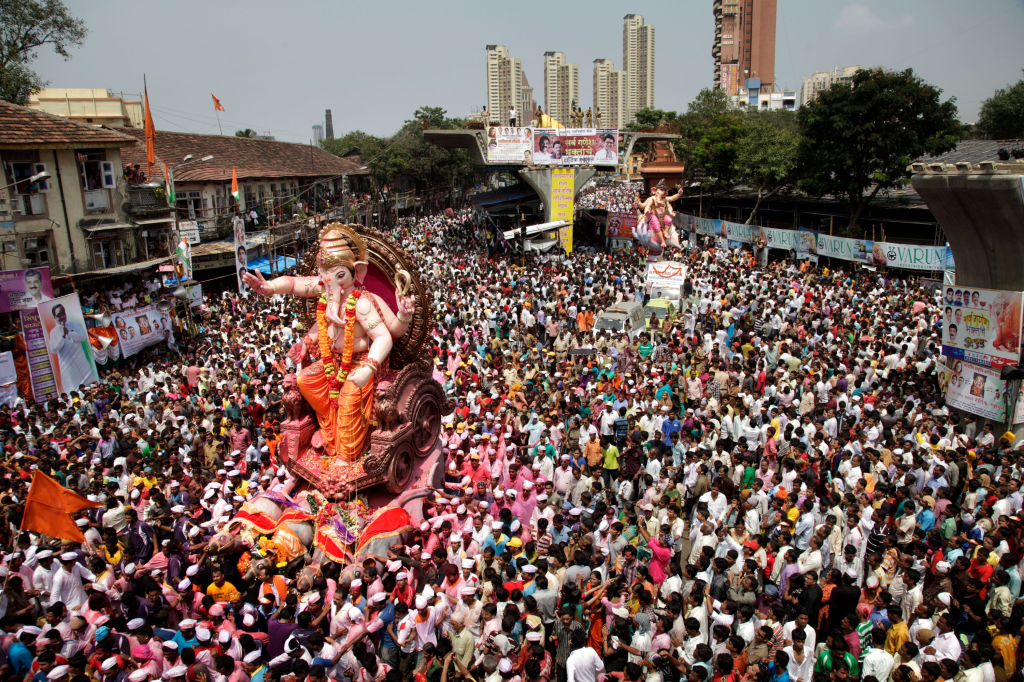
There are very grand celebrations all over… attracting millions of souls. The opulence of these celebrations is hard to describe in words.

A temporary Opulent Ganesh Pandal setup in India.

A temporary Opulent Ganesh Pandal setup in India.

Many souls undergo tremendous austerities and penances during this festival, which can span from 1 to 12 days. In return for these efforts, they ask for blessings which are often granted, depending on whether a person deserves those or not.

However, most of these blessings are temporary, like someone asking for more money, offspring, a better home, health, and so on…

Lord Ganesha accompanied by thousands of devotees, in procession

Lord Ganesha accompanied by thousands of devotees, in procession

However, many of the “worshipers” also degrade themselves by indulging in low class activities like materialistic movie songs, partaking of meat, and intoxicants like tobacco, alcohol, and in these modern days, even hard drugs.

Then, in that intoxicated state, they dance for hours and hours, part of long processions.

What really saddens me though, is that most people don’t realize that the greatest blessing of Lord Ganesha are contained within the great magnum opus Mahabharata, as the 700-verse Bhagavad Gita.

Veda Vyasa recited the Mahabharata, all of 100,000 verses, and Lord Ganesha acted as His scribe… and in this way, the treatise became available to us, unfortunate conditioned souls.

Veda Vyasa Recites the Mahabharata, containing the Bhagavad Gita and Lord Ganesha serves as the scribe.

Veda Vyasa Recites the Mahabharata, containing the Bhagavad Gita and Lord Ganesha serves as the scribe.

Within those 700 verses, one can learn about:

  • One’s own spiritual identity
  • The purpose of human life
  • The cause of one’s material bondage in the cycle of birth, death, old age, disease
  • The identity of the Supreme Absolute Truth, Krishna
  • One’s relationship with Krishna, and
  • The way to end this material tribulation once and for all

In fact, the Bhagavad Gita covers these main topics, covered in my Introduction to Bhagavad Gita series of classes, contact me to join:

  • Jiva – the spirit soul
  • Karma – the cycle of action and reaction
  • Prakriti – this material nature we currently inhabit
  • Kala – The Time Factor that moves everything
  • Bhagavan – the Supreme Absolute Truth, Krishna

Anyone who carefully studies and acts on the instructions of the Bhagavad Gita will not have any more obstacles… not just temporarily, but for all of eternity!

मत्कर्मकृन्मत्परमो मद्भ‍क्त: सङ्गवर्जित: ।
निर्वैर: सर्वभूतेषु य: स मामेति पाण्डव ॥ ५५ ॥

mat-karma-kṛn mat-paramo
mad-bhaktaḥ saṅga-varjitaḥ
nirvairaḥ sarva-bhūteṣu
yaḥ sa mām eti pāṇḍava

My dear Arjuna, he who engages in My pure devotional service, free from the contaminations of fruitive activities and mental speculation, he who works for Me, who makes Me the supreme goal of his life, and who is friendly to every living being – he certainly comes to Me.

Bg. 11.55

As I pass by the various installations of Lord Ganesha during my travels in the Holy Land of India, what I will be praying for? That all the obstacles in my pathway to understanding the Bhagavad Gita may be removed, and that I may serve Lord Ganesha in propagating the Bhagavad Gita all over the world, in every town and village.

What will you pray for?

Is Vedic geography and Cosmology limited to India alone?

Do the Vedic texts only refer to India? Is the Vedic view that the earth is flat? What is the truth here?

Manoj Tripathi, 19 May 2016

Hare Krishna dear devotees.

Please accept my humble obeisances.

I was reading the Mahabharata translation by Krsna Dharma prabhu, wherein there are references to several places on this earth. The most interesting ones are mentioned in the portions describing the Rajasuya and Ashwamedha yagyas which Maharaja Yudhishthira performed.

All the places mentioned in these parts of the text seem to be in or around India. Also, it is never mentioned that they crossed the ocean to go to some other place like present Australia or the USA. 

The questions that arise are following:

a. Were there no powerful kingdoms in other parts of the world; or were the capitals of all the kingdoms located in and around India?

b. Are many of the routes and places which were accessible to people in those times not visible to us now?

I reconcile the present and past with these two arguments. Is there anything else that should be understood while reading about the past?

Sorry if I have posted something irrelevant.

Thank you.

Manoj

Mahabhagavat Das SDA, 19 May 2016

Dear Manoj,

Hare Krishna!

Please accept my humble obeisances.

All glories to Srila Gurudeva.

All glories to Srila Prabhupada.

Yes, Krishna Dharma Prabhu is in disciplic succession from Srila Prabhupada and his translation is relied upon by many devotees within ISKCON.

What is missing in that edition of the Mahabharata is purports as found in Srila Prabhupada’s books to give us full context of the verses (our context is very different today)… but then the work would become really massive because with Srila Prabhupada’s Srimad Bhagavatam purports, with 18,000 verses it comes to 18 volumes of books… the Mahabharata has 100,000 verses! 🙂 How many of us have read even Srila Prabhupada’s books thoroughly?

On this topic of reconciling things as they appear today vs. Vedic history, a great reference is Devamrita Swami Maharaja’s “Searching for Vedic India“.

The main point is that human civilization is a devolution from Vedic civilization, things were not more primitive 5000 years as claimed by modern historians and scientists ago but actually more advanced. This cannot be accepted by a person who is proud.

In one lecture by Srila Prabhupada, on the verse BG 1.5, Srila Prabhupada says this:

“Practically in the Battle of Kuruksetra great personalities, warriors, from all parts of the world they came and joined. Some of them joined with this party and others joined with the other party. So far we have studied… just like Saibya, he belonged to Sibya. So all these personalities, we did not get their full description, it would enhance the pages. But these big personalities, we have got their information. There is a book, The Personalities of Mahabharata. Bhagavad-gita is part of Mahabharata. Mahabharata means greater India. Maha means greater, and bharata means India. So this whole planet was Bharata-varsa. There was only one flag. The whole planet was being ruled by one king. That is the king of this Hastinapura. The fight is that, that who would be the king, Maharaja Yudhisthira or Duryodhana. But a king… It is not a democratic; it is monarchy. So Krsna is deciding, “No, Duryodhana is unfit. Maharaja Yudhisthira is fit.” This is Krsna’s desire. Therefore this fight is there. Kuruksetra. Krsna wanted to wipe out all unwanted demons from the face of the world and enthrone Maharaja Yudhisthira because he is the exact representative of Krsna.” (Srila Prabhupada Lecture, “Everything (Even Dictatorship) Can Be Utilized for Krishna” 73/07/10 London, Bhagavad-gita 1.4-5)

So, the situation was that there were kings all over the world, but there were greater kings and lesser kings. And this was a war of the advanced Kshatriya races, the tribals, low-class humans, and animal-like-humans were not involved in it. In the Ashwamedha yajna, or declaration of supremacy, it was only necessary to get allegiance from the greater kings, the subordinates were naturally bound to follow suit. And of course, less advanced humans didn’t even figure in the equation.

Even in more modern times, it was like that with the Greek or Roman empire, if someone destroyed Athens or Rome, then the entire empire was practically gone.

Also, travel was not necessarily done as it is done today – for example, in the Mahabharata it is mentioned that Arjuna travelled to the heavenly planets. Where is the transportation means today that can take someone to the heavenly planets? So yes, the means of transportation as it existed then is not known today.

The secret is mantra yoga, by proper chanting of a mantra, one can achieve any desired success, whether material or spiritual, it is not necessary to make a tunnel to go through a mountain, it is not necessary to construct a floating ship to go over water, and it is not necessary to construct a metal tube with Bernoulli’s principle to fly in the air. The mantra is very powerful.

However, in the Krishna consciousness movement, we are not interested in discovering processes of material accomplishments, we simply want to chant

Hare Krishna Hare Krishna

Krishna Krishna Hare Hare

Hare Rama Hare Rama

Rama Rama Hare Hare

The Hare Krishna Maha Mantra

and become pure servants of the servants of the devotees of Krishna.

So therefore, we don’t always focus so much on the exact reconciliation of modern understanding with what is mentioned in the Vedic literature, we are going for the highest success, we don’t care to fly in a celestial flying craft or manufacture gold from chanting mantras etc.

Does this make sense?

Sincerely,

Mahabhagvat das

Manoj Tripathi, 19 May 2016

Thank you Mahabhagvata Prabhu for such a lucid answer.

These kinds of questions automatically come to mind, however upon thinking a little more I realize that there is no end to such inquiries.

Thank you so much for bringing me back.

Hare Krishna!

Sincerely,

Manoj

Kaspars, 02 June 2016

Hare Krishna!

Please accept my humble obeisances.

All glories to Srila Prabhupada.

Is the planet Earth considered circular or flat in Vedic literature? One local devotee answered to me like this. Advanced people see more dimensions, not our three… It is length, width, height. So we cannot even imagine how Earth looks in other dimensions. Still I am curious whether the Earth was considered flat by ancient people. And how then we get the circular globe.

Kaspars

Mahabhagavat Das SDA, 2 June 2016

Dear Kaspars,

Hare Krishna!

The 5th Canto of Srimad Bhagavatam gives a good idea of the structure of the Universe. See https://vedabase.io/en/library/sb/5/, especially SB 5.16 onwards.

The Vedic cosmology goes beyond our insignificant planet. The “earth” is actually a large collection of “earthly” planets (islands) that are arranged to form something that looks like a disc. So yes, the “earth” is flat, but only when you consider that “earth” means “earthly planetary system with many many planets such as ours”.

Also, this is a video especially for you, this is a simulation of the  chandelier that will be inside the TOVP dome, it gives a good idea of Vedic cosmology according to Srimad Bhagavatam 5th Canto… https://www.youtube.com/watch?v=zdX5lffC2IQ

All these things are difficult to fully understand, imagine an ant trying to understand the plan of a big city, it is practically impossible.

Sincerely,

Mahabhagavat Das

Please subscribe to daily inspirational emails from His Grace Sriman Sankarshan Das Adhikari (Writings and lectures archived at www.ecstaticmedia.com ), written fresh every day from his travels around the world sharing the highest spiritual knowledge with everyone. Sign up now at www.joincourse.com

The Lure of the Gamble

The lure of the gamble is strong. But ordinary gambling destroys consciousness. There is, however, one type of gamble that brings unlimited rewards…

Far too often, the lure of the gamble can draw someone in. Fast breaths, quickened pulse, have I lost, have I won? Ah the fear, the excitement, the tension, the suspense!

It could be a “harmless” little lottery ticket, or that lucky draw, or more serious, an actual gambling addiction.

Some professions, such as speculative trading on the markets, are also gambling.

In the famous Mahabharata, a gambling match was the genesis of the world war war that led to destruction of the entire clan and millions of soldiers.

In fact, gambling is really cheating. What is the logic or fairness behind a few people each giving some money to one person unnecessarily? There should be an exchange of value, at minimum – what value do I provide to someone when I roll the dice and win? What value to I derive when someone else wins at gambling?

And it is even worse when there’s a middleman involved, like a casino or a club. Then you can be sure there is no fairness, “the house always wins”.

But of course, even if mathematically, by the law of large numbers, one can be confident that the roll of a fair dice may be seen as random, up against a cheat, that is surely a match impossible to win.

द्यूतं छलयतामस्मि dyūtaṁ chalayatām asmi

I am also the gambling of cheats

There are many kinds of cheaters all over the universe. Of all cheating processes, gambling stands supreme and therefore represents Kṛṣṇa. As the Supreme, Kṛṣṇa can be more deceitful than any mere man. If Kṛṣṇa chooses to deceive a person, no one can surpass Him in His deceit. His greatness is not simply one-sided – it is all-sided

https://vedabase.io/en/library/bg/10/36/

Some ask “so, if I invest on the stock-market, is that gambling”, I respond “check your pulse, if your pulse has quickened, then it is”.

Spiritual life entails giving up the lure of the gamble.

But there is one type of gamble that is most adventure…

द्यूतं छलयतामस्मि तेजस्तेजस्विनामहम् ।
जयोऽस्मि व्यवसायोऽस्मि सत्त्वं सत्त्ववतामहम् ॥ ३६ ॥ dyūtaṁ chalayatām asmi
tejas tejasvinām aham
jayo ’smi vyavasāyo ’smi
sattvaṁ sattvavatām aham

I am also the gambling of cheats, and of the splendid I am the splendor. I am victory, I am adventure, and I am the strength of the strong.

https://vedabase.io/en/library/bg/10/36/

Whatever you may be able to accomplish, you can never cheat God. To a person who does not strive to meet God when alive, God meets them in the form of death. And everyone eventually finds out that life is all too short.

Don’t waste your time doing the little stuff. If you do want to gamble, go on, yes you do, then give your life to God. Life is an unlimited thrilling adventure at every moment, you will never know what’s coming at you the next moment. Try it.

How is Parashuram in both Ramayana and Mahabharata?

How is it that Parasurama is both in the Ramayana and the Mahabharata?

Meenakshi, 22nd November 2013

Hare Krishna,

Please accept my humble obeisances
All glories to Srila Prabhupada.

Ramayan dates back to Treta yuga (editor:over 2 million years ago) and Mahabharat dates to Dwapar yuga (editor:5000 years ago)…but in both there is mention of Parashuram…so what’s the time lag between Ramayan and Mahabharat and what’s age of Parashuram…to be part of both?

your humble servant
Meenakshi

Rathin Mandal, 23rd November 2013

Hare Krishna Mataji,

Please accept my humble obeisances,
All glories to Srila Gurudeva and Srimati Gurumataji,

All glories to Srila Prabhupada.

I can attempt to give the answer to first part of the question.
The four yugas make up a cycle which lasts 4,320,000 years. The duration of each yuga is:
SATYA YUGA:     1,728,000 years
TRETA YUGA:        1,296,000 years
DVAPARA YUGA:    864,000 years
KALI YUGA:        432,000 years

Mahabharata was towards the end of Dvapara yuga. So according to earthly time, Paraśurāma has a very long life.

But Lord Brahma’s one day is of 4,300,000,000 years, so the yuga time periods are very small compared to one day of Lord Brahma.

your Servant
Rathin

Mahabhagavat Das SDA, 23rd November 2013

Hare Krishna Mataji,

Please kindly accept my humble obeisances.
All glories to Srila Gurudeva.
All glories to Srila Prabhupada.

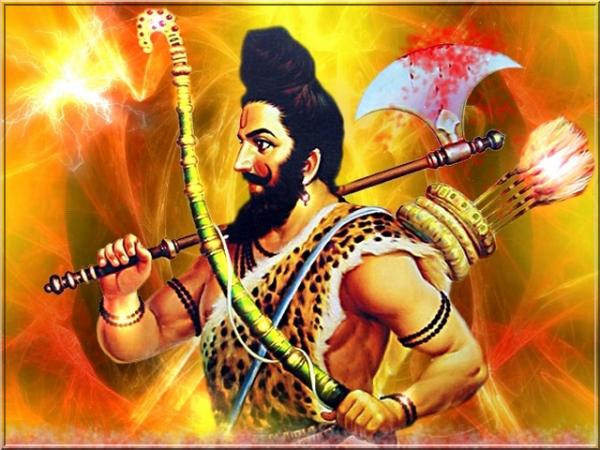
Also, Lord Parashurama is a shaktyavesha avataar, an empowered incarnation of Krishna who appears in the material world for a specific reason, so there is no ordinary limitation of birth, death, old age, and disease for Him.

Sincerely,
Mahabhagavat Das

Harish, 23rd November 2013

Hare Krsna !
Rathin Prabhu due to oversight has written “The four yugas make up a cycle which lasts 4,320,000 years.” But then he had classified the yugas properly.

Not only Lord Parshuram, but also devotee of Lord Rama – Jambavanta, the king of bears appears in both the yugas.

thank you.

your servant,

Mahabhagavat Das SDA, 25th November 2013

Yes, I missed that myself also. One thousand cycles of 4 yugas (1000 X 4.32 million years) make up one day of Brahma, and Lord Brahma’s one night is equal to the same period.
Please subscribe to daily inspirational emails from His Grace Sriman Sankarshan Das Adhikari (Writings and lectures archived at sda-archives.com), written fresh every day from his travels around the world sharing the highest spiritual knowledge with everyone. Sign up now at www.backtohome.com

What is the signficance of Hanuman’s presence on Arjuna’s chariot?

Rathin Mandal, 03rd April 2013

Hare Krishna,

Please accept my humble obeisances,
All glories to Srila Gurudeva and Srimati Gurumata,
All glories to Srila Prabhupada.

In Krishna book, chapter 58, describing the great war of Kurukshetra, it says that: “Both of them sat down on Arjuna’s chariot, which flew a flag with a picture of Hanumān. Arjuna’s special chariot is always marked with the picture of Hanumān, and therefore he is also named Kapidhvaja.”
I have couple of questions :

What is the pastime for having flag emblemed with Hanumanji on chariot of Arjuna? While as in Mahabharat serial it was shown that mostly warriors used to have flags emblemed with Suryadev (Sun).

Another reason for this question is that there is a very popular belief that because Arjuna had flag of Hanumanji on his chariot, he was protected by Hanumanji. Even I used to believe in this previously. But now I understand that when Supreme Personality of Godhead Sri Krishna is himself with Arjuna then Arjuna already has all the protection.
Is there any other pastime related here which got perverted with time?

your Servant
Rathin

Bhakta Sunil, 03rd April 2013

Hare Krishna Rathin Prabhu ji

Please accept my humble obeisances
All Glories to Srila Prabhupada

I read your question and was reminded of few lines which I had read

I searched and found few results and am pasting a search result which I think you would find relevant to your question :

TEXT 20:
atha vyavasthitan drishtva
dhartarashtran kapi-dhvajah
pravritte sastra-sampate
dhanur udyamya pandavah
hrishikesam tada vakyam
idam aha mahi-pate

TRANSLATION:
At that time Arjuna, the son of Pandu, seated in the chariot bearing the flag marked with Hanuman, took up his bow and prepared to shoot his arrows. O King, after looking at the sons of Dhritarashtra drawn in military array, Arjunathen spoke to Lord Krishna these words.

PURPORT:
The battle was just about to begin. It is understood from the above statement that the sons of Dhritarashtra were more or less disheartened by the unexpected arrangement of military force by the Pandavas, who were guided by the direct instructions of Lord Krishna on the battlefield. The emblem of Hanuman on the flag of Arjuna is another sign of victory because Hanuman cooperated with Lord Rama in the battle between Rama and Ravana, and Lord Rama emerged victorious. Now both Rama and Hanuman were present on the chariot of Arjuna to help him. Lord Krishna is Rama Himself, and wherever Lord Rama is, His eternal servitor Hanuman and His eternal consort Sita, the goddess of fortune, are present. Therefore, Arjuna had no cause to fear any enemies whatsoever. And above all, the Lord of the senses, Lord Krishna, was personally present to give him direction. Thus, all good counsel was available to Arjuna in the matter of executing the battle. In such auspicious conditions, arranged by the Lord for His eternal devotee, lay the signs of assured victory.
Regards,
Sunil
Mahabhagavat Das SDA, 04th April 2013

Dear Rathin Mandal,

Yes, it is correct that the chariot was protected by Sri Hanuman who is an eternal servitor of Lord Sri Krishna in His form as Lord Sri Ramachandra, this is mentioned in Srimad Bhagavatam and Mahabharata even before the war of Kurukshetra.

The makers of television serials are certainly influential, but are not authorities. For example, in one television serial I saw as a child, the actors playing the role of Brahmanas performing auspicious yajnas all had their sacred thread on the right shoulder going down to left side of waist (usually done only for certain duties considered inauspicious). It is sometimes quite unnerving to see the shortcuts etc., because they did not take advice and guidance of bona fide spiritual master. Still, some information is passed, on, but also much misinformation.

Re how it is that Hanuman appeared on the flag, there is a nice pastime of Krishna, but it might be too detailed for this international group of students. So contact me offline for that 🙂

Sincerely,
Mahabhagavat Das
Rathin Mandal, 04th April 2013

Hare Krishna,

Please accept my humble obeisances,
All glories to Srila Gurudeva and Srimati Gurumata,
All glories to Srila Prabhupada.

Thank you very much Sunil Prabhu and Mahabhagavat Prabhu for the answers.
This helps me to understand the meaning better.

your Servant
Rathin
Please subscribe to daily inspirational emails from His Grace Sriman Sankarshan Das Adhikari (Writings and lectures archived at sda-archives.com), written fresh every day from his travels around the world sharing the highest spiritual knowledge with everyone. Sign up now at www.backtohome.com