
Have you ever seen an animal that is about to be slaughtered? In the modern world, that includes most chickens, goats, sheep, pigs, cows, fish, and buffaloes.

These sheep are being led to slaughter
Animals cannot see their impending doom
I have spent much time in the South Indian City of Hyderabad. This city has a large Muslim population. The Muslims celebrate a festival called Bakri-eid, when many Muslims sacrifice a goat to Allah. It is a common sight to see a Muslim man leading a goat somewhere just before Eid, or even on the day of.

As a child, I was tempted to innocently call out to the goat “run away goat, run away, you are about to be slaughtered”. But no, neither do I have the power to make a goat understand that his life is in danger, nor does the goat have the intelligence to understand his fate.
Even right before being slaughtered, the animal can be seen calmly gobbling up grass here and there, oblivious.

We can extrapolate… think about the animals being transferred in trains or trucks from one place to another. They are all going to be slaughtered, sooner or later.

What about us? Can we see our own sufferings?
As we go about the world, we see so many suffering souls. Some are hungry, some others are unclothed, hot, or cold… yet others are diseased. And everyone is striving, struggling, to solve these problems of life, food, shelter, and clothing, medical treatment, and so on.

It is of course, natural for a human being or an animal to mitigate an immediate danger. For example, once an animal senses that someone is causing it harm, for example the pain of a hook in it’s mouth, or a botched attempt at slaughter, it will flap about, bleat, moo, or make some other frantic sounds, maybe try to fight it’s attacker, and even try to run away, but alas, by then it is usually too late.

Similarly, we see human beings trying to mitigate their sufferings in so many ways.
But do they really recognize the actual cause of their suffering?

Does that woman who is being wooed ardently by that handsome, passionate, suave, smooth-talking man realize that once the man has had his fill of sensual gratification, she will be left behind after an “it’s not you, it’s me conversation.”?

Does that hard-working employee staying late and working long hours realize that a business change means he is to be on the next list of employees to be laid off due to a “Reduction in Force” or “Headcount cut” or “Re-organization”?

Does that person suffering poverty, pestilence, or war realize that they have created their own situation with their own past actions?
तत्तेऽनुकम्पां सुसमीक्षमाणो
भुञ्जान एवात्मकृतं विपाकम् ।
हृद्वाग्वपुर्भिर्विदधन्नमस्ते
जीवेत यो मुक्तिपदे स दायभाक् ॥ ८ ॥tat te ’nukampāṁ su-samīkṣamāṇo
bhuñjāna evātma-kṛtaṁ vipākam
hṛd-vāg-vapurbhir vidadhan namas te
jīveta yo mukti-pade sa dāya-bhākMy dear Lord, one who earnestly waits for You to bestow Your causeless mercy upon him, all the while patiently suffering the reactions of his past misdeeds and offering You respectful obeisances with his heart, words and body, is surely eligible for liberation, for it has become his rightful claim.

How can we help everyone understand how to end this cycle of suffering?
Sometimes, not being satisfied with trying to please the senses, an intellectual may, instead, choose to live within the mind, for example in the realm of art, literature, poetry, scientific or mathematical endeavours, maybe even philosophy and speculation about God?

Does the frustrated intellectual, who has given up on gross materialistic gratification and is now involved in trying to satisfy the mind realize that he’s only headed towards insanity?

Neither the mind, nor the senses can ever be satisfied, as much as a fire can never be extinguished by giving it more fuel.
lust cannot be satisfied by any amount of sense enjoyment, just as fire is never extinguished by a constant supply of fuel. In the material world, the center of all activities is sex, and thus this material world is called maithunya-āgāra, or the shackles of sex life. In the ordinary prison house, criminals are kept within bars; similarly, the criminals who are disobedient to the laws of the Lord are shackled by sex life.

We try and we try and we try to help everyone understand that they are not their mind, that they are not this body, not the senses… we try and try to help them understand that actually they are the spirit soul.
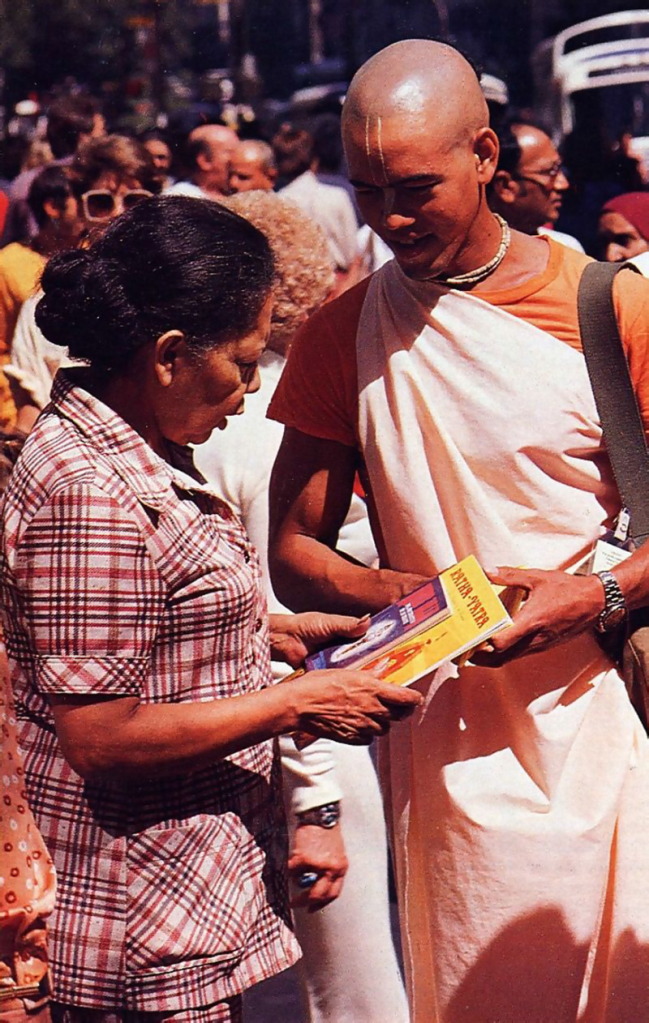
But unfortunately, most of the souls we come in contact with are not interested. They are content to pursue that next gourmet meal, that next sensual experience, that holiday, that next acquisition, be it a house or a car or some other shiny object. They are content to chase job after job, climbing the ladder to nowhere (more on that another time).
What do we call such a soul, even if in a human body?

We call such a person an animal in human form. You may be shocked at this. How dare I call a human being an animal? How arrogant and conceited of me! What sort of spiritualist am I, this Das?
यस्यात्मबुद्धि: कुणपे त्रिधातुके
स्वधी: कलत्रादिषु भौम इज्यधी: ।
यत्तीर्थबुद्धि: सलिले न कर्हिचि-
ज्जनेष्वभिज्ञेषु स एव गोखर: ॥ १३ ॥
yasyātma-buddhiḥ kuṇape tri-dhātuke
sva-dhīḥ kalatrādiṣu bhauma ijya-dhīḥ
yat-tīrtha-buddhiḥ salile na karhicij
janeṣv abhijñeṣu sa eva go-kharaḥOne who identifies his self as the inert body composed of mucus, bile and air, who assumes his wife and family are permanently his own, who thinks an earthen image or the land of his birth is worshipable, or who sees a place of pilgrimage as merely the water there, but who never identifies himself with, feels kinship with, worships or even visits those who are wise in spiritual truth — such a person is no better than a cow or an ass.
My dear reader, please understand that a spiritualist is just like an honest doctor. An honest doctor is not afraid to observe carefully and make the right diagnosis. From the doctor’s diagnosis comes a treatment plan, including diet, rest, exercise, and medicine. And from this comes a prognosis, some hope of hope, possibly.
But a doctor who sweeps the symptoms under a rug and pretends everything is just fine, is no doctor. Such a “doctor” is really an enemy in disguise.

And therefore, out of abundant compassion, we call such a human an animal. So that we may develop even more patience and compassion. After all, there is no point being too harsh with an animal or a child. We then try to coax and cajole and convince in this way or in that way.
Physician Heal Thyself
First things first. As a spiritualist, I seek to spot the times when I myself behave as if I were my mind or my body. And I strive to disassociate myself, my self interest from the urges of the body or the mind. If I can be honest with myself, then I will have a deep sense of humility and understanding as to why this is so difficult for me. My conditioning in the material world makes it extremely difficult, and I have been trying for decades!
So, what should I do? First and foremost, look in the mirror and be honest with myself at all times, places, and circumstances.

I cannot be like this kitten here!
Compassion and Equal Vision!
Just as we need to see ourselves and where we are, we need to see everyone with an equal vision, and understand that every spirit soul is precious!
Not all souls can be served in the same way… I cannot discuss philosophy with a dog, nor can I get a pig to appreciate delicious food.
विद्याविनयसम्पन्ने ब्राह्मणे गवि हस्तिनि ।
शुनि चैव श्वपाके च पण्डिता: समदर्शिन: ॥ १८ ॥vidyā-vinaya-sampanne
brāhmaṇe gavi hastini
śuni caiva śva-pāke ca
paṇḍitāḥ sama-darśinaḥThe humble sages, by virtue of true knowledge, see with equal vision a learned and gentle brāhmaṇa, a cow, an elephant, a dog and a dog-eater [outcaste].
For 99% of the population, we just try to engage in the chanting of God’s names. We give them Krishna Prasada, sanctified food, which has been lovingly cooked for and offered to Krishna. We then drip in a little bit of the medicine of the philosophy, you are not this body, you are not this mind, you are a spirit soul.

And so the effort continues, many, many spiritual warriors trying to save one soul, lifetime after lifetime, in a concerted harmonious effort.
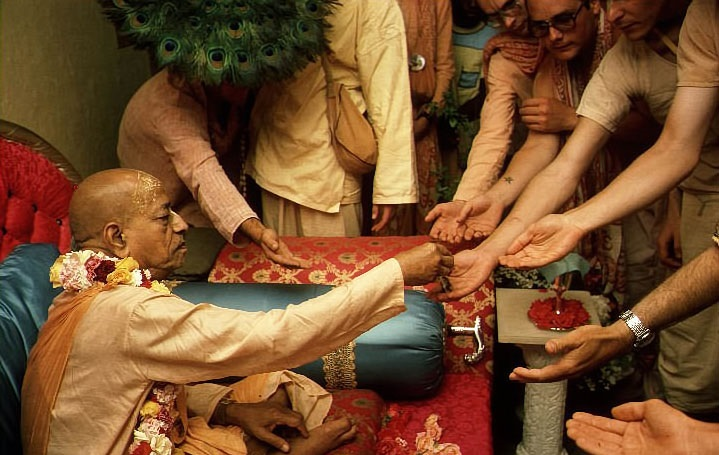
My dear soul, please help us with this greatest of all causes, please do your bit for yourself, and then turn to serve others and help them get on and stay on a spiritual journey. Hare Krishna!





 Freedom through Genuine Spiritual Progress