Why the different deities have different roles? Aren’t they all one- svayam bhagwan krsna? Is Gopinath vigraha superior to all deities?
“Śrīla Sanātana Gosvāmī is the ideal spiritual master, for he delivers one the shelter of the lotus feet of Madana-mohana. Even though one may be unable to travel on the field of Vṛndāvana due to forgetfulness of his relationship with the Supreme Personality of Godhead, he can get an adequate opportunity to stay in Vṛndāvana and derive all spiritual benefits by the mercy of Sanātana Gosvāmī. Śrī Govindajī acts exactly like the śikṣā-guru (instructing spiritual master) by teaching Arjuna the Bhagavad-gītā. He is the original preceptor, for He gives us instructions and an opportunity to serve Him. The initiating spiritual master is a personal manifestation of Śrīla Madana-mohana vigraha, whereas the instructing spiritual master is a personal representative of Śrīla Govindadeva vigraha. Both of these Deities are worshiped at Vṛndāvana. Śrīla Gopīnātha is the ultimate attraction in spiritual realization.”
Answer:
Yes, Krishna is one. Just like a multi-faceted diamond shines in different colours, similarly Krishna manifests differently according to the need and desire of the devotee…
Take for example, a man… in the business world he may be called as “Mr. Rana”, by his friends as “Arpit”, by his wife as “honey” by his juniors as “sir”, by his friends as “Arpi”, by his kids as “dad”… and so on. It is not that the person is different, he is the same person, but manifesting differently to different people… he’s doing business in one place, obeying instructions in another place, and so on…
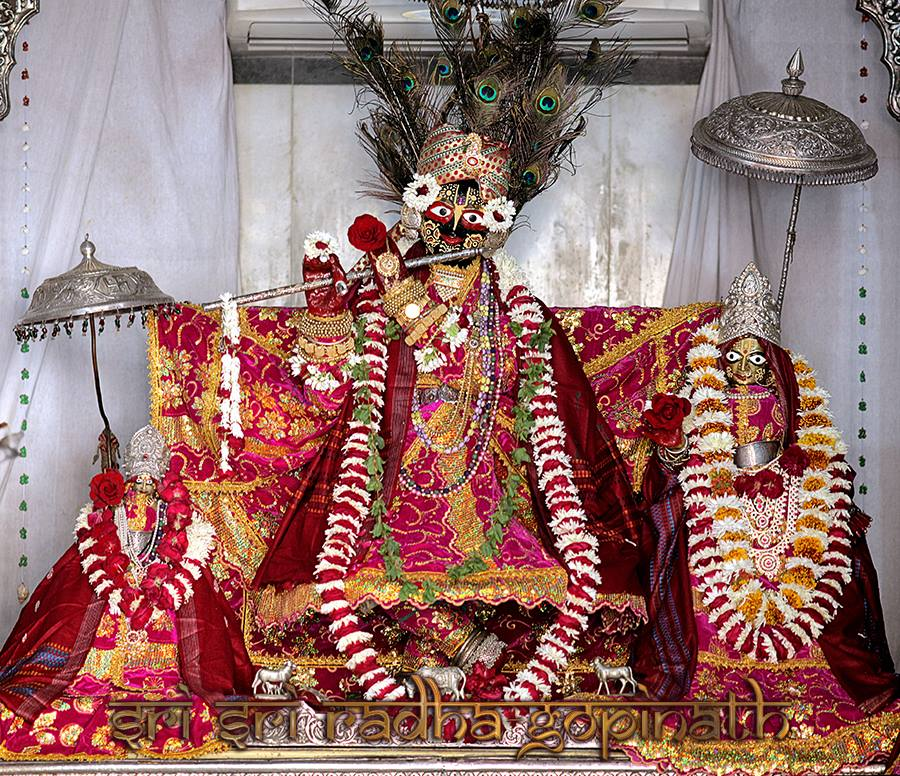
For example, we have Sri Radha Khirchor Gopinath on the altar, but to the person who is an atheist They manifest as a statue, to a person fearful of his mistakes, They appear as the Lawgivers… to a person in the mood of awe and reverence or not yet pure devotee… as Sri Lakshmi Narayana, in Their opulence etc.
What to speak of the deity… even Krishna will manifest Himself as the ishta deva of His devotee… for example to Murari Gupta, Chaitanya Mahaprabhu manifested as Lord Ramachandra as Murari Gupta is an incarnation of Hanuman… to one devotee as Varahadeva, to another as Narasimhadeva… when Krishna disappeared during the Rasa Lila, He tried to conceal Himself by appearing as Four-handed Narayana… but the Gopis’ love was so intense he couldn’t contain himself and appeared as Shyamasundar Krishna!
You will find many such instructions in the scriptures.
Please continue reading scrutinizingly and in a prayerful mood… does this help? Are there any other questions?
Lord Chaitanya Instructs Sanatana Goswami
Sri Radha Madana-Mohana, now in Karauli, Rajasthan, India
Sri Radha Govindaji, now in Jaipur, Rajasthan, India
Sri Radha Gopinath, now in Jaipur, Rajasthan, India
Many spiritualists fast. Especially Vaishnavas on Ekadasi day… but Ekadasi is meant for feasting. So how is it that someone can be simultaneously fasting and feasting at the same time?
In most religious traditions, there is a concept of fasting… whether it is fasting from vice, or fasting from food and water… For example, the Christians fast for 40 days during Lent. Muslims fast for a month during Ramadan/Ramzan… and many other traditions have similar fasts.
In the Vaishnava tradition which I practice, we fast once approximately every 14 days, on a day called Ekadasi or Ekadashi. Usually this is the eleventh day of the waxing or waning moon. Usually, because there are some details when the fasting is a day later, but we won’t get into all that right now.
However, some advanced Vaishnavas say that Ekadashi is meant to be a day of feasting, not fasting.
But…
One should fast on the two Ekādaśī days, which fall on the eleventh day of the waxing and waning moon, and on the birthdays of Lord Kṛṣṇa, Lord Rāma and Caitanya Mahāprabhu. There are many such fasting days.
If Vaishnavas are fasting from grains, beans, and in some cases from all food, and from all water too for some… then what are they feasting on?
Well, new practitioners may find it hard to fast from food, being how intricately attached we are to our bodies, minds, and serving them constantly. For such Vaishnavas, it is advised that they can eat as much as they need to, except no grains and beans… and all that they eat must be first offered to Krishna. This helps them regulate their senses at least on that level.
But many Vaishnavas often fast from much more than just grains and beans, so how is it that they can feast?
Let us take the example of Rupa Goswami and Sanatana Goswami, great Goswamis of Vrindavan… they had obtained exalted birth, a very sharp intelligence and tremendous knowledge, and were serving as the ministers of the Nawab of Bengal. Rupa Goswami’s life savings in gold coins filled up an entire boat with gold!
But these same two brothers, when in Vrindavan, had no fixed residence, spending each night under a different tree, with barely enough clothing to cover themselves, and austere food, spent all their time hearing and chanting about Krishna. How could they do that?
I offer my respectful obeisances unto the six Gosvamis, namely Sri Rupa Gosvami, Sri Sanatana Gosvami, Sri Raghunatha Bhatta Gosvami, Sri Raghunatha dasa Gosvami, Sri Jiva Gosvami, and Sri Gopala Bhatta Gosvami, who kicked off all association of aristocracy as insignificant. In order to deliver the poor conditioned souls, they accepted loincloths, treating themselves as mendicants, but they are always merged in the ecstatic ocean of the gopis’ love for Krishna and bathe always and repeatedly in the waves of that ocean.
How is it possible for such persons accustomed to royal pleasures to give them up?
It understand by spiritualists that the objects of the senses, the experiences we chase, the possessions we crave, the sensory satisfaction we seek, are compared to toys and children… the child is attached to the toy, but can be induced to give up the toy if offered a higher and better experience.
What could be a higher and better experience than all the pleasures of material life? Especially, how can one give up that most basic of bodily needs – food?
What does food do for us?
Food satisfies the tongue – this hankering of the tongue is practically unconquerable, no matter if we need the food or not, the tongue will never say no.
Food nourishes the body – we feel strength from the food.
Food produces renunciation from food – as we get full, we hanker for food less and less.
Devotion, direct experience of the Supreme Lord, and detachment from other things — these three occur simultaneously for one who has taken shelter of the Supreme Personality of Godhead, in the same way that pleasure, nourishment and relief from hunger come simultaneously and increasingly, with each bite, for a person engaged in eating.
So, if someone obtained an experience that fulfilled all three needs – satisifed the tongue, satisfied the bodily need for nourishment, and produced renunciation from the hankering for food, then that experience can replace food!
“I do not know how much nectar the two syllables ‘Kṛṣ-ṇa’ have produced. When the holy name of Kṛṣṇa is chanted, it appears to dance within the mouth. We then desire many, many mouths. When that name enters the holes of the ears, we desire many millions of ears. And when the holy name dances in the courtyard of the heart, it conquers the activities of the mind, and therefore all the senses become inert.”
Is it any wonder that if a Vaishnava experiences even a tiny drop of a fraction of the ecstasy that the Holy Name generates, that they can abstain from food?
So should the rest of us go and imitate these Vaishnavas and fast from food and water willy nilly, even if the body is hurting?
अशास्त्रविहितं घोरं तप्यन्ते ये तपो जना: । दम्भाहङ्कारसंयुक्ता: कामरागबलान्विता: ॥ ५ ॥ कर्षयन्त: शरीरस्थं भूतग्राममचेतस: । मां चैवान्त: शरीरस्थं तान्विद्ध्यासुरनिश्चयान् ॥ ६ ॥
aśāstra-vihitaṁ ghoraṁ tapyante ye tapo janāḥ dambhāhaṅkāra-saṁyuktāḥ kāma-rāga-balānvitāḥ
Those who undergo severe austerities and penances not recommended in the scriptures, performing them out of pride and egoism, who are impelled by lust and attachment, who are foolish and who torture the material elements of the body as well as the Supersoul dwelling within, are to be known as demons.
Of course, advanced Vaishnavas are not masochists or sadists, certainly not demons, and they don’t accept torturing their bodies, even if they have transcended the body… This is because the advanced Vaishnava sees the body as the property of Krishna.
In fact, when an advanced Vaishnava is seen by Krishna to be accepting too much austerity, Krishna gives that person more nourishment and opulence.
But those who always worship Me with exclusive devotion, meditating on My transcendental form – to them I carry what they lack, and I preserve what they have.
So, coming back to our original question… when a Vaishnava fasts, how is it that they are still feasting while fasting?
Simple. They feast on the Holy Name of Krishna
(1) Of sweet things, it’s the sweetest you will taste at any time; Of things that bring good fortune, it’s good fortune’s paradigm; Of things that purify, it purifies most powerf’lly; The Holy Name of Sri Hari is surely all that be. (2) From Brahma’s realm atop the sky down to the lowly grass, Illusion reigns in Maya-devi’s treacherous morass. The truth, the truth, the only truth: the Name of Sri Hari. The Holy Name of Sri Hari is surely all that be. (3) He’s the guru, he’s the father, he’s the friend most true, And she’s the real mother who most kindly teaches you To always chant and hear the Holy Name of Sri Hari. The Holy Name of Sri Hari is surely all that be. (4) Remember that our final breath may come at any time, No matter if we’re old and sick or in our youthful prime. So young and old alike should chant the Name incessantly. The Holy Name of Sri Hari is surely all that be. (5) Lord Sri Hari forever dwells wherever devotees Whose hearts are fixed on Him and free of all impurities Uplift their voices high and sing His Name in ecstasy. The Holy Name of Sri Hari is surely all that be. (6) Alas! What sorrow! What great pain! The worst calamity- For people to forget the Holy Name of Sri Hari! Although the Name’s a priceless gem, mere broken glass they see. The Holy Name of Sri Hari is surely all that be. (7) Just fill your ears, just fill them with the Name of Sri Hari! Just chant the Name, just chant the Name with all sincerity! Just sing the Name, just sing the Holy Name eternally! The Holy Name of Sri Hari is surely all that be. (8) It makes this world appear like bits of straw upon the ground; It splendorously reigns supreme-divinity in sound; It’s filled with transcendental bliss and peerless purity; The Holy Name of Sri Hari is surely all that be. (9) Inspired to glorify the Holy Name of Sri Hari, A certain sage composed this hymn in Sanskrit poetry. I pray that those who read this lowly version made by me Will chant the Holy Name of Sri Hari in ecstasy.




 Freedom through Genuine Spiritual Progress