Understanding Compassion: Actions That Truly Help (Part 2)

Suppose you want to help someone. Very noble! First do no harm. How can you tell if you are helping or hurting? Suppose we want to act with compassion… should we not understand what compassion is first? Here is a discussion about hte complexity of compassion and how well-intentioned actions in passion and ignorance cause harm. Effective compassion must be in the mode of goodness. But charity begins at home. If we are not compassionate with ourselves, we cannot be compassionate towards others. And how to be compassionate with ourselves?

This is part Two of a Series of Articles on Compassion. Part 1 is here. Part 3 is here

Let’s say we do somehow get past the most obvious schadenfreude for others. How to act with compassion?

How do we know if something is helping or hurting?

It is said, first, do no harm.

Take these situations… how would you “help” in these situations?

  • A crying, tantrum-throwing child is being firmly dealt with by a parent
  • A patient is on a very strict diet to allow their quick recovery
  • A homeless substance abuser is begging for money on the street

Would it be “compassion” to intervene in the first example of the child above? Should we stop the parent from being firm? No! The parent knows what the child needs. Maybe the child is hungry, maybe the child is tired and sleepy. The parent is being compassionate with that child, even if it’s not all kisses and hugs!

A child throws a tantrum

There is a second example of a sick friend on a strict diet. The patient asks you to sneak in a rich meal, they want to escape their bland, boring diet. You are his buddy. You really want your friend to have some great food! Would you be acting with compassion? No, you end up killing your friend with your “act of compassion”!

A patient is served hospital food

In the third example, the drug addict is on the street begging you for money. If you gave it to them, would that be compassionate? No, the person doesn’t know what is good for them! They will use your charity to hurt themselves, dig deeper into addiction! Maybe even die of an overdose!

Everything we experience in this world is composed of what is known as the modes of material nature. This includes substances, personalities, habits, and activities. It also encompasses the time of day or night, music, writing, and entertainment. Indeed, we can understand that these are the fundamental ingredients of material nature.

We can consider that trying to help someone is an intentional action. Being compassionate towards someone means acting to help that person. Being compassionate takes the form of charity.

Actions in the mode of passion give results that are sweet to start, but have a bitter end. Actions in the mode of ignorance bring results that are bitter in the beginning and bitter in the end.

The modes of material nature are three in number:

  • Goodness
  • Passion
  • Ignorance

Only actions in the mode of goodness produce a desirable result. They may taste bitter to start. This bitterness nevertheless, is only if someone is not situated in the mode of goodness.

The modes of material nature act on everyone. Indeed they are the ropes that bind us.

The result of charity is highly misunderstood in our world. Not everything we consider charitable is actually beneficial! There are three kinds of charity defined by Krishna in the Bhagavad Gita.

  • Charity in the Mode of Goodness
  • Charity in the Mode of Passion
  • Charity in the Mode of Ignorance
Charity, thre's more to it than meets the eye.

Charity given out of duty, without expectation of return, at the proper time and place, and to a worthy person is considered to be in the mode of goodness.

But charity performed with the expectation of some return, or with a desire for fruitive results, or in a grudging mood is said to be charity in the mode of passion.

And charity performed at an impure place, at an improper time, to unworthy persons, or without proper attention and respect is said to be in the mode of ignorance.

https://vedabase.io/en/library/bg/17/

The mode of goodness way to deal with an upset child is to let a parent handle the situation. This parent knows what the child actually needs. Others should not interfere.

The mode of goodness way to deal with a patient is to follow the physician’s prescription with food and medicine. This is true no matter how dissatisfied the patient is with a bland diet.

The mode of goodness way to deal with a drug addict on the street is to get them professional help. Seek assistance from those who are trained and qualified to help them.

How to “help” someone and not push them deeper into a hole?

Charity begins at home! To be compassionate with anyone else, I need to be compassionate with myself first!

What is that compassion? First, I must know the difference between what is compassion and what is not!

In a desert, say there is a mirage. If someone races towards that mirage, should I let them just run? Or should I stop them?

A mirage in the desert looks like water, but there is no water there.

trushna” is a Sanskrit word that indicates extreme thirst. This is a thirst that can never be quenched. An animal in the desert, running towards a mirage can never quench it’s thirst. In fact it will run to its death.

Similarly, conditioned souls in the material world are running, running running… Running with their tongues out, trying to get some taste, to quench their thirst. This they’re trying to do by pursuing sense gratification.

The conditioned living entities try to satisfy themselves by trying to satisfy the senses. At the extreme, this is hedonism. Everyone is on that trip, more or less.

Compassion is definitely not about gratifying the senses of a suffering soul.

The senses are like a fire! They can never be satisfied by giving them more gratification!

Think of it this way. If there’s a blazing fire, can it be put out by adding more fuel to it? No! A fire can be put out by cutting the supply of fuel and oxygen. But only an expert firefighter knows how to put out a really bad fire.

The senses are like fire, and sense gratification is like fuel. The senses can’t be satisfied, no matter how much we try to gratify them. They must be controlled for the soul to be satisfied.

Just like the expert firefighter, there are great souls who manifest compassion. They know actually what it means to “help” someone. We can learn from them and follow the process they have given us.

निवृत्ततर्षैरुपगीयमानाद्भवौषधाच्छ्रोत्रमनोऽभिरामात् ।

क उत्तमश्लोकगुणानुवादात्पुमान् विरज्येत विना पशुघ्नात् ॥ ४ ॥

nivṛtta-tarṣair upagīyamānād
bhavauṣadhāc chrotra-mano-’bhirāmāt
ka uttamaśloka-guṇānuvādāt
pumān virajyeta vinā paśughnāt

Glorification of the Supreme Personality of Godhead is performed in the paramparā system, that is, it is conveyed from the spiritual master to disciple. Such glorification is relished by those no longer interested in the false, temporary glorification of this cosmic manifestation. Descriptions of the Lord are the right medicine for the conditioned soul undergoing repeated birth and death. Therefore, who will cease hearing such glorification of the Lord except a butcher or one who is killing his own self?

https://vedabase.io/en/library/sb/10/1/4/

This is what is needed. Not sense gratification, but a clear understanding of what is helpful and what is not.

Do you want a specific suggestion on how to be compassionate with yourself and others?

तद्विद्धि प्रणिपातेन परिप्रश्न‍ेन सेवया ।
उपदेक्ष्यन्ति ते ज्ञानं ज्ञानिनस्तत्त्वदर्शिनः ॥ ३४ ॥

tad viddhi praṇipātena
paripraśnena sevayā
upadekṣyanti te jñānaṁ
jñāninas tattva-darśinaḥ

Just try to learn the truth by approaching a spiritual master. Inquire from him submissively and render service unto him. The self-realized souls can impart knowledge unto you because they have seen the truth.

https://vedabase.io/en/library/bg/4/34/

Want to act with compassion?

Be compassionate with yourself.

Approach a genuine spiritual master.

Sankarshan Das Adhikari, the author's spiritual master

From Schadenfreude to Compassion: A Journey (part 1)

Compassion is a complex and often misunderstood concept, as it calls for empathy towards all individuals, regardless of their circumstances. Balancing compassion for various groups can present challenges, especially when faced with conflicting needs and situations. Ultimately, striving for universal compassion is essential, despite the inherent difficulties in this pursuit. However, if we want to act with universal compassion, we should start with understanding what compassion is not! Schadenfreude, certainly not. Alas, it is more common than we think!

Compassion, this word is used very often. Someone wants us to have compassion upon the downtrodden and poor. Someone else wants us to have compassion upon the rich and powerful. Some want to be compassionate towards people with black skin. Others want to be compassionate upon the war veterans. Someone is working intently upon manifesting compassion towards those battling cancer.

This is part 1 of a 3 series of articles. Part 2 is here, and Part 3 is here.

I agree with them all. We should be compassionate with everyone in the whole world.

Do you agree that all those living entities mentioned above deserve to be treated with compassion? What about those not mentioned above? Do they deserve to be treated with compassion?

But for example, suppose I dedicate my life to, say, feeding hungry people. Now, all of my efforts are spent in finding the hungry, acquiring food and feeding them… how would I help the sick children, the war veterans, the people with black skin, and the cancer patients?

Or, if I invest all my time in trying to find a cure for Cancer… now how would I feed the hungry, take care of the sick children, the war veterans, the people with black skin?

Or maybe I do a little bit to help them all… donate to feed a few hungry people, donate to a charity helping war veterans, volunteer for a hospital that treats people with cancer… but then I notice that there are many more hungry, many more war veterans, many with cancer and many disadvantaged people with black skin!

What’s more, I find that the charity feeding the hungry is slaughtering innocent animals… the war veterans who are injured actually committed atrocities upon other people who are left in worse shape than them, some of the the people with cancer happened to be those who smoked all their lives, and some of the people with black skin are of poor character and have harmed many others…

Now what do I do?

Do I prioritize the “innocent” disadvantaged over those with a criminal background? Do I overlook Diabetes or Hypertension in my obsession over cancer? Do I ignore the elderly in my quest to help the children?

It appears that being compassionate is more difficult than it sounds at first!

It’s all extremely confusing and difficult to sort through!

I am just one teeny little soul, a tiny jiva, one little spirit soul among unlimited spirit souls. I have limited energy, limited time in this life, and very limited resources, power and influence in the world. And yet I want to be compassionate to all.

I don’t want to be compassionate to one group of living entities, say, sick children, and not be compassionate, say, to poor children who are not sick but lack education. I don’t want to be compassionate upon the hungry people of the world, and end up slaughtering animals to help temporarily prevent their hunger.

Do I have any hope of attaining my goal of being compassionate towards everyone then?

Can I be compassionate towards ALL souls?

Yes, in the Bhagavad Gita, Krishna speaks about compassion for all souls.

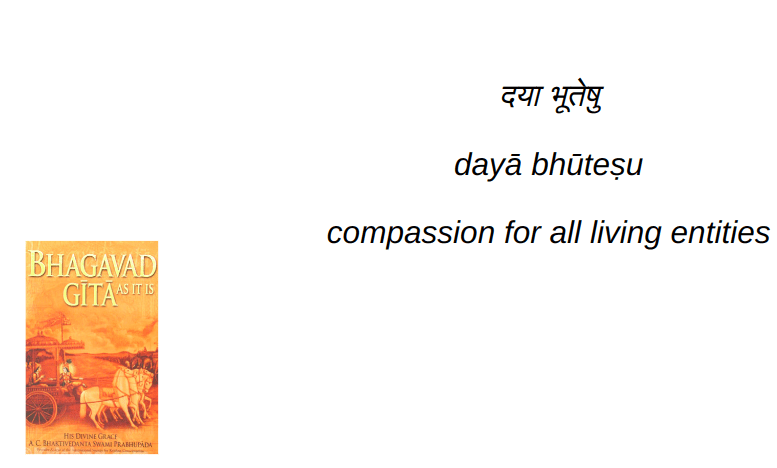
daya bhuteshu - compassion for all living entities, a quote from the Bhagavad Gita Chapter 16, Verse 2

दया भूतेषु – dayā bhūteṣu – compassion for all living entities

https://vedabase.io/en/library/bg/16/1-3/

More specifically, Krishna stresses that this quality, among a total of twenty size qualities, belong to those godly souls endowed with a divine nature.

So, clearly it is not hopeless to strive to be compassionate towards one and all.

In our present context though, we may not be “godly souls”, and we may not (yet) be endowed with a “divine nature”… what can we do?

First and foremost, we need to understand what compassion is not!

Yes, if we understand what is not compassion, then we should be able to steer our thoughts, words, and deeds in the direction of compassion.

Let’s look at the most obvious example of what is NOT compassion.

Schadenfreude (German) - pleasure derived from the misfortune of others.

The American Heritage Dictionary Defines Schadenfreude as follows:

schadenfreude /shäd′n-froi″də/

noun

  1. Pleasure derived from the misfortunes of others.
  2. Malicious enjoyment derived from observing someone else’s misfortune.
  3. Delight in another person’s misfortune.

We can safely say that someone who is feeling schadenfreude is not being compassionate!

Hey, I’m not like that!

So we may think. But here are just a few examples when we indulge in Schadenfreude…

  1. Sports – what happens when a team you support wins, and a team you oppose loses? Do you feel happy?
  2. Exams/Competition/Contests – what happens when you beat other competitors in an exam or competition? Do you feel elated?
  3. Business – what happens when you defeat a competitor, win a contract from an opponent, or put another company out of business? Do you celebrate?
  4. War – say the country you live in is at war with another country… no matter whose “fault” it was… if your army scores a “win”, does that not mean that someone on the other end is mourning a loved one?
  5. Politics – say the party you support wins an election and comes to power… does that mean that the defeated parties had nothing good to offer to the world at all?

When we examine our world, we find that…

In fact, our whole world, our society is built on top of deriving pleasure from the misfortunes of others.

Where does it all come from, one would wonder…

Schadenfreude comes from envy… “I wish that you don’t have what you have, I wish I have it instead, and you don’t”… it originally begins with Envy of God, but that is a discussion for another article.

Where there is envy, there can never be true co-operation, there can only be competition, sometimes, cut-throat.

Countries, communities, clubs, societies, networks, organizations are formed on the basis of envy against others. The envy may be based on race, religion, nationality, language, education, political, cultural or economic factors. It does not matter what the criteria separating the “us” and “them” are. And all of them engage wholesale in this schadenfreude.

We’re all members of such propagators of schadenfreude whether unwillingly or not!

So we can think about how to live in a world where competition is the name of the game!

Compassion means the exact opposite of Schadenfreude… to feel pain at the sufferings of others.

OK, let’s say we do somehow get past the most obvious schadenfreude. How to act with compassion?

For example, what if I’m trying to “help” someone, but I only end up hurting the person I’m trying to help?

How do we know if something we are thinking, feeling, willing, saying, or doing is helping or hurting?

Watch out for Part 2 of this series of articles…

In that post, we will go deeper into understanding how our intent to help can actually hurt.