Rapid fire questions… selfless service, amanina mana dena in marriage, Krishna Consciousness in a calamity, karma vs. compassion, free will, our anchor…

This article contains a series of questions and answers… it explores the essence of selfless service, emphasizing that true selfless action arises from a pure devotee’s desire to please Krishna, devoid of personal gain. It highlights how harmonious relationships are built on mutual respect. It also discusses how the Internal process of chanting Hare Krishna mbrings peace in challenging times. Understanding the difference between karmic reactions and divine mercy (kripa) allows devotees to perceive their experiences as opportunities for growth. Ultimately, it reinforces the concept of humility and service, reminding individuals of their role as servants of the lowliest servants in devotion to Krishna.

QUESTION 1) We talk a lot about selfless service, but can you pls tell one action devoid of gain in return?


MBD: Selfless service is not possible unless for a pure devotee, who does service for service sake. In all lower states of Bhakti, all service benefits the performer, even if it may benefit others. The higher the stage of the performer’s advancement, the more it benefits others. It benefits the performer less than it benefits others. Take any service. Krishna’s service to the living entities is always selfless. He does not need anything from anyone in return. Same with the spiritual master. He only seeks Krishna’s pleasure.

1.1) Can there be an action without result?


MBD: When you say result, do you mean “karmic” result? All action that is not purely transcendental has karmic reactions… everything in the modes. Devotional service has no karmic results. Still, there are devotional results. These start with the pleasure of Krishna and the purification of the heart of the devotee, etc.

(The question above is from before our discussion today.)

From what I have learned/heard: Anand/ Sukh (Bliss / Pleasure) is the ultimate goal of every action. So if the action is intended for the pleasure of the Lord, it is selfless. But if it is directed towards sense gratification or tries to satisfy sego, then it is selfish action.


MBD: Yes, you have the right understanding.

QUESTION 2) Does the phrase “amanina man dena…” apply in a husband/wife relationship?


MBD: Yes, it applies to all relationships. If 2 souls are perfectly in amanina (not expecting any respect), they experience a state of harmony. When they are in manadena (giving all respect), they are also in perfect harmony with the will of Krishna. They are thus very happy. Easier said than done.

QUESTION 3) In the most unbeatable calamity, what is your internal process in terms of Krishna Consciousness? What is the first thing that comes to your mind?


MBD: I chant Hare Krishna, if I can chant at all. In general, we are in good shape if we can make chanting the Lord’s name a reflex action. This should apply to anything that happens, whether good or bad. We can test how far we have come when something unexpected happens, good or bad.

QUESTION 4) How do we distinguish between the reactions of Karma from Kripa?


MBD: Kripa is undeserved, no one in material consciousness deserves it. For example getting Krishna Prasadam is a great privilege. You may have the karmic credits to be able to eat, digest, etc., but there is no karmic action that can “earn” you Krishna Prasasdam. Whatever our prarabdha is must be experienced without fail. Even pure devotees apparently enjoy or suffer karmic reactions. But Krishna gives them whatever is needed for others’ sake. This is to teach others by personal example. For devotees in the middle, Krishna can use karmic reactions to pat us on the back. He can also kick us in the butt, through maya or yogamaya. All devotional experiences, in general, are purely Kripa.

From what I have learned/heard: If something is happening to me/happened with me, it MUST be my prarabdh karma. But interpreting it as the mercy of the Lord helps. He is “kartum akartum anyatha kartum.” This helps to remain Krishna conscious in the moment. It erases the distinguishing line between karma and kripa.


MBD: That is where the attitude comes in. Whatever happened is by Krishna’s sanction. The devotee will see Krishna’s hand and understand the takeaway. The nondevotee will only try to adjust the situation to “avoid/improve/prevent/etc.” You are on the right track.

QUESTION 5) Do we really have freewill? (If Lord is the enjoyer/doer of all actions, and we are but a medium) So whatever “we think” has been done by us has actually been done by Him, no?


MBD: Knowing what you will do, and forcing you to do it are two different things. It’s like a parent. The parent knows what the child will do in a given situation. Nonetheless, they leave the child free in a limited way. This freedom allows the child to learn. In the material sense, Krishna is a non-doer. The 3 modes of material nature are set in motion by Krishna. They are the doer. In the devotional sense, Krishna does not know how exactly the devotee is going to serve Him. When Radharani cooks something, Krishna knows it will be amazing, but does not know what exactly it will be. He can know it if He wants, but Yogamaya overpowers His knowability. It is like Krishna’s Sarvajnata (all-knowing nature) and mugdhata (innocence) exist together. This would be a contradiction normally, but all contradictions converge and are resolved in Krishna.

QUESTION 6) What is that ONE anchor point to be aware of every time?


MBD: I am a servant of the servant of the servant. I serve at least as far as the extent of the current disciplic succession of Krishna. But I am a servant of all devotees, past, present, and future.


Understanding Compassion: Actions That Truly Help (Part 2)

Suppose you want to help someone. Very noble! First do no harm. How can you tell if you are helping or hurting? Suppose we want to act with compassion… should we not understand what compassion is first? Here is a discussion about hte complexity of compassion and how well-intentioned actions in passion and ignorance cause harm. Effective compassion must be in the mode of goodness. But charity begins at home. If we are not compassionate with ourselves, we cannot be compassionate towards others. And how to be compassionate with ourselves?

This is part Two of a Series of Articles on Compassion. Part 1 is here. Part 3 is here

Let’s say we do somehow get past the most obvious schadenfreude for others. How to act with compassion?

How do we know if something is helping or hurting?

It is said, first, do no harm.

Take these situations… how would you “help” in these situations?

  • A crying, tantrum-throwing child is being firmly dealt with by a parent
  • A patient is on a very strict diet to allow their quick recovery
  • A homeless substance abuser is begging for money on the street

Would it be “compassion” to intervene in the first example of the child above? Should we stop the parent from being firm? No! The parent knows what the child needs. Maybe the child is hungry, maybe the child is tired and sleepy. The parent is being compassionate with that child, even if it’s not all kisses and hugs!

A child throws a tantrum

There is a second example of a sick friend on a strict diet. The patient asks you to sneak in a rich meal, they want to escape their bland, boring diet. You are his buddy. You really want your friend to have some great food! Would you be acting with compassion? No, you end up killing your friend with your “act of compassion”!

A patient is served hospital food

In the third example, the drug addict is on the street begging you for money. If you gave it to them, would that be compassionate? No, the person doesn’t know what is good for them! They will use your charity to hurt themselves, dig deeper into addiction! Maybe even die of an overdose!

Everything we experience in this world is composed of what is known as the modes of material nature. This includes substances, personalities, habits, and activities. It also encompasses the time of day or night, music, writing, and entertainment. Indeed, we can understand that these are the fundamental ingredients of material nature.

We can consider that trying to help someone is an intentional action. Being compassionate towards someone means acting to help that person. Being compassionate takes the form of charity.

Actions in the mode of passion give results that are sweet to start, but have a bitter end. Actions in the mode of ignorance bring results that are bitter in the beginning and bitter in the end.

The modes of material nature are three in number:

  • Goodness
  • Passion
  • Ignorance

Only actions in the mode of goodness produce a desirable result. They may taste bitter to start. This bitterness nevertheless, is only if someone is not situated in the mode of goodness.

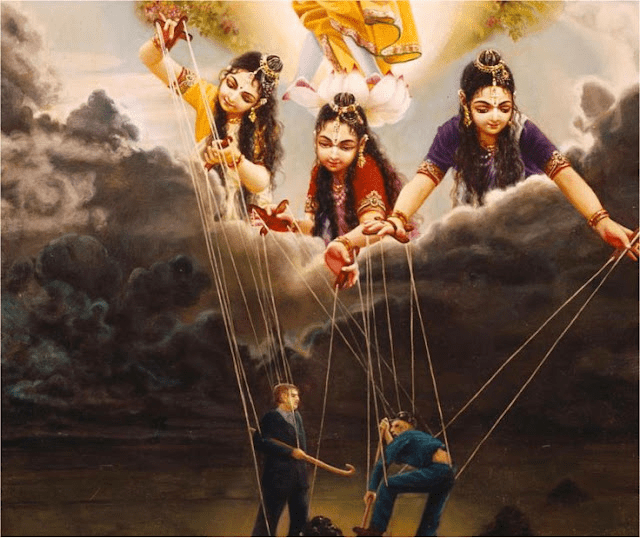
The modes of material nature act on everyone. Indeed they are the ropes that bind us.

The result of charity is highly misunderstood in our world. Not everything we consider charitable is actually beneficial! There are three kinds of charity defined by Krishna in the Bhagavad Gita.

  • Charity in the Mode of Goodness
  • Charity in the Mode of Passion
  • Charity in the Mode of Ignorance
Charity, thre's more to it than meets the eye.

Charity given out of duty, without expectation of return, at the proper time and place, and to a worthy person is considered to be in the mode of goodness.

But charity performed with the expectation of some return, or with a desire for fruitive results, or in a grudging mood is said to be charity in the mode of passion.

And charity performed at an impure place, at an improper time, to unworthy persons, or without proper attention and respect is said to be in the mode of ignorance.

https://vedabase.io/en/library/bg/17/

The mode of goodness way to deal with an upset child is to let a parent handle the situation. This parent knows what the child actually needs. Others should not interfere.

The mode of goodness way to deal with a patient is to follow the physician’s prescription with food and medicine. This is true no matter how dissatisfied the patient is with a bland diet.

The mode of goodness way to deal with a drug addict on the street is to get them professional help. Seek assistance from those who are trained and qualified to help them.

How to “help” someone and not push them deeper into a hole?

Charity begins at home! To be compassionate with anyone else, I need to be compassionate with myself first!

What is that compassion? First, I must know the difference between what is compassion and what is not!

In a desert, say there is a mirage. If someone races towards that mirage, should I let them just run? Or should I stop them?

A mirage in the desert looks like water, but there is no water there.

trushna” is a Sanskrit word that indicates extreme thirst. This is a thirst that can never be quenched. An animal in the desert, running towards a mirage can never quench it’s thirst. In fact it will run to its death.

Similarly, conditioned souls in the material world are running, running running… Running with their tongues out, trying to get some taste, to quench their thirst. This they’re trying to do by pursuing sense gratification.

The conditioned living entities try to satisfy themselves by trying to satisfy the senses. At the extreme, this is hedonism. Everyone is on that trip, more or less.

Compassion is definitely not about gratifying the senses of a suffering soul.

The senses are like a fire! They can never be satisfied by giving them more gratification!

Think of it this way. If there’s a blazing fire, can it be put out by adding more fuel to it? No! A fire can be put out by cutting the supply of fuel and oxygen. But only an expert firefighter knows how to put out a really bad fire.

The senses are like fire, and sense gratification is like fuel. The senses can’t be satisfied, no matter how much we try to gratify them. They must be controlled for the soul to be satisfied.

Just like the expert firefighter, there are great souls who manifest compassion. They know actually what it means to “help” someone. We can learn from them and follow the process they have given us.

निवृत्ततर्षैरुपगीयमानाद्भवौषधाच्छ्रोत्रमनोऽभिरामात् ।

क उत्तमश्लोकगुणानुवादात्पुमान् विरज्येत विना पशुघ्नात् ॥ ४ ॥

nivṛtta-tarṣair upagīyamānād
bhavauṣadhāc chrotra-mano-’bhirāmāt
ka uttamaśloka-guṇānuvādāt
pumān virajyeta vinā paśughnāt

Glorification of the Supreme Personality of Godhead is performed in the paramparā system, that is, it is conveyed from the spiritual master to disciple. Such glorification is relished by those no longer interested in the false, temporary glorification of this cosmic manifestation. Descriptions of the Lord are the right medicine for the conditioned soul undergoing repeated birth and death. Therefore, who will cease hearing such glorification of the Lord except a butcher or one who is killing his own self?

https://vedabase.io/en/library/sb/10/1/4/

This is what is needed. Not sense gratification, but a clear understanding of what is helpful and what is not.

Do you want a specific suggestion on how to be compassionate with yourself and others?

तद्विद्धि प्रणिपातेन परिप्रश्न‍ेन सेवया ।
उपदेक्ष्यन्ति ते ज्ञानं ज्ञानिनस्तत्त्वदर्शिनः ॥ ३४ ॥

tad viddhi praṇipātena
paripraśnena sevayā
upadekṣyanti te jñānaṁ
jñāninas tattva-darśinaḥ

Just try to learn the truth by approaching a spiritual master. Inquire from him submissively and render service unto him. The self-realized souls can impart knowledge unto you because they have seen the truth.

https://vedabase.io/en/library/bg/4/34/

Want to act with compassion?

Be compassionate with yourself.

Approach a genuine spiritual master.

Sankarshan Das Adhikari, the author's spiritual master

From Schadenfreude to Compassion: A Journey (part 1)

Compassion is a complex and often misunderstood concept, as it calls for empathy towards all individuals, regardless of their circumstances. Balancing compassion for various groups can present challenges, especially when faced with conflicting needs and situations. Ultimately, striving for universal compassion is essential, despite the inherent difficulties in this pursuit. However, if we want to act with universal compassion, we should start with understanding what compassion is not! Schadenfreude, certainly not. Alas, it is more common than we think!

Compassion, this word is used very often. Someone wants us to have compassion upon the downtrodden and poor. Someone else wants us to have compassion upon the rich and powerful. Some want to be compassionate towards people with black skin. Others want to be compassionate upon the war veterans. Someone is working intently upon manifesting compassion towards those battling cancer.

This is part 1 of a 3 series of articles. Part 2 is here, and Part 3 is here.

I agree with them all. We should be compassionate with everyone in the whole world.

Do you agree that all those living entities mentioned above deserve to be treated with compassion? What about those not mentioned above? Do they deserve to be treated with compassion?

But for example, suppose I dedicate my life to, say, feeding hungry people. Now, all of my efforts are spent in finding the hungry, acquiring food and feeding them… how would I help the sick children, the war veterans, the people with black skin, and the cancer patients?

Or, if I invest all my time in trying to find a cure for Cancer… now how would I feed the hungry, take care of the sick children, the war veterans, the people with black skin?

Or maybe I do a little bit to help them all… donate to feed a few hungry people, donate to a charity helping war veterans, volunteer for a hospital that treats people with cancer… but then I notice that there are many more hungry, many more war veterans, many with cancer and many disadvantaged people with black skin!

What’s more, I find that the charity feeding the hungry is slaughtering innocent animals… the war veterans who are injured actually committed atrocities upon other people who are left in worse shape than them, some of the the people with cancer happened to be those who smoked all their lives, and some of the people with black skin are of poor character and have harmed many others…

Now what do I do?

Do I prioritize the “innocent” disadvantaged over those with a criminal background? Do I overlook Diabetes or Hypertension in my obsession over cancer? Do I ignore the elderly in my quest to help the children?

It appears that being compassionate is more difficult than it sounds at first!

It’s all extremely confusing and difficult to sort through!

I am just one teeny little soul, a tiny jiva, one little spirit soul among unlimited spirit souls. I have limited energy, limited time in this life, and very limited resources, power and influence in the world. And yet I want to be compassionate to all.

I don’t want to be compassionate to one group of living entities, say, sick children, and not be compassionate, say, to poor children who are not sick but lack education. I don’t want to be compassionate upon the hungry people of the world, and end up slaughtering animals to help temporarily prevent their hunger.

Do I have any hope of attaining my goal of being compassionate towards everyone then?

Can I be compassionate towards ALL souls?

Yes, in the Bhagavad Gita, Krishna speaks about compassion for all souls.

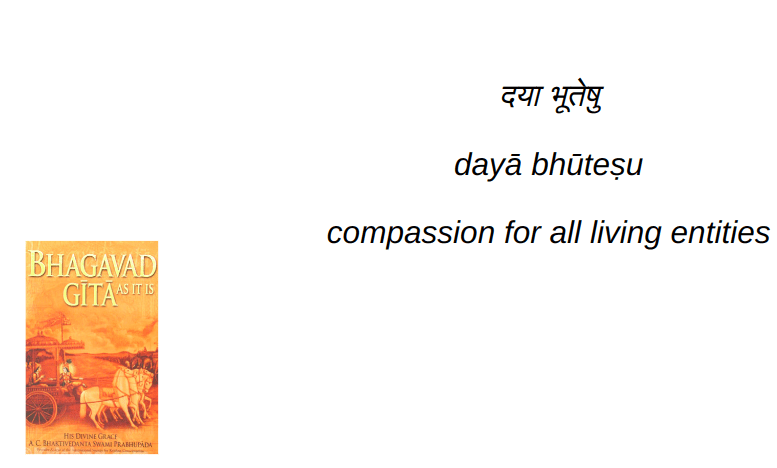
daya bhuteshu - compassion for all living entities, a quote from the Bhagavad Gita Chapter 16, Verse 2

दया भूतेषु – dayā bhūteṣu – compassion for all living entities

https://vedabase.io/en/library/bg/16/1-3/

More specifically, Krishna stresses that this quality, among a total of twenty size qualities, belong to those godly souls endowed with a divine nature.

So, clearly it is not hopeless to strive to be compassionate towards one and all.

In our present context though, we may not be “godly souls”, and we may not (yet) be endowed with a “divine nature”… what can we do?

First and foremost, we need to understand what compassion is not!

Yes, if we understand what is not compassion, then we should be able to steer our thoughts, words, and deeds in the direction of compassion.

Let’s look at the most obvious example of what is NOT compassion.

Schadenfreude (German) - pleasure derived from the misfortune of others.

The American Heritage Dictionary Defines Schadenfreude as follows:

schadenfreude /shäd′n-froi″də/

noun

  1. Pleasure derived from the misfortunes of others.
  2. Malicious enjoyment derived from observing someone else’s misfortune.
  3. Delight in another person’s misfortune.

We can safely say that someone who is feeling schadenfreude is not being compassionate!

Hey, I’m not like that!

So we may think. But here are just a few examples when we indulge in Schadenfreude…

  1. Sports – what happens when a team you support wins, and a team you oppose loses? Do you feel happy?
  2. Exams/Competition/Contests – what happens when you beat other competitors in an exam or competition? Do you feel elated?
  3. Business – what happens when you defeat a competitor, win a contract from an opponent, or put another company out of business? Do you celebrate?
  4. War – say the country you live in is at war with another country… no matter whose “fault” it was… if your army scores a “win”, does that not mean that someone on the other end is mourning a loved one?
  5. Politics – say the party you support wins an election and comes to power… does that mean that the defeated parties had nothing good to offer to the world at all?

When we examine our world, we find that…

In fact, our whole world, our society is built on top of deriving pleasure from the misfortunes of others.

Where does it all come from, one would wonder…

Schadenfreude comes from envy… “I wish that you don’t have what you have, I wish I have it instead, and you don’t”… it originally begins with Envy of God, but that is a discussion for another article.

Where there is envy, there can never be true co-operation, there can only be competition, sometimes, cut-throat.

Countries, communities, clubs, societies, networks, organizations are formed on the basis of envy against others. The envy may be based on race, religion, nationality, language, education, political, cultural or economic factors. It does not matter what the criteria separating the “us” and “them” are. And all of them engage wholesale in this schadenfreude.

We’re all members of such propagators of schadenfreude whether unwillingly or not!

So we can think about how to live in a world where competition is the name of the game!

Compassion means the exact opposite of Schadenfreude… to feel pain at the sufferings of others.

OK, let’s say we do somehow get past the most obvious schadenfreude. How to act with compassion?

For example, what if I’m trying to “help” someone, but I only end up hurting the person I’m trying to help?

How do we know if something we are thinking, feeling, willing, saying, or doing is helping or hurting?

Watch out for Part 2 of this series of articles…

In that post, we will go deeper into understanding how our intent to help can actually hurt.

02 Sep 2024 SB 3.9.7 ISKCON Mayapur

How can we elevate those who are unfortunate and bereft of good sense? How can we make their lives auspicious and allow them to enjoy unending, ever increasing bliss for ever?

Hare Krishna!

In this most intriguing and enlightening conversation called the Srimad Bhagavatam, the tricky topics of attaining to the Supreme Absolute Truth are discussed in great detail.

In fact, the Bhagavatam says this “The highest truth is reality distinguished from illusion for the welfare of all.” SB 1.1.2 (fragment)

Relative truths may be good for some time, some place, and some circumstance, but that is not good enough because such partial truths leave out some section of living entities.

Join to find out!

TOPIC: ISKCON Mayapur English Bhagavatam Class

LOCATION: ISKCON Mayapur Campus, West Bengal, India

DATE📆: Monday, 2nd Sep 2024

TIME⌚: 10:30 PM. ET USA+Canada/ 8:30 PM. CT USA/ 8:30 PM PST USA/ 2:30 AM UK/ 11:30 AM MYT/ 8:00 AM IST

I will record audio, and the class will also be broadcast online on the ISKCON Mayapur English Channel.

https://m.youtube.com/c/ISKCONMayapurOfficial

ŚB 3.9.7

दैवेन ते हतधियो भवत: प्रसङ्गा-
त्सर्वाशुभोपशमनाद्विमुखेन्द्रिया ये ।
कुर्वन्ति कामसुखलेशलवाय दीना
लोभाभिभूतमनसोऽकुशलानि शश्वत् ॥ ७ ॥


daivena te hata-dhiyo bhavataḥ prasaṅgāt
sarvāśubhopaśamanād vimukhendriyā ye
kurvanti kāma-sukha-leśa-lavāya dīnā
lobhābhibhūta-manaso ’kuśalāni śaśvat

Synonyms
daivena — by fate of misfortune; te — they; hata-dhiyaḥ — bereft of memory; bhavataḥ — of You; prasaṅgāt — from the topics; sarva — all; aśubha — inauspiciousness; upaśamanāt — curbing down; vimukha — turned against; indriyāḥ — senses; ye — those; kurvanti — act; kāma — sense gratification; sukha — happiness; leśa — brief; lavāya — for a moment only; dīnāḥ — poor fellows; lobha-abhibhūta — overwhelmed by greed; manasaḥ — of one whose mind; akuśalāni — inauspicious activities; śaśvat — always.

Translation
O my Lord, persons who are bereft of the all-auspicious performance of chanting and hearing about Your transcendental activities are certainly unfortunate and are also bereft of good sense. They engage in inauspicious activities, enjoying sense gratification for a very little while.

Purport
The next question is why people are against such auspicious activities as chanting and hearing the glories and pastimes of the Lord, which can bring total freedom from the cares and anxieties of material existence. The only answer to this question is that they are unfortunate because of supernatural control due to their offensive activities performed simply for the sake of sense gratification. The Lord’s pure devotees, however, take compassion upon such unfortunate persons and, in a missionary spirit, try to persuade them into the line of devotional service. Only by the grace of pure devotees can such unfortunate men be elevated to the position of transcendental service.

Enrollment alone will not help us progress to perfection

Many of us are enrolled in various programs… the program is designed to help us progress… but most of those enrolled don’t make any progress. Is enrollment alone sufficient to make progress?

My dear reader… consider this… suppose a student enrolls in a course of study at a prestigious university… Everywhere our student friend goes, they advertise… “I’m a student of such-and-such-course in so-and-so university”. Our student friend is met with pats on the back, and nods of approval… “yes”, everyone seems to say “that is a fantastic program at a great university”, and our student friend is quite pleased at this.

That’s it, our student friend is content with enrollment. Post-enrollment, apart from the bragging about the program they are enrolled in, we find that our student does not do anything else…

  • Attends no classes
  • Reads no textbooks
  • Does no research
  • Submits no assignments
  • Works on no projects
  • Does no practical work
  • Learns nothing about what they’re supposed to learn in that program

Now, my dear reader, would you expect our student friend to graduate, or even be allowed to stay on in the program?

Not at all! At minimum, our friend the student would forfeit their fees, potentially be kicked out of the program, and most definitely not get to see graduation!

We all would agree that this kind of enrollment in a program with no work done is of no real benefit.

And yet, the world is full of such students, enrolled in various Universities…

  • Hinduism
  • Christianity
  • Islam
  • Judaism
  • Buddhism
  • Jainism
  • Sikhism
  • this-ism
  • that-ism

Yes, my dear reader, all of these are universities… meant to teach us most important things:

  1. Who we are, Be who we are
  2. Know God, Love God
  3. Know that everything and everyone is God’s, to love, cherish, and engage in the service of God

Each of these “universities” was created to cater to a particular set of persons, in a particular time, place, and circumstance.

And yet, there are so many who are “enrolled”, but are not doing any of the work needed to actually graduate.

What is graduation? Graduation means spiritual perfection, which is an eternally ever-increasing thing, there is no limit to perfection. Perfection is a journey.

yasmin vijñāte sarvam evaṁ vijñātaṁ bhavati (Muṇḍaka Upaniṣad 1.3)

According to this Vedic injunction, simply by understanding Kṛṣṇa one understands Brahman, Paramātmā, prakṛti, the illusory energy, the spiritual energy and everything else. Everything will be revealed.

https://vedabase.io/en/library/sb/6/16/53-54/

Such a person who has graduated from their “university” manifests love and compassion at every moment and acts for the benefit of the whole world.

What is that ultimate benefit?

तव कथामृतं तप्तजीवनं
कविभिरीडितं कल्मषापहम् ।
श्रवणमङ्गलं श्रीमदाततं
भुवि गृणन्ति ये भूरिदा जना: ॥ ९ ॥

tava kathāmṛtaṁ tapta-jīvanaṁ
kavibhir īḍitaṁ kalmaṣāpaham
śravaṇa-maṅgalaṁ śrīmad ātataṁ
bhuvi gṛṇanti ye bhūri-dā janāḥ

The nectar of Your words and the descriptions of Your activities are the life and soul of those suffering in this material world. These narrations, transmitted by learned sages, eradicate one’s sinful reactions and bestow good fortune upon whoever hears them. These narrations are broadcast all over the world and are filled with spiritual power. Certainly those who spread the message of Godhead are most munificent.

https://vedabase.io/en/library/sb/10/31/9/

Alas, despite the world being filled with people professing all kinds of faith, there are so few who broadcast the glories of the Lord in this way.

We see persons of all kinds of faith lacking the basic qualities that their tradition aims to inculcate… persons of “faith” but without compassion, without tolerance, without understanding, without knowledge, without purity, without simplicity, without love, without care, without human qualities even!

So what is to be done, my dear reader?

Go deep, deep, deeper into the University you are enrolled in.

In general, you may find you are at one of these levels:

  • Atheism – the school of blind faith regarding God
  • Agnosticism – the school of blind doubt
  • Gnosticism – the school of unclear knowledge about God
  • Impersonalism – the school of detailed knowledge, mixed with envy of God
  • Fear of God – where God is known, and feared, out of ignorance
  • Fruitive Religion – Where God is treated as an Order Supplier
  • Dutiful Religion – Where God is adored and worshipped out of Duty
  • Pure Love of God – Where God is Loved and Served in Loving Devotion

Different “Universities” cater to different profiles of students… you have the ones for really bright students, the ones where you can get a sports scholarship, ones where the standards aren’t that high, the ones meant for rich people, and so on… ultimately, you need to decide how far your University can take you.

If you find that your institution is a vocational college and not really very deep in terms of giving you full spiritual perfection, then, search out that deeper place, where all the information about God is fully available, and you get the pure unadulterated knowledge… and you get theory, practice, and examples of role models actually practicing perfection.

But, coming back to the original point, simply labeling yourself as a Hindu, Muslim, Christian, or any other “ism” is not sufficient. You need to actually go deep into your tradition and learn everything there is to learn, experience everything there is to experience, serve in every possible way, and strive for spiritual advancement at every step. You cannot afford to be complacent, because human life is rare, and human life is short.

Here are some humble suggestions from this servant of the servant of God…

  • Know that Religion, singular, is one… Religions, plural, is another name for politics
  • Read your scripture
  • Understand it deeply by discussion, don’t be lazy about it
  • Follow your religious tenets carefully, pragmatically, not fanatically
  • Read scriptures from other traditions
  • Observe the principles, don’t get hung up on the details of the differences
  • Be tolerant, patient, enthusiastic, and compassionate to others
  • Practice your faith, every moment, every day
  • Try and understand other traditions by principles
  • Focus on the common denominator in spiritual life
  • Know that God is the God of all creatures, not just people, not just your faith tradition
  • Proof of the pudding? Do you love God? Do you love all that is God’s?

Are you just enrolled, or are you on your way to graduating?

Hare Krishna!

Watch out for the little guys

Do you watch out for the little guys when you are out and about? Yes, the ants,the snails, and others with smaller bodies than you?

Whenever I need to take the train to get to the office, I pass by an area that is home for snails. Yes, the slow and slimy little fellows with the shell.

For some reason, at around sunrise, many of them decide to cross the paved path that leads to the train station, out from their grassy home onto the bare asphalt. I took the time to pick them and put them back into the grass. Fortunately I didn’t miss my train. One famous so-called spiritual leader called that “stupid compassion”. I then learned that even though he is Buddhist, he eats meat. He lost my respect as a spiritual leader at that time, and now I see him as a mere social and political leader.

For people walking, running, or dashing to catch the train, these snails are practically invisible, to some they are a game “crunch, crunch, crunch”. Crushed under someone’s foot. I feel tremendous sorrow to see those that were crushed.

Imagine getting crushed to death! No need to imagine… we have indeed been crushed many times. The only reason we don’t remember is because otherwise we would be down with Post Traumatic Stress Disorder! As spirit souls, we have wandered around many many times in practically every one of the 8.4 million species of life. Yes Eight Million Four Hundred Thousand species.

We are all coming from the same eternal source. A genuine spiritualist feels oneness with all living entities. Not that all of us “are one” or that there is no individuality, but we are “of the One”. In other words, all of us have the same Original father and mother.

When we have that vision and realization, how can we possibly crush our own brothers and sisters under our feet? Would we not want to watch out for them? If you had a weak little sibling, would you crush him under your feet when he was in your way? Would you crush your little baby under your foot when she was crawling across the living room floor? Why then would one not extend the same kindness to an ant or a snail?

Unavoidable accidents are one thing, but any human should do their best to watch out for the little fellows in our way. In some cases, such as in fighting disease or pestilence, it may be necessary to kill other living creatures, indeed, we can’t even breathe without killing so many micro-organisms. But how can we transform ourselves to being more compassionate towards the little ones?

The famous example of this is Mrgari, the hunter – and here is an instructive lesson from the Chaitanya Charitamrita. A hunter, who once took pleasure in half-killing animals was inspired to become a great saint. Here is the entire incident in brief, if you would like to read… here is a beautiful summary for your pleasure…

Once upon a time the great saint Nārada, after visiting Lord Nārāyaṇa in the Vaikuṇṭhas, went to Prayāga to bathe at the confluence of three rivers — the Ganges, Yamunā and Sarasvatī.
Nārada Muni saw that a deer was lying on the path through the forest and that it was pierced by an arrow. It had broken legs and was twisting due to much pain.


Farther ahead, Nārada Muni saw a boar pierced by an arrow. Its legs were also broken, and it was twisting in pain.
When he went farther, he saw a rabbit that was also suffering. Nārada Muni was greatly pained at heart to see living entities suffer so.


When Nārada Muni advanced farther, he saw a hunter behind a tree. This hunter was holding arrows, and he was ready to kill more animals.
The hunter’s body was blackish. He had reddish eyes, and he appeared fierce. It was as if the superintendent of death, Yamarāja, were standing there with a bow and arrows in his hands.


When Nārada Muni left the forest path and went to the hunter, all the animals immediately saw him and fled.
When all the animals fled, the hunter wanted to chastise Nārada with abusive language, but due to Nārada’s presence, he could not utter anything abusive.
The hunter addressed Nārada Muni: ‘O gosvāmī! O great saintly person! Why have you left the general path through the forest to come to me? Simply by seeing you, all the animals I was hunting have now fled.’
Nārada Muni replied, ‘Leaving the path, I have come to you to settle a doubt that is in my mind.

‘I was wondering whether all the boars and other animals that are half-killed belong to you.’
Nārada Muni then inquired, ‘Why did you not kill the animals completely? Why did you half-kill them by piercing their bodies with arrows?’
The hunter replied, ‘My dear saintly person, my name is Mṛgāri, enemy of animals. My father taught me to kill them in that way.

 ‘When I see half-killed animals suffer, I feel great pleasure.’
Nārada Muni then told the hunter, ‘I have one thing to beg of you.’
 ‘I have many skins, if you would like them. I shall give you either a deerskin or a tiger skin.’
Nārada Muni said, ‘I do not want any of the skins. I am asking only one thing from you in charity.
 ‘I beg you that from this day on you will kill animals completely and not leave them half-dead.’


The hunter replied, ‘My dear sir, what are you asking of me? What is wrong with the animals’ lying there half-killed? Will you please explain this to me?’
Nārada Muni replied, ‘If you leave the animals half-dead, you are purposefully giving them pain. Therefore you will have to suffer in retaliation.’
Nārada Muni continued, ‘My dear hunter, your business is killing animals. That is a slight offense on your part. But when you consciously give them unnecessary pain by leaving them half-dead, you incur very great sins.’
Nārada Muni continued, ‘All the animals that you have killed and given unnecessary pain will kill you one after the other in your next life and in life after life.’


In this way, through the association of the great sage Nārada Muni, the hunter was a little convinced of his sinful activity. He therefore became somewhat afraid due to his offenses.
The hunter then admitted that he was convinced of his sinful activity, and he said, ‘I have been taught this business from my very childhood. Now I am wondering how I can become freed from these unlimited volumes of sinful activity.’
The hunter continued, ‘My dear sir, please tell me how I can be relieved from the reactions of my sinful life. Now I fully surrender unto you and fall down at your lotus feet. Please deliver me from sinful reactions.’


Nārada Muni assured the hunter, ‘If you listen to my instructions, I shall find the way you can be liberated.’
The hunter then said, ‘My dear sir, whatever you say I shall do.’
The hunter replied, ‘If I break my bow, how shall I maintain myself?’
Being thus assured by the great sage Nārada Muni, the hunter broke his bow, immediately fell down at the saint’s lotus feet and fully surrendered. After this, Nārada Muni raised him with his hand and gave him instructions for spiritual advancement.
Nārada Muni then advised the hunter, ‘Return home and distribute whatever riches you have to the pure brāhmaṇas who know the Absolute Truth. After you have distributed all your riches to the brāhmaṇas, you and your wife should leave home, each of you taking only one cloth to wear.’
Nārada Muni continued, ‘Leave your home and go to the river. There you should construct a small cottage, and in front of the cottage you should grow a tulasī plant on a raised platform.
 ‘After planting the tulasī tree before your house, you should daily circumambulate that tulasī plant, serve her by giving her water and other things, and continuously chant the Hare Kṛṣṇa mahā-mantra.’
Nārada Muni continued, ‘Every day I shall send sufficient food to you both. You can take as much food as you want.’


The three animals that were half-killed were then brought to their consciousness by the sage Nārada. Indeed, the animals got up and swiftly fled.
When the hunter saw the half-killed animals flee, he was certainly struck with wonder. He then offered his respectful obeisances to the sage Nārada and returned home.
After all this, Nārada Muni went to his destination. After the hunter returned home, he exactly followed the instructions of his spiritual master, Nārada.

The news that the hunter had become a Vaiṣṇava spread all over the village. Indeed, all the villagers brought alms and presented them to the Vaiṣṇava who had formerly been a hunter.
In one day enough food was brought for ten or twenty people, but the hunter and his wife would accept only as much as they could eat.


One day, while speaking to his friend Parvata Muni, Nārada Muni requested him to go with him to see his disciple the hunter.
As the saintly sages approached the hunter’s place, the hunter could see them from a distance.
With great alacrity the hunter began to run toward his spiritual master, but he could not fall down and offer obeisances because ants were running hither and thither around his feet.


Seeing the ants, the hunter whisked them away with a piece of cloth. After thus clearing the ants from the ground, he fell down flat to offer his obeisances.
Nārada Muni said, ‘My dear hunter, such behavior is not at all astonishing. A man in devotional service is automatically nonviolent. He is the best of gentlemen.
 ‘O hunter, good qualities like nonviolence, which you have developed, are not very astonishing, for those engaged in the Lord’s devotional service are never inclined to give pain to others because of envy.’


The hunter then received the two great sages in the courtyard of his house. He spread out a straw mat for them to sit upon, and with great devotion he begged them to sit down.
He then fetched water and washed the sages’ feet with great devotion. Then both husband and wife drank that water and sprinkled it on their heads.


When the hunter chanted the Hare Kṛṣṇa mahā-mantra before his spiritual master, his body trembled and tears welled up in his eyes. Filled with ecstatic love, he raised his hands and began to dance, waving his garments up and down.
When Parvata Muni saw the ecstatic loving symptoms of the hunter, he told Nārada, ‘Certainly you are a touchstone.’
Parvata Muni continued, ‘My dear friend Nārada Muni, you are glorified as the sage among the demigods. By your mercy, even a lowborn person like this hunter can immediately become attached to Lord Kṛṣṇa.’


Nārada Muni then asked the hunter, ‘My dear Vaiṣṇava, do you have some income for your maintenance?’
The former hunter said, ‘Please do not send so much grain. Only send what is sufficient for two people, no more.’
Nārada Muni approved his not wanting more than a daily supply of food, and he blessed him, saying, ‘You are fortunate.’ Nārada Muni and Parvata Muni then disappeared from that place.


Thus I have narrated the incident of the hunter. By hearing this narration, one can understand the influence of association with devotees

https://vedabase.io/en/library/cc/madhya/24/

Compared to all the other living entities, the “littleness” is only in the external covering, otherwise, as spirit souls, all of us are the same size. The crusher becomes the crushed, and the crushed becomes the crusher. So, compassion is in our own best self-interest, first and foremost. The only stupidity is to be devoid of compassion.

Your freedom ends where my nose begins. Your freedom ends where the ant’s body begins. Your freedom ends where the snail lies across the road. Take note dear spiritualists, and try your best to tread lightly in this world, and watch out for those brothers and sisters everywhere around us.

This can be taken literally as well as figuratively. You may be a big businessperson, famous artist, some big shot in a religious organization, or just more powerful than others in some way.

If we don’t see those little ones around us or if we don’t feel compassion, then what can we do? We can hang out with those who do feel compassion. We can receive their association. The pure Vaishnavas are most compassionate, they wouldn’t hurt an ant or snail, let alone bigger animals. We can accept their instructions. And this we can be eligible for spiritual advancement. Please let me know how I may assist you? I know a lot of compassionate saints!