Leveraging Jet Lag for Spiritual Growth

Recently returning from a transformative trip to India, I found jet lag to be an unexpected ally in my spiritual journey. Embracing early mornings, I engaged in meditation, reading, and serving Krishna. Instead of viewing jet lag negatively, I was able to leverage it to enhance my devotional practices and enrich my daily routine. What a blessing! Jet lag? Bring it on!

I have recently returned to Toronto from a hectic, exhausting, yet ecstatic trip to Bharat Bhumi, also known as India. I was away for a total of 14 days. Out of those, I got to spend 11 in the holy land.

The privilege of meeting, hearing from, and serving the sincere devotees of Krishna is, as always, a life changing experience.

I visited…

  • Frankfurt
  • Mantralayam
  • Hyderabad
  • Bengaluru
  • Pune
  • Mumbai

With a 10.5 hour time zone difference between Toronto and India, that is just enough to get jet lagged. Jet lag gets a bad rap… because the body clock is set to some other time zone. It wakes up at odd hours. It feels sleepy at odd hours and so on. There’s an entire cottage industry to help people cope with and overcome jet lag.

I even tried this app called “Timeshifter” but it was totally impractical for my lifestyle… for example it contained advice to use caffeine, which I avoid like the plague, and melatonin… It required specific times to go to sleep and wake up. There were also specific times to “see” light and to avoid it. This was almost like trying to hack the body and mind. It didn’t sit right with me. Was it really necessary to “overcome” jet lag? I wondered if jet lag can be leveraged for Krishna, for spiritual growth.

When I was in India, the jet lag was a great asset! I managed to wake up early enough to attend Mangala Arati. I completed my Sadhana. I got by with a short nap for the rest of the day. Early mornings, late nights, and the rest of the time spent in serving Krishna and His devotees, perfect!

When I got back to Toronto, for example this morning, I was up at 2AM. I wondered if I should try to go back to sleep… then I remembered that my Guru and Gurumata usually rise at this hour. They complete their japa, meditation on the Holy Names of Krishna on their beads, well before others rise… and then they can spend their whole day serving others on their spiritual journey.

So I decided to follow in their footsteps. After completing my meditation, I still had time to read, not one but parts of 2 books! Anyone who has a corporate career and a family understands the challenge. Finding quality time to read is incredibly hard. I still had enough time to complete Mangala Arati. Then I performed deity worship before getting an early start to the day!

In this way I will leverage jet lag to serve Krishna. And when the jet lag ends? I will simply go back to my earlier routine to serve Krishna!
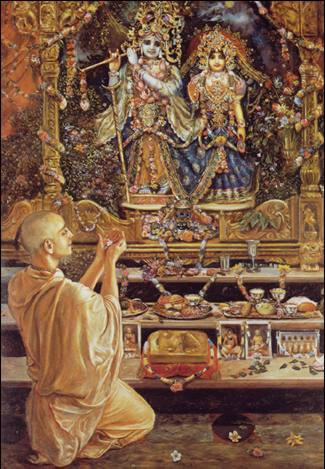
Devotee serving Krishna

Jet lag? Bring it on!

Of course, in all success, the credit goes to Guru and Krishna, as long as we are ready to be an instrument!

Now, in case you think that this idea to leverage jet lag in Krishna’s service somehow is mine… it is not.

Srila Rupa Goswami enunciated the principle of “avyarthakālatvam — being free from wasting time”, this was over 500 years ago…

ক্ষান্তিরব্যর্থকালত্বং বিরক্তির্মানশূন্যতা ।
আশাবন্ধঃ সমুৎকণ্ঠা নামগানে সদা রুচিঃ ॥ ১৮ ॥
আসক্তিস্তদ্‌গুণাখ্যানে প্রীতিস্তদ্বসতিস্থলে ।
ইত্যাদয়োঽনুভাবাঃ স্যু র্জাতভাবাঙ্কুরে জনে ॥ ১৯ ॥


kṣāntir avyartha-kālatvaṁ viraktir māna-śūnyatā
āśā-bandhaḥ samutkaṇṭhā nāma-gāne sadā ruciḥ
āsaktis tad-guṇākhyāne prītis tad-vasati-sthale
ity-ādayo ’nubhāvāḥ syur jāta-bhāvāṅkure jane

“ ‘When the seed of ecstatic emotion for Kṛṣṇa fructifies, the following nine symptoms manifest in one’s behavior: forgiveness, concern that time should not be wasted, detachment, absence of false prestige, hope, eagerness, a taste for chanting the holy name of the Lord, attachment to descriptions of the transcendental qualities of the Lord, and affection for those places where the Lord resides — that is, a temple or a holy place like Vṛndāvana. These are all called anubhāva, subordinate signs of ecstatic emotion. They are visible in a person in whose heart the seed of love of God has begun to fructify.’

https://vedabase.io/en/library/cc/madhya/23/18-19/

My spiritual master has indeed planted the seed of pure devotional service in my heart. However, I cannot claim any success in cultivating devotional service. I am just sincerely trying to practice sadhana bhakti.

And I have examples of great Vaishnavas who travel around the world…

So I brought Prabhupada his breakfast, and then when he was finished I came and took everything out and Prabhupada laid down. So I went back, I said, “Prabhupada’s resting.” So Paramahamsa and I, we laid down. Of course, we fell asleep, we were out, and Prabhupada maybe took 15 minutes or something and he was up. So finally I heard a bell ring. So I went into Prabhupada’s room, and it happened a few times where I would literally try to wake up as I was offering obeisances and exercise my eyes so Prabhupada couldn’t tell that I was sleeping. I sat up, and as soon as I sat up he said, “Why are you sleeping? You’re like dead men. Everyone is awake. The karmis are all at work but not the devotees. No, they’re sleeping.” He said, “They’re sleeping very soundly. Why are you sleeping?” And, of course, when Prabhupada asked why were you doing something wrong, I never had a response because whatever you said, he would just take that apart. So I just said, “Prabhupada, I’m sorry.” “What about Paramahamsa? Why is he sleeping?” He said, “Call him in here.” He goes in and immediately Prabhupada says, “You are a sannyasi. Your business is to minimize bodily demands, minimize sleeping, minimize eating. Why are you sleeping?” Paramahamsa said, “Prabhupada, I have jet lag,” and I thought, “Oh, no!” And Prabhupada said, “Jet lag?” He said, “Well, we just flew from here and done this,” and Prabhupada said, “So I am also flying, I am doing the same thing. I am awake.” Then he said, “All right, go on. Go sleep if you want.

https://srilaprabhupadalila.org/read/3665 

Srila Prabhupada circled the globe twelve times in less than 10 years… and no one ever recalls a time when he was jet lagged.

Gopal Krishna Goswami, a dear disciple of Srila Prabhupada, traveled from continent to continent. He was always on the altar offering Mangala Arati to the local deities at the temple he was staying at. This was regardless of which time zone he came in from and which time zone he traveled to. I have personally witnessed this, arrived at midnight, 1AM, 2AM, but no, at 4:30am he was on the altar.

My own spiritual master, Srila Sankarshan Das Adhikari, has circled the globe more than 50 times. My Gurumataji Srimati Vishnupriya Devi Dasi has accompanied him. They have never let jet lag stand in the way of their service to Krishna. They are both up early. They chant their rounds and offer their service to Sri Sri Radha Damodar. Then, they follow a full schedule of service all day, working 12-16 hours most days.

So why should I not try to follow in their illustrious footsteps?

Is your wealth safe?

Not long ago, Silicon Valley Bank collapsed. With over $209B in assets, it still collapsed. Where is your wealth? What is your wealth really? Who or what can protect your wealth?

Not long ago, Silicon Valley Bank, a large American bank, with over Two Hundred and Nine Billion Dollars in assets experienced a meltdown situation, where depositors tried to withdraw forty two billion dollars in one day. This is called a “run on the bank” and resulted in the bank collapsing.

Silicon Valley Bank collapsed. The US Government eventually bailed them out. But if a $209B bank can collapse, how safe is your wealth anywhere you may try to stash it?

Why did the depositors of the bank scramble to withdraw their money so quickly? Banks take your money, and then they try to invest it, keeping some of your money in cash, but most of it locked away in various types of investments, making them (usually) handsome returns. The amount of money they keep as cash, divided by the amount of money they invest, is called a “liquidity ratio”. And that liquidity ratio is strictly regulated. Despite this regulation, clearly, sometimes, the bank may just not have enough money to pay out!

The external reason of why Silicon Valley Bank crashed is because they had their money invested in bonds, which were dropping in value as interest rates rose. So, the bank was selling their bonds at a loss, and they were short by a couple billion dollars. The news got out and it was mayhem after.

Now, to put all that into perspective you know how much US$209B is? That is more than the total wealth of 103 different countries… Belarus, Jordan, Serbia, Slovenia, 103 of them. And it is more than the collective wealth of the world’s 44 poorest countries.

Think about it. Silicon Valley Bank had more wealth than 44 countries put together!

Silicon Valley Bank had more wealth than 44 of the poorest countries in the world put together. The bank was richer than 103 of the world's poorest countries!

Ultimately the bank was bailed out by the US Government and purchased by another bank, but otherwise depositors would have lost a lot of money.

In this particular case, the US taxpayers were left holding the bill for the collapsed bank.

In general, people assume that such things, like banks, governments, police, armies, weapons, communities, families, wealth, and our own bodies and minds can be actually relied upon. But all of them are fallible soldiers, liable to fail at any moment without notice.

If a bank with that much wealth can collapse from one day to the next, what to speak of your wealth? Surely you don’t have US$209B to your name at a bank?

Where is your wealth? We read the Alexander the Great left all his material wealth behind. But even if death is not about to get you in the next little while, your wealth is not safe.

Will your family protect you? No one can save you, not your family, your money, your community, your strength, or your intelligence.

Neither will your wealth, nor your family, nor your community, society, country, your own personal strength or intelligence save you!

देहापत्यकलत्रादिष्वात्मसैन्येष्वसत्स्वपि ।
तेषां प्रमत्तो निधनं पश्यन्नपि न पश्यति ॥ ४ ॥

dehāpatya-kalatrādiṣv
ātma-sainyeṣv asatsv api
teṣāṁ pramatto nidhanaṁ
paśyann api na paśyati

Persons devoid of ātma-tattva do not inquire into the problems of life, being too attached to the fallible soldiers like the body, children and wife. Although sufficiently experienced, they still do not see their inevitable destruction.

https://vedabase.io/en/library/sb/2/1/4/

Further, on a related note, Srila Prabhupada writes this…

Such persons complacently believe that their nations, communities or families can protect them, unaware that all such fallible soldiers will be destroyed in due course of time. 

https://vedabase.io/en/library/sb/6/3/28/ purport
The strongest military in the world cannot protect you

In other words, nothing that we have anywhere in this world is safe.

So how to protect what is ours?

There is only one way.

In general, only that which we give away, we get to keep.

Give away money? You will get it back in your future lifetimes. Give love? You will receive much love. What you have today is a sum total of what you have given away in the past.

What do I mean by that? That the credit for giving something away is what we take with us. As in the case of Alexander the great, he left his wealth behind upon death, but the results of his activities – all his conquests – the karmic reactions for so many killed, hurt, etc., that he took with him to suffer afterwards. For every death, he had to suffer a death, for every maiming, he had to be maimed himself, for every bit of gold stolen from others, he had to be robbed himself, and so on.

A boatload of gold is nothing when compared to the force of insurmountable time.

What is your real wealth, anyways?

यं लब्ध्वा चापरं लाभं मन्यते नाधिकं तत: ।

yaṁ labdhvā cāparaṁ lābhaṁ
manyate nādhikaṁ tataḥ

upon gaining this he thinks there is no greater gain

BG 6.22

What is it that will satisfy you so much that you will think there is no greater gain? It cannot be money or any other possession, because with money, no matter how much someone has, they are never fully satisfied by it. It cannot be posessions, because the satisfaction one gets from one’s possessions is a continuous downward trend. It cannot be sensual experiences, because when one has some sensual pleasure, they only hanker for more.

There must be something more, something on a completely different dimension!

What is that greatest wealth?

It is the wealth of the soul, which is spiritual in nature. Not material.

The example that comes to mind is that of the six Goswamis of Vrindavan. When Rupa Goswami retired, his wealth equalled a boat full of gold coins. The Goswamis were exalted in every respect, born in rich, aristocratic families, hobnobbing with the rich and famous, and yet, it is said about them…

tyaktva turnam asesha-mandala-pati-srenim sada tuccha-vat

who kicked off all association of aristocracy as insignificant

https://iskcondesiretree.com/page/shad-goswamy-ashtakam

Why is that? Who gives up something as insignificant?

Only one who finds something greater!

In the same song, Srinivas Acharya sings:

gopi-bhava-rasamritabdhi-lahari-kallola-magnau muhur

but they are always merged in the ecstatic ocean of the gopis’ love for Krishna and bathe always and repeatedly in the waves of that ocean

https://iskcondesiretree.com/page/shad-goswamy-ashtakam

So there you go, any wealth in any bank or locker or any kind of wealth we rely upon in the material world, whether it be our family, society, community, country, or any institution… we will have to leave it all behind, insurmountable time will take it all away.

What you will keep eternally is this:

नेहाभिक्रमनाशोऽस्ति प्रत्यवायो न विद्यते ।
स्वल्पमप्यस्य धर्मस्य त्रायते महतो भयात् ॥ ४० ॥

nehābhikrama-nāśo ’sti
pratyavāyo na vidyate
sv-alpam apy asya dharmasya
trāyate mahato bhayāt

In this endeavor there is no loss or diminution, and a little advancement on this path can protect one from the most dangerous type of fear.

https://vedabase.io/en/library/bg/2/40/

Your spiritual advancement is your only wealth!

My dear spirit soul, please cultivate your spiritual wealth. Don’t waste a single moment! Act now. Ask me how!

What is the difference between a Brahmavadi and Mayavadi?

What is the difference between a Brahmavaadi and a Mayavadi? Is one better than the other? Should we interact with one but leave the other alone? How to know which is which?

Brajanath Das, 26 December 2015

Hare Krishna!

Please accept my humble obeisances!

All glories to Sri Caitanya Mahaprabhu!

All glories to Srila Prabhupada!

While reading three stages of realization I got following  doubts – 

What is the difference between a Brahmavadi and a Mayavadi? What is their destination?

Different stages of Yogis realizations (in Paramatma realization)?

Please help me to understand.

your servant,

Brajanath Das

Amala-Purana Das, 28 December 2015

Hare Krsna Prabhuji,

Please accept my humble obeisances!

All Glories to Srila Gurudeva and Srimati Gurumata!

All Glories to Srila Prabhupada!!

Brahmavadis are those who are attracted to the impersonal Brahman but they are not offensive to the Lord’s personal form or consider the Lord’s form as material; it’s just they are either ignorant of the personal conception or they are indifferent towards personal conception i.e. not attracted towards they personal form of the Supreme Lord.

Mayavadis on the other hand are so deeply rooted in their impersonal conception that they blaspheme the transcendental form of Supreme Lord, consider it material and temporary and as a tool to go “something beyond” hence they are condemned.

Srimad Bhagavatam gives us two examples, four kumaras and Srila Sukadeva Goswami who were Brahmavadis and later became devotees.

Four Kumaras already knew about Lord Visnu. They heard about Visnu from Brahmaji and so they wanted to explore and they came to Vaikuntha. Thus, they knew about Lord Visnu, had no offensive attitude towards Visnu; it was just that they were not attracted towards Visnu. But when the fragrance of Tulsi offered on Lord’s lotus feet entered their nostrils, it agitated their impersonal conception and they became devotees.

Similarly, when Srila Sukadeva Goswami heard about Krishna from one of the disciples of Srila Vyasadeva, he became attracted and came to Vyasadeva and learned further from him.

People today in pursue of their spiritual goals can become attracted to Impersonal Brahman. This could be because of culture or natural course of spiritual evolution: one can move from form to formless i.e. from matter to spirit. In this way many people can acquire impersonal conception of the ultimate realty. Now that impersonal conception can:

– translate to offensive mentality towards personal conception

– translate to ignorance of the personal conception

– be indifferent towards personal conception (i.e. not attracted). For example, Four Kumaras

Out of above three first category is Mayavadis and other two are Brahmavadis. Brahmavadis can be elevated to the personal conception and become devotees when they associate with the devotees. So we should also not put every “Impersonal Brahaman seeker” in the category of Mayavadis. We should try to understand their conception of ultimate reality and if they are Mayavadis then we should stay away from them else we should try to inform them about the personal conception of the Absolute truth and bring them in contact with devotees.

Hope it helps

your servant,

Amala-Purana Das

Bhakta Sunil, 29 December 2015

Hare Krishna

Please accept my humble obeisances

All Glories to Vaishnavas

In reply to your question regarding difference between Brahmavadi and Mayavadi, the following conversation should help

——-

Conversations and Morning Walks

1975 Conversations and Morning Walks

Brahmavādī means those who are aspiring to merge into the impersonal Brahman effulgence. Māyāvādīs remain fools forever. They have no knowledge. Aviśuddha-buddhayaḥ, always impure.

Morning Walk — July 2, 1975, Denver:

Harikeśa: Śrīla Prabhupāda, what’s the difference between a Brahmavādī and a Māyāvādī?

Prabhupāda: That you already questioned. We answered.

Harikeśa: I did?

Prabhupāda: Yes. (break) …vādī means those who are aspiring to merge into the impersonal Brahman effulgence.

Harikeśa: And Māyāvādīs, they do not attain that impersonal realization?

Prabhupāda: Māyāvādīs remain fools forever.

Harikeśa: They never leave this material platform.

Prabhupāda: They do not know. They have no knowledge. Aviśuddha-buddhayaḥ (SB 10.2.32), always impure. Otherwise how they are thinking, so ‘ham: “I am same. I am God. I am moving the sun, I am…” Such rascals, they remain always in ignorance. (break) …no sense that “If I am the same, then why I have fallen down in this māyā?” They say, “It is my līlā. I have become dog. So it is my līlā. I have become hog. It is my līlā.” (laughs) This is their philosophy. Hare Kṛṣṇa. (break) Māyāvāda. They are fools, mūḍha. Māyayāpahṛta-jñānā. They are described in the Bhagavad-gītā. Māyāvādī means māyayāpahṛta-jñānā: “Their knowledge has been taken away by māyā.” Fools. Either you call them fool or call them lowest of the mankind or the most sinful, whatever way you can call, they are like that. All good qualifications. Therefore Caitanya Mahāprabhu has warned, māyāvādī-bhāṣya śunile haya sarva-nāśa: (CC Madhya 6.169) “If you hear from Māyāvādī, then your spiritual life is finished.” It’s so dangerous.

Harikeśa: The Brahmavādīs have some possibility of advancement?

Prabhupāda: Oh, yes.

Harikeśa: What is that thing that enables them to advance?

Prabhupāda: That you will know later on. First of all try to understand this. Don’t try to understand everything in a moment. That is foolishness.

——-

Regarding second question, the following lectures should help :

—–

Lecture on BG 4.24-34 — New York, August 12, 1966: 

So anyway, either the Brahmavādī or Paramātmavādī or the bhakta, they are all tattva-vit. They are all transcendentalists. There is no difference. But as there are three classes in every sphere, so there are three classes in the transcendental field also. So here Bhagavad-gītā, the Lord recommends that jñāninas tattva-darśinaḥ (BG 4.34). You have to find out a person who is tattva-darśī, who has realized the Absolute Truth, either in Brahman conception or in Paramātmā conception or in Personality of Godhead conception because we have got different tastes. So the Paramātmā or the Supreme Absolute Truth is also manifested in three phases: Brahman, Paramātmā, Bhagavān. So anyway, either you select the impersonal Brahman conception of the Absolute Truth, either you select the localized supreme soul, Supersoul conception of the Absolute Truth, or you accept the highest, the Supreme Personality of Godhead Śrī Kṛṣṇa. Mattaḥ parataraṁ nānyat kiñcid asti dhanañjaya (BG 7.7). The Lord says that “This is the last phase of Absolute Truth, what I am, Kṛṣṇa.”

Lecture on BG 4.34 — New York, August 14, 1966: 

And even in that knowledge field also… Of course, transcendental knowledge, as we have discussed already, they are viewed in different, three different angles of vision: the knowledge of Brahmavāda, or impersonal, impersonal Absolute Truth, and the knowledge of Paramātmā, the localized Supersoul, and the knowledge of Bhagavān, or the Supreme Personality of Godhead. There are different stages of development of knowledge. But the first beginning knowledge is that we must understand that “I am not this body. I am spirit soul, and my aim of life should be how to get out of this material entanglement.” That is knowledge. That is the beginning of knowledge.

—-

Sincerely,

Bhakta Sunil

Dra Varni, 04 January 2016

thank you  Hare Krsna!!

Dra Varni

Please subscribe to daily inspirational emails from His Grace Sriman Sankarshan Das Adhikari (Writings and lectures archived at https://ecstaticmedia.com/ ), written fresh every day from his travels around the world sharing the highest spiritual knowledge with everyone. Sign up now at www.joincourse.com

The Profession of Confession and Atonement

In many religious traditions, there is the concept of confessing and atoning for sins. But why do people keep sinning and keep confessing, keep atoning? What is the use of such confession and atonement? What can be done to completely get out of this nasty habit of committing sinful activities?

Some souls accept the authority of God in theory, but not in practice. In the article “Love of God, The Ultimate Variety“, I wrote about fear vs. love… who fears God? One who does not properly follow the instructions of God must necessarily fear God. Just like ordinary citizens are not afraid of the police, but the thief is.

The idea is that just as there is the state law, there is also God’s law. And just as someone who flouts the state law becomes a criminal or an outlaw, similarly, one who flouts God’s law also faces reactions. And depending on the severity of the crime, the reactions can be rather heavy.

In some traditions, practically all religious traditions, there is the idea of “atonement” or in Sanskrit “praayaschitta”. This has been formalized in so many different ways, for example, Christians often go to Church and then confess their sins to the priest. The priest says “OK, repent by doing this and this”, or maybe a Hindu might go to the temple and the priest might tell her “give this and that charity to such-and-such to atone for this sin”.

The atonement is supposed to release the soul of the sinful reaction for a much lower “cost”…

Confession, useful, but is it enough?

But even with or without atonement, though there is hellish punishment that purifies the sinner of the sinful reactions, the soul commits sin again, after all the purification! Why is this?

Do you know what the problem is?

क्‍वचिन्निवर्ततेऽभद्रात्‍क्‍वचिच्चरति तत्पुन: ।
प्रायश्चित्तमथोऽपार्थं मन्ये कुञ्जरशौचवत् ॥ १० ॥

kvacin nivartate ’bhadrāt
kvacic carati tat punaḥ
prāyaścittam atho ’pārthaṁ
manye kuñjara-śaucavat

Sometimes one who is very alert so as not to commit sinful acts is victimized by sinful life again. I therefore consider this process of repeated sinning and atoning to be useless. It is like the bathing of an elephant, for an elephant cleanses itself by taking a full bath, but then throws dust over its head and body as soon as it returns to the land.

https://vedabase.io/en/library/sb/6/1/10/
An elephant bathes in the water

Let’s examine the elephant… the elephant goes to the river and takes a bath in the river. Then the elephant comes out and pours dirt, sand and dust on itself after it comes out. Now, the wildlife experts may say why the elephant is doing that, how it protects its skin etc., but let’s just keep to the spirit of the example here.

An elephant dusts itself with mud

If we treat a confession or atonement as a bath, then why is it that people perform the required atonement and then sin again? Why do you need to take a bath again and again? Because you got dirty again after the last bath!

In the material world, dirt is unavoidable, our very bodies are quite dirty, and need to be cleansed again and again. But what about the spirit soul? Is the spirit soul not clean originally?

Hindus bathe in the Ganga to atone for their sins

Is it a good thing to become a professional at confession and atonement? There is no doubt that God is infinitely merciful… and can forgive unlimitedly. Does anyone think that God is such a fool as to accept repeated confessions of a professional sinner without giving the proper reactions to maintain fairness? God is also unlimitedly wise!

In the Srimad Bhagavatam, the highly intelligent Maharaja Parikshit and Shukadeva Goswami had this wonderful conversation on this topic. To this question, the answer given was:

Śukadeva Gosvāmī, the son of Vedavyāsa, answered: My dear King, since acts meant to neutralize impious actions are also fruitive, they will not release one from the tendency to act fruitively. Persons who subject themselves to the rules and regulations of atonement are not at all intelligent. Indeed, they are in the mode of darkness. Unless one is freed from the mode of ignorance, trying to counteract one action through another is useless because this will not uproot one’s desires. Thus even though one may superficially seem pious, he will undoubtedly be prone to act impiously. Therefore real atonement is enlightenment in perfect knowledge, Vedānta, by which one understands the Supreme Absolute Truth.

https://vedabase.io/en/library/sb/6/1/11/

But knowledge enough is not sufficient, one must act on that knowledge, Shukadeva Goswami continues…

My dear King, if a diseased person eats the pure, uncontaminated food prescribed by a physician, he is gradually cured, and the infection of disease can no longer touch him. Similarly, if one follows the regulative principles of knowledge, he gradually progresses toward liberation from material contamination.

https://vedabase.io/en/library/sb/6/1/12/

One should go beyond the lifestyle that produces sinful desires…

तपसा ब्रह्मचर्येण शमेन च दमेन च ।
त्यागेन सत्यशौचाभ्यां यमेन नियमेन वा ॥ १३ ॥
देहवाग्बुद्धिजं धीरा धर्मज्ञा: श्रद्धयान्विता: ।
क्षिपन्त्यघं महदपि वेणुगुल्ममिवानल: ॥ १४ ॥

tapasā brahmacaryeṇa
śamena ca damena ca
tyāgena satya-śaucābhyāṁ
yamena niyamena vā

deha-vāg-buddhijaṁ dhīrā
dharmajñāḥ śraddhayānvitāḥ
kṣipanty aghaṁ mahad api
veṇu-gulmam ivānalaḥ

To concentrate the mind, one must observe a life of celibacy and not fall down. One must undergo the austerity of voluntarily giving up sense enjoyment. One must then control the mind and senses, give charity, be truthful, clean and nonviolent, follow the regulative principles and regularly chant the holy name of the Lord. Thus a sober and faithful person who knows the religious principles is temporarily purified of all sins performed with his body, words and mind. These sins are like the dried leaves of creepers beneath a bamboo tree, which may be burned by fire although their roots remain to grow again at the first opportunity.

https://vedabase.io/en/library/sb/6/1/13-14/

It is commonly seen that even priests, supposed to be God’s representatives, sin, what to speak of the lay person! This means that even though one may lead a very closely regulated lifestyle, the desire to sin can still remain hidden as a root within the heart. So what is the ultimate solution?

केचित्केवलया भक्त्या वासुदेवपरायणा: ।
अघं धुन्वन्ति कार्त्स्‍न्येन नीहारमिव भास्कर: ॥ १५ ॥

kecit kevalayā bhaktyā
vāsudeva-parāyaṇāḥ
aghaṁ dhunvanti kārtsnyena
nīhāram iva bhāskaraḥ

Only a rare person who has adopted complete, unalloyed devotional service to Kṛṣṇa can uproot the weeds of sinful actions with no possibility that they will revive. He can do this simply by discharging devotional service, just as the sun can immediately dissipate fog by its rays.

https://vedabase.io/en/library/sb/6/1/15/

So therefore, it is impossible to be completely pure without being a pure devotee of God. Without being a pure lover of God, one cannot escape this sin. In fact, when one is rendering devotional service, at that time it is impossible to sin, because where is the time and the energy to perform sinful actions?

So therefore, instead of sinning and confessing, sinning and confessing, sinning and atoning, sinning and atoning, one should seek to develop pure uncontaminated Love of God in a practical way, which is the only way to be free of the desire and tendency to sin.

My spiritual master says it best “it’s hard to hit a moving target, so keep moving for Krishna, if you give illusion an inch, you will lose your life!”

Tongue, Belly, Genital Consciousness

How are you living your life? Would you like to relish genuine human life? Or stay on the animal platform?

During a class by my spiritual master, he said this phrase “Tongue, Belly and Genital Consciousness”. When we boil it down to the essential, we see that in this world, practically every one is in the mood of trying to satisfy their tongues, their bellies, and their genitals.

Of course, for creatures other than human, they have no choice but to follow their instinct. The dog must go around and sniff out the urine of other dogs. The birds must peck around and look for that worm. The fish must constantly swim around trying to find something to eat. The male or female of any species must find a mate… eating, sleeping, mating and defending, that’s all animals ever do.

But humans, we have been given a higher consciousness. Yes, to stay alive, we must gratify our senses to some extent. But what happens if we never transcend the urge of the tongue, the pull of the belly, and the itch of the genitals?

We remain animals. Yes, we may travel in the most fancy cars, planes, or yachts, live in the most opulent mansions, wear the most exquisite clothes, but what do we do with all that? Run here and there with our tongues out, trying hard to get some taste, the same taste we have experienced many times, chewing the same old,same old, tongue, belly, genitals. Very polished animals, but animals nevertheless.

Human society is chasing after the next big thing all the time, better clothing, better food, better residences, better conveyances, even wanting to go and live on other planets… what what will we do in all those? Eat, Sleep, Mate, and Defend? Just like the animals.

युक्ताहारविहारस्य युक्तचेष्टस्य कर्मसु ।
युक्तस्वप्‍नावबोधस्य योगो भवति दु:खहा ॥ १७ ॥

yuktāhāra-vihārasya
yukta-ceṣṭasya karmasu
yukta-svapnāvabodhasya
yogo bhavati duḥkha-hā

He who is regulated in his habits of eating, sleeping, recreation and work can mitigate all material pains by practicing the yoga system.

https://vedabase.io/en/library/bg/6/17/

If someone practices yoga, spirituality, or religion simply to improve their sex life, they are no better than an animal.

The scriptures repeatedly extol us to get out of the grip of this eating, sleeping, mating, and defending.

स एव पुनर्निद्राजगरगृहीतोऽन्धे तमसि मग्न: शून्यारण्य इव शेते नान्यत्किञ्चन वेद शव इवापविद्ध: ॥ २० ॥

sa eva punar nidrājagara-gṛhīto ’ndhe tamasi magnaḥ śūnyāraṇya iva śete nānyat-kiñcana veda śava ivāpaviddhaḥ.

Śukadeva Gosvāmī continued speaking to Mahārāja Parīkṣit: My dear King, sleep is exactly like a python. Those who wander in the forest of material life are always devoured by the python of sleep. Being bitten by this python, they always remain in the darkness of ignorance. They are like dead bodies thrown in a distant forest. Thus the conditioned souls cannot understand what is going on in life.

https://vedabase.io/en/library/sb/5/14/20/

But human life means “Nidrāhāra-vihārakādi-vijitau” – to conquer over the pressure of sleep, food, and sense gratification.

The famous 6 Goswamis of Vrindavana did this, but this was not their goal, Rupa Goswami, Sanatana Goswami, Raghunatha Dasa Goswami, Raghunatha Bhatta Goswami, Gopala Bhatta Goswami, and Jiva Goswami were so fully absorbed, practically intoxicated, in Krishna and His associates, that they naturally lost all taste for sense enjoyments, and they were able to sustain themselves with about 2 hours of sleep daily, and hardly any food. In such a state, they left behind personal examples and texts that will prove to be the saviour of humanity.

His Divine Grace A. C. Bhaktivedanta Swami Prabhupada also followed in the footsteps of the 6 Goswamis of Vrindavana.

If we do this, we can proceed to divine life, otherwise, we will descend back to animal life.

What can you do to rise to the platform of genuine human life? How may I serve you on your journey?

Srila Sriman Swami Goswami – what do they mean?

Raul, 13th April 2013

Hare Krishna!!

All Glories to Srila Prabhupada!!

Quick question:
What’s the difference between:

1. Srila and Sriman?

2. Swami and Goswami

Thank you
Hare Krishna!!

Mahabhagavat Das, 16th April 2013

Dear Raul,

Hare Krishna!

Quick answers to your questions, others may have more detail:

What’s the difference between: 1. Srila and Sriman?

Both are honorific titles used to indicate that the person being referred to has some significant opulence that sets them apart from ordinary persons.

“Srila” practically means “His Divine Grace”, used for exalted personalities – spiritual masters and also for Lord Krishna as in “Srila Govinda devau preshthamaanam smaraami”.

Sriman is used for any respectable personality, especially those serving sincerely.

There is another word “Srimad” in this connection, which can be translated as “most beautiful”

What’s the difference between: 2. Swami and Goswami

Practically no difference. “Swami” means “master”, and “Goswami” means “master of the senses” – if we ask “Swami of what”, it comes to the same thing “master of the senses”. Even though a pure devotee is a master of the senses, only someone who has entered and remained within the renounced order of life, Sannyas, should use the title “Swami” or “Goswami” according to their Sannyas vows.

Sincerely,
Mahabhagavat Das

Bhakta David, 16th April 2013

Please accept my humble obeisances, All glories to Srila Prabhupada, Srila Gurudeva and Srimati Guru Mataji.

This is a wonderful answer. Does this mean it is improper to call someone with the title “Swami” by the title “Goswami?” For example is it offensive to call Bhakti Caru Swami, Bhakti Caru Goswami? They are qualified for Goswami title, so is that improper?

your servant
Bhakta David

Mahabhagavat Das, 16th April 2013

In the case of Srila Bhakti Charu Swami Maharaja, “Swami” is a part of his official Sannyasa name. So for those who know of the glorious qualities of Srila Bhakti Charu Swami Maharaja, it would correct to say that Srila Bhakti Caru Maharaja is an exalted Goswami, but not quite appropriate to change his name! 🙂

Sincerely,
Mahabhagavat Das

Please subscribe to daily inspirational emails from His Grace Sriman Sankarshan Das Adhikari (Writings and lectures archived at sda-archives.com), written fresh every day from his travels around the world sharing the highest spiritual knowledge with everyone. Sign up now at www.backtohome.com.