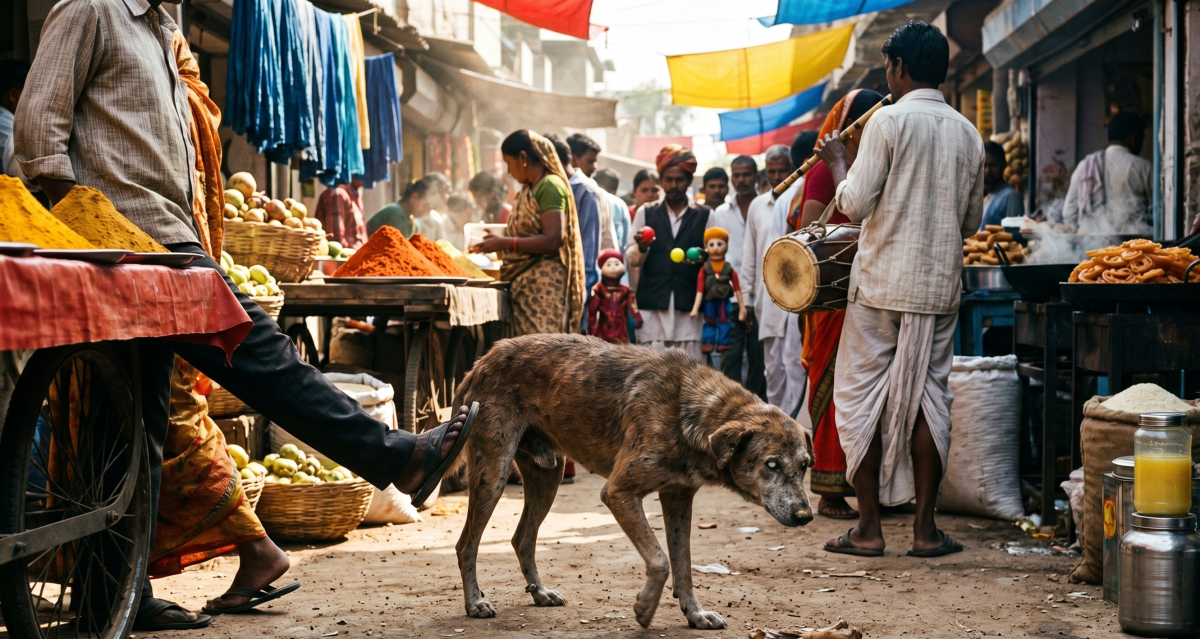
The blind dog comes to the fair

Ever feel like you’re running in circles, chasing things that look amazing but leave you feeling empty? 🐕🎪

Over 400 years ago, the legendary saint-poet Purandara Dasa wrote a masterclass in spiritual psychology using a stark, unforgettable metaphor: a blind dog wandering aimlessly into a chaotic village fair.

From treating sacred wisdom as mere “quotable quotes” to chasing fleeting illusions, this timeless piece, Kurudu Naayi Santege Bantante is a brilliant mirror for the human condition in material life.

Read this fresh English poetic adaptation and deep-dive explanation to discover why we get lost in the marketplace of life, and how to find our way back. 👇

#Philosophy #Spirituality #PurandaraDasa #IndianHeritage #PoetryOfLife

“Kurudu Naayi Santege Bantante” (ಕುರುಡು ನಾಯಿ ಸಂತೆಗೆ ಬಂತಂತೆ), composed by the 16th-century saint-poet Purandara Dasa, is a masterpiece. This piece of writing is inspired by Purandara Dasa’s great timeless song. I can’t describe in words how much I love this song.

The Blind Dog at the Fair

A blind dog wandered to the bustling fair, they say,

With sightless eyes and aimless paws, it stumbled on its way.

It knew not rules of traffic, nor where the paths aligned,

And plunged into the chaos, completely lost and blind.

Around it bloomed a riot of colors, vibrant, loud, and bright,

A grand kaleidoscope of life, hidden from its sight:

Mounds of golden turmeric, near heaps of scarlet spice,

Shining jars of liquid ghee, and sacks of polished rice.

Bright banners waved from canvas tents, trinkets caught the sun,

While sweetmeats fried, bubbling, enticing everyone.

Baskets filled with heavy fruits, and garments dyed in blue;

A dazzling sea of worldly wealth, fully out of view.

And through the crowd, the jugglers toss’d rings of painted wood,

While clever, dark-eyed magicians spun illusions where they stood.

With sleight of hand, they turned, stone into silver coin,

Inviting passing, hollow minds to marvel and to join.

The ragged buskers beat their drums and piped on hollow reeds,

Singing songs of fleeting joy to feed people’s greed.

A dancer spun in frantic steps, a puppeter held its string;

A thousand mock distractions in a loud, enchanted ring.

It spurned the trays of honeyed sweets and platters piled high,

To chew upon a broken bone, splintered, sharp, and dry.

Driven by a hungry belly, searching for a scrap,

It walked into a bustling store, right into a trap.

One vendor kicked it from the front, another struck its side,

With nowhere left to turn or run, and nowhere left to hide.

It yelped in pain but did not leave, sniffing for a bone,

Receiving blows of heavy sticks, and bruised by every stone.

For just a taste of garbage, it endured the market’s wrath,

Forgetting there was freedom outside that crowded path.

Such is fate of the mortal man who walks this earthly stage,

He enters into Samsara, a blinding, chaotic cage.

Through countless cycles, endless births, across a weary span,

It passed a million lifetimes just to win the form of man.

Yet blessed with rare human life, a prize beyond compare,

Squander’d; wandering, trapped in despair.

From garden unto garden, grove to grove, blindly runs,

And through the trackless forests, chasing shadows in the sun.

Bound tightly to its wife and child with fierce, attached embrace,

It anchored all its happiness within a changing face;

But when the hour of parting struck and swept them all away,

It stood alone in emptiness, with not a soul to stay.

It read the sacred Vedic texts just to quotable quote,

And left the inner wisdom, a lesson learned by rote.

Blinded it lost its way, despite the sacred lore,

And walked directly to the gates of Yamaraja’s door.

The priceless jewels of divine grace placed within its hand,

Yet like a clueless monkey, scattered in the sand.

And all this happened, all this grief, this tragic, blinding fall,

Because the foolish, wandering soul forgot the Lord of all.

It clean forgot sweet Krishna’s name, forgot Sri Ranga’s grace,

And turned its back on Vitthala to run this worldly race.

Ignorant of the spirit, blind to God’s design,

To chase the worthless dust of earth, rejecting the Divine.

To take the blows of fate and time, but crawl back for more,

Lured by the cheap illusions of the marketplace’s store.

Oh Purandara Vittala, hear a humble soul’s entreat

Guide me away from the market, back to Your lotus feet.

Purandara Dasa is known for using raw, everyday street imagery to convey profound Vedantic philosophy. In this song, he uses a biting, tragicomic allegory, a blind dog causing chaos at a village fair, to deliver a wake-up call to humanity about the nature of material existence.

I cannot ever do justice to his brilliance myself. But I can try to convey my appreciation for his deep devotion to Krishna and compassion upon souls like me.

1. The Blind Dog and the Fair

The core of the song rests on two brilliant metaphors:

  • The Blind Dog (Kurudu Naayi): Represents the spirit soul (Jivatma). It is “blind” because it lacks spiritual wisdom. It is driven entirely by its base, animalistic instincts… hunger, survival, and immediate sensory gratification.
  • The Market/Fair (Sante): Represents the material world (Samsara). A traditional Indian village market is temporary, loud, chaotic, and crowded. It sets up shop for a day and vanishes overnight, mirroring the fleeting, impermanent nature of worldly life.

When the blind dog stumbles into this chaotic marketplace, it has no map, no vision, and no understanding of how the market works. Similarly, souls plunge into the material world completely ignorant of our true purpose, navigating life purely by trial and error, mostly error.

2. Themes and Spiritual Lessons

The Illusion of Material Wealth (Maya)

The song describes the fair as incredibly vibrant, think piles of golden turmeric, scarlet spices, bubbling sweetmeats, jugglers, magicians, and buskers.

Samsara is not a boring wasteland, the material realm is dangerous precisely because it is so dazzling. The magicians and jugglers represent Maya (cosmic illusion). They perform tricks, turning stones into coins, symbolizing how the material world tricks us into believing that temporary worldly pleasures are permanent and valuable.

daivī hy eṣā guṇamayī mama māyā duratyayā / mām eva ye prapadyante māyām etāṁ taranti te

Translation: “This divine energy of Mine, consisting of the three modes of material nature, is difficult to overcome. But those who have surrendered unto Me can easily cross beyond it.”

https://vedabase.io/en/library/bg/7/14

The Misplaced Appetite (The Broken Bone)

One of the most poignant psychological observations in the song is the dog rejecting trays of honeyed sweets to chew on a dry, splintered, broken bone.

When a dog chews a dry bone, the sharp edges cut its own gums. The dog tastes its own blood but mistakenly believes the taste is coming from the bone. Purandara Dasa uses this to describe human desire: we reject the “honeyed sweet” of spiritual freedom and instead chase material pleasures that actively bind and hurt us, foolishly bleeding for joys that are entirely self-inflicted.

viṣayā vinivartante nirāhārasya dehinaḥ / rasa-varjaṁ raso ’py asya paraṁ dṛṣṭvā nivartate

Translation: “The embodied soul may be restricted from sense enjoyment, though the taste for sense objects remains. But, ceasing such engagements by experiencing a higher taste, he is fixed in consciousness.”

https://vedabase.io/en/library/bg/2/59

The Tragedy of Wasted Human Birth

Human life is incredibly rare, earned only after evolving through millions of lower lifetimes (as insects, birds, and animals).

Purandara Dasa laments that after finally achieving this precious human form, the soul wastes it. Instead of seeking Krishna, it walks “from garden to garden, forest to forest”, aimlessly wandering through the thickets of worldly distractions, entirely forgetting its own spiritual identity as an associate of God.

The Illusion of Temporary Relationships

The song sharply tackles human attachment (Moha). The soul binds itself fiercely to a spouse and children, building its entire universe around them. However, Purandara Dasa delivers a sobering truth: when the time of death arrives, the soul is ripped away from this environment. It enters the world alone, and it leaves the world alone. In the final hour, all worldly attachments are snatched away, leaving the soul to face its karmic accounts alone.

The Failure of Empty Intellectualism

Purandara Dasa was highly critical of ritualism and bookish knowledge devoid of true devotion (Bhakti). He notes that the soul might memorize and study all the Vedic texts, but if it lacks inner truth and humility, it will still lose its way. Intellectual pride only blinds the soul further, leading it straight to the gates of Yamaraja (the demigod in charge of Death and Judgment) to face inevitable punishment.

Lord Sri Krishna ridicules those who use the Vedas merely for temporary material gain or prestige (the “flowery words” or “quotable quotes”) rather than realizing that the ultimate purpose of all Vedic study is to know Krishna and serve Him.

yām imāṁ puṣpitāṁ vācaṁ pravadanty avipaścitaḥ / veda-vāda-ratāḥ pārtha nānyad astīti vādinaḥ

Translation: “People of small knowledge are very much attached to the flowery words of the Vedas, which recommend various fruitive activities… They say that there is nothing more than this.”

https://vedabase.io/en/library/bg/2/42-43

The Monkey and the Jewels

The poet uses a famous Kannada phrase, mangana kaiyalli manikyavante (like a precious gemstone in the hands of a monkey). A monkey has no concept of the value of a gemstone; it may simply play with it for a bit, surely get bored, and drop it in the sand somewhere. Divine grace, human consciousness, and the opportunity for spiritual perfection are the “priceless jewels” given to us, which many of us foolishly throw away to chase the worthless dust of material accumulation.

The Root Cause and the Remedy

Ultimately, Purandara Dasa asks: Why does the soul suffer like a stray dog being kicked from one market stall to the next?

The answer is simple: It forgot. It forgot the name of Krishna, it forgot the grace of Sri Ranga (Krishna), and it turned its back on our best friend and well-wisher, Krishna. The continuous “kicks and blows” we receive from fate, time, illness, and heartbreak are the natural consequences of wandering through the marketplace of Samsara unguided.

ye hi saṁsparśa-jā bhogā duḥkha-yonaya eva te / ādy-antavantaḥ kaunteya na teṣu ramate budhaḥ

Translation: “An intelligent person does not take part in the sources of misery, which are due to contact with the material senses. O son of Kuntī, such pleasures have a beginning and an end, and so the wise man does not delight in them.”

https://vedabase.io/en/library/bg/5/22

The wise person walks away from the market stalls of illusion, while the “blind dog” stays and helplessly takes the blows.

The song concludes not in despair, but with the classic signature (Ankita Mudra) of the poet. The only way out of the chaotic, abusive market of materialistic life is to stop chasing the scraps of the world, surrender the false ego, and find permanent refuge at the lotus feet of Purandara Vitthala (Krishna).

sarva-dharmān parityajya mām ekaṁ śaraṇaṁ vraja / ahaṁ tvāṁ sarva-pāpebhyo mokṣayiṣyāmi mā śucaḥ

Translation: “Abandon all varieties of religion and just surrender unto Me. I shall deliver you from all sinful reactions. Do not fear.”

https://vedabase.io/en/library/bg/18/66

I like this song because the song really sings my story, and likely yours. Fortunately for me, my master has already searched out and found me, has claimed me, and by his torchlight of knowledge, my blindness is disappearing rapidly.

This song gives me great hope. I know am on my way back home. Won’t you come with me?

Hear this song in Kannada.

Kannada lyrics and lyrics in latin scripts with diacritics below, with gratitude to Smt. Meera Subbarao. Especially in the original lyrics of the great Purandara Dasa, they have a haunting melody and reminder that stays long after we’ve heard it just once.

Original Lyrics

ಕುರುಡು ನಾಯಿ ಸಂತೆಗೆ ಬಂತಂತೆ || PA ||
ಅದು ಯಾತಕೆ (ಯಾಕೆ) ಬಂತೋ || A PA ||

ಖಂಡ ಸಕ್ಕರೆ ಹಿತವಿಲ್ಲವಂತೆ ಖಂಡ ಎಲುಬು ಕಡಿದಿತಂತೆ
ಹೆಂಡಿರ ಮಕ್ಕಳ ನೆಚ್ಚಿತಂತೆ ಕೊಂಡು ಹೋಗುವಾಗ ಯಾರಿಲ್ಲವಂತೆ || 1 ||

ಭರದಿ ಅಂಗಡಿ ಹೊಕ್ಕಿತಂತೆ ತಿರುವಿ ದೊಣ್ಣೆಲಿ ಇಕ್ಕಿದರಂತೆ
ಮರೆತರಿನ್ನು ವ್ಯರ್ಥವಂತೆ ನರಕದೊಳಗೆ ಬಿದ್ದಿತಂತೆ || 2 ||

ವೇದಶಾಸ್ತ್ರವನೋದಿತಂತೆ ಗಾದೆಯ ಮಾಡಿ ಬಿಟ್ಟಿತಂತೆ
ಹಾದಿ ತಪ್ಪಿ ನಡೆದು ಯಮನ ಬಾಧೆಗೆ ತಾ ಗುರಿಯಾಯಿತಂತೆ || 3 ||

ನಾನಾ ಜನ್ಮವನೆತ್ತಿತಂತೆ ಮಾನವನಾಗಿ ಹುಟ್ಟಿತಂತೆ
ಕಾನನಕಾನನ ತಿರುಗಿತಂತೆ ತಾನು ತನ್ನನೆ ಮರೆಯಿತಂತೆ || 4 ||

ಮಂಗನ ಕೈಯ ಮಾಣಿಕ್ಯದಂತೆ ಹಾಂಗೂ ಹೀಂಗೂ ಕಳೆದೀತಂತೆ
ರಂಗವಿಠಲನ ಮರೆತಿತಂತೆ ಭಂಗ ಬಹಳ ಪಟ್ಟಿತಂತೆ || 5 ||

kuruḍu nāyi santege bantante || PA ||

adu yāke bantō || A PA ||

khaṇḍa sakkare hitavillavante khaṇḍa elubu kaḍiditante

heṇḍira makkaḷa neccitante koṇḍu hōguvāga yārillavante || 1 ||

bharadi aṅgaḍi hokkitante tiruvi doṇṇeli ikkidarante

maretarinnu vyarthavante narakadoḷage bidditante || 2 ||

vēdaśāstravanōditante gādeya māḍi biṭṭitante

hādi tappi naḍedu yamana bādhege tā guriyāyitante || 3 ||

nānā janmavanettitante mānavanāgi huṭṭitante

kānanakānana tirugitante tānu tannane mareyitante || 4 ||

maṅgana kaiya māṇikyadante hāṅgū hīṅgū kaḷedītante

raṅgaviṭhalana maretitante bhaṅga bahaḷa paṭṭitante || 5 ||

I pray never to forget the import of this song, may Sri Purandara Dasa and all the great Vaishnava saints guide me back home.

Hare Krishna Hare Krishna Krishna Krishna Hare Hare Hare Rama Hare Rama Rama Rama Hare Hare
The Hare Krishna Mahamantra

Update: I will be writing a series of posts on this song, as there is so much depth there… This post will be updated to include links to those posts.


Tongue, Belly, Genital Consciousness

How are you living your life? Would you like to relish genuine human life? Or stay on the animal platform?

During a class by my spiritual master, he said this phrase “Tongue, Belly and Genital Consciousness”. When we boil it down to the essential, we see that in this world, practically every one is in the mood of trying to satisfy their tongues, their bellies, and their genitals.

Of course, for creatures other than human, they have no choice but to follow their instinct. The dog must go around and sniff out the urine of other dogs. The birds must peck around and look for that worm. The fish must constantly swim around trying to find something to eat. The male or female of any species must find a mate… eating, sleeping, mating and defending, that’s all animals ever do.

But humans, we have been given a higher consciousness. Yes, to stay alive, we must gratify our senses to some extent. But what happens if we never transcend the urge of the tongue, the pull of the belly, and the itch of the genitals?

We remain animals. Yes, we may travel in the most fancy cars, planes, or yachts, live in the most opulent mansions, wear the most exquisite clothes, but what do we do with all that? Run here and there with our tongues out, trying hard to get some taste, the same taste we have experienced many times, chewing the same old,same old, tongue, belly, genitals. Very polished animals, but animals nevertheless.

Human society is chasing after the next big thing all the time, better clothing, better food, better residences, better conveyances, even wanting to go and live on other planets… what what will we do in all those? Eat, Sleep, Mate, and Defend? Just like the animals.

युक्ताहारविहारस्य युक्तचेष्टस्य कर्मसु ।
युक्तस्वप्‍नावबोधस्य योगो भवति दु:खहा ॥ १७ ॥

yuktāhāra-vihārasya
yukta-ceṣṭasya karmasu
yukta-svapnāvabodhasya
yogo bhavati duḥkha-hā

He who is regulated in his habits of eating, sleeping, recreation and work can mitigate all material pains by practicing the yoga system.

https://vedabase.io/en/library/bg/6/17/

If someone practices yoga, spirituality, or religion simply to improve their sex life, they are no better than an animal.

The scriptures repeatedly extol us to get out of the grip of this eating, sleeping, mating, and defending.

स एव पुनर्निद्राजगरगृहीतोऽन्धे तमसि मग्न: शून्यारण्य इव शेते नान्यत्किञ्चन वेद शव इवापविद्ध: ॥ २० ॥

sa eva punar nidrājagara-gṛhīto ’ndhe tamasi magnaḥ śūnyāraṇya iva śete nānyat-kiñcana veda śava ivāpaviddhaḥ.

Śukadeva Gosvāmī continued speaking to Mahārāja Parīkṣit: My dear King, sleep is exactly like a python. Those who wander in the forest of material life are always devoured by the python of sleep. Being bitten by this python, they always remain in the darkness of ignorance. They are like dead bodies thrown in a distant forest. Thus the conditioned souls cannot understand what is going on in life.

https://vedabase.io/en/library/sb/5/14/20/

But human life means “Nidrāhāra-vihārakādi-vijitau” – to conquer over the pressure of sleep, food, and sense gratification.

The famous 6 Goswamis of Vrindavana did this, but this was not their goal, Rupa Goswami, Sanatana Goswami, Raghunatha Dasa Goswami, Raghunatha Bhatta Goswami, Gopala Bhatta Goswami, and Jiva Goswami were so fully absorbed, practically intoxicated, in Krishna and His associates, that they naturally lost all taste for sense enjoyments, and they were able to sustain themselves with about 2 hours of sleep daily, and hardly any food. In such a state, they left behind personal examples and texts that will prove to be the saviour of humanity.

His Divine Grace A. C. Bhaktivedanta Swami Prabhupada also followed in the footsteps of the 6 Goswamis of Vrindavana.

If we do this, we can proceed to divine life, otherwise, we will descend back to animal life.

What can you do to rise to the platform of genuine human life? How may I serve you on your journey?

What is the difference between occupational duty and prescribed duty?

What is the duty of a human being? What is prescribed? What about our ability? How to ensure that we can do what’s most important, what’s most urgent, and what’s most urgent and important? How to prioritize?

Bhakta Sunil, 06th January 2016

Hare Krishna every one,

Please accept my humble respects
All Glories to Vaishnavas

Please enlighten about occupational duty and prescribed duty , are both same or different?

Thanks in anticipation,
sunil

Prasadj dube, 08th January 2016

Hare Krishna!

Occupational duty means to attend the works of his livelihood. Prescribed duty means doing the eternal service to the Supreme Lord by devotedly chanting his name hare krishna hare krishna .

Prasadj dube

Shyamapriya devi dasi, 08th January 2016

Hare Krishna,

Thank you for this question!

The English dictionary says ‘occupation’ means job or profession and the word ‘prescribed’ means advisable or authorized.

And as per vedic understanding-

Occupational duties or Varnasrama-dharma are duties related to the four divisions of material— (namely brāhmaṇa, kṣatriya, vaiśya and śūdra) and and spiritual life (brahmacarya, gṛhastha, vānaprastha and sannyāsa).[SB 4.20.9] and

Prescribed duties or Sva-dharma mean duties enjoined according to one’s psychophysical condition, under the influence of three modes of material nature. [Bg 3.35]

Srila Prabhupada, explains more on prescribed duties as follows in the purport of Bg 3.35 :

“One should therefore discharge his prescribed duties in full Kṛṣṇa consciousness rather than those prescribed for others. Materially, prescribed duties are duties enjoined according to one’s psychophysical condition, under the spell of the modes of material nature. Spiritual duties are as ordered by the spiritual master for the transcendental service of Kṛṣṇa. But whether material or spiritual, one should stick to his prescribed duties even up to death, rather than imitate another’s prescribed duties. Duties on the spiritual platform and duties on the material platform may be different, but the principle of following the authorized direction is always good for the performer. When one is under the spell of the modes of material nature, one should follow the prescribed rules for his particular situation and should not imitate others. For example, a brāhmaṇa, who is in the mode of goodness, is nonviolent, whereas a kṣatriya, who is in the mode of passion, is allowed to be violent. As such, for a kṣatriya it is better to be vanquished following the rules of violence than to imitate a brāhmaṇa who follows the principles of nonviolence. Everyone has to cleanse his heart by a gradual process, not abruptly. However, when one transcends the modes of material nature and is fully situated in Kṛṣṇa consciousness, he can perform anything and everything under the direction of a bona fide spiritual master. In that complete stage of Kṛṣṇa consciousness, the kṣatriya may act as a brāhmaṇa, or a brāhmaṇa may act as a kṣatriya. In the transcendental stage, the distinctions of the material world do not apply. For example, Viśvāmitra was originally a kṣatriya, but later on he acted as a brāhmaṇa, whereas Paraśurāma was a brāhmaṇa but later on he acted as a kṣatriya. Being transcendentally situated, they could do so; but as long as one is on the material platform, he must perform his duties according to the modes of material nature. At the same time, he must have a full sense of Kṛṣṇa consciousness.” [ Purport Bg 3.35]

From the above reading we understand that, since every living entity (in human form) has acquired a particular nature (under the influence of three modes of nature -goodness, passion and ignorance), the vedic injunction accordingly prescribes one of his duty (through the institution of varna and asrama) by which one can gradually elevate oneself to the stage of transcendence, where one is free from the influence of these three modes.

Now, coming back to your question- both occupational and prescribed duties in vedic sense mean one and the same. i.e the vedic authorities prescribe a living entitiey to take up a certain profession or occupation (as a brahmana, ksatriya, vaisya or sudra) based on one’s pscho-physical condition (a consequence of three modes of nature). Along with this, it also reminds us to perform such duties not with the motive of material gain but to please the Supreme Personality of Godhead ultimately, then only can one be happy and content.

In conclusion, whatever our occupational or prescribed duties may be, the essence remains the same Jivera svarupa haya krsnera nitya dasa. The real occupation duty or Santana-dharma of a spirit soul or a living entity as prescribed by the authorized sources/scriptures like Bhagavad-gita is ultimately to please the Supreme Personality of Godhead, Sri Krishna by eternally serving Him with love.

I would appreciate if others can fill in the lacunae in the above explanation.

Sincerely,
Shyamapriya devi dasi

Guru Vandana devi dasi, 09th January 2016

Hare Krishna!

Srimad Bhagavatam 1.2.6, Suta Goswami says, “The supreme occupation [dharma] for all humanity is that by which men can attain to loving devotional service unto the transcendent Lord. Such devotional service must be unmotivated and uninterrupted to completely satisfy the self.”

Here Srila Prabhupada purposefully translates the word ‘dharma’ as occupation and not as religion. He says the word religion is misunderstood. It is taken as faith which can change but dharma or occupation is which cannot change.

When one is on bodily platform he manufactures some occupation to earn his livelihood according to his body, mind and circumstances. As a medical doctor one may have a livelihood by medical practice, as a civil servant one may serve his country etc.. But these occupations are temporary. It is finished as soon as the body is finished.

The question asked here is to describe about occupational duty. We must now inquire and understand what is our real occupational duty?

In verse 1.2.6 it is mentioned as ‘paro dharma’. Para means transcendental . Suta Goswami explains ‘bhaktih adhoksaje’. Our real dharma is -loving devotional service.

Krishna came to teach us this real occupational duty. The merciful Lord says to just give up all bodily occupation, mental occupation, intellectual occupation and surrender unto Him. It doesn’t mean these occupational duties as an engineer, lawyer, doctor, householder, etc .are not of real consideration and to be given up thinking that devotional service is executed under whatever circumstances we may whimsically decide. Arjuna performed his occupational duty not as a material obligation but as a devotional service.

Prescribed duty- Just like animals if we are simply interested only in eating, sleeping, mating and defending then there are no prescribed duties. But who wants to rise above animal life for him prescribed duties are there. According to the modes of nature Krishna has given prescribed duties in verses BG 18.42, 18.43,18.44

Peacefulness, self-control, austerity, purity, tolerance, honesty, knowledge, wisdom and religiousness—these are the natural qualities by which the brahmanas work.

Heroism, power, determination, resourcefulness, courage in battle, generosity and leadership are the natural qualities of work for the ksatriyas.

Farming, cow protection and business are the natural work for the vaisyas, and for the sudras there is labor and service to others.

When I asked Srila Gurudeva what my prescribed duty is , His Grace replied, “Your prescribed duties are what I give you.”

Are both same or different?

One’s occupational duties are prescribed in scriptures and by Guru and Vaishnavas. So for those who are interested in real occupation both occupational duties and prescribed duties are one and the same.

your servant
Guru Vandana devi dasi

Premananda das, 12th January 2016

Thank you for the wonderful question by Bhakta Sunil and beautiful answers by Mother Guruvandana and Mother ShyamaPriya.

your servant
Premananda Das

Premananda das, 13th January 2016

Hare Krishna

My apologies for the major and very careless typo error .I had written But Krishna was married to Draupati and Subhadara.
I was referring to Arjuna.
This is certainly my fault and only due to kindness and due diligence of Mahabhagavata prabhu I am glad to be corrected.Hare Krishna

Occupational duty is the external activities people are engaged for example a traveling monk,student ,businessman,housewife etc.
Prescibed duty means to make the purpose behind these responsibilities one with the purpose of loving God (Krishna).
This becomes natural when we are in association with saintly people who are already doing that.
It means to give up separate motives.
Lord Krishna told Arjuna .”You should surrender unto me .”But Arjuna was a married man.He was married to Draupadi and Subhadra and he had eight children and even grand children.He was a warrior.After hearing Bhagavat-Gita he did not become a sannyasi, a person in the renounced order.
He performed his duty of fighting because he was a military man and he continued to maintain his family.But he did all these in the spirit of service rather than spirit of greed and exploitation .He did it as an expression of love for God.
In this way he rightly oriented his occupation and domestic situation.He did not renounce it but renounced greed,envy pride and lust .
With a pure state of consciousness and a desire to serve he aspired for the ideal love of God through the situation he was in.
In conclusion as Srimati Gurumata and Srila Gurudeva always instructs that all actives should be dovetailed in Krishna consciousness.Krishna is the Centre of all our activities.Krishna is the Supreme enjoyer and we are His servants who are enjoyed by Him.Jivera swarupa Hoya Nitya Krishna Das. Our constitutional position is that we are all servants of Krishna.In this situation only we will be happy.

your servant
Premananda Das

Dra Varni, 15th January 2016

Hare Krsna, Thanks you for all the wonderful insight. For a contribution I would say to remember “you are not this body”

drv

Bhakta Sunil, 17th February 2016

A delayed but hearty Thank you very much! to prasadj dube Prabhu , Shyamapriya devi mataji , Guru Vandana Devi Mataji , Premananda Prabhu , Dra Varni ji and every one who contributed to enlighten on this nectar which at my stage , i could not dive deeply into , and relish as much as it actually is

All Glories to your replies!

your insignificant servant,
Bhakta Sunil

Please subscribe to daily inspirational emails from His Grace Sriman Sankarshan Das Adhikari (Writings and lectures archived at www.sda-archives.com), written fresh every day from his travels around the world sharing the highest spiritual knowledge with everyone. Sign up now at www.joincourse.com