Is there a festival that doesn’t exclude someone? Is there a festival that benefits everyone who comes across it? Is there such a festival at all?
Hare Krishna!
There are different kinds of festivals. Some celebrate their culture, some celebrate nationality, yet others celebrate a religious event.
Some festivals appeal to, say, Africans, or Indians, or Chinese people… yet other festivals appeal to those who like to drink a particular beverage or eat some particular food.
Some festivals are for children, some are for youth, some are for people pursuing a particular profession or professing a particular cause.
But is there a festival that is for all? Is there a festival that doesn’t exclude anyone?
If there is such a festival, it is called the Jagannatha Ratha Yatra, or the Chariot Festival of Lord Jagannath.
Ah, you may say, that’s an Indian festival… and that may be so, but for the last 50+ years, this festival has expanded to the Americas, Europe, Australia, Africa, every inhabited continent.
You might be forgiven for thinking this is a bunch of sentimental people pulling a cart with a rope, while singing, and dancing, and then feasting…
But there is a deep significance for anyone who comes across even just one of these festivals…
Someone may know nothing about Lord Jagannath or Krishna or any other spiritual matters
Someone may be a highly advanced spiritualists, practically at the cusp of spiritual perfection…
And someone may be someone in between…
This festival has something for everyone, the highest possible opportunity. What is that?
Join to find out!
TOPIC: ISKCON Ottawa Sunday Feast Class
LOCATION: 212 Somerset St E, Ottawa, Canada K1N 6V4
DATE📆: Sunday, 21st July 2024
TIME⌚: 3:30 PM. ET USA+Canada/ 2:30 PM. CT USA/ 12:30 PM PST USA/ 8:30 PM UK/ 4:30 AM MYT/ 2:00 AM IST
I will record audio, and the class will also be broadcast online on zoom.
One who knows the transcendental nature of My appearance and activities does not, upon leaving the body, take his birth again in this material world, but attains My eternal abode, O Arjuna.
Purport
The Lord’s descent from His transcendental abode is already explained in the sixth verse. One who can understand the truth of the appearance of the Personality of Godhead is already liberated from material bondage, and therefore he returns to the kingdom of God immediately after quitting this present material body. Such liberation of the living entity from material bondage is not at all easy. The impersonalists and the yogīs attain liberation only after much trouble and many, many births. Even then, the liberation they achieve – merging into the impersonal brahma-jyotir of the Lord – is only partial, and there is the risk of returning to this material world. But the devotee, simply by understanding the transcendental nature of the body and activities of the Lord, attains the abode of the Lord after ending this body and does not run the risk of returning to this material world. In the Brahma-saṁhitā (5.33) it is stated that the Lord has many, many forms and incarnations: advaitam acyutam anādim ananta-rūpam. Although there are many transcendental forms of the Lord, they are still one and the same Supreme Personality of Godhead. One has to understand this fact with conviction, although it is incomprehensible to mundane scholars and empiric philosophers. As stated in the Vedas (Puruṣa-bodhinī Upaniṣad):
“The one Supreme Personality of Godhead is eternally engaged in many, many transcendental forms in relationships with His unalloyed devotees.” This Vedic version is confirmed in this verse of the Gītā personally by the Lord. He who accepts this truth on the strength of the authority of the Vedas and of the Supreme Personality of Godhead and who does not waste time in philosophical speculations attains the highest perfectional stage of liberation. Simply by accepting this truth on faith, one can, without a doubt, attain liberation. The Vedic version tat tvam asi is actually applied in this case. Anyone who understands Lord Kṛṣṇa to be the Supreme, or who says unto the Lord, “You are the same Supreme Brahman, the Personality of Godhead,” is certainly liberated instantly, and consequently his entrance into the transcendental association of the Lord is guaranteed. In other words, such a faithful devotee of the Lord attains perfection, and this is confirmed by the following Vedic assertion:
tam eva viditvāti mṛtyum eti nānyaḥ panthā vidyate ’yanāya
“One can attain the perfect stage of liberation from birth and death simply by knowing the Lord, the Supreme Personality of Godhead, and there is no other way to achieve this perfection.” (Śvetāśvatara Upaniṣad 3.8) That there is no alternative means that anyone who does not understand Lord Kṛṣṇa as the Supreme Personality of Godhead is surely in the mode of ignorance and consequently he will not attain salvation simply, so to speak, by licking the outer surface of the bottle of honey, or by interpreting the Bhagavad-gītā according to mundane scholarship. Such empiric philosophers may assume very important roles in the material world, but they are not necessarily eligible for liberation. Such puffed-up mundane scholars have to wait for the causeless mercy of the devotee of the Lord. One should therefore cultivate Kṛṣṇa consciousness with faith and knowledge, and in this way attain perfection.
Why the different deities have different roles? Aren’t they all one- svayam bhagwan krsna? Is Gopinath vigraha superior to all deities?
“Śrīla Sanātana Gosvāmī is the ideal spiritual master, for he delivers one the shelter of the lotus feet of Madana-mohana. Even though one may be unable to travel on the field of Vṛndāvana due to forgetfulness of his relationship with the Supreme Personality of Godhead, he can get an adequate opportunity to stay in Vṛndāvana and derive all spiritual benefits by the mercy of Sanātana Gosvāmī. Śrī Govindajī acts exactly like the śikṣā-guru (instructing spiritual master) by teaching Arjuna the Bhagavad-gītā. He is the original preceptor, for He gives us instructions and an opportunity to serve Him. The initiating spiritual master is a personal manifestation of Śrīla Madana-mohana vigraha, whereas the instructing spiritual master is a personal representative of Śrīla Govindadeva vigraha. Both of these Deities are worshiped at Vṛndāvana. Śrīla Gopīnātha is the ultimate attraction in spiritual realization.”
Answer:
Yes, Krishna is one. Just like a multi-faceted diamond shines in different colours, similarly Krishna manifests differently according to the need and desire of the devotee…
Take for example, a man… in the business world he may be called as “Mr. Rana”, by his friends as “Arpit”, by his wife as “honey” by his juniors as “sir”, by his friends as “Arpi”, by his kids as “dad”… and so on. It is not that the person is different, he is the same person, but manifesting differently to different people… he’s doing business in one place, obeying instructions in another place, and so on…
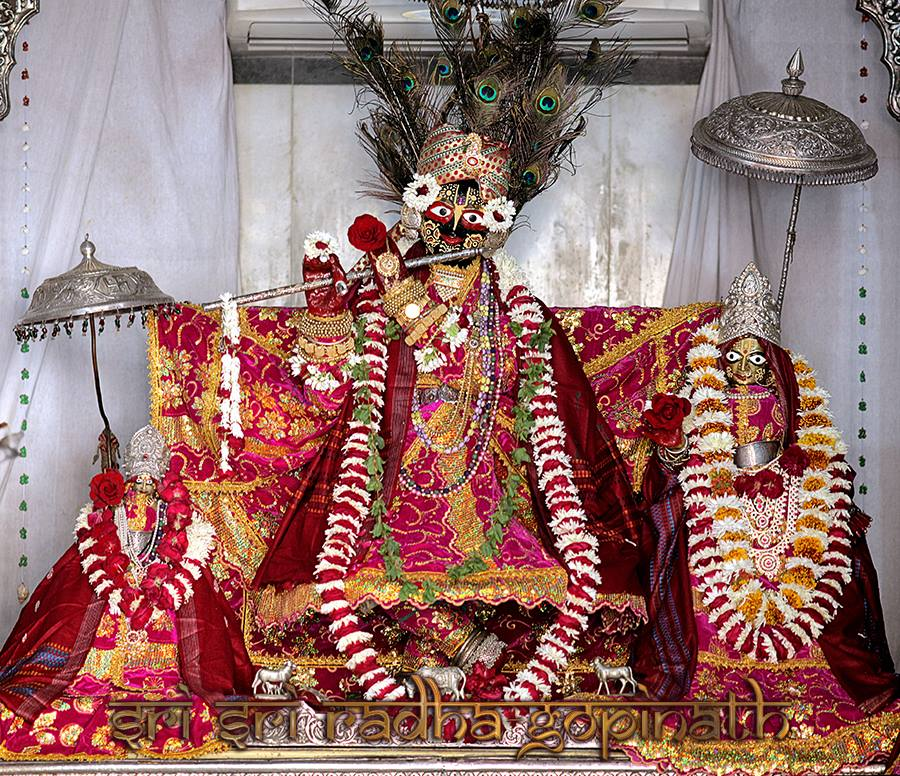
For example, we have Sri Radha Khirchor Gopinath on the altar, but to the person who is an atheist They manifest as a statue, to a person fearful of his mistakes, They appear as the Lawgivers… to a person in the mood of awe and reverence or not yet pure devotee… as Sri Lakshmi Narayana, in Their opulence etc.
What to speak of the deity… even Krishna will manifest Himself as the ishta deva of His devotee… for example to Murari Gupta, Chaitanya Mahaprabhu manifested as Lord Ramachandra as Murari Gupta is an incarnation of Hanuman… to one devotee as Varahadeva, to another as Narasimhadeva… when Krishna disappeared during the Rasa Lila, He tried to conceal Himself by appearing as Four-handed Narayana… but the Gopis’ love was so intense he couldn’t contain himself and appeared as Shyamasundar Krishna!
You will find many such instructions in the scriptures.
Please continue reading scrutinizingly and in a prayerful mood… does this help? Are there any other questions?
Lord Chaitanya Instructs Sanatana Goswami
Sri Radha Madana-Mohana, now in Karauli, Rajasthan, India
Sri Radha Govindaji, now in Jaipur, Rajasthan, India
Sri Radha Gopinath, now in Jaipur, Rajasthan, India
Prahlada was a boy saint, all of 5 years old when his loving devotion attracted the Lord, known as Narasimha, to appear in His half-man half-lion incarnation. We will discuss the life, character, and instructions of Prahlada…
Hare Krishna!
ISKCON Kitchener-Waterloo-Cambridge is hosting a program on the occasion of Sri Narasimha Chaturdashi, the appearance of the half-man half-lion incarnation of God.
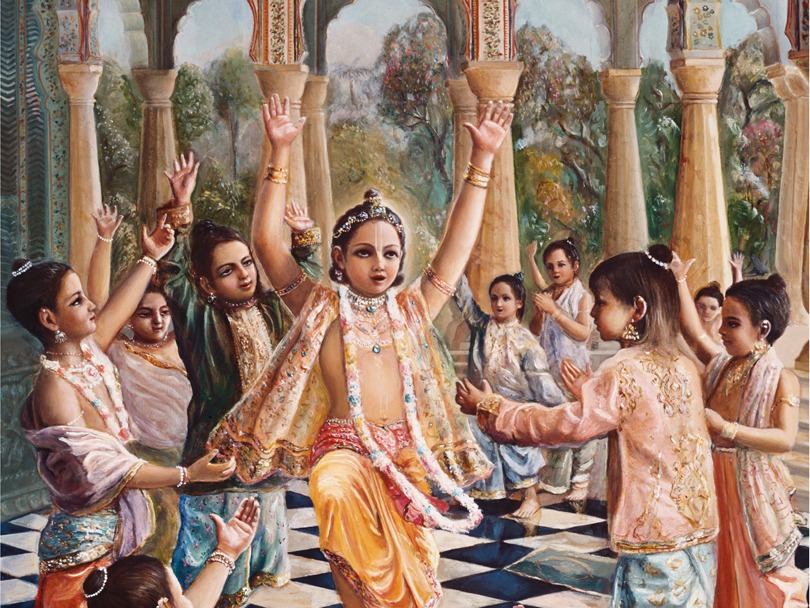
Prahlada dancing and chanting and instructing his classmates
DATE📆: Saturday, 25th May 2024
TIME⌚: 12:30 PM ET USA/ 11:30 AM CT USA/ 9:30 AM PST USA/ 6:00 PM UK/ 10:00 PM IST
PLACE: 405 King St N Waterloo, Ontario, Canada
The class will be available in person, broadcast online, and later as a recording. If you don’t know how to access the online broadcast, please contact.
Please join in person or online if you’re interested in joining this class, or let me know if you want to get a link to the recording.
Please read this summary from Srimad Bhagavatam Canto 7 (The Science of God), Chapters 5-10, for more information about the subject matter of the class.
Prahlāda Mahārāja, the Saintly Son of Hiraṇyakaśipu
Prahlāda Mahārāja did not carry out the orders of his teachers, for he was always engaged in worshiping Lord Viṣṇu. As described in this chapter, Hiraṇyakaśipu tried to kill Prahlāda Mahārāja, even by having a snake bite him and by putting him under the feet of elephants, yet he was unsuccessful.
Hiraṇyakaśipu’s spiritual master, Śukrācārya, had two sons named Ṣaṇḍa and Amarka, to whom Prahlāda Mahārāja was entrusted for education. Although the teachers tried to educate the boy Prahlāda in politics, economics and other material activities, he did not care for their instructions. Instead, he continued to be a pure devotee. Prahlāda Mahārāja never liked the idea of discriminating between one’s friends and enemies. Because he was spiritually inclined, he was equal toward everyone.
Once upon a time, Hiraṇyakaśipu inquired from his son what the best thing was that he had learned from his teachers. Prahlāda Mahārāja replied that a man engrossed in the material consciousness of duality, thinking, “This is mine, and that belongs to my enemy,” should give up his householder life and go to the forest to worship the Supreme Lord.
When Hiraṇyakaśipu heard from his son about devotional service, he decided that this small boy had been polluted by some friend in school. Thus he advised the teachers to take care of the boy so that he would not become a Kṛṣṇa conscious devotee. However, when the teachers inquired from Prahlāda Mahārāja why he was going against their teachings, Prahlāda Mahārāja taught the teachers that the mentality of ownership is false and that he was therefore trying to become an unalloyed devotee of Lord Viṣṇu. The teachers, being very angry at this answer, chastised and threatened the boy with many fearful conditions. They taught him to the best of their ability and then brought him before his father.
Hiraṇyakaśipu affectionately took his son Prahlāda on his lap and then inquired from him what the best thing was that he had learned from his teachers. As usual, Prahlāda Mahārāja began praising the nine processes of devotional service, such as śravaṇam and kīrtanam. Thus the King of the demons, Hiraṇyakaśipu, being extremely angry, chastised the teachers, Ṣaṇḍa and Amarka, for having wrongly trained Prahlāda Mahārāja. The so-called teachers informed the King that Prahlāda Mahārāja was automatically a devotee and did not listen to their instructions. When they proved themselves innocent, Hiraṇyakaśipu inquired from Prahlāda where he had learned viṣṇu-bhakti. Prahlāda Mahārāja replied that those who are attached to family life do not develop Kṛṣṇa consciousness, either personally or collectively. Instead, they suffer repeated birth and death in this material world and continue simply chewing the chewed. Prahlāda explained that the duty of every man is to take shelter of a pure devotee and thus become eligible to understand Kṛṣṇa consciousness.
Enraged at this answer, Hiraṇyakaśipu threw Prahlāda Mahārāja from his lap. Since Prahlāda was so treacherous that he had become a devotee of Viṣṇu, who had killed his uncle Hiraṇyākṣa, Hiraṇyakaśipu asked his assistants to kill him. The assistants of Hiraṇyakaśipu struck Prahlāda with sharp weapons, threw him under the feet of elephants, subjected him to hellish conditions, threw him from the peak of a mountain and tried to kill him in thousands of other ways, but they were unsuccessful. Hiraṇyakaśipu therefore became increasingly afraid of his son Prahlāda Mahārāja and arrested him. The sons of Hiraṇyakaśipu’s spiritual master, Śukrācārya, began teaching Prahlāda in their own way, but Prahlāda Mahārāja did not accept their instructions. While the teachers were absent from the classroom, Prahlāda Mahārāja began to preach Kṛṣṇa consciousness in the school, and by his instructions all his class friends, the sons of the demons, became devotees like him.
Prahlāda Instructs His Demoniac Schoolmates
This chapter describes Prahlāda Mahārāja’s instructions to his class friends. In speaking to his friends, who were all sons of demons, Prahlāda Mahārāja stressed that every living entity, especially in human society, must be interested in spiritual realization from the very beginning of life. When human beings are children, they should be taught that the Supreme Personality of Godhead is the worshipable Deity for everyone. One should not be very much interested in material enjoyment; instead, one should be satisfied with whatever material profits are easily obtainable, and because the duration of one’s life is very short, one should utilize every moment for spiritual advancement. One may wrongly think, “In the beginning of our lives let us enjoy material facilities, and in old age we may become Kṛṣṇa conscious.” Such materialistic thoughts are always useless because in old age one cannot be trained in the spiritual way of life. Therefore, from the very beginning of life, one should engage in devotional service (śravaṇaṁ kīrtanaṁ viṣṇoḥ). This is the duty of all living entities. Material education is infected by the three modes of nature, but spiritual education, for which there is a great need in human society, is transcendental. Prahlāda Mahārāja disclosed the secret of how he had received instructions from Nārada Muni. By accepting the lotus feet of Prahlāda Mahārāja, who is in the paramparā succession, one will be able to understand the mode of spiritual life. In accepting this mode of activity, there is no need for material qualifications.
After Prahlāda Mahārāja’s class friends had listened to Prahlāda Mahārāja, they inquired how he had become so learned and advanced. In this way the chapter ends.
What Prahlāda Learned in the Womb
In this chapter, to dissipate the doubts of his class friends, the sons of the demons, Prahlāda Mahārāja states how, within the womb of his mother, he had heard from the mouth of Nārada Muni, who had instructed him in bhāgavata-dharma.
When Hiraṇyakaśipu left his kingdom and went to the mountain known as Mandarācala to execute severe austerities, all the demons scattered. Hiraṇyakaśipu’s wife, Kayādhu, was pregnant at that time, and the demigods, mistakenly thinking that she carried another demon in her womb, arrested her. Their plan was that as soon as the child took birth they would kill him. While they were taking Kayādhu to the heavenly planets, they met Nārada Muni, who stopped them from taking her away and took her to his āśrama until Hiraṇyakaśipu’s return. In Nārada Muni’s āśrama, Kayādhu prayed for the protection of the baby in her womb, and Nārada Muni reassured her and gave her instructions on spiritual knowledge. Taking advantage of those instructions, Prahlāda Mahārāja, although a small baby within the womb, listened very carefully. The spirit soul is always apart from the material body. There is no change in the spiritual form of the living entity. Any person above the bodily conception of life is pure and can receive transcendental knowledge. This transcendental knowledge is devotional service, and Prahlāda Mahārāja, while living in the womb of his mother, received instructions in devotional service from Nārada Muni. Any person engaged in the service of the Lord through the instructions of a bona fide spiritual master is immediately liberated, and being free from the clutches of māyā, he is relieved of all ignorance and material desires. The duty of everyone is to take shelter of the Supreme Lord and thus become free from all material desires. Regardless of the material condition in which one is situated, one can achieve this perfection. Devotional service is not dependent on the material activities of austerity, penance, mystic yoga or piety. Even without such assets, one can achieve devotional service through the mercy of a pure devotee.Text 1: Nārada Muni said: Although Prahlāda Mahārāja was born in a family of asuras, he was the greatest of all devotees. Having thus been questioned by his class friends, the sons of the asuras, he remembered the words spoken to him by me and replied to his friends as follows.
Lord Nṛsiṁhadeva Slays the King of the Demons
As described in this chapter, Hiraṇyakaśipu was ready to kill his own son Prahlāda Mahārāja, but the Supreme Personality of Godhead appeared in front of the demon as Śrī Nṛkeśarī, half lion and half man, and killed him.
Following the instructions of Prahlāda Mahārāja, all the sons of the demons became attached to Lord Viṣṇu, the Supreme Personality of Godhead. When this attachment became pronounced, their teachers, Ṣaṇḍa and Amarka, were very much afraid that the boys would become more and more devoted to the Lord. In a helpless condition, they approached Hiraṇyakaśipu and described in detail the effect of Prahlāda’s preaching. After hearing of this, Hiraṇyakaśipu decided to kill his son Prahlāda. Hiraṇyakaśipu was so angry that Prahlāda Mahārāja fell down at his feet and said many things just to pacify him, but he was unsuccessful in satisfying his demoniac father. Hiraṇyakaśipu, as a typical demon, began to advertise himself as being greater than the Supreme Personality of Godhead, but Prahlāda Mahārāja challenged him, saying that Hiraṇyakaśipu was not God, and began to glorify the Supreme Personality of Godhead, declaring that the Lord is all-pervading, that everything is under Him, and that no one is equal to or greater than Him. Thus he requested his father to be submissive to the omnipotent Supreme Lord.
The more Prahlāda Mahārāja glorified the Supreme Personality of Godhead, the more angry and agitated the demon became. Hiraṇyakaśipu asked his Vaiṣṇava son whether his God existed within the columns of the palace, and Prahlāda Mahārāja immediately accepted that since the Lord is present everywhere, He was also present within the columns. When Hiraṇyakaśipu heard this philosophy from his young son, he derided the boy’s statement as just the talk of a child and forcefully struck the pillar with his fist.
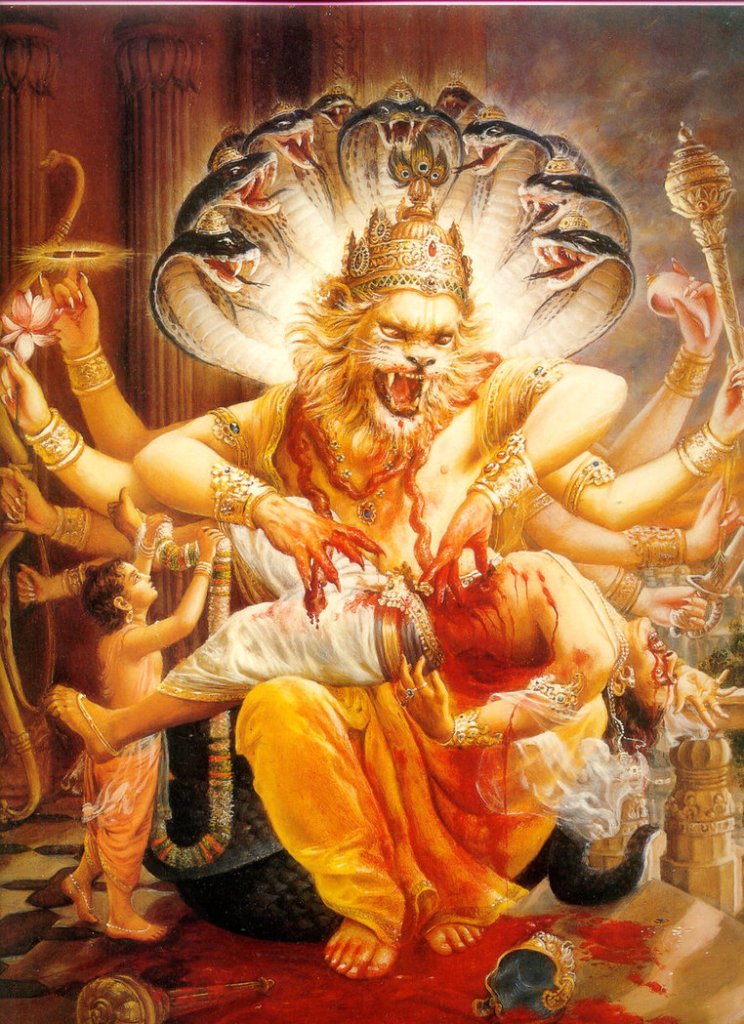
As soon as Hiraṇyakaśipu struck the column, there issued forth a tumultuous sound. At first Hiraṇyakaśipu, the King of the demons, could not see anything but the pillar, but to substantiate Prahlāda’s statements, the Lord came out of the pillar in His wonderful incarnation as Narasiṁha, half lion and half man. Hiraṇyakaśipu could immediately understand that the extraordinarily wonderful form of the Lord was surely meant for his death, and thus he prepared to fight with the form of half lion and half man. The Lord performed His pastimes by fighting with the demon for some time, and in the evening, on the border between day and night, the Lord captured the demon, threw him on His lap, and killed him by piercing his abdomen with His nails. The Lord not only killed Hiraṇyakaśipu, the King of the demons, but also killed many of his followers. When there was no one else to fight, the Lord, roaring with anger, sat down on Hiraṇyakaśipu’s throne.
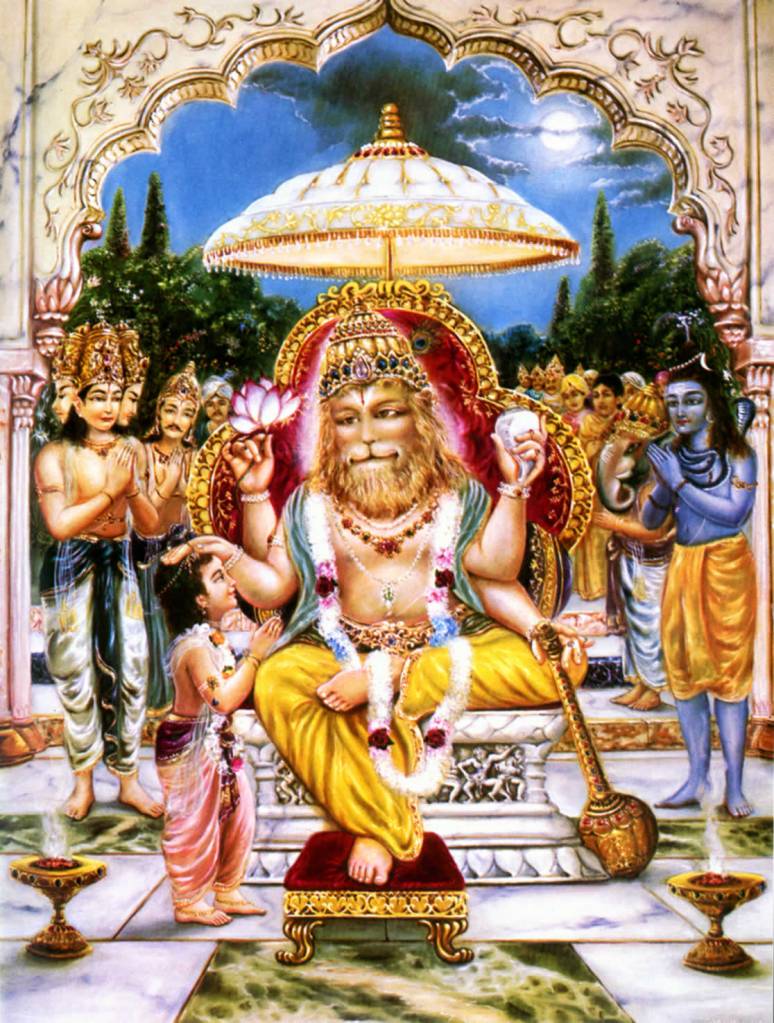
The entire universe was thus relieved of the rule of Hiraṇyakaśipu, and everyone was jubilant in transcendental bliss. Then all the demigods, headed by Lord Brahmā, approached the Lord. These included the great saintly persons, the Pitās, the Siddhas, the Vidyādharas, the Nāgas, the Manus, the prajāpatis, the Gandharvas, the Cāraṇas, the Yakṣas, the Kimpuruṣas, the Vaitālikas, the Kinnaras and also many other varieties of beings in human form. All of them stood not far from the Supreme Personality of Godhead and began offering their prayers unto the Lord, whose spiritual effulgence was brilliant as He sat on the throne.
Prahlāda Pacifies Lord Nṛsiṁhadeva with Prayers
As related in this chapter, Prahlāda Mahārāja, following the order of Lord Brahmā, pacified the Lord when the Lord was extremely angry after having killed Hiraṇyakaśipu.
After Hiraṇyakaśipu was killed, the Lord continued to be very angry, and the demigods, headed by Lord Brahmā, could not pacify Him. Even mother Lakṣmī, the goddess of fortune, the constant companion of Nārāyaṇa, could not dare come before Lord Nṛsiṁhadeva. Then Lord Brahmā asked Prahlāda Mahārāja to go forward and pacify the Lord’s anger. Prahlāda Mahārāja, being confident of the affection of his master, Lord Nṛsiṁhadeva, was not afraid at all. He very gravely appeared before the Lord’s lotus feet and offered Him respectful obeisances. Lord Nṛsiṁhadeva, being very much affectionate toward Prahlāda Mahārāja, put His hand on Prahlāda’s head, and because of being personally touched by the Lord, Prahlāda Mahārāja immediately achieved brahma-jñāna, spiritual knowledge. Thus he offered his prayers to the Lord in full spiritual knowledge and full devotional ecstasy. The instructions given by Prahlāda Mahārāja in the form of his prayers are as follows.
Prahlāda said, “I am not proud of being able to offer prayers to the Supreme Personality of Godhead. I simply take shelter of the mercy of the Lord, for without devotion one cannot appease Him. One cannot please the Supreme Personality of Godhead simply by dint of high parentage or great opulence, learning, austerity, penance or mystic power. Indeed, these are never pleasing to the Supreme Lord, for nothing can please Him but pure devotional service. Even if a nondevotee is a brāhmaṇa qualified with the twelve brahminical symptoms, he cannot be very dear to the Lord, whereas if a person born in a family of dog-eaters is a devotee, the Lord can accept his prayers. The Lord does not need anyone’s prayers, but if a devotee offers his prayers to the Lord, the devotee benefits greatly. Ignorant persons born in low families, therefore, can sincerely offer heartfelt prayers to the Lord, and the Lord will accept them. As soon as one offers his prayers to the Lord, he is immediately situated on the Brahman platform.”
Lord Nṛsiṁhadeva appeared for the benefit of all human society, not only for Prahlāda’s personal benefit. The fierce form of Lord Nṛsiṁhadeva may appear most awful to a nondevotee, but to the devotee the Lord is always affectionate as He is in other forms. Conditioned life in the material world is actually extremely fearful; indeed, a devotee is not afraid of anything else. Fear of material existence is due to false ego. Therefore the ultimate goal of life for every living entity is to attain the position of being servant of the servant of the Lord. The miserable condition of the living entities in the material world can be remedied only by the mercy of the Lord. Although there are so-called material protectors like Lord Brahmā and the other demigods, or even one’s own father, they are unable to do anything if one is neglected by the Supreme Personality of Godhead. However, one who has fully taken shelter of the Lord’s lotus feet can be saved from the onslaught of material nature. Therefore every living entity should be unattracted by material so-called happiness and should take shelter of the Lord by all means. That is the mission of human life. To be attracted by sense gratification is simply foolish. Whether one is a devotee of the Lord or is a nondevotee does not depend upon one’s birth in a high or low family. Even Lord Brahmā and the goddess of fortune cannot achieve the full favor of the Lord, whereas a devotee can very easily attain such devotional service. The Lord’s mercy is bestowed equally upon everyone, regardless of whether one is high or low. Because Prahlāda Mahārāja was blessed by Nārada Muni, Prahlāda became a great devotee. The Lord always saves the devotee from impersonalists and voidists. The Lord is present in everyone’s heart as the Supersoul to give the living being protection and all benefits. Thus the Lord acts sometimes as the killer and sometimes as the protector. One should not accuse the Lord for any discrepancies. It is His plan that we see varieties of life within this material world. All of them are ultimately His mercy.
Although the entire cosmic manifestation is nondifferent, the material world is nonetheless different from the spiritual world. Only by the mercy of the Supreme Lord can one understand how the wonderful material nature acts. For example, although Lord Brahmā appeared from the lotus seat that had grown from the abdomen of Garbhodakaśāyī Viṣṇu, he could not understand what to do after his appearance. He was attacked by two demons, Madhu and Kaiṭabha, who took away Vedic knowledge, but the Lord killed them and entrusted to Lord Brahmā the Vedic knowledge. Thus the Lord appears in every millennium in the societies of demigods, human beings, animals, saints and aquatics. All such incarnations are meant to protect the devotees and kill the demons, but this killing and protecting does not reflect any sense of partiality on the part of the Supreme Lord. The conditioned soul is always attracted by the external energy. Therefore he is subjected to lust and greed, and he suffers under the conditions of material nature. The Lord’s causeless mercy toward His devotee is the only means by which to get out of material existence. Anyone engaged in glorifying the Lord’s activities is always unafraid of this material world, whereas one who cannot glorify the Lord in that way is subjected to all lamentation.
Those interested in silently worshiping the Lord in solitary places may be eligible for liberation themselves, but a pure devotee is always aggrieved to see others suffering. Therefore, not caring for his own liberation, he always engages in preaching by glorifying the Lord. Prahlāda Mahārāja, therefore, had tried to deliver his class friends by preaching and had never remained silent. Although being silent, observing austerities and penances, learning the Vedic literature, undergoing ritualistic ceremonies, living in a solitary place and performing japa and transcendental meditation are approved means of liberation, they are meant for nondevotees or for cheaters who want to live at the expense of others. A pure devotee, however, being freed from all such deceptive activities, is able to see the Lord face to face.
The atomic theory of the composition of the cosmic manifestation is not factual. The Lord is the cause of everything, and therefore He is the cause of this creation. One should therefore always engage in devotional service by offering respectful obeisances to the Lord, offering prayers, working for the Lord, worshiping the Lord in the temple, always remembering the Lord and always hearing about His transcendental activities. Without these six kinds of activity, one cannot attain to devotional service.
Prahlāda Mahārāja thus offered his prayers to the Supreme Lord, begging His mercy at every step. Lord Nṛsiṁhadeva was pacified by Prahlāda Mahārāja’s prayers and wanted to give him benedictions by which Prahlāda could procure all kinds of material facilities. Prahlāda Mahārāja, however, was not misled by material facilities. Rather, he wanted to remain always a servant of the servant of the Lord.
Prahlāda, the Best Among Exalted Devotees
This chapter describes how the Supreme Personality of Godhead Nṛsiṁhadeva disappeared, after pleasing Prahlāda Mahārāja. It also describes a benediction given by Lord Śiva.
Lord Nṛsiṁhadeva wanted to bestow benedictions upon Prahlāda Mahārāja, one after another, but Prahlāda Mahārāja, thinking them impediments on the path of spiritual progress, did not accept any of them. Instead, he fully surrendered at the Lord’s lotus feet. He said: “If anyone engaged in the devotional service of the Lord prays for personal sense gratification, he cannot be called a pure devotee or even a devotee. He may be called only a merchant engaged in the business of give and take. Similarly, a master who wants to please his servant after taking service from him is also not a real master.” Prahlāda Mahārāja, therefore, did not ask anything from the Supreme Personality of Godhead. Rather, he said that if the Lord wanted to give him a benediction, he wanted the Lord to assure him that he would never be induced to take any benedictions for the sake of material desires. Exchanges of devotional service for lusty desires are always very prominent. As soon as lusty desires awaken, one’s senses, mind, life, soul, religious principles, patience, intelligence, shyness, beauty, strength, memory and truthfulness are all vanquished. One can render unalloyed devotional service only when there are no material desires in one’s mind.
The Supreme Personality of Godhead was greatly pleased with Prahlāda Mahārāja for his unalloyed devotion, yet the Lord provided him one material benediction — that he would be perfectly happy in this world and live his next life in Vaikuṇṭha. The Lord gave him the benediction that he would be the king of this material world until the end of the manvantara millennium and that although in this material world, he would have the facility to hear the glories of the Lord and depend fully on the Lord, performing service to Him in uncontaminated bhakti-yoga. The Lord advised Prahlāda to perform sacrifices through bhakti-yoga, for this is the duty of a king.
Prahlāda Mahārāja accepted whatever the Lord had offered him, and he prayed for the Lord to deliver his father. In response to this prayer, the Lord assured him that in the family of such a pure devotee as he, not only the devotee’s father but his forefathers for twenty-one generations are liberated. The Lord also asked Prahlāda to perform the ritualistic ceremonies appropriate after his father’s death.
Then Lord Brahmā, who was also present, offered many prayers to the Lord, expressing his obligation to the Lord for having offered benedictions to Prahlāda Mahārāja. The Lord advised Lord Brahmā not to offer benedictions to asuras as he had to Hiraṇyakaśipu, for such benedictions indulge them. Then Lord Nṛsiṁhadeva disappeared. On that day, Prahlāda Mahārāja was installed on the throne of the world by Lord Brahmā and Śukrācārya.
Thus Nārada Muni described the character of Prahlāda Mahārāja for Yudhiṣṭhira Mahārāja, and he further described the killing of Rāvaṇa by Lord Rāmacandra and the killing of Śiśupāla and Dantavakra in Dvāpara-yuga. Śiśupāla, of course, had merged into the existence of the Lord and thus achieved sāyujya-mukti. Nārada Muni praised Yudhiṣṭhira Mahārāja because the Supreme Lord, Kṛṣṇa, was the greatest well-wisher and friend of the Pāṇḍavas and almost always stayed in their house. Thus the fortune of the Pāṇḍavas was greater than that of Prahlāda Mahārāja.
Later, Nārada Muni described how the demon Maya Dānava constructed Tripura for the demons, who became very powerful and defeated the demigods. Because of this defeat, Lord Rudra, Śiva, dismantled Tripura; thus he became famous as Tripurāri. For this, Rudra is very much appreciated and worshiped by the demigods. This narration occurs at the end of the chapter.
The rules and regulations of the scripture are meant for purification. But all rules and regulations are within the mercy of the Lord, in other words, God is not a mechanical robot who prescribes punishments for unavoidable or accidental oversight of the rules. One should remember that God is not trying to catch us doing something wrong. We are almost always doing something or the other wrong. God is trying to catch us doing something right.
Question:
I did Ekadasi fast yesterday and time to end the fast was this morning – I hope I didn’t make a big mistake but I broke fast about 3 minutes after window of time.
Please can you advise how to not be punished too much for this as I’ve done most fasting for years and within prescribed times.
Demigods pray to Lord Vishnu at the boundary of the milk ocean
Background:
Spiritualists from all traditions have some form of fasting as part of their spiritual practices… Some Muslims fast for the month of Ramadan. Some Christians fast for Lent, before Easter. Some Jews fast on Yom Kippur and other days.
Vaishnavas, or those who follow the ancient texts such as the Bhagavad Gita and Srimad Bhagavatam, fast on several occasions, such as Ekadasi, the 11th day of each fortnight of the waxing and waning moon. There are specific rules for such fasting, such as the time when one ends the fast.
Answer:
Srila Prabhupada didn’t emphasize the time of ending one’s fast. We do try, but sometimes it just doesn’t work out.
For example yesterday I was in service from 4:45am-10pm, almost practically continuously. Then this morning I was in service again from 4:30am till now, approximately 5pm. There is still chanting to complete and the evening service of the Lord. I could only take breakfast at 7:45am, more than an hour after the official time to end fast today.
I’m not telling you all this for any other reason except to ask you… What sort of merciful Lord is Sri Krishna who gave the position of His Mother to Putana who came to kill Him disguising herself as a mother but smearing deadly poison on her breast?
So why will Krishna overlook your daily worship and sadhana and instead make you liable for a 3min delay in ending your fast? Can you see I’m trying to help you see the sweet merciful character of Sri Krishna who is all-merciful?
That is really the difference between Karma Kanda and Bhakti. In Bhakti we take shelter of the causeless mercy of the Lord.
And even if Krishna wants to use something that is like sinful reactions for my purification, my Lord is my best well-wisher so whatever He is is for my own best benefit. Please take full shelter of the lotus feet of Sri Krishna. Depend upon Him.
Is it OK to eat or drink water in front of the Deity?
Sudhanshu Soni, 22 July 2019
Hare Krishna
Please accept my humble obeisance
All glories to Srila Prabhupada
All glories to Srila Gurudeva
Hare Krishna as far as I know in front of deity we should not eat anything but I have seen many time devotee drinking water in front of altar many times especially during chanting they keep bottle with them or while having Bhagavatam class.
I wanted to know what is acceptable or prohibited in it and why is it so…
Thank you so much
your servant
Sudhanshu
Manian VB, 22 July 2019
Water is the human necessity.if they drink water during Bhagavatam classes or during chanting
Manian
Priya Sundari devi dasi, 22 July 2019
Hare Krishna Prabhu.
From what the Nectar of Devotion (Bhakti Rasamrita Sindhu) states, in Chapter 8 (Offenses to be avoided) –
One should not eat / accept / honor prasadam in front of the deities yes.
If the curtains are closed ie deities are resting then it is ok from what I have seen in various temples. Water is not considered a food in that sense so it is accepted. Same with Caranamrita – which is why after the darshan arati in the morning, devotees are given caranamrita and they wash their hands and mouth once it is honored.
I hope this helps answer your question.
your servant,
Priya Sundari devi dasi
*Kṛṣṇe matir astu*
Sudhanshu soni, 24 July 2019
Thank you so much Mata ji.
your servant,
Sudhanshu
Please subscribe to daily inspirational emails from His Grace Sriman Sankarshan Das Adhikari (Writings and lectures archived at sda-archives.com), written fresh every day from his travels around the world sharing the highest spiritual knowledge with everyone. Sign up now at www.joincourse.com
Krishna says He is Meru. Krishna also says He is Govardhan? And in some places it is mentioned that Govardhan is a devotee of Krishna. How is all this possible?
Brajanath Das, 12 November 2016
Hare Krishna Dear Devotees,
I offer to you my respectful obeisances!
All glories to Srila Prabhupada!
All glories to Srila Gurudeva!
Please help me to understand –
In Bg 10.23 Krishna says “… and of mountains I am Meru.” Then who is Govardhana? Govardhana is Krishna or His devotee?
your servant, Brajanath Das
Mahabhagavat Das SDA, 03 December 2016
Dear Brajanath Prabhu,
Please accept my humble obeisances. All glories to Srila Gurudeva. All glories to Srila Prabhupada.
Wrt. “In Bg 10.23 Krishna says “… and of mountains I am Meru.” Then who is Govardhana? Govardhana is Krishna or His devotee?”
It is incorrect to think that Krishna can be either one or the other. Krishna is unlimited.
In SB 10.24.35, this is the direct statement of Krishna:
“Kṛṣṇa then assumed an unprecedented, huge form to instill faith in the cowherd men. Declaring “I am Govardhana Mountain!” He ate the abundant offerings.”
The purport states this:
quote In Chapter Twenty-four of Kṛṣṇa, the Supreme Personality of Godhead, Śrīla Prabhupāda writes: “When everything was complete, Kṛṣṇa assumed a great transcendental form and declared to the inhabitants of Vṛndāvana that He was Himself Govardhana Hill in order to convince the devotees that Govardhana Hill and Kṛṣṇa Himself are identical. Then Kṛṣṇa began to eat all the food offered there. The identity of Kṛṣṇa and Govardhana Hill is still honored, and great devotees take rocks from Govardhana Hill and worship them exactly as they worship the Deity of Kṛṣṇa in the temples. The followers of the Krsna consciousness movement may therefore collect small rocks or pebbles from Govardhana Hill and worship them at home, because this worship is as good as Deity worship.”
Lord Kṛṣṇa had induced the residents of Vṛndāvana to assume a significant risk on His behalf. He convinced them to neglect a sacrifice to what is, after all, the powerful government of the universe and to worship a hill called Govardhana instead. The cowherd community did all this simply out of love for Kṛṣṇa, and now to convince them that their decision was correct, Lord Kṛṣṇa appeared in an unprecedented, huge transcendental form and demonstrated that He Himself was Govardhana Hill.
unquote
Also, in the 10th chapter of Bhagavad Gita, Krishna is answering these questions by Arjuna:
Bg 10.16 — Please tell me in detail of Your divine opulences by which You pervade all these worlds. Bg 10.17 — O Kṛṣṇa, O supreme mystic, how shall I constantly think of You, and how shall I know You? In what various forms are You to be remembered, O Supreme Personality of Godhead? Bg 10.18 — O Janārdana, again please describe in detail the mystic power of Your opulences. I am never satiated in hearing about You, for the more I hear the more I want to taste the nectar of Your words.
The words of Krishna describe His opulences. But His opulences are unlimited, still Krishna wants to give a hint of His greatness. For example, it is not that Krishna is every shark or every banyan tree, or the Gandharva named Chitraratha… But we can understand that the opulence of every shark, every banyan tree, that is a spark of Krishna’s splendor.
Srila Prabhupada writes this in the purport to BG 10.40:
“As stated in the Vedic literature, although the opulences and energies of the Supreme are understood in various ways, there is no limit to such opulences; therefore not all the opulences and energies can be explained. Simply a few examples are being described to Arjuna to pacify his inquisitiveness.”
Srila Prabhupada writes in the purport to BG 10.42:
“The Supreme Lord is represented throughout the entire material universes by His entering into all things as the Supersoul. The Lord here tells Arjuna that there is no point in understanding how things exist in their separate opulence and grandeur. He should know that all things are existing due to Kṛṣṇa’s entering them as Supersoul. From Brahmā, the most gigantic entity, on down to the smallest ant, all are existing because the Lord has entered each and all and is sustaining them.”
your servant, Mahabhagavat Das
Shyamapriya devi dasi, 19 December 2016 Hare Krishna! Brajanath Prabhu,
Please accept my humble obeisances. All glories to His Grace Sriman Sankarshan Das Adhikari Srila Gurudeva.
All glories to Srila Prabhupada. By the mercy of Sri Guru and Gauranga, I had a great fortune to go on Vraj Mandal Parikrama this year. On the day of Govardhan Parikrama (22 0ct 2016), all devotees (about 1200 in number) reached Govind Kund. And we had a Srimad Bhagavatam class there. The speaker was His Holiness Prabodhananda Sarasvati Swami Maharaj and His Holiness Radha Raman Swami Maharaj and His Holiness Bhakti Narasimha Swami Maharaj were among the audience.
The question Prabodhanana Sarasvati Swami Maharaj ji put to the audience was
“Is Govardhan- Krishna or Bhakta? Or both?”
Maharaj ji asked us to raise hands. Many hands were in the air for Govardhan is ‘Krishna’. Many hands again for Govardhan is ‘bhakta’. And of the few hands raised for Govardhan is both-Krishna and His devotee, my hand (hesitatingly!) was up too. I remember from a lecture that Govardhan is both Krishna and His devotee but apparently, forgot the details.
Maharaji beautifully explained how Sri Giri Govardhan is both Bhagavan and bhakta.
Inconceivable, but a fact! And this is how we can understand.
[Please note that I am writing on the strength of what I noted down in my journal during the SB class (mentioned above), personal query to His Holiness Lokanath Swami Maharaj and from various lectures I came across (by His Holiness Radhanath Swami Maharaj, His Holiness Giriraj Swami Maharaj, His Holiness Radha Govind Swami Maharaj and His Holiness Lokanath Swami Maharaj)]
Sri Giri Govardhan – Sri Krishna Himself
Mahabhagavat Prabhu has already quoted and given many references to explain this in detail.
Also, Sri Chaitanya Mahaprabhu gives a Govardhan shila to Srila Raghunath Das Goswami (with the thumb impression of Mahaprabhu on it) and says, He could see this Giriraj Shila as Brajendra Nandan, Lord Himself. Even today one can visit Sri Sri Radha Gokulananda Temple in Vrindavan and have darshan of this shila. I remember, Srila Gurudeva and Srimati Gurumataji took all of us to this temple during their Vrindavan visit last kartik (year 2015).
Sri Giri Govardhan – devotee
The simple-hearted Gopi-girls of Vraja say:
hantayam adrir abala hari-dasa-varyo yad rama-krsna-carana-sparasa-pramodah manam tanoti saha-go-ganayos tayor yat paniya-suyavasa-kandara-kandamulaih
“Of all the devotees, this Govardhana Hill is the best! O my friends, this hill supplies Krsna and Balarama, along with Their calves, cows and cowherd friends, with all kinds of necessities water for drinking, very soft grass, caves, fruits, flowers and vegetables. In this way the hill offers respects to the Lord. Being touched by the lotus feet of Krsna and Balarama, Govardhana Hill appears very jubilant.” (SB 10.21.18)
Srila Prabhupada translates, hanta, “oh” (expression reflecting how Gopis were so happy and with great joy talking with other Gopi girls) ayam adrir, “this hill (Govardhan)” is hari-dasa-varyah, “the best among the servants of the Lord (Hari)”, “which is touched by the lotus feet of Sri Krishna and Sri Balaram”- rama-krishna-carana-sparasa. And “he appears very jubilant” (pramodah).
So here is a devotee, who descended from Goloka (a wonderful story of Sri Govardhan’s appearance on planet Earth is described in Garga samhita), only to please the Supreme Personality of Godhead, Sri Krishna. And he is considered the best of the devotees of Sri Krishna (hari-dasa-varyo) because he dedicates his entire body in the service of the Lord and His associates (cowherd boys, girls and cows etc.) He supplies them nourishment by providing clean, refreshing drinking water, different varieties of fruits and roots to eat. The caves and green lustrous pastures on the hill became the sporting grounds for the Lord to play with His friends and for herding His cows and calves. And it is very significant to note here that Gopis mention that Sri Govardhan was so happy and joyfully rendering this service (pramodah). The servant is so happy serving his master and the master is so happy that His servant is so happy serving Him as if a transcendental competition is set between the duo.
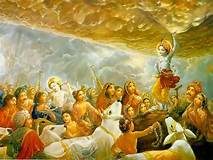
This wonderful reciprocation between the Lord and his devotee is further seen in the Govardhan lila- the puja of Govardhan followed by the attack by Indra and how Lord lifts Govardhan on His little (pinky) finger and how Govardhan faced the brunt of the ferocious, thunderous attacks by the ‘pralaya’ clouds (I forgot the name of the clouds summoned during the devastation of the material creation) with great joy just for the Lord and to protect His devotees.
So the conclusion is Giriraj is both Sri Krishna and His devotee simultaneously.
Then the obvious question may arise:
What mood we sadhakas should develop so we get full mercy of Sri Krishna or Sri Giri Govardhan?
Being followers of Sri Chaitanya Mahaprabhu, who came in the mood of Lord Hari’s servant and taught us gopi-bhartuh pada-kamalayor dasa-dasanudasah, by becoming and serving the servant of the servant of the Lord, we become recipients of Sri Krishna’s full mercy. And sastras show many pastimes of the Lord where a devotee of the Lord exhibited more mercy and compassion.
No doubt, it is equally potent to worship Sri Govardhan as both Sri Krishna or His devotee, but by following the mood of Lord Chaitanya, the mood of the gopis, the mood of becoming the servant of the servants of the Lord we will always get more mercy and please Sri Guru and Sri Krishna is the conclusion of the lecture.
In the same regard, couple of years ago, in a personal meeting (myself with my brother and parents) I had an opportunity to ask a question to His Holiness Lokanath Swami Maharaj.
(The following is based on what little I could remember from the conversation with His Holiness Lokanath Swami Maharaj, on evening walk outside his asrama, at the foot hill of Sri Govardhan, and also from a lecture by His Holiness on Govardhan Puja, this year 2016 at Barsana)
Q: What is the significance of Govardhan Pastime? (My doubt was why this pastime had to take place for 7 days and nights when the All Mighty, Sri Krishna could have stopped it immediately)
A: It gave an opportunity to all the living entities of Vrindavan to have personal and close association of Sri Krishna. They all spent 7 days and nights at the lotus feet of Sri Krishna. And there were many reciprocations between Krishna and every devotee (which of course were very special and unique to each individual.)
And while remembering and writing all this, it suddenly dawned on me what the above answer meant. This pastime clearly shows- when we take shelter of a devotee (Sri Govardhan) we get direct shelter of the Lotus feet of Sri Krishna.
Brajanath Prabhu, I thank you very much and appreciate for asking this wonderful question on this forum, for while attempting this exercise, it helped me drive home with the following message that Indirectly we get the direct benefit of associating with Lord Sri Krishna, when we serve the devotee(s) of the Lord.
Hope this answer is of some help.
And if further inputs or corrections needed in the above, I humbly beg the readers to add/ point them out for better understanding.
Your servant,
Shyamapriya devi dasi
Nashvin, 20 December 2016
Hare Krsna!
Yes, an important aspect of the reason for the Govardhana pastime is that Krsna wanted to associate with all His various devotees. Generally, He associates with different groups of devotees at different times (with cowherd boys during the day, gopis during the night etc). However, during this pastime, He was able to exchange loving glances and feelings with all the residents of Vrndavana, simultaneously.
your servant, Nashvin
Please subscribe to daily inspirational emails from His Grace Sriman Sankarshan Das Adhikari (Writings and lectures archived at www.sda-archives.com), written fresh every day from his travels around the world sharing the highest spiritual knowledge with everyone. Sign up now at www.joincourse.com
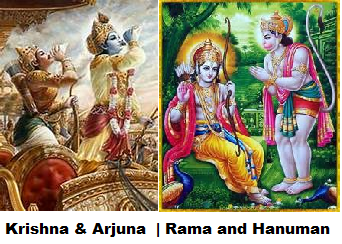
While there are so many temples dedicated to Hanuman, who is a servitor of Rama, why are there no temples dedicated to Arjuna who is so close to Krishna?
KV Rao, 13th December 2013
Hare Krishna dear devotees!
Please accept my humble obeisances!
All Glories to Sri Caitanya Mahaprabhu!
All Glories to Srila Prabhupada!
All Glories to your devotional service!
I hope you all had a blissful Gita Jayanti. While reading Bg Chapter 1 verse 20, the following question came to mind. Could you enlighten me, please?
Hanuman and Arjuna are devotees of the Lord. Hanuman has temples and people worship Hanuman, whereas Arjuna has no temples and people do not worship him (Arjuna). Why?
Haribol!
your servant,
Rao
Mahabhagavat Das SDA, 28th December 2013
Dear Sriman Rao,
Hare Krishna!
Please accept my humble obeisances.
All Glories to Srila Gurudeva.
All Glories to Srila Prabhupada.
Any temple where Hanuman, the eternal servitor of Lord Ramachandra is worshipped but His eternal Lord and master Lord Rama is not worshipped is an aberration, it is not bona fide. If you want to please someone, we aim to do what they want done. Hanuman has never asked anyone to worship him, in fact, he always worships Lord Rama and is very happy when others worship Lord Rama.
If a servitor is glorified more than the master, if the servitor is not a traitor to the master, he feels embarrassment, and passes it all up to his master. Sri Hanuman does take everything and pass it up to Lord Ramachandra, but would rather have him spoken of as a servant, not lord.
So while it is appropriate to have on an altar Sri Hanuman in his usual position as an associate of Lord Ramachandra along with Sri Lakshman and Srimati Sitadevi, it is not appropriate to worship Hanuman alone in exclusion as is commonly done in temples not authorized by any Paramnpara or disciplic succession. Of course, materialists who are after some good muscles, strength in celibacy, and some other material benedictions will worship “avidhipurvakam” – in a wrong way, as stated by Sri Krishna in BG 9.23 “Those who are devotees of other gods and who worship them with faith actually worship only Me, O son of Kunti, but they do so in a wrong way.”.
We are very happy that Sri Arjuna is not being embarrassed in the same way that Sri Hanuman is.
Sincerely,
Mahabhagavat Das
Hari Katha Das, 28th December 2013
Hari bol! Very convincing answer!
Sincerely,
Hari Katha Das Haladhar Das, 30th December 2013
Hare Krsna !
Jai Srila Gurudeva
Jai Srila Prabhupada
I totally agree to what Mahabhagavat prabhu ji has mentioned. A devotee one and only desire is to always hear the glories of his worshipable Lord and similarly the Lord is also very pleased when His devotee is glorified.
A almost similar topic was discussed earlier in this group. Arjuna is worshipped with Lord Krsna as Nar-Narayana Rishi. Details of earlier discussion are included herein below. Please see the details,
Also as clarified by Mahabhagavat prabhu mail, we have to understand that people generally worship different different demigods/people/ghosts etc according to their so called whims and desires. So what they will get from Arjuna, nobody would like to face what Arjuna and his brothers (the pandavas) faced as they cannot appreciate what they had, Lord Krsna Himself as their eternal companion.
Moreover as we know this universe is not all in all, and even we dont know much about this universe itself where we are living, so how can we know about others. There are some villages in India where people worship Dryodhana, Ravana etc. Even the area from where I am (Uttranchal, North India), in most of the villages people do glorify the pandavas brothers for almost continuous 14 days by celebrating pandav leela (pastimes of pandavas). It is a very popular festival being celebrated since many generations in the hills of Uttranchal.
thank you.
your servant
Haladhar Das
Details of earlier discussion :
Bhakta David :
Please accept my humble obeisances,
All Glories to Srila Prabhupada,
All Glories to Srila Gurudeva and Srimati Guru Mataji.
All Glories to Sri Sri Nitai Gauracandra.
Hare Krishna
Arjuna is always so close to Krishna, so much that Krishna chose him to explain Bhagavad Gita to. So my question is, is Arjuna a jiva? Or is he a demigod?
your servant
Bhakta David
Haladhar Das :
Hare Krsna Prabhu !
How do you differentiate between a jiva and a demigod. Isn’t a pure devotee better situated than any demigod, as he is eternally liberated as well as eternally associated with the Supreme Personality of Godhead.
Srimad Bhagvatam purport 3.5.51
The demigods are amongst the conditioned souls who have developed this pure consciousness of service to the Lord but who at the same time continue to desire to lord it over the material energy. Such mixed consciousness puts a conditioned soul in the position of managing the affairs of this creation. The demigods are entrusted leaders of the conditioned souls. As some of the old prisoners in government jails are entrusted with some responsible work of prison management, so the demigods are improved conditioned souls acting as representatives of the Lord in the material creation. Such demigods are devotees of the Lord in the material world, and when completely free from all material desire to lord it over the material energy they become pure devotees and have no desire but to serve the Lord.
The demigods are entrusted by the Lord to create different species of living entities according to their past deeds. They are herein asking the favor of the Lord for the intelligence and power to carry out their task. Similarly, any conditioned soul may also engage in the service of the Lord under the guidance of an expert spiritual master and thus gradually become freed from the entanglement of material existence.
Srimad Bhagvatam 4.1.59
tav imau vai bhagvato
harer amsav ihagatau
bhara-vyayaya ca bhuvah
krishnau yadu-kurudvahau
TRANSLATION That Nara-Narayana Rishi, who is a partial expansion of Krsna, has now appeared in the dynasties of Yadu and Kuru, in the forms of Krsna and Arjuna respectively, to mitigate the burden of the world.
PURPORT
Narayana is the Supreme Personality of Godhead, and Nara is a part of the Supreme Personality of Godhead, Narayana. Thus the energy and the energetic together are the Supreme Personality of Godhead. Maitreya informed Vidura that Nara, the portion of Narayana, had appeared in the family of the Kurus and that Narayana, the plenary expansion of Krsna, had come as Krsna, the Supreme Personality of Godhead, with the purpose of delivering suffering humanity from the pangs of material burdens. In other words, Narayana Rishi was now present in the world in the forms of Krsna and Arjuna.
your servant
Haladhar Das
Rathin Mandal :
Hare Krishna,
Please accept my humble obeisances,
All glories to Srila Gurudeva and Gurumataji,
All glories to Srila Prabhupada.
Be it a soul living in planet earth or any other heavenly kingdom, he is always a jivas. Demigods are also jivas. The following words were said to Arjuna by Sri Krishna:
BG 4.5: The Personality of Godhead said: Many, many births both you and I have passed. I can remember all of them, but you cannot, O subduer of the enemy!
In the purport of this verse Arjuna is referred as a pure devotee and a jiva part and parcel of Supreme Personality of Godhead. But as the jiva living in the material world gets affected by modes of material nature, he cannot remember his past life. Even we can see that in this kalpa the knowledge was first given by Sri Krishna to Sun-God, Vivasvān. Vivasvān being a demigod administering Sun may have knew teaching of Bhagavat Gita in his past life but in the beginning of this era he was again given the knowledge so that it can be passed from one generation to another.
In the following two verses also Sri Krishna address Arjuna as his pure devotee and distinguished him from demigods. Sri Krishna said to Arjuna that My Universal Form seen by you as a devotee but the demigods are just hoping to see this form.
BG 11.49: You have been perturbed and bewildered by seeing this horrible feature of Mine. Now let it be finished. My devotee, be free again from all disturbances. With a peaceful mind you can now see the form you desire.
BG 11.52: The Supreme Personality of Godhead said: My dear Arjuna, this form of Mine you are now seeing is very difficult to behold. Even the demigods are ever seeking the opportunity to see this form, which is so dear.
By the above verses we can also say that a pure devotee is even higher than Demigods, because they are blessed with opportunity to associate personally with Supreme Personality of Godhead. Such opportunity is not available to demigod. Arjuna been pure devotee of Lord was given the opportunity to see Universal Form of Sri Krishna. But said this one should never imitate the position of pure devotees like Arjuna, Mata Kunti, Nanda Maharaj, Mother Yasodha or all the cowherd boys and Gopis of Vrindavan.
your Servant
Rathin
Please subscribe to daily inspirational emails from His Grace Sriman Sankarshan Das Adhikari (Writings and lectures archived at sda-archives.com), written fresh every day from his travels around the world sharing the highest spiritual knowledge with everyone. Sign up now at www.backtohome.com




 Freedom through Genuine Spiritual Progress