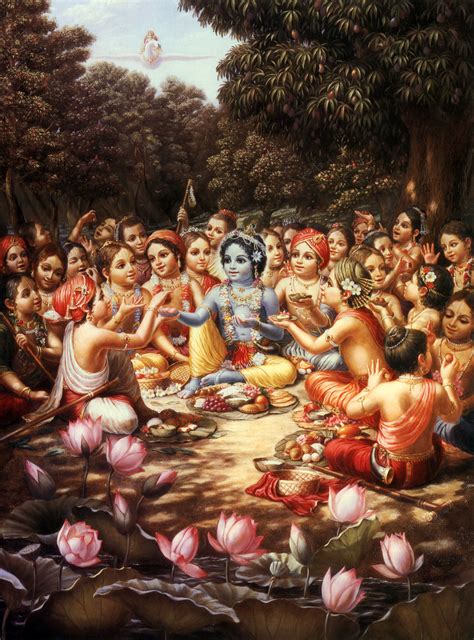
Delicious Names!

The Names of God are Unlimitedly Sweet. Purandara Dasa, who was a multi-billionaire, gave up the sweeter than honey money to taste the delicious names of God.

He wrote a beautiful song about the sweetness of the Lord’s Names…

To the Milk of Rama’s Name, add the Sugar of Krishna’s Name

Add the Ghee* of Vitthala’s Name, and Smack your Lips!

Bring the Wheat of Single-Mindedness, Grind with the Stones of Renunciation

Draw out the Fine Flour of Simplicity, and Roll into Thin Vermicelli

In the Pot of your Heart, with the Green Gram of your Faith

Cook it all down with your Intelligence, and Serve to Hari’s plate

Oh Joy Oh Bliss when you Experience, and Let Out Satisfied Burps

Then remember Our Lord Eternal Vitthala, the Form of Eternal Bliss!

In Feasting on the Holy Name, I offered a glimpse of how those dedicated to the spiritual path can avoid things like eating and sleeping.

Here in this article, I offer a tangible example of a great soul who actually could taste the holy name… and convey that to those of us who may not yet be tasting.

There are many great souls with a tangible taste of the Holy Name of God, for example, the great saint Rupa Goswami wrote this verse…

tuṇḍe tāṇḍavinī ratiṁ vitanute tuṇḍāvalī-labdhaye
karṇa-kroḍa-kaḍambinī ghaṭayate karṇārbudebhyaḥ spṛhām
cetaḥ-prāṅgaṇa-saṅginī vijayate sarvendriyāṇāṁ kṛtiṁ
no jāne janitā kiyadbhir amṛtaiḥ kṛṣṇeti varṇa-dvayī

“I do not know how much nectar the two syllables ‘Kṛṣ-ṇa’ have produced. When the holy name of Kṛṣṇa is chanted, it appears to dance within the mouth. We then desire many, many mouths. When that name enters the holes of the ears, we desire many millions of ears. And when the holy name dances in the courtyard of the heart, it conquers the activities of the mind, and therefore all the senses become inert.”https://vedabase.io/en/library/cc/antya/1/99/

Where I come from, we know a great saint named Purandara Dasa.
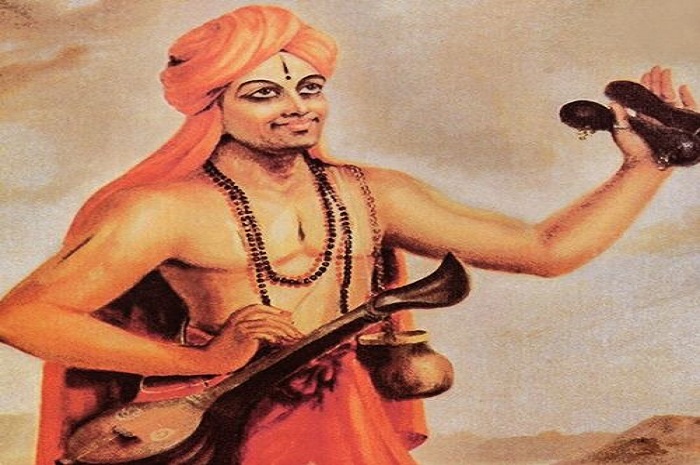
Purandara Dasa was born Srinivasa Nayaka, son of a rich diamond merchant. Srinivasa was trained in the fine arts and received a solid spiritual education, but as he grew up, he morphed into a ruthless businessman, business above all else, shrewd, calculating, though completely honest. He was a famed jeweller and he had business interests in mortgages, real estate, farmland, and much much more… all this over 500 years ago!

His net worth was said to be the equivalent of 90 million gold coins. If one gold coin was just 10 grams, then that means he owned the equivalent of 900,000 kilograms of gold. In today’s price of gold, Srinivasa Nayaka had an estimated net worth of slightly over USD 68 Billion, or with the current exchange rate!

For the sake of my readers in India, that is Five Lakh Forty Seven Thousand Crore Rupees as of today, or 5,47,000 Crore Rupees!

But, God had delicious plans for Srinivasa Nayaka! He appeared in very interesting disguises to Srinivasa Nayaka. Once there was an intriguing pastime of the nose ring of his wife, Saraswati… and completely bewildered and smitten, when our hero was hopelessly in love with God, he was instructed by God to give away all his wealth and focus exclusively on devotional service. Srinivasa Nayaka had to part with his dearest possession, his wealth, to gain the wealth of God!

How often do we find a Billionaire who gives away $68Bn of wealth and engage himself as a Haridasa, a fully surrendered servant of God?

Srinivasa Nayaka did that, and received initiation from Vyasa Tirtha, a pre-eminent saint in the line of Sri Madhwacharya. Sripad Vyasa Tirtha happens to the the grand-spiritual master of Sripad Madhavendra Puri of the Brahma-Madhwa-Gaudiya Sampradaya, into which this humble author has received initiation from Sripad Sankarshan Das Adhikari, disciple of Srila A. C. Bhaktivedanta Swami Prabhupada.

Initiated as Purandara Dasa, and given the “pen name” of “Purandara Vitthala”, Purandara Dasa is said to have composed more than 475,000 “kritis” or songs. Unfortunately for us, we have only a few known to us today, approximately 1000. Purandara Dasa, like many other pure devotees, Haridasas, spontaneously composed beautiful songs.

His songs are collectively referred to as “Purandaropanishad”… which can be translated as the eternal instructions that bring us closer to the Lord.

His songs explain the most esoteric of concepts in a very simple way, and even ordinary souls such as myself can understand, appreciate, and relish them. The result of meditating on his songs is that our devotional service becomes stronger.

One of my favourite songs of Purandara Dasa is about the most delicious Names of God…

The Names of God are sweeter to Purandara Dasa, whereas to ordinary souls, Money is sweeter than honey, but Purandara Dasa gave all his vast wealth away to obtain the wealth of the Names of God

Rama Nama Payasake – To the Milk of Rama’s Name…

In Kannada Script, the song looks like this:

ರಾಮನಾಮ ಪಾಯಸಕ್ಕೆ ಕೃಷ್ಣನಾಮ ಸಕ್ಕರೆ
ವಿಠಲನಾಮ ತುಪ್ಪವ ಬೆರೆಸಿ ಬಾಯಿ ಚಪ್ಪರಿಸಿರೊ

ಒಮ್ಮನ ಗೋಧಿಯ ತಂದು ವೈರಾಗ್ಯ ಕಲ್ಲಲಿ ಬೀಸಿ
ಸುಮ್ಮನ ಸಜ್ಜಿಗೆ ತೆಗೆದು ಸಣ್ಣ ಸೇವೆಗೆ ಹೊಸೆದು

ಹೃದಯವೆಂಬೊ ಪಾತ್ರೆಯೊಳಗೆ ಭಾವವೆಂಬೊ ಎಸರು ಇಟ್ಟು
ಬುದ್ದಿಯಿಂದ ಪಕ್ವವ ಮಾಡಿ ಹರಿವಾಣದೊಳಗೆ ನೀಡಿ

ಆನಂದ ಆನಂದವೆಂಬೊ ತೇಗು ಬಂದ ಪರಿಯಲಿ
ಆನಂದಮೂರುತಿ ನಮ್ಮ ಪುರಂದರವಿಠಲ ನೆನೆಯಿರೊ

raama naama paayasakke kRuShNanaama sakkare |
viThalanaama tuppava kalasi baayi capparisiro ||pa||

ommaana gOdhiya taMdu vairaagya kallili bIsi |
summane sajjigeya tegedu saNNa shaavigeya hosedu ||1||

hRudayaveMbo maDakeyalli bhaavaveMbo esaraniTTu |
buddhiyiMda paakamaaDi harivaaNake baDisikoMDu ||2||

aanaMda aanaMdaveMbo tEgu baMditu kANirO |
aanaMda mUruti namma puraMdara viThalana neneyiro ||3||

– Purandara Dasa

I will try to offer a translation for those who may not be conversant with Kannada…

To the Milk of Rama’s Name, add the Sugar of Krishna’s Name

Add the Ghee* of Vitthala’s Name, and Smack your Lips!

Bring the Wheat of Single-Mindedness, Grind with the Stones of Renunciation

Draw out the Fine Flour of Simplicity, and Roll into Thin Vermicelli

In the Pot of your Heart, with the Green Gram of your Faith

Cook it all down with your Intelligence, and Serve to Hari’s plate

Oh Joy Oh Bliss when you Experience, and Let Out Satisfied Burps

Then remember Our Lord Eternal Vitthala, the Form of Eternal Bliss!

– Purandara Dasa’s Rama Nama Payasake, translation by Mahabhagavata Dasa

* Ghee – Clarified Butter, a delicacy used to enhance the flavour of various dishes. Like most Bhakti experiences, it must be tasted and experienced in that way, there is no theoretical way to understand this flavour, the aroma, etc.

Now, my dear reader, please allow me to introduce the deep eternal spiritual truths contained in this simple 4-stanza song.

The Name of God is Sweet!

Is there any doubt about this Yes, beginners may not experience the sweetness, but it is not for lack of sweetness in the Lord’s names, but for the diseased tongue of the beginner to spiritual life… Rupa Goswami Says:

स्यात् कृष्णनामचरितादिसिताप्यविद्यापित्तोपतप्तरसनस्य न रोचिका नु ।
किन्त्वादरादनुदिनं खलु सैव जुष्टा स्वाद्वी क्रमाद्भवति तद्गदमूलहन्त्री ॥ ७ ॥

syāt kṛṣṇa-nāma-caritādi-sitāpy avidyā-
pittopatapta-rasanasya na rocikā nu
kintv ādarād anudinaṁ khalu saiva juṣṭā
svādvī kramād bhavati tad-gada-mūla-hantrī

The holy name, character, pastimes and activities of Kṛṣṇa are all transcendentally sweet like sugar candy. Although the tongue of one afflicted by the jaundice of avidyā [ignorance] cannot taste anything sweet, it is wonderful that simply by carefully chanting these sweet names every day, a natural relish awakens within his tongue, and his disease is gradually destroyed at the root.

https://vedabase.io/en/library/noi/7/

Single Mindedness is essential for Spiritual Perfection

For the attainment of any goal, focus is a requirement. The rarer and more distinguished the prize, the more single-minded focus is required.

Krishna says, in the Bhagavad Gita:

व्यवसायात्मिका बुद्धिरेकेह कुरूनन्दन ।
बहुशाखा ह्यनन्ताश्च बुद्धयोऽव्यवसायिनाम् ॥ ४१ ॥


vyavasāyātmikā buddhir
ekeha kuru-nandana
bahu-śākhā hy anantāś ca
buddhayo ’vyavasāyinām

Those who are on this path are resolute in purpose, and their aim is one. O beloved child of the Kurus, the intelligence of those who are irresolute is many-branched.

https://vedabase.io/en/library/bg/2/41/

Renunciation from Worldly Goals is required for someone seeking spiritual perfection

Krishna then continues, further on…

भोगैश्वर्यप्रसक्तानां तयापहृतचेतसाम् ।
व्यवसायात्मिका बुद्धिः समाधौ न विधीयते ॥ ४४ ॥


bhogaiśvarya-prasaktānāṁ
tayāpahṛta-cetasām
vyavasāyātmikā buddhiḥ
samādhau na vidhīyate

In the minds of those who are too attached to sense enjoyment and material opulence, and who are bewildered by such things, the resolute determination for devotional service to the Supreme Lord does not take place.

https://vedabase.io/en/library/bg/2/44/

Spiritual Life means Simplicity without any Duplicity

To some, spiritual life is extremely easy. To others it is the, most difficult thing.

Again, in the Bhagavad Gita describes the qualities of someone who is in spiritual life.

अमानित्वमदम्भित्वमहिंसा क्षान्तिरार्जवम्
आचार्योपासनं शौचं स्थैर्यमात्मविनिग्रह: ॥ ८ ॥


amānitvam adambhitvam ahiṁsā kṣāntir ārjavam
ācāryopāsanaṁ śaucaṁ sthairyam ātma-vinigrahaḥ


Humility; pridelessness; nonviolence; tolerance; simplicity; approaching a bona fide spiritual master; cleanliness; steadiness; self-control

https://vedabase.io/en/library/bg/13/8-12/

Simple for the simple, difficult for the crooked!

God lives in our Heart, so working on our heart is essential, it’s a very personal loving thing, not just dry intellectual pursuit!

तेषामेवानुकम्पार्थमहमज्ञानजं तम: ।
नाशयाम्यात्मभावस्थो ज्ञानदीपेन भास्वता ॥ ११ ॥


teṣām evānukampārtham
aham ajñāna-jaṁ tamaḥ
nāśayāmy ātma-bhāva-stho
jñāna-dīpena bhāsvatā

To show them special mercy, I, dwelling in their hearts, destroy with the shining lamp of knowledge the darkness born of ignorance.

https://vedabase.io/en/library/bg/10/11/

Faith in the Spiritual Process is a Necessary Ingredient

अश्रद्दधाना: पुरुषा धर्मस्यास्य परन्तप ।
अप्राप्य मां निवर्तन्ते मृत्युसंसारवर्त्मनि ॥ ३ ॥


aśraddadhānāḥ puruṣā
dharmasyāsya paran-tapa
aprāpya māṁ nivartante
mṛtyu-saṁsāra-vartmani

Those who are not faithful in this devotional service cannot attain Me, O conqueror of enemies. Therefore they return to the path of birth and death in this material world.

https://vedabase.io/en/library/bg/9/3/

Spiritual Progress is Made by those who endeavour Intelligently

इन्द्रियाणि पराण्याहुरिन्द्रियेभ्यः परं मनः ।
मनसस्तु परा बुद्धिर्यो बुद्धेः परतस्तु सः ॥ ४२ ॥


indriyāṇi parāṇy āhur
indriyebhyaḥ paraṁ manaḥ
manasas tu parā buddhir
yo buddheḥ paratas tu saḥ

The working senses are superior to dull matter; mind is higher than the senses; intelligence is still higher than the mind; and he [the soul] is even higher than the intelligence.

https://vedabase.io/en/library/bg/3/42/

In the purport to the above verse, Srila Prabhupada writes…

With intelligence one has to seek out the constitutional position of the soul and then engage the mind always in Kṛṣṇa consciousness. That solves the whole problem. A neophyte spiritualist is generally advised to keep aloof from the objects of the senses. But aside from that, one has to strengthen the mind by use of intelligence. If by intelligence one engages one’s mind in Kṛṣṇa consciousness, by complete surrender unto the Supreme Personality of Godhead, then, automatically, the mind becomes stronger, and even though the senses are very strong, like serpents, they will be no more effective than serpents with broken fangs. But even though the soul is the master of intelligence and mind, and the senses also, still, unless it is strengthened by association with Kṛṣṇa in Kṛṣṇa consciousness, there is every chance of falling down due to the agitated mind. – BG 3.42 purport by A. C. Bhaktivedanta Swami Prabhupada

Spiritual Perfection Must be Offered to God

Srila Prabhupada summarizes, in his Nectar of Devotion…

By the process of executing regulated devotional service, one is actually elevated to the transcendental stage, beyond the material modes of nature. At that time one’s heart becomes illuminated like the sun. The sun is far above the planetary systems, and there is no possibility of its being covered by any kind of cloud; similarly, when a devotee is purified like the sun, from his pure heart there is a diffusion of ecstatic love which is more glorious than the sunshine. Only at that time is the attachment to Kṛṣṇa perfect. Spontaneously, the devotee becomes eager to serve the Lord in his ecstatic love.

https://vedabase.io/en/library/nod/17/

There is no happiness like that from chanting God’s Holy names for anyone

In the Srimad Bhagavatam, we find this verse:

एतन्निर्विद्यमानानामिच्छतामकुतोभयम् ।
योगिनां नृप निर्णीतं हरेर्नामानुकीर्तनम् ॥ ११ ॥


etan nirvidyamānānām
icchatām akuto-bhayam
yogināṁ nṛpa nirṇītaṁ
harer nāmānukīrtanam


O King, constant chanting of the holy name of the Lord after the ways of the great authorities is the doubtless and fearless way of success for all, including those who are free from all material desires, those who are desirous of all material enjoyment, and also those who are self-satisfied by dint of transcendental knowledge.

https://vedabase.io/en/library/sb/2/1/11/

But we can see which taste is more delicious… the taste of untold wealth, or the taste of the Holy Names of God.

Purandara Dasa is the example.

Purandara Dasa is also known as the Father of Carnatic Classical Music, but above mere music is His simple devotion, which he expressed through music.

What will we give up to taste the most unlimitedly delicious sweet clear pure Names of God?

What if all you had to do was to chant this Mantra without giving anything else up?

Hare Krishna Hare Krishna Krishna Krishna Hare Hare Hare Rama Hare Rama Rama Rama Hare Hare

My Dear Reader, would you please chant this Mantra even just once?

Purandara Dasa is a Mahabhagavata, a mighty pure devotee of the Lord, and this Mahabhagavata Dasa aspires to be the servants of his servants, and hankers to taste their delicious remnants.

What does it mean to over endeavor? How do I know if I’m over endeavoring?

What does it mean to overdo effort? What does it mean to over endeavor? How do we know if we are putting our effort in the wrong direction? What is the antidote to this tendency?

KV Rao, 17 Mar 2015

Hare Krishna Dear Devotees!    

Please accept my humble obeisances!

All glories to Sri Caitanya Mahaprabhu!

All glories to Srila Prabhupada!

All glories to your devotional service!

Please help me to understand – how does one know that one is over endeavoring?

Haribol!

your servant,

KV Rao

Premananda Das, 17 Mar 2015

Please state context over endeavoring  for?

your servant 

Premananda das 

Bhakta Sunil, 19 Mar 2015

Hare Krishna Rao Prabhu

Please accept my humble obeisances

All Glories to Srila Prabhupada

One can know that one is over endeavoring for material things if one is not ready to give 100 % of one’s capacity to serve and please the Lord

For example , if one’s devotional routine involves chanting a particular number of rounds , but if one has a lingering thought of say, watching a cricket match and then does less rounds and switches on television to watch cricket , then it is over endeavoring mundanely

Sincerely hoping this helps to dispel your doubt

humbly,

Bhakta sunil

Shridhar Das, 26 Mar 2015

Hare Krishna,

I agree with the above answer too. As per my recent hearings, I feel that lack of determination for executing spiritual activities concludes in over-endeavouring for material activities. 

Spiritual activities surely includes a wide range of activities but from my current experience I am able to recall how maintaining a bimonthly sadhana chart, consisting of a sheet with various columns like date, wake up time, sleeping time, no of rounds chanted until a particular time, duration of hearing and reading, helps to keep track of spiritual determination. 

I fill this out on a regular basis and on the weekend submit it to my counsellor who expertly studies and accordingly guides for the next session. It is an amazing way of introspecting our spiritual endeavour and exposing the mind’s entanglement.

your servant

Shridhar das

Mahabhagavat Das SDA, 26 Mar 2015

Hare Krishna Sriman Rao,

Please accept my humble obeisances.

All glories to Srila Gurudeva.

All glories to Srila Prabhupada.

There are various levels of over-endeavor for material benefits. At the extreme edge of spiritual perfection, a liberated soul sees anything more than keeping body and soul together as over-endeavor. In fact, Vasudeva Vipra, a great Vaishnava, went further than that – he had some worms attacking his body, and if they fell off, he would pick them back up and put them on his body, because he was on the platform that actually his body was food for worms anyways, and why should he deprive them of their rightful share of food. (CC Madhya 7.137-138)

Most of us are not on that platform, and it is foolish to try to pretend to be on some higher level than one is.

What is “minimum necessity” for me, may be overindulgence for another, and what is minimum necessity for another may be “too much sense gratification for me”. On the other hand, no one else knows what and how much I need… Some people require 20 helpings of food to feel satisfied, another requires just one. The elephant needs hundreds of kilos of food and the ant needs just one grain or so, ultimately it is a very personal thing.

Srila Gurudeva was once asked the question “how do I know if I am making spiritual progress” and Srila Gurudeva answered “to the extent you feel less attracted to material sense gratification, you can know that you are making spiritual advancement” (both question and answer paraphrased, not literal quotes). Another time, he answered this question as “when you take some food, do you have to wait for someone else to tell you that you are full? No! You know when you are full”.

You know enough about your needs, about the ideals of spiritual life and enough about Krishna consciousness that you should be able to answer this question for yourself and recognize when you are over-endeavoring or not.

This is confirmed in the scripture, shastra:

bhaktiḥ pareśānubhavo viraktir

 anyatra caiṣa trika eka-kālaḥ

prapadyamānasya yathāśnataḥ syus

 tuṣṭiḥ puṣṭiḥ kṣud-apāyo ’nu-ghāsam

Devotion, direct experience of the Supreme Lord, and detachment from other things — these three occur simultaneously for one who has taken shelter of the Supreme Personality of Godhead, in the same way that pleasure, nourishment and relief from hunger come simultaneously and increasingly, with each bite, for a person engaged in eating. SB 11.2.42

I will not quote the purport, but I invite everyone to please read the purport at:

http://www.vedabase.com/sb/11/2/42/

In any case, the time is right now to be initiated by a bona fide spiritual master so that such things will not bother you – service and instructions directly received in spiritual life and followed carefully will sustain and satisfy one to the fullest possible extent.

For example, in response to a recent report, my spiritual master wrote to me:

Simply continue with your sincere efforts

to serve Guru and Gauranga and everything

will work out wonderfully.

And I shall hold on to that instruction which I have received personally. 🙂

Sincerely,

Mahabhagavat Das

Brhadnath dasa, 27 Mar 2015

Hare Krishna Shreyas prabhu, Please accept my humble obeisances. All glories to Srila Gurudeva. All glories to Srila Prabhupada.

Your words that lack of determination for executing spiritual activities concludes in over-endeavoring for material activities, are indeed very true, but we somehow find some excuse to be in this . Some devotees do talk about the benefits of sadhana chart, but somehow I did not seek their help. Please share the sadhana chart, if possible in the format, for the benefit of others. And also, please allow me to submit my chart to you  to help me.

your servant, 

Brhad nath dasa

Bhakta Sunil, 29 Mar 2015

Hare Krishna everyone

I came across following lines from the book “Nectar of Devotion” both set of lines from Text Two , which I understand would help in this topic :

“Jīvasya tattva jijñāsā: the real purpose of life is to inquire about the Absolute Truth. If our endeavor (prayāsa) is not to inquire about the Absolute Truth, we will simply increase our endeavor to satisfy our artificial needs. A spiritual aspirant should avoid mundane endeavor.”

“Śrīla Bhaktisiddhānta Sarasvatī Ṭhākura writes in his Anuvṛtti commentary that too much endeavor to acquire knowledge on the part of mental speculators or dry philosophers falls within the category of atyāhāra (collecting more than needed). According to Śrīmad-Bhāgavatam, the endeavor of philosophical speculators to write volumes of books on dry philosophy devoid of Kṛṣṇa consciousness is entirely futile. The work of karmīs who write volumes of books on economic development also falls within the category of atyāhāra. Similarly, those who have no desire for Kṛṣṇa consciousness and who are simply interested in possessing more and more material things—either in the shape of scientific knowledge or monetary gain—are all included under the control of atyāhāra.”

Regards,

Bhakta Sunil

Please subscribe to daily inspirational emails from His Grace Sriman Sankarshan Das Adhikari (Writings and lectures archived at www.ecstaticmedia.com ), written fresh every day from his travels around the world sharing the highest spiritual knowledge with everyone. Sign up now at www.joincourse.com.

Of Devotion & Devotional Service

What is the difference between devotion and devotional service? Is it possible to perform devotional service without devotion? Is it possible to have devotion without performing devotional service?

Brajanath Das, 26 April 2015
Hare Krishna Dear Devotees!        

Please accept my humble obeisances!

All glories to Sri Caitanya Mahaprabhu!

All glories to Srila Prabhupada!

Please help me to understand the invisible line of difference between devotion and devotional service. 

your servant,

Brajanath Das

Bhaktin Aruni, 26 Apr 2015

Hare Krishna!          

Pamho, 

All glories to Srila Prabhupada!

I think maybe devotion is the attitude and devotional service is the act …

aruni

Bhakta Jayakrishna, 27 April 2015

Hare krishna! Thank you Prabhu! 

I too had this doubt when first heard and yet never thought that there may be some serious difference.but i felt that there indeed exist some difference as, if ones devotion is not supported by some service in its way, it is most likely he lose his devotion also, (here i must confess that we neophyte devotees more or less are with such a stage,)and hence, devotion when backed up by service or activities suiting it is the devotional service, but i have no sastric reference and i wish to hear from our senior brothers who can give a better explanation.

your servant

Jayakrishna

Premananda Das, 27 April 2015

Hare Krishna

Devotion means ardent and  selfless affection  and dedication to a person or principle. According to Padma Purana one should always remember Lord Vishnu and never forget Him.This is called dhyana or meditation always remembering Krishna.

Srila Rupa Goswami says bhakti means devotional service to Krishna.Every service has some attractive features which drives the servitor progressively on and on.

A family man works day and night for his wife and children.A philanthropist works for the greater love of family and a nationalist for the cause of country and countrymen.The force that drives them is called a rasa or mellow (relationship) that is very sweet.Bhakti -rasa however does not finish with the end of life.It continues perpetually and therefore is called amrta that which does not die but exists perpetually.

According to Bhagavad Gita a little advancement in the bhakti rasa can save the devotee from greatest danger that is missing the opportunity of human life.The rasas derived from social and  family life or greater family life like altruism,philanthropy,socialism,communism nationalism does not guarantee next birth to be human life.

your servant

Premananda Das

Amogha Lila Das, 27 April 2015

Hare Krishna Prabhu. Please accept my humble obeisances.

All glories to Srila Gurudeva! All glories to Srila Prabhupada!

Devotion is cultivated through devotional service. There are nine processes by which one can cultivate devotion.

Sravanam, Kirtanam, Smaranam, Pada Sevanam, Arcanam, Vandanam, Dasyam, Sakhyam, Atma Nivedanam

Gurudeva often mentions these nine processes in his lectures and they are described by Prahlada Maharaja in the 7th Canto of the Srimad Bhagavatam (SB 7.5.23-24):       

To hear about Sri Visnu’s transcendental name, His form, His characteristics, His possessions and His pastimes and to hear and chant about His pastimes, to remember them, to serve the lotus feet of the Lord, to respectfully offer service to the Lord, to offer prayers to the Lord, to become His servant, to consider the Lord one’s best friend and to offer Him everything-these nine processes are recognized as pure devotional service.

Following the above nine processes one can gradually advance in devotional service and progress through the nine stages of Bhakti yoga as described in the Caitanya Caritamrta, Madhya-lila, by Sri Caitanya Mahaprabhu as follows:

“In the beginning there must be faith. Then one becomes interested in associating with pure devotees. Thereafter one is initiated by the spiritual master and executes the regulative principles under his orders. Thus one is freed from all unwanted habits and becomes finally fixed in devotional service. Thereafter, one develops taste and attachment. This is the way of sadhana-bhakti, the execution of devotional service according to the regulative principles. Gradually emotions intensify, and finally there is an awakening of love. This is the gradual development of love of Godhead for the devotee interested in Krsna consciousness.”

your humble servant,

Amogha Lila Das

Rantideva Das, 28 April 2015

My dear devotees,

Please accept my humble obeisances.

All glories to Sri Guru and Sri Gauranga.

All glories to Srila Prabhupada.

I trust that you are all well.

Very nice question and answers regarding devotion and devotional service. However, this subject brought to mind another question concerning the same subject matter. Is it possible to perform devotional service without devotion? And what about devotion without devotional service?

I remain your worthless servant,

Rantideva das

Hare Krishna Das, 28 April 2015

Dear Prabhu,

Please accept my humble and respectful obeisances!

All Glories to His Divine Grace Sriman Sankarshan Das Adhikari Gurumaharaj and Srimati Gurumata!

All Glories to Srila Prabhupada!

Devotion in itself includes service. Without service, there is no actual devotion. It is only lip service. But, to stress the importance of service and protect it from sahajiaism, Srila Prabhupada used the term devotional service. I admit, I also have no quotes (reference lines) from Senior Vaisnavas. This is my perspective. Willing to hear from others.

Thanking You,

your servant,

Hare Krishna Das

Mahabhagavat Das SDA, 30 April 2015

Dear Devotees,

Hare Krishna!

Please accept my humble obeisances.

All glories to Srila Gurudeva.

All glories to Srila Prabhupada.

This discussion was very enlivening for me. Thank you to all who have participated in this discussion. The question is already answered, from reading the emails together.

Since Srila Gurudeva stresses a careful reading of Srila Prabhupada’s books for all of us, I am adding quotes from Srila Prabhupada’s books to solidify our understanding. I have made a few sentences bold, as they jumped out at me, but of course, every word of Srila Prabhupada is of utmost significance…

(from purport to SB 1.2.19)

A living being in his normal constitutional position is fully satisfied in spiritual bliss. This state of existence is called brahma-bhūta (SB 4.30.20) or ātmā-nandī, or the state of self-satisfaction. This self-satisfaction is not like the satisfaction of the inactive fool. The inactive fool is in the state of foolish ignorance, whereas the self-satisfied ātmānandī is transcendental to the material state of existence. This stage of perfection is attained as soon as one is fixed in irrevocable devotional service. Devotional service is not inactivity, but the unalloyed activity of the soul.

The soul’s activity becomes adulterated in contact with matter, and as such the diseased activities are expressed in the form of lust, desire, hankering, inactivity, foolishness and sleep. The effect of devotional service becomes manifest by complete elimination of these effects of passion and ignorance. The devotee is fixed at once in the mode of goodness, and he makes further progress to rise to the position of Vāsudeva, or the state of unmixed sattva, or śuddha-sattva. Only in this śuddha-sattva state can one always see Kṛṣṇa eye to eye by dint of pure affection for the Lord

(from purport to SB 1.10.23)

Jitendriya means one who has full control over the senses. The senses are active parts of the body, and their activities cannot be stopped. The artificial means of the yogic processes to make the senses inactive has proved to be abject failure, even in the case of great yogīs like Viśvāmitra Muni. Viśvāmitra Muni controlled the senses by yogic trance, but when he happened to meet Menakā (a heavenly society woman), he became a victim of sex, and the artificial way of controlling the senses failed. But in the case of a pure devotee, the senses are not at all artificially stopped from doing anything, but they are given different good engagements. When the senses are engaged in more attractive activities, there is no chance of their being attracted by any inferior engagements. In the Bhagavad-gītā it is said that the senses can be controlled only by better engagements. Devotional service necessitates purifying the senses or engaging them in the activities of devotional service. Devotional service is not inaction. Anything done in the service of the Lord becomes at once purified of its material nature.

(From the Introduction to the Nectar of Devotion)

Pure devotional service should be free from the desire for any material benefit or for sense gratification, as these desires are cultivated through fruitive activities and philosophical speculation. Generally, people are engaged in different activities to get some material profit, while most philosophers are engaged in proposing transcendental realization through volumes of word jugglery and speculation. Pure devotional service must always be free from such fruitive activities and philosophical speculations. One has to learn Kṛṣṇa consciousness, or pure devotional service, from the authorities by spontaneous loving service.

This devotional service is a sort of cultivation. It is not simply inaction for people who like to be inactive or devote their time to silent meditation. There are many different methods for people who want this, but cultivation of Kṛṣṇa consciousness is different. The particular word used by Śrīla Rūpa Gosvāmī in this connection is anuśīlana, or cultivation by following the predecessor teachers (ācāryas). As soon as we say “cultivation,” we must refer to activity. Without activity, consciousness alone cannot help us.

I hope that these quotes help.

Sincerely,

Mahabhagavat Das

Rantideva das, 01 May 2015,

Reposting this question as no reply was received earlier…..

My dear devotees,

Please accept my humble obeisances.

All glories to Sri Guru and Sri Gauranga.

All glories to Srila Prabhupada.

I trust that you are all well.

Very nice question and answers regarding devotion and devotional service. However, this subject brought to mind another question concerning the same subject matter. Is it possible to perform devotional service without devotion? And what about devotion without devotional service?

I remain your worthless servant,

Rantideva das

Mahabhagavat Das SDA, 01 May 2015

Dear Rantideva Prabhu,

Please accept my humble obeisances.

All glories to Srila Gurudeva.

All glories to Srila Prabhupada.

Please forgive us, we didn’t mean to ignore your question, but somehow missed it.

It is possible to perform devotional service without devotion, in other words, it is called “ajnata sukriti” (unknowingly performed devotional service), this is when, for example, devotees engage others in devotional service without giving them the full details about how, why… this includes for example when devotees serve out Krishna Prasada for the masses, when they put on festivals like Jagannatha Ratha Yatra, or when they go out on Harinam Sankirtan, or go in public wearing Tilaka and devotional attire, etc.

Or, it could be like someone plants a tree and some devotee uses the fruits and flowers from that tree to offer to the Lord, the person who planted the tree gets the benefit of assisting in devotional service.

This also includes the devotees who feel no devotion but go through the motions anyways, for example, chant mechanically, or dance enthusiastically either because of fear or respect for the spiritual master, or to keep up with their vows or commitments. While they don’t make as much advancement as if it were done attentively and devotedly and genuinely, but still, they make some progress, so for example Srila Gurudeva says “mechanical chanting is better than no chanting”, and “offensive chanting is still better than no chanting”, etc. He also says “dance enthusiastically anyway and the ecstasy will come”, when asked about dancing in Kirtan.

Often it is seen that even such service, performed apparently without devotion, fructifies into full-fledged devotional service, I am one such example who did so much devotional service without any devotion and now I feel some attraction to pleasing Guru and Krishna. All glories to the wonderful devotees who engaged me in service throughout my life, my mother, father, cousins, teachers, devotees all over the world, Bhaktimarga Swami, devotees in Toronto, the book distributor who gave a copy of the Bhagavad Gita even though I was undeserving, Srila Gurudeva for giving me his personal attention even though I am undeserving, the list goes on and on, and I don’t even know how to express my gratitude to them all!

Of course, such “service without devotion” devotional service does not count as “pure devotional service”. 🙂

It is however, not possible to have any devotion without performing devotional service, as was hopefully clear from the various answers and Srila Prabhupada’s writings.

I hope this helped, I beg all group members that if I have misunderstood something, or created some misunderstanding, please do kindly help and correct me.

your servant,

Mahabhagavat Das

Haldhar Prabhu, 01 May 2015

Hare Krsna Mahabhagavat Prabhuji and Rantideva Prabhuji for one more perfect question and perfect answer.

I understood the question only after the answer 🙂

Hare Krsna !

your servant,

Haldhar Das

Rantideva das, 04 May 2015

My dear Godbrother,

Please accept my humble obeisances.

All glories to Srila Gurudeva.

All glories to Srila Prabhupada

I was thinking about Jayananda prabhu. How he could engage anyone in Sri Krishna’s service. He could take anyone from the street, say a homeless man or drunkard, and engage him in helping to build  a ratha cart. So this homeless man is engaged in devotional service but has no devotion for the Lord. He’s just working in hopes of receiving a free meal afterwards. Sometimes we even see how a homeless person will come to the temple on Sunday for a free meal. In both cases they are reaping great benefit by performing service for the Lord, or hearing the pastimes of the Lord, or taking Krishna prasadam.

 Since today is Jayananda Prabhu’s disappearance day, May 1, 1977, this topic of devotional service is very appropriate. By the mercy of Srila Gurudeva and Lord Sri Krishna, may we all reach the platform of pure loving service that our dear Jayananda Thakur displayed while here in this material world.

I remain your worthless servant,

Rantideva das

(das is the important part)

Mahabhagavat Das SDA, 05 May 2015

Dear Rantideva Prabhu,

Please accept my humble obeisances.

All glories to Srila Gurudeva.

All glories to Srila Prabhupada.

Actually I have met one hippie encouraged by Jayananda Prabhu… this was in Puerto Rico, I was visiting the Hare Krishna temple in Gurabo with my wife for a “retreat”, we once went to downtown San Juan. I had my Tilak on but was dressed in street clothes. An elderly man was doing something with some iron bars, some kind of welding work, and suddenly he saw me and called out “Hare Krishna, are you from the temple in Gurabo”, I was amazed and pleasantly surprised. Then he introduced himself as Lance, went on to describe how he “worked with” one taxi driver we consider a great saint, immediately I knew he was talking about Jayananda Prabhu.This man had met Srila Prabhupada even. I asked him what happened, and he sadly replied that with the drugs, he’d lost most of his intelligence, and even then, he heard only partially, and he does not remember much, but he appreciates everything.

It was the highlight of my day, practically the highlight of that trip, and a reaffirmation of the power of Sankirtan, tell everyone about Krishna, deliver Krishna’s mercy to them, and they will never forget Krishna, and this will help them, if not in this birth, then in the next. Clearly, Lance has performed some devotional service, with or without devotion, but I think the devotion had already started to manifest long ago…

your servant,

Mahabhagavat Das

Please subscribe to daily inspirational emails from His Grace Sriman Sankarshan Das Adhikari (Writings and lectures archived at www.ecstaticmedia.com ), written fresh every day from his travels around the world sharing the highest spiritual knowledge with everyone. Sign up now at www.joincourse.com

Bhakti Philosophy for the mind and Krishna’s Pastimes for the Heart?

How does Bhakti/Devotional Service deal with the intellectual / logical / analytical side of us as well as the emotional/feeling side of us? Does catering to one mean neglecting the other?

Brajanath Das, 02 November 2016

Hare Krishna Dear Devotees,

Please accept my humble obeisances!

All glories to Sri Caitanya Mahaprabhu!

All glories to Srila Prabhupada!

Please help me to understand the following phrase – 

“Pastimes of the Lord are for the heart and philosophy is for the mind.”

your servant,

Brajanath Das

Bhakta Sunil, 09 November 2016

Hare Krishna Prabhu

Dandavats!

The pastimes of the Lord help to easily realize the impurities in hearts by direct perception in story formats and reading philosophy engages the mind

Inversely , the reading of philosophy purifies the heart too and pastimes of the Lord engage the mind too

For example if we read this pastime of Lord Nrsimhadeva , not only we get moral by mind but also purifies our Hearts irrespective of how many times we read this, this transcendental literature is ever fresh contrary to mundane literature in news media and magazines :

THE PASTIMES OF LORD NRSIMHADEVA

There was once a great demon who was overwhelmed with rage: his brother Hiranyaksa had just been killed by the incarnation of Vishnu known as Lord Varaha. Thus he became very determined to become the emperor of the entire universe. In order to increase his power, he performed very powerful austerities. This penance was so severe that it disturbed the demigods. In fact, the demigods requested Lord Brahma to stop him. The chief of the demigods, Lord Brahma, therefore descended to pacify him by granting him a wish.

“Please grant that I not be killed by any created living being,” commanded Hiranyakasipu, “that I not die inside or outside any residence, during the daytime or night, nor on the ground or in the sky; that I not be killed by any being created by you, nor by any weapon, nor by any human being or animal indeed that I not meet death from any entity, either living or non-living; that I have no competitor; that I have sole lordship over all living entities and presiding deities, and that I acquire all mystic powers.”

After Brahma had granted him all these requests, Hiranyakasipu very swiftly conquered all the planets in the universe, took up residence in the lavish palace of King Indra, and forced the demigods to bow down to his feet. He even stole the sacrificial oblations meant for the demigods. Intoxicated physically by wine and mentally by power, Hiranyakasipu ruled the universe very severely.

During this time his queen, Kayadhu, returned to the palace of her husband and bore him a son, Prahlada. He was a reservoir of all transcendental qualities because he was a pure devotee of Lord Visnu. Determined to understand the Absolute Truth, he had full control over his senses and mind. He was kind to all living creatures and the best friend of everyone. Toward respectable persons he behaved just like a menial servant, to the poor he was like a father, and to his equals he was always like a sympathetic brother. Always very humble, he considered his teachers and spiritual masters to be as good as the Lord Himself. Indeed, he was completely free of any pride that might have arisen from his good education, riches, beauty, and aristocratic birth.

Hiranyakasipu wanted to raise his son to be a powerful demon, but Prahlada only wanted to learn about devotional service to Lord Visnu. After Prahlada attended school for some time, Hiranyakasipu took him on his lap and affectionately inquired, “My dear son, please tell me about your favorite subject in school.”

Fearlessly, Prahlada said, “Hearing (sravanam) and chanting (kirtanam) about the holy name, form, qualities, paraphernalia, and pastimes of the Supreme Lord; remembering (smaranam) them; serving the lotus feet of the Lord (pada-sevanam); offering the Lord respectful worship with sixteen types of paraphernalia (arcanam); offering prayers to the Lord (vandanam); becoming His servant (dasyam); considering the Lord one’s best friend (sakhyam); and surrendering to Him (atma-nivedanam, in other words, serving Him with body, mind and words); these nine processes are known as pure devotional service, and I consider anyone who has dedicated his life to service of Lord Visnu through these nine methods to be the most learned person, for he has acquired complete knowledge.”

Blinded by anger, Hiranyakasipu threw Prahlada from his lap onto the ground. “Servants! Take him away and kill him at once!” he screamed. However, Prahlada just sat silently and meditated on the Personality of Godhead, and the demons’ weapons had no effect on him. Seeing this Hiranyakasipu became fearful and contrived various ways to kill his son. His servants threw Prahlada beneath an elephant’s feet; they cast him into the midst of huge, fearful snakes; they cursed him with destructive spells; they hurled him from a hilltop; they gave him poison; they starved him; they exposed him to severe cold, winds, fire and water; they threw heavy stones to crush him. Hiranyakasipu even sent his sister Holika to burn him, but instead she herself was burned. But throughout these trials Prahlada was simply absorbed in thoughts of Lord Visnu, and thus he remained unharmed. Hiranyakasipu became very anxious about what to do next.

“You say there is a being superior to me,” said Hiranyakasipu, “but where is He? If He is present everywhere, then why is He not present in this pillar you see before you? Do you think He is in this pillar?” “Yes,” Prahlada answered, “He is there.”

Hiranyakasipu’s rage flared more and more. “Because you are speaking so much nonsense, I shall now sever your head from your body. Now let me see your most worshipable God come to protect you. I want to see it.” Cursing him again and again, Hiranyakasipu took up his sword, got up from his royal throne, and with great anger struck his fist against the column.

Then from within the very pillar that he had singled out came a wonderful half-man, half-lion form never before seen. The Lord’s form was extremely fearsome because of His angry eyes, which resembled molten gold; His shining mane, which expanded the dimensions of His fearful face; His deadly teeth; and His razor-sharp tongue. Lord Nrsimha then proceeded to battle with the wasp-like Hiranyakasipu.

Finally at twilight, Lord Nrsimha captured Hiranyakasipu and placed him in His lap on the doorway of the assembly hall. As He began ripping the demon to pieces with His many, many hands, Lord Nrsimha’s mouth and mane became sprinkled with drops of blood, and His fierce eyes, full of anger, were impossible to look at. Licking the edge of His mouth with His tongue, the Supreme Lord decorated Himself with a garland of intestines taken from Hiranyakasipu’s abdomen. Lord Nrsimha uprooted Hiranyakasipu’s heart and finally threw him aside and destroyed an army of Hiranyakasipu’s faithful followers.

By His transcendental cleverness, Lord Nrsimhadeva was able to kill Hiranyakasipu without contradicting any of Lord Brahma’s benedictions. The execution took place neither inside nor outside, but in the doorway; neither on land nor in sky, but on the Lord’s lap; neither during the day nor during the night, but at twilight; neither by man, beast, or demigod nor by any created being, but by the Personality of Godhead; and not by any weapon, but by the Lord’s own lotus hand, relieving the whole universe of Hiranyakasipu’s demonic activities.

Having been protected by the Lord, Prahlada Maharaja offered many prayers in a voice that faltered with love:

“My dear Lord Nrsimhadeva, please, therefore, allow Your angry feature to diminish, now that my evil father Hiranyakasipu has been killed . . . [The saintly persons] will always remember Your auspicious and fearsome incarnation, for it frees them from fear. In this way, my Lord, You appear in various incarnations as a human being, an animal, a great saint, a demigod, a fish or a tortoise, thus maintaining the entire creation in different planetary systems and killing the demoniac principles.”

Adapted from Srimad Bhagavatam, 7th Canto

Bhaktivedanta Book Trust. HDG A.C. Bhaktivedanta Swami Srila Prabhupada.

Hope this helps with your query

your insignificant servant,

Bhakta Sunil

Mahabhagavat Das, 11 November 2016

Dear Brajanath Prabhu,

Please accept my humble obeisances.

All glories to Sri Guru and Gauranga.

All glories to Srila Prabhupada.

“Pastimes of the Lord are for the heart and philosophy is for the mind.”

Such questions would greatly benefit from inclusion of context. Please do this going forward. A statement out of context is a perfect recipe for misunderstanding and confusion. Who said it, who was it said to, and in what specific context was that statement made? Without context, our answers may be insufficient or cause more misunderstandings.

Bhakti Yoga is a perfect synthesis of “heart” and “mind”. Thinking, feeling, willing, words, deeds, body, and mind, fully engaged in concert in harmoniously pleasing Krishna.

Generally, Bhakti means loving devotional service, there is no intellectual analysis needed or done in such pure devotional service, pure devotees simply love Krishna and act accordingly very naturally, doing whatever is needed for Krishna’s pleasure. They know “in their heart” what pleases Krishna. In this regard, hearing or chanting the pastimes of the Lord are devotional service.

Often, arguments and logic are undesirable in relishing Krishna’s sweetness.

Srila Rupa Goswami says, and Srila Prabhupada summarizes in the Introduction to his Nectar of Devotion

“Śrīla Rūpa Gosvāmī prays to his spiritual master, Śrīla Sanātana Gosvāmī, for the protection of Bhakti-rasāmṛta-sindhu—”The Ocean of the Pure Nectar of Devotional Service”—from the argumentative logicians who unnecessarily meddle in the science of service to the Lord. He compares their arguments and logic to volcanic eruptions in the midst of the ocean. In the midst of the ocean, volcanic eruptions can do very little harm, and similarly, those who are against devotional service to the Lord and who put forward many philosophical theses about the ultimate transcendental realization cannot disturb this great ocean of devotional service.”

But for someone who is conditioned by material energy, the mind and intelligence generally stands in the way of what is simply a matter of natural course of being true to our spiritual self. Such conditioned souls require philosophy and intellectual analysis to convince them to not do material nonsense but to render some devotional service, which, when done sincerely, gradually reawakens love of Krishna within the heart.

A pure devotee often engages in philosophizing on the pastimes, as our Acharyas, Srila Prabhupada and his disciples and grand-disciples do, but this is for our benefit, the benefit of the conditioned souls.

I hope this helps.

your servant,

Mahabhagavat Das

Dra Varni, 12 November 2016

Hare Krsna!!   This is a supreme question. While I am not a devotee I have had this experience. There are many answers, but “pastimes” and “theory” are not two separate things in this case. By this I mean one could not be without the other. And the outcome is not synthesis.  Elevation, in my experience, came from reading “pastimes” and “hearing” pastimes. Primarily, reading of Sri Caitanya Caritamrta, not all 17

Dra Varni

Dra Varni, 02 December 2016

All glories to Srila Prabhupada!, Dhruva Maharaja!

Hare Krsna!

“Bhakti Yoga is a perfect synthesis of  “heart” and “mind”. Thinking, feeling, willing, words, deeds, body, and mind, fully engaged in concert in harmoniously pleasing Krishna.”

I have taken time to respond to the above statement because its components are complicated and fragile . Above is the context of the message I received . I have a problem with the word “synthesis”. Below is my rendering to screen of why. I am sure too be only person with such thinking.

It is important to remember that the heart and mind are a continuum, not two distinct and separate energies. Given the age of Cali there is a compartmentalized effort to split everything. Objects for synthesis must be in direct opposition. Other look-a-likes are called “binary-oppositions” they just have the appearance of opposition. Used as a metaphor “Synthesis”would be fine depending on genre. And Bhakti Yoga would be the perfect synthesis of “heart”and “mind” if they were in opposition. 

Dra

Please subscribe to daily inspirational emails from His Grace Sriman Sankarshan Das Adhikari (Writings and lectures archived at www.ecstaticmedia.com ), written fresh every day from his travels around the world sharing the highest spiritual knowledge with everyone. Sign up now at www.joincourse.com

Eating or Drinking water in front of the Deity

Is it OK to eat or drink water in front of the Deity?

Sudhanshu Soni, 22 July 2019

Hare Krishna

Please accept my humble obeisance

All glories to Srila Prabhupada

All glories to Srila Gurudeva

Hare Krishna as far as I know in front of deity we should not eat anything but I have seen many time devotee drinking water in front of altar many times especially during chanting they keep bottle with them or while having Bhagavatam class.

I wanted to know what is acceptable or prohibited in it and why is it so…

Thank you so much

your servant

Sudhanshu

Manian VB, 22 July 2019

Water is the human necessity.if they drink water during Bhagavatam classes or during chanting

Manian

Priya Sundari devi dasi, 22 July 2019

Hare Krishna Prabhu.

From what the Nectar of Devotion (Bhakti Rasamrita Sindhu) states, in Chapter 8 (Offenses to be avoided) –

One should not eat / accept / honor prasadam in front of the deities yes.

If the curtains are closed ie deities are resting then it is ok from what I have seen in various temples. Water is not considered a food in that sense so it is accepted. Same with Caranamrita – which is why after the darshan arati in the morning, devotees are given caranamrita and they wash their hands and mouth once it is honored.

I hope this helps answer your question.

your servant,

Priya Sundari devi dasi

*Kṛṣṇe matir astu*

Sudhanshu soni, 24 July 2019

Thank you so much Mata ji.

your servant,

Sudhanshu

Please subscribe to daily inspirational emails from His Grace Sriman Sankarshan Das Adhikari (Writings and lectures archived at sda-archives.com), written fresh every day from his travels around the world sharing the highest spiritual knowledge with everyone. Sign up now at www.joincourse.com