11 Jun 2024 Atheist Father Tries to Kill Saintly Son… Srimad Bhagavatam Class with Bhakti Sanga Japa Group SB 7.8.14-15

When one tries to offer wisdom to an envious fool, the fool only becomes angry just as feeding a poisonous snake only increases his venom. Hiranyakashipu, the world’s topmost atheist was furious with his saintly son Prahlada, and prepared to kill his five year old son with his own sword. What happened at that time?

Hare Krishna!

The Bhakti Sanga Japa Group connects Krishna conscious devotees from across the world, be it a neophyte, serious sadhaka, or just someone with a casual interest in spirituality, through online conference calls! Bhakti Sanga group facilitates devotee association with several classes and japa sessions during the day. Classes include lectures on Srimad Bhagavatam, Sri Caitanya Caritamrta, Children’s sessions on scriptures, festival/holy days and assorted spiritual topics. The Bhakti Sanga group provides an informal setting where devotees can seek answers regarding their sadhana, spiritual topics and practices. Come experience Krishna consciousness in the association of devotees, from the very convenience of your home, just a phone call away!

TOPIC: Srimad Bhagavatam verse 7.8.14-15

DATE📆: Tuesday, 11th June 2024

TIME⌚: 7:20 AM. ET USA/ 6:20 AM. CT USA/ 4:20 AM PST USA/ 12:20 PM UK/ 8:20 PM MYT/ 4:50 PM IST

The class will be available on Zoom and later uploaded online on their Youtube Channel.

ZOOM Meeting ID: 681 873 6022 Password: 803604

https://www.youtube.com/channel/UCHty1ZkyTvzn_vTTfiYqwTA

Please join online if you’re interested in joining this class, or let me know if you want to get a link to the recording.
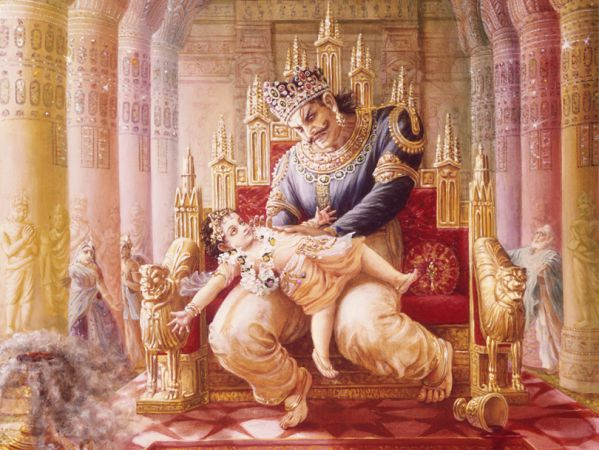
Lord Nṛsiṁhadeva Slays the King of the Demons


As described in this chapter, Hiraṇyakaśipu was ready to kill his own son Prahlāda Mahārāja, but the Supreme Personality of Godhead appeared in front of the demon as Śrī Nṛkeśarī, half lion and half man, and killed him.

Following the instructions of Prahlāda Mahārāja, all the sons of the demons became attached to Lord Viṣṇu, the Supreme Personality of Godhead. When this attachment became pronounced, their teachers, Ṣaṇḍa and Amarka, were very much afraid that the boys would become more and more devoted to the Lord. In a helpless condition, they approached Hiraṇyakaśipu and described in detail the effect of Prahlāda’s preaching. After hearing of this, Hiraṇyakaśipu decided to kill his son Prahlāda. Hiraṇyakaśipu was so angry that Prahlāda Mahārāja fell down at his feet and said many things just to pacify him, but he was unsuccessful in satisfying his demoniac father. Hiraṇyakaśipu, as a typical demon, began to advertise himself as being greater than the Supreme Personality of Godhead, but Prahlāda Mahārāja challenged him, saying that Hiraṇyakaśipu was not God, and began to glorify the Supreme Personality of Godhead, declaring that the Lord is all-pervading, that everything is under Him, and that no one is equal to or greater than Him. Thus he requested his father to be submissive to the omnipotent Supreme Lord.

The more Prahlāda Mahārāja glorified the Supreme Personality of Godhead, the more angry and agitated the demon became. Hiraṇyakaśipu asked his Vaiṣṇava son whether his God existed within the columns of the palace, and Prahlāda Mahārāja immediately accepted that since the Lord is present everywhere, He was also present within the columns. When Hiraṇyakaśipu heard this philosophy from his young son, he derided the boy’s statement as just the talk of a child and forcefully struck the pillar with his fist.

As soon as Hiraṇyakaśipu struck the column, there issued forth a tumultuous sound. At first Hiraṇyakaśipu, the King of the demons, could not see anything but the pillar, but to substantiate Prahlāda’s statements, the Lord came out of the pillar in His wonderful incarnation as Narasiṁha, half lion and half man. Hiraṇyakaśipu could immediately understand that the extraordinarily wonderful form of the Lord was surely meant for his death, and thus he prepared to fight with the form of half lion and half man. The Lord performed His pastimes by fighting with the demon for some time, and in the evening, on the border between day and night, the Lord captured the demon, threw him on His lap, and killed him by piercing his abdomen with His nails. The Lord not only killed Hiraṇyakaśipu, the King of the demons, but also killed many of his followers. When there was no one else to fight, the Lord, roaring with anger, sat down on Hiraṇyakaśipu’s throne.

The entire universe was thus relieved of the rule of Hiraṇyakaśipu, and everyone was jubilant in transcendental bliss. Then all the demigods, headed by Lord Brahmā, approached the Lord. These included the great saintly persons, the Pitās, the Siddhas, the Vidyādharas, the Nāgas, the Manus, the prajāpatis, the Gandharvas, the Cāraṇas, the Yakṣas, the Kimpuruṣas, the Vaitālikas, the Kinnaras and also many other varieties of beings in human form. All of them stood not far from the Supreme Personality of Godhead and began offering their prayers unto the Lord, whose spiritual effulgence was brilliant as He sat on the throne.

ŚB 7.8.14


एवं दुरुक्तैर्मुहुरर्दयन् रुषा
सुतं महाभागवतं महासुर: ।
खड्‌गं प्रगृह्योत्पतितो वरासनात्
स्तम्भं तताडातिबल: स्वमुष्टिना ॥ १४ ॥
evaṁ duruktair muhur ardayan ruṣā
sutaṁ mahā-bhāgavataṁ mahāsuraḥ
khaḍgaṁ pragṛhyotpatito varāsanāt
stambhaṁ tatāḍātibalaḥ sva-muṣṭinā
Synonyms
evam — thus; duruktaiḥ — by harsh words; muhuḥ — constantly; ardayan — chastising; ruṣā — with unnecessary anger; sutam — his son; mahā-bhāgavatam — who was a most exalted devotee; mahā-asuraḥ — Hiraṇyakaśipu, the great demon; khaḍgam — sword; pragṛhya — taking up; utpatitaḥ — having gotten up; vara-āsanāt — from his exalted throne; stambham — the column; tatāḍa — struck; ati-balaḥ — very strong; sva-muṣṭinā — by his fist.

Translation
Being obsessed with anger, Hiraṇyakaśipu, who was very great in bodily strength, thus chastised his exalted devotee-son Prahlāda with harsh words. Cursing him again and again, Hiraṇyakaśipu took up his sword, got up from his royal throne, and with great anger struck his fist against the column.

https://vedabase.io/en/library/sb/7/8/14/

ŚB 7.8.15


तदैव तस्मिन्निनदोऽतिभीषणो
बभूव येनाण्डकटाहमस्फुटत् ।
यं वै स्वधिष्ण्योपगतं त्वजादय:
श्रुत्वा स्वधामात्ययमङ्ग मेनिरे ॥ १५ ॥
tadaiva tasmin ninado ’tibhīṣaṇo
babhūva yenāṇḍa-kaṭāham asphuṭat
yaṁ vai sva-dhiṣṇyopagataṁ tv ajādayaḥ
śrutvā sva-dhāmātyayam aṅga menire
Synonyms
tadā — at that time; eva — just; tasmin — within (the pillar); ninadaḥ — a sound; ati-bhīṣaṇaḥ — very fearful; babhūva — there was; yena — by which; aṇḍa-kaṭāham — the covering of the universe; asphuṭat — appeared to crack; yam — which; vai — indeed; sva-dhiṣṇya-upagatam — reaching their respective abodes; tu — but; aja-ādayaḥ — the demigods, headed by Lord Brahmā; śrutvā — hearing; sva-dhāma-atyayam — the destruction of their abodes; aṅga — my dear Yudhiṣṭhira; menire — thought.

Translation
Then from within the pillar came a fearful sound, which appeared to crack the covering of the universe. O my dear Yudhiṣṭhira, this sound reached even the abodes of the demigods like Lord Brahmā, and when the demigods heard it, they thought, “Oh, now our planets are being destroyed!”

Purport
As we sometimes become very much afraid at the sound of a thunderbolt, perhaps thinking that our houses will be destroyed, the great demigods like Lord Brahmā feared the thundering sound that came from the pillar in front of Hiraṇyakaśipu.
https://vedabase.io/en/library/sb/7/8/15/

Taj Bibi – Mughal Queen, Pure Devotee of Krishna

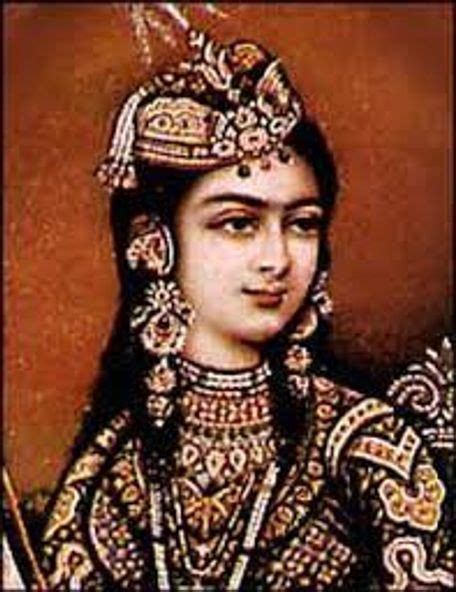
Taj Bibi was a Mughal queen. A wife of the great Mughal Emperor Akbar himself. But she is also a great Vaishnava saint. Her devotional songs are sung to this day. Her tomb is in Vrindavan. How did she make the journey from a mere Mughal Queen to an exalted pure devotee of Krishna?

It is often misunderstood that Krishna is the “God of the Hindus”, or “Hindu God”, or worse “A Hindu god”.

Nothing could be further from the truth, first of all, God is neither Hindu nor Muslim nor Christian nor Jewish nor any other designation you can think of.

God is God.

What to speak of God, even the devotee of God is beyond all material designations!

The very definition of devotion to God by the great Vaishnava saint Srila Rupa Goswami makes this abundantly clear.

সর্বোপাধিবিনির্মুক্তং তৎপরত্বেন নির্মলম্ ।
হৃষীকেণ হৃষীকেশ-সেবনং ভক্তিরুচ্যতে ॥ ১৭০ ॥

sarvopādhi-vinirmuktaṁ
tat-paratvena nirmalam
hṛṣīkeṇa hṛṣīkeśa-
sevanaṁ bhaktir ucyate

“ ‘Bhakti, or devotional service, means engaging all our senses in the service of the Lord, the Supreme Personality of Godhead, the master of all the senses. When the spirit soul renders service unto the Supreme, there are two side effects. One is freed from all material designations, and one’s senses are purified simply by being employed in the service of the Lord.’

https://vedabase.io/en/library/cc/madhya/19/170/

In other words, devotion to God is not possible for someone who is under material designations like Hindu, Muslim, Christian, Jew, or Indian, Pakistani, Chinese, American, African, Canadian.

By corollary, anyone who identifies with any material designation, has no devotion to God.

And when someone truly awakens to the Love of God, then nothing can stop them. Not the religion of their birth, not their gender, not their social or economic status, or their education. When Love of God awakens, it is a force that no other power can stop.

स वै पुंसां परो धर्मो यतो भक्तिरधोक्षजे ।
अहैतुक्यप्रतिहता ययात्मा सुप्रसीदति ॥ ६ ॥

sa vai puṁsāṁ paro dharmo
yato bhaktir adhokṣaje
ahaituky apratihatā
yayātmā suprasīdati

The supreme occupation [dharma] for all humanity is that by which men can attain to loving devotional service unto the transcendent Lord. Such devotional service must be unmotivated and uninterrupted to completely satisfy the self.

https://vedabase.io/en/library/sb/1/2/6/

Take the example of Taj Bibi, a great saint in the Bhakti tradition.

I first heard of Taj Bibi in a Youtube lecture series on Sri Radha Govindaji by His Holiness Indradyumna Swami, a former US Marine turned Vaishnava monk. He is a wonderful, inspiring, saintly Vaishnava.

Taj Bibi was born in a devout and well educated Muslim family. She was the daughter of a Maulvi, a Muslim priest well-connected to the Emperor Akbar. Practically, her father was one of Akbar’s spiritual advisors.

Growing up, she had a fascination for Allah that went beyond the instruction of the Quran. She wanted to see and serve Allah personally. She asked repeatedly if Allah could be seen… and all the Muslim religious leaders told her that if she went to Mecca and Medina on Hajj then she could see Allah. But she was dissuaded for being too young.

She was also exceedingly beautiful. When her father, Fadan Khan died, the Emperor Akbar married her and she became a respected Mughal Queen.

Taj Bibi, Mughal Queen and Vaishnava Saint

One day, on her way to Agra to see Emperor Akbar, she heard the bells of the famous Govindaji temple in Vrindavan. She asked her palanquin bearers what the sound was.

Little Allah!

Those are the bells of the temple of Govindaji, came the reply. She then asked who Govindaji was. The head Muslim Palanquin bearer answered “Oh, he is a little god of the Hindus”. Taj Bibi exclaimed “Oh! Chhota Allah”, which means “Little Allah”. She insisted on being taken to the temple.

Sri Govindaji, who now resides in Jaipur, Rajasthan. He was originally in Vrindavan, but the Mughal Emperor Aurangzeb wanted to desecrate the temple. After a spell-binding adventure, Sri Govindaji reached Jaipur over 400 years ago.

When she reached there, because she was Muslim, she wasn’t allowed entry into the temple. So she sat at the doorway, mesmerized by the sight of Govindaji. She sat there and sang and sang and sang.

The palanquin bearers reminded her that the Emperor was waiting. She ordered the palanquin bearers to inform the emperor to release her from the marriage. Akbar, being an evolved spiritualist himself, agreed.

Taj Bibi then made Vrindavan her home and entered deep into the love of her Allah, she knew Allah as Krishna and saw Him personally in meditation every day.

She also received Vaishnava initiation from her spiritual master Sri Vitthalnath ji, a disciple of Sripada Vallabhacharya of the Pushtimarga Sampradaya.

She spent her life immersed in loving devotional service and wrote many many songs, written in the agony of separation from her beloved, Krishna, or Govindaji. Her songs are sung by devotees to this very day.

In fact, she left her mortal body behind one day, in the sacred land of Vrindavan, eager to catch Krishna who was close by, playing Holi (the festival of colours) with His dearest associates. She went to meet her Beloved in her spiritual form, leaving her mortal body behind.

Her tomb in Raman Reti bears witness to the life of this great saint who fell in love with Krishna despite being born a Muslim and being in the materially exalted position of being a queen of the great Mughal emperor Akbar.

The tomb of the great Mughal Queen and Vaishnava Saint, Taj Bibi.

Bhakti knows no barriers.

Not very long ago, when I gave a Bhagavatam class at ISKCON Hyderabad, there was one young lady who was asking me some very intense questions. I learned that she was a girl from a Muslim family, and her teachers were discouraging her from practicing Krishna Bhakti. I said to her that Allah was standing in front of her in the form of Sri Radha Madan Mohan, and He was visible as He is to those whose eyes are tinged with the salve of Love of God. She was clearly very moved by Sri Radha Madan Mohan, as she stood in front of Him with tears in her eyes.

And of course, many readers have expressed appreciation for the Muslim Brahmin in Hyderabad.

Allah stands in the form of Sri Radha Madan Mohan in ISKCON Hyderabad, for thoe who have the eyes to see Him.

And how can you develop the eyes to see God?

Chant the names of God, even if according to your own tradition. If you are actually chanting the names of God, then you will see God everywhere, including in His deity form, and in every genuine name of God, you will feel ecstatic love.

एतन्निर्विद्यमानानामिच्छतामकुतोभयम् ।
योगिनां नृप निर्णीतं हरेर्नामानुकीर्तनम् ॥ ११ ॥

etan nirvidyamānānām
icchatām akuto-bhayam
yogināṁ nṛpa nirṇītaṁ
harer nāmānukīrtanam

O King, constant chanting of the holy name of the Lord after the ways of the great authorities is the doubtless and fearless way of success for all, including those who are free from all material desires, those who are desirous of all material enjoyment, and also those who are self-satisfied by dint of transcendental knowledge.

https://vedabase.io/en/library/sb/2/1/11/

If you would like to taste genuine spiritual bliss, please chant this mantra constantly:

Hare Krishna Hare Krishna
Krishna Krishna Hare Hare
Hare Rama Hare Rama
Rama Rama Hare Hare

There are many great saints, born in Muslim families, but who developed great devotion to Krishna and are exemplary in their devotional service. I will write about some of them in due course of time.

Do you have a question? Feel free to write to me!

Be careful what you think around saintly persons!

When we visit the great saints, and when we pray to them, are our prayers heard? Is there any reciprocation? How do we know it was not our imagination?

In various pilgrimages to visit saintly persons, I have had the good fortune to get much reciprocation.

With a saintly person who is yet in flesh, reciprocation is easy to get, they will convey that to you in word and deed, sometimes they will put that in writing too.

But what about the saintly persons in “samadhi” or trance, who are physically entombed (sometimes while still alive, at their instruction), but who are clearly not dead and gone.

What to speak of death for a saintly spiritually perfected being, there is no death even for all of us – we don’t die, we just carry on in some other guise. For someone like me, there may be positive and negative consequences of our actions in a future lifetime… but for a genuinely saintly person, they are eternal residents of the Kingdom of God, while still being available by prayer to the likes of me.

But in prayer and meditation, how to know if what we have received is actually from that saintly person and not a concoction of the mind? After all there are so many who claim to “speak to God” and yet do despicable things. I am personally not comfortable sharing my inner feelings here in this article, but I do have one recent experience with a great saintly soul which was a very sweet interaction, if somewhat painful for me! 🙂

Recently, I visited Mantralayam, in South Central India, the place where Sri Raghavendra Swami, a great 17th century saint, resides in samadhi. Thousands of pilgrims throng his shrine, and ask for all sorts of things. In my previous visit in 2019, I had asked “How may I serve you” and the inspiration came “Help people understand what to ask of me”… so I dedicated my time there to distributing spiritual literature from the 20th century saint Srila A. C. Bhaktivedanta Swami Prabhupada. I was summoned to the administrator’s office, interrogated, and then the administrator, satisfied with my responses, took some books for himself and gave me permission to distribute books there anytime… More about those experiences at another time.

Raghavendra Swami is a great saint who taught about Krishna and in order to attract attention and seriousness to his teachings, he performed some miracles… a lot of people have forgotten his actual instructions and are fully enamored of the miracles, and go asking for mundane temporary blessings that are surely taken away by all-devouring death. But such a great saint can give complete relief from all material misery by granting the ultimate spiritual perfection!

I have had many other interactions with him, but I will keep that private for now… here is one, where I got a gentle fatherly slap from him!

The day we arrived, I was very hungry, having fasted all day during the long bumpy journey, but the Prasada (sanctified food) served in the temple was somewhat scanty and I went to bed hungry… in my childish impudence on my way back from the temple, I happened to “complain” silently in my mind to Raghavendra Swami that his assistants didn’t ask me if I wanted more, rushed me out, and so I went hungry. I was like, how is it that someone, one of your servitors, comes to your place and goes hungry.

The next day, I rose early well before sunrise, took my bath, meditated at the temple doors before they opened, then performed my mantra meditation right at the shrine, and later that morning, went again to obtain more Prasada (literally food received as Krishna’s mercy)… and was secretly worried that I might go hungry once again! So, in the second course, I rushed to asked for more. The serving priest took one look at me, and gave me a MASSIVE glob of rice, and I was satisfied that this time I would be just fine, my quota was met, and I had enough.

But poor little me, I had not factored in the remaining courses coming, all different varieties of very delicious rice preparations with sides! One course, two courses, three, four… a total of 8 courses were served, and each one was a fresh surprise to me, and before I could react, the item was served on my banana leaf plate with great speed, the next course arriving while I was heads down, before I could finish what was on my plate.

I have a vow of never wasting any Krishna Prasada I have been served on my plate, so I put it all away somehow, with great difficulty, laughing to myself at the same time at the transcendental trick that was played on me.

I was barely able to stand up and walk on my way to washing my hands and mouth! Needless to say, I didn’t need anything to eat for a long time to come!

It was almost as if “Oh, you say you went hungry yesterday, so let’s see how much you can eat!” a light-hearted challenge from Raghavendra Swami! And I must happily say that he won, and I lost. He could, that powerful personality, from his Samadhi, arrange to supply me with more than I could possibly eat, not a word said to anyone!

After all, what does it matter a little less to eat once in a while, I did get food enough to survive, did I not? So clearly even though my original complaint was quite childish, Sri Raghavendra Swami did hear it, and acted on it, if only to give me a gentle slap in my face. And miraculously enough, even though I had eaten probably 5-6 times of my usual quota, I did not suffer from a stomach upset that day!

This was just one of many experiences I have had with the great saints, and thanks to their causeless mercy, I carry on in spiritual life. I am grateful for all the mercy I have received undeservedly, whether it was encouragement, or chastisement, and often, slaps in my face to set me straight.

So, when you’re around a saintly person, be careful of what you think, you might just get way more than you bargained for!

Devout Atheists

Does the phrase “Devout Atheist” sound strange to you? Do you know it takes a lot more faith and dogma to believe in atheism? Why do spiritualists bother with atheists?

Sounds strange? Using those words together? But a good friend, Aaron Joy, wrote that to me in an email, and the phrase startled me, and yet rang true!

He described how his parents were devout atheists!

To be an atheist requires a tremendous amount of blind faith.

Here’s the dogma. Once upon a time, no, wait, before time existed, or space or anything else, there was this big explosion that came out of nothing. The explosion happened for no reason whatsoever. And out of that explosion that came out of nothingness, this beautiful ordered well-designed universe showed up. All the planets in their intricate dance, all the stars and galaxies in their beautiful symmetric beauty were accidentally created. All the species with their well-designed abilities appeared by some carefully selected but random manner. All the seasons, the mountains, the rivers, the oceans, the beautiful sunrises and sunsets, they all just are an accident.

All the poetry in the world, the beauty of relationships, everything we cherish is no more significant than random electro-chemical flickering, noise in which we accidentally see any meaning.

Indeed, to be an atheist requires so much strength of belief. Despite evidence to the contrary that nothingness does not exist, that randomness is a myth, they stubbornly cling on to their concocted imaginations. Despite not even a shred of evidence that anything can come out of nothing, they continue to believe in the fairy tale of the big bang! My spiritual master Sankarshan Das Adhikari wrote about the hoax that is the BIg Bang Theory.

Bhakti Charu Swami said it very well. Once he was in Hyderabad, India, looking for a studio to make a movie on the life of Srila Prabhupada, the greatest spiritual leader the world has seen in modern times. He was speaking to the owner of one famous film studio. When the subject of the film was discussed, the owner arrogantly boasted that he was an atheist, by way of challenge.

Bhakti Charu Swami Maharaja calmly replied – if there is a blind man who cannot see the beautiful sun, what will you do? You will pity him. Similarly, we pity the atheists that they don’t see beautiful Krishna. And Maharaja took his valuable business elsewhere.

It is one thing to feel pity for someone who cannot see the sun, but what would you feel for the fool who refuses to open his eyes and look at the sun, instead claiming that the sun does not exist? So sometimes we use strong words, we call them fools and we call them rascals, we call them idiots.

We bear no ill will towards anyone. We are just like the surgeon cuts open the body of a diseased person to heal them and an oncologist (doctor who tries to treat cancer) gives poison (chemotherapy) to heal a person suffering from cancer. We bear only compassion. We know that it may not be well-received.

Radhanath Swami Maharaja tells the story of a saintly man who once saw a scorpion drowning. He immediately put his hand in the water and fished it out. The scorpion stung him and fell back into the water. He picked the scorpion up again, and got stung again. This happened several times before the scorpion was on dry land.

When asked about this, the saintly soul replied, “it is the scorpion’s nature to sting, and mine to serve”. So, we are simply trying to serve the poor deluded atheists.

I was once an atheist myself. I was saved by all these spiritualists, and I even stung many who were trying to save me. But I am saved now, in spiritual consciousness, Krishna consciousness. If I can be saved, anyone can be saved.

Life after life, I pray to pay it forward and reconnect the lost souls to Sri Krishna, the loving, anxious Father, who ever beckons. What’s a few little stings in return for the privilege of taking one soul back home to Godhead?