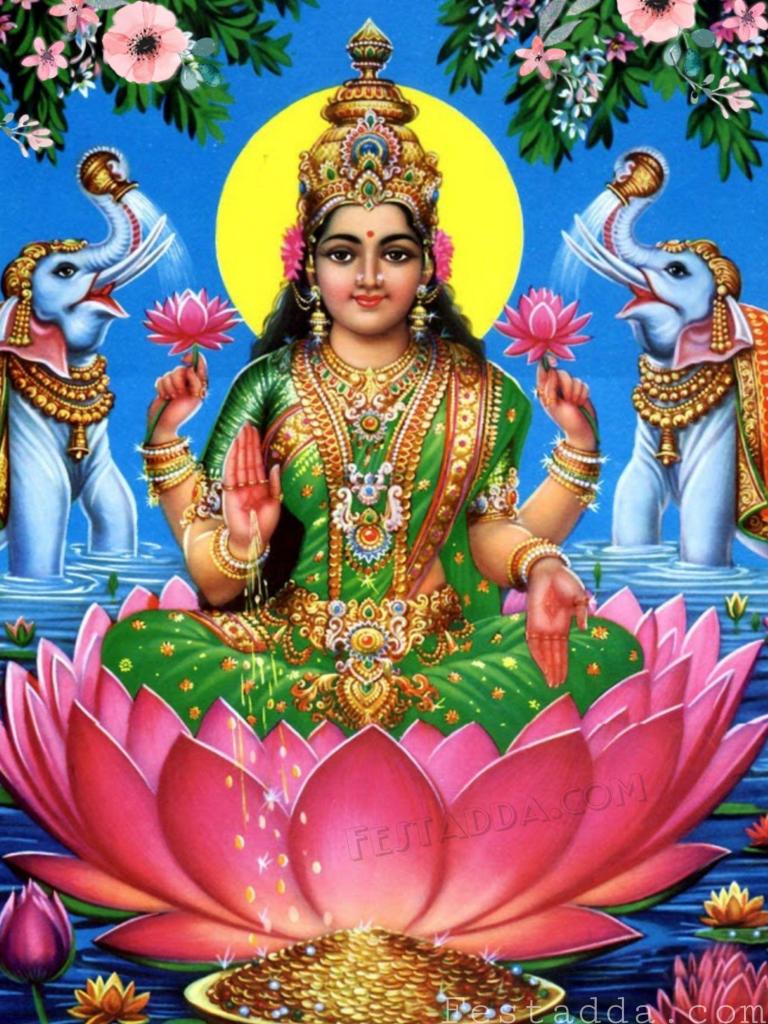
Lakshmi Puja is an essential aspect of Hindu Ritualistic practices, especially during Diwali or Deepavali. Lakshmidevi is worshipped as the Goddess of Fortune, and prayers are made to bestow wealth upon the worshippers. However, Lakshmidevi is also the wife of Lord Narayana. Should we attend, or should we avoid as a materialistic practice?
Hemanga Das, 15 August 2014
Hare Krishna Devotees!
Please accept my obeisances
All glories to Srila Prabhupada
The practice of performing Laxmi puja by householders in India is pretty common.My question is, What is the best thing to do when invited to Laxmi puja?
Can we attend these Pujas with an understanding that Laxmi is the wife Lord Narayana (One of Krishna’s incarnation) or should we see it as a demigod worship and refuse the invitation?
Thank you in advance.
your servant,
Hemanga Das
Bhakta Sunil, 19 August 2014
Hare Krishna
Please accept my humble obeisances
All Glories to Srila Prabhupada
Prabhu ji , this may not be answer to your question : Regarding Laxmi Puja during Diwali , I remember having heard that one should worship both Laxmi Mata and Narayana Bhagavan. I mean worship , not only Laxmi Mata during Laxmi Puja , but both Laxmi Mata and Narayana Bhagavan in the Laxmi Puja
Requesting readers to correct me if I am wrong
Humbly,
Sunil
Mahabhagavat Das SDA, 20 August 2014
Dear Hemanga Prabhu,
Please accept my humble obeisances.
All glories to Srila Gurudeva.
All glories to Srila Prabhupada.
It is true that it is not necessary for us to engage in demigod worship. The so-called Lakshmi Puja is essentially a prayer to the Goddess of wealth to please give wealth so that the worshiper may engage in sense gratification with the money. People want Lakshmi, but they don’t understand that where Lord Narayana goes, Lakshmidevi follows her husband.
However, as devotees in general society, if we outright reject all these things, then we will be seen as fanatics and we will not be effective in sharing Krishna consciousness with anyone.
So, since I know you are personally a fixed-up devotee, and I personally don’t see any risk if you go… I would say, weigh carefully all the pros and cons, and decide for yourself. Here are some advantages of going:
1. You make friendships with others and strengthen your relationships
2. You get a chance to share Krishna consciousness with others who may not come to temple etc.
3. You can pray to Lakshmidevi to please give you mercy so you can be a pure devotee – as long as you don’t pray to any demigod for sense gratification or consider any demigod the Supreme, you are fine.
You can take some books of Srila Prabhupada with you also, as presents for those who might not have them, on the auspicious occasion of Lakshmi Puja.
Sincerely,
Mahabhagavat Das
P.S: Srimati Lakshmidevi is also the primary link of the Sri Sampradaya, of which Sri Ramanujacharya is a great Vaishnava Acharya. We follow his instructions to this day!
Please subscribe to daily inspirational emails from His Grace Sriman Sankarshan Das Adhikari (Writings and lectures archived at www.ecstaticmedia.com), written fresh every day from his travels around our world and into the spiritual world, sharing the highest spiritual knowledge with everyone. Sign up now at www.joincourse.com
What is knowledge? What is ignorance? How do we acquire knowledge? Which method actually works? Finding out things the ascending way, or hearing from an authority? How to acquire perfect knowledge beyond all doubt?
Knowledge is a wonderful thing, isn’t it?
Are these people getting anywhere? Are they “progressing”?
With knowledge, comes power. Power to do good, and also power to do evil. Knowledge can be a liberator, but also can be a tool for enforcing bondage.
Also, what qualifies as knowledge anyway? If, for example, a person acquired some knowledge on “how to rob a bank” and applies that knowledge, landing in prison, or even if they escape somehow, was that really knowledge? Or was it ignorance?
There are 2 main types of knowledge:
Knowledge of the material world -material knowledge
Knowledge of what lies beyond this material world through the scriptures – spiritual knowledge – In Sanskrit “परोक्ष” or “parokṣa”
There are many means of acquiring knowledge:
By Direct experience or perception – In sanskrit “प्रत्यक्ष” or “pratyakṣa”
By hypothesis/logic/conjecture/guessing – In sanskrit “अनुमान” or “anumāna”
By hearing from a higher authority – In Sanskrit “शब्द” or “śabda”
Ultimately, there are 2 fundamental processes of acquiring knowledge:
Ascending Process – build up knowledge from building blocks – In Sanskrit “आरोहपन्था” or “ārohapanthā“
Descending Process – Knowledge descending directly from God and His messengers – In Sanskrit “अवरोहपन्था” or “avarohapanthā“
In an article, with an example of an ant who wanted to map the Universe, I discussed the futility of the ascending process of knowledge, especially about items that are outside of our realm of perception.
Much of what we know exists, is actually too subtle to perceive.
These are the material elements, listed in the Bhagavad Gita:
Gross Material Elements:
Earth
Water
Fire
Air
Ether (Space/Sky)
Subtle Material Elements:
Mind
Intelligence
False Ego
BG भूमिरापोऽनलो वायु: खं मनो बुद्धिरेव च । अहङ्कार इतीयं मे भिन्ना प्रकृतिरष्टधा ॥ ४ ॥
bhūmir āpo ’nalo vāyuḥ khaṁ mano buddhir eva ca ahaṅkāra itīyaṁ me bhinnā prakṛtir aṣṭadhā
Earth, water, fire, air, ether, mind, intelligence and false ego – all together these eight constitute My separated material energies.
Earth is the most gross of the material elements, more subtle is water, even more subtle is air, and ether is quite subtle, you can’t touch or feel space, but we can still perceive it. Now, when we get to the mind, that is even more subtle. Intelligence is still more subtle, and the most subtle material element is false ego, our sense of identity.
However, none of the material elements can directly approach that which is non-material, namely the spiritual is outside of the realm of material elements, even subtle.
If we see our material means of acquiring knowledge, the mind, intelligence, and our sense of identity are all material in nature, and therefore, the ascending process of acquiring knowledge cannot possibly extend to the spiritual realm.
There is another main reason why the ascending process of knowledge is flawed… all of us who are “conditioned” to accept a material identity, have 4 defects:
Tendency to be illusioned (In Sanskrit “भ्रम”or “bhrama”) – we often misunderstand facts and are illusioned about things as they are
Tendency to make mistakes (In Sanskrit “प्रमाद” or “pramāda”) – there is no conditioned souls who can say they never make mistakes
Tendency to cheat others (In Sanskrit “विप्रलिप्सा”or “vipralipsā”) – this is a great weakness, to want to appear better than we are, or know something we don’t, etc.
We possess imperfect senses (In Sanskrit “करण पाटव” or “karaṇa-pāṭava”) – all our senses are quite imperfect, and we miss a lot from our senses
So, with these 4 defects, it is impossible to acquire perfect knowledge using only our senses. Why is that? It is because with an imperfect instrument, you cannot make something that is perfect. No matter how hard we try, our imperfections stand in the way.
The common example is if we’re doing some mathematical calculation or solving an equation… a tiny mistake somewhere along the way can get us a wrong answer.
Let’s say, for example, someone didn’t know who their father was… they can do some detective work, or a DNA test of every man in the world, or they can take the answer from their mother. The mother’s answer is authoritative and a lot easier too.
Reconnecting Material to the Spiritual
The only way to acquire perfect knowledge, then, is through the descending process, “avarohapantha”. In this process, the Supreme Absolute Perfect (generically called God, specifically named Krishna, Allah, Rama, Govinda, Buddha, Jehovah, Yahweh, etc.) conveys the perfect knowledge, and whoever hears this knowledge passes it on without addition or subtraction.
Perfect Knowledge means something that never changes. Compare this to our ascending process of knowledge. Researchers make a career out of making mistakes! First they publish one paper hypothesizing (and sometimes also offering “proof”) one particular thing… the laypeople accept that as the truth, and then a little while later, that or another researcher publishes another paper contradicting the original hypothesis or proof. In this way, the so-called philosophers and scientists bumble about, going from imperfection to imperfection. This is not called knowledge, this is called nescience, or ignorance.
Why is that? Because material knowledge gives the impression of advancement, whereas it actually traps us in bigger and bigger problems, requiring more and ever more complexity. A material “solution” is only another problem in disguise… it is simply creating one problem in place of another. Therefore, material knowledge is not called knowledge, but ignorance. And those who pursue material knowledge excessively are said to be ignorant.
So therefore, spiritual knowledge is worth pursuing, and such knowledge cannot be “discovered/created/invented” by anyone else other than the Supreme Personality of Godhead.
धर्मं तु साक्षाद्भगवत्प्रणीतं न वै विदुऋर्षयो नापि देवा: । न सिद्धमुख्या असुरा मनुष्या: कुतो नु विद्याधरचारणादय: ॥ १९ ॥
dharmaṁ tu sākṣād bhagavat-praṇītaṁ na vai vidur ṛṣayo nāpi devāḥ na siddha-mukhyā asurā manuṣyāḥ kuto nu vidyādhara-cāraṇādayaḥ
Real religious principles are enacted by the Supreme Personality of Godhead. Although fully situated in the mode of goodness, even the great ṛṣis who occupy the topmost planets cannot ascertain the real religious principles, nor can the demigods or the leaders of Siddhaloka, to say nothing of the asuras, ordinary human beings, Vidyādharas and Cāraṇas.
Lord Brahmā, Bhagavān Nārada, Lord Śiva, the four Kumāras, Lord Kapila [the son of Devahūti], Svāyambhuva Manu, Prahlāda Mahārāja, Janaka Mahārāja, Grandfather Bhīṣma, Bali Mahārāja, Śukadeva Gosvāmī and I myself know the real religious principle. My dear servants, this transcendental religious principle, which is known as bhāgavata-dharma, or surrender unto the Supreme Lord and love for Him, is uncontaminated by the material modes of nature. It is very confidential and difficult for ordinary human beings to understand, but if by chance one fortunately understands it, he is immediately liberated, and thus he returns home, back to Godhead.
Now, at least some of those personalities have established disciplic successions on this planet.
There are 4 main authorized disciplic successions to receive perfect knowledge in discipic successions. A disciplic succession is known as “Sampradaya” or “That which gives completely”.
A mango, intact, passed down
A useful example is that if a ripe mango is high in a tree, then if the mango is handed from person to person from those who are at various heights pass the mango down from hand to hand, vs. trying to throw the mango down to the ground…
A Sampradaya delivers spiritual knowledge perfectly, without addition or subtraction
Brahma Sampradaya and its branches, especially expounded by the great teacher Madhva, Lord Chaitanya, and their followers.
Rudra Sampradaya and its branches, especially expounded by the great teacher Vishnu Swami and his followers.
Sri Sampradaya and its branches, begun by Lakshmi devi, the Goddess of Fortune, consort of Lord Narayana, and especially expounded by the great teacher Sri Ramanuja and his followers.
Kumara Sampradaya and its branches, especially expounded by the great teacher Sri Nimbarka and his followers.
What about the rest?
To the extent the teachings of others are in line with one of these descending lines of discipic succession, they are valid, and anything outside of these is at best a stepping stone to one of these 4 lines of disciplic succession. In the worst case, it is a materialistic business masquerading as a genuine spiritual tradition.
Those who claim to be part of a certain tradition but add or subtract from the fundamental principles or twist the teachings are called “apasampradayas” or “anti disciplic successions”.
His Grace Sriman Sankarshan Das Adhikari
By the mercy of my parents and then my spiritual master His Grace Sriman Sankarshan Das Adhikari who is a disciple of His Divine Grace A. C. Bhaktivedanta Swami Prabhupada The Founder Acharya of the International Society for Krishna Consciousness, even though personally unworthy, I am connected to one of these lines of disciplic succession, called the Brahma-Madhva-Gaudiya Sampradaya, and seeking to pass on those pure instructions to whoever may want to follow, without adding or subtracting any principle, only, if need be, adjusting details to suit the individual and times.
His Divine Grace A. C. Bhaktivedanta Swami Prabhupada, Founder Acharya of the International Society for Krishna Consciousness (ISKCON)
And what is a principle and what is a detail? That, Srila Prabhupada said, requires some intelligence. I pray for this intelligence, which in my case, I simply ask my spiritual master with a clear description of context.
Ultimately however, knowledge coming from the scriptures and the spiritual master in disciplic succession must be realized in the heart through a process of personal effort (sadhana) and purification. Then the paroksha jnana or scriptural knowledge through scripture, becomes “aparoksha” or that which is beyond the reach of the material senses. In order to experience such knowledge in action, one’s senses must be spiritually awakened, or re-spiritualized.
Krishna, the Supreme Personality of Godhead
Pure devotional service to Krishna is the Ultimate goal of all knowledge, and anything besides this is a waste of time.
Questions? I remain your servant on your spiritual journey! Hare Krishna!
Please kindly accept my humble obeisances.
All glories to Srila Gurudeva.
All glories to Srila Prabhupada.
All glories to devotees.
I have a doubt which I wish to ask. Please forgive me if my question is inappropriate.
While we acknowledge Lord Shiva as a devotee of Lord Krishna or as the top most vaishnava, why are we not acknowledging Shiva by having his picture or deity in our temples. I have heard in many sathsangs, being said by our devotees that Lord Shiva is the top most vaishnava. Why do we ignore Shiva from being worshiped? Is there any specific reason in the shastras? Kindly enlighten.
Haribol !
Sincerely,
Harish V Menon
Mahabhagavat Das SDA, 19th March 2013
Dear Harish,
Hare Krishna!
Please accept my humble obeisances.
All glories to Srila Gurudeva.
On the altar, we only have the specific Deity being worshiped along with that Deity’s associates and the disciplic succession, and that too, not the entire disciplic succession. The spiritual masters are usually on the altar of Sri Sri Gaura Nitai because we can approach Sri Sri Gaura Nitai only through our disciplic succession, and we can approach Krishna through Sri Sri Gaura Nitai.
Lord Shiva is not part of our direct disciplic succession. It is not possible to include every great personality on the altar, I mean, Lord Brahma is not on our altar even though he is the originator of our Sampradaya. Krishna alone has millions and billions of forms, those forms are not on the altar. Just because a personality is not on the altar does not mean we do not respect that personality. For example, one of our dearest Acharyas, Narottama Dasa Thakura is not on the altar, Baladeva Visyabhushana, to whom Srila Prabhupada dedicated his Bhagavad Gita As It Is, is not on the altar. Does that mean we do not consder them worshipable?
However, here is one interesting pastime which you should kindly take note of… there were some ecstatic Kirtanas going on in the ISKCON temple in London, England. Srila Prabhupada instructed his disciples to place 2 more Vyasasanas in the temple room, for Lord Shiva and Narada Muni, who were coming to attend the ecstatic Kirtanas. Srila Prabhupada could see who was coming for Kirtanas. Even today, it is said that at Brahma Muhurta, when the altar doors open, the demigods come to the temple room to take Darshan of Krishna, maybe we can have purified vision that we can perceive their presence. 🙂 Another thing is that in Kirtana, Lord Chaitanya and Lord Nityananda and their associates are personally present. Krishna is personally present in His name… do all of us perceive His presence?
But you know, the spiritual master is very exalted, because the spiritual master is sum total of all the demigods, and the spiritual master is the external manifestation of Krishna in this material world. When can we have the eyes to see the glory of the spiritual master who is there on the altar and sometimes also in person, that we don’t see who is not present, but see actually who is present?
Ultimately, watering the root gives water to the entire tree, we do not have to water every single leaf and branch separately and this is the key reason why, even though we respect the demigods greatly, we do not worship them.
Sincerely,
Mahabhagavat Das
Srivatsa Das, 19th March 2013
Hare Krishna
Please accept my humble obeisances,
All glories to Srila Gurudeva
Though Mahabhagavat Das Prabhu has clearely explained, below is the quote from Bhagavatam (just for additional information):
mumukṣavo ghora-rūpān
hitvā bhūta-patīn atha
nārāyaṇa-kalāḥ śāntā
bhajanti hy anasūyavaḥ
mumukṣavaḥ — persons desiring liberation; ghora — horrible, ghastly; rūpān — forms like that; hitvā — rejecting; bhūta–patīn — demigods; atha — for this reason; nārāyaṇa — the Personality of Godhead; kalāḥ — plenary portions; śāntāḥ — all-blissful; bhajanti — do worship; hi — certainly; anasūyavaḥ — nonenvious.
Translation:
Those who are serious about liberation are certainly nonenvious, and they respect all. Yet they reject the horrible and ghastly forms of the demigods and worship only the all-blissful forms of Lord Viṣṇu and His plenary portions.
PURPORT
The Supreme Personality of Godhead Sri Krishna, who is the original person of the Vishnu categories, expands Himself in two different categories, namely integrated plenary portions and separated parts and parcels. The separated parts and parcels are the servitors, and the integrated plenary portions of vishnu-tattvas are the worshipful objects of service.
All demigods who are empowered by the Supreme Lord are also separated parts and parcels. They do not belong to the categories of vishnu-tattva. The vishnu-tattvas are living beings equally as powerful as the original form of the Personality of Godhead, and They display different categories of power in consideration of different times and circumstances. The separated parts and parcels are powerful by limitation. They do not have unlimited power like the vishnu-tattvas. Therefore, one should never classify the vishnu-tattvas, or the plenary portions of Näräyana, the Personality of Godhead, in the same categories with the parts and parcels. If anyone does so he becomes at once an offender by the name päsandi. In the age of Kali many foolish persons commit such unlawful offenses and equalize the two categories.
The separated parts and parcels have different positions in the estimation of material powers, and some of them are like Käla-bhairava, Smasäna-bhairava, Sani, Mahäkäli and Candikä. These demigods are worshiped mostly by those who are in the lowest categories of the mode of darkness or ignorance. Other demigods, like Brahmä, Siva, Sürya, Ganesha and many similar deities, are worshiped by men in the mode of passion, urged on by the desire for material enjoyment. But those who are actually situated in the mode of goodness (sattva-guna) of material nature worship only vishnu-tattvas. Vishnu-tattvas are represented by various names and forms, such as Näräyana, Dämodara, Vämana, Govinda and Adhokshaja.
The qualified brähmanas worship the vishnu-tattvas represented by the sälagräma-silä, and some of the higher castes like the kshatriyas and vaisyas also generally worship the vishnu-tattvas.
Highly qualified brähmanas situated in the mode of goodness have no grudges against the mode of worship of others. They have all respect for other demigods, even though they may look ghastly, like Käla-bhairava or Mahäkäli. They know very well that those horrible features of the Supreme Lord are all different servitors of the Lord under different conditions, yet they reject the worship of both horrible and attractive features of the demigods, and they concentrate only on the forms of Vishnu because they are serious about liberation from the material conditions. The demigods, even to the stage of Brahmä, the supreme of all the demigods, cannot offer liberation to anyone. Hiranyakasipu underwent a severe type of penance to become eternal in life, but his worshipful deity, Brahmä, could not satisfy him with such blessings. Therefore Vishnu, and none else, is called mukti-päda, or the Personality of Godhead who can bestow upon us mukti, liberation. The demigods, being like other living entities in the material world, are all liquidated at the time of the annihilation of the material structure. They are themselves unable to get liberation, and what to speak of giving liberation to their devotees. The demigods can award the worshipers some temporary benefit only, and not the ultimate one.
It is for this reason only that candidates for liberation deliberately reject the worship of the demigods, although they have no disrespect for any one of them.
unquote
your servant
Srivatsa Das
Geetha, 19th March 2013
Hare Krishna
Thank you so much for enlightening me in this matter.
sincerely
Geetha Rao
Harish V Menon, 19th March 2013
Hare Krishna Prabhujis,
Please kindly accept my humble obeisances.
Thank you so much for enlightening me !
your servant,
Harish V Menon
Please subscribe to daily inspirational emails from His Grace Sriman Sankarshan Das Adhikari (Writings and lectures archived at sda-archives.com), written fresh every day from his travels around the world sharing the highest spiritual knowledge with everyone. Sign up now at www.backtohome.com




 Freedom through Genuine Spiritual Progress