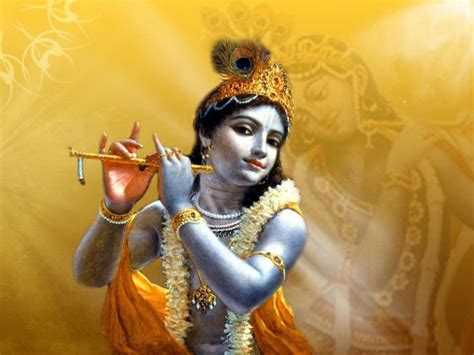
Do You Know How Heavy Your Lunch Is?

Usually, my bag is heavy with a laptop, books, and a lovingly prepared lunch. But on Ekadashi,the bag feels weightless, and for once, the “hunger” that usually rules the day miraculously vanishes. We spend our whole lives working to “pay” for our food, but are we actually settling the bill? Or are we just ignoring the debt we owe to the Sun, the Earth, and God who made them all? If we aren’t offering our food back to God, are we truly eating or are we just incurring a debt we can’t pay back? In the material world, “you die so I can live” is the standard. But there is a way to break this cycle of debt. Dive into my latest post on why Ekadashi is more than just a fast. What is the “weight” of our food?

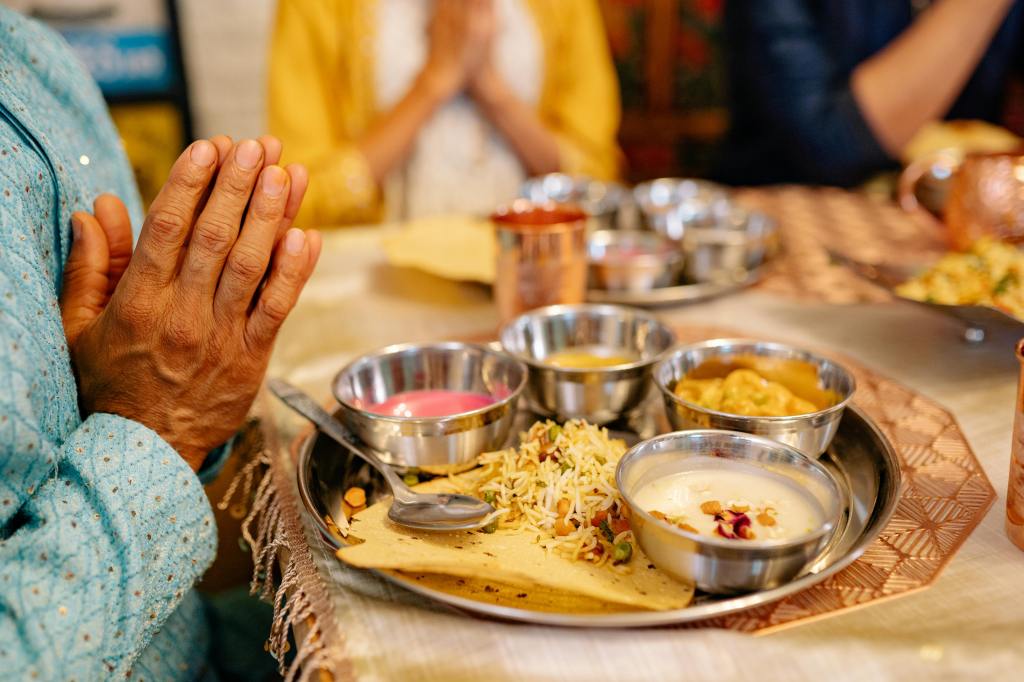
One day, as I set out for the morning, my backpack felt much lighter, practically weightless. Normally, it carries a laptop, a notebook, my meditation beads, some spiritual books to distribute to those looking for a higher taste in life, and a lovingly prepared lunch, offered first to Krishna. But on this day, there was no food in it.

On the eleventh (it can vary some times) day of every fortnight, Ekadashi, those who wish to make rapid spiritual progress observe a fast. The specific standard of the fast depends on many factors, but in my case, I am blessed that I do not need to eat on that day. It took a long time to get there, and the process was gradual, but it has been well worth it. I don’t take any credit for this, because He who creates the hunger that appears unbearable on other days simply chooses to free me from it on Ekadashi. This is so we can focus on something higher.

People sometimes fast for different reasons. But all the purposes of fasting are served when we fast for spiritual purposes, just as all purposes of a small well are served by a gigantic fresh water lake.

On Ekadashi days, I do drink water, which is a great blessing. Water cleanses in so many ways. One can appreciate the beautiful taste of water more when one is fasting from food.

रसोऽहमप्सु कौन्तेय

O son of Kuntī, I am the taste of water

https://vedabase.io/en/library/bg/7/8/

As a spirit soul full of eternity, knowledge and bliss, it is a humbling paradox that we are saddled with a body that “needs” to eat, sleep, and seek recreation. Because we are presently in the material world, everyone must work for their sustenance. Even the powerful “king of the jungle”, the lion cannot simply lie down, go to sleep, and expect food to enter its mouth.

न हि सुप्तस्य सिंहस्य प्रवि-शन्ति मुखे मृगाः

Animals don’t enter into the mouth of a sleeping lion

The weight of a meal

Eating is a requirement to keep the body alive, so we spend a vast amount of time working and making all the necessary arrangements. Yet, even when we pay for our food, we aren’t paying the full price of food. In this material world, some other living entity must die so that we may live. Whether it is a grain of rice, a bean, a potato, or a nut, a life is given so that I can survive. Because of this, I am careful to honor the life of these living entities by offering them in sacred sacrifice to Krishna.

In this sense, food is “heavy” in many ways, not just by its weight in a bag or its economic price, but by the karmic reactions attached to it.

Generally, the material world is a place where the philosophy is “you die so I can live”. Those who wish to advance spiritually abstain from meat.

अहस्तानि सहस्तानामपदानि चतुष्पदाम् ।
फल्गूनि तत्र महतां जीवो जीवस्य जीवनम् ॥ ४७ ॥

ahastāni sahastānām
apadāni catuṣ-padām
phalgūni tatra mahatāṁ
jīvo jīvasya jīvanam

Those who are devoid of hands are prey for those who have hands; those devoid of legs are prey for the four-legged. The weak are the subsistence of the strong, and the general rule holds that one living being is food for another.

https://vedabase.io/en/library/sb/1/13/47/

The Difference Between Need and Greed

Beyond the debt we owe to the source of our food, there is a karmic debt we incur when we take more than our share. We often mistake our greed for our “need,” and in doing so, we deprive others of their rightful portion.

Birds Eating grains and Seeds

Consider a sack of rice left out on an open road. A bird flies down, picks up a single grain at a time to satisfy its hunger, and flies away. Another bird follows, doing the same. They take only what is required for their sustenance. But when a human passes by, they don’t see a single meal! They may see a surplus to be hoarded. They might take the entire sack home, leaving nothing for the others who might follow. By claiming more than our rightful quota, we tighten the knot of karmic debts, forgetting that what we take in excess is effectively stolen from another’s plate. A person who takes more than their need makes themselves liable to have less than they need in future, as per the law of karma.

No one is recommending starvation, but moderation to our bare necessity is important, and voluntary fasting enables that, in the grand scheme of things.

ईशावास्यमिदँ सर्वं यत्किञ्च जगत्यां जगत् ।
तेन त्यक्तेन भुञ्जीथा मा गृधः कस्य स्विद्धनम् ॥ १॥

īśāvāsyam idaḿ sarvaṁ
yat kiñca jagatyāṁ jagat
tena tyaktena bhuñjīthā
mā gṛdhaḥ kasya svid dhanam

Everything animate or inanimate that is within the universe is controlled and owned by the Lord. One should therefore accept only those things necessary for himself, which are set aside as his quota, and one should not accept other things, knowing well to whom they belong.

https://vedabase.io/en/library/iso/1

The Hidden Costs

I reflected in quiet wonder, tracing the journey of a single morsel of food back to its source. We easily settle our debts with the farmer, the trader, and the storekeeper, the visible hands that bring food to our table. But what of the invisible ones? Mother Earth charges no rent for her soil; the sun sends no invoice for his light and warmth, the clouds ask for no payment for the rain. Our currency reaches the middlemen, but it never reaches the Source. Do we not owe a deeper debt to the ones who give everything for nothing in return?

Watering the Root

The only way to truly benefit all these contributors is to offer the food back to God. As God says:

यज्ञशिष्टाशिनः सन्तो मुच्यन्ते सर्वकिल्बिषै ।
भुञ्जते ते त्वघं पापा ये पचन्त्यात्मकारणात् ॥ १३ ॥

yajña-śiṣṭāśinaḥ santo
mucyante sarva-kilbiṣaiḥ
bhuñjate te tv aghaṁ pāpā
ye pacanty ātma-kāraṇāt
Synonyms

The devotees of the Lord are released from all kinds of sins because they eat food which is offered first for sacrifice. Others, who prepare food for personal sense enjoyment, verily eat only sin.

https://vedabase.io/en/library/bg/3/13/

Anyone who does not offer their food to God is caught in a cycle of debt. It is a matter of “an eye for an eye.” If I eat a grain of rice selfishly, I incur the karmic reaction of becoming a grain of rice myself, to be eaten by that same soul in another form. Time separates me from the inevitable consequences of my actions, but the consequence is unavoidable. As sure as death.
This is because when we water the root of the tree, all the branches, twigs, and leaves automatically get watered.

यथा तरोर्मूलनिषेचनेन
तृप्यन्ति तत्स्कन्धभुजोपशाखा: ।
प्राणोपहाराच्च यथेन्द्रियाणां
तथैव सर्वार्हणमच्युतेज्या ॥ १४ ॥

yathā taror mūla-niṣecanena
tṛpyanti tat-skandha-bhujopaśākhāḥ
prāṇopahārāc ca yathendriyāṇāṁ
tathaiva sarvārhaṇam acyutejyā

As pouring water on the root of a tree energizes the trunk, branches, twigs and everything else, and as supplying food to the stomach enlivens the senses and limbs of the body, simply worshiping the Supreme Personality of Godhead through devotional service automatically satisfies the demigods, who are parts of that Supreme Personality.

https://vedabase.io/en/library/sb/4/31/14/

Do you know how heavy your food is?

Can you afford the price of your food?

Can you carry it’s weight?

That Ekadashi was a great day, packed with a lot of extra time and energy. We often have no idea how much work it actually takes just to procure, eat, and digest all that food. The very next day, of course, my bag was heavy again. But having reflected on the cost, I carried it with a renewed sense of gratitude and responsibility.

With gratitude for feedback on a previous version of this article from my elder brother, Sriman Ravindra Joshi.

Ascending vs. Descending Process of knowledge

What is knowledge? What is ignorance? How do we acquire knowledge? Which method actually works? Finding out things the ascending way, or hearing from an authority? How to acquire perfect knowledge beyond all doubt?

Knowledge is a wonderful thing, isn’t it?

Are these people getting anywhere? Are they “progressing”?

With knowledge, comes power. Power to do good, and also power to do evil. Knowledge can be a liberator, but also can be a tool for enforcing bondage.

Also, what qualifies as knowledge anyway? If, for example, a person acquired some knowledge on “how to rob a bank” and applies that knowledge, landing in prison, or even if they escape somehow, was that really knowledge? Or was it ignorance?

There are 2 main types of knowledge:

  1. Knowledge of the material world -material knowledge
  2. Knowledge of what lies beyond this material world through the scriptures – spiritual knowledge – In Sanskrit “परोक्ष” or “parokṣa”

There are many means of acquiring knowledge:

  1. By Direct experience or perception – In sanskrit “प्रत्यक्ष” or “pratyakṣa”
  2. By hypothesis/logic/conjecture/guessing – In sanskrit “अनुमान” or “anumāna”
  3. By hearing from a higher authority – In Sanskrit “शब्द” or “śabda”

Ultimately, there are 2 fundamental processes of acquiring knowledge:

  1. Ascending Process – build up knowledge from building blocks – In Sanskrit “आरोहपन्था” or “ārohapanthā
  2. Descending Process – Knowledge descending directly from God and His messengers – In Sanskrit “अवरोहपन्था” or “avarohapanthā

In an article, with an example of an ant who wanted to map the Universe, I discussed the futility of the ascending process of knowledge, especially about items that are outside of our realm of perception.

Much of what we know exists, is actually too subtle to perceive.

These are the material elements, listed in the Bhagavad Gita:

Gross Material Elements:

  1. Earth
  2. Water
  3. Fire
  4. Air
  5. Ether (Space/Sky)

Subtle Material Elements:

  1. Mind
  2. Intelligence
  3. False Ego

BG भूमिरापोऽनलो वायु: खं मनो बुद्धिरेव च ।
अहङ्कार इतीयं मे भिन्ना प्रकृतिरष्टधा ॥ ४ ॥

bhūmir āpo ’nalo vāyuḥ
khaṁ mano buddhir eva ca
ahaṅkāra itīyaṁ me
bhinnā prakṛtir aṣṭadhā

Earth, water, fire, air, ether, mind, intelligence and false ego – all together these eight constitute My separated material energies.

https://vedabase.io/en/library/bg/7/4/

The Material-Spiritual Disconnect

Earth is the most gross of the material elements, more subtle is water, even more subtle is air, and ether is quite subtle, you can’t touch or feel space, but we can still perceive it. Now, when we get to the mind, that is even more subtle. Intelligence is still more subtle, and the most subtle material element is false ego, our sense of identity.

However, none of the material elements can directly approach that which is non-material, namely the spiritual is outside of the realm of material elements, even subtle.

If we see our material means of acquiring knowledge, the mind, intelligence, and our sense of identity are all material in nature, and therefore, the ascending process of acquiring knowledge cannot possibly extend to the spiritual realm.

There is another main reason why the ascending process of knowledge is flawed… all of us who are “conditioned” to accept a material identity, have 4 defects:

  1. Tendency to be illusioned (In Sanskrit “भ्रम”or “bhrama”) – we often misunderstand facts and are illusioned about things as they are
  2. Tendency to make mistakes (In Sanskrit “प्रमाद” or “pramāda”) – there is no conditioned souls who can say they never make mistakes
  3. Tendency to cheat others (In Sanskrit “विप्रलिप्सा”or “vipralipsā”) – this is a great weakness, to want to appear better than we are, or know something we don’t, etc.
  4.  We possess imperfect senses (In Sanskrit “करण पाटव” or “karaṇa-pāṭava”) – all our senses are quite imperfect, and we miss a lot from our senses

So, with these 4 defects, it is impossible to acquire perfect knowledge using only our senses. Why is that? It is because with an imperfect instrument, you cannot make something that is perfect. No matter how hard we try, our imperfections stand in the way.

The common example is if we’re doing some mathematical calculation or solving an equation… a tiny mistake somewhere along the way can get us a wrong answer.

Let’s say, for example, someone didn’t know who their father was… they can do some detective work, or a DNA test of every man in the world, or they can take the answer from their mother. The mother’s answer is authoritative and a lot easier too.

Reconnecting Material to the Spiritual

The only way to acquire perfect knowledge, then, is through the descending process, “avarohapantha”. In this process, the Supreme Absolute Perfect (generically called God, specifically named Krishna, Allah, Rama, Govinda, Buddha, Jehovah, Yahweh, etc.) conveys the perfect knowledge, and whoever hears this knowledge passes it on without addition or subtraction.

Perfect Knowledge means something that never changes. Compare this to our ascending process of knowledge. Researchers make a career out of making mistakes! First they publish one paper hypothesizing (and sometimes also offering “proof”) one particular thing… the laypeople accept that as the truth, and then a little while later, that or another researcher publishes another paper contradicting the original hypothesis or proof. In this way, the so-called philosophers and scientists bumble about, going from imperfection to imperfection. This is not called knowledge, this is called nescience, or ignorance.

Why is that? Because material knowledge gives the impression of advancement, whereas it actually traps us in bigger and bigger problems, requiring more and ever more complexity. A material “solution” is only another problem in disguise… it is simply creating one problem in place of another. Therefore, material knowledge is not called knowledge, but ignorance. And those who pursue material knowledge excessively are said to be ignorant.

So therefore, spiritual knowledge is worth pursuing, and such knowledge cannot be “discovered/created/invented” by anyone else other than the Supreme Personality of Godhead.

धर्मं तु साक्षाद्भ‍गवत्प्रणीतं
न वै विदुऋर्षयो नापि देवा: ।
न सिद्धमुख्या असुरा मनुष्या:
कुतो नु विद्याधरचारणादय: ॥ १९ ॥

dharmaṁ tu sākṣād bhagavat-praṇītaṁ
na vai vidur ṛṣayo nāpi devāḥ
na siddha-mukhyā asurā manuṣyāḥ
kuto nu vidyādhara-cāraṇādayaḥ

Real religious principles are enacted by the Supreme Personality of Godhead. Although fully situated in the mode of goodness, even the great ṛṣis who occupy the topmost planets cannot ascertain the real religious principles, nor can the demigods or the leaders of Siddhaloka, to say nothing of the asuras, ordinary human beings, Vidyādharas and Cāraṇas.

https://vedabase.io/en/library/sb/6/3/19/

But, one may ask, it’s not like the Supreme Personality of Godhead is directly perceivable to a materially conditioned soul. So what is to be done?

Fortunately, there is a clear way…

स्वयम्भूर्नारद: शम्भु: कुमार: कपिलो मनु: ।
प्रह्लादो जनको भीष्मो बलिर्वैयासकिर्वयम् ॥ २० ॥
द्वादशैते विजानीमो धर्मं भागवतं भटा: ।
गुह्यं विशुद्धं दुर्बोधं यं ज्ञात्वामृतमश्नुते ॥ २१ ॥

svayambhūr nāradaḥ śambhuḥ
kumāraḥ kapilo manuḥ
prahlādo janako bhīṣmo
balir vaiyāsakir vayam

dvādaśaite vijānīmo
dharmaṁ bhāgavataṁ bhaṭāḥ
guhyaṁ viśuddhaṁ durbodhaṁ
yaṁ jñātvāmṛtam aśnute

Lord Brahmā, Bhagavān Nārada, Lord Śiva, the four Kumāras, Lord Kapila [the son of Devahūti], Svāyambhuva Manu, Prahlāda Mahārāja, Janaka Mahārāja, Grandfather Bhīṣma, Bali Mahārāja, Śukadeva Gosvāmī and I myself know the real religious principle. My dear servants, this transcendental religious principle, which is known as bhāgavata-dharma, or surrender unto the Supreme Lord and love for Him, is uncontaminated by the material modes of nature. It is very confidential and difficult for ordinary human beings to understand, but if by chance one fortunately understands it, he is immediately liberated, and thus he returns home, back to Godhead.

https://vedabase.io/en/library/sb/6/3/20-21/

Now, at least some of those personalities have established disciplic successions on this planet.

There are 4 main authorized disciplic successions to receive perfect knowledge in discipic successions. A disciplic succession is known as “Sampradaya” or “That which gives completely”.

A mango, intact, passed down

A useful example is that if a ripe mango is high in a tree, then if the mango is handed from person to person from those who are at various heights pass the mango down from hand to hand, vs. trying to throw the mango down to the ground…

A Sampradaya delivers spiritual knowledge perfectly, without addition or subtraction
  1. Brahma Sampradaya and its branches, especially expounded by the great teacher Madhva, Lord Chaitanya, and their followers.
  2. Rudra Sampradaya and its branches, especially expounded by the great teacher Vishnu Swami and his followers.
  3. Sri Sampradaya and its branches, begun by Lakshmi devi, the Goddess of Fortune, consort of Lord Narayana, and especially expounded by the great teacher Sri Ramanuja and his followers.
  4. Kumara Sampradaya and its branches, especially expounded by the great teacher Sri Nimbarka and his followers.

What about the rest?

To the extent the teachings of others are in line with one of these descending lines of discipic succession, they are valid, and anything outside of these is at best a stepping stone to one of these 4 lines of disciplic succession. In the worst case, it is a materialistic business masquerading as a genuine spiritual tradition.

Those who claim to be part of a certain tradition but add or subtract from the fundamental principles or twist the teachings are called “apasampradayas” or “anti disciplic successions”.

His Grace Sriman Sankarshan Das Adhikari

By the mercy of my parents and then my spiritual master His Grace Sriman Sankarshan Das Adhikari who is a disciple of His Divine Grace A. C. Bhaktivedanta Swami Prabhupada The Founder Acharya of the International Society for Krishna Consciousness, even though personally unworthy, I am connected to one of these lines of disciplic succession, called the Brahma-Madhva-Gaudiya Sampradaya, and seeking to pass on those pure instructions to whoever may want to follow, without adding or subtracting any principle, only, if need be, adjusting details to suit the individual and times.

His Divine Grace A. C. Bhaktivedanta Swami Prabhupada, Founder Acharya of the International Society for Krishna Consciousness (ISKCON)

And what is a principle and what is a detail? That, Srila Prabhupada said, requires some intelligence. I pray for this intelligence, which in my case, I simply ask my spiritual master with a clear description of context.

Ultimately however, knowledge coming from the scriptures and the spiritual master in disciplic succession must be realized in the heart through a process of personal effort (sadhana) and purification. Then the paroksha jnana or scriptural knowledge through scripture, becomes “aparoksha” or that which is beyond the reach of the material senses. In order to experience such knowledge in action, one’s senses must be spiritually awakened, or re-spiritualized.

Krishna, the Supreme Personality of Godhead

Pure devotional service to Krishna is the Ultimate goal of all knowledge, and anything besides this is a waste of time.

Questions? I remain your servant on your spiritual journey! Hare Krishna!

Who can save the Earth today?

Janardan Mali, 27th August 2013

Hare Krishna,

In the present times who  could destroy all the demoniac and evil elements which are burdening the Earth ? Is there any hope?

Yours in Krishna Consciousness,
Janardan Mali

Sudeep Manchanda, 30th August 2013

Hare Krishna,

As per what I had read, in the present age of Kali almost everyone has fallen so much and are acting like demons,
So in this age the demoniac people are not killed but “cured” by the Hare Krishna Mahamantra and the avtar in Kali yuga is the Naam-Avtar (The Holy Name)

Please correct me if I am incorrect,

your Servant,
Sudeep Manchanda

Premananda das, 30th August 2013

Hare Krishna Prabhuji

In the present situation Krishna can destroy all the demoniac and evil elements which are burdening the Mother Earth.

The responsibilty is of each and every individual to remove the demoniac mentality within all of us.

For sure there is hope prabhuji.

ys servant
Premal

Ashok-Sahu, 30th August 2013

Hare Krishna Janardan Prabhu,
All Glories to Srila Gurudeva and Srila Proabhupada!
All Gories to Sri Guru & Gauranga

What I have learned is, a wide scale propagation of Krishna consciousness in the form of Hare Krishna Mahamantra, literatures, prasada etc can destroy all evils and demoniac elements from society today from root. This is the only hope in Kali Yuga.

Hare Krishna
Ashok

Jagannatha dasa, 02nd September 2013

Hare Krishna,

Thank you very much for your nice question.  Srila Gurudeva answered a similar question.  Please see his reply to that question, quoted below:

“He Has Appeared
You are absolutely correct in understanding the dire need for the Lord to appear. He has mercifully done so at the present time by manifesting Himself in the form of the Hare Krsna Movement. Kindly take advantage of this by fully dedicating your life to this movement.”

So our saving grace, as well as our personal responsibility are clearly shown.  I hope it helps.

your servant,
Jagannatha Dasa Brahmacari

Please subscribe to daily inspirational emails from His Grace Sriman Sankarshan Das Adhikari (Writings and lectures archived at sda-archives.com), written fresh every day from his travels around the world sharing the highest spiritual knowledge with everyone. Sign up now at www.backtohome.com