“Idol” and “Mythology” – Two words that are offensive to Vedic culture

Why should we avoid the terms “idol” and “mythology” when discussing Vedic culture? These terms undermine the Krishna and Vedic scriptures. Krishna is the Supreme Personality of Godhead. The Vedic scriptures expound the Supreme Absolute Truth and Universal history. The original misunderstanding stems from historical attacks on Vedic culture. What is actual idol worship? What is actual mythology? Read more to find out!

These two words “idol” and “mythology” should be avoided like the plague when speaking about Vedic Culture. Vedic Culture means the culture that increases our love for Krishna. Never use the words “idol” and “mythology” when speaking about Vedic culture, or Vishnu / Krishna.

Unfortunately, this happens a lot in India, which is sad.

I give dictionary meanings, before elaborating further.

Idol: /īd′l/ A false god. One that is adored, often blindly or excessively.

Mythology: /mĭ-thŏl′ə-jē/ A body or collection of myths belonging to a people and addressing their origin, history, deities, ancestors, and heroes. A body of myths associated with an event, individual, or institution.
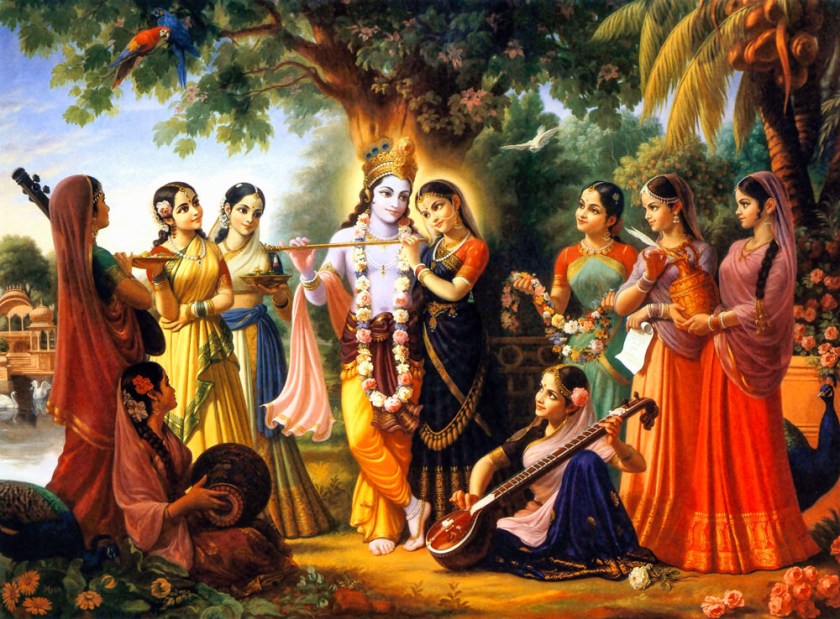
Radha Krishna and the 8 Topmost Gopis

Krishna is the Supreme Personality of Godhead. Krishna is known in other languages as Allah, Jehovah, Yahweh, and many other languages.

ईश्वरः परमः कृष्णः सच्चिदनन्द विग्रह:
अनदिरदिर् गोविन्दः सर्व कारण कारणं ।।१।।

īśvaraḥ paramaḥ kṛṣṇaḥ
sac-cid-ānanda-vigrahaḥ
anādir ādir govindaḥ
sarva-kāraṇa-kāraṇam

Kṛṣṇa who is known as Govinda is the Supreme Godhead. He has an eternal blissful spiritual body. He is the origin of all. He has no other origin and He is the prime cause of all causes. https://vedabase.io/en/library/bs/5/1/

Krishna is the Supreme Absolute Truth.

This means that Krishna’s name, form, pastimes, paraphernalia, abode, associates, etc., are all on the Absolute platform.

नाम चिन्तामणि कृष्णस्चैतन्य रस विग्रहः |
पूर्ण शुद्धो नित्य मुक्तो अभिन्नत्वं नाम नामिनोः ||

nāma cintāmaṇiḥ kṛṣṇaś
caitanya-rasa-vigrahaḥ
pūrṇaḥ śuddho nitya-mukto
’bhinnatvān nāma-nāminoḥ

“ ‘The holy name of Kṛṣṇa is transcendentally blissful. It bestows all spiritual benedictions, for it is Kṛṣṇa Himself, the reservoir of all pleasure. Kṛṣṇa’s name is complete, and it is the form of all transcendental mellows. It is not a material name under any condition, and it is no less powerful than Kṛṣṇa Himself. Since Kṛṣṇa’s name is not contaminated by the material qualities, there is no question of its being involved with māyā. Kṛṣṇa’s name is always liberated and spiritual; it is never conditioned by the laws of material nature. This is because the name of Kṛṣṇa and Kṛṣṇa Himself are identical.’ https://vedabase.io/en/library/cc/madhya/17/133/

Take a second look at the dictionary meaning of “idol”…

Idol: /īd′l/ A false god. One that is adored, often blindly or excessively.
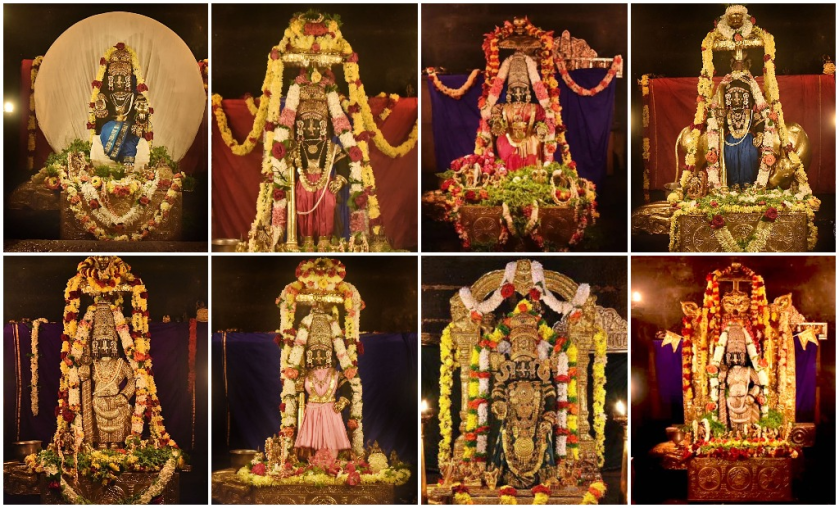
Udupi Sri Krishna
Udupi Sri Krishna

Nothing about Krishna is “false”. And there can be no such thing as “blind” or “excessive” adoration of Krishna. In fact, no matter how much we adore, it is always insufficient. Our problem is that we don’t adore Krishna enough. And we don’t adore Krishna sufficiently because we are blind. If we were not blind, we would be absolutely pure in our love of Krishna.

कृष्णे स्वधामोपगते धर्मज्ञानादिभि: सह ।
कलौ नष्टद‍ृशामेष पुराणार्कोऽधुनोदित: ॥ ४३ ॥

kṛṣṇe sva-dhāmopagate
dharma-jñānādibhiḥ saha
kalau naṣṭa-dṛśām eṣa
purāṇārko ’dhunoditaḥ

This Bhāgavata Purāṇa is as brilliant as the sun, and it has arisen just after the departure of Lord Kṛṣṇa to His own abode, accompanied by religion, knowledge, etc. Persons who have lost their vision due to the dense darkness of ignorance in the Age of Kali shall get light from this Purāṇa. https://vedabase.io/en/library/sb/1/3/43/

Now, to come back to the dictionary meaning of “mythology”…

Mythology: /mĭ-thŏl′ə-jē/ A body or collection of myths belonging to a people and addressing their origin, history, deities, ancestors, and heroes. A body of myths associated with an event, individual, or institution.

सर्वस्य चाहं हृदि सन्निविष्टो
मत्त: स्मृतिर्ज्ञानमपोहनं च ।
वेदैश्च सर्वैरहमेव वेद्यो
वेदान्तकृद्वेदविदेव चाहम् ॥ १५ ॥

sarvasya cāhaṁ hṛdi sanniviṣṭo
mattaḥ smṛtir jñānam apohanaṁ ca
vedaiś ca sarvair aham eva vedyo
vedānta-kṛd veda-vid eva cāham

I am seated in everyone’s heart, and from Me come remembrance, knowledge and forgetfulness. By all the Vedas, I am to be known. Indeed, I am the compiler of Vedānta, and I am the knower of the Vedas. https://vedabase.io/en/library/bg/15/15/
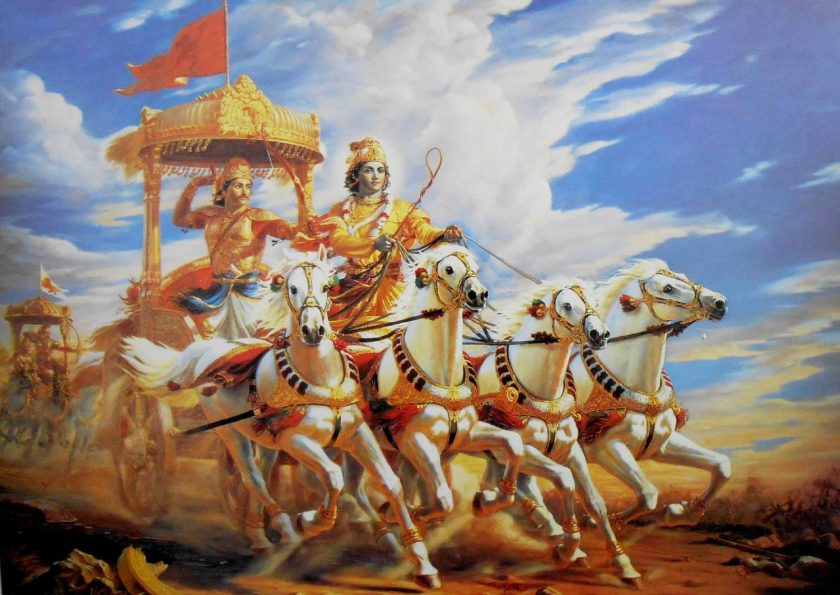
Krishna and Arjuna on the Battlefield of Kurukshetra

The Vedic Scriptures explain different aspects of Krishna. The Puranas are ancient history. So ancient and so broad that they encompass the entire Universe, and go back billions, even trillions of years. Who can comprehend that Universal range and time scale with our teeny little perspective?

Now, where did this misunderstanding come from?

Where did anyone get the idea to call images of Krishna as “idols” and the Vedic scriptures as “Mythology”?

The last surviving bastion of Vedic culture is what is current-day India, Pakistan, Nepal, Bangladesh, Sri Lanka, Thailand, Indonesia, etc.

Vedic culture has been under attack for well over 3000 years. It is natural, because we are in the kaliyuga, the age of quarrel and hypocrisy. Vedic culture i the opposite of quarrel and hypocrisy

First, it was the advent of Buddhism, and Jainism. These are essentially either impersonal, voidist, or both, depending on the specific flavor. Both twisted the Vedic scriptures in different ways. Both were philosophically defeated and Buddhism was mostly driven out to the far corners of the world, away from India.

Lord Buddha

Buddhism was advented by Lord Gautama Buddha to originally to drive out a corruption in Vedic culture.

तत: कलौ सम्प्रवृत्ते सम्मोहाय सुरद्विषाम् ।
बुद्धो नाम्नाञ्जनसुत: कीकटेषु भविष्यति ॥ २४ ॥

tataḥ kalau sampravṛtte
sammohāya sura-dviṣām
buddho nāmnāñjana-sutaḥ
kīkaṭeṣu bhaviṣyati

Then, in the beginning of Kali-yuga, the Lord will appear as Lord Buddha, the son of Añjanā, in the province of Gayā, just for the purpose of deluding those who are envious of the faithful theist.

https://vedabase.io/en/library/sb/1/3/24/

The origin of Jainism was a corruption of the pure teachings and example of Lord Rishbhadeva, an incarnation of Krishna.

Lord Rishabhadeva instructing His sons

यस्य किलानुचरितमुपाकर्ण्य कोङ्कवेङ्ककुटकानां राजार्हन्नामोपशिक्ष्य कलावधर्म उत्कृष्यमाणे भवितव्येन विमोहित: स्वधर्मपथमकुतोभयमपहाय कुपथपाखण्डमसमञ्जसं निजमनीषया मन्द: सम्प्रवर्तयिष्यते ॥ ९ ॥

yasya kilānucaritam upākarṇya koṅka-veṅka-kuṭakānāṁ rājārhan-nāmopaśikṣya kalāv adharma utkṛṣyamāṇe bhavitavyena vimohitaḥ sva-dharma-patham akuto-bhayam apahāya kupatha-pākhaṇḍam asamañjasaṁ nija-manīṣayā mandaḥ sampravartayiṣyate.

Śukadeva Gosvāmī continued speaking to Mahārāja Parīkṣit: My dear King, the King of Koṅka, Veṅka and Kuṭaka whose name was Arhat, heard of the activities of Ṛṣabhadeva and, imitating Ṛṣabhadeva’s principles, introduced a new system of religion. Taking advantage of Kali-yuga, the age of sinful activity, King Arhat, being bewildered, gave up the Vedic principles, which are free from risk, and concocted a new system of religion opposed to the Vedas. That was the beginning of the Jain dharma. Many other so-called religions followed this atheistic system. https://vedabase.io/en/library/sb/5/6/9/

Later invasions from the west

But then, there were the expansionist invasions by the zealots claiming to follow “Islam, the religion of peace”. Those invaders to the Holy Land of India were attracted by the wealth, the riches in the temples… But they were too uncivilized and uncultured to appreciate the nuances of Vedic culture.

So they started calling temple worship “idol worship” in their middle eastern languages, Arabic, Persian, etc. They started a systematic system of persecution, calling the followers of Vedic culture as “kafirs” or non-believers. They did not understand that Krishna is actually Allah Himself. This persecution conginues to this day, a thousand years on. For example in Pakistan and Bangladesh, followers of Vedic culture are still harshly persecuted.

The European powers made the most sophisticated attempts to culturally conquer the Vedic culture. They came to India about 600 years ago. They engaged in business and military conquest. They also sought to replace Vedic culture with barbarian European culture through an insidious system called “modern education”.

Indians have been conditioned to denigrate their own culture!

Indians began to speak Portuguese, Dutch, French, and English. They were made to forget their own languages, their own customs and refined practices. It was deeply rooted. The Europeans, especially the British, sought to vilify all Vedic practices through their Christian missionaries.

  1. Deity worship became “Idol Worship”.
  2. Krishna became a “tribal chieftain” or at best, a “Hindu god”.
  3. All the ancient historical texts like the Vedas, the Upanishads, the Puranas, became “Hindu myths”.

Vedic culture will rescue with world from its dense darkness. To revive the glorious Vedic culture, we must first reject this insulting word “idol” in relation to Krishna. We must also reject the derogatory “mythology” in relation to the Vedic scriptures.

What is idol worship then?

It is the worship of politicians, business people, actors, sports people, military leaders, etc. It is the worship of TV personalities and entertainers. The western world fully engages in idol worship daily. They do this through their thousands of TV channels, their movies, their books, newspapers, magazines, their marketplaces, and living spaces.

Sports fans indulging in Idol Worship

“Western Culture”, an oxymoron, means to worship the temporary bodies, through luxurious homes devoid of a culture of Krishna Consciousness. It means lavish bathrooms and swimming pools. It means arenas to celebrate war in disguise. It means a worship of their dogs and cats. It means the killing of cows and bulls, which are dear to Krishna.

Reject idol worship, by all means, but the form of Krishna is not an “idol”.

We can use the these words instead to describe images of Krishna:

  1. “Archa Vigraha” (अर्च विग्र:) – the Divine Worshipable Form of God
  2. Deity
  3. Divine Form of God

And what is mythology?

What is called “modern science” is mostly mythology. And the western version of “history” is mythology. Common uncultured rascals have been promoted as great personalities. Alexander “the great” was a looter and marauder. Napoleon was a low class murderer and looter. He conspired to become king of France after the French had executed their king and rejected the monarchy. Winston Churchill was a disgusting narrow minded bigot. He was a lying manipulator. He was not a great leader by any stretch of the imagination, because he was full of all vices.

False history propagated by the Europeans

Everything that opposes the pristine Vedic culture is mythology. This includes the spiritual texts of the Middle East, that were once great and pure. These texts like the Quran, Bible, etc., have been censored, edited and misinterpreted. They have lost spiritual value due to tampering. They are only good as political manifestos now. Even if the text is intact, the misinterpretation and misunderstanding of it has depleted its value.

So, yes, reject mythology also, but the Vedic scriptures are not mythology.

धर्म: प्रोज्झितकैतवोऽत्र परमो निर्मत्सराणां सतां
वेद्यं वास्तवमत्र वस्तु शिवदं तापत्रयोन्मूलनम् ।
श्रीमद्भागवते महामुनिकृते किं वा परैरीश्वर:
सद्यो हृद्यवरुध्यतेऽत्र कृतिभि: शुश्रूषुभिस्तत्क्षणात् ॥ २ ॥

dharmaḥ projjhita-kaitavo ’tra paramo nirmatsarāṇāṁ satāṁ
vedyaṁ vāstavam atra vastu śivadaṁ tāpa-trayonmūlanam
śrīmad-bhāgavate mahā-muni-kṛte kiṁ vā parair īśvaraḥ
sadyo hṛdy avarudhyate ’tra kṛtibhiḥ śuśrūṣubhis tat-kṣaṇāt

Completely rejecting all religious activities which are materially motivated, this Bhāgavata Purāṇa propounds the highest truth, which is understandable by those devotees who are fully pure in heart. The highest truth is reality distinguished from illusion for the welfare of all. Such truth uproots the threefold miseries. This beautiful Bhāgavatam, compiled by the great sage Vyāsadeva [in his maturity], is sufficient in itself for God realization. What is the need of any other scripture? As soon as one attentively and submissively hears the message of Bhāgavatam, by this culture of knowledge the Supreme Lord is established within his heart. https://vedabase.io/en/library/sb/1/1/2/

You can call the Vedic scriptures as:

  1. The Yoga texts of India
  2. Vedas or Puranas
  3. Vedic scriptures
  4. Vedic literature
  5. Vedic History

Please give up the use of the words “idol” and “mythology” in relation with Vedic Culture! Hare Krishna!

Why Religious Conversion Does Not Equal True Transformation

A reflection on the nature of religious conversion… does it often lack genuine transformation? What is religious conversion driven by? Let us not ignore the importance of personal development and the cultivation of qualities such as compassion, truthfulness, and humility, rather than merely changing religious labels!

A Hindu can convert to Islam or Christianity. A Christian can convert to Hinduism or Islam. And of course, a Muslim can give up his faith to become an agnostic or Hindu or Christian. Replace any label with any other label, an “X” can convert to “Y”.

When someone converts, then some rejoice, and others fret and fume. One lady once said to me, after revealing to me her previous background “don’t reveal this to anyone, those people, they will kill me if they find out.”. I was quite saddened to hear that someone could be so barbaric as to try and kill her.

Neither is religious conversion of any value, nor should we worry about it. Rest assured, it will have no effect whatsoever. Religious conversion is a farce. It is a political move at best. Why is that?

The work we do inside a trligious tradition matters, not just professing some faith!

What is The Purpose of Religious Tradition?

Because, religious traditions, are like universities or other educational institutions. You don’t “convert” from Stanford to Yale, for example. Neither do you “convert” from computer science to mathematics.

Yes, you can transfer credits from one program to another, you can even switch from one university to another, but it is laughable to say that you have “converted” from studying to be, say, a doctor, to studying to be a medical researcher.

No matter if you are a doctor, or a lawyer, or a medical researcher or a mathematician or a software engineer or whatever… ultimately the result of your work is an income, which you use to meet your needs and wants. A religious tradition is similar, in it that you are meant to use your religious tradition to get closer to God! So don’t use your religious tradition for political purposes or any other lesser purpose!

Now, after an academic transfer, if you actually complete the requirements of your new program and put your acquired knowledge and experience to do better than before, then maybe the transfer was worthwhile, otherwise, it is like the farce of enrolling into a program, and doing nothing to actually fulfill the requirements!

Conversions Galore, and Re-Conversions Too!

I come from India, and throughout my history lessons, I studied how, starting about 2,500 years ago, “Hindus” were converting to Buddhism. Then, I read how, as the philosophy of Buddhism was defeated by great Acharyas such as Adi Shankaracharya, Sripad Ramanujacharya, and Sri Madhvacharya… all those former Buddhists reconverted to “Hinduism”.

Then later on, the Muslims invaded India from Central Asia, the Middle East, and those parts of the world… and they “converted” many of the “Hindus” into “Muslims”. Some of those “Muslims” later reconverted to being called “Hindus” while others adopted their new identities.

After a few hundred years, the Christian missionaries came to India, and began to “convert” Hindus, Muslims, and even the remaining Buddhists, into “Christians”. Some convert back, or to something else!

And this conversion roulette continues to be played today.

It is a farce. A person who professes some label, now claiming to profess some other label doesn’t change anything!

rotten fruit juice is no nectar

Labels Labels Everywhere

If you took some rotten fruit juice and put it into a different bottle labeled something… will the rotten fruit juice be transformed into nectar? No, rotten will remain rotten, maybe even become more so!

You can take an animal, let’s say, a dog, and you can label him a cat, but does he change to being a cat? Can you label a bird as a fish and now the “bird-labeled-fish” will be able to breathe under water and swim around like a fish?

Yes, you could try to indoctrinate the dog all you want… you could tell him “ok, now you are a cat… cats are ‘yours’ and dogs are the enemy”… will it work? No, the next time that dog sees a cat, he will be after it, barking away.

a dog is a dog, in any dress or conditioniong

Similarly, if you take a person who is unable to, say, practice the high Brahminical standards… and you convert that person into, say, a Christian. Will there be any transformation in the person based on this conversion? No, that person will still not be able to follow the highest tenets of Christianity!

In this case, the religious conversion was just to avoid following higher standards. In this way, conversion for the sake of some temporary economic benefit, or social pressure, or frustration with the community – these are the signs of a farcical conversion!

Someone may convert to Christianity because of promise of money or a job or some gifts, like a blanket or a pot or a stove… some convert to Christianity to get access to an addiction recovery service.

After all, how many Christians can follow the ten commandments? In fact, most of the Christians were so incapable of following the ten commandments that they had to water them down! And still they are hard to follow for most people who profess Christianity.

Embodying the Essence!

But to a dedicated follower of the Vedic Principles, the ten commandments are nothing, merely common sense, not even some great philosophical revelation! They have no trouble naturally following the ten commandments!

So what is the real deal? The real deal is when a person’s consciousness is transformed, taking it from animal-like consciousness to a divine state of consciousness!

That is the test. When someone tells me “I am X” or “I am Y”… I look at whether the person has actually developed a love for God, a love for their fellow beings, and not just humans of a certain label. I look for qualities like compassion, cleanliness, truthfulness, punctuality, honesty, and so on. In fact, these are the qualities I try and cultivate within myself…

kṛpālu, akṛta-droha, satya-sāra, sama
nidoṣa, vadānya, mṛdu, śuci, akiñcana
sarvopakāraka, śānta, kṛṣṇaika-śaraṇa
akāma, anīha, sthira, vijita-ṣaḍ-guṇa
mita-bhuk, apramatta, mānada, amānī
gambhīra, karuṇa, maitra, kavi, dakṣa, maunī

SYNONYMS
kṛpālu—merciful; akṛta-droha—not defiant; satya-sāra—thoroughly truthful; sama—equal; nidoṣa—faultless; vadānya—magnanimous; mṛdu—mild; śuci—clean; akiñcana—without material possessions; sarva-upakāraka—working for the welfare of everyone; śānta—peaceful; kṛṣṇa-eka-śaraṇa—exclusively surrendered to Kṛṣṇa; akāma—desireless; anīha—indifferent to material acquisitions; sthira—fixed; vijita-ṣaṭ-guṇa—completely controlling the six bad qualities (lust, anger, greed, etc.); mita-bhuk—eating only as much as required; apramatta—without inebriation; māna-da—respectful; amānī—without false prestige; gambhīra—grave; karuṇa—compassionate; maitra—a friend; kavi—a poet; dakṣa—expert; maunī—silent.

TRANSLATION
”Devotees are always merciful, humble, truthful, equal to all, faultless, magnanimous, mild and clean. They are without material possessions, and they perform welfare work for everyone. They are peaceful, surrendered to Kṛṣṇa and desireless. They are indifferent to material acquisitions and are fixed in devotional service. They completely control the six bad qualities—lust, anger, greed and so forth. They eat only as much as required, and they are not inebriated. They are respectful, grave, compassionate and without false prestige. They are friendly, poetic, expert and silent.

https://vedabase.io/en/library/cc/madhya/22/78-80/

In fact, the Bhagavatam goes on to say this…

ŚB 5.18.12
यस्यास्ति भक्तिर्भगवत्यकिञ्चना
सर्वैर्गुणैस्तत्र समासते सुरा: ।
हरावभक्तस्य कुतो महद्गुणा
मनोरथेनासति धावतो बहि: ॥ १२ ॥

yasyāsti bhaktir bhagavaty akiñcanā
sarvair guṇais tatra samāsate surāḥ
harāv abhaktasya kuto mahad-guṇā
manorathenāsati dhāvato bahiḥ

Synonyms
yasya — of whom; asti — there is; bhaktiḥ — devotional service; bhagavati — to the Supreme Personality of Godhead; akiñcanā — without any motive; sarvaiḥ — with all; guṇaiḥ — good qualities; tatra — there (in that person); samāsate — reside; surāḥ — all the demigods; harau — unto the Supreme Personality of Godhead; abhaktasya — of a person who is not devoted; kutaḥ — where; mahat-guṇāḥ — good qualities; manorathena — by mental speculation; asati — in the temporary material world; dhāvataḥ — who is running; bahiḥ — outside.

Translation
All the demigods and their exalted qualities, such as religion, knowledge and renunciation, become manifest in the body of one who has developed unalloyed devotion for the Supreme Personality of Godhead, Vāsudeva. On the other hand, a person devoid of devotional service and engaged in material activities has no good qualities. Even if he is adept at the practice of mystic yoga or the honest endeavor of maintaining his family and relatives, he must be driven by his own mental speculations and must engage in the service of the Lord’s external energy. How can there be any good qualities in such a man?

https://vedabase.io/en/library/sb/5/18/12/

In the purport, Srila Prabhupada clarifies more…

The Qualities of an Advanced Spiritualist

In the Ādi-līlā of Caitanya-caritāmṛta, Chapter Eight, there is a description of some of the qualities of devotees. For example, Śrī Paṇḍita Haridāsa is described as being very well-behaved, tolerant, peaceful, magnanimous and grave. In addition, he spoke very sweetly, his endeavors were very pleasing, he was always patient, he respected everyone, he always worked for everyone’s benefit, his mind was free of duplicity, and he was completely devoid of all malicious activities. These are all originally qualities of Kṛṣṇa, and when one becomes a devotee they automatically become manifest. Śrī Kṛṣṇadāsa Kavirāja, the author of Caitanya-caritāmṛta, says that all good qualities become manifest in the body of a Vaiṣṇava and that only by the presence of these good qualities can one distinguish a Vaiṣṇava from a non-Vaiṣṇava. Kṛṣṇadāsa Kavirāja lists the following twenty-six good qualities of a Vaiṣṇava:

(1) He is very kind to everyone.

(2) He does not make anyone his enemy.

(3) He is truthful.

(4) He is equal to everyone.

(5) No one can find any fault in him.

(6) He is magnanimous.

(7) He is mild.

(8) He is always clean.

(9) He is without possessions.

(10) He works for everyone’s benefit.

(11) He is very peaceful.

(12) He is always surrendered to Kṛṣṇa.

(13) He has no material desires.

(14) He is very meek.

(15) He is steady.

(16) He controls his senses.

(17) He does not eat more than required.

(18) He is not influenced by the Lord’s illusory energy.

(19) He offers respect to everyone.

(20) He does not desire any respect for himself.

(21) He is very grave.

(22) He is merciful.

(23) He is friendly.

(24) He is poetic.

(25) He is expert.

(26) He is silent.

So let us all, with every means offered to us by our own religious tradition, strive to inculcate these qualities.

Let us not be a disgrace to our teachers, prophets, saints, philosophers, Gurus, Acharyas, Rabbis, Mullahs, Imams, Priests, Mentors, Pastors, Sangomas, and so on.

Let us not be a disgrace to our leaders. And it will be worse if we ourselves are the leaders!

In fact, it will be an even bigger disgrace if we ourselves are in such a respectable position as to advise others, and we ourselves have none of the transformation, none of the qualities mentioned above.

Let us all be converted in the only way that matters, develop pure Love for God.

Srila Prabhupada, a pure lover of God.

Hare Krishna!

Enrollment alone will not help us progress to perfection

Many of us are enrolled in various programs… the program is designed to help us progress… but most of those enrolled don’t make any progress. Is enrollment alone sufficient to make progress?

My dear reader… consider this… suppose a student enrolls in a course of study at a prestigious university… Everywhere our student friend goes, they advertise… “I’m a student of such-and-such-course in so-and-so university”. Our student friend is met with pats on the back, and nods of approval… “yes”, everyone seems to say “that is a fantastic program at a great university”, and our student friend is quite pleased at this.

That’s it, our student friend is content with enrollment. Post-enrollment, apart from the bragging about the program they are enrolled in, we find that our student does not do anything else…

  • Attends no classes
  • Reads no textbooks
  • Does no research
  • Submits no assignments
  • Works on no projects
  • Does no practical work
  • Learns nothing about what they’re supposed to learn in that program

Now, my dear reader, would you expect our student friend to graduate, or even be allowed to stay on in the program?

Not at all! At minimum, our friend the student would forfeit their fees, potentially be kicked out of the program, and most definitely not get to see graduation!

We all would agree that this kind of enrollment in a program with no work done is of no real benefit.

And yet, the world is full of such students, enrolled in various Universities…

  • Hinduism
  • Christianity
  • Islam
  • Judaism
  • Buddhism
  • Jainism
  • Sikhism
  • this-ism
  • that-ism

Yes, my dear reader, all of these are universities… meant to teach us most important things:

  1. Who we are, Be who we are
  2. Know God, Love God
  3. Know that everything and everyone is God’s, to love, cherish, and engage in the service of God

Each of these “universities” was created to cater to a particular set of persons, in a particular time, place, and circumstance.

And yet, there are so many who are “enrolled”, but are not doing any of the work needed to actually graduate.

What is graduation? Graduation means spiritual perfection, which is an eternally ever-increasing thing, there is no limit to perfection. Perfection is a journey.

yasmin vijñāte sarvam evaṁ vijñātaṁ bhavati (Muṇḍaka Upaniṣad 1.3)

According to this Vedic injunction, simply by understanding Kṛṣṇa one understands Brahman, Paramātmā, prakṛti, the illusory energy, the spiritual energy and everything else. Everything will be revealed.

https://vedabase.io/en/library/sb/6/16/53-54/

Such a person who has graduated from their “university” manifests love and compassion at every moment and acts for the benefit of the whole world.

What is that ultimate benefit?

तव कथामृतं तप्तजीवनं
कविभिरीडितं कल्मषापहम् ।
श्रवणमङ्गलं श्रीमदाततं
भुवि गृणन्ति ये भूरिदा जना: ॥ ९ ॥

tava kathāmṛtaṁ tapta-jīvanaṁ
kavibhir īḍitaṁ kalmaṣāpaham
śravaṇa-maṅgalaṁ śrīmad ātataṁ
bhuvi gṛṇanti ye bhūri-dā janāḥ

The nectar of Your words and the descriptions of Your activities are the life and soul of those suffering in this material world. These narrations, transmitted by learned sages, eradicate one’s sinful reactions and bestow good fortune upon whoever hears them. These narrations are broadcast all over the world and are filled with spiritual power. Certainly those who spread the message of Godhead are most munificent.

https://vedabase.io/en/library/sb/10/31/9/

Alas, despite the world being filled with people professing all kinds of faith, there are so few who broadcast the glories of the Lord in this way.

We see persons of all kinds of faith lacking the basic qualities that their tradition aims to inculcate… persons of “faith” but without compassion, without tolerance, without understanding, without knowledge, without purity, without simplicity, without love, without care, without human qualities even!

So what is to be done, my dear reader?

Go deep, deep, deeper into the University you are enrolled in.

In general, you may find you are at one of these levels:

  • Atheism – the school of blind faith regarding God
  • Agnosticism – the school of blind doubt
  • Gnosticism – the school of unclear knowledge about God
  • Impersonalism – the school of detailed knowledge, mixed with envy of God
  • Fear of God – where God is known, and feared, out of ignorance
  • Fruitive Religion – Where God is treated as an Order Supplier
  • Dutiful Religion – Where God is adored and worshipped out of Duty
  • Pure Love of God – Where God is Loved and Served in Loving Devotion

Different “Universities” cater to different profiles of students… you have the ones for really bright students, the ones where you can get a sports scholarship, ones where the standards aren’t that high, the ones meant for rich people, and so on… ultimately, you need to decide how far your University can take you.

If you find that your institution is a vocational college and not really very deep in terms of giving you full spiritual perfection, then, search out that deeper place, where all the information about God is fully available, and you get the pure unadulterated knowledge… and you get theory, practice, and examples of role models actually practicing perfection.

But, coming back to the original point, simply labeling yourself as a Hindu, Muslim, Christian, or any other “ism” is not sufficient. You need to actually go deep into your tradition and learn everything there is to learn, experience everything there is to experience, serve in every possible way, and strive for spiritual advancement at every step. You cannot afford to be complacent, because human life is rare, and human life is short.

Here are some humble suggestions from this servant of the servant of God…

  • Know that Religion, singular, is one… Religions, plural, is another name for politics
  • Read your scripture
  • Understand it deeply by discussion, don’t be lazy about it
  • Follow your religious tenets carefully, pragmatically, not fanatically
  • Read scriptures from other traditions
  • Observe the principles, don’t get hung up on the details of the differences
  • Be tolerant, patient, enthusiastic, and compassionate to others
  • Practice your faith, every moment, every day
  • Try and understand other traditions by principles
  • Focus on the common denominator in spiritual life
  • Know that God is the God of all creatures, not just people, not just your faith tradition
  • Proof of the pudding? Do you love God? Do you love all that is God’s?

Are you just enrolled, or are you on your way to graduating?

Hare Krishna!

Satan as Competitor to God, what an absurdity!

On Easter Friday, reflecting on Jesus’ sacrifice, compassion, and forgiveness fills us with hope. While beliefs about Satan vary, turning inward reveals our own role in turning away from God – the cause of all problems. Instead of blaming external forces, let’s embrace personal responsibility and reconnect with God’s boundless love and grace. No one else can thwart our journey to knowledge and bliss. Hare Krishna!

I write this on Easter Friday. I reflect on the great sacrifice of Jesus Christ. I reflect on his deep compassion, humility, and grace. I reflect on his wonderful quality of forgiveness. I reflect on his instructions in the Bible.

Specifically, I reflect on this prayer of Jesus Christ, while he was being crucified, and the men in charge of this ghastly deed were gambling to divide his clothes amongst themselves… “Father, forgive them; for they know not what they do”.

One of my spiritual master’s favourite prayers is “not my will, but thine, be done.”.

Jesus is the Son of God, and we are all meant to be sons and daughters of God.

In the Abrahamic traditions, Judaism, Christianity, and Islam, there is the idea of Satan.

Wikipedia says this about Satan… “”Satan, also known as the Devil, and sometimes also called Lucifer in Christianity, is an entity in Abrahamic religions that seduces humans into sin or falsehood. In Judaism, Satan is seen as an agent subservient to God, typically regarded as a metaphor for the yetzer hara, or “evil inclination”. In Christianity and Islam, he is usually seen as a fallen angel or jinn who has rebelled against God, who nevertheless allows him temporary power over the fallen world and a host of demons. In the Quran, Shaitan, also known as Iblis, is an entity made of fire who was cast out of Heaven because he refused to bow before the newly created Adam and incites humans to sin by infecting their minds with waswās (“evil suggestions”).

The most accurate Abrahamic idea about the concept of Satan is the one accepted in Judaism.

However, too many people around the world actually believe that Satan is some sort of a competitor to God. This is quite foolish.

Christians routinely denounce anyone who does not accept their particular sectarian view of God and His creation as “Satanic”. One intelligent agnostic lady, after asking uncomfortable questions sincerely, was labeled by some Christians as Satan!

It is not that asking questions and being inquisitive is bad! When one does not know things as they are, then one feels threatened by any question or idea that is not covered in one’s limited understanding.

But rest assured, God has absolutely NO competition!

God is known as “asamaurdhva” which is a combination or “asama” and “urdhva” which means He who has neither equal nor superior.

In the Bhagavad Gita, the Song of God, Krishna, the Supreme Personality of Godhead, describes His own opulences in great detail. But even Krishna acknowledges that it is impossible for us to understand all of His opulences because they are limitless.

अथवा बहुनैतेन किं ज्ञातेन तवार्जुन ।
विष्टभ्याहमिदं कृत्स्नमेकांशेन स्थितो जगत् ॥ ४२ ॥

atha vā bahunaitena
kiṁ jñātena tavārjuna
viṣṭabhyāham idaṁ kṛtsnam
ekāṁśena sthito jagat

But what need is there, Arjuna, for all this detailed knowledge? With a single fragment of Myself I pervade and support this entire universe.

https://vedabase.io/en/library/bg/10/42/

Then why does this idea of Satan exist?

It is tempting to blame some other personality for all the ills in the world, all the troubles we face. It is quite convenient to concoct the idea that somehow Satan is the cause of our ills.

But really, we have to look inward, and look at ourselves.

কৃষ্ণ ভুলি’ সেই জীব অনাদি-বহির্মুখ ।
অতএব মায়া তারে দেয় সংসার-দুঃখ ॥ ১১৭ ॥

kṛṣṇa bhuli’ sei jīva anādi-bahirmukha
ataeva māyā tāre deya saṁsāra-duḥkha

“Forgetting Kṛṣṇa, the living entity has been attracted by the external feature from time immemorial. Therefore the illusory energy [māyā] gives him all kinds of misery in his material existence.

https://vedabase.io/en/library/cc/madhya/20/117/

It is us, with our own free will, who have chosen to turn away from God. It is not that someone else has incited or influenced us, it is our own individual personal decision.

When we decide to turn towards God again, and gradually purify our consciousness, we will see that God has absolutely no competitors.

The closest parallel from the Vedic tradition to the idea of Satan is “Maya”.

Maya is the illusory energy of God. And this energy does not affect anyone who is turned towards God in every thought, word, and deed. In fact, the very same Maya, who is acting as “Mahamaya” in the illusory aspect, now transforms into “Yogamaya”, or one who is diligently engaged in connecting the living entity and God’s energies in harmony with God.

The energy of the Lord called avidyā is the bewildering factor of the conditioned souls. The material nature is called avidyā, or ignorance, but to the devotees of the Lord engaged in pure devotional service, this energy becomes vidyā, or pure knowledge. This is confirmed in Bhagavad-gītā. The energy of the Lord transforms from mahā-māyā to yoga-māyā and appears to pure devotees in her real feature. The material nature therefore appears to function in three phases: as the creative principle of the material world, as ignorance and as knowledge.

https://vedabase.io/en/library/sb/3/10/17/

But Maya is not any kind of competitor… she is a most dear servitor of God…

sṛṣṭi-sthiti-pralaya-sādhana-śaktir ekā
chāyeva yasya bhuvanāni bibharti durgā
icchānurūpam api yasya ca ceṣṭate sā
govindam ādi-puruṣaṁ tam ahaṁ bhajāmi


The external potency Māyā who is of the nature of the shadow of the cit potency, is worshiped by all people as Durgā, the creating, preserving and destroying agency of this mundane world. I adore the primeval Lord Govinda in accordance with whose will Durgā conducts herself.

https://vedabase.io/en/library/bs/5/44/

So, dear souls, there is absolutely no one else holding us back from an eternity in full knowledge and bliss, except ourselves. Questions?

Hare Krishna!

Muslim Brahmin in Hyderabad

Can a Muslim be a Brahmin? Can a Vaishnava be as good as a Mullah or Rabbi or Christian priest? Here are some great insights from a Maulvi in Hyderabad!

Not long ago, I was out on the street distributing the Bhagavad Gita in the South Central Indian City of Hyderabad. Hyderabad, like most cities in India, is a beautiful confluence of many cultures. Specifically, in Hyderabad, there is a significant mix of Hindu, Muslim, and Christian populations, and the history of the city has a strong Muslim flavour. For the most part, people have lived in harmony for hundreds of years. There have been flash-points and incidents of hatred, but relatively rare.

One day, as I stood on the street, I saw an elderly gentlemen, clearly Muslim from his long white beard with moustache shaved off, a baggy light-coloured Salwar Kameez, and a distinctive skull cap. He walked slowly, with a walker, that he gently placed in front of him, and then moved his legs closer to the walker, shuffling by slowly. I respectfully made way for this gentleman and greeted him with a little bow.

He passed back-and-forth a few times, and seeing his friendly countenance, I asked him if he would read the Bhagavad Gita. He said he most certainly would, if I had a Hindi version available. He then told me that he had been to the ISKCON Radha Madan Mohan temple in Abids, Hyderabad several times for the Sunday feast program, and had participated in Harinam Sankirtan, and taken Prasad many times at the temple. The surprise must have been clear on my face, because he then said “Do you know that I am a Brahmin?”.

He then explained “I am the Maulvi of this mosque around this corner. I have dedicated my life to Allah. I don’t eat meat and I don’t drink alcohol. I teach the scripture. So how am I not a Brahmin?”. He then added “The Gita was spoken by Allah and the Q’uran was spoken by Allah, so why would I read one but not the other?“. I was very much gladdened by his mature understanding. This is exactly our Vaishnava understanding too.

In the Bhagavad Gita, Sri Krishna describes the qualities of a Brahmin…

शमो दमस्तप: शौचं क्षान्तिरार्जवमेव च ।
ज्ञानं विज्ञानमास्तिक्यं ब्रह्मकर्म स्वभावजम् ॥ ४२ ॥

śamo damas tapaḥ śaucaṁ
kṣāntir ārjavam eva ca
jñānaṁ vijñānam āstikyaṁ
brahma-karma svabhāva-jam

Peacefulness, self-control, austerity, purity, tolerance, honesty, knowledge, wisdom and religiousness – these are the natural qualities by which the brāhmaṇas work.

https://vedabase.io/en/library/bg/18/42/

So, if we see any living entity from any cultural background or any religious orientation who has these qualities, we must accept them as good as Brahmins. Of course, Krishna also says that Brahmin is not only by quality, but also by the work they do…

चातुर्वर्ण्यं मया सृष्टं गुणकर्मविभागशः ।
तस्य कर्तारमपि मां विद्ध्यकर्तारमव्ययम् ॥ १३ ॥

cātur-varṇyaṁ mayā sṛṣṭaṁ
guṇa-karma-vibhāgaśaḥ
tasya kartāram api māṁ
viddhy akartāram avyayam

According to the three modes of material nature and the work associated with them, the four divisions of human society are created by Me. And although I am the creator of this system, you should know that I am yet the nondoer, being unchangeable.

https://vedabase.io/en/library/bg/4/13/

Srila Prabhupada describes the 6 duties of a Brahmin…

Brāhmaṇas are supposed to acquire six kinds of auspicious qualifications: they become very learned scholars (paṭhana) and very qualified teachers (pāṭhana); they become expert in worshiping the Lord or the demigods (yajana), and they teach others how to execute this worship (yājana); they qualify themselves as bona fide persons to receive alms from others (pratigraha), and they distribute the wealth in charity (dāna).

https://vedabase.io/en/library/sb/5/17/11/

Based on instructions from the Vaishnava Acharyas, the great saintly teachers, we accept that Prophet Muhammad is an empowered messenger sent directly by God, practically, speaking a “shaktyavesha avataar” or a living entity but with the power to act in a way empowered by God. We accept that Jesus Christ is the son of God, a pure devotee fully dovetailed with the desire of God. We accept that there is only one God, known by different names and different degrees of understanding, as an impersonal spirit (Brahman), as a localized supersoul (Paramatma), and as the Personality of Godhead (Bhagavan).

When our constitutional position, or dharma, is deteriorated due to the contaminations of matter, the Lord Himself comes as an incarnation or sends some of His confidential servitors. Lord Jesus Christ called himself the “son of God,” and so is a representative of the Supreme. Similarly, Mohammed identified himself as a servant of the Supreme Lord. Thus whenever there is a discrepancy in our constitutional position, the Supreme Lord either comes Himself or sends His representative to inform us of the real position of the living entity.

On the Way to Krishna, Chapter 2

I offered my deepest respects to that great Maulvi, that Muslim priest, who has realized the essence of Allah Consciousness in principle. Surely, he is very very close to Allah. By speaking his sweet realized words, he gave me hope that this world can be rectified from its current sectarian path.

In the same way, all the Muslims should accept the advanced Vaishnavas as good as their own Maulvis and Hazrats.

The Christians should accept the advanced Vaishnavas as good as their own nuns, monks, and priests.

The Jews should accept the advanced Vaishnavas as good as their own Rabbis.

This is the principle. One God. Many scriptures according to time, place, and circumstance.

So, what was our conclusion as we parted ways? We concluded that the genuine mature follower of any genuine faith tradition is very similar, they love God, and they love all of God’s creation. They see God everywhere, and see everyone as God’s children, to be loved and served. But the follower-in-name, a materialist or religion-politician of any faith is equally sectarian or in many cases, inhuman, and unfortunately, also evil.

The origin of western religion

What is it with those who claim to have the one and only true eternal religion? And why do they spew hatred? Would you like to understand the origin of the western religious traditions?

Many Western Religions, that is religious traditions that originated in the Middle East, such as Islam and Christianity, claim to be the “One and Only Original True Religion”. I have had people tell me I’m going to hell because I’m not following their particular denomination.

You know, it is really sad to see one type of Muslim denouncing another type of Muslim (for example Shias and Sunnis), or one type of Christian denouncing another type of Christian… Is that not the fundamental anti-thesis of the life of Lord Jesus Christ? Did Prophet Mohammad teach hatred?

But when I converse with them about their own religious tradition, they descend into unreasonable hatred towards others very quickly without actually expressing any understanding about God Himself. I cannot accept that such a soul has any proper understanding of religion which means to re-connect.

So, when I do meet such a person, I follow this advice, and try to get away as soon as possible. What is the use of discussing politics when I want to discuss God?

Of course, there are the pious souls who follow a religious tradition just so they can use God as an order-supplier. For such souls, I strive to encourage them to go deeper into their own understanding of their own faith, so they can reach the essence of their tradition, at minimum, in this lifetime.

God is One without a second, and has absolutely no competition. I would accept your acceptance of your tradition as genuine if you actually know something about God and you actually love God, and by corollary, every single living entity. I could accept your acceptanc of your faith if you know yourself and if you are yourself, meaning, without external material designation.

Every genuine religion tradition has come into being because the great teacher, messenger of God, had something of value to share, and they had to share it in the particular time, place, and circumstances that they were in. Giving undue importance to the details originating from the specific time, place, and circumstance and losing the essence of the teaching is the pastime of fools.

So Śrī Caitanya Mahāprabhu’s movement is, the starting point is, the spirit soul. And automatically, unless… In the Bhagavad-gītā, the Lord said the sarva-dharmān parityajya mām ekaṁ śaraṇaṁ vraja: [Bg. 18.66] “You give up the so-called man-made duties or occupation or dharma. You just surrender unto Me.” So actually this is dharma, or religion, to surrender to God. God is one. He is neither Hindu nor Muslim nor Christian. God is one. If there is another God, then there is competition. God cannot be two. God is one. Eko brahma dvitīya nasti. That is the Vedic injunction. So God is one. So either you become Hindu or Muslim, the God is one. This is to be understood. So the science of God, that is Kṛṣṇa consciousness. You try to understand scientifically what is meant by God, what is meant by religion. That is Caitanya Mahāprabhu’s preaching. Jīvera svarūpa haya nitya kṛṣṇa dāsa [Cc. Madhya 20.108-109]. He begins His teaching on this principle, that every living being is eternal servant of God. That’s all. And this is religion. Religion does not mean stamping in different way. Religion means to know God the great and we are subordinate, maintained by God. This is religion. If anyone knows these two things only—God is great, and we are subordinate; our duty is to abide by the orders of God—that is religion. So unity can be established on the spiritual platform.

A. C. Bhaktivedanta Swami Prabhupada

Recently, I came across this interesting article on the website of His Holiness Bhakti Charu Swami on the Origin of Western Religion – it is worth a read!

https://www.bhakticharuswami.com/2014/01/the-origin-of-western-religions/

I won’t repeat what’s in this insightful article, but I encourage you to go and take a read yourself!

As always, if I may assist you on your spiritual journey please let me know!

Overcoming Dr. Frog Mentality

Why does anyone try to measure God against themselves?

I heard this example from my spiritual master Sri Sankarshan Das Adhikari several times. Once upon a time, Dr. Frog lived in a well. He was the authority on the well. He knew all its inhabitants, he knew the varying water levels. Dr. Frog was born in the well, and knew that of course, his well was the greatest water body in the world.

One day, a little visitor came to his well, hop hop hop. This visitor had just come from the ocean’s edge. Dr. Frog welcomed his little guest, and they got talking. Dr. Frog told him all about his well. The little one said all that was fine but that he had seen a water body much bigger than the well. Dr. Frog couldn’t believe his ears. He decided to humour his little visitor.

He puffed up his chest a little. “This much bigger?” he asked. The little one said, “No Dr. Frog, much bigger”. Dr. Frog was a master puffer. So he puffed himself up some more. And more. And more. Until his chest burst. And that was the end of Dr. Frog.

Similarly, the Dr. Frogs of this world are trying to measure the glory of God in relation to themselves. When they hear Krishna drank deadly poison as a newborn and sucked out the life of Putana the child-killing demoness, they think, surely this is a fairy tale. When they hear how Krishna lifted Govardhan Hill for 7 days and 7 nights on the little finger of his left hand without a break to protect the citizens of Vrindavan, they think this is surely a myth. When they hear Krishna danced with 3 Billion Gopis and made each of them feel that she was the only one, they say, surely this is a male fantasy. When they hear Krishna married 16,108 wives and each of the wives thought she was the only one, they may think surely Krishna must refer to a tribe of men.

Each materialist, atheist, and pseudo-spiritualist tries to measure God against Himself. This is Maya, that which is not, trying to measure God against one’s own puny little self.

But we little fellows, recovering atheists, are going around telling the little Dr. Frogs of the world, sir, there is a God, and God is very very great, much much greater than you, and they simply puff up their chests. We also say God is very very sweet, not an angry old man, and they think we are fools. We tell them we know what God looks like and they think we are idol worshippers.

But everyone should remember that a frog who croaks too loud attracts his own death in the form of a hungry snake.

The snake of time will devour us all, but those of us in a compact of Love with God, death is simply taking a nap and waking up in our eternal form.

Please read the books of Srila A. C. Bhaktivedanta Swami Prabhupada. Please strive to understand and follow them. Please chant Hare Krishna, serve the Krishna Consciousness Movement directly or in any of its many branches like Hinduism, Christianity, Judaism, or Islam, and continue your progessive journey home.

If I may serve you on your journey please reach out!