Why a Dog? And Why Blind? Unpacking Purandara Dasa’s Master Metaphor

Why would a 16th-century saint-poet choose a blind street dog wandering into a crowded village market to describe the human condition? In my previous post, we explored Purandara Dasa’s masterclass in spiritual psychology, Kurudu Naayi Santege Bantante. But behind this allegory lies a deeper question: out of 8.4 million species of life, why specifically a dog? And why blind?

Today, we peel back the layers of this brilliant metaphor. By examining raw animal behavior alongside timeless Vedic scriptures, we discover an uncomfortable truth: this sightless, wandering dog isn’t just poetry, it is a mirror holding up our own lives.

In a previous post, A blind dog comes to the fair, I promised you a more detailed exploration of the 16th-century saint-poet Purandara Dasa’s timeless song, “Kurudu Naayi Santege Bantante”.

In this article, we will focus on the sheer genius of his chosen imagery: Why did he specifically choose a “dog”? And why a “blind dog” at that? This is what we’re focusing on n this article.

ಕುರುಡು ನಾಯಿ ಸಂತೆಗೆ ಬಂತಂತೆ
ಅದು ಯಾತಕೆ (ಯಾಕೆ) ಬಂತೋ

kuruḍu nāyi santege bantante

adu yāke bantō

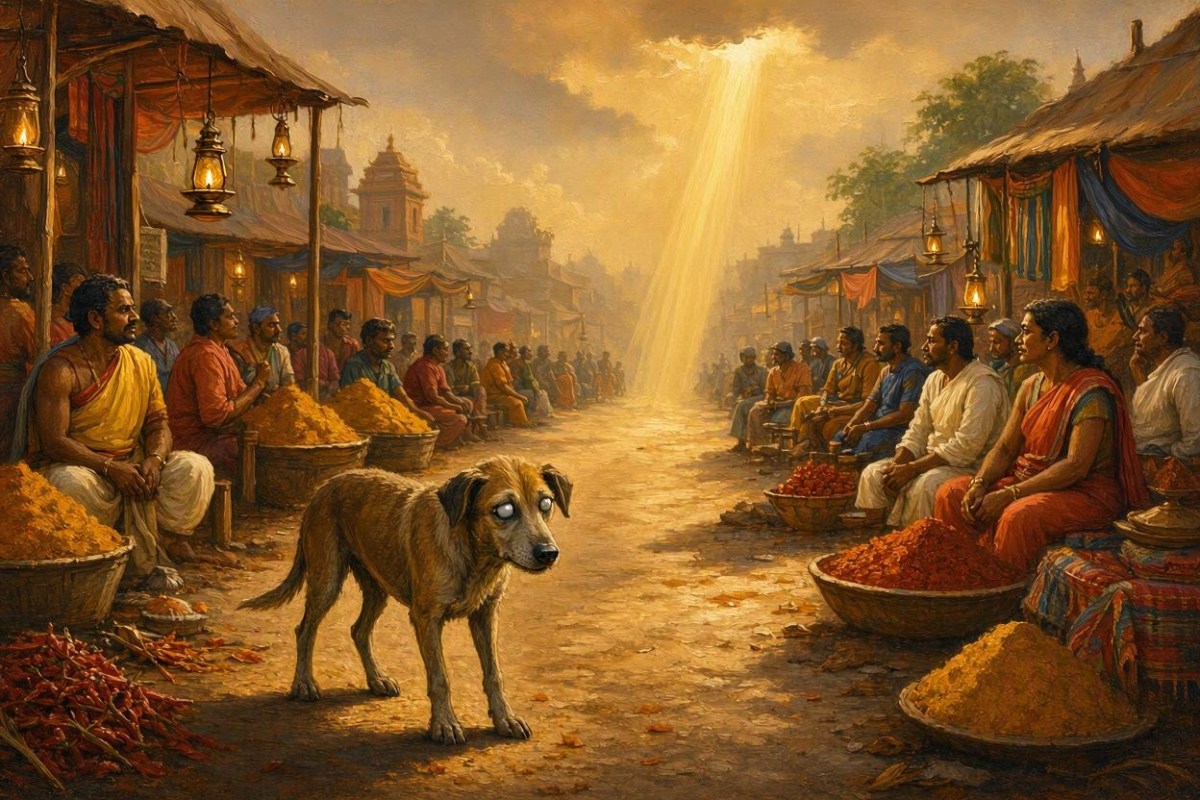
A blind dog stumbled to the bustling fair,

With sightless eyes and an aimless tread;

Ah, who can say what brought it to the market square,

Or by what strange desire it was led?

Though it is impossible to fully grasp the inner depth and complete import of a great saint like Purandara Dasa, we can make a humble attempt to understand the brilliant lessons hidden inside this poignant analogy, and see how it directly mirrors the wisdom of the Śrīmad-Bhāgavatam and Bhagavad-gītā.

Translating High Philosophy into Everyday Street Language

The profound truths contained in Sanskrit scriptures like the Bhagavad-gītā and Śrīmad-Bhāgavatam can sometimes feel distant or abstract to ordinary people busy navigating the struggles of daily life. This is where the compassionate genius of saint-poets like Purandara Dasa shines.

As a prominent leader of the Haridasa movement and the father of Carnatic music, Purandara Dasa made it his mission to take high Vedantic philosophy out of exclusive scholastic circles and bring it straight to the streets. Instead of overwhelming everyday listeners with dense technical terminology, he wrapped timeless spiritual psychology in raw, unforgettable, real-world imagery.

By recasting Samsara (the endless cycle of material birth and death) as a noisy, chaotic village fair (sante), and the illusioned spirit soul as a blind dog wandering through it, Purandara Dasa transformed complex theology into a vivid wake-up call that anyone, from a scholar to a street vendor could immediately grasp and feel in their heart.

Out of 8,400,000 Species of Life, Why a “Dog”?

According to Vedic knowledge, the soul travels through 8.4 million species of life across endless cosmic cycles. So why did Purandara Dasa select a dog to represent the soul adrift in the material world?

A dog possesses a psychological profile that uncannily reflects conditioned human nature. In fact, in the commentary to Śrīmad-Bhāgavatam 2.3.19, the acharyas detail these exact traits: a dog wags its tail for anyone who offers a scrap of bread, barks fiercely at strangers, submits completely to a stronger opponent by rolling on its back, yet fights bitterly over a bone with its equals, and mercilessly subdues the weak.

Purandara Dasa draws on these precise characteristics to hold up a mirror to our own lives:

  1. Very Relatable: Dogs have lived alongside human society since antiquity, making their behavior instantly recognizable to all of us.
  2. Fickle Faithfulness: A dog exhibits intense devotion, but primarily to whoever provides it with immediate sensory gratification or food.
  3. Hostile to Strangers: It barks at, mistrusts, and attacks anyone outside its familiar circle.
  4. Unpredictable Loyalty: Despite its reputation for loyalty, a dog can unexpectedly turn on and bite the very master who feeds it.
  5. Fiercely Territorial: It is especially inimical to competitors, viciously guarding its small patch of dirty pavement or territory.
  6. Flattering to the Strong: It knows how to be submissive, rolling over and flattering a proven stronger opponent to avoid a thrashing.
  7. A Dog-Eat-Dog World: When survival is on the line, dogs can be ruthless. Take Jack London’s The Call of the Wild, when sled dogs fight, the loser, even if stronger than the rest, ends up torn to shreds and eaten by the rest of the pack.
  8. Endless Sensory Greed: A dog is perpetually greedy, sniffing around for new sensory experiences, pacing endlessly with its tongue hanging out.

We Are Like That Dog

When we examine this list honestly, a sobering realization hits home: we are like that dog.

(If my use of the word “we” throughout this article felt presumptuous or brought any offense, please forgive me. I speak first and foremost of myself and those who share in my struggles.)

In our material conditioning, we are experts at making high-minded resolutions, but terrible at living up to them.

Imagine a dog sitting on a foul heap of garbage, quietly pondering, seemingly reconsidering its life choices after finding nothing of value. The very moment someone throws a fresh bag of new garbage onto the heap, off the dog runs to investigate.

We do the exact same thing. We recognize the emptiness of worldly pursuits, vow to pursue a higher spiritual life, and then abandon our resolve the instant a shiny new distraction is tossed into our path.

Lord Kapila describes this tragic loop of worldly attachment in Śrīmad-Bhāgavatam 3.30.20:

तत्राप्यनाथवत् क्षेत्रे गृहेत्ताभिरुपेक्षितः ।

यथा गृहे शुनाहारमुपानीतमश्नन् भूङ्क्ते ॥

tatrāpy anāthavat kṣetre gṛhe tābhir upekṣitaḥ

yathā gṛhe śunāhāram upānītam aśnan bhūṅkte

Translation: “In old age, neglected by the very family members he spent his entire life maintaining, he remains at home like a pet dog (śunā), eating whatever few scraps are reluctantly thrown to him.”

We slave our entire lives for material attachments, only to wind up like an old household dog, taking whatever scraps our illusory masters toss our way. From top dog to a nobody.

But Why Blind?

Purandara Dasa didn’t just choose a dog; he wrote about a blind dog wandering into the middle of a chaotic village fair.

A dog naturally relies heavily on its smell, but it uses vision to navigate safely. A blind dog can “smell” something delicious sitting inside a shop stall, but it cannot see the danger standing in its path, the heavy carts, the narrow traps, or the vendor holding a stick. Driven purely by its nose, it marches straight into a beating.

This spiritual blindness is a central theme throughout Vedic literature. In Śrīmad-Bhāgavatam 7.5.31, Prahlāda Mahārāja poignantly describes the tragic state of souls who lack spiritual vision:

न ते विदुः स्वार्थगतिं हि विष्णुं दुराशया ये बहिरर्थमानिनः ।

अन्धा यथान्धैरुपनीयमानाः तेऽपीशतन्त्र्यामुरुदाम्नि बद्धाः ॥

na te viduḥ svārtha-gatiṁ hi viṣṇuṁ

durāśayā ye bahir-artha-māninaḥ

andhā yathāndhair upanīyamānāḥ

te ‘pīśa-tantryām uru-dāmni baddhāḥ

Translation: “Persons who are strongly entrapped by the consciousness of enjoying material life do not know that the ultimate goal of human life is Lord Viṣṇu. Like blind men led by another blind man (andhā yathāndhaiḥ), they fall off the path and remain tightly bound by the strong ropes of material nature.”

This loss of vision is described in Bhagavad-gītā 2.67:

इन्द्रियाणां हि चरतां यन्मनोऽनुविधीयते ।

तदस्य हरति प्रज्ञां वायुर्नावमिवाम्भसि ॥

indriyāṇāṁ hi caratāṁ yan mano ‘nuvidhīyate

tad asya harati prajñāṁ vāyur nāvam ivāmbhasi

Translation: “As a strong wind sweeps away a boat on the water, even one of the roaming senses on which the mind focuses can carry away a man’s intelligence.”

Just as scent sweeps away the blind dog’s caution, our untamed senses sweep away our intelligence (prajñā). We can “smell” the fleeting pleasures of the material world, and our desires pull us forward. But without the eyes of spiritual knowledge (jnana), we remain blind to the karmic traps and the inevitable blows of fate waiting at every stall.

Freedom from Illusory Masters

The great Vaishnava saint Śrī Rūpa Gosvāmī captured this exact plight in a prayer that is frequently cited throughout the Śrīmad-Bhāgavatam purports (Bhakti-rasāmṛta-sindhu 3.2.35):

कामौदीनां कति न कतिधा पालिता दुर्निदेशास्

तेषां जाता मयि न करुणा न त्रपा नोपशान्तिः ।

उत्सृज्यैतानथ यदुपते साम्प्रतं लब्धबुद्धिस्

त्वामायातः शरणमभयं मां नियुङ्क्ष्वात्मदास्ये ॥

kāmādīnāṁ kati na katidhā pālitā durnideśās

teṣāṁ jātā mayi na karuṇā na trapā nopaśāntiḥ

utsṛjyaitān atha yadu-pate sāmprataṁ labdha-buddhis

tvām āyātaḥ śaraṇam abhayaṁ māṁ niyuṅkṣvātma-dāsye

Translation: “O my Lord, there is no limit to the unwanted orders of my material masters such as lust, anger, and greed. Although I have served them so faithfully for so long, they have shown no mercy to me, nor have I felt any shame, nor any peace. O Lord of the Yadus, now that my intelligence has finally awakened, I abandon them all. I come to You today to take shelter at Your fearless lotus feet. Please engage me in Your service.”

The underlying lesson here is profound: while we may appear to be serving various external masters in this world, we are actually serving only those who gratify our senses. In truth, no matter who the external master seems to be, we remain bound in servitude to our own ruthless, merciless material senses.

Returning to Our True Home

The tragic truth underlying Purandara Dasa’s poem is that the soul’s aimless wandering through this chaotic marketplace is entirely unnecessary. We are not native to this world of birth, disease, old age, and death; our true home is in the eternal spiritual realm (Vaikuntha). As eternal fragmental parts of the Supreme Lord, we have simply strayed away, mistaking the noisy, temporary stalls of Samsara for our permanent residence. We can end this grueling cycle of wandering the moment we stop surrendering to ruthless, illusory masters and accept our original, true Master, Śrī Kṛṣṇa.

In Bhagavad-gītā 15.6 & 15.7, Lord Kṛṣṇa reminds us of our real identity and our true home:

न तद्भासयते सूर्यो न शशाङ्को न पावकः ।

यद्गत्वा न निवर्तन्ते तद्धाम परमं मम ॥

ममैवांशो जीवलोके जीवभूतः सनातनः ।

मनःषष्ठानीन्द्रियाणि प्रकृतिस्थानि कर्षति ॥

na tad bhāsayate sūryo na śaśāṅko na pāvakaḥ

yad gatvā na nivartante tad dhāma paramaṁ mama

mamaivāṁśo jīva-loke jīva-bhūtaḥ sanātanaḥ

manaḥ-ṣaṣṭhānīndriyāṇi prakṛti-sthāni karṣati

Translation: “That supreme abode of Mine is not illumined by the sun or moon, nor by fire or electricity. Those who reach it never return to this material world.. The living entities in this conditioned world are My eternal fragmental parts. Due to conditioned life, they are struggling very hard with the six senses, which include the mind.”

Echoing this, Śrīmad-Bhāgavatam 10.14.58 confirms that once we surrender to our true Master, the vast, dangerous ocean of material existence shrinks to nothing:

समाश्रिता ये पदपल्लवप्लवं महत्पदं पुण्ययशोमुरारेः ।

भवाम्बुधिर्वत्सपदं परं पदं पदं पदं यद्विपदां न तेषाम् ॥

samāśritā ye pada-pallava-plavaṁ mahat-padaṁ puṇya-yaśo-murāreḥ

bhavāmbudhir vatsa-padaṁ paraṁ padaṁ padaṁ padaṁ yad vipadāṁ na teṣām

Translation: “For those who have accepted the boat of the lotus feet of the Supreme Lord, the ocean of the material world is like the water contained in a calf’s footprint. Their destination is paraṁ padam, the spiritual realm where there are no miseries, rather than this world where there is danger at every step.”

A Humble Prayer

Purandara Dasa’s metaphor is not an insult; it is a merciful wake-up call to help us open our spiritual eyes. In that spirit, let us pray together:

O my dear Śrī Kṛṣṇa, You are the most merciful benevolent ever-merciful Master, and yet I am chasing all sorts of illusory masters who abuse me more than anything else.

Please kindly release me from the bondage of these illusory masters and let me take shelter at Your lotus feet.

Please allow me to bring other such blind dogs like myself into Your eternal shelter.

Hare Krishna Hare Krishna

Krishna Krishna Hare Hare

Hare Rama Hare Rama

Rama Rama Hare Hare
Lord Krishna, the Supreme Personality of Godhead

In the next post we will explore the next two lines of the song.

ಖಂಡ ಸಕ್ಕರೆ ಹಿತವಿಲ್ಲವಂತೆ ಖಂಡ ಎಲುಬು ಕಡಿದಿತಂತೆ
ಹೆಂಡಿರ ಮಕ್ಕಳ ನೆಚ್ಚಿತಂತೆ ಕೊಂಡು ಹೋಗುವಾಗ ಯಾರಿಲ್ಲವಂತೆ || 1 ||

khaṇḍa sakkare hitavillavante khaṇḍa elubu kaḍiditante

heṇḍira makkaḷa neccitante koṇḍu hōguvāga yārillavante || 1 ||

Translation:

Pure rock sugar held no sweetness to his taste,

Yet on dry and splintered bones his teeth he placed.

He spurned the honeyed bliss that sets the spirit free,

To crunch on sharp despair in blind captivity.

He doted on his wife and children day and night,

And anchored all his love within their changing sight.

Yet when the final hour called his breath away,

Not one could join his soul upon that lonely way.

The Butcher’s Needle: Why are Doctors Killing People?

Is life “unfair,” or is it perfectly just? ⚖️

We often view terminal illness as a cruel tragedy, but from a Vedic perspective, every moment of suffering is a divine education. When pioneers like Dr. Ian Ball offer a shortcut through lethal injection, they aren’t just ending pain—they are interrupting a vital lesson that the soul must eventually return to finish.

Read more on the “Karmic Demotion” and why perseverance is the only true way to “burn the mountain” of our past.

Dr. Ian Ball is a Canadian physician and a pioneer in what is known as Medical Assistance in Dying (MAID). This procedure is for those diagnosed with a terminal illness. There is no hope of recovery or prognosis. For instance, if a patient suffering from cancer finds their pain unbearable, they may request MAID. In these instances, Dr. Ball or a colleague arrives to administer death through a specific set of lethal injections.

The scale of this practice has grown significantly. In 2024, in Canada alone, 16,499 people died by MAID, lives ended by the choice of patients. These are deaths through the direct actions of a doctor. This staggering figure represents over 5% of all registered deaths in Canada for that year. For those who know the value of life through spiritual knowledge, this trend is deeply distressing.

It is to be noted that doctors are also heavily involved in the other side of assisted death. They call it abortions. This has already resulted in a massive reduction of life expectancy rates around the world.

The Infallible Law of Karma

The law of karma is perfectly just and infallible. It is a misconception to say that “life is unfair”; in reality, life is perfectly fair to everyone. The principle is simple: As you sow, so shall you reap. What goes around, truly comes around. The cycle of actions and reactions is incredibly complex. As a result, many fail to understand this intricate chain of cause and effect.

Alas, a materially motivated person continues in this cycle:

नूनं प्रमत्त: कुरुते विकर्म
यदिन्द्रियप्रीतय आपृणोति ।
न साधु मन्ये यत आत्मनोऽय-
मसन्नपि क्लेशद आस देह: ॥ ४ ॥

nūnaṁ pramattaḥ kurute vikarma
yad indriya-prītaya āpṛṇoti
na sādhu manye yata ātmano ’yam
asann api kleśada āsa dehaḥ

When a person considers sense gratification the aim of life, he certainly becomes mad after materialistic living and engages in all kinds of sinful activity. He does not know that due to his past misdeeds he has already received a body which, although temporary, is the cause of his misery. Actually the living entity should not have taken on a material body, but he has been awarded the material body for sense gratification. Therefore I think it not befitting an intelligent man to involve himself again in the activities of sense gratification by which he perpetually gets material bodies one after another.

https://vedabase.io/en/library/sb/5/5/4/

The intricacies of action and reaction are extremely difficult to understand, actually – it is not always what it looks like:

किं कर्म किमकर्मेति कवयोऽप्यत्र मोहिताः ।
तत्ते कर्म प्रवक्ष्यामि यज्ज्ञात्वा मोक्ष्यसेऽश‍ुभात् ॥ १६ ॥

kiṁ karma kim akarmeti
kavayo ’py atra mohitāḥ
tat te karma pravakṣyāmi
yaj jñātvā mokṣyase ’śubhāt

Even the intelligent are bewildered in determining what is action and what is inaction. Now I shall explain to you what action is, knowing which you shall be liberated from all misfortune.

https://vedabase.io/en/library/bg/4/16/

Our joys and sufferings are the direct result of our own past karmic reactions. We are affected by everything in this material world. This includes our genes, family, brain, body, work, health, money, and relationships. These are reactions to our past activities. These reactions are not punishments, but lessons meant to help us advance toward spiritual perfection. We are meant to accept them with grace, tolerance, and love, while maintaining gratitude toward God, as expressed in the mood of:

तत्तेऽनुकम्पां सुसमीक्षमाणो
भुञ्जान एवात्मकृतं विपाकम् ।
हृद्वाग्वपुर्भिर्विदधन्नमस्ते
जीवेत यो मुक्तिपदे स दायभाक् ॥ ८ ॥

tat te ’nukampāṁ su-samīkṣamāṇo
bhuñjāna evātma-kṛtaṁ vipākam
hṛd-vāg-vapurbhir vidadhan namas te
jīveta yo mukti-pade sa dāya-bhāk

My dear Lord, one who earnestly waits for You to bestow Your causeless mercy upon him, all the while patiently suffering the reactions of his past misdeeds and offering You respectful obeisances with his heart, words and body, is surely eligible for liberation, for it has become his rightful claim.

https://vedabase.io/en/library/sb/10/14/8/

The Himalayan Mountain vs. The Spoonful

To truly grasp the gravity of our situation, we must realize that our karmic reactions are virtually unlimited. We have been in the material realm for millions and millions of lives. Many of these reactions are mostly hidden from our view. Our total accumulated karma is comparable to the size of a Himalayan mountain. We bring only the equivalent of a single spoonful into any one lifetime. This portion is known as prarabdha karma. It progresses through three stages. Kutam signifies the hidden potential. Bijam is the seed form. Phala represents the visible “flowers and fruits” of pleasure or pain. When a doctor administers MAID to “stop the pain,” they aim to pluck out a single piece of “bitter fruit.” This action leaves the vast mountain of seeds and latent reactions untouched. These seeds are then ready to sprout again.

Himalayan Mountain
Himalayan Mountain

This statement is confirmed in the Padma Purāṇa:

aprārabdha-phalaṁ pāpaṁ
kūtaṁ bījaṁ phalonmukham
krameṇaiva pralīyante
viṣṇu-bhakti-ratātmanā

For those who are engaged in the devotional service of the Supreme Personality of Godhead, all sinful reactions, whether fructified, in the stock, or in the form of a seed, gradually vanish.

https://vedabase.io/en/library/bg/9/2/ – purport

A Spoonful...
A Spoonful…

The Alchemy of Perseverance: Burning the Mountain

On the other hand, when a soul chooses to persevere for spiritual perfection, a miraculous transformation occurs. This happens through the fire of pain. By meeting suffering with equanimity and devotion, the soul doesn’t just pay off the spoonful of current karma. It actually burns off a vast amount of accumulated reactions from that hidden Himalayan mountain. This conscious endurance acts as a spiritual furnace. It incinerates the seeds (bijam) and latent potentials (kutam). These would have otherwise forced the soul into countless future births of suffering. What seems like a tragedy to the material eye is actually the soul’s best chance to clear the books. It is also the final liberation.

The Gift of Human Consciousness vs. Animal Instinct

It is vital to understand the distinction between human life and the lower species. In animal life, there is neither agency nor freedom, nor is there any inherent desire to do better. The specific animal form imposes its conditioning completely; the creature simply acts according to instinct. In contrast, human life is a unique gift. We alone possess the ability to reflect upon our condition, to tolerate our circumstances, and to grow. An animal is a prisoner of its biological programming. However, a human being can use even the most difficult suffering. This suffering can serve as a catalyst for spiritual evolution.

नृदेहमाद्यं सुलभं सुदुर्लभं
प्लवं सुकल्पं गुरुकर्णधारम् ।
मयानुकूलेन नभस्वतेरितं
पुमान् भवाब्धिं न तरेत् स आत्महा ॥ १७ ॥

nṛ-deham ādyaṁ su-labhaṁ su-durlabhaṁ
plavaṁ su-kalpaṁ guru-karṇadhāram
mayānukūlena nabhasvateritaṁ
pumān bhavābdhiṁ na taret sa ātma-hā
Synonyms

The human body, which can award all benefit in life, is automatically obtained by the laws of nature, although it is a very rare achievement. This human body can be compared to a perfectly constructed boat having the spiritual master as the captain and the instructions of the Personality of Godhead as favorable winds impelling it on its course. Considering all these advantages, a human being who does not utilize his human life to cross the ocean of material existence must be considered the killer of his own soul.

https://vedabase.io/en/library/sb/11/20/17/

Human Consciousness
Human Consciousness

The Moment of Death and the Karmic Demotion

Furthermore, the consciousness of the soul at the moment of death determines its next destination. By choosing the “easy way out” through MAID, the soul avoids its challenges. This decision leads to spiritual stagnation. Instead of finding liberation from pain, the soul returns to the karmic cycle. It suffers even more than before. The individual has wasted the precious opportunity to use the human form for spiritual growth. As a result, they face a demotion. They are forced to take birth in a species characterized by tremendous suffering. In this new form, the light of human reason is no longer available to them. If I die like an animal running away from mere bodily pain, I will take life as an animal.

यं यं वापि स्मरन्भावं त्यजत्यन्ते कलेवरम् ।
तं तमेवैति कौन्तेय सदा तद्भ‍ावभावित: ॥ ६ ॥

yaṁ yaṁ vāpi smaran bhāvaṁ
tyajaty ante kalevaram
taṁ tam evaiti kaunteya
sadā tad-bhāva-bhāvitaḥ
Synonyms

Whatever state of being one remembers when he quits his body, O son of Kuntī, that state he will attain without fail.

https://vedabase.io/en/library/bg/8/6/

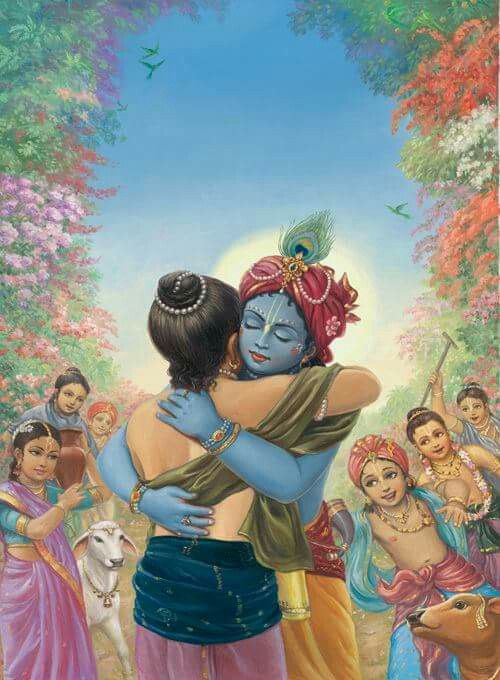
Krishna embraces His Devotee

Temporary Suffering as Education

Karmic reactions act like the discipline of a benevolent, loving parent. If I have caused pain to other living entities, I must learn what that pain feels like. If I have brought joy to others, I am given a proportionate reaction. When this educational process is cut short by artificial means, the lesson remains unlearned. It is like dropping out of a difficult course of study. You will not get the “degree” until the requirements are met.

  • The Compounding Debt: When “therapeutic” pain is cut short, the patient suffers even more in the future. A debt balloons if not paid on time. A fire rages if unchecked. A disease festers when untreated.
  • Treating the Symptom: The terminal patient’s pain is not the disease! The terminal illness is not the disease! The true disease is the unfortunate attitude and impious activities that led to a material body. The material body is already doomed with a terminal illness the day it is born. Alas, the disease remains untreated, and the doctors are responsible for letting that spiritual disease flourish.

जातस्य हि ध्रुवो मृत्युर्ध्रुवं जन्म मृतस्य च ।
तस्मादपरिहार्येऽर्थे न त्वं शोचितुमर्हसि ॥ २७ ॥

jātasya hi dhruvo mṛtyur
dhruvaṁ janma mṛtasya ca


One who has taken his birth is sure to die, and after death one is sure to take birth again.

https://vedabase.io/en/library/bg/2/27/

Intelligence vs. Mere Cleverness

To understand why this happens, we must distinguish between true intelligence and mere cleverness. Intelligence is the higher capacity to see right from wrong, the power of discrimination. Cleverness is simply the mental ability to solve material problems. One can be incredibly clever at administering a medical procedure while remaining completely unintelligent about the moral and karmic consequences. Without the ability to discern what benefits the soul, cleverness can harm it. Cleverness becomes a dangerous tool under these circumstances.

तेषां सततयुक्तानां भजतां प्रीतिपूर्वकम् ।
ददामि बुद्धियोगं तं येन मामुपयान्ति ते ॥ १० ॥

teṣāṁ satata-yuktānāṁ
bhajatāṁ prīti-pūrvakam
dadāmi buddhi-yogaṁ taṁ
yena mām upayānti te
Synonyms

teṣām — unto them; satata–yuktānām — always engaged; bhajatām — in rendering devotional service; prīti–pūrvakam — in loving ecstasy; dadāmi — I give; buddhi–yogam — real intelligence; tam — that; yena — by which; mām — unto Me; upayānti — come; te — they.Translation

To those who are constantly devoted to serving Me with love, I give the understanding by which they can come to Me.

https://vedabase.io/en/library/bg/10/10/

The Blind Leading the Blind

Physicians who perform these acts suffer terrible karmic reactions themselves. It is not that Dr. Ball and his colleagues set out with ill intent; they do this because of their lack of spiritual education. They are in ignorance, acting in ignorance, a classic case of the blind leading the blind.

Dr. Ball is undoubtedly a highly trained physician. He has an above-average mental capacity. He also has the courage to perform a very difficult task. Unfortunately, I presently have no influence over him or his colleagues. It is said that “fools rush in where angels fear to tread.” He is very clever, but he is unintelligent. He has no clue about the laws that govern the soul in the material world.

न ते विदु: स्वार्थगतिं हि विष्णुं
दुराशया ये बहिरर्थमानिन: ।
अन्धा यथान्धैरुपनीयमाना-
स्तेऽपीशतन्‍त्र्यामुरुदाम्नि बद्धा: ॥ ३१ ॥

na te viduḥ svārtha-gatiṁ hi viṣṇuṁ
durāśayā ye bahir-artha-māninaḥ
andhā yathāndhair upanīyamānās
te ’pīśa-tantryām uru-dāmni baddhāḥ
Synonyms

Persons who are strongly entrapped by the consciousness of enjoying material life, and who have therefore accepted as their leader or guru a similar blind man attached to external sense objects, cannot understand that the goal of life is to return home, back to Godhead, and engage in the service of Lord Viṣṇu. As blind men guided by another blind man miss the right path and fall into a ditch, materially attached men led by another materially attached man are bound by the ropes of fruitive labor, which are made of very strong cords, and they continue again and again in materialistic life, suffering the threefold miseries.

https://vedabase.io/en/library/sb/7/5/31/

Blind Leading the Blind

A Final Plea

I pray that God grants all such people the proper intelligence to do the right thing. At the very least, doctors should not be in the business of killing. That is the business of butchers, not healers.

Hare Krishna!

Please chant:

Hare Krishna Hare Krishna Krishna Krishna Hare Hare Hare Rama Hare Rama Rama Rama Hare Hare
The Hare Krishna Mahamantra