In a previous post, A blind dog comes to the fair, I promised you a more detailed exploration of the 16th-century saint-poet Purandara Dasa’s timeless song, “Kurudu Naayi Santege Bantante”.
In this article, we will focus on the sheer genius of his chosen imagery: Why did he specifically choose a “dog”? And why a “blind dog” at that? This is what we’re focusing on n this article.
ಕುರುಡು ನಾಯಿ ಸಂತೆಗೆ ಬಂತಂತೆ
ಅದು ಯಾತಕೆ (ಯಾಕೆ) ಬಂತೋkuruḍu nāyi santege bantante
adu yāke bantō
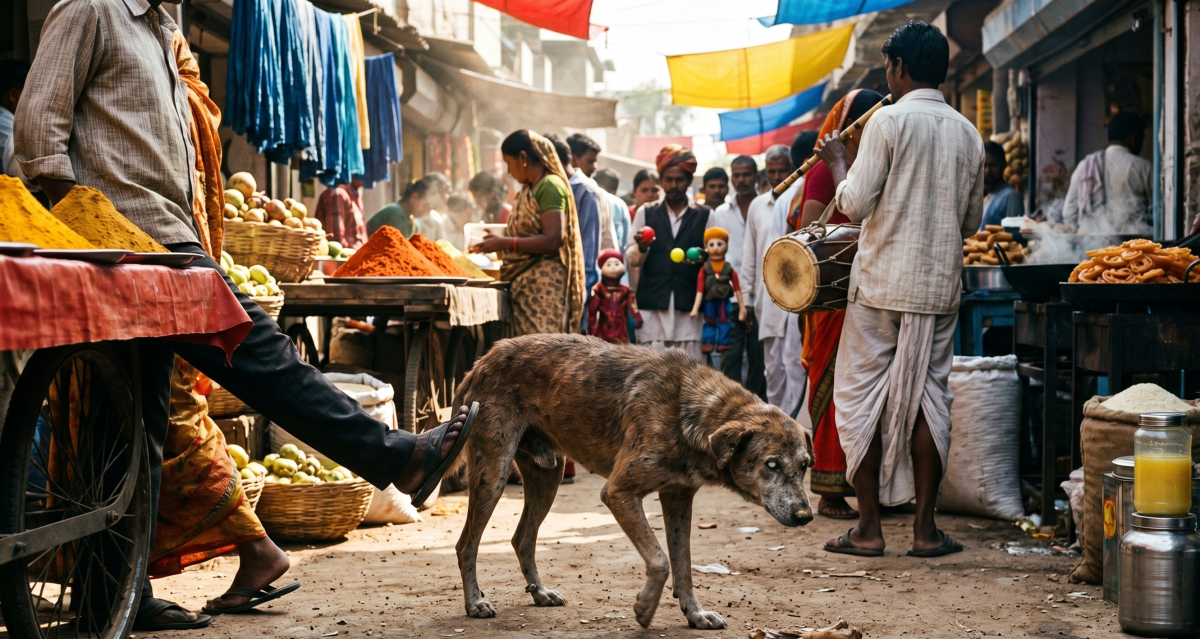
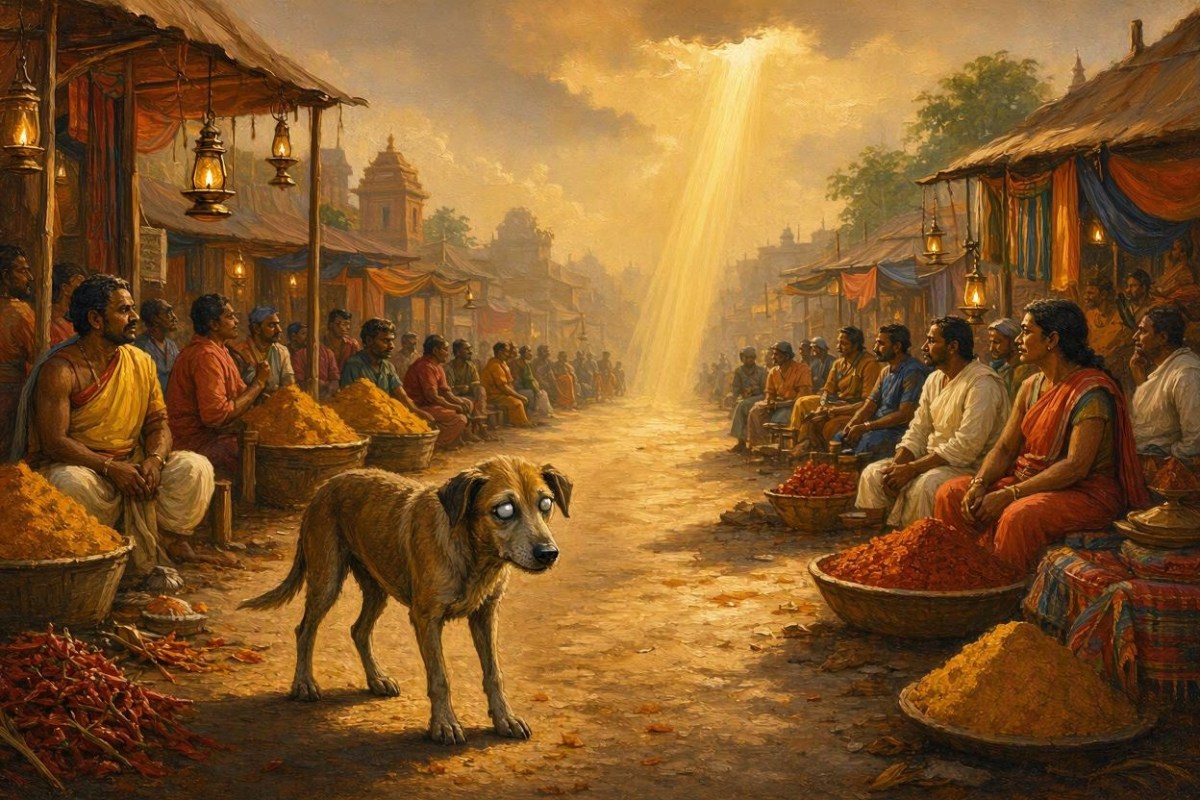
A blind dog stumbled to the bustling fair,
With sightless eyes and an aimless tread;
Ah, who can say what brought it to the market square,
Or by what strange desire it was led?
Though it is impossible to fully grasp the inner depth and complete import of a great saint like Purandara Dasa, we can make a humble attempt to understand the brilliant lessons hidden inside this poignant analogy, and see how it directly mirrors the wisdom of the Śrīmad-Bhāgavatam and Bhagavad-gītā.
Translating High Philosophy into Everyday Street Language
The profound truths contained in Sanskrit scriptures like the Bhagavad-gītā and Śrīmad-Bhāgavatam can sometimes feel distant or abstract to ordinary people busy navigating the struggles of daily life. This is where the compassionate genius of saint-poets like Purandara Dasa shines.
As a prominent leader of the Haridasa movement and the father of Carnatic music, Purandara Dasa made it his mission to take high Vedantic philosophy out of exclusive scholastic circles and bring it straight to the streets. Instead of overwhelming everyday listeners with dense technical terminology, he wrapped timeless spiritual psychology in raw, unforgettable, real-world imagery.
By recasting Samsara (the endless cycle of material birth and death) as a noisy, chaotic village fair (sante), and the illusioned spirit soul as a blind dog wandering through it, Purandara Dasa transformed complex theology into a vivid wake-up call that anyone, from a scholar to a street vendor could immediately grasp and feel in their heart.
Out of 8,400,000 Species of Life, Why a “Dog”?
According to Vedic knowledge, the soul travels through 8.4 million species of life across endless cosmic cycles. So why did Purandara Dasa select a dog to represent the soul adrift in the material world?
A dog possesses a psychological profile that uncannily reflects conditioned human nature. In fact, in the commentary to Śrīmad-Bhāgavatam 2.3.19, the acharyas detail these exact traits: a dog wags its tail for anyone who offers a scrap of bread, barks fiercely at strangers, submits completely to a stronger opponent by rolling on its back, yet fights bitterly over a bone with its equals, and mercilessly subdues the weak.
Purandara Dasa draws on these precise characteristics to hold up a mirror to our own lives:
- Very Relatable: Dogs have lived alongside human society since antiquity, making their behavior instantly recognizable to all of us.
- Fickle Faithfulness: A dog exhibits intense devotion, but primarily to whoever provides it with immediate sensory gratification or food.
- Hostile to Strangers: It barks at, mistrusts, and attacks anyone outside its familiar circle.
- Unpredictable Loyalty: Despite its reputation for loyalty, a dog can unexpectedly turn on and bite the very master who feeds it.
- Fiercely Territorial: It is especially inimical to competitors, viciously guarding its small patch of dirty pavement or territory.
- Flattering to the Strong: It knows how to be submissive, rolling over and flattering a proven stronger opponent to avoid a thrashing.
- A Dog-Eat-Dog World: When survival is on the line, dogs can be ruthless. Take Jack London’s The Call of the Wild, when sled dogs fight, the loser, even if stronger than the rest, ends up torn to shreds and eaten by the rest of the pack.
- Endless Sensory Greed: A dog is perpetually greedy, sniffing around for new sensory experiences, pacing endlessly with its tongue hanging out.
We Are Like That Dog
When we examine this list honestly, a sobering realization hits home: we are like that dog.
(If my use of the word “we” throughout this article felt presumptuous or brought any offense, please forgive me. I speak first and foremost of myself and those who share in my struggles.)
In our material conditioning, we are experts at making high-minded resolutions, but terrible at living up to them.
Imagine a dog sitting on a foul heap of garbage, quietly pondering, seemingly reconsidering its life choices after finding nothing of value. The very moment someone throws a fresh bag of new garbage onto the heap, off the dog runs to investigate.
We do the exact same thing. We recognize the emptiness of worldly pursuits, vow to pursue a higher spiritual life, and then abandon our resolve the instant a shiny new distraction is tossed into our path.
Lord Kapila describes this tragic loop of worldly attachment in Śrīmad-Bhāgavatam 3.30.20:
तत्राप्यनाथवत् क्षेत्रे गृहेत्ताभिरुपेक्षितः ।
यथा गृहे शुनाहारमुपानीतमश्नन् भूङ्क्ते ॥
tatrāpy anāthavat kṣetre gṛhe tābhir upekṣitaḥ
yathā gṛhe śunāhāram upānītam aśnan bhūṅkte
Translation: “In old age, neglected by the very family members he spent his entire life maintaining, he remains at home like a pet dog (śunā), eating whatever few scraps are reluctantly thrown to him.”
We slave our entire lives for material attachments, only to wind up like an old household dog, taking whatever scraps our illusory masters toss our way. From top dog to a nobody.
But Why Blind?
Purandara Dasa didn’t just choose a dog; he wrote about a blind dog wandering into the middle of a chaotic village fair.
A dog naturally relies heavily on its smell, but it uses vision to navigate safely. A blind dog can “smell” something delicious sitting inside a shop stall, but it cannot see the danger standing in its path, the heavy carts, the narrow traps, or the vendor holding a stick. Driven purely by its nose, it marches straight into a beating.
This spiritual blindness is a central theme throughout Vedic literature. In Śrīmad-Bhāgavatam 7.5.31, Prahlāda Mahārāja poignantly describes the tragic state of souls who lack spiritual vision:
न ते विदुः स्वार्थगतिं हि विष्णुं दुराशया ये बहिरर्थमानिनः ।
अन्धा यथान्धैरुपनीयमानाः तेऽपीशतन्त्र्यामुरुदाम्नि बद्धाः ॥
na te viduḥ svārtha-gatiṁ hi viṣṇuṁ
durāśayā ye bahir-artha-māninaḥ
andhā yathāndhair upanīyamānāḥ
te ‘pīśa-tantryām uru-dāmni baddhāḥ
Translation: “Persons who are strongly entrapped by the consciousness of enjoying material life do not know that the ultimate goal of human life is Lord Viṣṇu. Like blind men led by another blind man (andhā yathāndhaiḥ), they fall off the path and remain tightly bound by the strong ropes of material nature.”
This loss of vision is described in Bhagavad-gītā 2.67:
इन्द्रियाणां हि चरतां यन्मनोऽनुविधीयते ।
तदस्य हरति प्रज्ञां वायुर्नावमिवाम्भसि ॥
indriyāṇāṁ hi caratāṁ yan mano ‘nuvidhīyate
tad asya harati prajñāṁ vāyur nāvam ivāmbhasi
Translation: “As a strong wind sweeps away a boat on the water, even one of the roaming senses on which the mind focuses can carry away a man’s intelligence.”
Just as scent sweeps away the blind dog’s caution, our untamed senses sweep away our intelligence (prajñā). We can “smell” the fleeting pleasures of the material world, and our desires pull us forward. But without the eyes of spiritual knowledge (jnana), we remain blind to the karmic traps and the inevitable blows of fate waiting at every stall.
Freedom from Illusory Masters
The great Vaishnava saint Śrī Rūpa Gosvāmī captured this exact plight in a prayer that is frequently cited throughout the Śrīmad-Bhāgavatam purports (Bhakti-rasāmṛta-sindhu 3.2.35):
कामौदीनां कति न कतिधा पालिता दुर्निदेशास्
तेषां जाता मयि न करुणा न त्रपा नोपशान्तिः ।
उत्सृज्यैतानथ यदुपते साम्प्रतं लब्धबुद्धिस्
त्वामायातः शरणमभयं मां नियुङ्क्ष्वात्मदास्ये ॥
kāmādīnāṁ kati na katidhā pālitā durnideśās
teṣāṁ jātā mayi na karuṇā na trapā nopaśāntiḥ
utsṛjyaitān atha yadu-pate sāmprataṁ labdha-buddhis
tvām āyātaḥ śaraṇam abhayaṁ māṁ niyuṅkṣvātma-dāsye
Translation: “O my Lord, there is no limit to the unwanted orders of my material masters such as lust, anger, and greed. Although I have served them so faithfully for so long, they have shown no mercy to me, nor have I felt any shame, nor any peace. O Lord of the Yadus, now that my intelligence has finally awakened, I abandon them all. I come to You today to take shelter at Your fearless lotus feet. Please engage me in Your service.”
The underlying lesson here is profound: while we may appear to be serving various external masters in this world, we are actually serving only those who gratify our senses. In truth, no matter who the external master seems to be, we remain bound in servitude to our own ruthless, merciless material senses.
Returning to Our True Home
The tragic truth underlying Purandara Dasa’s poem is that the soul’s aimless wandering through this chaotic marketplace is entirely unnecessary. We are not native to this world of birth, disease, old age, and death; our true home is in the eternal spiritual realm (Vaikuntha). As eternal fragmental parts of the Supreme Lord, we have simply strayed away, mistaking the noisy, temporary stalls of Samsara for our permanent residence. We can end this grueling cycle of wandering the moment we stop surrendering to ruthless, illusory masters and accept our original, true Master, Śrī Kṛṣṇa.
In Bhagavad-gītā 15.6 & 15.7, Lord Kṛṣṇa reminds us of our real identity and our true home:
न तद्भासयते सूर्यो न शशाङ्को न पावकः ।
यद्गत्वा न निवर्तन्ते तद्धाम परमं मम ॥
ममैवांशो जीवलोके जीवभूतः सनातनः ।
मनःषष्ठानीन्द्रियाणि प्रकृतिस्थानि कर्षति ॥
na tad bhāsayate sūryo na śaśāṅko na pāvakaḥ
yad gatvā na nivartante tad dhāma paramaṁ mama
mamaivāṁśo jīva-loke jīva-bhūtaḥ sanātanaḥ
manaḥ-ṣaṣṭhānīndriyāṇi prakṛti-sthāni karṣati
Translation: “That supreme abode of Mine is not illumined by the sun or moon, nor by fire or electricity. Those who reach it never return to this material world.. The living entities in this conditioned world are My eternal fragmental parts. Due to conditioned life, they are struggling very hard with the six senses, which include the mind.”
Echoing this, Śrīmad-Bhāgavatam 10.14.58 confirms that once we surrender to our true Master, the vast, dangerous ocean of material existence shrinks to nothing:
समाश्रिता ये पदपल्लवप्लवं महत्पदं पुण्ययशोमुरारेः ।
भवाम्बुधिर्वत्सपदं परं पदं पदं पदं यद्विपदां न तेषाम् ॥
samāśritā ye pada-pallava-plavaṁ mahat-padaṁ puṇya-yaśo-murāreḥ
bhavāmbudhir vatsa-padaṁ paraṁ padaṁ padaṁ padaṁ yad vipadāṁ na teṣām
Translation: “For those who have accepted the boat of the lotus feet of the Supreme Lord, the ocean of the material world is like the water contained in a calf’s footprint. Their destination is paraṁ padam, the spiritual realm where there are no miseries, rather than this world where there is danger at every step.”
A Humble Prayer
Purandara Dasa’s metaphor is not an insult; it is a merciful wake-up call to help us open our spiritual eyes. In that spirit, let us pray together:
O my dear Śrī Kṛṣṇa, You are the most merciful benevolent ever-merciful Master, and yet I am chasing all sorts of illusory masters who abuse me more than anything else.
Please kindly release me from the bondage of these illusory masters and let me take shelter at Your lotus feet.
Please allow me to bring other such blind dogs like myself into Your eternal shelter.
Hare Krishna Hare Krishna
Krishna Krishna Hare Hare
Hare Rama Hare Rama
Rama Rama Hare Hare

In the next post we will explore the next two lines of the song.
ಖಂಡ ಸಕ್ಕರೆ ಹಿತವಿಲ್ಲವಂತೆ ಖಂಡ ಎಲುಬು ಕಡಿದಿತಂತೆ
ಹೆಂಡಿರ ಮಕ್ಕಳ ನೆಚ್ಚಿತಂತೆ ಕೊಂಡು ಹೋಗುವಾಗ ಯಾರಿಲ್ಲವಂತೆ || 1 ||khaṇḍa sakkare hitavillavante khaṇḍa elubu kaḍiditante
heṇḍira makkaḷa neccitante koṇḍu hōguvāga yārillavante || 1 ||
Translation:
Pure rock sugar held no sweetness to his taste,
Yet on dry and splintered bones his teeth he placed.
He spurned the honeyed bliss that sets the spirit free,
To crunch on sharp despair in blind captivity.
He doted on his wife and children day and night,
And anchored all his love within their changing sight.
Yet when the final hour called his breath away,
Not one could join his soul upon that lonely way.