“Kurudu Naayi Santege Bantante” (ಕುರುಡು ನಾಯಿ ಸಂತೆಗೆ ಬಂತಂತೆ), composed by the 16th-century saint-poet Purandara Dasa, is a masterpiece. This piece of writing is inspired by Purandara Dasa’s great timeless song. I can’t describe in words how much I love this song.
The Blind Dog at the Fair
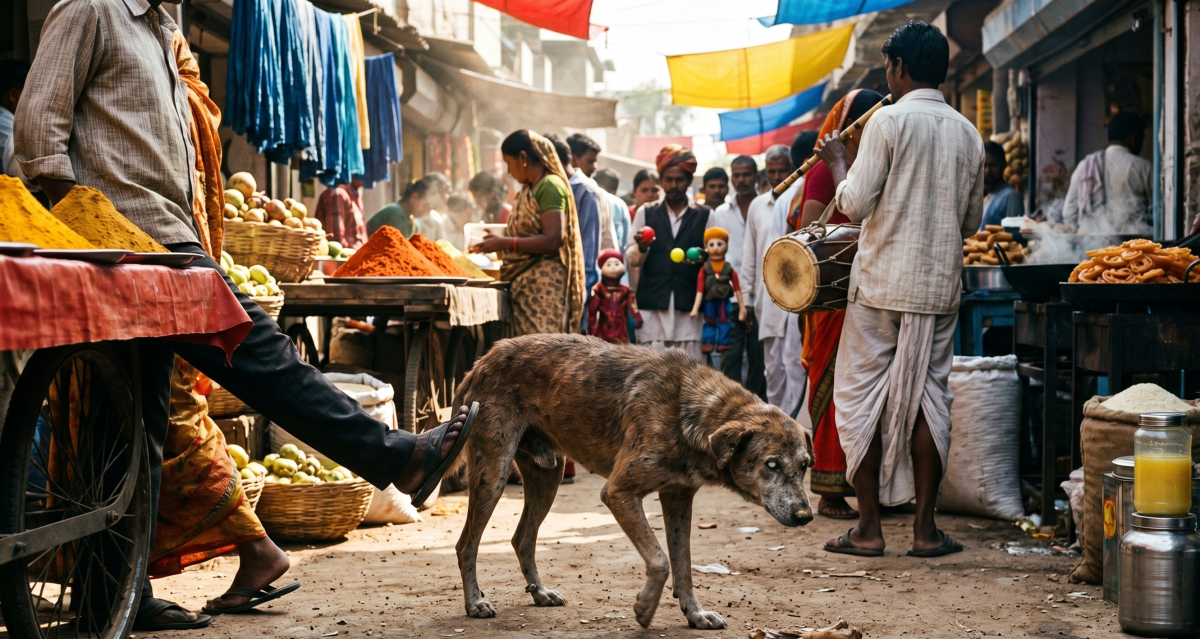
A blind dog wandered to the bustling fair, they say,
With sightless eyes and aimless paws, it stumbled on its way.
It knew not rules of traffic, nor where the paths aligned,
And plunged into the chaos, completely lost and blind.
Around it bloomed a riot of colors, vibrant, loud, and bright,
A grand kaleidoscope of life, hidden from its sight:
Mounds of golden turmeric, near heaps of scarlet spice,
Shining jars of liquid ghee, and sacks of polished rice.
Bright banners waved from canvas tents, trinkets caught the sun,
While sweetmeats fried, bubbling, enticing everyone.
Baskets filled with heavy fruits, and garments dyed in blue;
A dazzling sea of worldly wealth, fully out of view.
And through the crowd, the jugglers toss’d rings of painted wood,
While clever, dark-eyed magicians spun illusions where they stood.
With sleight of hand, they turned, stone into silver coin,
Inviting passing, hollow minds to marvel and to join.
The ragged buskers beat their drums and piped on hollow reeds,
Singing songs of fleeting joy to feed people’s greed.
A dancer spun in frantic steps, a puppeter held its string;
A thousand mock distractions in a loud, enchanted ring.
It spurned the trays of honeyed sweets and platters piled high,
To chew upon a broken bone, splintered, sharp, and dry.
Driven by a hungry belly, searching for a scrap,
It walked into a bustling store, right into a trap.
One vendor kicked it from the front, another struck its side,
With nowhere left to turn or run, and nowhere left to hide.
It yelped in pain but did not leave, sniffing for a bone,
Receiving blows of heavy sticks, and bruised by every stone.
For just a taste of garbage, it endured the market’s wrath,
Forgetting there was freedom outside that crowded path.
Such is fate of the mortal man who walks this earthly stage,
He enters into Samsara, a blinding, chaotic cage.
Through countless cycles, endless births, across a weary span,
It passed a million lifetimes just to win the form of man.
Yet blessed with rare human life, a prize beyond compare,
Squander’d; wandering, trapped in despair.
From garden unto garden, grove to grove, blindly runs,
And through the trackless forests, chasing shadows in the sun.
Bound tightly to its wife and child with fierce, attached embrace,
It anchored all its happiness within a changing face;
But when the hour of parting struck and swept them all away,
It stood alone in emptiness, with not a soul to stay.
It read the sacred Vedic texts just to quotable quote,
And left the inner wisdom, a lesson learned by rote.
Blinded it lost its way, despite the sacred lore,
And walked directly to the gates of Yamaraja’s door.
The priceless jewels of divine grace placed within its hand,
Yet like a clueless monkey, scattered in the sand.
And all this happened, all this grief, this tragic, blinding fall,
Because the foolish, wandering soul forgot the Lord of all.
It clean forgot sweet Krishna’s name, forgot Sri Ranga’s grace,
And turned its back on Vitthala to run this worldly race.
Ignorant of the spirit, blind to God’s design,
To chase the worthless dust of earth, rejecting the Divine.
To take the blows of fate and time, but crawl back for more,
Lured by the cheap illusions of the marketplace’s store.
Oh Purandara Vittala, hear a humble soul’s entreat
Guide me away from the market, back to Your lotus feet.
Purandara Dasa is known for using raw, everyday street imagery to convey profound Vedantic philosophy. In this song, he uses a biting, tragicomic allegory, a blind dog causing chaos at a village fair, to deliver a wake-up call to humanity about the nature of material existence.
I cannot ever do justice to his brilliance myself. But I can try to convey my appreciation for his deep devotion to Krishna and compassion upon souls like me.
1. The Blind Dog and the Fair
The core of the song rests on two brilliant metaphors:
- The Blind Dog (Kurudu Naayi): Represents the spirit soul (Jivatma). It is “blind” because it lacks spiritual wisdom. It is driven entirely by its base, animalistic instincts… hunger, survival, and immediate sensory gratification.
- The Market/Fair (Sante): Represents the material world (Samsara). A traditional Indian village market is temporary, loud, chaotic, and crowded. It sets up shop for a day and vanishes overnight, mirroring the fleeting, impermanent nature of worldly life.
When the blind dog stumbles into this chaotic marketplace, it has no map, no vision, and no understanding of how the market works. Similarly, souls plunge into the material world completely ignorant of our true purpose, navigating life purely by trial and error, mostly error.
2. Themes and Spiritual Lessons
The Illusion of Material Wealth (Maya)
The song describes the fair as incredibly vibrant, think piles of golden turmeric, scarlet spices, bubbling sweetmeats, jugglers, magicians, and buskers.
Samsara is not a boring wasteland, the material realm is dangerous precisely because it is so dazzling. The magicians and jugglers represent Maya (cosmic illusion). They perform tricks, turning stones into coins, symbolizing how the material world tricks us into believing that temporary worldly pleasures are permanent and valuable.
daivī hy eṣā guṇamayī mama māyā duratyayā / mām eva ye prapadyante māyām etāṁ taranti te
Translation: “This divine energy of Mine, consisting of the three modes of material nature, is difficult to overcome. But those who have surrendered unto Me can easily cross beyond it.”
The Misplaced Appetite (The Broken Bone)
One of the most poignant psychological observations in the song is the dog rejecting trays of honeyed sweets to chew on a dry, splintered, broken bone.
When a dog chews a dry bone, the sharp edges cut its own gums. The dog tastes its own blood but mistakenly believes the taste is coming from the bone. Purandara Dasa uses this to describe human desire: we reject the “honeyed sweet” of spiritual freedom and instead chase material pleasures that actively bind and hurt us, foolishly bleeding for joys that are entirely self-inflicted.
viṣayā vinivartante nirāhārasya dehinaḥ / rasa-varjaṁ raso ’py asya paraṁ dṛṣṭvā nivartate
Translation: “The embodied soul may be restricted from sense enjoyment, though the taste for sense objects remains. But, ceasing such engagements by experiencing a higher taste, he is fixed in consciousness.”
The Tragedy of Wasted Human Birth
Human life is incredibly rare, earned only after evolving through millions of lower lifetimes (as insects, birds, and animals).
Purandara Dasa laments that after finally achieving this precious human form, the soul wastes it. Instead of seeking Krishna, it walks “from garden to garden, forest to forest”, aimlessly wandering through the thickets of worldly distractions, entirely forgetting its own spiritual identity as an associate of God.
The Illusion of Temporary Relationships
The song sharply tackles human attachment (Moha). The soul binds itself fiercely to a spouse and children, building its entire universe around them. However, Purandara Dasa delivers a sobering truth: when the time of death arrives, the soul is ripped away from this environment. It enters the world alone, and it leaves the world alone. In the final hour, all worldly attachments are snatched away, leaving the soul to face its karmic accounts alone.
The Failure of Empty Intellectualism
Purandara Dasa was highly critical of ritualism and bookish knowledge devoid of true devotion (Bhakti). He notes that the soul might memorize and study all the Vedic texts, but if it lacks inner truth and humility, it will still lose its way. Intellectual pride only blinds the soul further, leading it straight to the gates of Yamaraja (the demigod in charge of Death and Judgment) to face inevitable punishment.
Lord Sri Krishna ridicules those who use the Vedas merely for temporary material gain or prestige (the “flowery words” or “quotable quotes”) rather than realizing that the ultimate purpose of all Vedic study is to know Krishna and serve Him.
yām imāṁ puṣpitāṁ vācaṁ pravadanty avipaścitaḥ / veda-vāda-ratāḥ pārtha nānyad astīti vādinaḥ
Translation: “People of small knowledge are very much attached to the flowery words of the Vedas, which recommend various fruitive activities… They say that there is nothing more than this.”
The Monkey and the Jewels
The poet uses a famous Kannada phrase, mangana kaiyalli manikyavante (like a precious gemstone in the hands of a monkey). A monkey has no concept of the value of a gemstone; it may simply play with it for a bit, surely get bored, and drop it in the sand somewhere. Divine grace, human consciousness, and the opportunity for spiritual perfection are the “priceless jewels” given to us, which many of us foolishly throw away to chase the worthless dust of material accumulation.
The Root Cause and the Remedy
Ultimately, Purandara Dasa asks: Why does the soul suffer like a stray dog being kicked from one market stall to the next?
The answer is simple: It forgot. It forgot the name of Krishna, it forgot the grace of Sri Ranga (Krishna), and it turned its back on our best friend and well-wisher, Krishna. The continuous “kicks and blows” we receive from fate, time, illness, and heartbreak are the natural consequences of wandering through the marketplace of Samsara unguided.
ye hi saṁsparśa-jā bhogā duḥkha-yonaya eva te / ādy-antavantaḥ kaunteya na teṣu ramate budhaḥ
Translation: “An intelligent person does not take part in the sources of misery, which are due to contact with the material senses. O son of Kuntī, such pleasures have a beginning and an end, and so the wise man does not delight in them.”
The wise person walks away from the market stalls of illusion, while the “blind dog” stays and helplessly takes the blows.
The song concludes not in despair, but with the classic signature (Ankita Mudra) of the poet. The only way out of the chaotic, abusive market of materialistic life is to stop chasing the scraps of the world, surrender the false ego, and find permanent refuge at the lotus feet of Purandara Vitthala (Krishna).
sarva-dharmān parityajya mām ekaṁ śaraṇaṁ vraja / ahaṁ tvāṁ sarva-pāpebhyo mokṣayiṣyāmi mā śucaḥ
Translation: “Abandon all varieties of religion and just surrender unto Me. I shall deliver you from all sinful reactions. Do not fear.”
I like this song because the song really sings my story, and likely yours. Fortunately for me, my master has already searched out and found me, has claimed me, and by his torchlight of knowledge, my blindness is disappearing rapidly.
This song gives me great hope. I know am on my way back home. Won’t you come with me?
Hear this song in Kannada.
Kannada lyrics and lyrics in latin scripts with diacritics below, with gratitude to Smt. Meera Subbarao. Especially in the original lyrics of the great Purandara Dasa, they have a haunting melody and reminder that stays long after we’ve heard it just once.
Original Lyrics
ಕುರುಡು ನಾಯಿ ಸಂತೆಗೆ ಬಂತಂತೆ || PA ||
ಅದು ಯಾತಕೆ (ಯಾಕೆ) ಬಂತೋ || A PA ||ಖಂಡ ಸಕ್ಕರೆ ಹಿತವಿಲ್ಲವಂತೆ ಖಂಡ ಎಲುಬು ಕಡಿದಿತಂತೆ
ಹೆಂಡಿರ ಮಕ್ಕಳ ನೆಚ್ಚಿತಂತೆ ಕೊಂಡು ಹೋಗುವಾಗ ಯಾರಿಲ್ಲವಂತೆ || 1 ||ಭರದಿ ಅಂಗಡಿ ಹೊಕ್ಕಿತಂತೆ ತಿರುವಿ ದೊಣ್ಣೆಲಿ ಇಕ್ಕಿದರಂತೆ
ಮರೆತರಿನ್ನು ವ್ಯರ್ಥವಂತೆ ನರಕದೊಳಗೆ ಬಿದ್ದಿತಂತೆ || 2 ||ವೇದಶಾಸ್ತ್ರವನೋದಿತಂತೆ ಗಾದೆಯ ಮಾಡಿ ಬಿಟ್ಟಿತಂತೆ
ಹಾದಿ ತಪ್ಪಿ ನಡೆದು ಯಮನ ಬಾಧೆಗೆ ತಾ ಗುರಿಯಾಯಿತಂತೆ || 3 ||ನಾನಾ ಜನ್ಮವನೆತ್ತಿತಂತೆ ಮಾನವನಾಗಿ ಹುಟ್ಟಿತಂತೆ
ಕಾನನಕಾನನ ತಿರುಗಿತಂತೆ ತಾನು ತನ್ನನೆ ಮರೆಯಿತಂತೆ || 4 ||ಮಂಗನ ಕೈಯ ಮಾಣಿಕ್ಯದಂತೆ ಹಾಂಗೂ ಹೀಂಗೂ ಕಳೆದೀತಂತೆ
ರಂಗವಿಠಲನ ಮರೆತಿತಂತೆ ಭಂಗ ಬಹಳ ಪಟ್ಟಿತಂತೆ || 5 ||kuruḍu nāyi santege bantante || PA ||
adu yāke bantō || A PA ||
khaṇḍa sakkare hitavillavante khaṇḍa elubu kaḍiditante
heṇḍira makkaḷa neccitante koṇḍu hōguvāga yārillavante || 1 ||
bharadi aṅgaḍi hokkitante tiruvi doṇṇeli ikkidarante
maretarinnu vyarthavante narakadoḷage bidditante || 2 ||
vēdaśāstravanōditante gādeya māḍi biṭṭitante
hādi tappi naḍedu yamana bādhege tā guriyāyitante || 3 ||
nānā janmavanettitante mānavanāgi huṭṭitante
kānanakānana tirugitante tānu tannane mareyitante || 4 ||
maṅgana kaiya māṇikyadante hāṅgū hīṅgū kaḷedītante
raṅgaviṭhalana maretitante bhaṅga bahaḷa paṭṭitante || 5 ||
I pray never to forget the import of this song, may Sri Purandara Dasa and all the great Vaishnava saints guide me back home.

Update: I will be writing a series of posts on this song, as there is so much depth there… This post will be updated to include links to those posts.