The Simple Devotion of Haridasa Varya Prabhu

Haridasa Varya Prabhu, a humble and devoted soul, exemplifies the profound impact of simple devotion. Initiated at the age of 82, he lived a quiet life in Maharashtra, embodying true spirituality through daily chanting and reading. Despite illness, his dedication never wavered, demonstrating that it’s never too late to pursue a spiritual path. Surrounded by supportive devotees, his sincere humility and consistent practice of chanting the Hare Krishna mantra brought him closer to Krishna, ultimately guiding him to spiritual perfection.

Haridasa Varya Prabhu is not a well known devotee. He is not a Guru. He is not a big leader. He does not give classes. He does not write books. He did not take any tremendous vows. He did not commit to or achieve some ambitious project. He is a simple devotee. But his simple devotion earned him a place in the spiritual realm. Read more about the simplicity of this sweet devotee that made him dear to Guru and Krishna.

Born in 1941, Haridasa Varya Prabhu left for the spiritual world in 2025 at the age of 84. He was initiated quite recently, in 2023. How did he achieve this amazing feat, and that too “so quickly”?

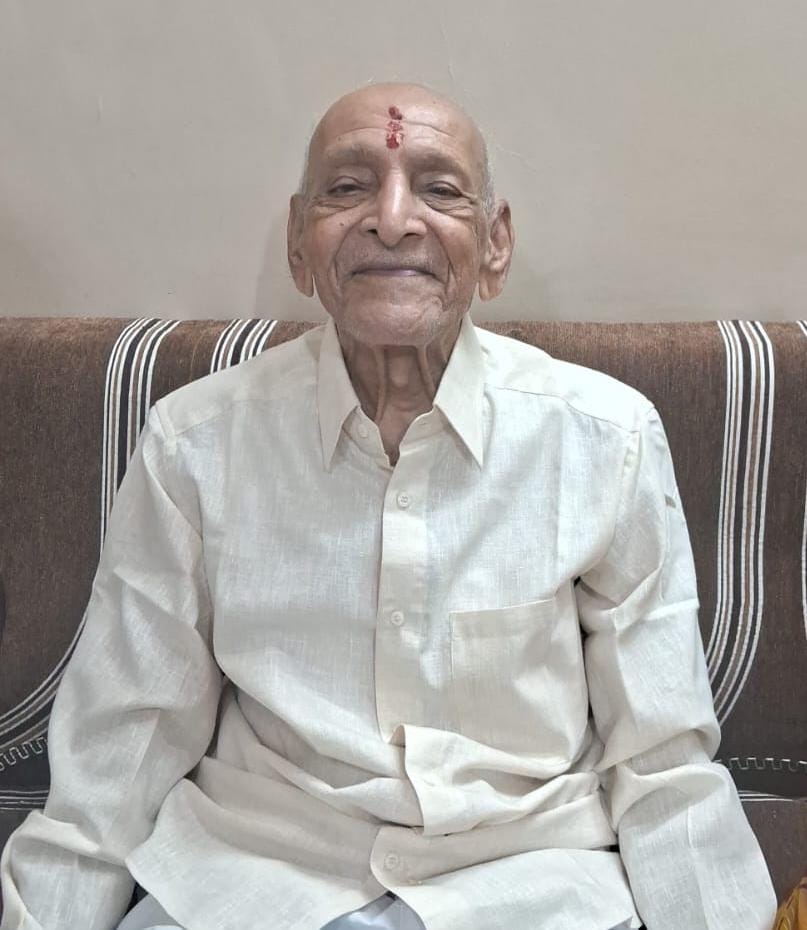
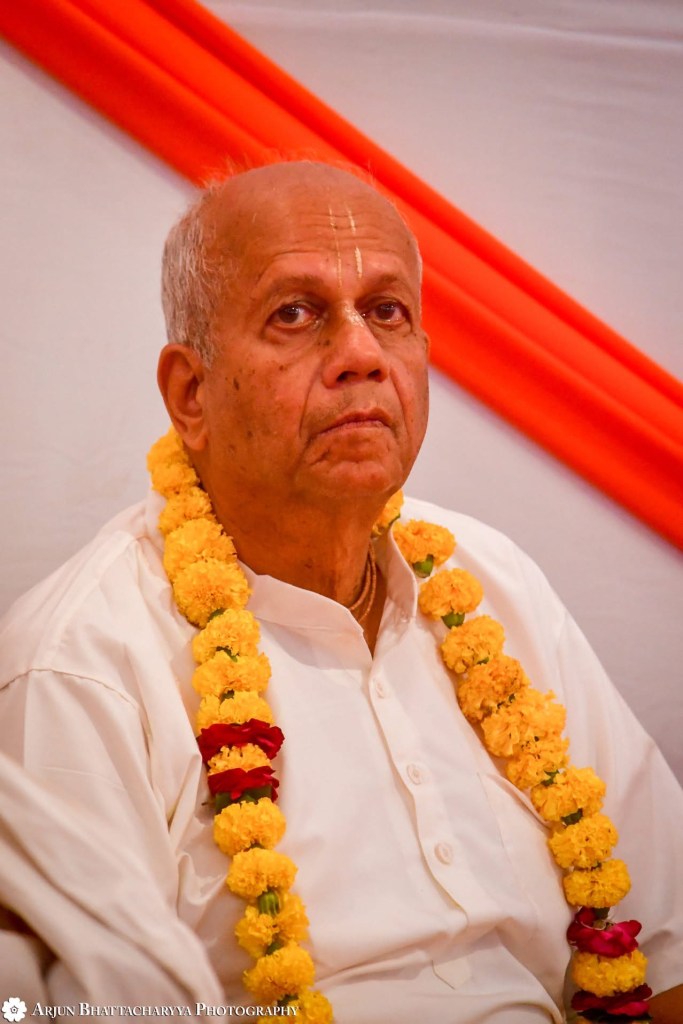
His Grace Haridasa Varya Prabhu

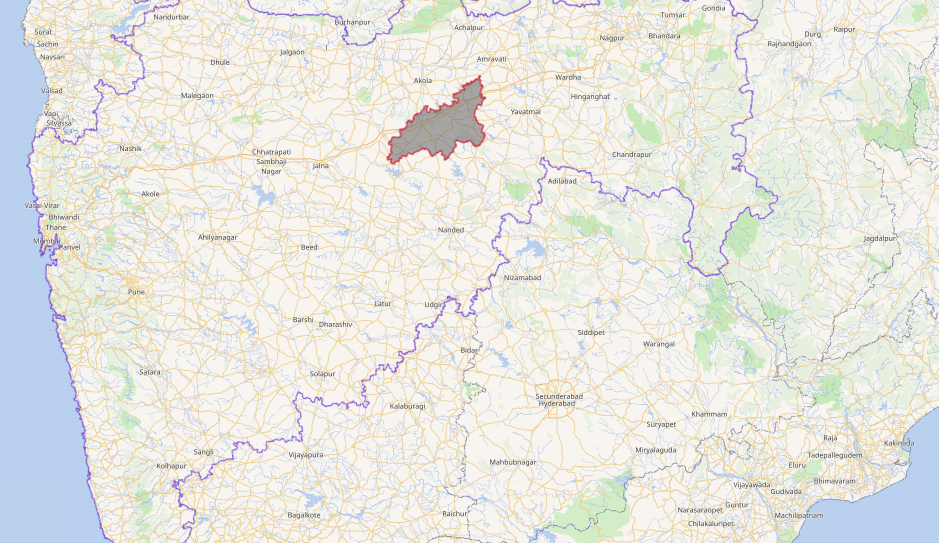
Our hero was born in a pious Marathi-speaking family. It was in a little village in the Washim District of Maharashtra. He led a very quiet and simple life. Married, early, he had two sons and a daughter. I learned about this great soul through his daughter. She is a devotee named Shyama Gauri Devi Dasi. She is a disciple of His Holiness Radhanath Swami. When she spoke about her father, I was inspired and struck by the simple devotion of her father. I had to write about it.

A map of India highlighting the Washim District of the State of Maharashtra

A map of India highlighting the Washim District of the State of Maharashtra

Once, not long ago, a visiting preacher, Ram Narayan Prabhu asked this elderly gentlemen “How many rounds are you chanting?”. The answer came back “Five”. The preacher asked “How will you reach spiritual perfection by chanting only five rounds?”. He added “If you chant a sixteen rounds, I will arrange for your initiation”. Our elderly hero was incredulous “What, even I can get initiated?” – thinking himself so unqualified for spiritual initiation, nevertheless started chanting sixteen rounds of the Hare Krishna Mahamantra. Every single day our octogenarian hero would chant Hare Krishna. Minimum of 16 rounds. Every single day.

Baladev Prabhu is our hero’s spiritual guide. He served as “Atma Pradarshak Guru” and “Shiksha Guru”, the instructing spiritual master. He took great pains to craft a plan of spiritual practice suitable for an octogenarian. Another spiritual guide was Vednath Prabhu, the Bhakti Vriksha leader or the local community.

Simple things get harder in old age. That’s one reason to start as early as possible. But, our hero never skipped his rounds. Even in ill health. Even in pain. No matter how hard it got, there was no stopping until he got to the magic number 16 rounds.

When it came time to getting initiated, though, there was a problem. He couldn’t travel far. In fact, he barely traveled to a nearby village. So how would he get initiated?

His Grace Samika Rishi Prabhu is a disciple of Srila Prabhupada. When he heard about this sincere soul, he agreed to initiate him. Not only is Samika Rishi Prabhu an accomplished physician of the body, he also is a doctor for the soul. The spiritual master has over 50 years of dedicated service under his belt. He agreed to visit the little village in Washim, Maharashtra. He came just to initiate this sincere soul.

On the initiation day, everyone was moved by the sincerity of the octogenarian initiate! His simplicity and dedication were clearly seen by all. New initiates are required to take the following vows:

  1. To chant a minimum of 16 rounds of the Hare Krishna Mahamantra (1728 utterances of the mantra) every day.
  2. To follow these four regulative principles
    • No illicit sex
    • No gambling
    • No meat eating
    • No intoxication

When taking the vows to follow the regulative, our hero was embarrassed. He didn’t want anyone thinking he used to do these things before and would now abstain from them! So he took the vows somewhat like this:

“I don’t partake of illicit sex, gambling, meat eating, or intoxication” – deliberately using the present tense!

That simple innocence definitely brought a chuckle to everyone present!

His Grace Samika Rishi Prabhu initiated our hero with the name “Haridasa Varya Das.” This name means “The foremost among the servants of Sri Hari.” He took his spiritual life very seriously.

This was the daily schedule of Haridasa Varya Prabhu:

7:00 AM – rise, cleanse teeth, have breakfast, take a bath, apply Tilaka, recite his mantras at the altar. The mantras starting with the Ganapati Stotra and other mantras he was used to reciting since childhood.

8:00 AM – Chant 16 rounds of the Hare Krishna Mahamantra on meditation beads

11 AM – Lunch

12 Noon – Nap

2 PM – Read the Srimad Bhagavatam, at least 40 pages daily – make a daily record of his reading

4PM – Watch TV, speak with other villagers

6PM – dinner

7PM – Chant Hare Krishna some more

9PM – Rest

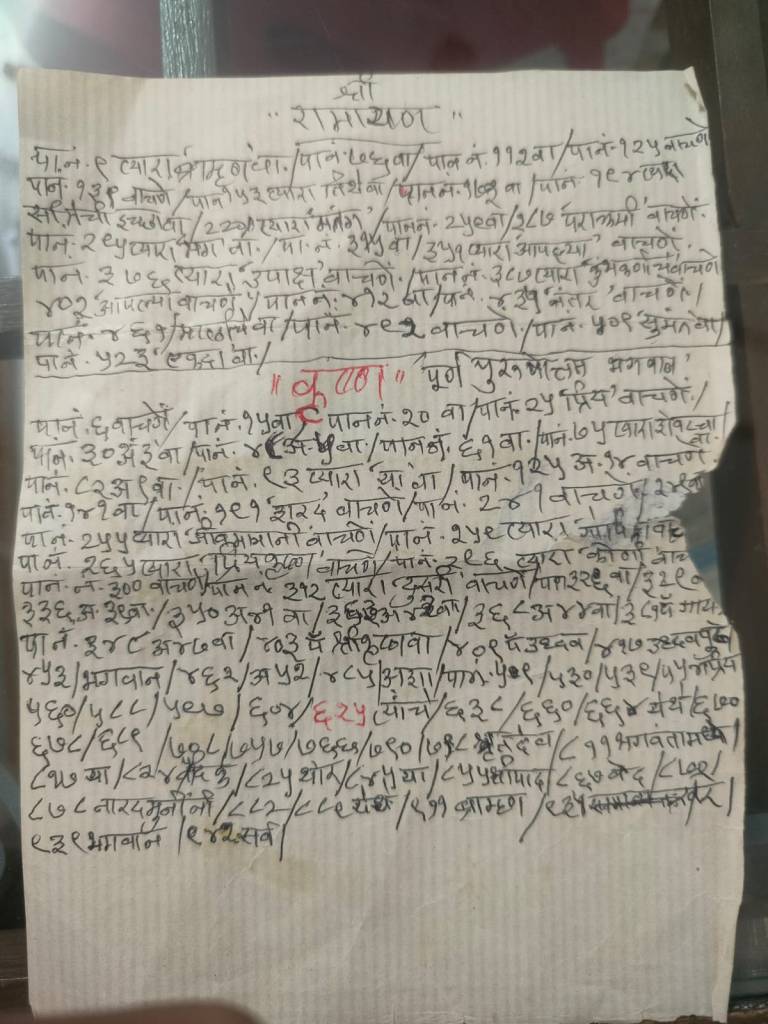
Handwritten notes containing the reading progress of His Grace Haridasa Varya Prabhu around the date of his departure

Handwritten notes example, containing the reading progress of His Grace Haridasa Varya Prabhu around the date of his departure

When he became sick closer to departure from his body, he chanted constantly, with or without beads. Even without beads, or while “asleep”, he would “move the beads”on a piece of cloth in bed.

Just before he departed, he did this:

  • Asked for his beads
  • Asked for a picture of Krishna to be brought before him. Not just any picture of Krishna from some magazine, but a picture of Sri Radha Pandharinath from ISKCON Pandharpur.
  • He told his daughter-in-law “There are four personalities here. They have come to take me home”
  • He asked to go outside in the sun, and spoke to passersby as if saying goodbye to everyone
  • Took Krishna Prasadam
  • A neighbor who had gone to Prayagraj for the Maha Kumbha Mela gave him some Ganga Jal (water from the Ganga)
  • Refused to go into his bedroom to sleep
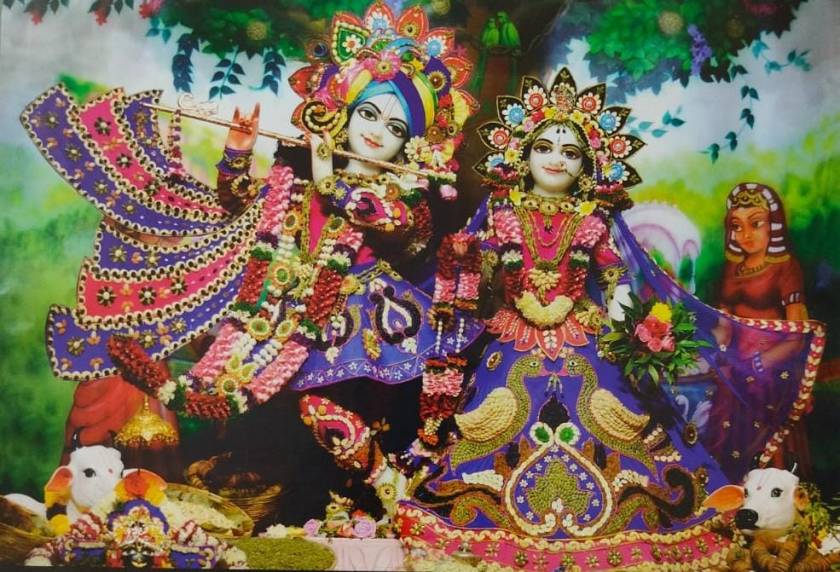
  • Sat down on a couch gazing at a picture of Sri Radha Vrindavan Chandra from ISKCON NVCC Pune.
  • Told his daughter-in-law, “Yes, there are four of them who have come for me”
  • Took his “bath”, a sponge bath from one of his daughters-in-law
  • He departed just when his arms were raised to put on his shirt
Sri Radha Vrindavan Chandra, ISKCON NVCC Pune

Haridasa Varya Prabhu used to love to lead Harinam Kirtan in his own special way. Someone would hold a microphone close to his mouth and he would sing a simple song or two. His sincere Kirtan was appreciated by all.

This was one of his favourite songs:

तू माझा यजमान रामा, तू माझा यजमान ||धृ||

जननी जठरी रक्षियले मज,पोसुनी पंचहि प्राण ||१||

बाहेर निघता मातेचे स्तनी,पय केले निर्माण ||२||

ऐसे असता या पोटाची,का करू चिंता जाण ||३||

मध्व मुनीश्वर स्वामी रमापती,धरी माझा अभिमान ||४||

You are my Lord Rama, You are my Lord

In the womb of my mother, you protected me, you preserved my five life airs

When I came out, you caused milk to flow from my mother’s breast

When this is so, why shall I worry for my own sustenance

He read the entire Srimad Bhagavatam and the entire Chaitanya Charitamrita. He was on his second round of reading the Srimad Bhagavatam around the date of his departure.

He leaves behind his wife, Mother Damodar Priya Devi Dasi, also initiated by Samika Rishi Prabhu.

At the end, he pulled out an ace… attained perfection… whatever he did or not, at the end, he did. – Her Grace Rukmini Devi Dasi (JPS)

Haridasa Varya Prabhu, I pray at your lotus feet the next prayer taught to me by my spiritual master. I fall down in the dust of your lotus feet while praying this prayer to you. You have shown us by your personal example of humility, eagerness, consistency, and presence of mind. You have attained pure devotional service at the lotus feet of Sri Radha Vrindavan Chandra. You are very kind and merciful Vaishnava. Please grant this poor soul shelter at your lotus feet.

From Haridasa Varya Prabhu’s life, we get the following lessons:

  1. It is never too late to start – of course, start as early as possible, but start, and GO!
  2. When the disciple is ready, the spiritual master is sent by Krishna. In this case, Haridasa Varya Prabhu’s spiritual master came all the way from New Jersey, USA.
  3. Humility is a great asset – Haridasa Varya Prabhu considered himself unfit for initiation!
  4. Take spiritual practice seriously. It is potent. Chanting Hare Krishna. Reading Srimad Bhagavatam. Every bit counts!
  5. Focus consciousness on what is most important, and do it every day.
  6. Simplicity in spiritual life is a prized asset, we should cultivate this simplicity that allows us to chant always.
  7. Krishna is very kind and merciful, and His devotee is even more so. We see this from the example of all the devotees who encouraged Haridasa Varya Prabhu.
  8. The process of devotional service as given to us by His Divine Grace A. C. Bhaktivedanta Swami Prabhupada works.

ये तु सर्वाणि कर्माणि मयि सन्न्यस्य मत्परा: ।
अनन्येनैव योगेन मां ध्यायन्त उपासते ॥ ६ ॥
तेषामहं समुद्धर्ता मृत्युसंसारसागरात् ।
भवामि न चिरात्पार्थ मय्यावेशितचेतसाम् ॥ ७ ॥

ye tu sarvāṇi karmāṇi mayi sannyasya mat-parāḥ
ananyenaiva yogena māṁ dhyāyanta upāsate

teṣām ahaṁ samuddhartā mṛtyu-saṁsāra-sāgarāt
bhavāmi na cirāt pārtha mayy āveśita-cetasām

But those who worship Me, giving up all their activities unto Me and being devoted to Me without deviation, engaged in devotional service and always meditating upon Me, having fixed their minds upon Me, O son of Pṛthā – for them I am the swift deliverer from the ocean of birth and death.

https://vedabase.io/en/library/bg/12/6-7/

And this beautiful verse…

अहो बकी यं स्तनकालकूटं
जिघांसयापाययदप्यसाध्वी ।
लेभे गतिं धात्र्युचितां ततोऽन्यं
कं वा दयालुं शरणं व्रजेम ॥ २३ ॥

aho bakī yaṁ stana-kāla-kūṭaṁ
jighāṁsayāpāyayad apy asādhvī
lebhe gatiṁ dhātry-ucitāṁ tato ’nyaṁ
kaṁ vā dayāluṁ śaraṇaṁ vrajema

Alas, how shall I take shelter of one more merciful than He who granted the position of mother to a she-demon [Pūtanā] although she was unfaithful and she prepared deadly poison to be sucked from her breast?

https://vedabase.io/en/library/sb/3/2/23/

Srila Prabhupada
Srila Prabhupada

Class on SB 8.7.40-42 21 Aug 2025 Online

Join us for an enlightening session on Srimad Bhagavatam verses 8.7.40-42 with HG Mahabhagavat Das. This uplifting discussion highlights Lord Shiva’s selfless compassion and the importance of benevolence for all living entities. Don’t miss this opportunity to deepen your understanding on August 21, 2025, at 7:20 AM ET!

A class recording will be shared after.

Hare Krishna 🙏
Bhakti sanga Japa Conference Call Presents.

SPEAKER: HG Mahabhagavat Das

TOPIC:*Srimad Bhagavatam verse 8.7.40-42

DATE📆: Thursday, 21st August 2025

TIME⌚: 7:20 AM. ET USA/ 6:20 AM. CT USA/ 4:20 AM PST USA/ 12:20 PM UK/ 7:20 PM MYT/ 4:50 PM IST

Chanting Starts at 5:00 AM EST

Join by Zoom:

https://tinyurl.com/85hntx44

One tap mobile, +14086380968,,6818736022#,,1#,803604# US (San Jose)

Meeting ID: 681 873 6022
Password for all numbers: 803604

🌹Hare Krishna Hare Krishna
Krishna Krishna Hare Hare
Hare Rama Hare Rama
Rama Rama Hare Hare🌹

ŚB 8.7.40

पुंस: कृपयतो भद्रे सर्वात्मा प्रीयते हरि: ।
प्रीते हरौ भगवति प्रीयेऽहं सचराचर: ।
तस्मादिदं गरं भुञ्जे प्रजानां स्वस्तिरस्तु मे ॥ ४० ॥

puṁsaḥ kṛpayato bhadre
sarvātmā prīyate hariḥ
prīte harau bhagavati
prīye ’haṁ sacarācaraḥ
tasmād idaṁ garaṁ bhuñje
prajānāṁ svastir astu me

Synonyms

puṁsaḥ — with a person; kṛpayataḥ — engaged in benevolent activities; bhadre — O most gentle Bhavānī; sarvaātmā — the Supersoul; prīyate — becomes pleased; hariḥ — the Supreme Personality of Godhead; prīte — because of His pleasure; harau — the Supreme Lord, Hari; bhagavati — the Personality of Godhead; prīye — also become pleased; aham — I; sacaraacaraḥ — with all others, moving and nonmoving; tasmāt — therefore; idam — this; garam — poison; bhuñje — let me drink; prajānām — of the living entities; svastiḥ — welfare; astu — let there be; me — by me.

Translation

My dear gentle wife Bhavānī, when one performs benevolent activities for others, the Supreme Personality of Godhead, Hari, is very pleased. And when the Lord is pleased, I am also pleased, along with all other living creatures. Therefore, let me drink this poison, for all the living entities may thus become happy because of me.

ŚB 8.7.41

श्रीशुक उवाच
एवमामन्‍त्र्य भगवान्भवानीं विश्वभावन: ।
तद् विषं जग्धुमारेभे प्रभावज्ञान्वमोदत ॥ ४१ ॥

śrī-śuka uvāca
evam āmantrya bhagavān
bhavānīṁ viśva-bhāvanaḥ
tad viṣaṁ jagdhum ārebhe
prabhāva-jñānvamodata

Synonyms

śrīśukaḥ uvāca — Śrī Śukadeva Gosvāmī said; evam — in this way; āmantrya — addressing; bhagavān — Lord Śiva; bhavānīm — Bhavānī; viśvabhāvanaḥ — the well-wisher of all the universe; tat viṣam — that poison; jagdhum — to drink; ārebhe — began; prabhāvajñā — mother Bhavānī, who perfectly knew the capability of Lord Śiva; anvamodata — gave her permission.

Translation

Śrīla Śukadeva Gosvāmī continued: After informing Bhavānī in this way, Lord Śiva began to drink the poison, and Bhavānī, who knew perfectly well the capabilities of Lord Śiva, gave him her permission to do so.

ŚB 8.7.42

तत: करतलीकृत्य व्यापि हालाहलं विषम् ।
अभक्षयन्महादेव: कृपया भूतभावन: ॥ ४२ ॥

tataḥ karatalī-kṛtya
vyāpi hālāhalaṁ viṣam
abhakṣayan mahā-devaḥ
kṛpayā bhūta-bhāvanaḥ

Synonyms

tataḥ — thereafter; karatalīkṛtya — taking in his hand; vyāpi — widespread; hālāhalam — called hālahalaviṣam — poison; abhakṣayat — drank; mahādevaḥ — Lord Śiva; kṛpayā — out of compassion; bhūtabhāvanaḥ — for the welfare of all living entities.

Translation

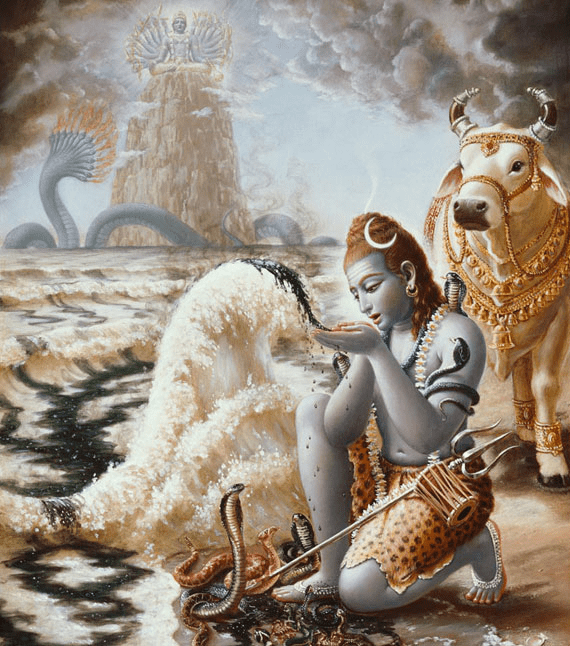
Thereafter, Lord Śiva, who is dedicated to auspicious, benevolent work for humanity, compassionately took the whole quantity of poison in his palm and drank it.

Purport

Although there was such a great quantity of poison that it spread all over the universe, Lord Śiva had such great power that he reduced the poison to a small quantity so that he could hold it in his palm. One should not try to imitate Lord Śiva. Lord Śiva can do whatever he likes, but those who try to imitate Lord Śiva by smoking ganja and other poisonous things will certainly be killed because of such activities.

Is Srila Prabhupada insulting Lord Shiva?

Srila Prabhupada, a great teacher, wrote prolifically. Even though his works are lucid and clear, there are many misunderstandings about his writings. One is that he insulted Lord Shiva. Is this true?

Question:

A devotee who has been with ISKCON for 7 years has asked this question… he says he does not agree with Srila Prabhupada’s purport to BG 2.62.

Lord Śiva was deep in meditation, but when Pārvatī agitated him for sense pleasure, he agreed to the proposal, and as a result Kārtikeya was born.

https://vedabase.io/en/library/bg/2/62/

He says that this is not the real story also he doesn’t agree that Lord Shiva can be agitated.

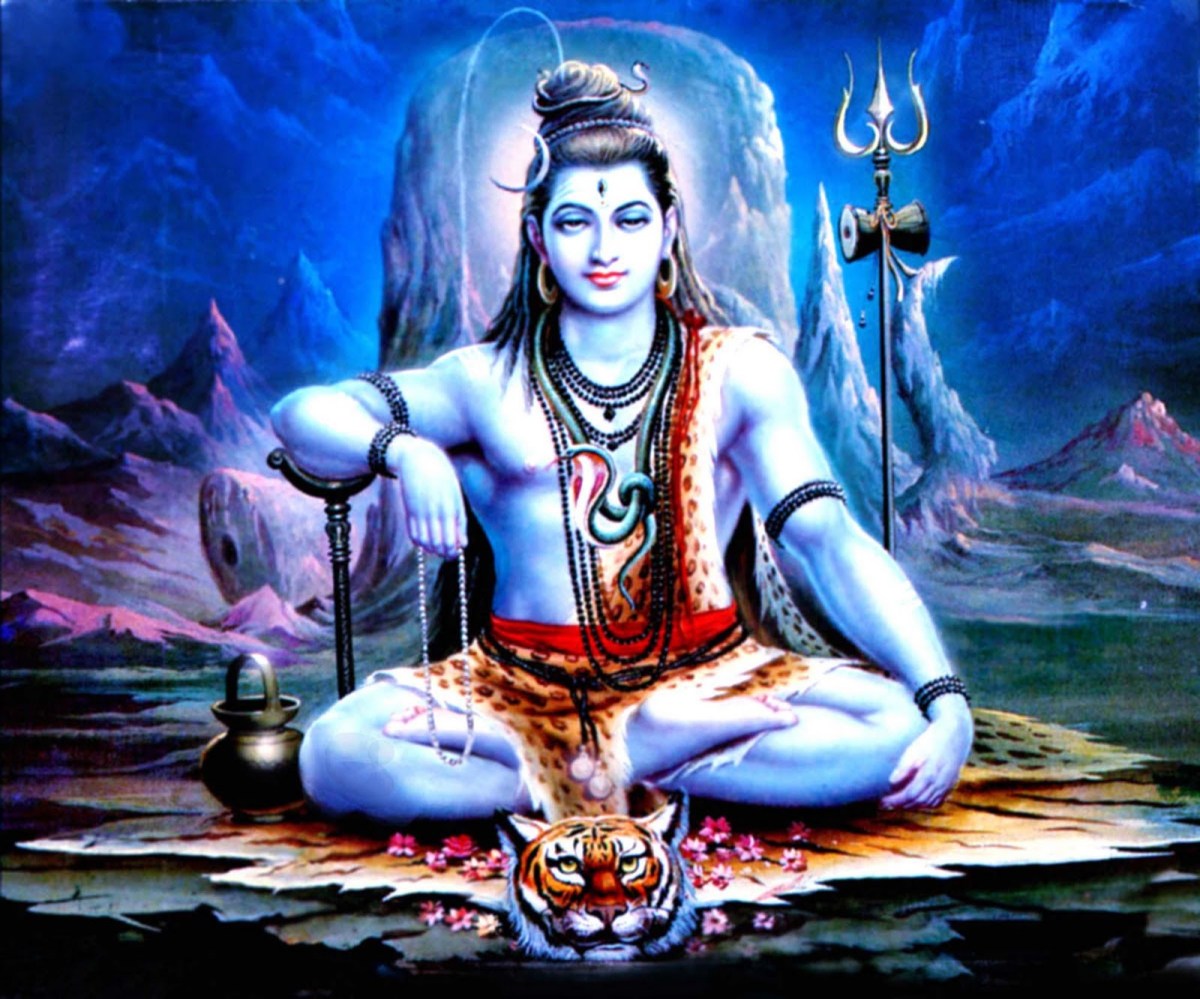
Lord Shiva, Parvati Devi, and their children Kartikeya and Ganesha

Answer:

Thank you for writing to me about this. It is an important thing.

First and foremost we have to understand who is Srila Prabhupada. Srila Prabhupada is a pure devotee. As a pure devotee, Srila Prabhupada has no envy in his heart. Srila Prabhupada has no desire to criticize someone unnecessarily. He also has no tendency to try and pull someone down. In fact, Srila Prabhupada is on the Uttama Adhikari platform. As an Uttama Adhikari, he feels that everyone else is serving Krishna except himself. But Srila Prabhupada came down to the Madhyama Adhikari platform. On this platform, he suppressed his ecstatic emotions and took the role of a teacher of Krishna Consciousness. Thus he preached to us poor lost souls in the material world. Srila Prabhupada undertook an austerity for us. Just like Lord Shiva drank up the ocean of poison, Srila Prabhupada tolerated the poisonous nature of this material world. His sacrifice saves us all.

Great personalities accept voluntary suffering for the benefit of others

“tapyante loka taapena”, this is a verse from the Bhagavatam glorifying personalities like Lord Shiva and Srila Prabhupada.

तप्यन्ते लोकतापेन साधव: प्रायशो जना: ।
परमाराधनं तद्धि पुरुषस्याखिलात्मन: ॥ ४४ ॥

tapyante loka-tāpena
sādhavaḥ prāyaśo janāḥ
paramārādhanaṁ tad dhi
puruṣasyākhilātmanaḥ

It is said that great personalities almost always accept voluntary suffering because of the suffering of people in general. This is considered the highest method of worshiping the Supreme Personality of Godhead, who is present in everyone’s heart.

https://vedabase.io/en/library/sb/8/7/44/

Lord Shiva drinks up an ocean of deadly poison and keeps it suspended in his throat

On the Madhyama Adhikari platform…

A devotee behaves differently with different kinds of personalities. A Madhyama Adhikari is a teacher/preacher… and his mission is to guide souls to spiritual perfection.

  1. To Supreme Personality of Godhead or His plenary expansions, he offers prayers
  2. To the devotees of Krishna, he makes friendship
  3. To the innocent, he preaches Krishna Consciousness
  4. Those envious of Krishna, he avoids

ईश्वरे तदधीनेषु बालिशेषु द्विषत्सु च ।
प्रेममैत्रीकृपोपेक्षा य: करोति स मध्यम: ॥ ४६ ॥

īśvare tad-adhīneṣu
bāliśeṣu dviṣatsu ca
prema-maitrī-kṛpopekṣā
yaḥ karoti sa madhyamaḥ

An intermediate or second-class devotee, called madhyama-adhikārī, offers his love to the Supreme Personality of Godhead, is a sincere friend to all the devotees of the Lord, shows mercy to ignorant people who are innocent and disregards those who are envious of the Supreme Personality of Godhead.

https://vedabase.io/en/library/sb/11/2/46/

Srila Prabhupada, the great Vaishnava Acharya

Now, let us examine who is Lord Shiva.

Lord Shiva is the Topmost Vaishnava, “vaishnavaanaam yathaa shambhu” as stated in the Bhagavatam.

निम्नगानां यथा गङ्गा देवानामच्युतो यथा ।
वैष्णवानां यथा शम्भु: पुराणानामिदं तथा ॥ १६ ॥

nimna-gānāṁ yathā gaṅgā
devānām acyuto yathā
vaiṣṇavānāṁ yathā śambhuḥ
purāṇānām idam tathā

Just as the Gaṅgā is the greatest of all rivers, Lord Acyuta the supreme among deities and Lord Śambhu [Śiva] the greatest of Vaiṣṇavas, so Śrīmad-Bhāgavatam is the greatest of all Purāṇas.

https://vedabase.io/en/library/sb/12/13/16/

In the Brahma Samhita (kshiram yatha dadhi vikaaram) it is stated that Lord Vishnu transforms as Lord Shiva when Lord Vishnu is “in touch” with material energy. This is just like how milk turns to curds when touched with tamarind. In other words, Lord Vishnu and Lord Shiva have no difference of opinion. Krishna desires everyone to be His pure devotee. Similarly, Lord Shiva desires everyone to be Krishna’s pure devotee.

क्षीरं यथा दधि विकारविशेषयोगात्
सञ्जायते न हि ततः पृथगस्ति हेतोः ।
यः शम्भुतामपि तथा समुपैति कार्या-
-द्गोविन्दमादिपुरुषं तमहं भजामि ॥ ४५ ॥

kṣīraṁ yathā dadhi vikāra-viśeṣa-yogāt
sañjāyate na hi tataḥ pṛthag asti hetoḥ
yaḥ śambhutām api tathā samupaiti kāryād
govindam ādi-puruṣaṁ tam ahaṁ bhajāmi

Just as milk is transformed into curd by the action of acids, but yet the effect curd is neither same as, nor different from, its cause, viz., milk, so I adore the primeval Lord Govinda of whom the state of Śambhu is a transformation for the performance of the work of destruction.

https://vedabase.io/en/library/bs/5/45/

In fact, without the mercy of Lord Shiva, no one can become a Vaishnava. Lord Shiva and Parvati Devi are regarded as the father and mother of the material world. As you know, father and mother are the first teachers of every child.

As such, Lord Shiva is beyond all criticism. And as Lord Shiva is a pure devotee, Srila Prabhupada would never criticize Lord Shiva.

Srila Prabhupada is stating the fact.

Lord Kartikeya was born of Shiva and Parvati’s union. Lord Brahma, who is Lord Vishnu’s son is born directly from Himself without the help or assistance of Lakshmi Devi.

In the Valmiki Ramayana, Kartikeya is mentioned as the son of Rudra and Parvati. Agni and Ganga Devi aided in his birth. We accept Valmiki Muni as an utmost authority.

Valmiki, the author of the Original Ramayana

In the Mahabharata, Kartikeya is mentioned as the son of Shiva and Parvati. He emerged as a result of Lord Shiva’s sexual union with Parvati Devi. The details I will not mention here. Ganga Devi cultivated the seed of Lord Shiva. Agni Deva, the demigod in charge of fire, kept it warm.

Now, there is a third story, from the Shiva Purana… Lord Shiva was meditating. Parvati Devi was trying to attract him. Kamadeva tried to help but was burned to ashes by the wrath of Lord Shiva. Lord Shiva, being merciful, then paid attention to Parvati Devi. He married her, and Kartikeya was conceived.

There is additionally a Tamil version of the Skanda Purana in which another story is presented. I read that story in the Amar Chitra Katha comics as a child. Only later I learned where the story came from. The demigods prayed to Lord Shiva and pleased Him. As a result, Lord Shiva manifested 5 additional heads. From each head came one spark. Vayu Deva, the demigod in charge of the wind, carried these sparks and handed them to Agni Deva. Agni Deva then carried the sparks to Ganga Devi, who took them to Saravana lake. There, 6 boys were born. The 6 boys were merged into one by Krittika Devi. This marked the appearance of Kartikeya. He then defeated the demons Surapadma and Simhamukha. These demons surrendered to Kartikeya and became his assistant associates.

Valmiki Ramayana is the Absolute Truth. Mahabharata is also composed by Veda Vyasa. Therefore, we have 2 authoritative references to support Srila Prabhupada’s statement about Lord Shiva in BG 2.62.

Srila Prabhupada is a highly empowered Vaishnava Acharya who has presented Krishna Consciousness in the Brahma Madhva Gaudiya Sampradaya. Why should anyone accept an objection raised by an uncontrolled mind? Instead, whenever we hear the instruction of the Acharya, we should strive to understand how it is true. It’s not about whether it is true or not, but how it is true. This is called surrender. It may take time. It took me many years to surrender to my Guru Maharaja, but eventually I did. Whenever I had any doubts about Srila Prabhupada’s words, my spiritual masters helped me. They guided me with proper understanding to overcome that doubt.

To “disagree” with an Acharya, is simply immaturity.

Sometimes Acharyas disagree with each other. This is alright if they are of an equal stature. In that case, the rest of us must try to understand how they are right, all of them! Spiritual reality is truly wonderful. It is not one dimensional.

Puranic stories sometimes differ because they describe one kalpa (a day of Brahma) or another. On different days of Lord Brahma, there can be variations in some details.

Lord Shiva’s agitation by Parvati is not an insult to Lord Shiva.

Instead, it glorifies his great devotion to Sri Krishna. By personal example, Lord Shiva is showing how great Lord Krishna is. Lord Krishna remained without agitation even when surrounded by 3 Billion beautiful young gopis. The gopis were ready to do anything for Krishna. Krishna is an eternal Brahmachari, and the proof of this statement is Sri Bhishmadeva who has stated this personally!

Does this help?

Glossary – Personalities & Concepts mentioned in the article:

  • Acharya – A teacher in one of 4 authorized disciplic successions from God, who teaches by personal example
  • Agni Deva – The demigod in charge of fire
  • Bhagavatam – The topmost spiritual scripture, available online at https://vedabase.io/en/library/sb/
  • Bhishmadeva – Among the 12 greatest spiritual authorities of our universe, played a pivotal role in the Mahabharata, sometimes referred to as “grandsire” or “grandfather”
  • Brahma – The creator of this universe, son of Lord Vishnu
  • Brahma Samhita – The composition of Lord Brahma is a 100-chapter book. Only Chapter 5 is available. It can be found online at https://vedabase.io/en/library/bs
  • Deva – “Demigod”, also used as an honorific for divine personalities
  • Ganga – The most sacred river in our Universe, a liquid form of God
  • Gopis – The topmost saints, devotees of Krishna
  • Guru – Spiritual Master, also “heavy”
  • Kalpa – A day of Brahma, 4.32 Billion Years long
  • Kama – Literally “lust”, used to refer to the demigod in charge of love
  • Kartikeya – Son of Shiva and Parvati, the military commander of the demigods
  • Krishna – The Supreme Personality of Godhead, source of both spiritual and material realms, the One and Only appearing Himself in different forms and with different names
  • Krittika Devi – a demigoddess
  • Madhva Gaudiya Sampradaya – A current unbroken line of disciplic succession from God Himself, included below for reference
  • Madhyama Adhikari – defined above
  • Maharaja – King among men, used to refer to royalty and to renounced or exalted souls
  • Parvati – The consort of Lord Shiva, expanded as the material energy
  • Purana – Authorized history of the Universe, there are 18 such histories, 6 meant for those in the mode of goodness, 6 for those in the mode of passion, and 6 meant for those in the mode of passion
  • Ramayana – The pastimes of Lord Rama, the Personality of Godhead
  • Rudra – A son of Lord Brahma, born of his anger from his forehead
  • Simhamukha & Surapadma – Former demons who accepted the shelter of Kartikeya and became his assistants
  • Shiva – The auspicious one, also referred to as Rudra
  • Shiva Purana – The scripture describing the pastimes of Lord Shiva, meant for the benefit of those situated in the mode of ignorance
  • Sri – Opulence, refers to the Goddess of Fortune, or someone blessed with some extraordinary opulence
  • Uttama Adhikari – defined above
  • Valmiki – The author of the original Ramayana, disciple of Narada
  • Vayu Deva – The demigod in charge of the air and wind
  • Vishnu – An expansion of Krishna
  • Vyasa – The compiler of Vedic literature

The Brahma Madhva Gaudiya Sampradaya:

1. Kṛṣṇa
2. Brahmā
3. Nārada
4. Vyāsa
5. Madhva
6. Padmanābha
7. Nṛhari
8. Mādhava
9. Akṣobhya
10. Jaya Tīrtha
11. Jñānasindhu
12. Dayānidhi
13. Vidyānidhi
14. Rājendra
15. Jayadharma
16. Puruṣottama
17. Brahmaṇya Tīrtha
18. Vyāsa Tīrtha
19. Lakṣmīpati
20. Mādhavendra Purī
21. Īśvara Purī, (Nityānanda, Advaita)
22. Lord Caitanya
23. Rūpa, (Svarūpa, Sanātana)
24. Raghunātha, Jīva
25. Kṛṣṇadāsa
26. Narottama
27. Viśvanātha
28. (Baladeva), Jagannātha
29. Bhaktivinoda
30. Gaurakiśora
31. Bhaktisiddhānta Sarasvatī
32. A. C. Bhaktivedanta Swami Prabhupāda

The Author’s spiritual master, His Grace Sriman Sankarshan Das Adhikari, is a disciple of His Divine Grace A. C. Bhaktivedanta Swami Prabhupada.

11 Jun 2024 Atheist Father Tries to Kill Saintly Son… Srimad Bhagavatam Class with Bhakti Sanga Japa Group SB 7.8.14-15

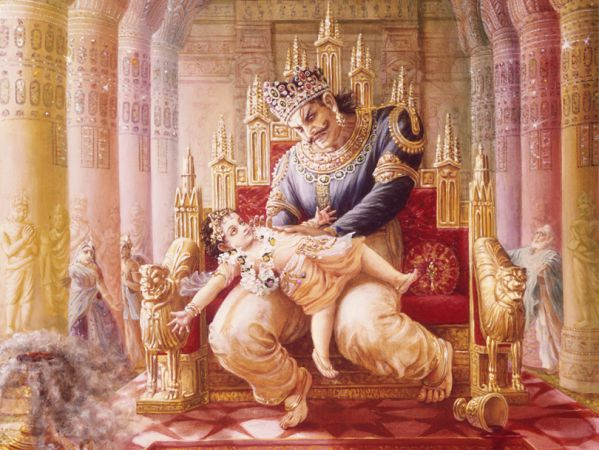
When one tries to offer wisdom to an envious fool, the fool only becomes angry just as feeding a poisonous snake only increases his venom. Hiranyakashipu, the world’s topmost atheist was furious with his saintly son Prahlada, and prepared to kill his five year old son with his own sword. What happened at that time?

Hare Krishna!

The Bhakti Sanga Japa Group connects Krishna conscious devotees from across the world, be it a neophyte, serious sadhaka, or just someone with a casual interest in spirituality, through online conference calls! Bhakti Sanga group facilitates devotee association with several classes and japa sessions during the day. Classes include lectures on Srimad Bhagavatam, Sri Caitanya Caritamrta, Children’s sessions on scriptures, festival/holy days and assorted spiritual topics. The Bhakti Sanga group provides an informal setting where devotees can seek answers regarding their sadhana, spiritual topics and practices. Come experience Krishna consciousness in the association of devotees, from the very convenience of your home, just a phone call away!

TOPIC: Srimad Bhagavatam verse 7.8.14-15

DATE📆: Tuesday, 11th June 2024

TIME⌚: 7:20 AM. ET USA/ 6:20 AM. CT USA/ 4:20 AM PST USA/ 12:20 PM UK/ 8:20 PM MYT/ 4:50 PM IST

The class will be available on Zoom and later uploaded online on their Youtube Channel.

ZOOM Meeting ID: 681 873 6022 Password: 803604

https://www.youtube.com/channel/UCHty1ZkyTvzn_vTTfiYqwTA

Please join online if you’re interested in joining this class, or let me know if you want to get a link to the recording.

Lord Nṛsiṁhadeva Slays the King of the Demons


As described in this chapter, Hiraṇyakaśipu was ready to kill his own son Prahlāda Mahārāja, but the Supreme Personality of Godhead appeared in front of the demon as Śrī Nṛkeśarī, half lion and half man, and killed him.

Following the instructions of Prahlāda Mahārāja, all the sons of the demons became attached to Lord Viṣṇu, the Supreme Personality of Godhead. When this attachment became pronounced, their teachers, Ṣaṇḍa and Amarka, were very much afraid that the boys would become more and more devoted to the Lord. In a helpless condition, they approached Hiraṇyakaśipu and described in detail the effect of Prahlāda’s preaching. After hearing of this, Hiraṇyakaśipu decided to kill his son Prahlāda. Hiraṇyakaśipu was so angry that Prahlāda Mahārāja fell down at his feet and said many things just to pacify him, but he was unsuccessful in satisfying his demoniac father. Hiraṇyakaśipu, as a typical demon, began to advertise himself as being greater than the Supreme Personality of Godhead, but Prahlāda Mahārāja challenged him, saying that Hiraṇyakaśipu was not God, and began to glorify the Supreme Personality of Godhead, declaring that the Lord is all-pervading, that everything is under Him, and that no one is equal to or greater than Him. Thus he requested his father to be submissive to the omnipotent Supreme Lord.

The more Prahlāda Mahārāja glorified the Supreme Personality of Godhead, the more angry and agitated the demon became. Hiraṇyakaśipu asked his Vaiṣṇava son whether his God existed within the columns of the palace, and Prahlāda Mahārāja immediately accepted that since the Lord is present everywhere, He was also present within the columns. When Hiraṇyakaśipu heard this philosophy from his young son, he derided the boy’s statement as just the talk of a child and forcefully struck the pillar with his fist.

As soon as Hiraṇyakaśipu struck the column, there issued forth a tumultuous sound. At first Hiraṇyakaśipu, the King of the demons, could not see anything but the pillar, but to substantiate Prahlāda’s statements, the Lord came out of the pillar in His wonderful incarnation as Narasiṁha, half lion and half man. Hiraṇyakaśipu could immediately understand that the extraordinarily wonderful form of the Lord was surely meant for his death, and thus he prepared to fight with the form of half lion and half man. The Lord performed His pastimes by fighting with the demon for some time, and in the evening, on the border between day and night, the Lord captured the demon, threw him on His lap, and killed him by piercing his abdomen with His nails. The Lord not only killed Hiraṇyakaśipu, the King of the demons, but also killed many of his followers. When there was no one else to fight, the Lord, roaring with anger, sat down on Hiraṇyakaśipu’s throne.

The entire universe was thus relieved of the rule of Hiraṇyakaśipu, and everyone was jubilant in transcendental bliss. Then all the demigods, headed by Lord Brahmā, approached the Lord. These included the great saintly persons, the Pitās, the Siddhas, the Vidyādharas, the Nāgas, the Manus, the prajāpatis, the Gandharvas, the Cāraṇas, the Yakṣas, the Kimpuruṣas, the Vaitālikas, the Kinnaras and also many other varieties of beings in human form. All of them stood not far from the Supreme Personality of Godhead and began offering their prayers unto the Lord, whose spiritual effulgence was brilliant as He sat on the throne.

ŚB 7.8.14


एवं दुरुक्तैर्मुहुरर्दयन् रुषा
सुतं महाभागवतं महासुर: ।
खड्‌गं प्रगृह्योत्पतितो वरासनात्
स्तम्भं तताडातिबल: स्वमुष्टिना ॥ १४ ॥
evaṁ duruktair muhur ardayan ruṣā
sutaṁ mahā-bhāgavataṁ mahāsuraḥ
khaḍgaṁ pragṛhyotpatito varāsanāt
stambhaṁ tatāḍātibalaḥ sva-muṣṭinā
Synonyms
evam — thus; duruktaiḥ — by harsh words; muhuḥ — constantly; ardayan — chastising; ruṣā — with unnecessary anger; sutam — his son; mahā-bhāgavatam — who was a most exalted devotee; mahā-asuraḥ — Hiraṇyakaśipu, the great demon; khaḍgam — sword; pragṛhya — taking up; utpatitaḥ — having gotten up; vara-āsanāt — from his exalted throne; stambham — the column; tatāḍa — struck; ati-balaḥ — very strong; sva-muṣṭinā — by his fist.

Translation
Being obsessed with anger, Hiraṇyakaśipu, who was very great in bodily strength, thus chastised his exalted devotee-son Prahlāda with harsh words. Cursing him again and again, Hiraṇyakaśipu took up his sword, got up from his royal throne, and with great anger struck his fist against the column.

https://vedabase.io/en/library/sb/7/8/14/

ŚB 7.8.15


तदैव तस्मिन्निनदोऽतिभीषणो
बभूव येनाण्डकटाहमस्फुटत् ।
यं वै स्वधिष्ण्योपगतं त्वजादय:
श्रुत्वा स्वधामात्ययमङ्ग मेनिरे ॥ १५ ॥
tadaiva tasmin ninado ’tibhīṣaṇo
babhūva yenāṇḍa-kaṭāham asphuṭat
yaṁ vai sva-dhiṣṇyopagataṁ tv ajādayaḥ
śrutvā sva-dhāmātyayam aṅga menire
Synonyms
tadā — at that time; eva — just; tasmin — within (the pillar); ninadaḥ — a sound; ati-bhīṣaṇaḥ — very fearful; babhūva — there was; yena — by which; aṇḍa-kaṭāham — the covering of the universe; asphuṭat — appeared to crack; yam — which; vai — indeed; sva-dhiṣṇya-upagatam — reaching their respective abodes; tu — but; aja-ādayaḥ — the demigods, headed by Lord Brahmā; śrutvā — hearing; sva-dhāma-atyayam — the destruction of their abodes; aṅga — my dear Yudhiṣṭhira; menire — thought.

Translation
Then from within the pillar came a fearful sound, which appeared to crack the covering of the universe. O my dear Yudhiṣṭhira, this sound reached even the abodes of the demigods like Lord Brahmā, and when the demigods heard it, they thought, “Oh, now our planets are being destroyed!”

Purport
As we sometimes become very much afraid at the sound of a thunderbolt, perhaps thinking that our houses will be destroyed, the great demigods like Lord Brahmā feared the thundering sound that came from the pillar in front of Hiraṇyakaśipu.

https://vedabase.io/en/library/sb/7/8/15/

The Form of God

God has a form. There are specific descriptions of His form. Meditation of His Lotus Feet, for example, dispels all the thick gloom of the heart.

Sometimes spiritualists imagine that since a material form is a limitation, therefore God cannot possibly have a form.

In some religious tradition, the form of God is not at all described.

Some imagine some form of God according to their own concoctions.

It is not that God does not have a form or that His form is imaginary. But it is that one needs to approach the form of God properly.

God’s form is called “saccidananda vigraha”, or that which is composed of sat (eternality), chit(purely conscious knowledge), and ananda(unmitigated bliss). This form of God is unlimited, not constrained by space or time, neither does God’s form deteriorate like material forms.

In a beautiful section of the Srimad Bhagavatam, Lord Kapila, an incarnation of the Supreme Personality of Godhead, describes the process of devotional service.

Here is one beautiful text, an example for you to relish.

सञ्चिन्तयेद्भगवतश्चरणारविन्दं
वज्राङ्कुशध्वजसरोरुहलाञ्छनाढ्यम् ।
उत्तुङ्गरक्तविलसन्नखचक्रवाल-
ज्योत्‍स्‍नाभिराहतमहद्‍धृदयान्धकारम् ॥ २१ ॥

sañcintayed bhagavataś caraṇāravindaṁ
vajrāṅkuśa-dhvaja-saroruha-lāñchanāḍhyam
uttuṅga-rakta-vilasan-nakha-cakravāla-
jyotsnābhir āhata-mahad-dhṛdayāndhakāram

The devotee should first concentrate his mind on the Lord’s lotus feet, which are adorned with the marks of a thunderbolt, a goad, a banner and a lotus. The splendor of their beautiful ruby nails resembles the orb of the moon and dispels the thick gloom of one’s heart.

https://vedabase.io/en/library/sb/3/28/21/
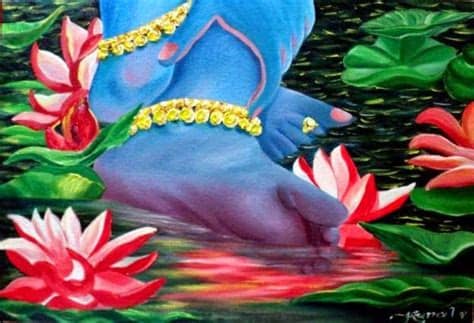
Krishna’s lotus feet

God has feet, which defeat the splendour of a lotus in full bloom. The soles of His lotus feet are adorned with specific marks.

Each and every mark has specific significance. Just the lustre of His beautiful red toenail can be compared to a full moon.

Meditating on the lotus feet of God dispels all gloom.

The sole of Sri Radha(right) Krishna(left)

Why can we not meditate on the lotus feet of the Lord?

I spend most of my time meditating on all sorts of things. I pray that all these useless meditations may be replaced by unbroken meditation on the lotus feet of Sri Radha Krishna.

Spiritualists, speak up and be heard

When going about your spiritual practices, hearing and chanting about God, don’t do it quietly, do it loudly. Why? Can spiritual sound vibration benefit others?

Many spiritualists are very quiet. Certain spiritual practices are quiet in nature. However, for maximum benefit to ourselves and others, it is important to vibrate the spiritual sound vibrations openly, and not keep them quiet. Why is this, you may ask.

As I write this, my father lives in India and is 80 years of age and my son lives with us in Toronto and is 7 years of age. They have a beautiful practice where each reads out aloud to the other. My father first reads from the Krishna Book, and then his grandson reads from the Children’s version of the same book. Sometimes they read several chapters to each other.

Several days ago, I was in the kitchen, cooking, and also thinking about an upcoming talk I was giving to young men, all smart and well-educated, but also interested in spiritual life. The goal of any such talk is to inspire. But in order to inspire, I need to be inspired myself, correct? There were many topics suggested, and I had run through many myself, but none seemed to resonate with the mood of the present times, which is filled with uncertainty and difficulty.

Many of these young men have lost their jobs due to the Pandemic-related economic fallout. Some have lost relatives to COVID-19. Some are stuck in some online version of their educational program, a poor substitute for the real thing. Some are in financial hardships. Some have challenges resulting from isolation and loneliness. But all these young men were interested in spiritual life, and were looking for spiritual answers to their problems. I had to give them something worthy, not just words but genuine spiritual inspiration.

Suddenly, I heard my father’s voice on the speakerphone, as he recited from the 56th Chapter of the book, in which Krishna is falsely accused by Satrajit of stealing a precious jewel and killing the bearer, Prasena. In order to clear up His good name, Krishna went looking, with some citizens accompanying him. Krishna soon found out that a lion had killed Prasena, and a great bear named Jambavan had killed the lion. Jambavan had then taken away the jewel and given it to his young son as a toy.

Krishna followed the trail to a deep dark cave, decided to go in. The citizens were too afraid to accompany Krishna into the cave. He then found the little child, cared for by a nurse, playing with the jewel. The nurse raised an alarm when she saw this stranger entering, and Jambavan came out in a very angry mood to find the intruder in his home.

Jambavan is in the form of a bear but a great great devotee of Krishna, in His incarnation as Lord Rama. Still, due to his anger, Jambavan didn’t recognize His Lord. Krishna and Jambavan fought for 28 days and 28 nights, first with weapons, stones, trees, and finally with their fists. Even though he was practically the strongest living entity on the planet at that time, Jambavan felt very very tired, his body hurt greatly. Note that this is the same Krishna who pounded the tyrant Kamsa (who had the strength of 10,000 elephants) to death in a short time – this was 28 days and 28 nights of pounding Jambavan had endured! Krishna was very pleased with the fighting pastime, it is hard for Krishna to find someone who can fight at His level! Jambavan finally recognized that his opponent was none other than his own very dear Lord. He surrendered and offered beautiful prayers. Jambavan said:

[Jāmbavān said:] I know now that You are the life air and the sensory, mental and bodily strength of all living beings. You are Lord Viṣṇu, the original person, the supreme, all-powerful controller. You are the ultimate creator of all creators of the universe, and of everything created You are the underlying substance. You are the subduer of all subduers, the Supreme Lord and Supreme Soul of all souls. You are He who impelled the ocean to give way when His sidelong glances, slightly manifesting His anger, disturbed the crocodiles and timiṅgila fish within the watery depths. You are He who built a great bridge to establish His fame, who burned down the city of Laṅkā, and whose arrows severed the heads of Rāvaṇa, which then fell to the ground.

https://vedabase.io/en/library/sb/10/56/26/, https://vedabase.io/en/library/sb/10/56/27/, https://vedabase.io/en/library/sb/10/56/28/

All this greatly inspired me, because I realized something important – that when the difficulty is insurmountable, this is Krishna, appearing in the form of the difficulty! This realization had a profound impact on me. The hairs on my body stood up as I stood in the kitchen listening to my father read out Srila Prabhupada’s words on speakerphone, all the way from India! It was as if an electric current flowed through my body. This was it! This was Krishna’s answer to my prayers for inspiration!

I was then able to prepare a talk going from the attitude of the overconfident materialist who always is defeated by the material nature or the plans of God, all the way through to a consummate spiritualist who does their best while depending on God. I will write about that another time.

Here, I want to bring out how the spiritual sound vibration, when given manifest form by someone’s sincere voice, touches souls. The Sankirtan was going on between by son and my father, but the collateral benefit was to me, standing in the kitchen.

The greatest example of this was a great soul, Haridas Thakur, born in a Muslim family, rejected both by the Muslims and the Hindus, but the highest calibre of saint, elevated to the status of “Namacharya” the great preceptor of the Holy Name, by Sri Chaitanya Mahaprabhu. He quoted “Anyone who chants Your name purifies all who hear His chanting, as well as Himself.” – SB 10.34.17

Because I was inspired by hearing, I could inspire over 25 young men in their spiritual life with a talk called”When the going gets tough”. And all this started from Srila Prabhupada’s Kirtan, which was inspired by his spiritual master’s Kirtan, which was inspired by his own spiritual master’s Kirtan.

None of this would have happened if any of the great saints in our line had remained silent, and had not inspired others with their spiritual sound vibrations.

When we loudly recite spiritual knowledge, the Lord’s names, and activities, we benefit other living entities even unknowingly. We benefit the trees, the insects, and the animals around us, we benefit the germs living in our body, and we purify the atmosphere all around. Just like that little living entity standing in the kitchen who was fortunate to hear the sound vibration that was originating from India and coming across the Internet all the way to Canada for the benefit of my little boy.

Next time you are remembering God, and following in the footsteps of great souls, don’t do it quietly, even if there is apparently no one around you.

Someone, somewhere will be inspired, and you will surely be counted as one of the saviours of this world.

Please let me know if I may serve you on your spiritual journey.

“Old” New Discoveries

Do you think the Vedic Scriptures are Mythology? Do you think that modern scientists know better? Did you know that scientists are simply re-discovering whatever was already explained in the Vedic Scriptures?

Sometimes, it is thought that we are making advancement in this world today. It is thought that the Vedic Scriptures are archaic and full of superstition and dogma. In fact, I grew up in India, where I was taught that the Vedic scriptures are “mythology”.

Nothing could be further from the truth.

The Vedic Scriptures are the most advanced science we have today. But most of the knowledge contained in the Vedic scriptures is not understood by most of us.

The knowledge in the Vedic scriptures require purity and sharp consciousness, not consciousness dulled by repeated sense gratification like meat eating, intoxication, gambling, and illicit sex.

Let us consider one example…

Robert Boyle, an Anglo-Irish son of an Earl, is credited with discovering that sound must travel through a medium in the year 1660. While it is nice that he discovered this, he is not the first to know that sound travels through the air.

Over 5000 years ago, in the Srimad Bhagavatam, here is a verse:

चालनं व्यूहनं प्राप्तिर्नेतृत्वं द्रव्यशब्दयो: ।
सर्वेन्द्रियाणामात्मत्वं वायो: कर्माभिलक्षणम् ॥ ३७ ॥

cālanaṁ vyūhanaṁ prāptir
netṛtvaṁ dravya-śabdayoḥ
sarvendriyāṇām ātmatvaṁ
vāyoḥ karmābhilakṣaṇam

The action of the air is exhibited in movements, mixing, allowing approach to the objects of sound and other sense perceptions, and providing for the proper functioning of all other senses.

https://vedabase.io/en/library/sb/3/26/37/

But there is a lot more information contained the ancient Vedic knowledge. The great seer His Divine Grace A. C. Bhaktivedanta Swami Prabhupada, writes, in his purport to the above verse…

We can perceive the action of the air when the branches of a tree move or when dry leaves on the ground collect together. Similarly, it is only by the action of the air that a body moves, and when the air circulation is impeded, many diseases result. Paralysis, nervous breakdowns, madness and many other diseases are actually due to an insufficient circulation of air. In the Āyurvedic system these diseases are treated on the basis of air circulation. If from the beginning one takes care of the process of air circulation, such diseases cannot take place. From the Āyur-veda as well as from the Śrīmad-Bhāgavatam it is clear that so many activities are going on internally and externally because of air alone, and as soon as there is some deficiency in the air circulation, these activities cannot take place. Here it is clearly stated, netṛtvaṁ dravya-śabdayoḥ. Our sense of proprietorship over action is also due to the activity of the air. If the air circulation is stifled, we cannot approach a place after hearing. If someone calls us, we hear the sound because of the air circulation, and we approach that sound or the place from which the sound comes. It is clearly said in this verse that these are all movements of the air. The ability to detect odors is also due to the action of the air.

His Divine Grace A. C. Bhaktivedanta Swami Prabhupada

Robert Boyle didn’t know all this. So he spent his life re-discovering what was already known. Most modern scientists are fools in that respect, running around re-discovering what was already known, and often making foolish mistakes along the way. But they are proud. They will not accept the Vedic Scriptures. And the rest of us are even bigger fools for trusting them.

The Vedic Scriptures contain everything one can possibly need. But at the end, they say this is not our home. So therefore, it is important to learn to end our material sojourn as quickly as possible, not get caught up in material consciousness.

Please look into the Genuine Vedic Scriptures. Please follow them. Please perfect your life, and go back home, where you belong. By following the Vedic Scriptures under the guidance of the bonafide spiritual master, one can live happily in this world, and at the end of one’s life, be transferred to the spiritual sky.

How may I serve you on your spiritual journey?

What does a foetus feel in the womb?

What does a foetus in the womb feel? Are the descriptions in the Scripture confirmed by Science?

Nikhil Mishra, 30 June 2018

Hare Krsna                                                                                

Obeisance to Guru , Gauranga and devotess.

Please refer the below link.

http://www.vedabase.com/en/sb/3/31

In it, is described the development of foetus. My question is – has it been seen by modern scientific instrument like ultrasound etc that fetus is totally unhappy n unable to move his/her limbs inside womb?  because in one youtube video, (if i remember correctly !!), they showed one grown baby fetus smiling inside belly of mother!!

Sincerely

Nikhil

Mahabhagavat Das SDA, 03 July 2018

Dear Sriman Nikhil,

Hare Krishna!

I think I remember seeing one such video, but really, we all know that videos can be easily faked.

From what I know, yes, the amount of space available to the foetus continuously decreases, and in the initial months, the foetus can swim around, but later on, everything gets progressively very tight – that part is clearly confirmed from data and experience.

In fact, one of the things that expecting mothers are taught to do is to take a few moments throughout the day to monitor that the foetus is moving around – too many just give up their life inside the womb and sometimes the mother doesn’t even know for days after! Re facial expressions, I have seen that the baby as seen in ultrasound images could be neutral, crying, or grimacing.

In any case, the ultrasound lasts for a few seconds or minutes, it cannot be done 24X7.

It is not possible to conclusively confirm, as baby is not verbal until about a year after birth, and the trauma of birth takes away all memory of life in the womb.

I have witnessed childbirth myself. It is no walk in the park, even with all sorts of pain medication. It is clearly Krishna’s mercy that women don’t remember it, otherwise, no one would have children in this world.

There is also no need to doubt the statements of the Bhagavatam which is spotlessly pure and free of fault by the personal statement of Sri Chaitanya Mahaprabhu Himself and thousands of other great Vaishnava Acharyas.

Sincerely,

Mahabhagavat Das

Nikhil Mishra, 04 July 2018

Thank you very much Mahabhagavat Prabhu for taking out time to express your views on my question. I really appreciate that and offer my gratitude to you for the same.

Knowing views of other vaisnavas help me to intensify my search about truth and devotion while keeping my intellect sane.

Sincerely

Nikhil

Mahabhagavat Das SDA, 05 July 2018

Dear Sriman Nikhil,

Hare Krishna!

I completely understand where you are coming from.

Srila Gurudeva once told me “the sign of a Brahmana is one who can keep two opposing viewpoints in the mind without getting disturbed” and then he added “that is also a definition of intelligence”.

Basically, when we position the scripture and modern scientific understanding as competing against each other, it is always a difficult situation.

But they are not competing fields of knowledge, but complementary fields of knowledge.

Reality is very vast, and there is much of reality that is not materially perceivable – for example, material science expresses thoughts, emotions, as mere eletrochemical reactions. Yes, it is true that someone may observe that my thoughts and emotions might be expressed on one level as electrochemical reactions. BUT, that sort of reductionist viewpoint is incomplete, because we all have personal experience that thoughts and emotions are much more than just electrochemical reactions.

Science explicitly looks for matter, and thus therefore finds matter… starts with the assumption that anything that is not mathematically provable or empirically observable does not exist (though there are inconsistencies there – for example what is the square root of -1, can anyone show me an i?).

Scripture and Science are two different genres of knowledge – you cannot always take the rules of one and apply to the other.

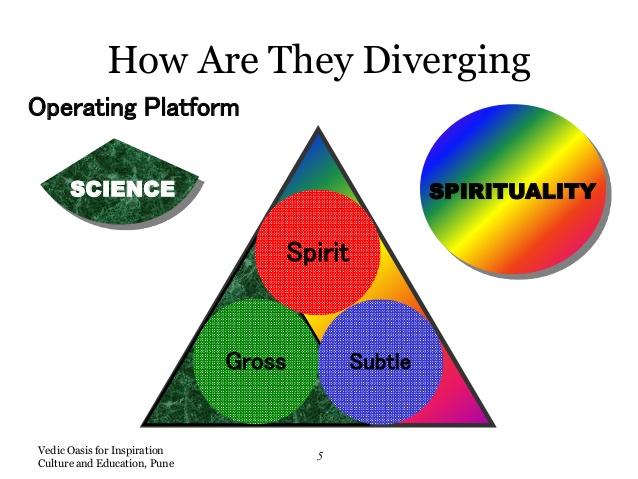
For example, take the image below… reality consists of gross, subtle, and spiritual, but materialistic science only deals with the gross. (Image courtesy of His Grace Chaitanya Charan Das The Spiritual Scientist). Spirituality on the other hand, doesn’t concern itself so much with the gross, but focuses on the subtle and spiritual.

Vedic Oasis for Inspiration
Culture and Education, Pune
5
How Are They Diverging
Operating Platform
Spirit
SubtleGross
SCI...

I hope this helps!

Sincerely,

Mahabhagavat Das

Nikhil Mishra, 05 July 2018

Hare Krsna

Thank you for writing me again Mahabhagavat prabhu. Yes you got the essence of query and your answer further helped me.

Really Vaishnavas are so merciful.

Hari bol

Sincerely

Nikhil

Please subscribe to daily inspirational emails from His Grace Sriman Sankarshan Das Adhikari (Writings and lectures archived at www.sda-archives.com), written fresh every day from his travels around the world sharing the highest spiritual knowledge with everyone. Sign up now at www.joincourse.com.

The Dark Well of the Material World

Material existence is compared to a dark well… why such a dark analogy? Well read on!

Vasudevan K, 4 December 2017

Respected devotees,

Hare Krishna,

Please accept my humble obeisanaces.

All glories to Srila prabhupada

All glories to srila gurudeva and gurumathaji

I have heard that there is a sloka in bhagavatham which describes material world as dark well and living entity who has fallen into the well is catching a creeper and that creeper is constantly chewed by 2 rats – One white and one black. Insdie the darkwell there is a phython with it’s mouth wide open and on top of the well there is a tiger which is ready to devour the living entity if he comes out. At that time some few drops of honey falls on the mouth of the person and he completely forgets his precarious condition.

The creeper is the life span, 2 rats (black and white ) are the day and night, phython is the jaws of death and tiger is the liberation.

Can you please let me know the sloka for it with it’s sloka number?

Always an insignificant servant,

Hare Krishna,

Vasudevan K

Mahabhagavat Das SDA, 29 January 2018

Dear Sriman Vasudevan,

Hare Krishna!

Please accept my humble obeisances.
All glories to Srila Gurudeva.
All glories to Srila Prabhupada.

Sorry for the extreme delay in getting back to you. As a group, we are guilty of ignoring your sincere question and we beg your forgiveness for our tardiness.

The analogies you mention, at least most of them, are included in the later conversation between Jada Bharat, the great realized soul, and Maharaja Rahugana, a-proud-but-receptive-king-turned-disciple.

These analogies are mentioned in the 13th Chapter of the 5th Canto of Srimad Bhagavatam.

https://www.vedabase.com/en/sb/5/13

Summary text of the chapter is as follows:

“The brāhmaṇa Jaḍa Bharata became very kind to King Rahūgaṇa, and to disassociate him from the material world, he spoke figuratively of the forest of the material world. He explained that this material world is like a great forest in which one becomes entangled due to association with material life. In this forest there are plunderers (the six senses) as well as carnivorous animals like jackals, wolves and lions (wife, children and other relatives) who are always anxious to suck the blood from the head of the family. The forest plunderers and the carnivorous blood-sucking animals combine to exploit the energy of a man within this material world. In this forest there is also a black hole, covered by grass, into which one may fall. Coming into the forest and being captivated by so many material attractions, one identifies himself with this material world, society, friendship, love and family. Having lost the path and not knowing where to go, being harassed by animals and birds, one is also victimized by many desires. Thus one works very hard within the forest and wanders here and there. He becomes captivated by temporary happiness and becomes aggrieved by so-called distress. Actually one simply suffers in the forest from so-called happiness and distress. Sometimes he is attacked by a snake (deep sleep), and due to the snakebite he loses consciousness and becomes puzzled and bewildered about discharging his duties. Sometimes he is attracted by women other than his wife, and thus be thinks he enjoys extramarital love with another woman. He is attacked by various diseases, by lamentation and by summer and winter. Thus one within the forest of the material world suffers the pains of material existence. Expecting to become happy, the living entity changes his position from one place to another, but actually a materialistic person within the material world is never happy. Being constantly engaged in materialistic activities, he is always disturbed. He forgets that one day he has to die. Although he suffers severely, being illusioned by the material energy, he still hankers after material happiness. In this way he completely forgets his relationship with the Supreme Personality of Godhead.”

It is risky to read verses or chapter summaries without context – especially without Srila Prabhupada’s purports, so I invite everyone to please read the entire interaction from start to finish.

https://www.vedabase.com/en/sb/5/10

https://www.vedabase.com/en/sb/5/11

https://www.vedabase.com/en/sb/5/12

and of course

https://www.vedabase.com/en/sb/5/13

and for better understanding, followed by

https://www.vedabase.com/en/sb/5/14

However, everyone one of us is meant to study Srila Prabhupada’s books in great detail. To this end, we have the Bhagavata Online Academy, the 2017 class of which is about to stop accepting applications and the 2018 class is about to begin accepting applications.

Sincerely,
Mahabhagavat Das

Please subscribe to daily inspirational emails from His Grace Sriman Sankarshan Das Adhikari (Writings and lectures archived at www.sda-archives.com), written fresh every day from his travels around the world sharing the highest spiritual knowledge with everyone. Sign up now at www.joincourse.com.

Is Krishna Govardhana or Meru? One or the other, or both?

Krishna says He is Meru. Krishna also says He is Govardhan? And in some places it is mentioned that Govardhan is a devotee of Krishna. How is all this possible?

Brajanath Das, 12 November 2016

Hare Krishna Dear Devotees,

I offer to you my respectful obeisances!

All glories to Srila Prabhupada!

All glories to Srila Gurudeva!

Please help me to understand –

In Bg 10.23 Krishna says “… and of mountains I am Meru.” Then who is Govardhana? Govardhana is Krishna or His devotee?

your servant,
Brajanath Das

Mahabhagavat Das SDA, 03 December 2016

Dear Brajanath Prabhu,

Please accept my humble obeisances.
All glories to Srila Gurudeva.
All glories to Srila Prabhupada.

Wrt. “In Bg 10.23 Krishna says “… and of mountains I am Meru.” Then who is Govardhana? Govardhana is Krishna or His devotee?”

It is incorrect to think that Krishna can be either one or the other. Krishna is unlimited.

In SB 10.24.35, this is the direct statement of Krishna:

kṛṣṇas tv anyatamaṁ rūpaṁ
 gopa-viśrambhaṇaṁ gataḥ
śailo ’smīti bruvan bhūri
 balim ādad bṛhad-vapuḥ

“Kṛṣṇa then assumed an unprecedented, huge form to instill faith in the cowherd men. Declaring “I am Govardhana Mountain!” He ate the abundant offerings.”

The purport states this:

quote
In Chapter Twenty-four of Kṛṣṇa, the Supreme Personality of Godhead, Śrīla Prabhupāda writes: “When everything was complete, Kṛṣṇa assumed a great transcendental form and declared to the inhabitants of Vṛndāvana that He was Himself Govardhana Hill in order to convince the devotees that Govardhana Hill and Kṛṣṇa Himself are identical. Then Kṛṣṇa began to eat all the food offered there. The identity of Kṛṣṇa and Govardhana Hill is still honored, and great devotees take rocks from Govardhana Hill and worship them exactly as they worship the Deity of Kṛṣṇa in the temples. The followers of the Krsna consciousness movement may therefore collect small rocks or pebbles from Govardhana Hill and worship them at home, because this worship is as good as Deity worship.”

Lord Kṛṣṇa had induced the residents of Vṛndāvana to assume a significant risk on His behalf. He convinced them to neglect a sacrifice to what is, after all, the powerful government of the universe and to worship a hill called Govardhana instead. The cowherd community did all this simply out of love for Kṛṣṇa, and now to convince them that their decision was correct, Lord Kṛṣṇa appeared in an unprecedented, huge transcendental form and demonstrated that He Himself was Govardhana Hill.

unquote

Also, in the 10th chapter of Bhagavad Gita, Krishna is answering these questions by Arjuna:

Bg 10.16 — Please tell me in detail of Your divine opulences by which You pervade all these worlds.
Bg 10.17 — O Kṛṣṇa, O supreme mystic, how shall I constantly think of You, and how shall I know You? In what various forms are You to be remembered, O Supreme Personality of Godhead?
Bg 10.18 — O Janārdana, again please describe in detail the mystic power of Your opulences. I am never satiated in hearing about You, for the more I hear the more I want to taste the nectar of Your words.

The words of Krishna describe His opulences. But His opulences are unlimited, still Krishna wants to give a hint of His greatness.
For example, it is not that Krishna is every shark or every banyan tree, or the Gandharva named Chitraratha…
But we can understand that the opulence of every shark, every banyan tree, that is a spark of Krishna’s splendor.

Srila Prabhupada writes this in the purport to BG 10.40:

“As stated in the Vedic literature, although the opulences and energies of the Supreme are understood in various ways, there is no limit to such opulences; therefore not all the opulences and energies can be explained. Simply a few examples are being described to Arjuna to pacify his inquisitiveness.”

Srila Prabhupada writes in the purport to BG 10.42:

“The Supreme Lord is represented throughout the entire material universes by His entering into all things as the Supersoul. The Lord here tells Arjuna that there is no point in understanding how things exist in their separate opulence and grandeur. He should know that all things are existing due to Kṛṣṇa’s entering them as Supersoul. From Brahmā, the most gigantic entity, on down to the smallest ant, all are existing because the Lord has entered each and all and is sustaining them.”

your servant,
Mahabhagavat Das

Shyamapriya devi dasi, 19 December 2016

Hare Krishna! Brajanath Prabhu,

Please accept my humble obeisances.
All glories to His Grace Sriman Sankarshan Das Adhikari Srila Gurudeva.

All glories to Srila Prabhupada.
By the mercy of Sri Guru and Gauranga, I had a great fortune to go on Vraj Mandal Parikrama this year. On the day of Govardhan Parikrama (22 0ct 2016), all devotees (about 1200 in number) reached Govind Kund. And we had a Srimad Bhagavatam class there. The speaker was His Holiness Prabodhananda Sarasvati Swami Maharaj and His Holiness Radha Raman Swami Maharaj and His Holiness Bhakti Narasimha Swami Maharaj were among the audience.

The question Prabodhanana Sarasvati Swami Maharaj ji put to the audience was

“Is Govardhan- Krishna or Bhakta? Or both?”

Maharaj ji asked us to raise hands. Many hands were in the air for Govardhan is ‘Krishna’. Many hands again for Govardhan is ‘bhakta’. And of the few hands raised for Govardhan is both-Krishna and His devotee, my hand (hesitatingly!) was up too. I remember from a lecture that Govardhan is both Krishna and His devotee but apparently, forgot the details.

Maharaji beautifully explained how Sri Giri Govardhan is both Bhagavan and bhakta.

Inconceivable, but a fact! And this is how we can understand.

[Please note that I am writing on the strength of what I noted down in my journal during the SB class (mentioned above), personal query to His Holiness Lokanath Swami Maharaj and from various lectures I came across (by His Holiness Radhanath Swami Maharaj, His Holiness Giriraj Swami Maharaj, His Holiness Radha Govind Swami Maharaj and His Holiness Lokanath Swami Maharaj)]

Sri Giri Govardhan – Sri Krishna Himself

Mahabhagavat Prabhu has already quoted and given many references to explain this in detail.

Also, Sri Chaitanya Mahaprabhu gives a Govardhan shila to Srila Raghunath Das Goswami (with the thumb impression of Mahaprabhu on it) and says, He could see this Giriraj Shila as Brajendra Nandan, Lord Himself. Even today one can visit Sri Sri Radha Gokulananda Temple in Vrindavan and have darshan of this shila. I remember, Srila Gurudeva and Srimati Gurumataji took all of us to this temple during their Vrindavan visit last kartik (year 2015).

Sri Giri Govardhan – devotee

The simple-hearted Gopi-girls of Vraja say:

hantayam adrir abala hari-dasa-varyo
yad rama-krsna-carana-sparasa-pramodah
manam tanoti saha-go-ganayos tayor yat
paniya-suyavasa-kandara-kandamulaih

“Of all the devotees, this Govardhana Hill is the best! O my friends, this hill supplies Krsna and Balarama, along with Their calves, cows and cowherd friends, with all kinds of necessities water for drinking, very soft grass, caves, fruits, flowers and vegetables. In this way the hill offers respects to the Lord. Being touched by the lotus feet of Krsna and Balarama, Govardhana Hill appears very jubilant.” (SB 10.21.18)

Srila Prabhupada translates, hanta, “oh” (expression reflecting how Gopis were so happy and with great joy talking with other Gopi girls) ayam adrir, “this hill (Govardhan)” is hari-dasa-varyah, “the best among the servants of the Lord (Hari)”, “which is touched by the lotus feet of Sri Krishna and Sri Balaram”- rama-krishna-carana-sparasa. And “he appears very jubilant” (pramodah).

So here is a devotee, who descended from Goloka (a wonderful story of Sri Govardhan’s appearance on planet Earth is described in Garga samhita), only to please the Supreme Personality of Godhead, Sri Krishna. And he is considered the best of the devotees of Sri Krishna (hari-dasa-varyo) because he dedicates his entire body in the service of the Lord and His associates (cowherd boys, girls and cows etc.) He supplies them nourishment by providing clean, refreshing drinking water, different varieties of fruits and roots to eat. The caves and green lustrous pastures on the hill became the sporting grounds for the Lord to play with His friends and for herding His cows and calves. And it is very significant to note here that Gopis mention that Sri Govardhan was so happy and joyfully rendering this service (pramodah). The servant is so happy serving his master and the master is so happy that His servant is so happy serving Him as if a transcendental competition is set between the duo.

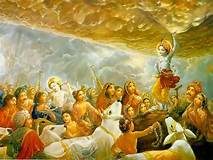
This wonderful reciprocation between the Lord and his devotee is further seen in the Govardhan lila- the puja of Govardhan followed by the attack by Indra and how Lord lifts Govardhan on His little (pinky) finger and how Govardhan faced the brunt of the ferocious, thunderous attacks by the ‘pralaya’ clouds (I forgot the name of the clouds summoned during the devastation of the material creation) with great joy just for the Lord and to protect His devotees.

So the conclusion is Giriraj is both Sri Krishna and His devotee simultaneously.

Then the obvious question may arise:

What mood we sadhakas should develop so we get full mercy of Sri Krishna or Sri Giri Govardhan?

Being followers of Sri Chaitanya Mahaprabhu, who came in the mood of Lord Hari’s servant and taught us gopi-bhartuh pada-kamalayor dasa-dasanudasah, by becoming and serving the servant of the servant of the Lord, we become recipients of Sri Krishna’s full mercy. And sastras show many pastimes of the Lord where a devotee of the Lord exhibited more mercy and compassion.

No doubt, it is equally potent to worship Sri Govardhan as both Sri Krishna or His devotee, but by following the mood of Lord Chaitanya, the mood of the gopis, the mood of becoming the servant of the servants of the Lord we will always get more mercy and please Sri Guru and Sri Krishna is the conclusion of the lecture.


In the same regard, couple of years ago, in a personal meeting (myself with my brother and parents) I had an opportunity to ask a question to His Holiness Lokanath Swami Maharaj.

(The following is based on what little I could remember from the conversation with His Holiness Lokanath Swami Maharaj, on evening walk outside his asrama, at the foot hill of Sri Govardhan, and also from a lecture by His Holiness on Govardhan Puja, this year 2016 at Barsana)

Q: What is the significance of Govardhan Pastime? (My doubt was why this pastime had to take place for 7 days and nights when the All Mighty, Sri Krishna could have stopped it immediately)

A: It gave an opportunity to all the living entities of Vrindavan to have personal and close association of Sri Krishna. They all spent 7 days and nights at the lotus feet of Sri Krishna. And there were many reciprocations between Krishna and every devotee (which of course were very special and unique to each individual.)

And while remembering and writing all this, it suddenly dawned on me what the above answer meant. This pastime clearly shows- when we take shelter of a devotee (Sri Govardhan) we get direct shelter of the Lotus feet of Sri Krishna.

Brajanath Prabhu, I thank you very much and appreciate for asking this wonderful question on this forum, for while attempting this exercise, it helped me drive home with the following message that Indirectly we get the direct benefit of associating with Lord Sri Krishna, when we serve the devotee(s) of the Lord.

Hope this answer is of some help.

And if further inputs or corrections needed in the above, I humbly beg the readers to add/ point them out for better understanding.

Your servant,

Shyamapriya devi dasi


Nashvin, 20 December 2016

Hare Krsna!

Yes, an important aspect of the reason for the Govardhana pastime is that Krsna wanted to associate with all His various devotees. Generally, He associates with different groups of devotees at different times (with cowherd boys during the day, gopis during the night etc). However, during this pastime, He was able to exchange loving glances and feelings with all the residents of Vrndavana, simultaneously.

your servant,
Nashvin

Please subscribe to daily inspirational emails from His Grace Sriman Sankarshan Das Adhikari (Writings and lectures archived at www.sda-archives.com), written fresh every day from his travels around the world sharing the highest spiritual knowledge with everyone. Sign up now at www.joincourse.com

What is the difference between occupational duty and prescribed duty?

What is the duty of a human being? What is prescribed? What about our ability? How to ensure that we can do what’s most important, what’s most urgent, and what’s most urgent and important? How to prioritize?

Bhakta Sunil, 06th January 2016

Hare Krishna every one,

Please accept my humble respects
All Glories to Vaishnavas

Please enlighten about occupational duty and prescribed duty , are both same or different?

Thanks in anticipation,
sunil

Prasadj dube, 08th January 2016

Hare Krishna!

Occupational duty means to attend the works of his livelihood. Prescribed duty means doing the eternal service to the Supreme Lord by devotedly chanting his name hare krishna hare krishna .

Prasadj dube

Shyamapriya devi dasi, 08th January 2016

Hare Krishna,

Thank you for this question!

The English dictionary says ‘occupation’ means job or profession and the word ‘prescribed’ means advisable or authorized.

And as per vedic understanding-

Occupational duties or Varnasrama-dharma are duties related to the four divisions of material— (namely brāhmaṇa, kṣatriya, vaiśya and śūdra) and and spiritual life (brahmacarya, gṛhastha, vānaprastha and sannyāsa).[SB 4.20.9] and

Prescribed duties or Sva-dharma mean duties enjoined according to one’s psychophysical condition, under the influence of three modes of material nature. [Bg 3.35]

Srila Prabhupada, explains more on prescribed duties as follows in the purport of Bg 3.35 :

“One should therefore discharge his prescribed duties in full Kṛṣṇa consciousness rather than those prescribed for others. Materially, prescribed duties are duties enjoined according to one’s psychophysical condition, under the spell of the modes of material nature. Spiritual duties are as ordered by the spiritual master for the transcendental service of Kṛṣṇa. But whether material or spiritual, one should stick to his prescribed duties even up to death, rather than imitate another’s prescribed duties. Duties on the spiritual platform and duties on the material platform may be different, but the principle of following the authorized direction is always good for the performer. When one is under the spell of the modes of material nature, one should follow the prescribed rules for his particular situation and should not imitate others. For example, a brāhmaṇa, who is in the mode of goodness, is nonviolent, whereas a kṣatriya, who is in the mode of passion, is allowed to be violent. As such, for a kṣatriya it is better to be vanquished following the rules of violence than to imitate a brāhmaṇa who follows the principles of nonviolence. Everyone has to cleanse his heart by a gradual process, not abruptly. However, when one transcends the modes of material nature and is fully situated in Kṛṣṇa consciousness, he can perform anything and everything under the direction of a bona fide spiritual master. In that complete stage of Kṛṣṇa consciousness, the kṣatriya may act as a brāhmaṇa, or a brāhmaṇa may act as a kṣatriya. In the transcendental stage, the distinctions of the material world do not apply. For example, Viśvāmitra was originally a kṣatriya, but later on he acted as a brāhmaṇa, whereas Paraśurāma was a brāhmaṇa but later on he acted as a kṣatriya. Being transcendentally situated, they could do so; but as long as one is on the material platform, he must perform his duties according to the modes of material nature. At the same time, he must have a full sense of Kṛṣṇa consciousness.” [ Purport Bg 3.35]

From the above reading we understand that, since every living entity (in human form) has acquired a particular nature (under the influence of three modes of nature -goodness, passion and ignorance), the vedic injunction accordingly prescribes one of his duty (through the institution of varna and asrama) by which one can gradually elevate oneself to the stage of transcendence, where one is free from the influence of these three modes.

Now, coming back to your question- both occupational and prescribed duties in vedic sense mean one and the same. i.e the vedic authorities prescribe a living entitiey to take up a certain profession or occupation (as a brahmana, ksatriya, vaisya or sudra) based on one’s pscho-physical condition (a consequence of three modes of nature). Along with this, it also reminds us to perform such duties not with the motive of material gain but to please the Supreme Personality of Godhead ultimately, then only can one be happy and content.

In conclusion, whatever our occupational or prescribed duties may be, the essence remains the same Jivera svarupa haya krsnera nitya dasa. The real occupation duty or Santana-dharma of a spirit soul or a living entity as prescribed by the authorized sources/scriptures like Bhagavad-gita is ultimately to please the Supreme Personality of Godhead, Sri Krishna by eternally serving Him with love.

I would appreciate if others can fill in the lacunae in the above explanation.

Sincerely,
Shyamapriya devi dasi

Guru Vandana devi dasi, 09th January 2016

Hare Krishna!

Srimad Bhagavatam 1.2.6, Suta Goswami says, “The supreme occupation [dharma] for all humanity is that by which men can attain to loving devotional service unto the transcendent Lord. Such devotional service must be unmotivated and uninterrupted to completely satisfy the self.”

Here Srila Prabhupada purposefully translates the word ‘dharma’ as occupation and not as religion. He says the word religion is misunderstood. It is taken as faith which can change but dharma or occupation is which cannot change.

When one is on bodily platform he manufactures some occupation to earn his livelihood according to his body, mind and circumstances. As a medical doctor one may have a livelihood by medical practice, as a civil servant one may serve his country etc.. But these occupations are temporary. It is finished as soon as the body is finished.

The question asked here is to describe about occupational duty. We must now inquire and understand what is our real occupational duty?

In verse 1.2.6 it is mentioned as ‘paro dharma’. Para means transcendental . Suta Goswami explains ‘bhaktih adhoksaje’. Our real dharma is -loving devotional service.

Krishna came to teach us this real occupational duty. The merciful Lord says to just give up all bodily occupation, mental occupation, intellectual occupation and surrender unto Him. It doesn’t mean these occupational duties as an engineer, lawyer, doctor, householder, etc .are not of real consideration and to be given up thinking that devotional service is executed under whatever circumstances we may whimsically decide. Arjuna performed his occupational duty not as a material obligation but as a devotional service.

Prescribed duty- Just like animals if we are simply interested only in eating, sleeping, mating and defending then there are no prescribed duties. But who wants to rise above animal life for him prescribed duties are there. According to the modes of nature Krishna has given prescribed duties in verses BG 18.42, 18.43,18.44

Peacefulness, self-control, austerity, purity, tolerance, honesty, knowledge, wisdom and religiousness—these are the natural qualities by which the brahmanas work.

Heroism, power, determination, resourcefulness, courage in battle, generosity and leadership are the natural qualities of work for the ksatriyas.

Farming, cow protection and business are the natural work for the vaisyas, and for the sudras there is labor and service to others.

When I asked Srila Gurudeva what my prescribed duty is , His Grace replied, “Your prescribed duties are what I give you.”

Are both same or different?

One’s occupational duties are prescribed in scriptures and by Guru and Vaishnavas. So for those who are interested in real occupation both occupational duties and prescribed duties are one and the same.

your servant
Guru Vandana devi dasi

Premananda das, 12th January 2016

Thank you for the wonderful question by Bhakta Sunil and beautiful answers by Mother Guruvandana and Mother ShyamaPriya.

your servant
Premananda Das

Premananda das, 13th January 2016

Hare Krishna

My apologies for the major and very careless typo error .I had written But Krishna was married to Draupati and Subhadara.
I was referring to Arjuna.
This is certainly my fault and only due to kindness and due diligence of Mahabhagavata prabhu I am glad to be corrected.Hare Krishna

Occupational duty is the external activities people are engaged for example a traveling monk,student ,businessman,housewife etc.
Prescibed duty means to make the purpose behind these responsibilities one with the purpose of loving God (Krishna).
This becomes natural when we are in association with saintly people who are already doing that.
It means to give up separate motives.
Lord Krishna told Arjuna .”You should surrender unto me .”But Arjuna was a married man.He was married to Draupadi and Subhadra and he had eight children and even grand children.He was a warrior.After hearing Bhagavat-Gita he did not become a sannyasi, a person in the renounced order.
He performed his duty of fighting because he was a military man and he continued to maintain his family.But he did all these in the spirit of service rather than spirit of greed and exploitation .He did it as an expression of love for God.
In this way he rightly oriented his occupation and domestic situation.He did not renounce it but renounced greed,envy pride and lust .
With a pure state of consciousness and a desire to serve he aspired for the ideal love of God through the situation he was in.
In conclusion as Srimati Gurumata and Srila Gurudeva always instructs that all actives should be dovetailed in Krishna consciousness.Krishna is the Centre of all our activities.Krishna is the Supreme enjoyer and we are His servants who are enjoyed by Him.Jivera swarupa Hoya Nitya Krishna Das. Our constitutional position is that we are all servants of Krishna.In this situation only we will be happy.

your servant
Premananda Das

Dra Varni, 15th January 2016

Hare Krsna, Thanks you for all the wonderful insight. For a contribution I would say to remember “you are not this body”

drv

Bhakta Sunil, 17th February 2016

A delayed but hearty Thank you very much! to prasadj dube Prabhu , Shyamapriya devi mataji , Guru Vandana Devi Mataji , Premananda Prabhu , Dra Varni ji and every one who contributed to enlighten on this nectar which at my stage , i could not dive deeply into , and relish as much as it actually is

All Glories to your replies!

your insignificant servant,
Bhakta Sunil

Please subscribe to daily inspirational emails from His Grace Sriman Sankarshan Das Adhikari (Writings and lectures archived at www.sda-archives.com), written fresh every day from his travels around the world sharing the highest spiritual knowledge with everyone. Sign up now at www.joincourse.com

How many corpses have you carried?How many more do you have?

If you are reading this, you are a spirit soul. As a spirit soul, you are alive and conscious, and actually eternal, knowledgeable, and blissful.

But chances are that the body you currently inhabit is not eternal, is a network prone to ignorance, and often far from blissful

So there you are, dear spirit soul, dear “Atma”, you are carrying around a dead body. It’s heavy.

स्वप्नायितं नृपसुखं परतन्त्रमीश
शश्वद्भ‍येन मृतकेन धुरं वहाम: ।
हित्वा तदात्मनि सुखं त्वदनीहलभ्यं
क्लिश्यामहेऽतिकृपणास्तव माययेह ॥ २८ ॥ svapnāyitaṁ nṛpa-sukhaṁ para-tantram īśa
śaśvad-bhayena mṛtakena dhuraṁ vahāmaḥ
hitvā tad ātmani sukhaṁ tvad-anīha-labhyaṁ
kliśyāmahe ’ti-kṛpaṇās tava māyayeha

O Lord, with this corpselike body, always full of fear, we bear the burden of the relative happiness of kings, which is just like a dream. Thus we have rejected the real happiness of the soul, which comes by rendering selfless service to You. Being so very wretched, we simply suffer in this life under the spell of Your illusory energy.

https://vedabase.io/en/library/sb/10/70/28/

Why is the body called corpselike? Well, it has no value, no use after the soul leaves it! No matter how beautiful a man or woman may have been, while millions might desire that person while they were alive, no one wants to associate with a dead body (with exceptions, there are always exceptions).

Why is that? If it was the body we really wanted, we’d have no problems associating with corpses. What we really crave for is the association with the spirit souls that animates and enlivens that corpse.

Which brings us the point – how do we get a ‘corpselike’ material body?

Material desires! What are material desires? Desire to be #1, the desire to be Lord and Master of all I survey, Desire to be the Center of the Universe, the Desire to be this, that, and other, the Desire to be what we are not.

Uneasy lies the head that wears the crown

William Shakespeare, Henry IV, Part II, 1597

Well before Shakespeare, it was known that material desires create material bodies.

One material body per material desire, at least.

Influenced by the illusory material energy that is all around us, we’re creating our next millions and billions of material bodies right now. The desire for money, the desire for sex, the desire for fame, the desire to be powerful, the desire to have blue eyes or smooth skin or long hair, the desire to do this or that… all corpses in disguise, seductive but deadly.

But why do we want to create yet another corpse? How many have we carried already? How many do we have yet to carry?

Better to be free of this material bondage, repeated, birth, death, old age, and disease!

जन्ममृत्युजराव्याधिदु:खदोषानुदर्शनम्

janma-mṛtyu-jarā-vyādhi-

duḥkha-doṣānudarśanam

the perception of the evil of birth, death, old age and disease

https://vedabase.io/en/library/bg/13/8-12/

A genuine spiritual practice, devoid of the trickery of material sense gratification disguised as religion leads to this perception of who I am, not this body, but a pure spirit soul, eternally part-and-parcel of God.

Not carrying a corpse in the material world, as a spirit soul, free to be me!

Enter your email address to subscribe to this blog and receive notifications of new posts by email.

How old is the Universe? When will it all end?

How old is the Universe? When will the Universe end? What transitions take place? Do we have a way beyond speculation?

There is a lot of speculation about the age of the Universe. Every little while, there is some new number, with language like “research suggests”, or “new evidence reveals”, etc. Numbers like 9 Billion years, 13.8 Billion years, etc., are thrown around. All speculative.

Then there’s the Biblican/Abrahamic version, which puts the age of the Universe to just a few thousand years.

There is authoritative information available, however, as to:

  • How old is the Universe presently
  • When will the Universe be dissolved
  • What transitions take place in the Universe
  • How big is the Universe
  • One Universe or more than one Universe

According to the Srimad Bhagavatam https://vedabase.io/en/library/sb/3/11/advanced-view/, which gives information from the perspective of the Creator of the Universe, this particular universe has a total lifespan of approximately 311 Trillion Years. https://vedabase.io/en/library/bg/8/17/

Of that lifespan, approximately 50% is completed. So the present age of the Universe is 155 Trillion Years. http://www.krishna.com/how-he-creates

This Universe is one of innumerable, just like bubbles in the foam of the waves of the ocean.

There is a partial dissolution of the Universe periodically, every 4.32 Billion Years.

No matter how long all this may seem to be, in the context of eternity, this is but a flash in the pan.

Our Universe, The Source of the Universe is practically Infinite. We are each an infinitesimal part of The Infinite. What does that make us then? Why should we be attached to one particular situation on one particular planet in one particular Universe in one particular iteration of the Creation?

Enter your email address to subscribe to this blog and receive notifications of new posts by email.