Exploring our Origin, Past Life Memories and the Soul- Three Questions on the Gita

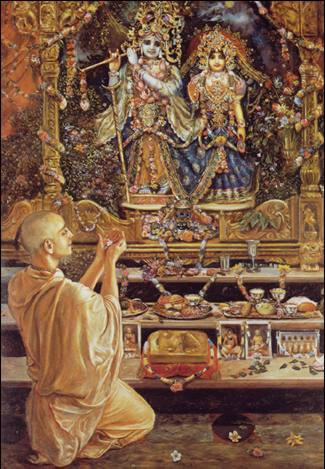
Are you ready? Unraveling the soul’s origin sparks a provocative inquiry into our eternal essence. Souls emanate from Krishna, existing beyond creation, spiraling through lifetimes with desires entangled in material shackles. Memories of past lives lie buried, mostly to shield us from trauma, leaving lingering impressions as we cycle through bodies shaped by our will and divine sanction. Spiritual perfection delivers liberation, culminating in eternal pastimes with Krishna, where desire meets destiny. The journey demands a vigorous pursuit of understanding, action, and devotion—our only ticket home.

Soul in the Human Body

We had a few questions come up in Gita Class that I would have to ask you for the answers.

1.) Where did the soul originate?

Souls are eternal, just like Krishna. They originate as “emanations” or “expansions” from Krishna. There is no moment when they were created. Therefore, they are eternal. Krishna is eternally emanating us. Here is a crude example. Imagine a lit candle with a mirror in front of it. When did the reflection originate? Now in the case of our example, someone placed the candle and the mirror. They lit the candle. All this happened at a certain time. But if you conceive of the inconceivable, when the candle, mirror and flame eternally existent… then the reflection originated in the original flame, and will continue eternally. In our case, we are “separated expansions” unlike say Lord Narasimha, Lord Narayana, etc., who are “nondifferent” expansions. 

Bg. 15.7

ममैवांशो जीवलोके जीवभूत: सनातन: ।
मन:षष्ठानीन्द्रियाणि प्रकृतिस्थानि कर्षति ॥ ७ ॥

mamaivāṁśo jīva-loke
jīva-bhūtaḥ sanātanaḥ
manaḥ-ṣaṣṭhānīndriyāṇi
prakṛti-sthāni karṣati

The living entities in this conditioned world are My eternal fragmental parts. Due to conditioned life, they are struggling very hard with the six senses, which include the mind.

https://vedabase.io/en/library/bg/7/15/

Bg. 2.12

न त्वेवाहं जातु नासं न त्वं नेमे जनाधिपाः ।
न चैव नभविष्यामः सर्वे वयमतः परम् ॥ १२ ॥na tv evāhaṁ jātu nāsaṁ
na tvaṁ neme janādhipāḥ
na caiva na bhaviṣyāmaḥ
sarve vayam ataḥ param

Never was there a time when I did not exist, nor you, nor all these kings; nor in the future shall any of us cease to be.

https://vedabase.io/en/library/bg/2/12/

The philosophy of “achintya bheda abheda tattva”, inconceivable, simultaneous oneness and difference, is very deep. It can take us many, many lifetimes to fully understand it. But I don’t need to directly concern myself with all that. My job is to be a pure devotee acceptable by my spiritual master. He will cause everything to be revealed to me.

2.) How do people remember their past lives?

The spirit soul in the material world is encased in a subtle body. This body consists of the subtle material elements (mind, intelligence, and false ego). Now, this subtle body encasing the soul is suspended in 5 kinds of air. Each air is more subtle than the previous one: prana, apana, udana, vyana, and samana… This package is placed inside the heart of the living entity by the material nature.

eṣo ’ṇur ātmā cetasā veditavyo
yasmin prāṇaḥ pañcadhā saṁviveśa
prāṇaiś cittaṁ sarvam otaṁm prajānāṁ
yasmin viśuddhe vibhavaty eṣa ātmā

“The soul is atomic in size and can be perceived by perfect intelligence. This atomic soul is floating in the five kinds of air [prāṇa, apāna, vyāna, samāna and udāna]. The soul is situated within the heart, and it spreads its influence all over the body of the embodied living entities. When the soul is purified from the contamination of the five kinds of material air, its spiritual influence is exhibited.”

Muṇḍaka Upaniṣad (3.1.9), quoted in https://vedabase.io/en/library/sb/11/3/39/

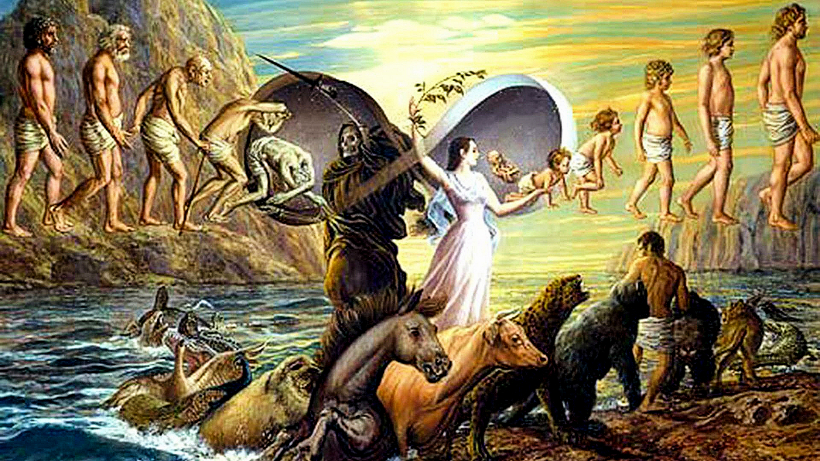
When someone dies, the spirit soul leaves the gross material body. This body is made of the gross material elements earth, water, fire, air, and space. The soul remains cocooned inside the subtle body. It follows the various paths chalked out by Yamaraja into the next body.

Past life memories are usually buried or erased. This prevents trauma in the next life. For example helps avoid Post-Traumatic Stress Disorder (PTSD) cases. Consider what can happen if someone was a deer in their last lifetime. Suppose they remember when they were devoured alive by a tiger… Now think about this: If we remembered every single traumatic thing we ever experienced? These experiences span millions and billions of lifetimes… This is the mercy of the material nature under the direction of Krishna that we don’t remember past lives.

Young babies and small children are said to remember their past lives for some time. They forget as they grow up. Sometimes, remembrance of past lives is allowed for reasons that I know. One reason is to avoid the same mistakes again. There are also other reasons.

3.) This was about the impressions that people have based on their desires. We understand that people take another body, and they bring their impressions based on their desires with them.  Can a person have a desire to not change into another body, meaning not wanting to come back?  If they manifest it, then will it happen? 

MBD: There is only so much we can control… “karmana daiva netrena jantar deha upapatti”. Our body is given by higher authorities according to what we desire and deserve, not just what we desire.

ŚB 3.31.1

श्रीभगवानुवाच
कर्मणा दैवनेत्रेण जन्तुर्देहोपपत्तये ।
स्त्रिया: प्रविष्ट उदरं पुंसो रेत:कणाश्रय: ॥ १ ॥śrī-bhagavān uvāca
karmaṇā daiva-netreṇa
jantur dehopapattaye
striyāḥ praviṣṭa udaraṁ
puṁso retaḥ-kaṇāśrayaḥ

The Personality of Godhead said: Under the supervision of the Supreme Lord and according to the result of his work, the living entity, the soul, is made to enter into the womb of a woman through the particle of male semen to assume a particular type of body.

https://vedabase.io/en/library/sb/3/31/1/

If we act in purely spiritual ways, then naturally the higher authorities will provide us with a spiritual body.

Bg. 13.22

पुरुष: प्रकृतिस्थो हि भुङ्क्ते प्रकृतिजान्गुणान् ।
कारणं गुणसङ्गोऽस्य सदसद्योनिजन्मसु ॥ २२ ॥

puruṣaḥ prakṛti-stho hi
bhuṅkte prakṛti-jān guṇān
kāraṇaṁ guṇa-saṅgo ’sya
sad-asad-yoni-janmasu

The living entity in material nature thus follows the ways of life, enjoying the three modes of nature. This is due to his association with that material nature. Thus he meets with good and evil among various species.

https://vedabase.io/en/library/bg/13/22/

This spiritual body has no flaws. Once a material body is obtained, no one can prevent its death. This is unless sanctioned by God or someone empowered by God. Not just by wishing or willing can we escape old age, disease, or death. “jatasya hi dhruvo mrtyuh” BG 2.27 One who has taken birth must die. One who has died must take birth again, until spiritual perfection is reached.

The spirit soul takes on different bodies depending on the consciousness.

Bg. 2.27

जातस्य हि ध्रुवो मृत्युर्ध्रुवं जन्म मृतस्य च ।
तस्मादपरिहार्येऽर्थे न त्वं शोचितुमर्हसि ॥ २७ ॥

jātasya hi dhruvo mṛtyur
dhruvaṁ janma mṛtasya ca
tasmād aparihārye ’rthe
na tvaṁ śocitum arhasi

One who has taken his birth is sure to die, and after death one is sure to take birth again. Therefore, in the unavoidable discharge of your duty, you should not lament.

https://vedabase.io/en/library/bg/2/27/

This is why we bless “may you never take birth again”. If a person does reach spiritual perfection, then for one last lifetime, they will be transferred to a specific Universe. In that Universe, Krishna is performing His pastimes. These can be any of His expansions, depending on the love of the soul for a particular form of Krishna. They are born there and trained there. They reach their eternal competence. When Krishna winds up His pastimes, He takes that soul back to the spiritual world. The soul is in the specific eternal form that it has. This return happens without any birth. Then the soul experiences pastimes with Krishna eternally.

There are innumerable universes, and the Lord is appearing in one of these universes at every moment. Therefore His pastimes are called nitya-līlā, eternal pastimes. The Lord’s appearance as a child in the house of Devakī takes place continuously in one universe after another. Therefore, the devotee is first transferred to that particular universe where the pastimes of the Lord are current. As stated in Bhagavad-gītā, even if a devotee does not complete the course of devotional service, he enjoys the happiness of the heavenly planets, where the most pious people dwell, and then takes birth in the house of a śuci or śrīmān, a pious brāhmaṇa or a wealthy vaiśya (śucīnāṁ śrīmatāṁ gehe yoga-bhraṣṭo ’bhijāyate). Thus a pure devotee, even if unable to execute devotional service completely, is transferred to the upper planetary system, where pious people reside. From there, if his devotional service is complete, such a devotee is transferred to the place where the Lord’s pastimes are going on.

https://vedabase.io/en/library/sb/10/1/23/ purport

My Guru Maharaja has expressed the desire to stay here till all the souls are delivered back! 🙂 We can see what Krishna does with Him. It is possible for Krishna to do anything. For example, He can keep a soul in the spiritual realm. He can also let them serve Him in the material world. Many of our Acharyas could go into the spiritual realm in their meditation. They could bring back tangible objects back to the material realm. Like jewellery, food, flower, perfume, etc. There are many pastimes where Krishna has done it also… Take for example when Krishna married the 16,100 princesses at once… His parents, priest, wives, and other relatives where all at once attending the 16,100 weddings! 🙂 Krishna’s associates live a most adventurous life!

I know these are deep, but they were discussing it was beyond my capacity of understanding

MBD: This kind of churning is required for a person to genuinely understand the philosophy. Then, when they practice sincerely, they will realize the philosophy for themselves. When someone applies themselves wholeheartedly with a combination of knowledge, action, service and humility, then they reach the Supreme Destination. Our job is to send everyone back home, back to Godhead. Back home to Krishna. Hare Krishna!

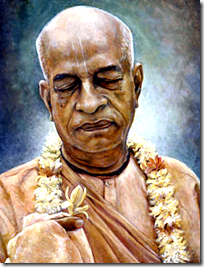
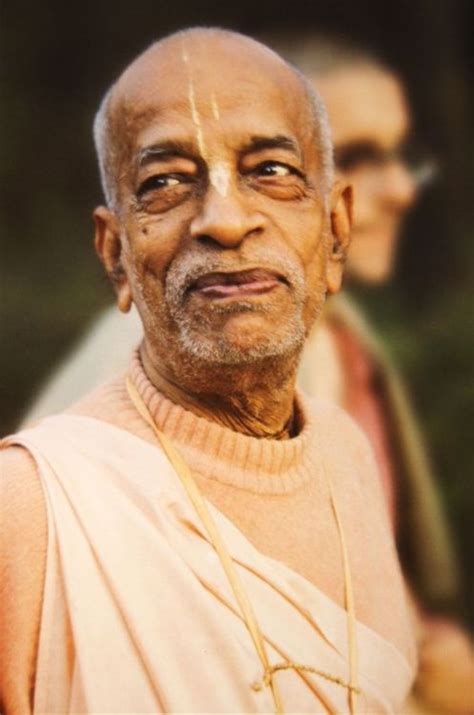
His Divine Grace A. C. Bhaktivedanta Swami Prabhupada.

Join the Mission: Distribute 100,000 Bhagavad Gitas Worldwide

I reflect on a transformative spiritual journey that began 25+ years ago with the Bhagavad Gita As It Is, from a monk in Mumbai. Initially skeptical, I engaged, allowing the Gita to purify my heart through countless readings. Inspired by my benefactor, I set a goal to distribute 100,000 copies of the Gita. Through persistent outreach, I have successfully shared over 10,000 copies worldwide but I recognize the challenge ahead. I invite you to join in this great mission. Can you see the potential for worldwide transformational change as each inspired individual can significantly impact countless lives? Will you help?

Approximately twenty five years ago, I was a young, haughty engineer. I was also an atheist then. I got my copy of the Bhagavad Gita As It Is from a monk in Mumbai (then Bombay). He gave it to me free of charge. The story of my early spiritual journey is here.

The Perfect Escape Manual

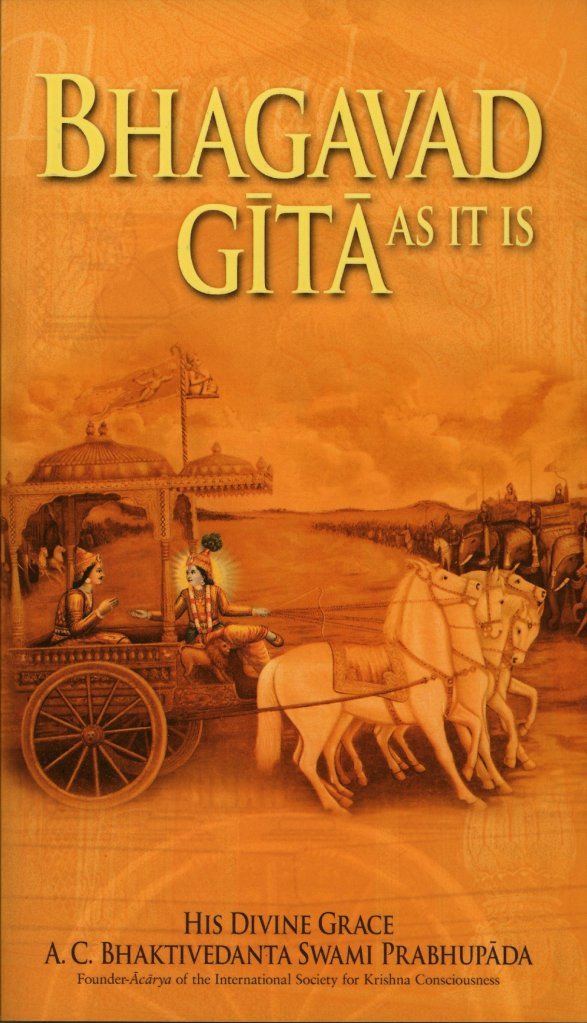
Bhagavad Gita As It Is
Bhagavad Gita As It Is is the perfect escape manual for those trapped in the material realm.

I had read many editions of the Gita before, but they were more or less useless. I had discarded them. I had concluded that the Bhagavad Gita was complete nonsense. I planned to read and discard this one too. So I began to try and find the faults. This book ended up finding my faults, honestly.

My Journey with the Gita

As I travelled all over the world, my Gita went with me. Reflecting on the pure instructions of Krishna cleansed my consciousness. Reading the Bhagavad Gita hundreds of times, the clear writings of His Divine Grace A. C. Bhaktivedanta Swami Prabhupada purified my heart. I wasn’t speaking to anyone about spiritual life during those years. It was just me and the book…It was many years until I actually came into the association of the devotees. It was not just philosophy, but also a full manual to living life in a joyful spiritual way.

That interaction with our unknown hero, the Hare Krishna monk, has been the single most transformational one in my life.

Paying It Forward: The 100,000 Gita Goal

I began to gratefully consider how to respond… I didn’t know by benefactor by name or by face. I didn’t have any contact information for him. While I couldn’t do anything for him, I decided to pay it forward .

Impulsively, I think, at first, but with great conviction after, I picked a target to distribute 100,000 of those Bhagavad Gita As It Is, or equivalent. I don’t know how I came up with the number. But now it’s ingrained. I have committed this to myself. I have committed this to God. I have given my word to my Guru. I have asserted it to so many others. I’ve got to do it, or die trying.

It’s got to be done, the 100,000 Gitas or equivalent. And after 18 years of trying, I’m finally past the 10,000 mark. So 10% there. It’s not totally hopeless.

Testing a New Approach

But recently, I began to have a sneaking suspicion that I couldn’t do it alone. So I decided to test it out.

I continued to distribute Srila Prabhupada’s books as I did, hand-to-hand, person-to-person. I went into apartment buildings. I went to street corners. I went to busy intersections with a lot of people milling about. I approached strangers late at night. I distributed books on buses, trains, planes. I called people. I wrote online. I mailed books to people I’d met. Sometimes they gave me a donation. At other times I covered the cost of the books myself.

As I approach the end of my corporate career, I realized something important. I can’t continue to cover the costs myself for much longer!

The Reality of Spiritual Book Distribution

I quickly discovered that it’s almost impossible to even give spiritual books away. People who are uninterested or against the ideas in the books just do not want them. And to someone who is interested, they will gladly donate generously. There are the friends and family who have donated so much. There is the lady who emptied her bank account on a late night for a book that cost $1. Recently an auto mechanic did the “give you everything in my account right now” thing.

I also compared my hand-to-hand distribution score with the score I got from others’ help. And in the last few years, others have helped me distribute more books than I have distributed myself!

So this boils down the book distribution project down to finding interested people. An interested person wants a book for themselves. Or someone interested wants to help me distribute them to others.

I can only hit the 100,000 goal with others’ help!

The Numbers Don’t Lie

On average, whenever I go out to distribute books, very few people interact with me. Usually, about one in a hundred people will engage with me in any way. The interactions are on a wide spectrum. Some are quite positive. Some are nasty. Of those who do interact in any way, about one out of ten will take a book. Mostly it’s a small book. Rarely it is a Bhagavad Gita. And even more rarely, someone will get a full set of books, like the Srimad Bhagavatam, or the Chaitanya Charitamrita. All in all, it takes me about 10,000 attempts to distribute the equivalent of a single Bhagavad Gita.

My lifetime total is 100,000 Gitas. The last time I counted, I had about 90,000 to go.

The Impossible Math

Simple Math tells me that it will take me about 900,000,000 attempts. That is 900 Million. The human population of our planet is 8.2 Billion. I will need to approach 1 out of every 9 people on this planet. All this to distribute the equivalent of 90,000 Bhagavad Gitas hand-to-hand! This still sounds possible somehow, through my website, through my various outings all over the world.

But, given that a successful book distribution takes around 10 minutes on average including the unsuccessful interactions… that is 900,000 minutes, or 15,000 hours. I can presently go out 108 times a year. If each of my outings were to last just 2 hours, I’d need to go out 7,500 times. And at my current rate, that would take me another 70 years. I’m already over fifty years of bodily age in my current lifetime… It is unlikely I will live to be 120 years old! And even if I were to live that long, my “useful lifespan” would be much shorter than that.

Long story short. I really can’t do this alone. I need help.

Why can’t everyone just get the Gita for themselves?

That’s a valid question. After all, God helps those who helps themselves, right?Why should I or anyone else go through all this trouble? There are some key reasons why someone can’t get the Gita themselves:

  1. They don’t know about it yet – that’s why we reach out relentlessly
  2. They haven’t found a genuine edition of the Gita yet – most versions are full of motivated concoctions – I had read so many editions before, but that monk helped me get the pure message of the Gita, so can we help others
  3. They just can’t afford it – I know many souls who just can’t afford to buy the book, in India, in Africa, in South America, and elsewhere
  4. They don’t realize the value of the Gita – there are many who can very well afford to buy a copy, but don’t know the value – giving them a taste of the Gita will help them tremendously, and they will support the cause themselves

A donated copy of the Bhagavad Gita removes those barriers. Distributors can freely distribute to anyone who is interested.

That monk gave me a copy of the Bhagavad Gita As It Is free of charge. Someone sponsored that copy. So I have yet another unknown benefactor!

Being an Instrument

So how to do it?

It is not that I have to personally distribute the Bhagavad Gitas myself. I just need to be an instrument in the distribution of the Gitas. We know that Krishna advised Arjuna “nimitta-mātraṁ bhava“, “be but an instrument” (BG 11.33). Since the instructions of the Gita apply to all of humanity, they also apply to me, and to you. We can all choose to be instruments in the hands of God.

How can we be an instrument?

I can be an instrument if I can inspire a lot of people, each doing a little bit! And you can be an instrument if you choose to help.

We can be like a scalpel in the hands of the expert surgeon. We can work to remove the cancer of a Godless society together.

An Invitation for you to Join

य इदं परमं गुह्यं मद्भ‍क्तेष्वभिधास्यति ।
भक्तिं मयि परां कृत्वा मामेवैष्यत्यसंशय: ॥ ६८ ॥

ya idaṁ paramaṁ guhyaṁ
mad-bhakteṣv abhidhāsyati
bhaktiṁ mayi parāṁ kṛtvā
mām evaiṣyaty asaṁśayaḥ

For one who explains this supreme secret to the devotees, pure devotional service is guaranteed, and at the end he will come back to Me.

https://vedabase.io/en/library/bg/18/68/

न च तस्मान्मनुष्येषु कश्चिन्मे प्रियकृत्तम: ।
भविता न च मे तस्मादन्य: प्रियतरो भुवि ॥ ६९ ॥

na ca tasmān manuṣyeṣu
kaścin me priya-kṛttamaḥ
bhavitā na ca me tasmād
anyaḥ priya-taro bhuvi

There is no servant in this world more dear to Me than he, nor will there ever be one more dear.

https://vedabase.io/en/library/bg/18/69/

You, my dear reader, can surely help. If you help me, then together, we can change another 90,000 lives at least. The collateral improvement from this can be much bigger. Each of those lives can impact another 90,000, and each of those another 90,000… Don’t you want to save the world with Krishna’s wisdom from the Bhagavad Gita?

We can distribute Bhagavad Gitas anywhere on the planet. Whether it is Africa, or North America, or South America, Europe, Australia, or Asia. Any country in the world. Any of the 90+ languages the Bhagavad Gita is now available in.

Will you please help? das@dasadas.com

“Idol” and “Mythology” – Two words that are offensive to Vedic culture

Why should we avoid the terms “idol” and “mythology” when discussing Vedic culture? These terms undermine the Krishna and Vedic scriptures. Krishna is the Supreme Personality of Godhead. The Vedic scriptures expound the Supreme Absolute Truth and Universal history. The original misunderstanding stems from historical attacks on Vedic culture. What is actual idol worship? What is actual mythology? Read more to find out!

These two words “idol” and “mythology” should be avoided like the plague when speaking about Vedic Culture. Vedic Culture means the culture that increases our love for Krishna. Never use the words “idol” and “mythology” when speaking about Vedic culture, or Vishnu / Krishna.

Unfortunately, this happens a lot in India, which is sad.

I give dictionary meanings, before elaborating further.

Idol: /īd′l/ A false god. One that is adored, often blindly or excessively.

Mythology: /mĭ-thŏl′ə-jē/ A body or collection of myths belonging to a people and addressing their origin, history, deities, ancestors, and heroes. A body of myths associated with an event, individual, or institution.

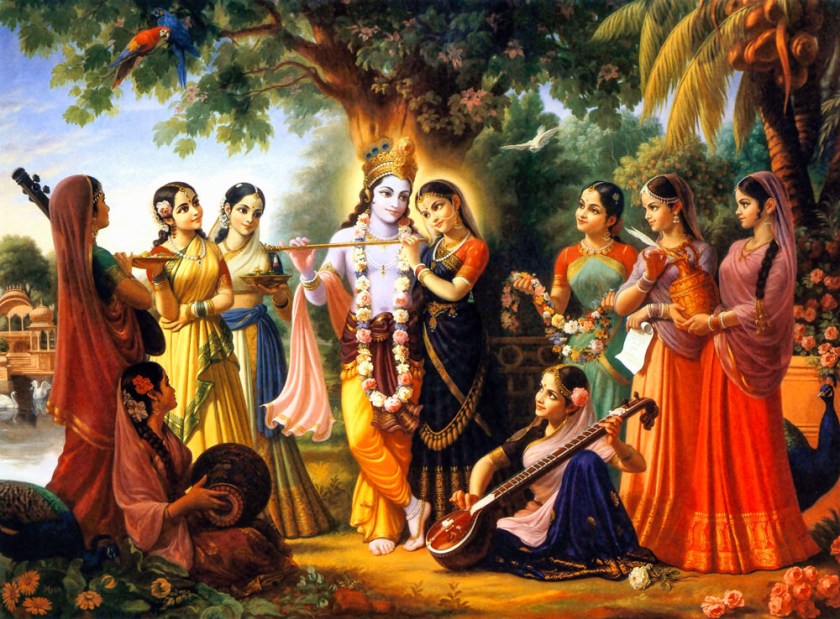
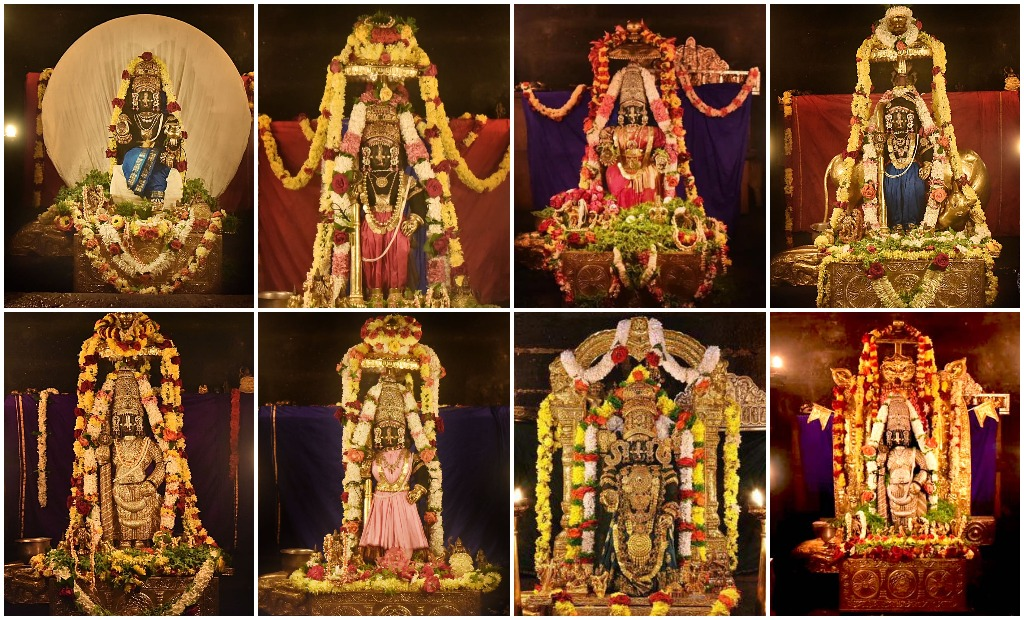
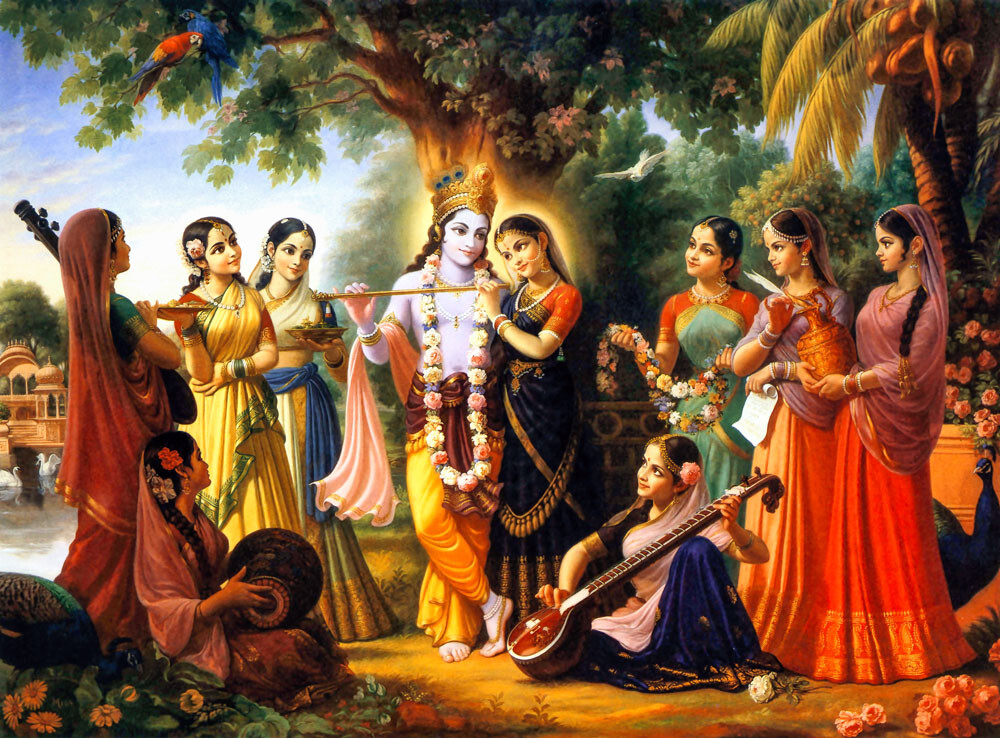
Radha Krishna and the 8 Topmost Gopis

Krishna is the Supreme Personality of Godhead. Krishna is known in other languages as Allah, Jehovah, Yahweh, and many other languages.

ईश्वरः परमः कृष्णः सच्चिदनन्द विग्रह:
अनदिरदिर् गोविन्दः सर्व कारण कारणं ।।१।।

īśvaraḥ paramaḥ kṛṣṇaḥ
sac-cid-ānanda-vigrahaḥ
anādir ādir govindaḥ
sarva-kāraṇa-kāraṇam

Kṛṣṇa who is known as Govinda is the Supreme Godhead. He has an eternal blissful spiritual body. He is the origin of all. He has no other origin and He is the prime cause of all causes. https://vedabase.io/en/library/bs/5/1/

Krishna is the Supreme Absolute Truth.

This means that Krishna’s name, form, pastimes, paraphernalia, abode, associates, etc., are all on the Absolute platform.

नाम चिन्तामणि कृष्णस्चैतन्य रस विग्रहः |
पूर्ण शुद्धो नित्य मुक्तो अभिन्नत्वं नाम नामिनोः ||

nāma cintāmaṇiḥ kṛṣṇaś
caitanya-rasa-vigrahaḥ
pūrṇaḥ śuddho nitya-mukto
’bhinnatvān nāma-nāminoḥ

“ ‘The holy name of Kṛṣṇa is transcendentally blissful. It bestows all spiritual benedictions, for it is Kṛṣṇa Himself, the reservoir of all pleasure. Kṛṣṇa’s name is complete, and it is the form of all transcendental mellows. It is not a material name under any condition, and it is no less powerful than Kṛṣṇa Himself. Since Kṛṣṇa’s name is not contaminated by the material qualities, there is no question of its being involved with māyā. Kṛṣṇa’s name is always liberated and spiritual; it is never conditioned by the laws of material nature. This is because the name of Kṛṣṇa and Kṛṣṇa Himself are identical.’ https://vedabase.io/en/library/cc/madhya/17/133/

Take a second look at the dictionary meaning of “idol”…

Idol: /īd′l/ A false god. One that is adored, often blindly or excessively.

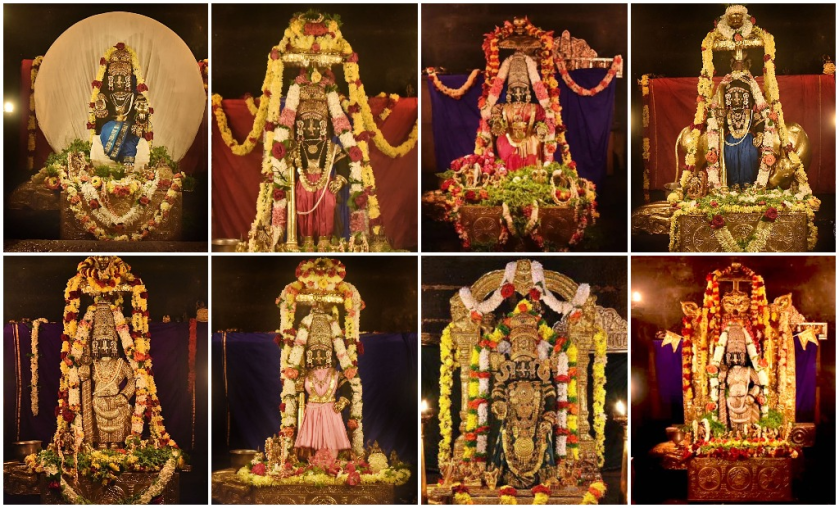
Udupi Sri Krishna
Udupi Sri Krishna

Nothing about Krishna is “false”. And there can be no such thing as “blind” or “excessive” adoration of Krishna. In fact, no matter how much we adore, it is always insufficient. Our problem is that we don’t adore Krishna enough. And we don’t adore Krishna sufficiently because we are blind. If we were not blind, we would be absolutely pure in our love of Krishna.

कृष्णे स्वधामोपगते धर्मज्ञानादिभि: सह ।
कलौ नष्टद‍ृशामेष पुराणार्कोऽधुनोदित: ॥ ४३ ॥

kṛṣṇe sva-dhāmopagate
dharma-jñānādibhiḥ saha
kalau naṣṭa-dṛśām eṣa
purāṇārko ’dhunoditaḥ

This Bhāgavata Purāṇa is as brilliant as the sun, and it has arisen just after the departure of Lord Kṛṣṇa to His own abode, accompanied by religion, knowledge, etc. Persons who have lost their vision due to the dense darkness of ignorance in the Age of Kali shall get light from this Purāṇa. https://vedabase.io/en/library/sb/1/3/43/

Now, to come back to the dictionary meaning of “mythology”…

Mythology: /mĭ-thŏl′ə-jē/ A body or collection of myths belonging to a people and addressing their origin, history, deities, ancestors, and heroes. A body of myths associated with an event, individual, or institution.

सर्वस्य चाहं हृदि सन्निविष्टो
मत्त: स्मृतिर्ज्ञानमपोहनं च ।
वेदैश्च सर्वैरहमेव वेद्यो
वेदान्तकृद्वेदविदेव चाहम् ॥ १५ ॥

sarvasya cāhaṁ hṛdi sanniviṣṭo
mattaḥ smṛtir jñānam apohanaṁ ca
vedaiś ca sarvair aham eva vedyo
vedānta-kṛd veda-vid eva cāham

I am seated in everyone’s heart, and from Me come remembrance, knowledge and forgetfulness. By all the Vedas, I am to be known. Indeed, I am the compiler of Vedānta, and I am the knower of the Vedas. https://vedabase.io/en/library/bg/15/15/

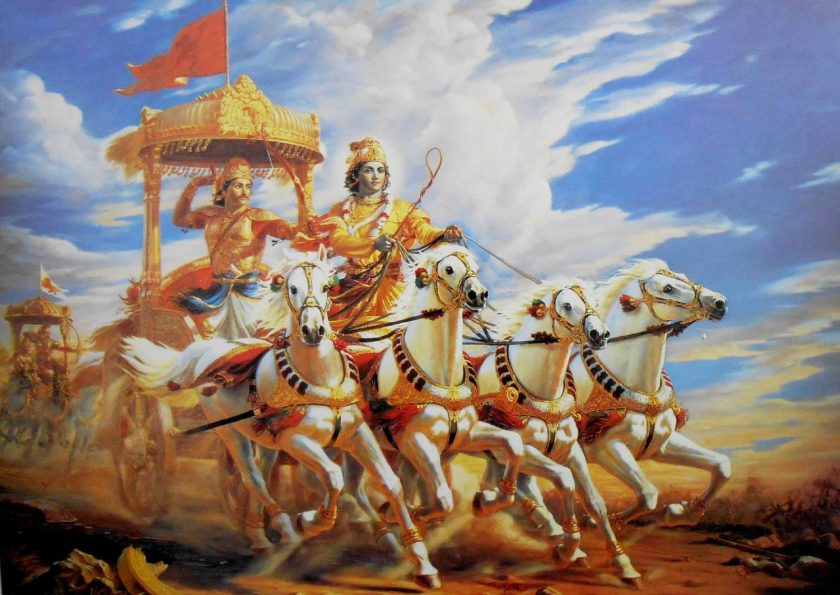
Krishna and Arjuna on the Battlefield of Kurukshetra

The Vedic Scriptures explain different aspects of Krishna. The Puranas are ancient history. So ancient and so broad that they encompass the entire Universe, and go back billions, even trillions of years. Who can comprehend that Universal range and time scale with our teeny little perspective?

Now, where did this misunderstanding come from?

Where did anyone get the idea to call images of Krishna as “idols” and the Vedic scriptures as “Mythology”?

The last surviving bastion of Vedic culture is what is current-day India, Pakistan, Nepal, Bangladesh, Sri Lanka, Thailand, Indonesia, etc.

Vedic culture has been under attack for well over 3000 years. It is natural, because we are in the kaliyuga, the age of quarrel and hypocrisy. Vedic culture i the opposite of quarrel and hypocrisy

First, it was the advent of Buddhism, and Jainism. These are essentially either impersonal, voidist, or both, depending on the specific flavor. Both twisted the Vedic scriptures in different ways. Both were philosophically defeated and Buddhism was mostly driven out to the far corners of the world, away from India.

Lord Buddha

Buddhism was advented by Lord Gautama Buddha to originally to drive out a corruption in Vedic culture.

तत: कलौ सम्प्रवृत्ते सम्मोहाय सुरद्विषाम् ।
बुद्धो नाम्नाञ्जनसुत: कीकटेषु भविष्यति ॥ २४ ॥

tataḥ kalau sampravṛtte
sammohāya sura-dviṣām
buddho nāmnāñjana-sutaḥ
kīkaṭeṣu bhaviṣyati

Then, in the beginning of Kali-yuga, the Lord will appear as Lord Buddha, the son of Añjanā, in the province of Gayā, just for the purpose of deluding those who are envious of the faithful theist.

https://vedabase.io/en/library/sb/1/3/24/

The origin of Jainism was a corruption of the pure teachings and example of Lord Rishbhadeva, an incarnation of Krishna.

Lord Rishabhadeva instructing His sons

यस्य किलानुचरितमुपाकर्ण्य कोङ्कवेङ्ककुटकानां राजार्हन्नामोपशिक्ष्य कलावधर्म उत्कृष्यमाणे भवितव्येन विमोहित: स्वधर्मपथमकुतोभयमपहाय कुपथपाखण्डमसमञ्जसं निजमनीषया मन्द: सम्प्रवर्तयिष्यते ॥ ९ ॥

yasya kilānucaritam upākarṇya koṅka-veṅka-kuṭakānāṁ rājārhan-nāmopaśikṣya kalāv adharma utkṛṣyamāṇe bhavitavyena vimohitaḥ sva-dharma-patham akuto-bhayam apahāya kupatha-pākhaṇḍam asamañjasaṁ nija-manīṣayā mandaḥ sampravartayiṣyate.

Śukadeva Gosvāmī continued speaking to Mahārāja Parīkṣit: My dear King, the King of Koṅka, Veṅka and Kuṭaka whose name was Arhat, heard of the activities of Ṛṣabhadeva and, imitating Ṛṣabhadeva’s principles, introduced a new system of religion. Taking advantage of Kali-yuga, the age of sinful activity, King Arhat, being bewildered, gave up the Vedic principles, which are free from risk, and concocted a new system of religion opposed to the Vedas. That was the beginning of the Jain dharma. Many other so-called religions followed this atheistic system. https://vedabase.io/en/library/sb/5/6/9/

Later invasions from the west

But then, there were the expansionist invasions by the zealots claiming to follow “Islam, the religion of peace”. Those invaders to the Holy Land of India were attracted by the wealth, the riches in the temples… But they were too uncivilized and uncultured to appreciate the nuances of Vedic culture.

So they started calling temple worship “idol worship” in their middle eastern languages, Arabic, Persian, etc. They started a systematic system of persecution, calling the followers of Vedic culture as “kafirs” or non-believers. They did not understand that Krishna is actually Allah Himself. This persecution conginues to this day, a thousand years on. For example in Pakistan and Bangladesh, followers of Vedic culture are still harshly persecuted.

The European powers made the most sophisticated attempts to culturally conquer the Vedic culture. They came to India about 600 years ago. They engaged in business and military conquest. They also sought to replace Vedic culture with barbarian European culture through an insidious system called “modern education”.

Indians have been conditioned to denigrate their own culture!

Indians began to speak Portuguese, Dutch, French, and English. They were made to forget their own languages, their own customs and refined practices. It was deeply rooted. The Europeans, especially the British, sought to vilify all Vedic practices through their Christian missionaries.

  1. Deity worship became “Idol Worship”.
  2. Krishna became a “tribal chieftain” or at best, a “Hindu god”.
  3. All the ancient historical texts like the Vedas, the Upanishads, the Puranas, became “Hindu myths”.

Vedic culture will rescue with world from its dense darkness. To revive the glorious Vedic culture, we must first reject this insulting word “idol” in relation to Krishna. We must also reject the derogatory “mythology” in relation to the Vedic scriptures.

What is idol worship then?

It is the worship of politicians, business people, actors, sports people, military leaders, etc. It is the worship of TV personalities and entertainers. The western world fully engages in idol worship daily. They do this through their thousands of TV channels, their movies, their books, newspapers, magazines, their marketplaces, and living spaces.

Sports fans indulging in Idol Worship

“Western Culture”, an oxymoron, means to worship the temporary bodies, through luxurious homes devoid of a culture of Krishna Consciousness. It means lavish bathrooms and swimming pools. It means arenas to celebrate war in disguise. It means a worship of their dogs and cats. It means the killing of cows and bulls, which are dear to Krishna.

Reject idol worship, by all means, but the form of Krishna is not an “idol”.

We can use the these words instead to describe images of Krishna:

  1. “Archa Vigraha” (अर्च विग्र:) – the Divine Worshipable Form of God
  2. Deity
  3. Divine Form of God

And what is mythology?

What is called “modern science” is mostly mythology. And the western version of “history” is mythology. Common uncultured rascals have been promoted as great personalities. Alexander “the great” was a looter and marauder. Napoleon was a low class murderer and looter. He conspired to become king of France after the French had executed their king and rejected the monarchy. Winston Churchill was a disgusting narrow minded bigot. He was a lying manipulator. He was not a great leader by any stretch of the imagination, because he was full of all vices.

False history propagated by the Europeans

Everything that opposes the pristine Vedic culture is mythology. This includes the spiritual texts of the Middle East, that were once great and pure. These texts like the Quran, Bible, etc., have been censored, edited and misinterpreted. They have lost spiritual value due to tampering. They are only good as political manifestos now. Even if the text is intact, the misinterpretation and misunderstanding of it has depleted its value.

So, yes, reject mythology also, but the Vedic scriptures are not mythology.

धर्म: प्रोज्झितकैतवोऽत्र परमो निर्मत्सराणां सतां
वेद्यं वास्तवमत्र वस्तु शिवदं तापत्रयोन्मूलनम् ।
श्रीमद्भागवते महामुनिकृते किं वा परैरीश्वर:
सद्यो हृद्यवरुध्यतेऽत्र कृतिभि: शुश्रूषुभिस्तत्क्षणात् ॥ २ ॥

dharmaḥ projjhita-kaitavo ’tra paramo nirmatsarāṇāṁ satāṁ
vedyaṁ vāstavam atra vastu śivadaṁ tāpa-trayonmūlanam
śrīmad-bhāgavate mahā-muni-kṛte kiṁ vā parair īśvaraḥ
sadyo hṛdy avarudhyate ’tra kṛtibhiḥ śuśrūṣubhis tat-kṣaṇāt

Completely rejecting all religious activities which are materially motivated, this Bhāgavata Purāṇa propounds the highest truth, which is understandable by those devotees who are fully pure in heart. The highest truth is reality distinguished from illusion for the welfare of all. Such truth uproots the threefold miseries. This beautiful Bhāgavatam, compiled by the great sage Vyāsadeva [in his maturity], is sufficient in itself for God realization. What is the need of any other scripture? As soon as one attentively and submissively hears the message of Bhāgavatam, by this culture of knowledge the Supreme Lord is established within his heart. https://vedabase.io/en/library/sb/1/1/2/

You can call the Vedic scriptures as:

  1. The Yoga texts of India
  2. Vedas or Puranas
  3. Vedic scriptures
  4. Vedic literature
  5. Vedic History

Please give up the use of the words “idol” and “mythology” in relation with Vedic Culture! Hare Krishna!

The Simple Devotion of Haridasa Varya Prabhu

Haridasa Varya Prabhu, a humble and devoted soul, exemplifies the profound impact of simple devotion. Initiated at the age of 82, he lived a quiet life in Maharashtra, embodying true spirituality through daily chanting and reading. Despite illness, his dedication never wavered, demonstrating that it’s never too late to pursue a spiritual path. Surrounded by supportive devotees, his sincere humility and consistent practice of chanting the Hare Krishna mantra brought him closer to Krishna, ultimately guiding him to spiritual perfection.

Haridasa Varya Prabhu is not a well known devotee. He is not a Guru. He is not a big leader. He does not give classes. He does not write books. He did not take any tremendous vows. He did not commit to or achieve some ambitious project. He is a simple devotee. But his simple devotion earned him a place in the spiritual realm. Read more about the simplicity of this sweet devotee that made him dear to Guru and Krishna.

Born in 1941, Haridasa Varya Prabhu left for the spiritual world in 2025 at the age of 84. He was initiated quite recently, in 2023. How did he achieve this amazing feat, and that too “so quickly”?

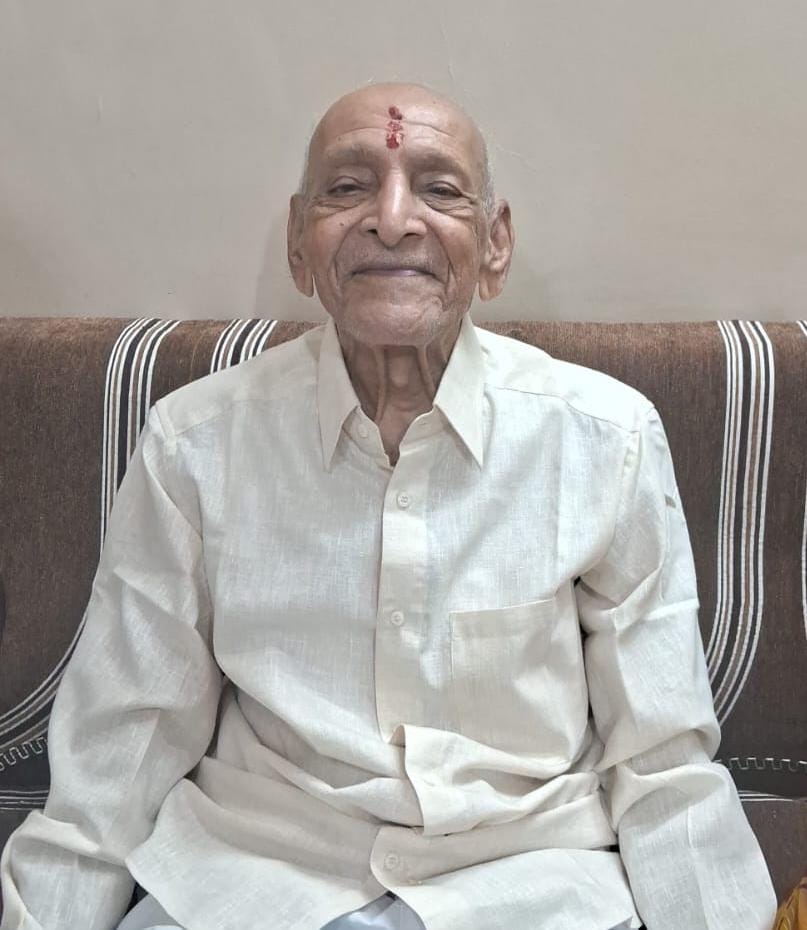
His Grace Haridasa Varya Prabhu

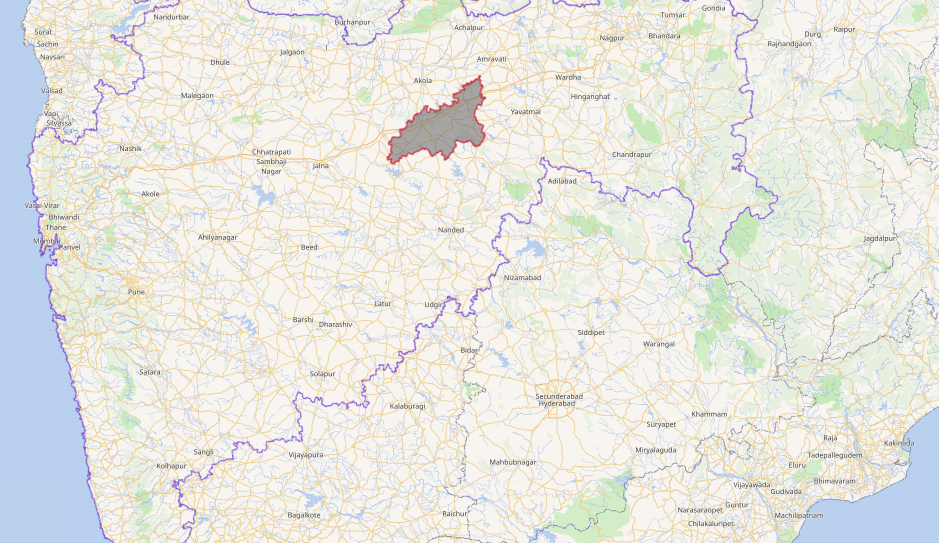
Our hero was born in a pious Marathi-speaking family. It was in a little village in the Washim District of Maharashtra. He led a very quiet and simple life. Married, early, he had two sons and a daughter. I learned about this great soul through his daughter. She is a devotee named Shyama Gauri Devi Dasi. She is a disciple of His Holiness Radhanath Swami. When she spoke about her father, I was inspired and struck by the simple devotion of her father. I had to write about it.

A map of India highlighting the Washim District of the State of Maharashtra

A map of India highlighting the Washim District of the State of Maharashtra

Once, not long ago, a visiting preacher, Ram Narayan Prabhu asked this elderly gentlemen “How many rounds are you chanting?”. The answer came back “Five”. The preacher asked “How will you reach spiritual perfection by chanting only five rounds?”. He added “If you chant a sixteen rounds, I will arrange for your initiation”. Our elderly hero was incredulous “What, even I can get initiated?” – thinking himself so unqualified for spiritual initiation, nevertheless started chanting sixteen rounds of the Hare Krishna Mahamantra. Every single day our octogenarian hero would chant Hare Krishna. Minimum of 16 rounds. Every single day.

Baladev Prabhu is our hero’s spiritual guide. He served as “Atma Pradarshak Guru” and “Shiksha Guru”, the instructing spiritual master. He took great pains to craft a plan of spiritual practice suitable for an octogenarian. Another spiritual guide was Vednath Prabhu, the Bhakti Vriksha leader or the local community.

Simple things get harder in old age. That’s one reason to start as early as possible. But, our hero never skipped his rounds. Even in ill health. Even in pain. No matter how hard it got, there was no stopping until he got to the magic number 16 rounds.

When it came time to getting initiated, though, there was a problem. He couldn’t travel far. In fact, he barely traveled to a nearby village. So how would he get initiated?

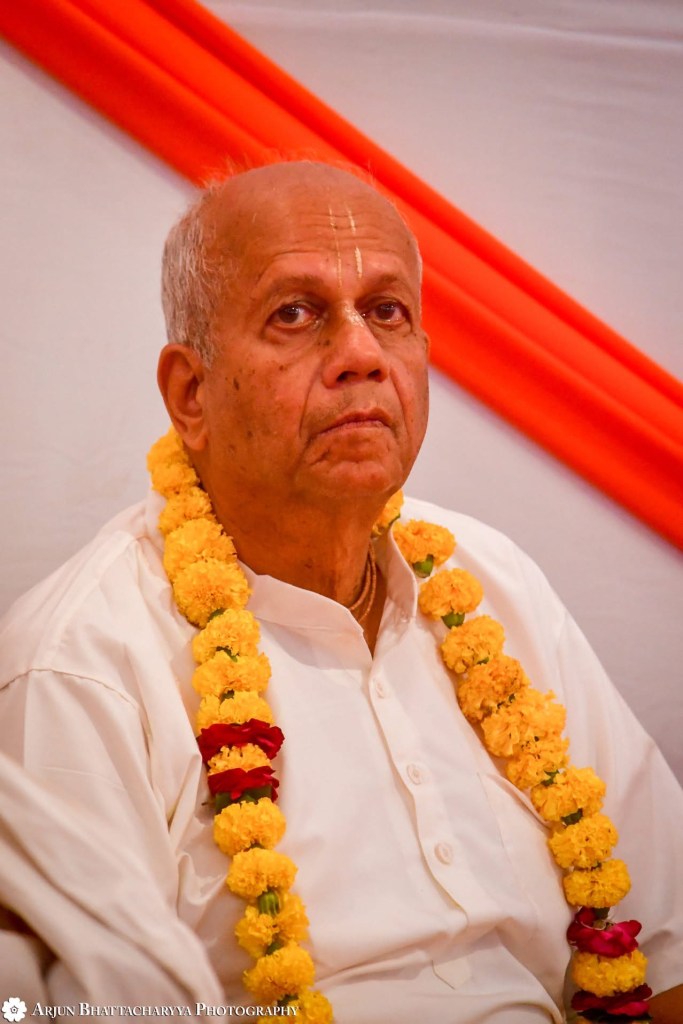
His Grace Samika Rishi Prabhu is a disciple of Srila Prabhupada. When he heard about this sincere soul, he agreed to initiate him. Not only is Samika Rishi Prabhu an accomplished physician of the body, he also is a doctor for the soul. The spiritual master has over 50 years of dedicated service under his belt. He agreed to visit the little village in Washim, Maharashtra. He came just to initiate this sincere soul.

His Grace Samika Rishi Prabhu, disciple of His Divine Grace A. C. Bhaktiveddanta Swami Prabhupada, the spiritual master of Haridasa Varya Prabhu

On the initiation day, everyone was moved by the sincerity of the octogenarian initiate! His simplicity and dedication were clearly seen by all. New initiates are required to take the following vows:

  1. To chant a minimum of 16 rounds of the Hare Krishna Mahamantra (1728 utterances of the mantra) every day.
  2. To follow these four regulative principles
    • No illicit sex
    • No gambling
    • No meat eating
    • No intoxication

When taking the vows to follow the regulative, our hero was embarrassed. He didn’t want anyone thinking he used to do these things before and would now abstain from them! So he took the vows somewhat like this:

“I don’t partake of illicit sex, gambling, meat eating, or intoxication” – deliberately using the present tense!

That simple innocence definitely brought a chuckle to everyone present!

His Grace Samika Rishi Prabhu initiated our hero with the name “Haridasa Varya Das.” This name means “The foremost among the servants of Sri Hari.” He took his spiritual life very seriously.

This was the daily schedule of Haridasa Varya Prabhu:

7:00 AM – rise, cleanse teeth, have breakfast, take a bath, apply Tilaka, recite his mantras at the altar. The mantras starting with the Ganapati Stotra and other mantras he was used to reciting since childhood.

8:00 AM – Chant 16 rounds of the Hare Krishna Mahamantra on meditation beads

11 AM – Lunch

12 Noon – Nap

2 PM – Read the Srimad Bhagavatam, at least 40 pages daily – make a daily record of his reading

4PM – Watch TV, speak with other villagers

6PM – dinner

7PM – Chant Hare Krishna some more

9PM – Rest

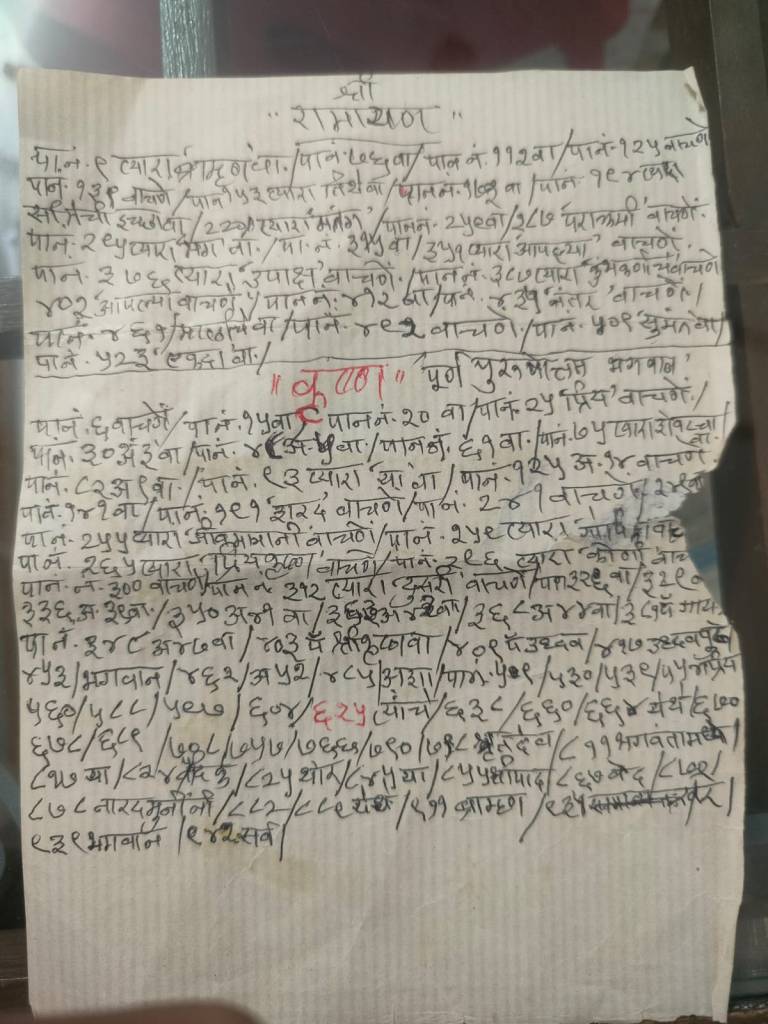
Handwritten notes containing the reading progress of His Grace Haridasa Varya Prabhu around the date of his departure

Handwritten notes example, containing the reading progress of His Grace Haridasa Varya Prabhu around the date of his departure

When he became sick closer to departure from his body, he chanted constantly, with or without beads. Even without beads, or while “asleep”, he would “move the beads”on a piece of cloth in bed.

Just before he departed, he did this:

  • Asked for his beads
  • Asked for a picture of Krishna to be brought before him. Not just any picture of Krishna from some magazine, but a picture of Sri Radha Pandharinath from ISKCON Pandharpur.
  • He told his daughter-in-law “There are four personalities here. They have come to take me home”
  • He asked to go outside in the sun, and spoke to passersby as if saying goodbye to everyone
  • Took Krishna Prasadam
  • A neighbor who had gone to Prayagraj for the Maha Kumbha Mela gave him some Ganga Jal (water from the Ganga)
  • Refused to go into his bedroom to sleep
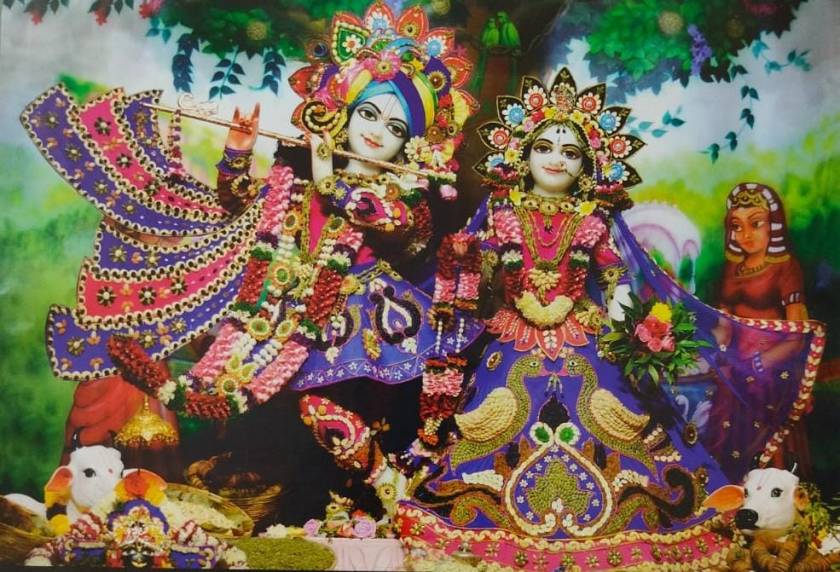
  • Sat down on a couch gazing at a picture of Sri Radha Vrindavan Chandra from ISKCON NVCC Pune.
  • Told his daughter-in-law, “Yes, there are four of them who have come for me”
  • Took his “bath”, a sponge bath from one of his daughters-in-law
  • He departed just when his arms were raised to put on his shirt
Sri Radha Vrindavan Chandra, ISKCON NVCC Pune

Haridasa Varya Prabhu used to love to lead Harinam Kirtan in his own special way. Someone would hold a microphone close to his mouth and he would sing a simple song or two. His sincere Kirtan was appreciated by all.

This was one of his favourite songs:

तू माझा यजमान रामा, तू माझा यजमान ||धृ||

जननी जठरी रक्षियले मज,पोसुनी पंचहि प्राण ||१||

बाहेर निघता मातेचे स्तनी,पय केले निर्माण ||२||

ऐसे असता या पोटाची,का करू चिंता जाण ||३||

मध्व मुनीश्वर स्वामी रमापती,धरी माझा अभिमान ||४||

You are my Lord Rama, You are my Lord

In the womb of my mother, you protected me, you preserved my five life airs

When I came out, you caused milk to flow from my mother’s breast

When this is so, why shall I worry for my own sustenance

He read the entire Srimad Bhagavatam and the entire Chaitanya Charitamrita. He was on his second round of reading the Srimad Bhagavatam around the date of his departure.

He leaves behind his wife, Mother Damodar Priya Devi Dasi, also initiated by Samika Rishi Prabhu.

At the end, he pulled out an ace… attained perfection… whatever he did or not, at the end, he did. – Her Grace Rukmini Devi Dasi (JPS)

Haridasa Varya Prabhu, I pray at your lotus feet the next prayer taught to me by my spiritual master. I fall down in the dust of your lotus feet while praying this prayer to you. You have shown us by your personal example of humility, eagerness, consistency, and presence of mind. You have attained pure devotional service at the lotus feet of Sri Radha Vrindavan Chandra. You are very kind and merciful Vaishnava. Please grant this poor soul shelter at your lotus feet.

From Haridasa Varya Prabhu’s life, we get the following lessons:

  1. It is never too late to start – of course, start as early as possible, but start, and GO!
  2. When the disciple is ready, the spiritual master is sent by Krishna. In this case, Haridasa Varya Prabhu’s spiritual master came all the way from New Jersey, USA.
  3. Humility is a great asset – Haridasa Varya Prabhu considered himself unfit for initiation!
  4. Take spiritual practice seriously. It is potent. Chanting Hare Krishna. Reading Srimad Bhagavatam. Every bit counts!
  5. Focus consciousness on what is most important, and do it every day.
  6. Simplicity in spiritual life is a prized asset, we should cultivate this simplicity that allows us to chant always.
  7. Krishna is very kind and merciful, and His devotee is even more so. We see this from the example of all the devotees who encouraged Haridasa Varya Prabhu.
  8. The process of devotional service as given to us by His Divine Grace A. C. Bhaktivedanta Swami Prabhupada works.

ये तु सर्वाणि कर्माणि मयि सन्न्यस्य मत्परा: ।
अनन्येनैव योगेन मां ध्यायन्त उपासते ॥ ६ ॥
तेषामहं समुद्धर्ता मृत्युसंसारसागरात् ।
भवामि न चिरात्पार्थ मय्यावेशितचेतसाम् ॥ ७ ॥

ye tu sarvāṇi karmāṇi mayi sannyasya mat-parāḥ
ananyenaiva yogena māṁ dhyāyanta upāsate

teṣām ahaṁ samuddhartā mṛtyu-saṁsāra-sāgarāt
bhavāmi na cirāt pārtha mayy āveśita-cetasām

But those who worship Me, giving up all their activities unto Me and being devoted to Me without deviation, engaged in devotional service and always meditating upon Me, having fixed their minds upon Me, O son of Pṛthā – for them I am the swift deliverer from the ocean of birth and death.

https://vedabase.io/en/library/bg/12/6-7/

And this beautiful verse…

अहो बकी यं स्तनकालकूटं
जिघांसयापाययदप्यसाध्वी ।
लेभे गतिं धात्र्युचितां ततोऽन्यं
कं वा दयालुं शरणं व्रजेम ॥ २३ ॥

aho bakī yaṁ stana-kāla-kūṭaṁ
jighāṁsayāpāyayad apy asādhvī
lebhe gatiṁ dhātry-ucitāṁ tato ’nyaṁ
kaṁ vā dayāluṁ śaraṇaṁ vrajema

Alas, how shall I take shelter of one more merciful than He who granted the position of mother to a she-demon [Pūtanā] although she was unfaithful and she prepared deadly poison to be sucked from her breast?

https://vedabase.io/en/library/sb/3/2/23/

Srila Prabhupada
Srila Prabhupada

How Spiritual Practices Combat Material Pollution

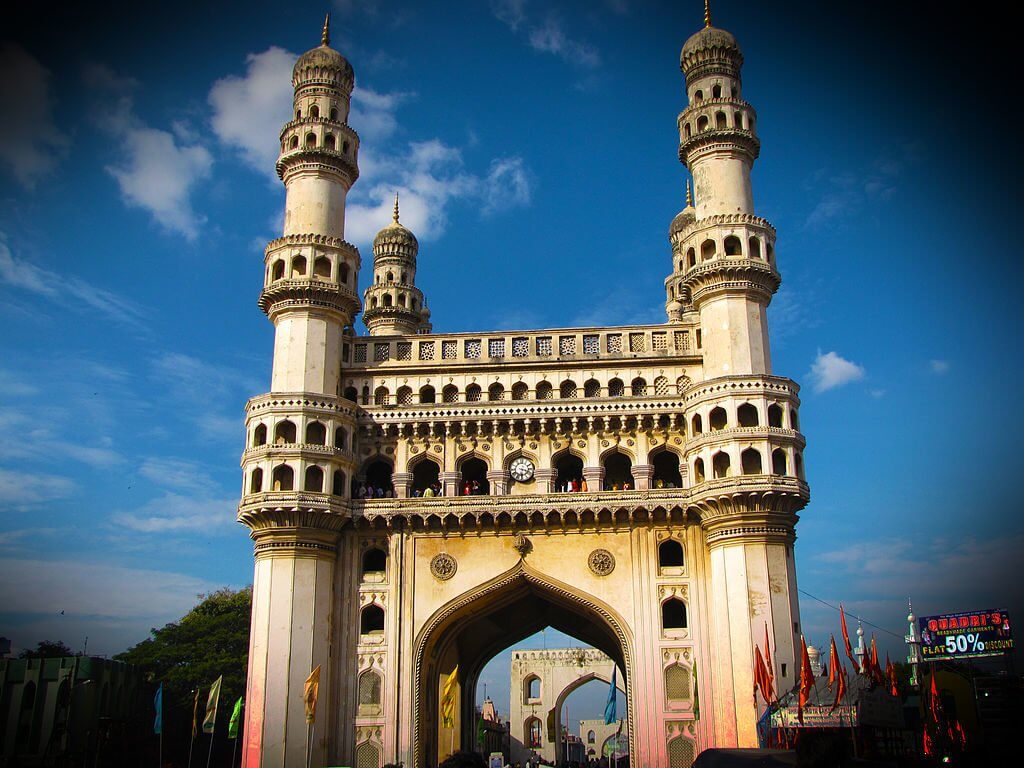
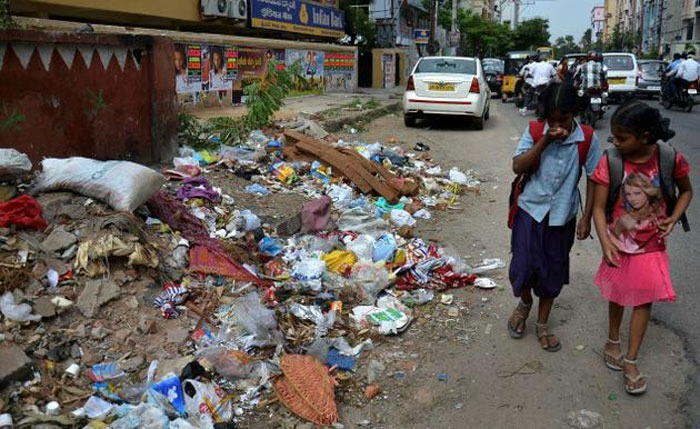
Hyderabad, like many other cities, is a vibrant chaos of litter. Dedicated street cleaners face a relentless battle against the chronic litterbugs who trash the city daily. Despite their morning efforts, the streets revert to their messy state by evening. This mirrors our spiritual lives where temporary cleansings fail to eliminate deeper impurities. The battle against sin and distraction is exacerbated by our habits that pollute consciousness. The antidote? Fully embrace Krishna Consciousness—an all-encompassing practice that brings clarity, purpose, and purity to both streets and spirit.

I am here in India presently, the booming bustling messy city of Hyderabad.

Every morning, I walk back from the temple after the morning program. I admire the cleaners busily cleansing the streets of all sorts of garbage… pieces of paper, plastic wrappers, cigarette butts, and more.

Street Sweepers in Hyderabad

They work quite hard, actually. They diligently sweep and clean up everything. They collect it all, put it into their carts, and take it all away. At about 8 AM in the morning, everything looks so neat and clean!

But come the afternoon, the streets look almost the same as they did before. This, despite all the hard work by the cleaners of Hyderabad!

No matter how much the cleaners clean, Hyderabad streets remain as messy as ever.

What just happened?

Litterbug city

The culprits are the citizens (no offense intended) of Hyderabad! Most of them are chronic litterbugs… I saw one man on a motorcycle. He opens up a sachet of tobacco. He pops the contents into his mouth and discards the wrapper right there. All this while he is stopped in traffic.

Motorcycle riders in Hyderabad

A child peels the wrapper off a sweet. She pops it into her mouth. Then she discards the wrapper.

A street vendor is preparing some fruit for sale… He discards all the peels in a heap behind his cart.

A fruit vendor in Hyderabad

A housewife has just swept her home, and she dumps the rubbish right on the street outside her house.

A man in a business suit is in a chauffeured car. He rolls down the tinted window of his fancy car. He out throws out an envelope, carefully torn into tiny bits. He spits out a stream of red tobacco induced liquid.

Boys light firecrackers on the street – it is a few weeks to Diwali. They’re getting a head start on the merriment… Every firework is left right there on the street where it went off… Bits of plastic, paper tubes, shredded paper.

Multiply that 11 Million times… the population of Hyderabad. It’s a recipe for one messy place!

Then the next morning, the cleaners will be at it again… sweep, collect, throw.

But Hyderabad looks as messy as ever, day after day. The rivers are open sewers, drains are clogged with plastic film… People have been spitting all over the place.

The cleaners don’t stand a chance, they are outnumbered!

Spiritual Cleansing, Materialistic Littering

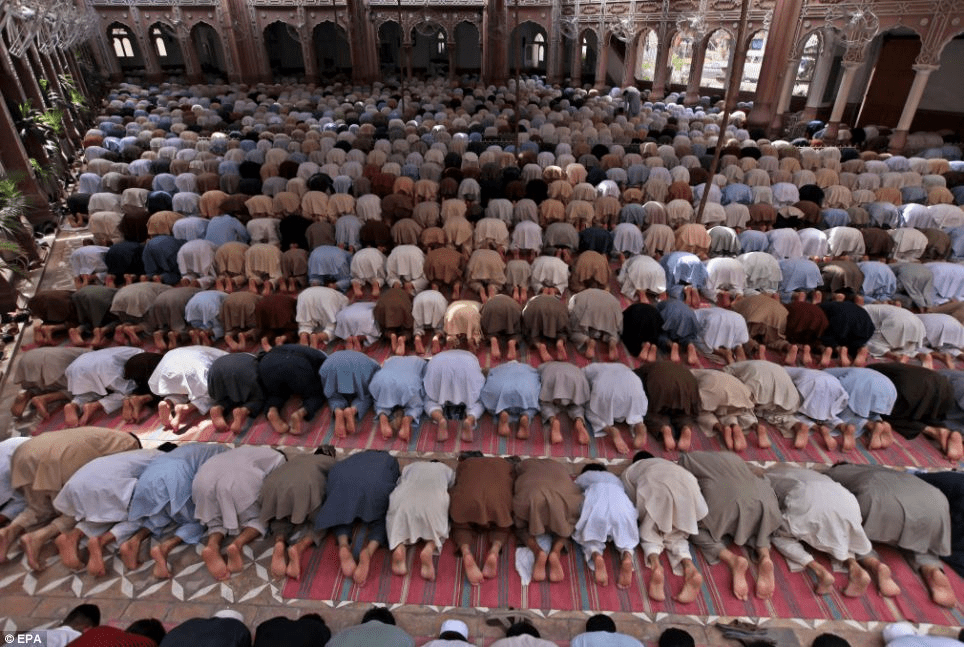
On the spiritual path, people often engage in cleanups… Prayers, Purificatory rituals, penances, austerities… But sometimes we feel discouraged when there is no progress.

Faithful Muslims Praying

Let’s say someone prays or meditates (cleansing the consciousness) for 5 minutes, 20 minutes, or even two hours every day. Or more. What happens for the remaining time during the day?

It’s the same thing – gotta’ stop littering for the effects of the cleaning to show!

The streets of Hyderabad are cleaned each morning. But the actions of the chronic litterbugs make it seem futile. Similarly, our consciousness can be littered by where we choose to focus our attention.

It is important to focus our consciousness in a way that doesn’t litter our consciousness with more materialistic garbage.

The elephant’s bath

In a picturesque analogy from the Bhagavatam, King Parikshit makes this astute observation. He observes the souls passing in turn through regions of enjoyment and purgatory throughout the Universe. Souls are rewarded with heavenly pleasures for their pious activities, and punished for their sinful activities.

King Parikshit receives transcendental knowledge from the great sage Sukadeva Goswami

These pious and impious activities don’t cancel each other out. The after-effects of both must be experienced separately. Enjoyment for pious deeds, and suffering for the impious. And every such activity leaves behind a seed of future entanglement.

Many of us on the spiritual path are very keen to avoid the sinful activities. But all too often, we still fall victim.

क्‍वचिन्निवर्ततेऽभद्रात्‍क्‍वचिच्चरति तत्पुन: ।
प्रायश्चित्तमथोऽपार्थं मन्ये कुञ्जरशौचवत् ॥ १० ॥

kvacin nivartate ’bhadrāt
kvacic carati tat punaḥ
prāyaścittam atho ’pārthaṁ
manye kuñjara-śaucavat

Sometimes one who is very alert so as not to commit sinful acts is victimized by sinful life again. I therefore consider this process of repeated sinning and atoning to be useless. It is like the bathing of an elephant, for an elephant cleanses itself by taking a full bath, but then throws dust over its head and body as soon as it returns to the land.

https://vedabase.io/en/library/sb/6/1/10/

An elephant bathes himself with clean water
An elephant showers himself with mud

Many of us do the same… we engage in purification, and then we cover our consciousness with dirt.

What is that “dirt”… It is activities which cover our spiritual consciousness with material contamination. Think television, newspapers, mundane movies, games of crickets and soccer, video games, internet gossip and worse.

Why?

It’s so important to lose the habit of littering our consciousness!

Lord Krishna says this in His Song, the Bhagavad Gita, the Song of God…

विषया विनिवर्तन्ते निराहारस्य देहिनः ।
रसवर्जं रसोऽप्यस्य परं दृष्ट्वा निवर्तते ॥ ५९ ॥

viṣayā vinivartante
nirāhārasya dehinaḥ
rasa-varjaṁ raso ’py asya
paraṁ dṛṣṭvā nivartate

Though the embodied soul may be restricted from sense enjoyment, the taste for sense objects remains. But, ceasing such engagements by experiencing a higher taste, he is fixed in consciousness.

https://vedabase.io/en/library/bg/2/59/

You see, the taste for sense objects remains. There is facility, there is time, and so, we fall headlong.

But is there a way to prevent this? How to avoid the fall?

केचित्केवलया भक्त्या वासुदेवपरायणा: ।
अघं धुन्वन्ति कार्त्स्‍न्येन नीहारमिव भास्कर: ॥ १५ ॥

kecit kevalayā bhaktyā
vāsudeva-parāyaṇāḥ
aghaṁ dhunvanti kārtsnyena
nīhāram iva bhāskaraḥ

Translation

Only a rare person who has adopted complete, unalloyed devotional service to Kṛṣṇa can uproot the weeds of sinful actions with no possibility that they will revive. He can do this simply by discharging devotional service, just as the sun can immediately dissipate fog by its rays.

https://vedabase.io/en/library/sb/6/1/15/

The process of Krishna Consciousness is so sublime. There is Krishna Consciousness activity to immerse ourselves twenty four hours a day.

24/7 Spiritual Engagement

We can start with rising early for Mangala Arati. We can engage in a full morning program of hearing, chanting, and worship. Our consciousness becomes charged up with Krishna. We can then insert Krishna Conscious thoughts, words, and deeds throughout the day as we go about our duties.

And of course, someone who rises early is also forced to rest early. So much trouble avoided!

And of course, genuine spiritualists do not litter. Not their consciousness, not their homes, nor their streets.

Let us take advantage of this process! Want to avoid littering your streets of your consciousness? Want to know how?

P.S: I have nothing against the city or the people of Hyderabad. It is practically the same story in every village, town, or city in the world. It is the terrible practice of littering, both spiritual and material, but especially the spiritual littering that I’m advocating against.

Madhvacharya’s Genius: A Solution for Managerial issues

Managing in religious organizations is uniquely challenging, with managers often facing burnout from balancing volunteer dynamics, demanding senior leaders, and resource limitations. There are other issues too, leading to dysfunctional management. This can hinder personal and spiritual growth. Implementing a rotational management system, like Madhvacharya’s, can combat burnout and foster healthier organizational environments, allowing managers, the organizaton, and the congregations to thrive.

He who is regulated in his habits of eating, sleeping, recreation and work can mitigate all material pains by practicing the yoga system. BG 6.17

Have you ever met a dysfunctional manager?

Someone who has been managing up, managing down, managing sideways, somehow trying to get things to work but failing? In your temple, church, mosque or synagogue?

A manager can be any one of burned out, corrupt, entitled, or arrogant. It is possible that a manager in a religious organization has lost touch with the purpose of the organization… I discussed that in one of my previous posts. That article talks about whether it is possible for a genuinely spiritual organization to even exist.

Corporate vs. Religious Management

In the corporate world, managers have it relatively easy. After all, when things get sticky, they can choose to leave. They switch jobs or fire people. They can also switch roles. We concluded with the sage words of Srila Prabhupada on how to manage effectively. The essence is that the managers or leaders can’t lose sight of the spiritual goal, the main thing.

Burned out manager

The dysfunctional manager’s dual persona

The confusing part is usually when we meet such a dysfunctional the manager as an individual. They are usually a perfectly nice person. But when we meet the individual in their role as a manager, they can be cold or calculating. They may behave as shrewd, political, or even diabolical. They might seem callous, jealous, or envious. Sometimes, they are angry, sad, frustrated, anxious, or exhibit other negative traits. Most of the time, they may come across as uninspired and uninspiring.

Challenges for Managers in Religious Organizations

Let’s face it. Managers in religious organizations have it tough.

Managing Volunteers
On the one hand, they manage an organization of volunteers. Volunteers can choose to accept what the manager is telling them, or do otherwise. Volunteers are few and far between. Volunteers are hard to fire. Every religious organization needs its volunteers.

Volunteers

Reporting to Senior Leaders
On the other hand, managers in religious organizations often report to senior religious leaders. These leaders can be very demanding and authoritarian. Some of them can be egotists, worse than leaders in the corporate or business world. After all, a person who actually believes he is worthy of his exalted position can be dangerous. This belief is downright perilous.

Resource and Donor Management

There are other constraints. Managing scarce resources is one of them. Keeping donors happy without pandering to their every whim is another difficult job.

Leaders in religious organizations

The Consequences of Burnout
Continuously managing in this way leads to burnout. Managers lose their focus, their vision, and their enthusiasm. They end up acting in petty ways or developing serious issues like abuse of power, corruption, etc. Such managers land their organizations in hot water. Then, they cease to think or act “spiritual” by any stretch of the imagination. The news headlines reveal this all too often, unfortunately.

The Neglect of Personal Well-being
Mainly, the problem is that management stresses leave the managers no time and energy. Managers (often volunteers themselves) can’t take care of their own physical, mental, emotional needs. Most importantly, they can’t invest into their own spiritual needs. All too often, managers in religious organizers manage, manage, manage their way into personal destruction, disrepute, disgrace, and eventually oblivion.

A spiritual leader in poor health

The Difficulty of Finding Qualified Managers

Understandably, it is very hard to find a serious spiritualist who will take up management responsibility in a religious organization. So many individuals with integrity and capability refuse. The task is very challenging. As a result, all too often, someone ends up in the role who is not qualified to manage. This happens out of necessity or just convenience. Someone who happened to be at the right place at the right time. So, unfortunately, it so happens that a dysfunctional manager is often kept in the role for too long. To the detriment of the individual. To the detriment of the organization. And to the detriment of the congregation.

To a sincere but capable soul, accepting management responsibility with no end in sight seems like spiritual suicide.

Not just burnout…

There is a well-known saying that power corrupts, and absolute power corrupts absolutely. This applies to all situations where someone has some power. But it is especially applicable to managerial situations in religious organizations. After all, a manager in a religious organization does have material power. This includes access to money, people, land, and resources. But they also carry the special cachet of being close to God.

To anyone who opposes a dysfunctional manager, that is a double jeopardy… They are dealing with someone who is undoubtedly very powerful. This person is also apparently very close to God!

And of course, all members of religious organizations are instructed to be subservient to authority! See the problem?

When someone has lost the mood of a servant

In all effective organizations, the leadership must keep the mood of being a servant.

Sri Chaitanya Mahaprabhu, God Himself appearing in the form of His own devotee, famously said this:

नाहं विप्रो न च नरपति नापि वैश्यो न शूद्रो
नाहं वर्णी न च गर्हपतिर्नो वनस्थो यतिर्वा |
किन्तुप्रोद्यननिखिलपरमानन्दपुर्णाम्र्ताब्धेर्
गोपीभर्तुः पदकमलयोर्दासदासनुदासः ||

nāhaṁ vipro na ca nara-patir nāpi vaiśyo na śūdro
nāhaṁ varṇī na ca gṛha-patir no vanastho yatir vā
kintu prodyan-nikhila-paramānanda-pūrnāmṛtābdher
gopī-bhartuḥ pada-kamalayor dāsa-dāsānudāsaḥ

“ ‘I am not a brāhmaṇa, I am not a kṣatriya, I am not a vaiśya or a śūdra. Nor am I a brahmacārī, a householder, a vānaprastha or a sannyāsī. I identify Myself only as the servant of the servant of the servant of the lotus feet of Lord Śrī Kṛṣṇa, the maintainer of the gopīs. He is like an ocean of nectar, and He is the cause of universal transcendental bliss. He is always existing with brilliance.’ ” https://vedabase.io/en/library/cc/madhya/13/80/

God Himself is flawless in all respects, in every role. Yet, God’s illusory energy, Maya, she, is a formidable temptress. Maya can convince anyone of that which is not. A manager or a leader can be falsely convinced that they are not a servant.

दैवी ह्येषा गुणमयी मम माया दुरत्यया ।
मामेव ये प्रपद्यन्ते मायामेतां तरन्ति ते ॥ १४ ॥

daivī hy eṣā guṇa-mayī
mama māyā duratyayā
mām eva ye prapadyante
māyām etāṁ taranti te

This divine energy of Mine, consisting of the three modes of material nature, is difficult to overcome. But those who have surrendered unto Me can easily cross beyond it. https://vedabase.io/en/library/bg/7/14/

It is very easy for anyone to fall prey to the illusory material energy. After all, religious organizations are not full of perfected beings, but those who are trying to become spiritually perfect! So, it is practically unfair for a religious organization to leave someone in a position of power for too long.

Madhvacharya’s Management Genius

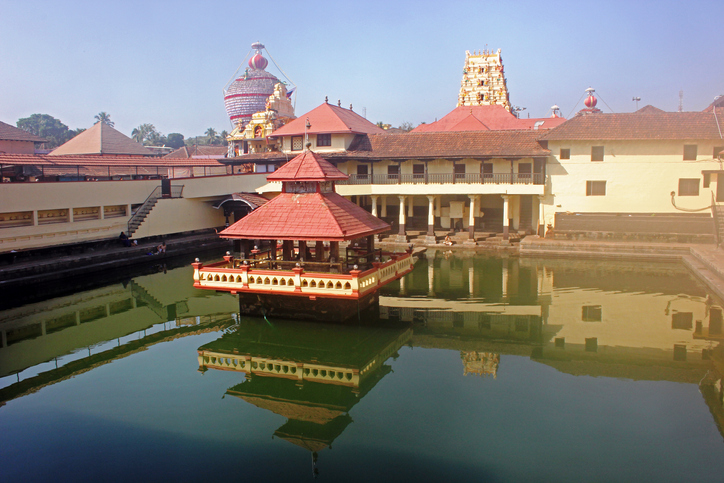
The Udupi Sri Krishna temple

Madhvacharya, an influential 13th Century Guru was a management genius. While his spiritual contributions are unparalleled, there is another amazing contribution. He presented a very intelligent management paradigm that religious organizations should take note of. He recognized all these problems and came up with a master stroke of a management strategy.

Madhvacharya disappeared from our view in the Himalayas at Badarikashram over 700 years ago. He went to associate with his Guru Sri Veda Vyasa. It is said that the spiritual master and disciple are still living there, up in the Himalayas. But the management system he put into place still continues to work in Udupi, at the Sri Krishna Matha.

Lord Sri Krishna in Udupi

The Rotating Management System
What is Madhvacharya’s management genius? He built 8 management teams under 8 capable leaders. Not one, not two, but EIGHT! He then put each team in charge of management of the temple for two years, on a permanent rotation basis. So one team takes charge, manages the massive temple for two years, then hands over to the next team… continuously rotating.

Benefits of Rotation
Each team gets 14 years to invest into their own physical, mental, emotional and spiritual wellbeing. Then they sacrifice two years to serve at the temple… and then, before any of the above negative things start happening, they exit the main stage. They are now ready to recover, recoup, and reinvest into their spiritual core. They get a good 14 years to regroup, share reflections, and prepare for their next shot at the management service.

The Impact on Manager Motivation
Put yourself in their shoes. If you get 14 years to prepare for something, how eager and enthusiastic would you be? How hard-working, sincere, and serious would you be if you have just 2 years to actually do it? Many leaders don’t even get one chance to do the service, because after all, death appears to everyone. But if you do get more than one opportunity, we can be sure that the service will be always better.

The Importance of Rotation
There is no burnout, and no time to get involved in any detrimental activities. There is enough time to deeply ponder the purpose and mood and mission of the service. Religious organizations should take note of this. Any organization that does not follow such a rotation policy risks making the headlines for the wrong reasons. Do not keep a manager in a management role for too long. Find others, keep switching it up. Give everyone enough time to take care of their own health, physical, mental, emotional, and above all, spiritual.

Sri Krishna says this in the Bhagavad Gita…

युक्ताहारविहारस्य युक्तचेष्टस्य कर्मसु ।
युक्तस्वप्‍नावबोधस्य योगो भवति दु:खहा ॥ १७ ॥

yuktāhāra-vihārasya
yukta-ceṣṭasya karmasu
yukta-svapnāvabodhasya
yogo bhavati duḥkha-hā

He who is regulated in his habits of eating, sleeping, recreation and work can mitigate all material pains by practicing the yoga system.

https://vedabase.io/en/library/bg/6/17/

If you are a manager in a religious organization yourself, watch out!

You won’t get to your spiritual destination if you don’t take care of your spiritual growth. Managerial growth, or more fame, power, money or influence, is not the same as spiritual growth! Please guard your spiritual life with great attention!

Happy Hare Krishnas

I pray for your success!

Hare Krishna!

The author humbly expresses his gratitude to Sriman Ravindra Shyamsundar Joshi, his elder brother. His valuable feedback on this article addressed a key misunderstanding. It helped clarify that burnout was not the only cause of managerial issues in religious organizations.

India Trip 2-18 October 2025

The author joyfully shares his upcoming journey to India from 2-18 October 2025, where he will immerse himself in spiritual practices centered around Krishna. He plans to visit sacred sites, engage in prayers, and connect with family and friends. This enriching experience promises to deepen his devotion and foster community service. Hare Krishna!

Hare Krishna!

It is a great pleasure and privilege to be back in the holy land of Bharat Bhumi. Most of us also know this land as India.

When in India, I will be hearing and chanting about Krishna. I will visit some places of pilgrimage. Sincere and serious devotees have based their lives around hearing and chanting about Krishna in these places.

This is my schedule

  • Till 29 September 2025, Toronto
  • 30 September 2025, Travel Toronto – Frankfurt
  • 1 October 2025, Travel Frankfurt – Hyderabad
  • 2 October 2025, Hyderabad, Vijayadashami, Dussehra, the victory of Lord Rama over Ravana, Sri Madhvacharya’s Appearance Day
  • 2 – 8 October 2025, Hyderabad
  • 9 – 12 October 2025, Pune
  • 12 – 14 Oct 2025, Mumbai
  • 15-17 October 2025, Tiruvanantapuram / Trivandrum
  • 18 October 2025, Hyderabad
  • 18 – 19 October, Travel Hyderabad – Delhi – Toronto
  • 19 October 2025 onward, Toronto

These are the planned activities

  1. Spend some time with my elderly parents.
  2. Attend the full morning program.
    • Join Mangala Arati at 4:30AM .
    • Engage in Japa, or chanting Hare Krishna.
    • See Shringara Arati
    • Offer Guru Puja to Srila Prabhupada.
    • Attend classes on Srimad Bhagavatam at the nearest ISKCON temple with the devotees.
  3. Distributing Srila Prabhupada’s books.
  4. Read and Hear from Srila Prabhupada’s books.
  5. Sing in Harinam Sankirtan.
  6. Give Classes where possible.
  7. Meet, serve, and hear from my Guru – spiritual master and Guru Mata.
  8. Meet family and friends.

If you want to meet me when I’m in India, please write to das@dasadas.com. Meeting individually is not always possible. Nonetheless, I will try to invite you to any programs I am attending or serving at.

And just so you have some spiritual gain from viewing this post, some beautiful spiritual images to meditate on…

ISKCON Hyderabad View of the Altars

ISKCON Hyderabad View of the Altars

Presiding Deities of Hyderabad Sri Radha Madan Mohan

Presiding Deities of Hyderabad Sri Radha Madan Mohan

ISKCON NVCC Pune

ISKCON NVCC Pune

Presiding Deities of ISKCON NVCC Pune, Sri Radha Vrindavan Chandra

Presiding Deities of ISKCON NVCC Pune, Sri Radha Vrindavan Chandra

Presiding Deities of ISKCON Camp, Pune, Sri Radha Kunjabihari

Presiding Deities of ISKCON Camp, Pune, Sri Radha Kunjabihari

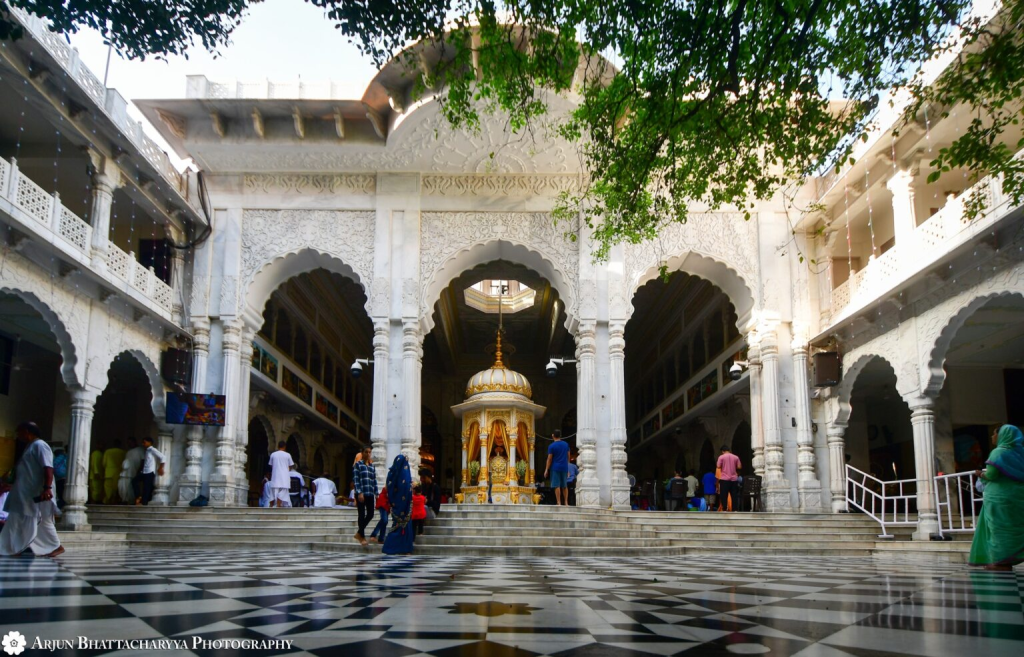
Courtyard of ISKCON Juhu, Mumbai

Courtyard of ISKCON Juhu, Mumbai

Presiding Deities of ISKCON Juhu, Sri Radha Rasabihari

Presiding Deities of ISKCON Juhu, Sri Radha Rasabihari

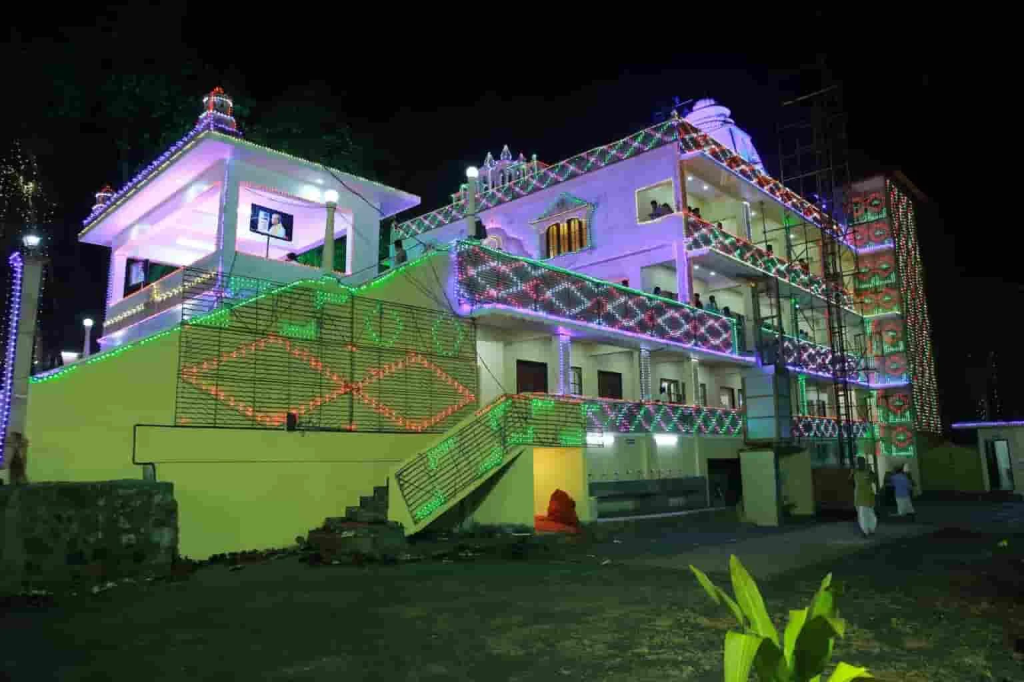
Night View of ISKCON Trivandrum

Night View of ISKCON Trivandrum, India

Presiding Deities of ISKCON Trivandrum, Sri Krishna Balaram

Sri Krishna Balaram, ISKCON Trivandrum, India
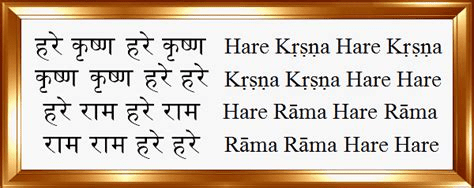
the mahamantra hare krishna hare krishna krishna krishna hare hare hare rama hare rama rama rama hare hare

Can Spiritual Organizations Truly Exist?

Is “spiritual organization” a contradiction? Spirituality is all about simplicity while organizations lean towards complexity. Combining them poses risks, like losing sight of true spiritual goals. Yet, if done right, organizations can help spread spiritual teachings and drive broader impacts. It’s all about focus! Do you see problems with spiritual organizations?

“Spiritual Organization” – is that an oxymoron?

An oxymoron is when two contradictory words are used together. This can occur sometimes intentionally and sometimes by accident. Occasionally, it is not meant to be so, but hypocrisy is the cause.

In this case, we are aware of many spiritual organizations, think temples, churches, mosques, and so on… there are many. Some of them are spiritual, some religious, some both.

When I think about what spirituality is, and what organization must be, we wonder if they can ever go together.

Simplicity vs. Complexity

Spirituality means simplicity. For someone who is not simple, spiritual life is extremely complicated.

But organization means complexity… it is impossible to build and grow an organization without avoiding complexity.

On the other hand, without good organization, it is not possible to have a greater spiritual impact. Many pure saints have come and gone for thousands of years. Their existence remains a well-kept secret. They come, and they go, sight unseen. Almost no one knows about their teachings, instructions, or example.

Spiritual descendants of those simple saints often take a risk. They make the effort to organize and distribute their teachings on a wider scale. They regularly get sucked into the complexities of organizations. As a result, they sometimes lose sight of the simplicity that makes spiritual practice possible.

So this is the dichotomy… “spiritual” means simple, frugal, minimal, open, honest, etc.

But “organization” means people, money, structure, process, secrecy, and inevitably, politics.

Can spirituality exist in an organization? Can an organization fulfill spiritual goals?

How to properly understand this? How to reconcile these?

Let us examine both, and understand the risks better.

Spirituality

Spirituality means a pursuit that is non-material. A genuine spiritualist does not care for money, fame, power, influence, or any material trappings.

Organization

Organization means, fundamentally, some land or real estate, some money, and people… and some structure so that it can all be effectively governed.

In an organization, we need different types of roles. We need individual contributors. These include preachers, teachers, singers, cooks, cleaners, priests, musicians, etc. We also need managers, we need wranglers who can get things done. We need thinkers, we need executive leaders who can articulate a vision. And we need those who can execute on that vision. We need accountants, we need lawyers, we need marketing people too… we need fundraisers, we need people leaders and technically skilled leaders.

Amidst all of this, there is also a class of bureaucrats… people who can figure out a system and work it, to their advantage, to others’ disadvantage. There is also a rise of the people who don’t really contribute to the mission of the organization. They broker relationships, they broker rewards, they broker power and peddle influence. They also broker corruption. It is unavoidable, in any organization, even a spiritual organization. Even if there are parasites. Yes, we can strive to root them out, but it is often hard to tell. So we often tolerate them.

Why? Because a genuine spiritual process can transform even the most hardened materialist. So we have hope for them, even if we see through them. Even if we see their machinations, their schemes. Even if we must tolerate their shenanigans, while continuing to cultivate spiritual purity ourselves.

Srila Prabhupada spoke about this…

Just like a ripe mango and green mango. Green mango is the cause of ripe mango. But to taste ripe mango is better than unripe mango. Similarly, before attaining love of Godhead, you have got different stages. Just like the same mango, it passes through different stages, then one day it comes nice yellow color, fully ripened, and taste is so nice.

The same mango. The mango does not change, but it comes to the mature stage. So this . . . as this example, the mango is in the beginning a flower, then gradually a little fruit. Then gradually it grows. Then it becomes very tight, green, and then, gradually, it becomes little, little yellowish, and it becomes fully ripe.

This is the process of everything. In material world also, there are six processes, and the last process is vanquish. This mango example or any other material example, we can accept it so far the growth is required, concerned, but material example is not perfect. Just like mango, when it is ripe, somebody eats, that’s all right.

Otherwise it will overripe, it will decompose, it will fall down and finish. That is material. But spiritual is not like that. It is not finished. If you once come to the stage of mature stage of love, then that perfectional stage continues eternally, and your life is successful. Premā pum-artho mahān 

https://vanisource.org/wiki/681018_-Lecture-_Seattle?hl=ripe|mango

Should we do away with organizations?

It is tempting to think in that way… no organizations, no money, no power, no corruption, no bureaucrats, no parasites, right?

The power, the money, the powerful, the influential, the famous, and the stars. We all know fame corrodes and power corrupts. Absolute power corrupts absolutely.

No, because despite it all… Despite many challenges. By organizing ourselves better, we can help more souls advance spiritually. It is worth all the effort. Organization, sacrifices, and compromises make it possible, but only when we haven’t lost sight of the goal. Working together towards a common goal makes it possible, even if it is difficult to do so.

After all, one lone saintly person, how much can he do? How many souls can he reach?

So many saints have come and gone. Many have cried in the wilderness. Most are unknown. Those saints who took the time and trouble to organize did something tangible. Even if they had to distract themselves with the mundane temporarily, their efforts were worthwhile.

There is every risk that an organization becomes ineffective… That is a risk for any organization. Not just a danger for spiritual organizations.

I had written about this before. Srila Prabhupada wisely warned us against thinking that simply by being part of some organization we can advance spiritually…

But if we want to go to the spiritual platform, then these bodily demands, at least for the present, we have to regulate. We cannot enjoy material life without any restriction and at the same time we can stand on the spiritual platform. That is the whole thing. The difficult problem is there: we want to be spiritualist by speculation only. That is the whole tendency.

People are much interested in philosophical speculation without any practical life. In the modern world it is said, yaśo ‘rthe dharma-yajanam. This is the symptom of this age. Yaśaḥ arthe. I want to associate with some organization, spiritual, just for the sake of name: “Oh, I am attached to that such big organization.” But, so far my life is concerned, it is as it is. https://vanisource.org/wiki/660418_-_Lecture_BG_02.59-69_-_New_York?hl=organization

So? What is the conclusion?

Spiritualists, organize properly!

But how?

By making sure to keep the main thing the main thing!

Srila Prabhupada

I leave you with profound instructions from the great His Divine Grace A. C. Bhaktivedanta Swami Prabhupada.

The point is to be engaged in doing something for Krishna, never mind what is that job, but being so engaged in doing something very much satisfying to the devotee that he remains always enthusiastic.

He will automatically follow the regulative principles because they are part of his occupational duty–by applying them practically as his occupational duty, he realises the happy result of regulative principles.

So the future of this Krishna Consciousness movement is very bright, so long the managers remain vigilant that 16 rounds are being chanted by everyone without fail, that they are all rising before four morning, attending mangal arotik–our leaders shall be careful not to kill the spirit of enthusiastic service, which is individual and spontaneous and voluntary.

They should try always to generate some atmosphere of fresh challenge to the devotees, so that they will agree enthusiastically to rise and meet it.

That is the art of management: to draw out spontaneous loving spirit of sacrificing some energy for Krishna.

But where are so many expert managers? All of us should become expert managers and preachers. We should not be very much after comforts and become complacent or self-contented.

There must be always some tapasya, strictly observing the regulative principles

Krishna Consciousness movement must be always a challenge, a great achievement to be gained by voluntary desire to do it, and that will keep it healthy.

So you big managers now try to train up more and more some competent preachers and managers like yourselves.

Forget this centralizing and bureaucracy.

https://vanisource.org/wiki/721222_-_Letter_to_Karandhara_written_from_Bombay?hl=individual|spontaneous|voluntary

This is a cautionary note for all spiritual organizations.

Can Anyone Engage in Devotional Service? Is Good Karma required? Key Insights

Is spiritual advancement not possible for someone who has not done good deeds before? The discussion emphasizes that devotional service is accessible to everyone, regardless of past karma. The mercy of a pure devotee is crucial for spiritual growth, allowing even those with sinful backgrounds to engage in devotion. Ultimately, faith and appreciation can be cultivated through this divine grace, inspiring a hopeful journey toward Krishna Consciousness. Won’t you try? Hare Krishna!

Bhakta Sunil, 9 December 2015

Hare Krishna every one

Please help understand the following lines from Bhagavatam 2.7.15 Purport :

Every living entity is always distressed in this material world because this place is such that at every step one has to meet with some kind of distress. But one who is supported by his past good deeds engages himself in the devotional service of the Lord, as confirmed in the Bhagavad-gita (7.16). Those who are supported by impious acts cannot be engaged in the devotional service of the Lord, even though they are distressed. This is also confirmed in the Bhagavad-gita (7.15)

Does this mean, one has to have past good karma in order to engage in devotional service?

Thanks in anticipation

your insignificant servant,
Sunil

Sudarshan Das, 9 December 2015
Hare Krishna,

Prabhuji, Devotional service is for everybody. Bhagavad Gita and the Maha Mantra is freely available to the people of the world because of Srila Prabhupada’s mercy. Srila Gurudev extends this mercy via the free online course. But does everybody take it? You are such an enthusiastic preacher and I am sure you talk about Krishna Consciousnesses to many people, but how many of them take it?

For a soul to be able to appreciate devotional service, they should at least be in mode of goodness in some form or the other. This consciousnesses is defined by past deeds. Lord Buddha preached non-violence to the people, so that they will at least leave the sinful life of meat eating and come to goodness so that they appreciate devotional service and take it up. That sukriti is required, it can be a agyat sukriti also, one that you get unknowingly like appreciating a devotee for the amazing kirtan he did..

To conclude, for one to appreciate and take up devotional service, good karmas create a favorable situation. If one has the causeless mercy of the Lord then the soul will surrender under any situation. 🙂

your servant,
Sudarshan Das

Amala-Purana Das, 9 December 2015
Hi Sunil,

In response to your question: Does this mean, one has to have past good karma in order to engage in devotional service?

Answer: No. one does not need to have past good karma to engage in devotional service. It’s only the mercy of a pure devotee that one can take to devotional service and become a pure devotee. Pious persons are qualified to take to devotional service not exactly because of their piety, but because piety attracts a pure devotee’s mercy. It is the mercy of the Lord’s devotee and nothing else that destroys sins and establishes faith in bhakti

Srila Prabhupada informs us in BG 7.16 Purport:
“When these four kinds of persons come to the Supreme Lord for devotional service and are completely purified by the association of a pure devotee, they also become pure devotees. As far as the miscreants are concerned, for them devotional service is very difficult because their lives are selfish, irregular and without spiritual goals. But even some of them, by chance, when they come in contact with a pure devotee, also become pure devotees.”

Also, Lord Krishna confirms in BG 4.36:
“Even if you are considered to be the most sinful of all sinners, when you are situated in the boat of transcendental knowledge you will be able to cross over the ocean of miseries.”

Hope it helps

your servant,
Amala-Purana Das

Amala-Purana Das, 9 December 2015
Adding further:

In Caitanya lila, we see how most sinful of all sinners, Jagai and Madhai were delivered by the mercy of Lord Nityananda

Also, there is a famous verse in Caitanya Caritamrta (Madhya 19.151), quoted often by Srila Prabhupada and Srila Gurudeva,

brahmāṇḍa bhramite kona bhāgyavān jīva
guru-kṛṣṇa-prasāde pāya bhakti-latā-bīja

“According to their karma, all living entities are wandering throughout the entire universe. Some of them are being elevated to the upper planetary systems, and some are going down into the lower planetary systems. Out of many millions of wandering living entities, one who is very fortunate gets an opportunity to associate with a bona fide spiritual master by the grace of Kṛṣṇa. By the mercy of both Kṛṣṇa and the spiritual master, such a person receives the seed of the creeper of devotional service.”

your servant,,
Amala-Purana Das

Bhakta Sunil, 12 December 2015
Jaya Sudarshan Prabhu and Amala-Purana Prabhu. The doubts have been dispelled

Sudarshan Prabhu, I also remember your enthusiasm of how you had helped another member in this forum, by giving analogy of ceiling fan taking time to come to halt after switching it off

Amala-Purana Prabhu, both of your answers have successfully vanquished the doubt

your insignificant servant,
Bhakta Sunil


Please subscribe to daily inspirational emails from His Grace Sriman Sankarshan Das Adhikari (Writings and lectures archived at www.ecstaticmedia.com ), written fresh every day from his travels around the world sharing the highest spiritual knowledge with everyone. Sign up now at www.joincourse.com

Rapid fire questions… selfless service, amanina mana dena in marriage, Krishna Consciousness in a calamity, karma vs. compassion, free will, our anchor…

This article contains a series of questions and answers… it explores the essence of selfless service, emphasizing that true selfless action arises from a pure devotee’s desire to please Krishna, devoid of personal gain. It highlights how harmonious relationships are built on mutual respect. It also discusses how the Internal process of chanting Hare Krishna mbrings peace in challenging times. Understanding the difference between karmic reactions and divine mercy (kripa) allows devotees to perceive their experiences as opportunities for growth. Ultimately, it reinforces the concept of humility and service, reminding individuals of their role as servants of the lowliest servants in devotion to Krishna.

QUESTION 1) We talk a lot about selfless service, but can you pls tell one action devoid of gain in return?


MBD: Selfless service is not possible unless for a pure devotee, who does service for service sake. In all lower states of Bhakti, all service benefits the performer, even if it may benefit others. The higher the stage of the performer’s advancement, the more it benefits others. It benefits the performer less than it benefits others. Take any service. Krishna’s service to the living entities is always selfless. He does not need anything from anyone in return. Same with the spiritual master. He only seeks Krishna’s pleasure.

1.1) Can there be an action without result?


MBD: When you say result, do you mean “karmic” result? All action that is not purely transcendental has karmic reactions… everything in the modes. Devotional service has no karmic results. Still, there are devotional results. These start with the pleasure of Krishna and the purification of the heart of the devotee, etc.

(The question above is from before our discussion today.)

From what I have learned/heard: Anand/ Sukh (Bliss / Pleasure) is the ultimate goal of every action. So if the action is intended for the pleasure of the Lord, it is selfless. But if it is directed towards sense gratification or tries to satisfy sego, then it is selfish action.


MBD: Yes, you have the right understanding.

QUESTION 2) Does the phrase “amanina man dena…” apply in a husband/wife relationship?


MBD: Yes, it applies to all relationships. If 2 souls are perfectly in amanina (not expecting any respect), they experience a state of harmony. When they are in manadena (giving all respect), they are also in perfect harmony with the will of Krishna. They are thus very happy. Easier said than done.

QUESTION 3) In the most unbeatable calamity, what is your internal process in terms of Krishna Consciousness? What is the first thing that comes to your mind?


MBD: I chant Hare Krishna, if I can chant at all. In general, we are in good shape if we can make chanting the Lord’s name a reflex action. This should apply to anything that happens, whether good or bad. We can test how far we have come when something unexpected happens, good or bad.

QUESTION 4) How do we distinguish between the reactions of Karma from Kripa?


MBD: Kripa is undeserved, no one in material consciousness deserves it. For example getting Krishna Prasadam is a great privilege. You may have the karmic credits to be able to eat, digest, etc., but there is no karmic action that can “earn” you Krishna Prasasdam. Whatever our prarabdha is must be experienced without fail. Even pure devotees apparently enjoy or suffer karmic reactions. But Krishna gives them whatever is needed for others’ sake. This is to teach others by personal example. For devotees in the middle, Krishna can use karmic reactions to pat us on the back. He can also kick us in the butt, through maya or yogamaya. All devotional experiences, in general, are purely Kripa.

From what I have learned/heard: If something is happening to me/happened with me, it MUST be my prarabdh karma. But interpreting it as the mercy of the Lord helps. He is “kartum akartum anyatha kartum.” This helps to remain Krishna conscious in the moment. It erases the distinguishing line between karma and kripa.


MBD: That is where the attitude comes in. Whatever happened is by Krishna’s sanction. The devotee will see Krishna’s hand and understand the takeaway. The nondevotee will only try to adjust the situation to “avoid/improve/prevent/etc.” You are on the right track.

QUESTION 5) Do we really have freewill? (If Lord is the enjoyer/doer of all actions, and we are but a medium) So whatever “we think” has been done by us has actually been done by Him, no?


MBD: Knowing what you will do, and forcing you to do it are two different things. It’s like a parent. The parent knows what the child will do in a given situation. Nonetheless, they leave the child free in a limited way. This freedom allows the child to learn. In the material sense, Krishna is a non-doer. The 3 modes of material nature are set in motion by Krishna. They are the doer. In the devotional sense, Krishna does not know how exactly the devotee is going to serve Him. When Radharani cooks something, Krishna knows it will be amazing, but does not know what exactly it will be. He can know it if He wants, but Yogamaya overpowers His knowability. It is like Krishna’s Sarvajnata (all-knowing nature) and mugdhata (innocence) exist together. This would be a contradiction normally, but all contradictions converge and are resolved in Krishna.

QUESTION 6) What is that ONE anchor point to be aware of every time?


MBD: I am a servant of the servant of the servant. I serve at least as far as the extent of the current disciplic succession of Krishna. But I am a servant of all devotees, past, present, and future.

A Moment of Reflection: Mantras and Unexpected Friendships

During a serene lunch break by Lake Ontario, a spontaneous encounter with a young man named George transformed a potentially uneasy moment into a thoughtful exchange about spirituality. Embracing the opportunity, I conveyed some nuggets of spiritual knowledge, fostering connection and understanding. Then I chanted my mantras. Ultimately, I left the encounter gratefully, having made a new friend.

I sat at one end of the bench and prepared to chant my Gayatri mantras. This big burly young man came and plonked himself right on the other end. The whole bench shook with the force of his landing. All other benches were empty, and this man chose to sit on the same one I was on.

The unkempt, untidy, muscular fellow was looking at me with some unusual interest… I wondered if I should move… was it going to be trouble? But I decided to stay there and chant my Gayatri mantras there anyways. After all, Krishna is non-different from His Names. I was in safe hands, come what may.

To make matters worse, this young man lit a cigarette. Oh no, I thought, how can I chant here amidst all the smoke? But still I resisted the urge to move. There was after all a reason why the Paramatma, the Supersoul in his heart inspired him to sit there. On the lone occupied bench on the entire pier.

All this happened one afternoon earlier this week, on my lunch break. Mantras on the pier that looks onto Lake Ontario – a typical lunch time routine for me. I took a slow walk, beads in hand, softly chanting the Hare Krishna Mahamantra. Then I chose an empty bench, which was not hard to do. Even though it was bright and sunny, it was still cold, about plus two degrees Celsius. So I had the pier all to myself, or so I thought. Krishna clearly had other plans!

Thus the intelligent person who places his faith in the Paramātmā or the Supreme Personality of Godhead begins to advance toward a blissful eternal life of knowledge.

https://vedabase.io/en/library/bg/13/23/

Suddenly he asked me, interrupting, “Are you praying to the the Buddha?”. I said I was chanting the Hare Krishna Mahamantra. He said “I believe it all, the cross, Buddha, all”.

So then George, who is from Greece, and I had a nice little chat. We spoke about how there is only one God and we know the same God by different names. I chanted peacefully. George just sat there, taking a puff, looking at me, taking a puff…

As he smoked, I was hoping the smoke didn’t blow my way, and it didn’t, for the most part. Except for the last puff – the wind changed directions that moment. But then, he threw away the cigarette, and with a “be well, my friend” got up walked away.

Why had I wanted to avoid the interaction? What was the difference between this brief interaction and the ones that we view as more significant? Yes, the time span was different. This one was a few minutes, the others, a few hours, days, weeks, months, years, or even decades.

But no matter what, we have to part ways, is it not? We sometimes meet each other again, our paths cross again… but is it guaranteed that they will? So why did I want to get away from George? It was the mind that was playing tricks, that’s all!

Thereafter, Devayānī, the daughter of Śukrācārya, understood that the materialistic association of husband, friends and relatives is like the association in a hotel full of tourists. The relationships of society, friendship and love are created by the māyā of the Supreme Personality of Godhead, exactly as in a dream. By the grace of Kṛṣṇa, Devayānī gave up her imaginary position in the material world. Completely fixing her mind upon Kṛṣṇa, she achieved liberation from the gross and subtle bodies.

सा सन्निवासं सुहृदां प्रपायामिव गच्छताम् ।
विज्ञायेश्वरतन्त्राणां मायाविरचितं प्रभो: ॥ २७ ॥
सर्वत्र सङ्गमुत्सृज्य स्वप्नौपम्येन भार्गवी ।
कृष्णे मन: समावेश्य व्यधुनोल्लिङ्गमात्मन: ॥ २८ ॥

sā sannivāsaṁ suhṛdāṁ
prapāyām iva gacchatām
vijñāyeśvara-tantrāṇāṁ
māyā-viracitaṁ prabhoḥ

sarvatra saṅgam utsṛjya
svapnaupamyena bhārgavī
kṛṣṇe manaḥ samāveśya
vyadhunol liṅgam ātmanaḥ

https://vedabase.io/en/library/sb/9/19/27-28/

It is best to serve another soul whenever we get a chance. No postponing. After all, who knows if and when our paths will cross again?

I don’t know why George chose to sit next to me. I wonder if he just wanted to have an interaction with another human. But I feel that Krishna, God, inspired George. I hope I served the soul passing for George for the brief length of our interaction! I hope that the few nuggets of spiritual knowledge was pleasing to the soul in the body called George. I pray that my effort was pleasing to Krishna, who sits in my heart as well as George’s as Paramatma, the Supersoul.

I am glad I overcame my preconceived notions about this young man. It was by Krishna’s grace. Otherwise I would have missed the service opportunity, maybe even conveyed some misunderstanding to George. It is not very pleasant when someone tries to avoid you, especially if you don’t know why.

Too often, spiritual people end up pushing others away. This is because we are not in tune with the dictations of God sitting within our heart. It is because we fall prey to the urges of the mind.

Chanting Mantras with meditation beads...

I then chanted my Gayatri in peace. I continued chanting the Mahamantra after. Finally, it was time to get back to the office for a quick lunch and my next meeting.

It all ended well. I made a new friend, George from Greece. I prayed that he also experience Krishna in the form of His His Names, some day.

Hare Krishna Hare Krishna 
Krishna Krishna Hare Hare 
Hare Rama Hare Rama 
Rama Rama Hare Hare
The Hare Krishna Mahamantra

The Spiritual Connection revealed at a Farewell

At a funeral in Toronto for a man from Kazakhstan, the author, even though unfamiliar with the deceased, reflects on his unexpected role in the cremation, arising from a shared devotion to Krishna. Krishna is the All-Knowing, All-Powerful Supreme Personality of Godhead. This unexpected connection demonstrates Krishna’s omniscience and the surprising spiritual connections that intertwine our lives.

I stood at the funeral home, my finger poised on the button, ready to press it. The button was connected to the circuit that would ignite the fire. The flames would transform the lifeless body to ashes. The material elements would be consumed. The spirit soul that once inhabited the body, freed from it’s current bondage, would be free to move on.

Normally, this service of offering fire at the end of life is reserved for the son of the deceased. But this was not my father. In fact, before the funeral, I had never met him personally for a long time. We had seen each other in the past. In 2012 or 2013, but no significant interactions after that, just once, a short conversation. Victor recalled me asking him if he’d read the Bhagavad Gita, and turns out, he had!

The departed gentleman was from Kazakhstan, and I am from India. The funeral was being conducted in Toronto. The gentleman had two daughters, and no sons.

So how was it that his daughter, Lilamayi, no (bodily) relation to me, picked me to serve her father in this way?

It turns out that both of us, the daughter of the man, and I are devotees of Krishna. We are both initiated into spiritual life by disciples of His Divine Grace A. C. Bhaktivedanta Prabhupada. Her spiritual master is His Holiness Sacinandana Swami, and my spiritual master is His Grace Sriman Sankarshan Das Adhikari.

And we have both served in the Krishna Consciousness Movement, the International Society for Krishna Consciousness, ISKCON, for many years. I saw the young lady first come into our community. I happily witnessed her journey, deeper and deeper involved in hearing and chanting about Krishna. She is a noted kirtan leader today, Her Grace Lilamayi Devi Dasi.

Who arranged all this?

Krishna arranged all this. It seemed like it was “right at the last minute” to us. But Krishna knew who the gentleman was. Krishna knows who I am. Krishna knows who his daughter is. Krishna knew what my service to these souls would be. All this, well before we even came together. Krishna knows what that soul’s future trajectory is. Krishna knows mine too.

वेदाहं समतीतानि वर्तमानानि चार्जुन ।
भविष्याणि च भूतानि मां तु वेद न कश्चन ॥ २६ ॥


vedāhaṁ samatītāni
vartamānāni cārjuna
bhaviṣyāṇi ca bhūtāni
māṁ tu veda na kaścana

O Arjuna, as the Supreme Personality of Godhead, I know everything that has happened in the past, all that is happening in the present, and all things that are yet to come. I also know all living entities; but Me no one knows. https://vedabase.io/en/library/bg/7/26/

Dear Sri Krishna, you are omniscient. You are Omnipotent. You are the Supreme Well-wisher of us all.

भोक्तारं यज्ञतपसां सर्वलोकमहेश्वरम् ।
सुहृदं सर्वभूतानां ज्ञात्वा मां शान्तिमृच्छति ॥ २९ ॥


bhoktāraṁ yajña-tapasāṁ
sarva-loka-maheśvaram
suhṛdaṁ sarva-bhūtānāṁ
jñātvā māṁ śāntim ṛcchati

A person in full consciousness of Me, knowing Me to be the ultimate beneficiary of all sacrifices and austerities, the Supreme Lord of all planets and demigods, and the benefactor and well-wisher of all living entities, attains peace from the pangs of material miseries.

https://vedabase.io/en/library/bg/5/29/

My Dear Sri Krishna, I pray to remain your surrendered servant, and the servant of your servants. What shall I do for your devotees Krishna?

Who was Victor before? What is my connection to him? Only you know, Dear Krishna. You remember everything, and I, almost nothing. Surely you had mapped out an auspicious trajectory for Victor. Why else were there so many Vaishnavas chanting Your Holy Names at Victor’s funeral?

I pray never to forget you, Dear Krishna. Please help me to always remember You.

Victor gained a son after his death, and I, service to someone dear to Krishna.

I now recall the same prayers I offered on behalf of Victor, the fortunate soul You had me serve. It was my good fortune that You gave me this service. May I never forget Your magnanimity.

वायुरनिलममृतमथेदं भस्मान्तं शरीरम् ।
ॐ क्रतो स्मर कृतं स्मर क्रतो स्मर कृतं स्मर ॥ १७॥

vāyur anilam amṛtam
athedaṁ bhasmāntaṁ śarīram
oṁ krato smara kṛtaṁ smara
krato smara kṛtaṁ smara

Let this temporary body be burnt to ashes, and let the air of life be merged with the totality of air. Now, O my Lord, please remember all my sacrifices, and because You are the ultimate beneficiary, please remember all that I have done for You.

https://vedabase.io/en/library/iso/17/

अग्ने नय सुपथा राये अस्मान्
विश्वानि देव वयुनानि विद्वान् ।
युयोध्यस्मज्जुहुराणमेनो
भूयिष्ठां ते नमउक्तिं विधेम ॥ १८॥

agne naya supathā rāye asmān
viśvāni deva vayunāni vidvān
yuyodhy asmaj juhurāṇam eno
bhūyiṣṭhāṁ te nama-uktiṁ vidhema

O my Lord, as powerful as fire, O omnipotent one, now I offer You all obeisances, falling on the ground at Your feet. O my Lord, please lead me on the right path to reach You, and since You know all that I have done in the past, please free me from the reactions to my past sins so that there will be no hindrance to my progress.

https://vedabase.io/en/library/iso/18/

Hare Krishna Hare Krishna

Krishna Krishna Hare Hare

Hare Rama Hare Rama

Rama Rama Hare Hare

Thank you, Krishna.

Leveraging Jet Lag for Spiritual Growth

Recently returning from a transformative trip to India, I found jet lag to be an unexpected ally in my spiritual journey. Embracing early mornings, I engaged in meditation, reading, and serving Krishna. Instead of viewing jet lag negatively, I was able to leverage it to enhance my devotional practices and enrich my daily routine. What a blessing! Jet lag? Bring it on!

I have recently returned to Toronto from a hectic, exhausting, yet ecstatic trip to Bharat Bhumi, also known as India. I was away for a total of 14 days. Out of those, I got to spend 11 in the holy land.

The privilege of meeting, hearing from, and serving the sincere devotees of Krishna is, as always, a life changing experience.

I visited…

  • Frankfurt
  • Mantralayam
  • Hyderabad
  • Bengaluru
  • Pune
  • Mumbai

With a 10.5 hour time zone difference between Toronto and India, that is just enough to get jet lagged. Jet lag gets a bad rap… because the body clock is set to some other time zone. It wakes up at odd hours. It feels sleepy at odd hours and so on. There’s an entire cottage industry to help people cope with and overcome jet lag.

I even tried this app called “Timeshifter” but it was totally impractical for my lifestyle… for example it contained advice to use caffeine, which I avoid like the plague, and melatonin… It required specific times to go to sleep and wake up. There were also specific times to “see” light and to avoid it. This was almost like trying to hack the body and mind. It didn’t sit right with me. Was it really necessary to “overcome” jet lag? I wondered if jet lag can be leveraged for Krishna, for spiritual growth.

When I was in India, the jet lag was a great asset! I managed to wake up early enough to attend Mangala Arati. I completed my Sadhana. I got by with a short nap for the rest of the day. Early mornings, late nights, and the rest of the time spent in serving Krishna and His devotees, perfect!

When I got back to Toronto, for example this morning, I was up at 2AM. I wondered if I should try to go back to sleep… then I remembered that my Guru and Gurumata usually rise at this hour. They complete their japa, meditation on the Holy Names of Krishna on their beads, well before others rise… and then they can spend their whole day serving others on their spiritual journey.

So I decided to follow in their footsteps. After completing my meditation, I still had time to read, not one but parts of 2 books! Anyone who has a corporate career and a family understands the challenge. Finding quality time to read is incredibly hard. I still had enough time to complete Mangala Arati. Then I performed deity worship before getting an early start to the day!

In this way I will leverage jet lag to serve Krishna. And when the jet lag ends? I will simply go back to my earlier routine to serve Krishna!

Devotee serving Krishna

Jet lag? Bring it on!

Of course, in all success, the credit goes to Guru and Krishna, as long as we are ready to be an instrument!

Now, in case you think that this idea to leverage jet lag in Krishna’s service somehow is mine… it is not.

Srila Rupa Goswami enunciated the principle of “avyarthakālatvam — being free from wasting time”, this was over 500 years ago…

ক্ষান্তিরব্যর্থকালত্বং বিরক্তির্মানশূন্যতা ।
আশাবন্ধঃ সমুৎকণ্ঠা নামগানে সদা রুচিঃ ॥ ১৮ ॥
আসক্তিস্তদ্‌গুণাখ্যানে প্রীতিস্তদ্বসতিস্থলে ।
ইত্যাদয়োঽনুভাবাঃ স্যু র্জাতভাবাঙ্কুরে জনে ॥ ১৯ ॥


kṣāntir avyartha-kālatvaṁ viraktir māna-śūnyatā
āśā-bandhaḥ samutkaṇṭhā nāma-gāne sadā ruciḥ
āsaktis tad-guṇākhyāne prītis tad-vasati-sthale
ity-ādayo ’nubhāvāḥ syur jāta-bhāvāṅkure jane

“ ‘When the seed of ecstatic emotion for Kṛṣṇa fructifies, the following nine symptoms manifest in one’s behavior: forgiveness, concern that time should not be wasted, detachment, absence of false prestige, hope, eagerness, a taste for chanting the holy name of the Lord, attachment to descriptions of the transcendental qualities of the Lord, and affection for those places where the Lord resides — that is, a temple or a holy place like Vṛndāvana. These are all called anubhāva, subordinate signs of ecstatic emotion. They are visible in a person in whose heart the seed of love of God has begun to fructify.’

https://vedabase.io/en/library/cc/madhya/23/18-19/

My spiritual master has indeed planted the seed of pure devotional service in my heart. However, I cannot claim any success in cultivating devotional service. I am just sincerely trying to practice sadhana bhakti.

And I have examples of great Vaishnavas who travel around the world…

So I brought Prabhupada his breakfast, and then when he was finished I came and took everything out and Prabhupada laid down. So I went back, I said, “Prabhupada’s resting.” So Paramahamsa and I, we laid down. Of course, we fell asleep, we were out, and Prabhupada maybe took 15 minutes or something and he was up. So finally I heard a bell ring. So I went into Prabhupada’s room, and it happened a few times where I would literally try to wake up as I was offering obeisances and exercise my eyes so Prabhupada couldn’t tell that I was sleeping. I sat up, and as soon as I sat up he said, “Why are you sleeping? You’re like dead men. Everyone is awake. The karmis are all at work but not the devotees. No, they’re sleeping.” He said, “They’re sleeping very soundly. Why are you sleeping?” And, of course, when Prabhupada asked why were you doing something wrong, I never had a response because whatever you said, he would just take that apart. So I just said, “Prabhupada, I’m sorry.” “What about Paramahamsa? Why is he sleeping?” He said, “Call him in here.” He goes in and immediately Prabhupada says, “You are a sannyasi. Your business is to minimize bodily demands, minimize sleeping, minimize eating. Why are you sleeping?” Paramahamsa said, “Prabhupada, I have jet lag,” and I thought, “Oh, no!” And Prabhupada said, “Jet lag?” He said, “Well, we just flew from here and done this,” and Prabhupada said, “So I am also flying, I am doing the same thing. I am awake.” Then he said, “All right, go on. Go sleep if you want.

https://srilaprabhupadalila.org/read/3665 

Srila Prabhupada circled the globe twelve times in less than 10 years… and no one ever recalls a time when he was jet lagged.

Gopal Krishna Goswami, a dear disciple of Srila Prabhupada, traveled from continent to continent. He was always on the altar offering Mangala Arati to the local deities at the temple he was staying at. This was regardless of which time zone he came in from and which time zone he traveled to. I have personally witnessed this, arrived at midnight, 1AM, 2AM, but no, at 4:30am he was on the altar.

My own spiritual master, Srila Sankarshan Das Adhikari, has circled the globe more than 50 times. My Gurumataji Srimati Vishnupriya Devi Dasi has accompanied him. They have never let jet lag stand in the way of their service to Krishna. They are both up early. They chant their rounds and offer their service to Sri Sri Radha Damodar. Then, they follow a full schedule of service all day, working 12-16 hours most days.

So why should I not try to follow in their illustrious footsteps?

Brahmachari vs Bhramachari: Which one do you want to be?

A Brahmachari is like a spiritual athlete, dedicated to serving the Supreme Truth, while a Bhramachari chases illusions—basically like a spiritual couch potato, confusing the finish line for a mirage in a desert. We dive into how society’s roles, like Brahmanas and Shudras, fit into this divine quest, reminding us that serving God is the real goal, whether you’re a householder or a renounced sage. Remember, folks: always be a Brahmachari, not a Bhramachari—that’s the real spiritual workout!

A Brahmachari is a person who is dedicated to the pursuit and service of the Supreme Absolute Truth.

ब्रह्म आचरति इति ब्रह्मचारी

brahma ācarati iti brahmacāri

Brahmachari worships Radha Krishna

And a Bhramachari is a person is the exact opposite.

The Sanskrit word “bhrama” means “illusion”.

 Illusion, from the dictionary

So, someone who chases after illusory happiness is the opposite of someone who dedicates themselves to the Absolute Truth.

What got me thinking was a typo. The person writing was referring to a gentleman who is solidly dedicated to the Supreme Absolute Truth. At first I chuckled, but then I started thinking about the difference between the two.

I concluded that I can be one or the other at any given time, either I am engaged in the service of the Supreme Absolute Truth, or I am engaged in something frivolous that is temporary at best, illusory in nature.

Human society is divided by God into 4 natural orders of spiritual life, and 4 social orders, according to the natural qualities and work performed by the various people. And Brahmacharis can exist in all spiritual and social orders. This natural division is clearly visible in the nature and activities of people, it’s not the birth-based caste system as it has degenerated to.

चातुर्वर्ण्यं मया सृष्टं गुणकर्मविभागशः ।
तस्य कर्तारमपि मां विद्ध्यकर्तारमव्ययम् ॥ १३ ॥

cātur-varṇyaṁ mayā sṛṣṭaṁ
guṇa-karma-vibhāgaśaḥ
tasya kartāram api māṁ
viddhy akartāram avyayam

According to the three modes of material nature and the work associated with them, the four divisions of human society are created by Me. And although I am the creator of this system, you should know that I am yet the nondoer, being unchangeable. https://vedabase.io/en/library/bg/4/13/

The 4 Social Orders are:

  • Brahmanas: The intelligent class, the “head” of society
  • Kshatriyas: The administrator class, the “arms” of society
  • Vaishyas: The mercantile community, merchants, traders, farmers, the “belly” of society
  • Shudras: The worker class, the “legs” of society
Varna: The 4 social orders created by God. BG 4.13

And then there are the 4 spiritual orders:

  • Brahmachari: The celibate student
  • Grihastha: The householder family man
  • Vanaprastha: The former householder, retired from family life
  • Sannyasa: The fully renounced order of life

However, no matter which social or spiritual order one may be situated in…

अत: पुम्भिर्द्विजश्रेष्ठा वर्णाश्रमविभागश: ।
स्वनुष्ठितस्य धर्मस्य संसिद्धिर्हरितोषणम् ॥ १३ ॥


ataḥ pumbhir dvija-śreṣṭhā
varṇāśrama-vibhāgaśaḥ
svanuṣṭhitasya dharmasya
saṁsiddhir hari-toṣaṇam

O best among the twice-born, it is therefore concluded that the highest perfection one can achieve by discharging the duties prescribed for one’s own occupation according to caste divisions and orders of life is to please the Personality of Godhead. https://vedabase.io/en/library/sb/1/2/13/

All these 4 orders of society are meant to serve God in their own way, just like the different parts of the body serves the whole – the hand feeds the stomach, the leg moves the body, and the brain regulates the hand, stomach, and legs. One without the others is a handicapped body, not very effective. Neither is one more or less important than others.

By following the activities according to one’s own nature, and offering that in the service of God, one can indeed attain perfection.

यत: प्रवृत्तिर्भूतानां येन सर्वमिदं ततम् ।
स्वकर्मणा तमभ्यर्च्य सिद्धिं विन्दति मानव: ॥ ४६ ॥

yataḥ pravṛttir bhūtānāṁ
yena sarvam idaṁ tatam
sva-karmaṇā tam abhyarcya
siddhiṁ vindati mānavaḥ

By worship of the Lord, who is the source of all beings and who is all-pervading, a man can attain perfection through performing his own work. https://vedabase.io/en/library/bg/18/46/

Which now brings us to the main topic of our discussion…

No matter where we might fit into society, we are all meant to serve God with all our faculties, with all our gifts, with all our abilities, and all our resources.

This is how one may remain a Brahmachari, no matter where one may be situated in…

  • Brahmacharis in the Brahmachari Ashrama – these are either students or those dedicated to spiritual life without deviation, and/or preparing themselves for the renounced order, usually younger men, but also many older men. Being in young bodies or being inexperienced does not mean they can pursue unrestricted sense enjoyment.
  • Grihastha Brahmacharis, or those who pursue spiritual life even while accepting the responsibilities of householder or family life. It’s not that taking on family responsibilities give the person to pursue illusion in an unrestricted manner.
  • Vanaprastha Brahmacharis, or those who have retired from family life, or decided to marry a like-minded person dedicated to spiritual life – even while living as a married couple, they have no family responsibilities. However, just because they are not directly responsible for their family doesn’t mean they don’t accept responsibility for other Grihasthas and Brahmacharis. The dedicate themselves to being on “constant pilgrimage” and leveraging their life experience and spiritual knowledge to benefit others.
  • Sannyasa Brahmacharis, or those who are in the renounced order of life, with no family or social connections. But just because someone is in the renounced order of life doesn’t mean they don’t do anything. In fact, they adopt the whole world as their family, meeting others just so they can convey God Consciousness, Krishna Consciousness to them, and staying just long enough to deliver the message and keep moving on.

Importantly, one needs to remain focused on the goal of life, which is to attain spiritual perfection. The way one expresses one’s Brahmacharya, or dedication to spiritual advancement, may look different depending on which Varna and Ashram one is in, but the principles of a regulated spiritually focused life remain.

No matter if you are a man or woman, young or old, whether you wear white, or saffron, or any other colour… If you’re serious about spiritual life, then you must be a Brahmachari, in every thought, word, and deed.

So we have a choice, no matter what our official social and spiritual status might be. At every moment, with every thought, word, and deed, we all need to be Brahmacharis, not Bhramacharis.

Thoughts?

Understanding Buddhi Yoga and Jnana-Mishra-Bhakti

If Buddhi means intelligence, and Jnana means knowledge, then to use one’s intelligence, does it means to speculate on the knowledge?

What does Krishna mean by “Buddi Yoga”?

Buddhi-Yoga is not just mundane intelligence! It’s the ultimate key to true devotion and liberation. Mixed with speculative knowledge however, Jnana dilutes pure bhakti, making it a distant dream. Real progress in spiritual pursuits demands a focus on Krishna alone, stripping away distractions, and achieving clarity in devotion. Are you ready to commit to the pursuit of spiritual perfection?

Bhakta Sunil, 26 February 2021

Please accept my humble obeisances
All Glories to Srila Prabhupada

Does Buddhi-Yoga mean utilizing one’s intelligence to serve the Lord?
If yes , is Buddhi Yoga the same as Gyaan-Yoga-Mishrit-Bhakti?

What is the difference between Buddhi-Yoga and Gyaan-Yoga-Mishrit-Bhakti?

your servant,
sunil

Bhakta Sunil, 12 March 2015
Hare Krishna

To rephrase / add to the query : Can a person do Buddhi-Yoga if his bhakti is tinged with mental speculation?

your servant,
sunil

Shridhar Das, 13 March 2015
Hare Krishna Sunil Prabhu,
Please accept my humble obeisances!
All Glories to his Divine Grace Srila Prabhupada!

Your question is clearly answered in BG 10.10:

teṣāṁ satata-yuktānāṁ
bhajatāṁ prīti-pūrvakam
dadāmi buddhi-yogaṁ taṁ
yena mām upayānti te

“Buddhi-yoga itself is action in Kṛṣṇa consciousness; that is the highest intelligence.”
“When one tries to go back home, back to Godhead, and takes fully to Kṛṣṇa consciousness in devotional service, his action is called buddhi-yoga. In other words, buddhi-yoga is the process by which one gets out of the entanglement of this material world.”(From the Purport)

This can be confirmed from BG 10.8 also:

ahaṁ sarvasya prabhavo
mattaḥ sarvaṁ pravartate
iti matvā bhajante māṁ
budhā bhāva-samanvitāḥ

“I am the source of all spiritual and material worlds. Everything emanates from Me. The wise” [budha] “who perfectly know this engage in My devotional service and worship Me with all their hearts.” (BG 10.8)

As per His Divine Grace Srila Prabhupada:

Intelligence means to know how to go back to home, back to Godhead.

Buddhi means intelligence and buddhi yoga is apt for bhakti yoga only because in various other yogas, the spiritualists are taking so much pain by changing their positions, locations, shelters, what not, but failing to realize – Krishna is complete, Krishna is everything and the only shelter.

For the same reason Krishna states – I will give you the “intelligence” by which you can come to me, hence this is real intelligence, real buddhi and hence buddhi yoga is bhakti yoga.

A broader understanding of buddhi yoga – To be able to discriminate whether our acts are on the platform of pure consciousness (pleasing Guru and Krishna) or on the platform of body? This technique of being able to rectify our own act is also buddhi yoga as per His Divine Grace.

Interestingly, this also connects with BG 2.49 and confirms buddhi yoga:

dūreṇa hy avaraṁ karma
buddhi-yogād dhanañ-jaya
buddhau śaranam anviccha
kṛpaṇāḥ phala-hetavaḥ

“O Dhanañjaya, keep all abominable activities far distant by devotional service, and in that consciousness surrender unto the Lord. Those who want to enjoy the fruits of their work are misers.” (BG 2.49)

I personally also relate this with vyavasaya-atmika buddhir (BG 2.41) – resoluteness in Krishna consciousness.

Finally, Srila Prabhupada again specifies Buddhi yoga from BG 10.10:

So what is that buddhi-yoga? Krsna says, tesam satata-yuktanam: “Persons who are twenty-four hours engaged,” satata… Satata means always. Engaged. What kind of engagement? Bhajatam priti-purvakam. This engagement means always trying to render some service to the Lord. How? Priti-purvakam: “with love and faith.” Not that “Oh, I have to do it? All right, let me do.” No. “Oh, I have to do it? Let me do it nicely.”(September 12, 1973, London)

I hope this helps us conclude clearly what Buddhi yoga ultimately means.

Regarding difference between the 2 yogas, Srila Prabhupada states:

All other yoga system, there is little tinge of vasudeva-bhakti, but not cent percent pure. It is mixed. Misra-bhakti. Misra-bhakti will not be immediately fruitful. It will take long, long time. Bahunam janmanam ante jnanavan mam prapadyate [Bg. 7.19]. Everything, there is some bhakti-yoga, but if it is not pure.then it will take very, very, very, very long time, bahunam janmanam. One janma means hundreds of years.

Jnana-misra-bhakti means affinity for scriptural knowledge or tendency towards monistic liberation among sadhakas. Instead of trying to serve, to know and to experience, we are more in the mood of trying to be a pandita without following. We already know pure devotional service is anyabhilasita sunyam jnana-karma-adi anavrtam – free of all desires except the desire to please Krishna.

I also had read Uddhava was among jnana-misra-bhakta, being a disciple of Brihaspati. For the same reason Lord Krishna chose him for Vrindavan so that he may take to pure devotional service while associating with the Vrajavasis, especially the gopis. However, position of Uddhava having Lord’s personal association is not to be considered as a subject of comparison.

Personally sharing, when I was researching the strict differences and understandings between jnana and jnana-misra-bhakti yoga an year ago, which has scholarly been distinguished by Srila Vishvanath Chakravarti Thakur and Srila Bhaktivinoda Thakura, I ultimately concluded – Let me take shelter of that which will help with my current struggle against the dirt in my heart and mind. If Krishna wants, He shall drag me to all these studies in future.

your servant,
Shridhar Das

Bhakta Sunil, 16 March 2015
Hare Krishna Shridhar Prabhu

Please accept my humble obeisances
All Glories to Srila Prabhupada

Prabhu amazing knowledge you shared

my , any doubts on this topic have been dispelled

All Glories to your enthusiastic endeavor

in humble mood,
sunil

Mahabhagavat Das, 17 March 2015
Dear Devotees,

Hare Krishna!

As I was reflecting to find a concise way to describe the difference between Buddhi Yoga (Yoga of Intelligence) and Jnana-Mishra-Bhakti (Devotional Service tinged with the desire to become One with the Supreme), and very much inspired by Shridhar Prabhu’s’ answer, I also came across this wonderful purport by Srila Prabhupada in my regular study, it was very profound, and this is from the purport to SB 7.2.47:

“The living entity is bound by the subtle body, consisting of the mind, intelligence and false ego. At the time of death, therefore, the position of the mind becomes the cause for the next body. As confirmed in Bhagavad-gītā (8.6), yaṁ yaṁ vāpi smaran bhāvaṁ tyajaty ante kalevaram: at the time of death the mind sets the criteria for the spirit soul’s being carried to another type of body. If a living being resists the dictation of the mind and engages the mind in the loving service of the Lord, the mind cannot degrade him. The duty of all human beings, therefore, is to keep the mind always engaged at the lotus feet of the Lord (sa vai manaḥ kṛṣṇa-padāravindayoḥ). When the mind is engaged at the lotus feet of Kṛṣṇa, the intelligence is purified, and then the intelligence gets inspiration from the Supersoul (dadāmi buddhi-yogaṁ tam). Thus the living entity makes progress toward liberation from material bondage.”

What jumped out at me was “If a living being resists the dictation of the mind and engages the mind in the loving service of the Lord, the mind cannot degrade him.”, and then ” When the mind is engaged at the lotus feet of Kṛṣṇa, the intelligence is purified, and then the intelligence gets inspiration from the Supersoul (dadāmi buddhi-yogaṁ tam). Thus the living entity makes progress toward liberation from material bondage.”

In other words, as stated by Srila Prabhupada in the purport to BG 10.10, as referred by Shridhar Prabhu:

“In this verse the word buddhi-yogam is very significant. We may remember that in the Second Chapter the Lord, instructing Arjuna, said that He had spoken to him of many things and that He would instruct him in the way of buddhi-yoga. Now buddhi-yoga is explained. Buddhi-yoga itself is action in Kṛṣṇa consciousness; that is the highest intelligence. Buddhi means intelligence, and yoga means mystic activities or mystic elevation. When one tries to go back home, back to Godhead, and takes fully to Kṛṣṇa consciousness in devotional service, his action is called buddhi-yoga. In other words, buddhi-yoga is the process by which one gets out of the entanglement of this material world. The ultimate goal of progress is Kṛṣṇa. People do not know this; therefore the association of devotees and a bona fide spiritual master are important. One should know that the goal is Kṛṣṇa, and when the goal is assigned, then the path is slowly but progressively traversed, and the ultimate goal is achieved.”

So therefore, I would summarize that Buddhi Yoga means Bhakti Yoga, or pure devotional service, and every other mixup is an unfortunate distraction.

Sincerely,
Mahabhagavat Das

Sudarshan Das, 20 March 2015
Hare Krishna,

I also had been thinking on the question and the following translations by His Divine Grace caught my attention which further supports Mahabhagavat Prabhuji’s mail.

BG 2.44:

bhogaiśvarya-prasaktānāṁ
tayāpahṛta-cetasām
vyavasāyātmikā buddhiḥ
samādhau na vidhīyate

“In the minds of those who are too attached to sense enjoyment and material opulence, and who are bewildered by such things, the resolute determination for devotional service to the Supreme Lord does not take place.”

Here: buddhiḥ — devotional service to the Lord

And then BG 2.50:

buddhi-yukto jahātīha
ubhe sukṛta-duṣkṛte
tasmād yogāya yujyasva
yogaḥ karmasu kauśalam

“A man engaged in devotional service rids himself of both good and bad reactions even in this life. Therefore strive for yoga, which is the art of all work.”

Here: buddhi-yuktaḥ — one who is engaged in devotional service

your servant,
Sudarshan Das

Bhakta Sunil, 21 March 2015
Amazing finds Sudarshan Prabhu

Jaya

All Glories to your sincere endeavour

your insignificant servant,
Bhakta Sunil

Shridhar Das, 21 March 2015
Hare Krishna!

All Glories to Srila Gurudeva and Srimati Gurumataji!

One time I had a good fortune to be near Srila Gurudeva while Srila Gurudeva was singing “Jaya Radhe Jaya Krishna Jaya Vrindavan” while departing from Gokula Vrindavan. Then when “Mahavan” was sung in the bhajan (kalindi jamuna jaya jaya mahavan”), Srila Gurudeva searched for Mahavan in Vedabase and further shared of the 12 forests, 5 situated in East and 7 in the West, separated by Yamuna, Mahavan maybe situated in the East. Then Srila Gurudeva shared few pastimes of Lord Krishna which connected with Mahavan. Then Srila Gurudeva asked me all that I remembered from the first part(which I typed above).

Srila Gurudeva inspired me to refer to Vedabase and research on topics although I had Vedabase 2014 lying on laptop desktop unused for a long time. Now these questions, an amazing one such as yours, are helping me to use Vedabase nicely and conclude as per acharyas. Therefore All Glories to Srila Gurudeva and your (Sunil Prabhu) question which are allowing me to follow my heart, at least begin with it in some way.

Mahabhagavat prabhuji, you have shared the dividing line and the science that takes from mishrit to shuddha bhakti from such a sublime purport from His Divine Grace that would have not sparked a bulb in my mind. Glad to have your association. Additions from Sudarshan Prabhu makes us seem that we had an essence conclusion of what buddhi-yoga is.

your servant,
Shridhar Das

Please subscribe to daily inspirational emails from His Grace Sriman Sankarshan Das Adhikari (Writings and lectures archived at www.ecstaticmedia.com ), written fresh every day from his travels around the world sharing the highest spiritual knowledge with everyone. Sign up now at www.joincourse.com

Krishna’s Message on Spiritual Equality in Devotion

Does birth matter in the eyes of God? What does it mean to be lowborn? Are women lowborn? Are merchants lowborn? Are workers lowborn? And if someone does happen to be “lowborn”, are they rejected by God?
In the Bhagavad Gita, Krishna emphasizes that all individuals, regardless of social standing or gender, have the potential for spiritual elevation through devotional service. True worth is defined by one’s internal consciousness, not external circumstances. By taking shelter in Krishna, everyone can attain the supreme destination, fostering hope for all.

Question:

B.G 9.32 says women are considered as low born. I answered this but somehow I am not satisfied with my answer. Please guide me on this.

Answer:

You are referring to the this verse from the Bhagavad Gita…

Bg. 9.32

मां हि पार्थ व्यपाश्रित्य येऽपि स्यु: पापयोनय: ।
स्त्रियो वैश्यास्तथा श‍ूद्रास्तेऽपि यान्ति परां गतिम् ॥ ३२ ॥

māṁ hi pārtha vyapāśritya
ye ’pi syuḥ pāpa-yonayaḥ
striyo vaiśyās tathā śūdrās
te ’pi yānti parāṁ gatim

Synonyms

mām — of Me; hi — certainly; pārtha — O son of Pṛthā; vyapāśritya — particularly taking shelter; ye — those who; api — also; syuḥ — are; pāpa-yonayaḥ — born of a lower family; striyaḥ — women; vaiśyāḥ — mercantile people; tathā — also; śūdrāḥ — lower-class men; te api — even they; yānti — go; parām — to the supreme; gatim — destination.

Translation

O son of Pṛthā, those who take shelter in Me, though they be of lower birth – women, vaiśyas [merchants] and śūdras [workers] – can attain the supreme destination.

https://vedabase.io/en/library/bg/9/32/

In this verse above, Krishna is covering over 90% of the human population, including men! So should we all take offense that Krishna is saying this?

Srila Prabhupada writes this in his purport:

It is clearly declared here by the Supreme Lord that in devotional service there is no distinction between the lower and higher classes of people. In the material conception of life there are such divisions, but for a person engaged in transcendental devotional service to the Lord there are not. Everyone is eligible for the supreme destination. In the Śrīmad-Bhāgavatam (2.4.18) it is stated that even the lowest, who are called caṇḍālas (dog-eaters), can be purified by association with a pure devotee. Therefore devotional service and the guidance of a pure devotee are so strong that there is no discrimination between the lower and higher classes of men; anyone can take to it. The most simple man taking shelter of the pure devotee can be purified by proper guidance. According to the different modes of material nature, men are classified in the mode of goodness (brāhmaṇas), the mode of passion (kṣatriyas, or administrators), the mixed modes of passion and ignorance (vaiśyas, or merchants), and the mode of ignorance (śūdras, or workers). Those lower than them are called caṇḍālas, and they are born in sinful families. Generally, the association of those born in sinful families is not accepted by the higher classes. But the process of devotional service is so strong that the pure devotee of the Supreme Lord can enable people of all the lower classes to attain the highest perfection of life. This is possible only when one takes shelter of Kṛṣṇa. As indicated here by the word vyapāśritya, one has to take shelter completely of Kṛṣṇa. Then one can become much greater than great jñānīs and yogīs.

https://vedabase.io/en/library/bg/9/32/

Spiritually speaking, Krishna describes all living entities as “Prakriti.” As spirit souls, we’re higher than material elements.

Earth, water, fire, air, ether, mind, intelligence and false ego – all together these eight constitute My separated material energies.

https://vedabase.io/en/library/bg/7/4/

Besides these, O mighty-armed Arjuna, there is another, superior energy of Mine, which comprises the living entities who are exploiting the resources of this material, inferior nature.

https://vedabase.io/en/library/bg/7/5/

“Energy” indicates that the energy belongs to the “energetic”. For example, the sunshine is an energy of the sun. A living entity’s core nature is as a part-and-parcel of God. The living entities are “energies” of God. This is true whether someone is in a male body or a female body. The energetic is called “male” and the energy is called “female”. The “minute energy” is not the Supreme Energetic, God. Then, the only true “male” is God Himself, or Krishna, because other than God everyone is an energy.

In the same verse, Vaishyas and Shudras are also considered to be lowborn, and that includes men also. Why are Vaishyas included here? Vaishya means business person. If a business person cares only about money, and not about spiritual advancement, then are they not lowborn? A Shudra is a person who cannot do anything independently. A Shudra laments unnecessarily over inconsequential things. A Shudra lacks higher training. When a Shudra is not interested in spiritual advancement, then are they not lowborn?

A person who considers themselves a woman is definitely lowborn. A woman who they are a spirit soul in the body of a woman is elevated. The same thing applies to men also… For example a person who works for a salary is a Shudra, a worker. This is not dependent on their birth. Socially speaking, they are employed, so they are Shudra. A person who works in abominable professions is worse than a Shudra. If such a person uses their time and money to advance in Krishna Consciousness, they are ONLY externally a Shudra. Internally they are advancing spiritually. Thus, they are a Vaishnava. The internal consciousness of a person trumps the externals.

But the focus of the verse is not that someone is lowborn or highborn etc. It does not matter who or what someone is externally. Anyone can be elevated to the highest platform by devotional service to Krishna. We should not lose focus of what Krishna is saying and focus tangentially extracting some obscure meaning.

I leave you with this paraphrased quote of Krishna. Please try to understand it in the proper context

Those who take shelter in Me … Reach the supreme destination. – Lord Krishna

Why Religious Conversion Does Not Equal True Transformation

A reflection on the nature of religious conversion… does it often lack genuine transformation? What is religious conversion driven by? Let us not ignore the importance of personal development and the cultivation of qualities such as compassion, truthfulness, and humility, rather than merely changing religious labels!

A Hindu can convert to Islam or Christianity. A Christian can convert to Hinduism or Islam. And of course, a Muslim can give up his faith to become an agnostic or Hindu or Christian. Replace any label with any other label, an “X” can convert to “Y”.

When someone converts, then some rejoice, and others fret and fume. One lady once said to me, after revealing to me her previous background “don’t reveal this to anyone, those people, they will kill me if they find out.”. I was quite saddened to hear that someone could be so barbaric as to try and kill her.

Neither is religious conversion of any value, nor should we worry about it. Rest assured, it will have no effect whatsoever. Religious conversion is a farce. It is a political move at best. Why is that?

The work we do inside a trligious tradition matters, not just professing some faith!

What is The Purpose of Religious Tradition?

Because, religious traditions, are like universities or other educational institutions. You don’t “convert” from Stanford to Yale, for example. Neither do you “convert” from computer science to mathematics.

Yes, you can transfer credits from one program to another, you can even switch from one university to another, but it is laughable to say that you have “converted” from studying to be, say, a doctor, to studying to be a medical researcher.

No matter if you are a doctor, or a lawyer, or a medical researcher or a mathematician or a software engineer or whatever… ultimately the result of your work is an income, which you use to meet your needs and wants. A religious tradition is similar, in it that you are meant to use your religious tradition to get closer to God! So don’t use your religious tradition for political purposes or any other lesser purpose!

Now, after an academic transfer, if you actually complete the requirements of your new program and put your acquired knowledge and experience to do better than before, then maybe the transfer was worthwhile, otherwise, it is like the farce of enrolling into a program, and doing nothing to actually fulfill the requirements!

Conversions Galore, and Re-Conversions Too!

I come from India, and throughout my history lessons, I studied how, starting about 2,500 years ago, “Hindus” were converting to Buddhism. Then, I read how, as the philosophy of Buddhism was defeated by great Acharyas such as Adi Shankaracharya, Sripad Ramanujacharya, and Sri Madhvacharya… all those former Buddhists reconverted to “Hinduism”.

Then later on, the Muslims invaded India from Central Asia, the Middle East, and those parts of the world… and they “converted” many of the “Hindus” into “Muslims”. Some of those “Muslims” later reconverted to being called “Hindus” while others adopted their new identities.

After a few hundred years, the Christian missionaries came to India, and began to “convert” Hindus, Muslims, and even the remaining Buddhists, into “Christians”. Some convert back, or to something else!

And this conversion roulette continues to be played today.

It is a farce. A person who professes some label, now claiming to profess some other label doesn’t change anything!

rotten fruit juice is no nectar

Labels Labels Everywhere

If you took some rotten fruit juice and put it into a different bottle labeled something… will the rotten fruit juice be transformed into nectar? No, rotten will remain rotten, maybe even become more so!

You can take an animal, let’s say, a dog, and you can label him a cat, but does he change to being a cat? Can you label a bird as a fish and now the “bird-labeled-fish” will be able to breathe under water and swim around like a fish?

Yes, you could try to indoctrinate the dog all you want… you could tell him “ok, now you are a cat… cats are ‘yours’ and dogs are the enemy”… will it work? No, the next time that dog sees a cat, he will be after it, barking away.

a dog is a dog, in any dress or conditioniong

Similarly, if you take a person who is unable to, say, practice the high Brahminical standards… and you convert that person into, say, a Christian. Will there be any transformation in the person based on this conversion? No, that person will still not be able to follow the highest tenets of Christianity!

In this case, the religious conversion was just to avoid following higher standards. In this way, conversion for the sake of some temporary economic benefit, or social pressure, or frustration with the community – these are the signs of a farcical conversion!

Someone may convert to Christianity because of promise of money or a job or some gifts, like a blanket or a pot or a stove… some convert to Christianity to get access to an addiction recovery service.

After all, how many Christians can follow the ten commandments? In fact, most of the Christians were so incapable of following the ten commandments that they had to water them down! And still they are hard to follow for most people who profess Christianity.

Embodying the Essence!

But to a dedicated follower of the Vedic Principles, the ten commandments are nothing, merely common sense, not even some great philosophical revelation! They have no trouble naturally following the ten commandments!

So what is the real deal? The real deal is when a person’s consciousness is transformed, taking it from animal-like consciousness to a divine state of consciousness!

That is the test. When someone tells me “I am X” or “I am Y”… I look at whether the person has actually developed a love for God, a love for their fellow beings, and not just humans of a certain label. I look for qualities like compassion, cleanliness, truthfulness, punctuality, honesty, and so on. In fact, these are the qualities I try and cultivate within myself…

kṛpālu, akṛta-droha, satya-sāra, sama
nidoṣa, vadānya, mṛdu, śuci, akiñcana
sarvopakāraka, śānta, kṛṣṇaika-śaraṇa
akāma, anīha, sthira, vijita-ṣaḍ-guṇa
mita-bhuk, apramatta, mānada, amānī
gambhīra, karuṇa, maitra, kavi, dakṣa, maunī

SYNONYMS
kṛpālu—merciful; akṛta-droha—not defiant; satya-sāra—thoroughly truthful; sama—equal; nidoṣa—faultless; vadānya—magnanimous; mṛdu—mild; śuci—clean; akiñcana—without material possessions; sarva-upakāraka—working for the welfare of everyone; śānta—peaceful; kṛṣṇa-eka-śaraṇa—exclusively surrendered to Kṛṣṇa; akāma—desireless; anīha—indifferent to material acquisitions; sthira—fixed; vijita-ṣaṭ-guṇa—completely controlling the six bad qualities (lust, anger, greed, etc.); mita-bhuk—eating only as much as required; apramatta—without inebriation; māna-da—respectful; amānī—without false prestige; gambhīra—grave; karuṇa—compassionate; maitra—a friend; kavi—a poet; dakṣa—expert; maunī—silent.

TRANSLATION
”Devotees are always merciful, humble, truthful, equal to all, faultless, magnanimous, mild and clean. They are without material possessions, and they perform welfare work for everyone. They are peaceful, surrendered to Kṛṣṇa and desireless. They are indifferent to material acquisitions and are fixed in devotional service. They completely control the six bad qualities—lust, anger, greed and so forth. They eat only as much as required, and they are not inebriated. They are respectful, grave, compassionate and without false prestige. They are friendly, poetic, expert and silent.

https://vedabase.io/en/library/cc/madhya/22/78-80/

In fact, the Bhagavatam goes on to say this…

ŚB 5.18.12
यस्यास्ति भक्तिर्भगवत्यकिञ्चना
सर्वैर्गुणैस्तत्र समासते सुरा: ।
हरावभक्तस्य कुतो महद्गुणा
मनोरथेनासति धावतो बहि: ॥ १२ ॥

yasyāsti bhaktir bhagavaty akiñcanā
sarvair guṇais tatra samāsate surāḥ
harāv abhaktasya kuto mahad-guṇā
manorathenāsati dhāvato bahiḥ

Synonyms
yasya — of whom; asti — there is; bhaktiḥ — devotional service; bhagavati — to the Supreme Personality of Godhead; akiñcanā — without any motive; sarvaiḥ — with all; guṇaiḥ — good qualities; tatra — there (in that person); samāsate — reside; surāḥ — all the demigods; harau — unto the Supreme Personality of Godhead; abhaktasya — of a person who is not devoted; kutaḥ — where; mahat-guṇāḥ — good qualities; manorathena — by mental speculation; asati — in the temporary material world; dhāvataḥ — who is running; bahiḥ — outside.

Translation
All the demigods and their exalted qualities, such as religion, knowledge and renunciation, become manifest in the body of one who has developed unalloyed devotion for the Supreme Personality of Godhead, Vāsudeva. On the other hand, a person devoid of devotional service and engaged in material activities has no good qualities. Even if he is adept at the practice of mystic yoga or the honest endeavor of maintaining his family and relatives, he must be driven by his own mental speculations and must engage in the service of the Lord’s external energy. How can there be any good qualities in such a man?

https://vedabase.io/en/library/sb/5/18/12/

In the purport, Srila Prabhupada clarifies more…

The Qualities of an Advanced Spiritualist

In the Ādi-līlā of Caitanya-caritāmṛta, Chapter Eight, there is a description of some of the qualities of devotees. For example, Śrī Paṇḍita Haridāsa is described as being very well-behaved, tolerant, peaceful, magnanimous and grave. In addition, he spoke very sweetly, his endeavors were very pleasing, he was always patient, he respected everyone, he always worked for everyone’s benefit, his mind was free of duplicity, and he was completely devoid of all malicious activities. These are all originally qualities of Kṛṣṇa, and when one becomes a devotee they automatically become manifest. Śrī Kṛṣṇadāsa Kavirāja, the author of Caitanya-caritāmṛta, says that all good qualities become manifest in the body of a Vaiṣṇava and that only by the presence of these good qualities can one distinguish a Vaiṣṇava from a non-Vaiṣṇava. Kṛṣṇadāsa Kavirāja lists the following twenty-six good qualities of a Vaiṣṇava:

(1) He is very kind to everyone.

(2) He does not make anyone his enemy.

(3) He is truthful.

(4) He is equal to everyone.

(5) No one can find any fault in him.

(6) He is magnanimous.

(7) He is mild.

(8) He is always clean.

(9) He is without possessions.

(10) He works for everyone’s benefit.

(11) He is very peaceful.

(12) He is always surrendered to Kṛṣṇa.

(13) He has no material desires.

(14) He is very meek.

(15) He is steady.

(16) He controls his senses.

(17) He does not eat more than required.

(18) He is not influenced by the Lord’s illusory energy.

(19) He offers respect to everyone.

(20) He does not desire any respect for himself.

(21) He is very grave.

(22) He is merciful.

(23) He is friendly.

(24) He is poetic.

(25) He is expert.

(26) He is silent.

So let us all, with every means offered to us by our own religious tradition, strive to inculcate these qualities.

Let us not be a disgrace to our teachers, prophets, saints, philosophers, Gurus, Acharyas, Rabbis, Mullahs, Imams, Priests, Mentors, Pastors, Sangomas, and so on.

Let us not be a disgrace to our leaders. And it will be worse if we ourselves are the leaders!

In fact, it will be an even bigger disgrace if we ourselves are in such a respectable position as to advise others, and we ourselves have none of the transformation, none of the qualities mentioned above.

Let us all be converted in the only way that matters, develop pure Love for God.

Srila Prabhupada, a pure lover of God.

Hare Krishna!

11 Jun 2024 Atheist Father Tries to Kill Saintly Son… Srimad Bhagavatam Class with Bhakti Sanga Japa Group SB 7.8.14-15

When one tries to offer wisdom to an envious fool, the fool only becomes angry just as feeding a poisonous snake only increases his venom. Hiranyakashipu, the world’s topmost atheist was furious with his saintly son Prahlada, and prepared to kill his five year old son with his own sword. What happened at that time?

Hare Krishna!

The Bhakti Sanga Japa Group connects Krishna conscious devotees from across the world, be it a neophyte, serious sadhaka, or just someone with a casual interest in spirituality, through online conference calls! Bhakti Sanga group facilitates devotee association with several classes and japa sessions during the day. Classes include lectures on Srimad Bhagavatam, Sri Caitanya Caritamrta, Children’s sessions on scriptures, festival/holy days and assorted spiritual topics. The Bhakti Sanga group provides an informal setting where devotees can seek answers regarding their sadhana, spiritual topics and practices. Come experience Krishna consciousness in the association of devotees, from the very convenience of your home, just a phone call away!

TOPIC: Srimad Bhagavatam verse 7.8.14-15

DATE📆: Tuesday, 11th June 2024

TIME⌚: 7:20 AM. ET USA/ 6:20 AM. CT USA/ 4:20 AM PST USA/ 12:20 PM UK/ 8:20 PM MYT/ 4:50 PM IST

The class will be available on Zoom and later uploaded online on their Youtube Channel.

ZOOM Meeting ID: 681 873 6022 Password: 803604

https://www.youtube.com/channel/UCHty1ZkyTvzn_vTTfiYqwTA

Please join online if you’re interested in joining this class, or let me know if you want to get a link to the recording.

Lord Nṛsiṁhadeva Slays the King of the Demons


As described in this chapter, Hiraṇyakaśipu was ready to kill his own son Prahlāda Mahārāja, but the Supreme Personality of Godhead appeared in front of the demon as Śrī Nṛkeśarī, half lion and half man, and killed him.

Following the instructions of Prahlāda Mahārāja, all the sons of the demons became attached to Lord Viṣṇu, the Supreme Personality of Godhead. When this attachment became pronounced, their teachers, Ṣaṇḍa and Amarka, were very much afraid that the boys would become more and more devoted to the Lord. In a helpless condition, they approached Hiraṇyakaśipu and described in detail the effect of Prahlāda’s preaching. After hearing of this, Hiraṇyakaśipu decided to kill his son Prahlāda. Hiraṇyakaśipu was so angry that Prahlāda Mahārāja fell down at his feet and said many things just to pacify him, but he was unsuccessful in satisfying his demoniac father. Hiraṇyakaśipu, as a typical demon, began to advertise himself as being greater than the Supreme Personality of Godhead, but Prahlāda Mahārāja challenged him, saying that Hiraṇyakaśipu was not God, and began to glorify the Supreme Personality of Godhead, declaring that the Lord is all-pervading, that everything is under Him, and that no one is equal to or greater than Him. Thus he requested his father to be submissive to the omnipotent Supreme Lord.

The more Prahlāda Mahārāja glorified the Supreme Personality of Godhead, the more angry and agitated the demon became. Hiraṇyakaśipu asked his Vaiṣṇava son whether his God existed within the columns of the palace, and Prahlāda Mahārāja immediately accepted that since the Lord is present everywhere, He was also present within the columns. When Hiraṇyakaśipu heard this philosophy from his young son, he derided the boy’s statement as just the talk of a child and forcefully struck the pillar with his fist.

As soon as Hiraṇyakaśipu struck the column, there issued forth a tumultuous sound. At first Hiraṇyakaśipu, the King of the demons, could not see anything but the pillar, but to substantiate Prahlāda’s statements, the Lord came out of the pillar in His wonderful incarnation as Narasiṁha, half lion and half man. Hiraṇyakaśipu could immediately understand that the extraordinarily wonderful form of the Lord was surely meant for his death, and thus he prepared to fight with the form of half lion and half man. The Lord performed His pastimes by fighting with the demon for some time, and in the evening, on the border between day and night, the Lord captured the demon, threw him on His lap, and killed him by piercing his abdomen with His nails. The Lord not only killed Hiraṇyakaśipu, the King of the demons, but also killed many of his followers. When there was no one else to fight, the Lord, roaring with anger, sat down on Hiraṇyakaśipu’s throne.

The entire universe was thus relieved of the rule of Hiraṇyakaśipu, and everyone was jubilant in transcendental bliss. Then all the demigods, headed by Lord Brahmā, approached the Lord. These included the great saintly persons, the Pitās, the Siddhas, the Vidyādharas, the Nāgas, the Manus, the prajāpatis, the Gandharvas, the Cāraṇas, the Yakṣas, the Kimpuruṣas, the Vaitālikas, the Kinnaras and also many other varieties of beings in human form. All of them stood not far from the Supreme Personality of Godhead and began offering their prayers unto the Lord, whose spiritual effulgence was brilliant as He sat on the throne.

ŚB 7.8.14


एवं दुरुक्तैर्मुहुरर्दयन् रुषा
सुतं महाभागवतं महासुर: ।
खड्‌गं प्रगृह्योत्पतितो वरासनात्
स्तम्भं तताडातिबल: स्वमुष्टिना ॥ १४ ॥
evaṁ duruktair muhur ardayan ruṣā
sutaṁ mahā-bhāgavataṁ mahāsuraḥ
khaḍgaṁ pragṛhyotpatito varāsanāt
stambhaṁ tatāḍātibalaḥ sva-muṣṭinā
Synonyms
evam — thus; duruktaiḥ — by harsh words; muhuḥ — constantly; ardayan — chastising; ruṣā — with unnecessary anger; sutam — his son; mahā-bhāgavatam — who was a most exalted devotee; mahā-asuraḥ — Hiraṇyakaśipu, the great demon; khaḍgam — sword; pragṛhya — taking up; utpatitaḥ — having gotten up; vara-āsanāt — from his exalted throne; stambham — the column; tatāḍa — struck; ati-balaḥ — very strong; sva-muṣṭinā — by his fist.

Translation
Being obsessed with anger, Hiraṇyakaśipu, who was very great in bodily strength, thus chastised his exalted devotee-son Prahlāda with harsh words. Cursing him again and again, Hiraṇyakaśipu took up his sword, got up from his royal throne, and with great anger struck his fist against the column.

https://vedabase.io/en/library/sb/7/8/14/

ŚB 7.8.15


तदैव तस्मिन्निनदोऽतिभीषणो
बभूव येनाण्डकटाहमस्फुटत् ।
यं वै स्वधिष्ण्योपगतं त्वजादय:
श्रुत्वा स्वधामात्ययमङ्ग मेनिरे ॥ १५ ॥
tadaiva tasmin ninado ’tibhīṣaṇo
babhūva yenāṇḍa-kaṭāham asphuṭat
yaṁ vai sva-dhiṣṇyopagataṁ tv ajādayaḥ
śrutvā sva-dhāmātyayam aṅga menire
Synonyms
tadā — at that time; eva — just; tasmin — within (the pillar); ninadaḥ — a sound; ati-bhīṣaṇaḥ — very fearful; babhūva — there was; yena — by which; aṇḍa-kaṭāham — the covering of the universe; asphuṭat — appeared to crack; yam — which; vai — indeed; sva-dhiṣṇya-upagatam — reaching their respective abodes; tu — but; aja-ādayaḥ — the demigods, headed by Lord Brahmā; śrutvā — hearing; sva-dhāma-atyayam — the destruction of their abodes; aṅga — my dear Yudhiṣṭhira; menire — thought.

Translation
Then from within the pillar came a fearful sound, which appeared to crack the covering of the universe. O my dear Yudhiṣṭhira, this sound reached even the abodes of the demigods like Lord Brahmā, and when the demigods heard it, they thought, “Oh, now our planets are being destroyed!”

Purport
As we sometimes become very much afraid at the sound of a thunderbolt, perhaps thinking that our houses will be destroyed, the great demigods like Lord Brahmā feared the thundering sound that came from the pillar in front of Hiraṇyakaśipu.

https://vedabase.io/en/library/sb/7/8/15/

Next Class: Why does someone act against their own self interest? Srimad Bhagavatam Class ISKCON Toronto Sunday 5 May 2024

The ISKCON Toronto Srimad Bhagavatam Class on 05 May 2024 at 7:30 AM (Eastern Time) will address the guidance of Lord Rishabhadeva on understanding our actions, the motivation behind them, and their consequences. The class will be recorded and shared. Join in person or online to explore how to avoid long-term pain for short-term gain, and how to find lasting happiness devoid of undesirable reactions.

Hare Krishna!

ISKCON Toronto Srimad Bhagavatam Class on 05 May 2024 7:30 AM (Eastern Time)

ISKCON Toronto Youtube

ISKCON Toronto, 243 Avenue Road, Toronto, ON, M5R 2J6

I will also record this class. Later on, I will send out a link of the recording to those who have expressed interest.

Please contact if you’re interested in this class.

Class Overview

Despite knowing that certain actions are not in one’s own best self-interest, why do people still act in that way? What impels them to hurt themselves?

This is one of the instructions spoken by Lord Rishabhadeva, an incarnation of Krishna, the Supreme Personality of Godhead. These instructions were given to his sons.

ŚB 5.5.4


नूनं प्रमत्त: कुरुते विकर्म
यदिन्द्रियप्रीतय आपृणोति ।
न साधु मन्ये यत आत्मनोऽय-
मसन्नपि क्लेशद आस देह: ॥ ४ ॥


nūnaṁ pramattaḥ kurute vikarma
yad indriya-prītaya āpṛṇoti
na sādhu manye yata ātmano ’yam
asann api kleśada āsa dehaḥ

Synonyms
nūnam — indeed; pramattaḥ — mad; kurute — performs; vikarma — sinful activities forbidden in the scriptures; yat — when; indriya-prītaye — for sense gratification; āpṛṇoti — engages; na — not; sādhu — befitting; manye — I think; yataḥ — by which; ātmanaḥ — of the soul; ayam — this; asan — being temporary; api — although; kleśa-daḥ — giving misery; āsa — became possible; dehaḥ — the body.

Translation
When a person considers sense gratification the aim of life, he certainly becomes mad after materialistic living and engages in all kinds of sinful activity. He does not know that due to his past misdeeds he has already received a body which, although temporary, is the cause of his misery. Actually the living entity should not have taken on a material body, but he has been awarded the material body for sense gratification. Therefore I think it not befitting an intelligent man to involve himself again in the activities of sense gratification by which he perpetually gets material bodies one after another.

Purport
Begging, borrowing and stealing to live for sense gratification is condemned in this verse because such consciousness leads one to a dark, hellish condition. The four sinful activities are illicit sex, meat-eating, intoxication and gambling. These are the means by which one gets another material body that is full of miseries. In the Vedas it is said: asaṅgo hy ayaṁ puruṣaḥ. The living entity is not really connected with this material world, but due to his tendency to enjoy the material senses he is put into the material condition. One should perfect his life by associating with devotees. He should not become further implicated in the material body.

Next Class: Bhagavad Gita Chapter 2 Summary – Part 2 May 3/4 2024

In this exciting journey through Chapter 2 of the Bhagavad Gita, we delve into the essence of spiritual wisdom. Krishna compassionately guides Arjuna as he unveils profound truths about spirit, duty, devotion, and enlightenment. This immersive course offers a transformative experience, with online classes and accessible recordings. Join us for an enlightening exploration!

Hare Krishna!

We explored an introduction to the first part of Chapter 2, and now part 2 coming up.

Chapter 2 of the Bhagavad Gita is called “सांख्ययोग” / “Saankhya Yoga” – Contents of the Gita Summarized.

Krishna, the Perfect Teacher, summarizes the subject matter of the Bhagavad Gita in this course.

Arjuna, paralyzed by his material compassion, accepts Krishna as his spiritual master. Krishna first berates Arjuna, and then masterfully begins to instruct Arjuna.

Actually, Arjuna, as Krishna’s eternal associate, needs no instruction, but Arjuna is playing the part of the rest of us materially entangled souls so that Krishna can mercifully delivery the knowledge of the Bhagavad Gita to us, those whose need is great.

We explore how Krishna explains this knowledge from different perspectives… Krishna appeals to Arjuna’s sense of honour and chivalry as a warrior, then explains the fundamental spiritual truths regarding the soul, and in terms of the duty of the embodied soul, the art of work without attachment – karma yoga.

Krishna goes on to explain working in devotion, working in Love for the Supreme, Bhakti Yoga, with permanent and ever-increasing bliss beyond the short-lived results from the Vedic rituals.

Arjuna asks intelligent questions, and then Krishna describes the fully enlightened Bhakti Yogi, the perfect Jiva.

The topics introduced in this second chapter will be explained in detail in later chapters, and Chapter 2 serves as a key to the rest of the Gita.

We rely on the Bhagavad Gita As It Is with translations and purports by His Divine Grace A. C. Bhaktivedanta Swami Prabhupada, published by the Bhaktivedanta Book Trust, as our textbook.

Please contact if you’re interested in joining this course.

Next Class is online, on Friday May 3 / Saturday May 4, depending on your timezone. The class is online and recordings are available to everyone registered.

Thank you for engaging me in the study of Bhagavad Gita.

Next Class: Appearance of Sri Radha Kunda, ISKCON Stouffville, 28 Apr 2024

Sri Radha Kunda and Sri Shyam Kunda are sacred places of pilgrimage at Sri Govardhan, near Vrindavan. This class discusses the appearance pastime, and how to approach such a sacred site as this. There will also be a discussion as to what is stopping us from appreciating such spiritually elevated pastimes and topics, and what we can do to improve our spiritual standing.

Hare Krishna!

ISKCON Stouffville Program on 28 Apr 2024 5:15 PM (Eastern Time)

https://www.facebook.com/IStouffville

St. James Presbytarian Church, 6432 Main St, Stouffville, L4A 1G3

Appearance of Sri Radha Kunda

Sri Radha Kunda, along with Sri Shyam Kunda, are among the holiest places of pilgrimage for Vaishnavas. Located at the foot of Sri Govardhan near Vrindavan, they are most auspicious for any fortunate soul who can get a chance to visit them.

We will discuss the following at this class:

  1. The Deliverance of the Demon Aristasura
  2. The playful interactions of Krishna and the Gopis
  3. The appearance of Sri Shyam Kunda
  4. The appearance of Sri Radha Kunda
  5. The disappearance and rediscovery of these sacred ponds
  6. The depth of pastimes such as these, and why we don’t discuss them publicly except in an introductory form
  7. Who cannot appreciate such pastimes
  8. The condition of most of humanity at present
  9. How to improve our spiritual life following the instructions of Srila Prabhupada.

The class will be recorded by ISKCON Stouffville and later uploaded online.

I will also record this class and broadcast it live. Later on, I will send out a link to the recording to those who have expressed interest.

Please contact if you’re interested in joining this class.

Next Class: Bhagavad Gita Chapter 2 Summary – Part 1

Hello, Hare Krishna! In the first 7 classes, we covered the Introduction to Bhagavad Gita, exploring Jiva, Prakriti, Karma, Kala, and Bhagavan. Moving on to individual chapter summaries, we will soon delve into Chapter 2. The course relies on the Bhagavad Gita As It Is with translations and purports by His Divine Grace A. C. Bhaktivedanta Swami Prabhupada. If interested, the next class is on Friday April 19 and Saturday April 20. Thank you for your engagement.

Hare Krishna!

After these first 7 introductory classes over the last 12 weeks…

  1. Introduction to Bhagavad Gita
  2. Jiva – the Spirit Soul
  3. Prakriti – Material Nature
  4. Karma – Work, Actions, Reactions
  5. Kala – Time that Impels, Absolute & Relative
  6. Bhagavan – Who is He and why should I care
  7. Chapter 1 Summary – Arjuna Vishaada Yoga or Observing the Armies on the Battlefield of Kurukshetra

We are moving to individual chapter summaries. Chapter 2 Part 1 coming up.

Chapter 2 of the Bhagavad Gita called “सांख्ययोग” / “Saankhya Yoga” – Contents of the Gita Summarized.

Krishna, the Perfect Teacher, summarizes the subject matter of the Bhagavad Gita in this course.

We rely on the Bhagavad Gita As It Is with translations and purports by His Divine Grace A. C. Bhaktivedanta Swami Prabhupada, published by the Bhaktivedanta Book Trust, as our textbook.

Please contact if you’re interested in joining this course.

Next Class is on Friday April 19 / Saturday April 20, depending on your timezone. The class is online and recordings are available to everyone registered.

Thank you for engaging me in the study of Bhagavad Gita.

Anxious from physical pain or health issue? Leverage it!

When facing physical pain, it’s natural to feel anxious. This anxiety can be debilitating if not channeled properly. However, this can be channeled to deepen Krishna Consciousness. Just like a cricket batsman flicks away a fast ball from an aggressive bowler to score many runs, embracing verses like 10.14.8 from Srimad Bhagavatam within the heart and leveraging hardships to increase devotion can lead to liberation. Just as a legitimate son inherits from his father, a sincere devotee will gain the mercy of the Lord and attain the kingdom of God.

Question

When I get any physical pain or physical health problem, I tend to get extremely anxious. How to deal with that?

Answer

The anxiety in response to physical pain is natural. After all your body is your home, home of the spirit soul.

If there is a fire or flood in our home we get anxious and take care to mitigate the issue. People spend their whole life maintaining their house and clothes and car.

India is full of people who are mad after cricket. So here is a cricket analogy… when a fast bowler sends a very fast ball the batsman who is skillful channels the energy of the bowler to score runs, just by flicking the ball away to the boundary.

Cricket batsman plays the flick shot...

We may not be able to avoid anxiety but we can channel that anxiety to increase our Krishna Consciousness. We can use the opportunity to remember that the present body is temporary, to remember Krishna and take to His shelter more deeply. Whenever I feel such pain I ask if this may be my last moment in this life and try to remember Krishna very sincerely and cry, even if internally, that I am not yet Krishna Conscious.

Verse 10.14.8 from Srimad Bhagavatam is my favorite to take shelter of when facing adverse situations. Learn it by heart and take shelter of that verse whenever you feel anxious.

तत्तेऽनुकम्पां सुसमीक्षमाणो
भुञ्जान एवात्मकृतं विपाकम् ।
हृद्वाग्वपुर्भिर्विदधन्नमस्ते
जीवेत यो मुक्तिपदे स दायभाक् ॥ ८ ॥


tat te ’nukampāṁ su-samīkṣamāṇo
bhuñjāna evātma-kṛtaṁ vipākam
hṛd-vāg-vapurbhir vidadhan namas te
jīveta yo mukti-pade sa dāya-bhāk

Translation
My dear Lord, one who earnestly waits for You to bestow Your causeless mercy upon him, all the while patiently suffering the reactions of his past misdeeds and offering You respectful obeisances with his heart, words and body, is surely eligible for liberation, for it has become his rightful claim.

Purport
Śrīla Śrīdhara Svāmī explains in his commentary that just as a legitimate son has to simply remain alive to gain an inheritance from his father, one who simply remains alive in Kṛṣṇa consciousness, following the regulative principles of bhakti-yoga, automatically becomes eligible to receive the mercy of the Personality of Godhead. In other words, he will be promoted to the kingdom of God.

The word su-samīkṣamāṇa indicates that a devotee earnestly awaits the mercy of the Supreme Lord even while suffering the painful effects of previous sinful activities. Lord Kṛṣṇa explains in the Bhagavad-gītā that a devotee who fully surrenders unto Him is no longer liable to suffer the reactions of his previous karma. However, because in his mind a devotee may still maintain the remnants of his previous sinful mentality, the Lord removes the last vestiges of the enjoying spirit by giving His devotee punishments that may sometimes resemble sinful reactions. The purpose of the entire creation of God is to rectify the living entity’s tendency to enjoy without the Lord, and therefore the particular punishment given for a sinful activity is specifically designed to curtail the mentality that produced the activity. Although a devotee has surrendered to the Lord’s devotional service, until he is completely perfect in Kṛṣṇa consciousness he may maintain a slight inclination to enjoy the false happiness of this world. The Lord therefore creates a particular situation to eradicate this remaining enjoying spirit. This unhappiness suffered by a sincere devotee is not technically a karmic reaction; it is rather the Lord’s special mercy for inducing His devotee to completely let go of the material world and return home, back to Godhead.

A sincere devotee earnestly desires to go back to the Lord’s abode. Therefore he willingly accepts the Lord’s merciful punishment and continues offering respects and obeisances to the Lord with his heart, words and body. Such a bona fide servant of the Lord, considering all hardship a small price to pay for gaining the personal association of the Lord, certainly becomes a legitimate son of God, as indicated here by the words dāya-bhāk. Just as one cannot approach the sun without becoming fire, one cannot approach the supreme pure, Lord Kṛṣṇa, without undergoing a rigid purificatory process, which may appear like suffering but which is in fact a curative treatment administered by the personal hand of the Lord.

https://vedabase.io/en/library/sb/10/14/8/

Next Class: Connecting to Lord Rama, ISKCON Barrie, Ontario, Canada 13 Apr 2024

Jai Sri Ram! The auspicious chant resounds all over the world! But would you like to connect on a deeper level than that?

Hare Krishna!

ISKCON Barrie Program on 13 Apr 2024

Northwest Barrie United Church, Barrie, Ontario

464 Ferndale Dr N, Barrie ON L4N 7X6, Canada

12:30 – 3:30 PM

Please contact if you’re interested in joining this class.

What is “reflective” chanting?

What are the stages in chanting the Hare Krishna Maha Mantra? Especially, what is reflecting chanting? What are the benefits experienced by someone at the various levels of chanting?

Madumitha, 11 November 2014

Hare Krishna!

Please accept my humble obeisances.

All glories to Srila Prabhupada!

All glories to Guru and Gauranga!

Could you please elaborate on what is meant by ‘reflective chanting’. I understand that the offensive chanting stage is when a neophyte devotee commits offenses while chanting and the offenseless chanting stage is when one does not commit any offenses towards the Holy Name, but I am unable to understand what happens in this intermediate stage. It is also mentioned that it is in the reflective chanting stage that one attains a stage of emancipation. What does this mean? Doesn’t one become liberated at the offenseless chanting stage?  

Thanks, 

Madumitha

Srivatsa Das, 13 November 2014

Hare Krishna

Please accept my humble obeisances

All glories to Srila Gurudeva

 In previous yugas, the devotees attained purified goodness mode by training of yoga by a Brahmana or a bona fide spiritual master away from the devotee’s home under brahmacharya asrama.  In the present age,  it is not possible to have this,  but still, we can attain the same purified goodness or Vasudeva sattva stage by the easy process of chanting the mahamantra offencelessly and reading regularly Srimad Bhagavad gita and Srimad Bhagavatam along with other devotees. In both the cases we can see that the seed of bhakti has to be planted into the heart of the devotee by a bonafide spiritual master.

As the chanting continues along with other devotional services, purification starts.  The three stages of chanting as I understood are as follows:

1. offensive chanting –  In this stage purification starts

2.  intermediate stage of chanting – Attains liberation

3. in the offence-less chanting – in this stage one attains Vasudeva sattva stage by real love and devotion towards the Lord.  In this stage, the devotee might be present in this material world physically, but he is already in the Goloka Vrindavana serving the Lord at His lotus feet.

Waiting to read others understanding about the question

your servant

Srivatsa Das

Bhakta Sunil, 13 November 2014

Hare Krishna

Please accept my humble obeisances

All Glories to Srila Prabhupada

All Glories to the assembled devotees , in this group

Regarding your query about “Thought For the Day” of 10th November 2014 : 

—————————

Today’s Thought–Broadcast daily to over 16,000 subscriber in over 100 countries listed at: http://www.backtohome.com/countries 

The Offenseless Chanter Lives in God’s Kingdom

uploaded from ISKCON Austin, Texas USA

We read in Srila Prabhupada’s purport to Srimad Bhagavatam 2.2.30:

“There are three stages in chanting the holy name of the Lord. The first stage is the offensive chanting of the holy name, and the second is the reflective stage of chanting the holy name. The third stage is the offenseless chanting of the holy name of the Lord. In the second stage only, the stage of reflection, between the offensive and offenseless stages, one automatically attains the stage of emancipation. And in the offenseless stage, one actually enters into the kingdom of God, although physically he may apparently be within the material world.”

This is truly amazing! Even while apparently being situated in his material body the offenseless chanter of Krishna’s holy names is actually situated in Krishna’s pastimes in the spiritual world. What this means is that the devotee does not have to wait for the demise of his material body to go back to Godhead. He can gradually attain the perfection of going back to Godhead even while he is in his present body simply by becoming an offenseless chanter of the Hare Krishna mahamantra. At this perfectional stage while associating within his heart with Krishna, he will be externally engaged on this planet for bringing about a spiritual revolution and thus the influence of the age of Kali to go into remission.

Sankarshan Das Adhikari

www.joincourse.com

———————– 

On researching for your query , I understand that reflective chanting refers to the ‘clearing of offenses leading to liberation’. At this stage of chanting , one gets taste of the Holy Names or ‘namabhasa’

The following references ( courtesy webpage )  may help further clarify your doubts :

The three stages of chanting the holy name:

The simple process of offenselessly chanting and hearing the holy name of the Lord will gradually promote one very soon to the stage of emancipation. There are three stages in chanting the holy name of the Lord. The first stage is the offensive chanting of the holy name, and the second is the reflective stage of chanting the holy name. The third stage is the offenseless chanting of the holy name of the Lord. In the second stage only, the stage of reflection, between the offensive and offenseless stages, one automatically attains the stage of emancipation. And in the offenseless stage, one actually enters into the kingdom of God, although physically he may apparently be within the material world.

Srimad Bhagavatam 2.2.30

There are three stages in chanting the holy name of the Lord−the offensive stage, the stage of lessening offenses, and the pure stage. When a neophyte takes to the chanting of the Hare Krsna mantra, he generally commits many offenses. There are ten basic offenses, and if the devotee avoids these, he can glimpse the next stage, which is situated between offensive chanting and pure chanting. When one attains the pure stage, he is immediately liberated. This is called bhava−mahadavagni−nirvapanam. As soon as one is liberated from the blazing fire of material existence, he can relish the taste of transcendental life.

The Nectar of Instruction Text 7

There are three stages in chanting the holy name of the Lord. In the first stage, one commits ten kinds of offenses while chanting. In the next stage, namabhasa, the offenses have almost stopped, and one is coming to the platform of pure chanting. In the third stage, when one chants the Hare Krsna mantra without offenses, his dormant love for Krsna immediately awakens. This is the perfection.

Srimad Bhagavatam 5.24.20

________________________________

The namabhasa stage of chanting elevates one to the position of offenseless chanting:

[Chand Kazi to his orderlies]: “‘The Hindus chant the name Hari because that is the name of their God. But you are Muhammadan meat−eaters. Why do you chant the name of the Hindus’ God?’ The meat−eater replied, ‘Sometimes I joke with the Hindus. Some of them are called Krsnadasa, and some are called Ramadasa. Some of them are called Haridasa. They always chant “Hari, Hari,” and thus I thought they would steal the riches from someone’s house. Since that time, my tongue always vibrates the sound “Hari, Hari.” I have no desire to say it, but still my tongue says it. I do not know what to do.’ Another meat−eater said, ‘Sir, please hear me. Since the day I joked with some Hindus in this way, my tongue chants the Hare Krsna hymn and cannot give it up. I do not know what mystic hymns and herbal potions these Hindus know.'”

Sometimes demoniac nonbelievers, not understanding the potency of the holy name, make fun of the Vaisnavas when the Vaisnavas chant the Hare Krsna maha−mantra. This joking is also beneficial for such persons. Srimad−Bhagavatam, Sixth Canto, Second Chapter, verse 14, indicates that the chanting of the Hare Krsna maha−mantra, even in joking, in the course of ordinary discussion, in indicating something extraneous, or in negligence, is called namabhasa, which is chanting that is almost on the transcendental stage. This namabhasa stage is better than namaparadha. Namabhasa awakens the supreme remembrance of Lord Visnu. When one remembers Lord Visnu, he becomes free from material enjoyment. Thus he gradually comes forward toward the transcendental service of the Lord and becomes eligible to chant the holy name of the Lord in the transcendental position.

Sri Caitanya caritamrta Adi−lila 17.197−202

__

Hope this helps,

Sincerely,

Bhakta Sunil

Guru Vandana devi dasi, 13 November 2014

Hare Krishna!

When the mirror is covered by dust it does not reflect our image clearly. But when it is polished a clear picture is reflected from the impressions on it.Similarly when our minds are covered with material contamination our reflections on holy name are not clear.

Gradually as the transcendental sound of the holy names cleanses the dust of our heart and leads to the reflective stage where one is able to reflect the names or remember the Lord.The stage is when one is free from material anxieties, lamentation, hankering and is elevated to brahma bhutah stage.

your servant

Guru Vandana devi dasi

Sulakshana devi dasi, 14 November 2014

Hare Krishna

Please accept my humble obeisances

All glories to Srila Gurudeva and Smt Gurumataji!

All Glories to Srila Prabhupada!

Thank you Guru Vandana mataji for such a nice explanation.

Your humble servant,

Sulakshana devi dasi

Mahabhagavat Das SDA, 22 November 2014

Hare Krishna!

Answer from Srila Gurudeva below. Note the specific meaning of the word “reflective/reflection” in this context coming to us from Srila Prabhupada. I hope this clears all doubts.

Sincerely,

Mahabhagavat Das

———- Forwarded message ———-

From: Sankarshan Das Adhikari

Date: Fri, Nov 14, 2014 at 7:41 AM

Subject: Re: [sda_students:4624] Question regarding thought for the day Nov 10,2014

To: Mahabhagavat Das SDA

From: ISKCON Austin, Texas USA

My Dear Mahabhagavat,  

Please accept my blessings.

All glories to Srila Prabhupada.

Srila Prabhupada has used this term for the clearing stage:

The first stage is the offensive chanting of the holy name, and the second is the reflective stage of chanting the holy name. The third stage is the offenseless chanting of the holy name of the Lord. In the second stage only, the stage of reflection, between the offensive and offenseless stages, one automatically attains the stage of emancipation. And in the offenseless stage, one actually enters into the kingdom of God, although physically he may apparently be within the material world. 

purport to  SB 2.2.30

Reflection means  serious thought or consideration.  So in the clearing stage one is deeply thoughtful about his chanting.  In other words, he is carefully chanting and trying to avoid all of the offenses. 

I hope this meets you in the best of health and in an ecstatic mood.

Your ever well-wisher,

Sankarshan Das Adhikari

kṛṣṇe matir astu (“May you become Krishna conscious”).

From: Mahabhagavata Das <mahabhag…@gmail.com>

Date: Wednesday, November 12, 2014 at 3:55 PM

To: Sankarshan Das Adhikari <s…@backtohome.com>

Subject: Fwd: [sda_students:4624] Question regarding thought for the day Nov 10,2014

Dear Srila Gurudeva,

Please accept my humble obeisances.

All glories unto your divine grace.

The following question was asked on your students’ group. I cannot understand exactly why you used the specific word “reflective” to mention the intermediate “clearing” stage. Instead of speculating, it is better you answer the question, will post it to the entire group.

your servant,

Mahabhagavat Das

Madhumitha, 22 November 2014

Hare Krishna!

Please accept my humble obeisances.

All glories to Srila Prabhupada!

All glories to Guru and Gauranga!

Thank you very much Prabhus and Matajis for clarifying this for me. I understand it now.

Thanks,

Madumitha

Please subscribe to daily inspirational emails from His Grace Sriman Sankarshan Das Adhikari ( Writings and lectures archived at www.ecstaticmedia.com ), written fresh every day from his travels around the world sharing the highest spiritual knowledge with everyone. Sign up now at www.joincourse.com

An eye for an eye, a tooth for a tooth?

An eye for an eye, a tooth for a tooth? Where does that leave us all? And if we don’t want to get involved, what can we do instead?

All over the world, whether between nations, or between adherents of different religious traditions, or persons of different ideological beliefs, or even competing business interests, there is constant strife. This strife is increasing, not just disagreements but heinous acts of violence, including war.

The idea behind this is that “they harmed us, we must get them back”. But what is perceived as righteous by one group is perceived as an atrocity by another. That incident is then recorded and narrated as something that must be avenged.

And so the cycle continues.

For example, as I write this, there is a full-scale war going in Palestine between Hamas and Israel. There is another one going in Ukraine between the Russian and the Ukrainian governments. Similar conflicts rage on in parts of Asia, Africa, Australia, The Americas, and Europe.

map showing israel and palestine

Neither are these conflicts are localized… for example some supporters of Palestine are openly manifesting aggression against Jewish people. Some Ukrainians and Russians in other parts of the world don’t get along with each other, even if they belong to other common groups, such as nationality or profession.

flags of the united nations, ukraine and russia

Many unrelated parties have taken sides, looked at the available facts, and made a decision in their minds as to who is right, and who is wrong. They support the conflict by adding fuel to the fire, either with their thoughts, words, or deeds. Some may supply money and weapons, or intelligence.

Everyone who has taken sides has become implicated in these conflicts, sure to be drawn in just as a moth is drawn to a flame.

moth flying towards a flame

I don’t know how far back in time the seeds of hatred were sown in these conflicts. But I surely know that many many, countless seeds are being sown now. Many of those trees will bear innumerable trees, thorns, flowers, and fruit.

Based on our violent past, we have a violent present. Based on the violent present, we are sure to experience a violent future.

what seeds are we sowing?

It is not that conflict is unavoidable. In the material world, where everyone has arrived with a “I’m #1, me first, me me me” consciousness, conflict is inevitable. Nor can violence be prevented, in a world in which simply to breathe or move or eat means to commit horrendous violence on other living entities.

Of course, not all violence is created equal. There is violence that comes naturally through the acts of God, and there is violence we beget on our own accord, often quite against the injunctions of God.

For example, in the Middle East, there are supposed to be at least 3, yes, three major “religions of peace”. They are all supposed to be “brothers of the book”… they all share the same prophets, and the same sets of instructions. And yet, they fight worse than cats and dogs. Yes, I’m talking about the Jews, Christians, and Muslims in the Middle East.

Why do they fight so?

me first, me me me

So what is one to do with all this?

First of all, we must recognize that the Law of Karma dictates the” eye for an eye, tooth for a tooth” idea. Every action has an equal and opposite reaction, whether desirable or undesirable. The law of karma is infallible and inescapable.

What goes around, indeed does come around.

Karma the laws of nature

But more importantly, as my mentor Rupanuga Prabhu likes to say “Who died and made you judge”, in other words, we are not meant to intentionally try and become instruments of the Law of Karma.

Everyone will suffer earthquakes, pestilence, famine, heat, cold, and other vagaries of nature. Everyone is sure to grow old, get sick, and die. We don’t have to enforce any karmic reaction on anyone… their own genes are already encoded with the results of their karmic reactions.

The Law of Karma, according to the Universal arrangements of God, takes it’s own course. Horrible incidents will happen, even if we don’t try to cause them!

karma - what goes around comes around

For example, a person who has wronged others will naturally end up being wronged himself. A cheater will surely get cheated. A merchant of death will surely reap death as profit.

A person will be born in the specific time, place, and circumstance that has been cooked up for them to experience the results of their past activities… no one needs to explicitly serve them justice…

the karmic tree is endless, and the enjoyment and suffering from it are endless

Have you ever thought why one child is born in the relative safety of a country like Norway, and another is born in Gaza in the middle of the eye of the storm? It’s called karma, both individual and collective.

Why is one child born a prince and another born as the daughter of a prostitute?

Even so, due to our attachments with the external designations of the body, we surely may find ourselves getting involved, in one way or another, even if it may be well outside of our duty. How can we avoid getting swept away?

First of all, we must remember not to identify ourselves as this body.

The moment we identify ourselves as this body, then insults and injustices done to the body become part of our consciousness. Injustices done to bodies related to our bodies become as if our own. Even though the body is temporary, and is meant to bite the dust, still, the adopted consciousness that we, the riders of these bodies acquire, lasts well beyond the destruction of this body.

We are not this body, we are not the mind.

we are spirit souls, not these bodies, not these minds

Next we must remember that God does not take sides

God is One. However, you may know God, we should know that God is God of all Creation, not just mine or yours. God is beyond all understandings of religion, God is beyond the limitations of space and time, and is the loving father of us all. If I commit an injustice, no matter whether I do it on my own account, or in the name of God, God does not take sides!

नादत्ते कस्यचित्पापं न चैव सुकृतं विभु: ।
अज्ञानेनावृतं ज्ञानं तेन मुह्यन्ति जन्तव: ॥ १५ ॥

nādatte kasyacit pāpaṁ
na caiva sukṛtaṁ vibhuḥ
ajñānenāvṛtaṁ jñānaṁ
tena muhyanti jantavaḥ

Nor does the Supreme Lord assume anyone’s sinful or pious activities. Embodied beings, however, are bewildered because of the ignorance which covers their real knowledge.

https://vedabase.io/en/library/bg/5/15/
God does not take sides

Finally, we must remember that as we are not the Centre of the Universe.

Everyone acts according to what they think is in their greatest self interest. A thief may think that a fat stolen wallet is in his own best interest. A child may think that not going to school is in her own best interest. A politician might think that pitting one group of people against another is in his own best interest.

But they would all be sadly mistaken… because the thief doesn’t know that the owner of the wallet suffers and he himself will suffer too, the child does not know that without education she will suffer in the future, and the politician does not know that he will have to reap the same hatred he sows.

The real problem is that everyone is seeing the whole world as theirs to enjoy, to do with as they please. They don’t understand that indeed, they are not the owner…

We are not the centre of the Universe

Our world has become an unspeakable nightmare.
Peace is destroyed replaced by brutal warfare.
All hell is breaking loose on this planet right now,
And for stopping it the leaders have no idea how.

But here is the peace formula. Please take it my friends.
Please take it. You’ll see. It will not fail.
Here is the peace formula. Please take it, my friends.
Please take it. Surely peace will prevail.

We come into this world possessing nothing.
And we leave from this world with absolutely nothing.
But in the middle we fight and kill claiming this is mine.
Ignoring the real owner who reclaims everything in time.

Yes, Here is the peace formula. Please take it my friends.
Please take it. You’ll see. It will not fail.
Here is the peace formula. Please take it, my friends.
Please take it. Surely peace will prevail.

Now listen here all of you world leaders.
If you want real peace, this you must now understand.
There’s a Supreme Proprietor to whom everything belongs.
What you think is yours is just now slipping through your hands.
Acknowledge that Supreme Owner, Enjoyer, and Friend.
Peace will come and this turmoil will completely end.

Yes, Here is the peace formula. Please take it my friends.
Please take it. You’ll see. It will not fail.
Here is the peace formula. Please take it, my friends.
Please take it. Surely peace will prevail.
Please take it. Worldwide peace will prevail.

His Grace Sriman Sankarshan Das Adhikari

Replace competition with Cooperation

Competition is encouraged in our world, in fact, it is ruthlessly cultivated through education, culture, and society… but is competition with ourselves as the centre based on envy of others, ultimately based on envy of God, worth the cost?

We cannot get rid of this scourge unless we co-operate with, instead of competing against each other. In fact, unless we co-operate with God, we cannot co-operate with others in the truest sense of the word.

But this co-operation is impossible unless we all have a single centre, the same goal.

We must have a common centre to direct our efforts

Unless we all agree and keep a single centre, our efforts will always compete and clash against each other.

What is the way to escape this eye for an eye, tooth for a tooth then?

The only way to escape this eye for an eye, tooth for a tooth world, is to re-enter the spiritual realm, where birth, death, old age, and disease are absent, and the effects of time are conspicuous by their absence. That world is one where everyone is trying to give more than they receive, where everyone is trying to serve one another in their service to the Supreme, who I know as Krishna. That is a world where every step is a dance, and every word, a song, every tree is desire fulfilling, where the earth is made of touchstone, and water is the elixir of immortality. That is a world where the Supreme Lord Sri Krishna plays His flute, where every entity is fully conscious and ecstatically in love with Him. That is a world in which infinite cows make oceans of nectarean milk, where even the wild beasts are saintly, where there is no lamentation or anxiety from the past or future. That world is where everyone lives in the eternal ever present. That world is known as Goloka, and cannot be reached by those who remain in bodily consciousness or without pure devotion to God. Chanting Hare Krishna is the surest and fastest way to get there.

How does the Hare Krishna Mahamantra work?

Dear Spirit Soul, I am going there, by the mercy of my spiritual master, please come with me.

भोक्तारं यज्ञतपसां सर्वलोकमहेश्वरम् ।
सुहृदं सर्वभूतानां ज्ञात्वा मां शान्तिमृच्छति ॥ २९ ॥

bhoktāraṁ yajña-tapasāṁ
sarva-loka-maheśvaram
suhṛdaṁ sarva-bhūtānāṁ
jñātvā māṁ śāntim ṛcchati

A person in full consciousness of Me, knowing Me to be the ultimate beneficiary of all sacrifices and austerities, the Supreme Lord of all planets and demigods, and the benefactor and well-wisher of all living entities, attains peace from the pangs of material miseries.

https://vedabase.io/en/library/bg/5/29/

Surrender yourself, with your intelligence

In spiritual life, we often hear the term “surrender”, and surrender we should. But dear reader, never surrender your intelligence!

In spiritual life, one of the key tenets is surrender to God. Without surrender to the will of God, spirituality has no meaning. But since most of us are not at a level where we can surrender directly to God, because it is hard to differentiate between the ranting of the mind and the voice of God within the heart, we often offer our surrender to a representative of God.

Now, it is required that any representative of God is of pure heart, simple, clean, and honest. But since we are all here in the material world, and the illusory energy of God is extremely strong, it is possible that even the most dedicated servant of God can come under the sway of illusion, even if momentarily.

Therefore, it is extremely important never to surrender our intelligence. In other words, while we surrender to the authority of the representative of God, a priest, a Rabbi, a Mullah, an Imam, a Guru, or a Pastor by any other name, we need to constantly remain on guard and not suspend our common sense and intelligence.

Not doing this, in other words, surrendering our common sense and intelligence has resulted in horrific abuses, including sexual abuse of children, abuse of poor and vulnerable people, and the destruction of faith in many a venerable religious organization. Such a loss is lamentable, because then, the purpose for which the spiritual tenets were coalesced to form a religious organization is lost.

My spiritual master instructed me “Surrender with your intelligence”.

What does this mean? If the actions of a superior in spiritual life are somehow incongruous, or going against our common sense or clear knowledge not tainted with opinions, then it is important to distance those from our surrender.

On the one hand, real spirituality is pure, but to take the essence of that spirituality to a large population, it is necessary to organize… And organization brings about its own sets of risks.

In a religious organization, managerial authority is often conflated with spiritual authority. It often happens that a person with spiritual authority is also given significant managerial authority. In such cases, the person may wear different hats at different times… or their actions while wearing one hat may conflict with their actions while wearing with the other. While it is extremely difficult to contest an instruction given under spiritual authority, every member of every religious organization has the right to carefully assess every single instruction given under managerial authority with their common sense and intelligence.

Doing so with small and big things is absolutely critical to preserve the spiritual purity of an organization. It is impossible to avoid dynamics of sycophancy, groupism, nepotism, politics, and positional power in any organization. That is the definition of the material world… A religious organization is still an organization in the material world, though its core is spiritual.

We deal with these types of political issues in business, Government, at Universities, in Hospitals, and all types of institutions, even Religious Institutions. But while all other types of organizations give an individual a choice to walk away from a job or a contract, in religious institutions, the situation is very different. A spiritual person associated with a religious institution often finds that their entire personal and social life is intertwined with the facilities afforded by that religious institution! And the leaders in those organizations know this very well. So it becomes extremely difficult for an ordinary member to “walk away”. Because walking away means leaving a big part of your life behind. And this becomes the reason for perpetration of all kinds of issues.

Abuse can range all the way from the innocuous to “I can do whatever I want and face no consequence”. And because powerful people are often surrounded by sycophants who, in order to fulfill their own personal agendas, will not speak the truth to the powerful, it is important for those of us with a conscience to reject nonsense when we see it.

Recently, I was in a situation where a very powerful individual tried to use their influence to “rewrite” facts. They had done something that was irresponsible, and they wanted to spin their actions as being reasonable, and wanted me to accept their version of the “alternative” facts. They were very angry with my refusal to “believe” their version which went against all reason and fundamental facts. I had to resist with all my might. I struggled with emotions like fear, guilt, and shame. They told me “I had a lot of respect for you, but I must say that it has diminished greatly”.

There may be material consequences in the short and long term, for example, I may not be in the “inner circle of confidantes” of this particular powerful person. And maybe I may remain far removed from positions of power within that religious organization. But as my spiritual master has instructed me to always remain focused on the spiritual essence, to be a pure devotee of Krishna, I must remain careful not to become a sycophant.

But what do I care about material consequences? My goal is pure devotional service to the lotus feet of Sri Krishna. If I had to endure a million material miseries for millions of times, it would be worth it to be a pure devotee of Krishna.

Another instruction my spiritual master gave was on the definition of intelligence. He said “the intelligent person is one who can hold two opposing sides of an argument or a concept, and not be disturbed by either of them“. So that was an interesting instruction.. what this means in this case is that while a person may have made a mistake on one aspect – the managerial side, the other aspect, the spiritual side does not automatically get diminished…

However, this very same person has indeed helped me in my spiritual life for many years. I need to learn to distinguish between the same person acting in a spiritual capacity, and the same person acting in a managerial capacity. So while I reject the erroneous actions and attitude of the managerial side, I still retain my respect and love for the spiritual side of the same person. So therefore, while I reject that person’s heavy-handedness and accept the consequences of doing so, I cannot discount the contribution of that person to my spiritual journey.

In the Srimad Bhagavatam, there is an instructive exchange between Maharaja Parikshit, the ideal example of a ruler, and Dharma, the personality of religion… https://vedabase.io/en/library/sb/1/17/ and I will excerpt a couple of key passages…

न वयं क्लेशबीजानि यत: स्यु: पुरुषर्षभ ।
पुरुषं तं विजानीमो वाक्यभेदविमोहिता: ॥ १८ ॥

na vayaṁ kleśa-bījāni
yataḥ syuḥ puruṣarṣabha
puruṣaṁ taṁ vijānīmo
vākya-bheda-vimohitāḥ

O greatest among human beings, it is very difficult to ascertain the particular miscreant who has caused our sufferings, because we are bewildered by all the different opinions of theoretical philosophers.

https://vedabase.io/en/library/sb/1/17/18/

केचिद् विकल्पवसना आहुरात्मानमात्मन: ।
दैवमन्येऽपरे कर्म स्वभावमपरे प्रभुम् ॥ १९ ॥

kecid vikalpa-vasanā
āhur ātmānam ātmanaḥ
daivam anye ’pare karma
svabhāvam apare prabhum

Some of the philosophers, who deny all sorts of duality, declare that one’s own self is responsible for his personal happiness and distress. Others say that superhuman powers are responsible, while yet others say that activity is responsible, and the gross materialists maintain that nature is the ultimate cause.

https://vedabase.io/en/library/sb/1/17/19/

अप्रतर्क्यादनिर्देश्यादिति केष्वपि निश्चय: ।
अत्रानुरूपं राजर्षे विमृश स्वमनीषया ॥ २० ॥

apratarkyād anirdeśyād
iti keṣv api niścayaḥ
atrānurūpaṁ rājarṣe
vimṛśa sva-manīṣayā

There are also some thinkers who believe that no one can ascertain the cause of distress by argumentation, nor know it by imagination, nor express it by words. O sage amongst kings, judge for yourself by thinking over all this with your own intelligence.

https://vedabase.io/en/library/sb/1/17/20/

In other words, whatever happens to us is by the direct sanction of the Supreme Personality of Godhead! We are meant to learn something from every experience, and without casting blame, we must intelligently figure out what is to be learned, learn that lesson, and move on.

The above two verses were spoken by Dharma, in the form a bull whose 3 legs had been broken by Kali, the personality of the age of quarrel and hypocrisy we live in Kaliyuga-not to be confused with Kali devi, the fierce form of the material nature. Maharaja Parikshit, who was responsible for the welfare of all, especially Dharma, inquired who was responsible for this violence, but Dharma stayed silent and did not incriminate Kali

And by applying the instructions of my spiritual master to every situation intelligently, I shall be always happy by his grace.

So, dear spiritualists, without getting bewildered by these tests of our faith, let us remain committed to the truth, and nothing but the Supreme Absolute Truth Sri Krishna and remained surrendered to Him at all times, places, and circumstances!

Mind is like a child, Intelligence is like the mother

How does a mother take care of the child? Your intelligence should take care of your mind the same way. Read to find out more!

Hearing a class by my spiritual master Srila Sankarshan Das Adhikari on SB 3.31.15, he made this statement “The mind is like a child, and the intelligence is like the mother of that child”.

When I first heard this many years ago, I was startled by the clarity of the example, especially when after some time, I observed my wife with our son.

Even though every child is unique in a way, children are also very similar to each other. They often have short attention spans, are easily distracted, can be either very easy to convince or stubbornly refuses to co-operate. Children are also extremely imaginative and inventive, and usually don’t bear grudges against the mother even though the mother may be strict.

When we compare our mind to a child, the comparison fits very nicely! So, for most people struggling to control the mind, look no further than the means adopted by an expert mother.

What does a mother do? The mother treats the child very lovingly. She coaxes, cajoles, and pleads with the child. But she is also firm with the child when it is time to be firm. She sometimes shouts at the child, she also sometimes yells and when it comes to it, offers correction in an appropriate way. It sometimes happens that the mother walks away from the child too and the child often suddenly complies with the wishes of the mother and follows along with her. Sometimes, others may see a mother as being harsh, but more often than not, she knows what she is doing!

The playful child, the whimsical child, the recalcitrant child, the stubborn child, the angry child, the sad child, the moody child, they all find their match in the same mother, behaving in specific different ways.

This is how intelligence is meant to be used, to act just as a mother.

The mind has three functions, thinking, willing, and feeling. And the mind is like a flip-flop switch – the same situations will cause it to react differently and keep changing around, often for no rhyme or reason. Sometimes the mind will think positive, sometimes it will act negative, sometime it will be cheerful, and sometimes it will be gloomy, sometimes it will be hardworking, sometimes it will be lazy. But just as a mother can get a child to act for his own welfare, similarly the intelligence is meant to perform that service.

Here are some examples, conversations between the intelligence and mind.

OK mind, so you want to do that? Why is that? Does it make sense? (the mind rambles on) “Hey look at this!” (intelligence distracts the mind)

Mind, mind, my dear mind, do you know what an amazing surprise I have for you today? (mind eagerly follows the intelligence waiting for the surprise).

Mind, if you continue to do this, I will have to take (names a privilege) away.

Mind, you can do whatever you want, but I’m not going there with you (mind follows).

OK, I cannot do justice to the nuances of the range and subtleties of the conversation between any mother and child in such an abbreviated manner, but I am hoping the examples point you in the right direction. On the spiritual path, the mind may present many such obstacles every moment, but we are meant to use our God-given intelligence properly.

It may take some time apparently (it does not have to, many have attained spiritual perfection in a moment, but that is rare), Sri Krishna instructs us in this encouraging way…

शनै: शनैरुपरमेद्‍बुद्ध्या धृतिगृहीतया ।
आत्मसंस्थं मन: कृत्वा न किञ्चिदपि चिन्तयेत् ॥ २५ ॥

śanaiḥ śanair uparamed
buddhyā dhṛti-gṛhītayā
ātma-saṁsthaṁ manaḥ kṛtvā
na kiñcid api cintayet

Gradually, step by step, one should become situated in trance by means of intelligence sustained by full conviction, and thus the mind should be fixed on the Self alone and should think of nothing else.

https://vedabase.io/en/library/bg/6/25/

Krishna also says this, specifically…

यतो यतो निश्चलति मनश्चञ्चलमस्थिरम् ।
ततस्ततो नियम्यैतदात्मन्येव वशं नयेत् ॥ २६ ॥

yato yato niścalati
manaś cañcalam asthiram
tatas tato niyamyaitad
ātmany eva vaśaṁ nayet

From wherever the mind wanders due to its flickering and unsteady nature, one must certainly withdraw it and bring it back under the control of the Self.

https://vedabase.io/en/library/bg/6/26/

Again, please note that we are not the mind. We are spirit soul. The intelligence, mind, and our sense of identity all are part of what is known as our “subtle body”, but more on that another day.

And how to make sure that our intelligence is being a “good mother” to the mind?

अध्येष्यते च य इमं धर्म्यं संवादमावयो: ।
ज्ञानयज्ञेन तेनाहमिष्ट: स्यामिति मे मति: ॥ ७० ॥

adhyeṣyate ca ya imaṁ
dharmyaṁ saṁvādam āvayoḥ
jñāna-yajñena tenāham
iṣṭaḥ syām iti me matiḥ

And I declare that he who studies this sacred conversation of ours worships Me by his intelligence.

https://vedabase.io/en/library/bg/18/70/

Study Bhagavad Gita daily. Try it!

With gratitude to my spiritual master, who mercifully came back to the material world just to save me, and many others like me. Dear Srila Gurudeva, I pray to assist you in your mission, moment after moment, day after day, and life after life, more and more and more eternally ever-increasingly.

Living with Science and Scripture – development of the fetus

The Bhagavatam says that the foetus, in development, is very distressed. Does science offer any evidence of this? In general, how to reconcile science and spirituality?

Nikhil Mishra, 30 June 2018

Hare Krsna                                                                                

Obeisance to Guru, Gauranga and devotees.

Please refer the below link.

http://www.vedabase.com/sb/3/31

In it, is described the development of foetus. My question is- has it been seen by modern scientific instrument like ultrasound etc that fetus is totally unhappy and unable to move his/her limbs inside womb ?

Because in one youtube video, (if i remember correctly !!), they showed one grown baby fetus smiling inside belly of mother!!

Sincerely

Nikhil

Mahabhagavat Das SDA, 03 July 2018

Dear Sriman Nikhil,

Hare Krishna!

I think I remember seeing one such video, but really, we all know that videos can be easily faked.

From what I know, yes, the amount of space available to the foetus continuously decreases, and in the initial months, the foetus can swim around, but later on, everything gets progressively very tight – that part is clearly confirmed from data and experience.

In fact, one of the things that expecting mothers are taught to do is to take a few moments throughout the day to monitor that the foetus is moving around – too many just give up their life inside the womb and sometimes the mother doesn’t even know for days after! Re facial expressions, I have seen that the baby as seen in ultrasound images could be neutral, crying, or grimacing.

In any case, the ultrasound lasts for a few seconds or minutes, it cannot be done 24X7.

It is not possible to conclusively confirm, as baby is not verbal until about a year after birth, and the trauma of birth takes away all memory of life in the womb.

I have witnessed childbirth myself. It is no walk in the park, even with all sorts of pain medication. It is clearly Krishna’s mercy that women don’t remember it, otherwise, no one would have children in this world.

There is also no need to doubt the statements of the Bhagavatam which is spotlessly pure and free of fault by the personal statement of Sri Chaitanya Mahaprabhu Himself and thousands of other great Vaishnava Acharyas.

Sincerely,

Mahabhagavat Das

Nikhil Mishra, 04 July 2018

Thank you very much Mahabhagavat prabhu for taking out time to express your views on my question. I really appreciate that and offer my gratitude to you for the same.

Knowing views of other vaisnavas help me to intensify my search about truth and devotion while keeping my intellect sane.

Sincerely

Nikhil

Mahabhagavat Das SDA, 05 July 2018

Dear Sriman Nikhil,

Hare Krishna!

I completely understand where you are coming from.

Srila Gurudeva once told me “the sign of a Brahmana is one who can keep two opposing viewpoints in the mind without getting disturbed” and then he added “that is also a definition of intelligence”.

Basically, when we position the scripture and modern scientific understanding as competing against each other, it is always a difficult situation.

But they are not competing fields of knowledge, but complementary fields of knowledge.

Reality is very vast, and there is much of reality that is not materially perceivable – for example, material science expresses thoughts, emotions, as mere eletrochemical reactions. Yes, it is true that someone may observe that my thoughts and emotions might be expressed on one level as electrochemical reactions. BUT, that sort of reductionist viewpoint is incomplete, because we all have personal experience that thoughts and emotions are much more than just electrochemical reactions.

Science explicitly looks for matter, and thus therefore finds matter… starts with the assumption that anything that is not mathematically provable or empirically observable does not exist (though there are inconsistencies there – for example what is the square root of -1, can anyone show me an i?).

Scripture and Science are two different genres of knowledge – you cannot always take the rules of one and apply to the other.

For example, take the image below… reality consists of gross, subtle, and spiritual, but materialistic science only deals with the gross. (Image courtesy of His Grace Chaitanya Charan Das The Spiritual Scientist). Spirituality on the other hand, doesn’t concern itself so much with the gross, but focuses on the subtle and spiritual.

I hope this helps!

Sincerely,

Mahabhagavat Das

Nikhil Mishra, 05 July 2018

Hare Krsna

Thank you for writing to me again Mahabhagavat prabhu. Yes you got the essence of query and your answer further helped me.

Really vaisnavas are so merciful.

Hari bol

Sincerely

Nikhil

Please subscribe to daily inspirational emails from His Grace Sriman Sankarshan Das Adhikari (Writings and lectures archived at sda-archives.com), written fresh every day from his travels around the world sharing the highest spiritual knowledge with everyone. Sign up now at www.joincourse.com

Spiritualists, speak up and be heard

When going about your spiritual practices, hearing and chanting about God, don’t do it quietly, do it loudly. Why? Can spiritual sound vibration benefit others?

Many spiritualists are very quiet. Certain spiritual practices are quiet in nature. However, for maximum benefit to ourselves and others, it is important to vibrate the spiritual sound vibrations openly, and not keep them quiet. Why is this, you may ask.

As I write this, my father lives in India and is 80 years of age and my son lives with us in Toronto and is 7 years of age. They have a beautiful practice where each reads out aloud to the other. My father first reads from the Krishna Book, and then his grandson reads from the Children’s version of the same book. Sometimes they read several chapters to each other.

Several days ago, I was in the kitchen, cooking, and also thinking about an upcoming talk I was giving to young men, all smart and well-educated, but also interested in spiritual life. The goal of any such talk is to inspire. But in order to inspire, I need to be inspired myself, correct? There were many topics suggested, and I had run through many myself, but none seemed to resonate with the mood of the present times, which is filled with uncertainty and difficulty.

Many of these young men have lost their jobs due to the Pandemic-related economic fallout. Some have lost relatives to COVID-19. Some are stuck in some online version of their educational program, a poor substitute for the real thing. Some are in financial hardships. Some have challenges resulting from isolation and loneliness. But all these young men were interested in spiritual life, and were looking for spiritual answers to their problems. I had to give them something worthy, not just words but genuine spiritual inspiration.

Suddenly, I heard my father’s voice on the speakerphone, as he recited from the 56th Chapter of the book, in which Krishna is falsely accused by Satrajit of stealing a precious jewel and killing the bearer, Prasena. In order to clear up His good name, Krishna went looking, with some citizens accompanying him. Krishna soon found out that a lion had killed Prasena, and a great bear named Jambavan had killed the lion. Jambavan had then taken away the jewel and given it to his young son as a toy.

Krishna followed the trail to a deep dark cave, decided to go in. The citizens were too afraid to accompany Krishna into the cave. He then found the little child, cared for by a nurse, playing with the jewel. The nurse raised an alarm when she saw this stranger entering, and Jambavan came out in a very angry mood to find the intruder in his home.

Jambavan is in the form of a bear but a great great devotee of Krishna, in His incarnation as Lord Rama. Still, due to his anger, Jambavan didn’t recognize His Lord. Krishna and Jambavan fought for 28 days and 28 nights, first with weapons, stones, trees, and finally with their fists. Even though he was practically the strongest living entity on the planet at that time, Jambavan felt very very tired, his body hurt greatly. Note that this is the same Krishna who pounded the tyrant Kamsa (who had the strength of 10,000 elephants) to death in a short time – this was 28 days and 28 nights of pounding Jambavan had endured! Krishna was very pleased with the fighting pastime, it is hard for Krishna to find someone who can fight at His level! Jambavan finally recognized that his opponent was none other than his own very dear Lord. He surrendered and offered beautiful prayers. Jambavan said:

[Jāmbavān said:] I know now that You are the life air and the sensory, mental and bodily strength of all living beings. You are Lord Viṣṇu, the original person, the supreme, all-powerful controller. You are the ultimate creator of all creators of the universe, and of everything created You are the underlying substance. You are the subduer of all subduers, the Supreme Lord and Supreme Soul of all souls. You are He who impelled the ocean to give way when His sidelong glances, slightly manifesting His anger, disturbed the crocodiles and timiṅgila fish within the watery depths. You are He who built a great bridge to establish His fame, who burned down the city of Laṅkā, and whose arrows severed the heads of Rāvaṇa, which then fell to the ground.

https://vedabase.io/en/library/sb/10/56/26/, https://vedabase.io/en/library/sb/10/56/27/, https://vedabase.io/en/library/sb/10/56/28/

All this greatly inspired me, because I realized something important – that when the difficulty is insurmountable, this is Krishna, appearing in the form of the difficulty! This realization had a profound impact on me. The hairs on my body stood up as I stood in the kitchen listening to my father read out Srila Prabhupada’s words on speakerphone, all the way from India! It was as if an electric current flowed through my body. This was it! This was Krishna’s answer to my prayers for inspiration!

I was then able to prepare a talk going from the attitude of the overconfident materialist who always is defeated by the material nature or the plans of God, all the way through to a consummate spiritualist who does their best while depending on God. I will write about that another time.

Here, I want to bring out how the spiritual sound vibration, when given manifest form by someone’s sincere voice, touches souls. The Sankirtan was going on between by son and my father, but the collateral benefit was to me, standing in the kitchen.

The greatest example of this was a great soul, Haridas Thakur, born in a Muslim family, rejected both by the Muslims and the Hindus, but the highest calibre of saint, elevated to the status of “Namacharya” the great preceptor of the Holy Name, by Sri Chaitanya Mahaprabhu. He quoted “Anyone who chants Your name purifies all who hear His chanting, as well as Himself.” – SB 10.34.17

Because I was inspired by hearing, I could inspire over 25 young men in their spiritual life with a talk called”When the going gets tough”. And all this started from Srila Prabhupada’s Kirtan, which was inspired by his spiritual master’s Kirtan, which was inspired by his own spiritual master’s Kirtan.

None of this would have happened if any of the great saints in our line had remained silent, and had not inspired others with their spiritual sound vibrations.

When we loudly recite spiritual knowledge, the Lord’s names, and activities, we benefit other living entities even unknowingly. We benefit the trees, the insects, and the animals around us, we benefit the germs living in our body, and we purify the atmosphere all around. Just like that little living entity standing in the kitchen who was fortunate to hear the sound vibration that was originating from India and coming across the Internet all the way to Canada for the benefit of my little boy.

Next time you are remembering God, and following in the footsteps of great souls, don’t do it quietly, even if there is apparently no one around you.

Someone, somewhere will be inspired, and you will surely be counted as one of the saviours of this world.

Please let me know if I may serve you on your spiritual journey.

The Hare Krishnas are not pessimistic, optimistic, or realistic – we are simply joyful!

Are the Hare Krishnas pessmistic? Are they realistic? Why do they keep talking about death and the futility of the material pursuit? Could it be, could they be, simply… joyful?

Brajanath Das, 20th February 2017

Hare Krishna Dear Devotees,

Please accept my humble obeisances!
All glories to Sri Caitanya Mahaprabhu!
All glories to Srila Prabhupada!
All glories to Srila Gurudeva!

Please help me to how to explain if someone says that the Hare Krishnas are not realistic but pessimistic

your servant
Brajanath das

Bhaktarupa Das, 21st February 2017

Dear Brajanath Prabhu,

Please accept my humble obeisances.
All glories to Srila Gurudeva.
All glories to Srila Prabhupada.

You have asked what if someone questions why Hare Krishna’s are pessimistic. You wanted to explain to them that we are realistic and not pessimistic.

One of the dictionary meaning of “pessimistic” is
“tending to see the worst aspect of things or believe that the worst will happen”.

Dictionary meaning of “optimistic” is
“hopeful and confident about the future.”

If we introspect ourselves, as devotees we follow the regulative principles and chant at least 16 rounds of mahamantra every day.
Generally for non-devotees, following them every day is very austere and difficult. In fact even for devotees in the beginning it is very austere and difficult. But still why do we try to follow them strictly? If there is no benefit in doing so, why do we still do it? The fact is there is immense benefit.

A student who is serious to graduate from school, undergoes severe austerities in studying the subjects thoroughly by spending long hours, sacrificing other recreational activities like watching movies, TV, passing time in browsing internet, Facebook, whats-app, etc. which the student would have engaged in these recreational activities if not serious about graduating from the school. Such taking up of austerities by the student should be criticized as being pessimistic? or appreciate the student as being optimistic who spends time in recreational activities by neglecting to prepare for the graduation?

The sincere student who takes up austerities for graduating is the one who is actually optimistic about the life. The student sees a very bright future and enjoy bigger happiness by taking up these austerities. But the student who does not see the value of graduating from school and spends time in immediate recreational activities is the one who is actually pessimistic. Because the student is pessimistic, looks for all those things that can give immediate sense enjoyments rather than taking up austerities now for a bigger and lasting happiness in the future.

Similarly we “sadhakas” or practicing devotees, also take up austerities now because we are optimistic about our future. We wanted to taste lasting happiness, we realize that the happiness or pleasures provided by the immediate recreational activities did not give us lasting happiness, which every one of us are looking for. This is the exact same thing Lord Sri Krishna and the saintly devotees in the line of disciplic succession are teaching us. We are infected with the disease of ignorance, which hides our original identity, nature and relationships. They teach us on how to get rid of the disease and rise above and situate in the platform of pure last happiness. That process is called Krishna Consciousness. In the beginning these austerities might seem to be very bitter. But Krishna explains that happiness which is bitter in the beginning and becomes nectar in the end is in the mode of goodness. Scriptures explain that this is called “shreyas”, but that happiness which is like nectar in the beginning and becomes bitter in the end is in the mode of passion, called as “preyas”. The sense pleasures provided by the recreational activities are in the mode of passion. It will appear nectar in the beginning but it will turn to be bitter or even poison in the end.

Optimistic people take up austerities to obtain lasting happiness; but pessimistic people settle with immediate temporary pleasures, not seeing the optimistic future. Therefore the Hare Krishna devotees are not only realistic but in fact they are optimistic.

Hare Krishna!

your servant,
Bhaktarupa Das

Dra Varni, 21st February

Hare Krsna!!! Very optimistic, destination and a vehicle for departure. dra

Dra Varni

Mahabhagavat Das SDA, 22nd February 2017

Dear Brajanath Prabhu,

Please accept my humble obeisances.
All glories to Srila Gurudeva.
All glories to Srila Prabhupada.

Thank you for the question, and a rare and wonderful response from Bhaktarupa Prabhu! Thank you!

Such questions really should be answered in the same vein as they are asked – most people asking such questions about Hare Krishnas are really not serious about understanding spiritual life – why should we justify anything to anyone? We don’t owe casual askers anything. When someone is serious, then they ask questions differently, and they accompany their question with actions too, trying to do something about their spiritual progress. So we should know when to answer and when not to answer directly.

Actually, we are truly pessimistic about anyone’s chances in the material world, everyone who was born in the material world eventually dies. And everyone who tries to make some nice situation here fails, at minimum, at death, but mostly everyone fails at other times too. We challenge anyone on this point – so many empires have come and gone, so many people have come and gone, so many great people are totally forgotten – what is the value of material efforts? Zero, it all comes to nought.

And we are immensely optimistic about Krishna’s mercy, in fact, we are not just optimistic, but we are experiencing it every day, so we have got direct confidence by personal experience.

The best answer I got to such questions was “try it and see for yourself”. If someone chants Hare Krishna even just once they will benefit more than anything I can say to them for all my lifetime:

https://www.vedabase.com/bg/9/2

rāja-vidyā rāja-guhyaṁ
pavitram idam uttamam
pratyakṣāvagamaṁ dharmyaṁ
su-sukhaṁ kartum avyayam

This knowledge is the king of education, the most secret of all secrets. It is the purest knowledge, and because it gives direct perception of the self by realization, it is the perfection of religion. It is everlasting, and it is joyfully performed. BG 9.2

Srila Prabhupada writes in the purport:

“Generally, people are not educated in this confidential knowledge; they are educated in external knowledge. As far as ordinary education is concerned, people are involved with so many departments: politics, sociology, physics, chemistry, mathematics, astronomy, engineering, etc. There are so many departments of knowledge all over the world and many huge universities, but there is, unfortunately, no university or educational institution where the science of the spirit soul is instructed. Yet the soul is the most important part of the body; without the presence of the soul, the body has no value. Still people are placing great stress on the bodily necessities of life, not caring for the vital soul.”

Then he writes: “It is said that the execution of devotional service is so perfect that one can perceive the results directly. This direct result is actually perceived, and we have practical experience that any person who is chanting the holy names of Kṛṣṇa (Hare Kṛṣṇa, Hare Kṛṣṇa, Kṛṣṇa Kṛṣṇa, Hare Hare/ Hare Rāma, Hare Rāma, Rāma Rāma, Hare Hare) in course of chanting without offenses feels some transcendental pleasure and very quickly becomes purified of all material contamination. This is actually seen. Furthermore, if one engages not only in hearing but in trying to broadcast the message of devotional activities as well, or if he engages himself in helping the missionary activities of Kṛṣṇa consciousness, he gradually feels spiritual progress. This advancement in spiritual life does not depend on any kind of previous education or qualification. The method itself is so pure that by simply engaging in it one becomes pure.”

And finally, to conclude (purport continues but for this point – this is sufficient):

“The process of devotional service is a very happy one (su-sukham). Why? Devotional service consists of śravaṇaṁ kīrtanaṁ viṣṇoḥ, so one can simply hear the chanting of the glories of the Lord or can attend philosophical lectures on transcendental knowledge given by authorized ācāryas. Simply by sitting, one can learn; then one can eat the remnants of the food offered to God, nice palatable dishes. In every state devotional service is joyful. One can execute devotional service even in the most poverty-stricken condition. The Lord says, patraṁ puṣpaṁ phalaṁ toyam: He is ready to accept from the devotee any kind of offering, never mind what. Even a leaf, a flower, a bit of fruit, or a little water, which are all available in every part of the world, can be offered by any person, regardless of social position, and will be accepted if offered with love. There are many instances in history. Simply by tasting the tulasī leaves offered to the lotus feet of the Lord, great sages like Sanat-kumāra became great devotees. Therefore the devotional process is very nice, and it can be executed in a happy mood. God accepts only the love with which things are offered to Him.”

We are not even realistic, we are simply joyful! 🙂

Srila Prabhupada’s final words in that purport?

“Thus the process of devotional service, of Kṛṣṇa consciousness, is the king of all education and the king of all confidential knowledge. It is the purest form of religion, and it can be executed joyfully without difficulty. Therefore one should adopt it.”

your servant,
Mahabhagavat Das

Please subscribe to daily inspirational emails from His Grace Sriman Sankarshan Das Adhikari (Writings and lectures archived at www.sda-archives.com), written fresh every day from his travels around the world sharing the highest spiritual knowledge with everyone. Sign up now at www.joincourse.com

Eating Meat is not for Spiritualists

Many aspiring spiritualists, while trying to pursue a spiritual path, also consume meat, yes, from slaughtered creatures.

यातयामं गतरसं पूति पर्युषितं च यत् ।
उच्छिष्टमपि चामेध्यं भोजनं तामसप्रियम् ॥ १० ॥

yāta-yāmaṁ gata-rasaṁ
pūti paryuṣitaṁ ca yat
ucchiṣṭam api cāmedhyaṁ
bhojanaṁ tāmasa-priyam

Food prepared more than three hours before being eaten, food that is tasteless, decomposed and putrid, and food consisting of remnants and untouchable things is dear to those in the mode of darkness. BG 17.10

https://vedabase.io/en/library/bg/17/10/

Leaders of many spiritual traditions choose to turn a blind eye, giving in to “give them what they want”, instead of “teach them what they need”.

For example, one of the Commandments in the Bible states “Thou Shalt Not Kill”. It’s clear as daylight, “Not Kill”. But many church leaders, eager to fill up their churches and their coffers with the money of those addicted to meat and blood, interpret that as “Thou Shalt Not Murder”, in other words, it’s ok to slaughter those poor cows. We can’t blame business-people for wanting to maximize their profits at all costs, but are these religious leaders genuinely spiritual?

Whatever happened to “As you sow, so shall you reap”? Inflict all that horror and cruelty upon another sentient being and expect peace and enlightenment in return?

A good friend told me “its not what goes inside that defiles a man, but what comes out”. So, let’s think about that for a moment. One regulatory definition of meat is as follows ” the carcass of a food animal, the blood of a food animal, or a product or by-product of its carcass.”

Eating “carcass”, “blood”, or a product or by-product of “carcass and/or blood” makes you all spiritually surcharged does it?


It is only through brute mentality that this killing goes on. The civilized method of obtaining needed fat is by milk. Slaughter is the way of subhumans. Protein is amply available through split peas, dāl, whole wheat, etc.

A. C. Bhaktivedanta Swami Prabhupada BG 17.10 Purport

Anyone who wants to pursue spiritual advancement, needs to stay away from this bloodthirsty behaviour. Regardless of which spiritual tradition someone follows, it is possible to follow that tradition without the consumption of meat.

It wasn’t long ago, that certain peoples, nations, races, were not seen as human, yes, even just a few decades ago. But today, that is seen as backward and barbaric. It is envy of others that causes such callousness. “Let him die so I may live”.

I look forward to the day when eating meat from slaughtered birds, animals, and insects is seen as something reserved for other carnivorous creatures who have no choice, no intelligence, and certainly no ability to progress spiritually.

In the meantime, I pray this prayer, following in the footsteps of the great boy saint Prahlada:


स्वस्त्यस्तु विश्वस्य खल: प्रसीदतां
ध्यायन्तु भूतानि शिवं मिथो धिया ।
मनश्च भद्रं भजतादधोक्षजे
आवेश्यतां नो मतिरप्यहैतुकी ॥ ९ ॥
svasty astu viśvasya khalaḥ prasīdatāṁ
dhyāyantu bhūtāni śivaṁ mitho dhiyā
manaś ca bhadraṁ bhajatād adhokṣaje
āveśyatāṁ no matir apy ahaitukī


May there be good fortune throughout the universe, and may all envious persons be pacified. May all living entities become calm by practicing bhakti-yoga, for by accepting devotional service they will think of each other’s welfare. Therefore let us all engage in the service of the supreme transcendence, Lord Śrī Kṛṣṇa, and always remain absorbed in thought of Him.

https://vedabase.io/en/library/sb/5/18/9/

“all envious persons may undergo a change of heart and think of the welfare of others.”

A. C. Bhaktivedanta Swami Prabhupada, SB 5.18.9 Purport

Check out this book, A Higher Taste. If you want to, then follow your own spiritual tradition, omit bloodthirst, feel your own advancement, help others advance too. Need resources? Contact me.

Enter your email address to subscribe to this blog and receive notifications of new posts by email.

Why does talk about religion make some people uncomfortable

Bhakta Sunil, 14th April 2014

Hare Krishna everyone!

Please accept my humble obeisances
All Glories to Srila Prabhupada

Why do some persons avoid talking about religion? or try to keep the topic ‘private’?

regards,
sunil

Sudeep Manchanda, 16th April 2014

Hare Krishna,

I feel that people in general have started relating ‘religion’ with a set of orthodox beliefs which do not align with today’s scientific world. I guess a lot of people shy away from talking about God or any other related topics because they fear being categorized as someone who would follow things without a logic or does not challenge it. This is mainly because the so called called ‘religious’ people find it difficult to explain to the world what they feel is correct.

What would be your reaction if one asks you “Does God exists?”.. answers can be yes, no or maybe but a lot of times this answer is not dependent on your belief but on the fact that would one be able to justify the answer or not. So to avoid any debate … a lot of people would say ‘maybe’.

That is where Srila Prabhupada has shown his mercy. He has provided us with the answers to all the questions so that we can with confidence say that yes God exists and yes I follow the process of bhakti.

Regards,
Sudeep Manchanda

Bhakta Sunil, 16th April 2014

Very nice points in your reply! An eye-opener , helpful to keep in mind while preaching Jaya! Thanks ys, sunil

Mahabhagavat Das SDA, 18th April 2014

Nice question! Nice answer also! One can tell both Sunil and Sudeep are thinking about this and trying to share Krishna consciousness with others! 🙂

Here are some points which come out:

1. People really don’t know anything much about religion/God, and who wants to look foolish not knowing something, which, supposedly, internal desire, they feel they ought to know about.

2. They fear that if their understanding differs from yours, then the relationship they have is at stake – in other words, it may become an “irreconcilable difference”

3. They fear that the person who wants to talk about religion/God will bash them on the head with all sorts of dogma

4. They have been brainwashed by the atheists to believe that to be God conscious is to be foolish – it is some kind of peer pressure to look “cool”

5. They feel they already know better than you, and that you are too slow to understand what they know, and they cannot be bothered to take the trouble (but actually the more someone actually knows about God, the more they want to share, no matter how unqualified the other person appears to be)

6. They genuinely have *no* ability to show interest because they are so busy with the hard struggle for existence or satisfying the shrill demands of the senses

7. They don’t really care about anything at all, God consciousness included, and nothing (job etc.) is at stake so they don’t pretend to be interested in God consciousness as they would pretend to be interested in other things

8. They don’t trust me enough to be able to share such a deep personal thing with me.

There are many many more, the more we try to share Krishna consciousness, the more we get to know about all the blocks.

Sincerely,
Mahabhagavat Das

Bhakta Sunil, 18th April 2014

Jaya! thank you again and again to all the respondents with humble respects

your insignificant servant,
Bhakta Sunil

Please subscribe to daily inspirational emails from His Grace Sriman Sankarshan Das Adhikari (Writings and lectures archived at sda-archives.com), written fresh every day from his travels around the world sharing the highest spiritual knowledge with everyone. Sign up now at www.backtohome.com

What is the Difference between Intelligence and Knowledge?

Geetha, 31st March 2013

Hare Krishna,
Please accept my humble obeisances,
All glories to Srila Prabhupada.

I read Bhagavat Gita, chapter 3, 40th sloka there I want to know  what is the difference between Intelligence and Knowledge?

Please help me, if in my question any thing wrong please excuse me.

Thanking you,
your servant,
Geetha

Virendra, 31st March 2013
Hare Krishna mataji,

Please accept my humble obeisances.
All glories to Srila Prabhupada and his faithful servitors!

Knowledge is information. Intelligence is the power to deliberate and discriminate.

Knowledge sharpens your intelligence.

your servant,
Virendra
Rathin Mandal, 31st March 2013

Hare Krishna,
Please accept my humble obeisances,
All glories to Srila Gurudev and Srimati Gurumataji,
All glories to Srila Prabhupada.

Knowledge means knowing about the subject. In our case it is Krishna Consciousness. And intelligence meaning knowing how to apply the knowledge. In this sloka it is saying that when intelligence is bewildered by material desires it covers the knowledge.

I can give one example in this regard. Ravana was very knowledgeable person. He was a Brahmin. He was able to please Brahmadev and Lord Siva both. But his knowledge was contaminated with desires of ego and lust.

Although knowing identity of Mother Sita, he kidnapped her and knowing who Lord Sri Ram was he went to fight with Him. We can see that although Ravana was knowledgeable he did not use his intelligence well.

your Servant
Rathin
Bhakta Shashank, 1st April 2013

Hare Krishna Prabhuji,

Dandvats Pranam.

All Glories to Srila Prabhupada.
All Glories to Srila Gurudev and Srimati Gurumata ji.
All Glories to Devotees.

Very nicely explained Prabhuji. Very nice 🙂

your servant,
Shashank.
Geetha, 2nd April 2013

Hare Krishna,
Pleace accept my humble obeisances
All glories to Srila Prabhupada

Thank you Virendra Prabhu for you reply.

Thank you Rathin Mandal Prabhu for your explanation with an example I understood very clearly. Thank you once again.

Thanking you,
your servant,
Geetha.

Please subscribe to daily inspirational emails from His Grace Sriman Sankarshan Das Adhikari (Writings and lectures archived at sda-archives.com), written fresh every day from his travels around the world sharing the highest spiritual knowledge with everyone. Sign up now at www.backtohome.com.

Is it necessary to live in a temple or monastery for spiritual progress?

Francisco, Aug 25 2011

All glories to Srila Prabhupada
All glories to the devotees of Krishna

Dear student group devoted to the SDA, I wish you a happy life with Krishna and took the opportunity to ask this question:

To be a good devotee of Krishna is it essential to live in a temple of Krishna?  Hare Krishna

Your servant and friend
Francisco

 
Mahabhagavat Das SDA, Aug 25 2011
Dear Francisco Prabhu,

Hare Krishna!

In today’s environment, over 99% of the devotees of ISKCON live outside the temple, as they are householders.

Temple environment is definitely most conducive to spiritual life, but it is not a prerequisite to a Krishna Conscious life. In fact, if someone is not ready, then temple environment can scare them, because it is very austere and one has to be very surrendered to stay on in a temple for all of one’s life.

I take it that you don’t live in a temple… you may have some way of earning a livelihood, think every morning who are you working for, not for your employer, not for your family, not for yourself, but for Krishna. Chant Hare Krishna minimum 16 rounds and follow the 4 regulative principles strictly. This is 50% temple life. In your home you have walls and book shelves, saturate them with Krishna and His devotees. You have some entertainment equipment? Listen to Krishna’s devotees speaking. You have some space in a clean comfortable corner of your home? Invite Krishna to come and live there, and care for Him at least as you would care for your dearest most respected human friend. Every day you eat something. So please cook for Krishna what He likes, and take only His remnants. Krishna Prasadam. Finally, according to your capacity, help the devotees who are not working to preach Krishna Consciousness all over the world. Go to temple whenever you can.

In this way, we can strive to make our heart and home into a temple for Krishna.

Your servant,
Mahabhagavat Das
                      
Francisco, Aug 25 2011
Loved and admired Das Mahabhagavat

Hare Krishna!

Prabhu, I will, but how to offer the food to Krishna?

Your servant,
Francisco

Mahabhagavat Das SDA, Aug 25 2011

Dear Francisco Prabhu,
Hare Krishna! You are very kind Francisco Prabhu.

Here is an introduction to how you may prepare and offer food to Krishna and take His Prasada.

http://www.ultimateselfrealization.com/how_to_offer_food.htm

For all, the website http://www.ultimateselfrealization.com is a wonderful website with a lot of information about basic things and advanced things in Krishna Consciousness.

Your servant,
Mahabhagavat Das
 
Francisco, Aug 25 2011

Dear Mahabhagavat Das:

Please extend your comment about whether it is possible for a devotee of Krishna who does not live in a temple to achieve self-realization, that is, become a pure devotee of Krishna?  Are there examples of this?

Thanks for your time dedicated
All glories to Srila Prabhupada

Your servant and friend
Francisco

Mahabhagavat Das SDA, Aug 25 2011

Dear Francisco Prabhu,

Hare Krishna!

We have to understand that “becoming a pure devotee” is not something that is dependent on something external, like living in the temple. Otherwise it would be a really simple formula!  🙂 Otherwise, the millions of people in India who live in Holy towns would all be pure devotees.

Yes, there are many examples of persons who lived in their own homes and were pure devotees. His Divine Grace A. C. Bhaktivedanta Swami Prabhupada is such an example. He was a pure devotee even when running a pharmacy business and maintaining his family. Bhaktivinode Thakura is also such an example.

In my personal life, I have the great benefit of observing many such persons who are exceedingly pure in their devotion, but because these persons are very humble they will never advertise themselves. But I can see that their every thought, word and deed is dedicated to serving Krishna. They have never lived in a temple except for visiting other places, etc.

Your servant,
Mahabhagavat Das

Colour of Lord Krishna and Meaning of Plenary Expansion

Sunil, 20th July 2011

Respected Disciples and Devotees,

Please accept my humble obeisances

On reading books of Krishna Consciousness I understand that amazing knowledge is shared in this group and I am thankful to all group members who do so

I would like to ask following two questions:

What is the colour of Lord Krishna? I think that I have read that Lord Krishna’s colour is black as cloud and in photos I have many times seen Lord Krishna is blue in colour, So I am confused

Please also tell what is meaning of plenary expansion

Regards

Sunil

Indira G, 20th July 2011

Please accept my humble obeisances

I dont know whether my answer will help you or not  but i think Shri Krishna , the brahma is symbol of infinity so he appears in color of some time in deep blue or some time in black, or some time in green all  dark shades of all three hues reminds us the unfathomable depth of brahma.

Thanks & Regards

Indira G

Mahabhagavat Das SDA, 21th July 2011

Dear Sunil Prabhu,

Please accept my humble obeisances.

All glories to Srila Gurudeva.

All glories to Srila Prabhupada.

Thank you very much for your active involvement and participation. This shows that you are really engaging your intelligence in Prabhupada’s books.

Krishna’s color: Is not material in nature! It is a spiritual color, cannot be seen by anyone with material eyes. In various texts, Krishna is described as “blackish”, or “color of a newly formed rain cloud” or bluish in complexion, the color of the Tamal tree, etc. It is important to note that Krishna’s color is not static, for example, He may take the color that pleases Him most, and this could change – for example, the complexion of Radharani, or any other color that pleases Him. In deity form, it is said that the pure devotee sees Him as He is. So our goal should be to purify ourselves so that we may see Krishna face-to-face and see for ourselves what is really His color – as Lord Brahma says in the Brahma Samhita, and as Srila Gurudeva repeats often “Premanjana Chhurita Bhakti Vilochanena” – we can only see Him with eyes smeared with the ointment of Love, pure Love for Krishna. There is no mundane explanation for Krishna’s color. The impersonalists say that Krishna is a certain color because Krishna represents Brahman, but this is not correct. Krishna is the source of Brahman, the Brahmajyoti or Brahman effulgence emanates from His transcendental body, not the other way around – crude example: the sunshine exists because of the sun, not that the sun exists because of the sunshine.

Plenary expansion: Means expansion that carries the full potency of the original. This means that just because Sri Narayana is an expansion of Krishna, that does not mean that Sri Narayana is not all-powerful or omnipresent. Plenary expansion of Krishna means Vishnu-tattva. All the living entities are also expansions of Krishna, but we are not plenary expansions, we are jiva tattva, it means that we are one in quality with Krishna, that we are full of knowledge and bliss, but in quantity we are infinitesimal…

Dictionary meaning from dictionary.com is given below:

Origin: 1510s, earlier plenar  (late 13c.), from M.L. plenarius  “entire, complete,” from L. plenus  “full,” from PIE *ple-  “to be full”

as an adverb:

full; complete; entire; absolute; unqualified: plenary powers

attended by all qualified members; fully constituted: a plenary session of Congress.

As an adjective: full and complete in every respect

Your servant,

Mahabhagavat Das

SUPARTHA RUDRA, 21th July 2011

Hare Krishna Sunil Prabhuji,

Please accept my humble obeisances.

All glories to Srila Gurudeva.

All glories to Srila Prabhupada

The explanation given by Mahabhagavat Prabhuji is very nice and complete in sense.

With this may I most humbly add something that I recently read in this group?

It has been written by Jagannath Parbhuji. I’m just putting it below:

In Srila Prabhupada’s purport to Caitanya Caritamrta Madhya Lila Chapter 9,

text 144 he compares the qualities of Vishnu and Krishna.

“Lord Narayana has sixty transcendental qualities. Over and above these,

Krishna has four extraordinary transcendental qualities absent in Lord

Narayana. These four qualities are (1) His wonderful pastimes, which are

compared to an ocean, (2) His association in the circle of the supreme

devotees in conjugal love (the gopés), (3) His playing on the flute, whose

vibration attracts the three worlds, and (4) His extraordinary beauty, which

surpasses the beauty of the three worlds. Lord Krishna’s beauty is unequaled

and unsurpassed.”

From this it is clear that even though Lord Sri Krishna & His unlimited PLENARY EXPANSIONS are at the same plane but their moods (bhava) are different. Srila Prabhupad used to give the example of a Supreme Court Judge in the office (comparable to Lord Narayan) and that same Supreme Court Judge in his home( comparable to Lord Shri Krishna). In the Court room every body has respect with awe & reverence for the Judge. But in home that same Judge is enjoying sweet loving reciprocation with all the family members. That graveness of court room is not their in home. Similarly with Lord Shri Krishna the loving devotional service attitude dipped in either of the above-mentioned FOUR  TRANSCEDENTAL mellows can be sweetly reciprocated. But for us, we should consider ourselves as das anu das–servant of the servant of the Lord Shir Krishna and perform our devotional service following proper regulation prescribed in the scriptures under the expert and bonafide guidance of pure devotee (Spiritual Master) of Lord.

your servant,

supartha rudra

Sunil, 21st July 2011

Respected Devotees and Disciples

Please accept my humble obeisances

When I have read your answers I have felt satisfaction

Maybe this is what is called Relishing the nectar of transcendental knowledge

Regards

Sunil

Do all paths lead to God?

Sen,16 May,2011

Sages of all ages preached to hold steadfastly to your own belief and through introspection one can reach the ultimate truth of self realisation.

This can be seen over the ages, for which different cults, sects, believers emerged in this world over, with different religions and variety of practices to help the mundane, the lowliest of the lowly, all children of god, to rise above the rest and be free.

This feeling of one-self to be one with the whole is the ultimate achievement in one’s life, be it through any means. One should not be dogmatic that my path is the best. It is for the learner to choose which path suits him best as per his self-like and dislike.

Through the passage of time, the more one progresses, more one becomes refined, silence and peace dwells within his heart and becomes above all these petty issues.

Whoever likes Krishna, let him come to this path. Whoever likes Shiva or Kali or any other form of god, let him or her choose the same and be free.

Does the Krishna Bhakta’s believe in this ideology or is there something more in their understanding on the path of realisation? Of course, the path of love is the shortest way to reach to the ultimate truth and the core of all religions preaches the same.

pranathi sundaragiri,16th May,2011

Hare Krishna!

All glories to Guru and Gauranga 🙂

Religion is the order of God. Dharman tu sakshad bhagavat pranitam. So 1st of all, we must know who is God, then we take education about what His orders are and how to follow them. If we donot know who is God then where is the question of following His orders??

The orders of God are very clearly enunciated in our scriptures which tell us that the Supreme, the Highest, the Personality of Godhead is Lord Sri Krishna. We are also informed of the various prescribed ways to approach Him based on our currently prevalent material condition. The same has been advocated by sages of all times.

All this, IF we are serious about our spiritual life- our real life. If we want to imagine and manufacture, we can always do so. But the results are highly questionable.

Krishna is God. He is accepted by all the realized souls Including Shiva, Devi, Brahma and all the great acharyas including the famous mayavadi acharya, Sri Shankaracharya. God cannot be manufactured or imagined. Nor can someone become God just because a few people believe in them.

The idea of moksha as being fused with the Brahman aspect of God is highly prevalent but it is one of the five and, in fact, the least favoured type of liberation -known as sayujya mukti. The result of following a religion or dharma, the true test is whether we have learnt to love God, Adhokshaja.

sa vai pumsam paro dharmo yato bhaktir adhokshaje -srimad Bhagawatam 1.2.6

Hare Krishna

Mahabhagavat Das SDA,16th May,2011

Hare Krishna!

Thank you for this lively discussion.

It is best to also reflect on some writings by Srila Gurudeva, Sri Sankarshan Das Adhikari on this subject.

There are many many more writings on this subject as it is a common question.

Humbly,

Mahabhagavat Das

From 23 Sep 2009

Request:  Help Me Get Out of Suffering

——————————————————————————–

Dear Gurudeva,

Please accept my deepest respects for your love and devotion to God and for delivering the human race from suffering.

If I can be granted any mercy or favor in your sight, please respond with patience and understanding for my ignorance and gross darkness; I am not a devotee.

1. I have the most difficult time trusting God since my prayers don’t get answered.

2. I gather that He is aloof and that there is no guarantee for salvation unless I earn it, and still there is no guarantee. Because of unanswered prayers in my practices, I struggle with trusting any deity though I thirst for a personal living God. I am told there is one, but He is not real to me. I am reluctant to surrender to a deity for fear of discouragement, and I am thus walking away from God like I have done many times in the past. Voidism is a ‘safe haven’ for avoiding this discouragement by putting my salvation all on me, but it does not fulfill the heart of craving for fellowship. Plus, I have been let down by false masters who have knowledge but no wisdom. Worse, they knock other religions and have monetary motivations. Please assist me in this search and help me get out of suffering.

Thank you.

Your student

——————————————————————————–

Answer: Follow My Instructions. You Will Be Saved.

——————————————————————————–

If you are prayers are not being answered, you are not praying properly. It is a fact that God is aloof from those approach Him to fulfill their material desires. But He becomes the intimate associate of those who approach Him to humbly submit themselves at His feet as His eternal servants. Your salvation is 100% guaranteed if you will simply surrender yourself to Him. Voidness or the philosophy of absolute nothingness can never bring happiness to your heart because it denies your very existence, which is an obvious absurdity. If a guru teaches that there are different religions, he is not bona fide because religion is one, to become a pure lover God. And he is after your money, he is also not bona fide because the bona fide spiritual master is attracted to Krishna and only to Krishna.

If you are ready to fully open heart and learn the science of bhakti, I am willing to teach you, but for the teachings to be effective you have to be willing to carefully and sincerely follow my instructions. If you will adopt the proper practice of bhakti under qualified guidance I can assure you that will gradually become free from all suffering.

Sankarshan Das Adhikari

From June 4, 2006:


Why Does God Have Different Rules for Different Religions?…

Why do people fight in the name of religion? To stop doing such deeds, what are Krishna’s thoughts, as well as what do you feel about it? If God is one, then why Islamic people are so cruel for their religion? Why does god differentiate between Hindu, Muslim or Christian? Why does He have different rules for different religions?

What is the difference between religion, peace and love?

With regards,

Sangita

There Are Not Different Religions…

People who fight in the name of religion do so in complete ignorance of what is the meaning of religion. Religion means to obey the laws of God. It does not mean to exploit others. A devotee, a lover of God, does not even want to harm an ant because he sees every living being as a dear child of God.

God does not differentiate between religions because there is no such thing as different religions. It is man who has concocted these different so-called religions. God has given us one religion, to develop our pure love for Him.

True religion means to become a true lover of God and all of His creation. Only someone who comes to this platform can experience real peace. This is described by Lord Sri Krishna in the Bhagavad-gita as follows:

bhoktaram yajna-tapasam

sarva-loka-mahesvaram

suhrdam sarva-bhutanam

jnatva mam santim rcchati

“Only that person who knows Me to be the Supreme Enjoyer, the Supreme Proprietor, and the Supreme Friend can experience true peace.” Bhagavad-gita 5.29

Sankarshan Das Adhikari

From Aug 23, 2005


Which is the Best Religion?

Dear Prabhuji ,

Thanks for your reply. I was glad to receive your explanations. I am happy to read “Thought for the Day”, and I am benefiting from the same.

I would like to ask you a few more questions.

There are different religions in the world like Hinduism , Christianity, Islam , Buddhist , Sikhism , Jainism and a few other religions. Krishna says in the Gita he is supreme and similarly Christ and Allah are saying they are supreme in their religious books. How does an average neutral human being judge the major religions and decide which is the best way forward. I feel confused each religion is telling that their God is superior and to accept their ideology . Kindly advise me on this. Does this mean if a person accepts Krishna consciousness he is liberated and if he follows other religions he is not on the right track.

Hare Krishna

Regards,

Krishna

My Dear Krishna,

Please accept my blessings.

All glories to Srila Prabhupada.

In the Christian Bible and Islamic teachings there are statements indicating that is more knowledge beyond what those teachings are revealing. For example, the Bible Christ states, “There is so much that I have yet to tell thee, but you cannot bear to hear it now.”

Compare this with Krishna states in the Bhagavad-gita:

jnanam te ‘ham sa-vijnanam

idam vaksyamy asesatah

yaj jnatva neha bhuyo ‘nyaj

jnatavyam avasisyate

“I shall now declare unto you in full this knowledge, both phenomenal and numinous. This being known, nothing further shall remain for you to know.” Bhagavad-gita 7.2

So according to what the Christian, Islamic, and Vedic teachings say about themselves, the Vedas are giving the complete full knowledge and the Christian and Islamic teachings are giving a portion of it. This does not deny the validity of the Christian and Islamic teachings. This is simply to establish the more complete nature of the Vedic teachings. It is just like the difference between a pocket dictionary and an unabridged dictionary. Do you understand?  Both dictionaries are valid, but one is more complete than the other one.

This is not our bias.  This is according to the version of the teachings themselves.  This is why I am following the Vedic teachings.  If the Bible or Islamic teachings were more complete, I would follow them instead.  I am not attached to any particular religion or any particular organization.  I am simply attached to realizing and living the Truth in its most complete form.

My membership in ISKCON, the Hare Krishna Movement, is utilitarian, not blind.  I participate in ISKCON because they have the most perfect and complete conception of the Absolute Truth and the most perfect and complete methodology for realizing the Absolute Truth.

Hoping this meets you in the best of health and in a cheerful mood,

Your eternal well-wisher,

Sankarshan Das Adhikari

From 23 Jan 2011

Today’s Thought:

            Connecting with the Universal Religion

Uploaded from New Dwarka–Los Angeles, California, USA

There are many billions of people throughout the world who consider themselves religious. Generally each of them adheres to a particular religious tradition, which is in many ways similar and also in many ways different from other religious traditions. Often, they consider that their tradition is the only valid tradition, and that others who are not participants in their tradition are lost souls condemned to be denied access to the kingdom of God. In this way, they fail to see the true universal nature of religion. Unfortunately this exclusivist mentality leads to increasing chaos and conflict in a world that is already too much overburdened by chaos and conflict.  Religion is supposed to be God’s gift to man so that he can have a heaven on earth and qualify to return to God’s kingdom upon leaving his current body. So what is going wrong? And what can be done to change it?

What’s going wrong is that we approach God to fulfill our desires instead of His desires. In other words we approach Him with our contaminated consciousness of subtly considering ourselves to be the Supreme. We place ourselves over Him by asking Him to serve us instead of us serving Him. This is selfishness, not selflessness. And this is what is going wrong in the hearts of practically everyone who approaches God. To change this we must teach that selfless service to Supreme Person is the only way that one can experience genuine complete happiness. If the hand wants to get nourishment, it must give the food to the belly. God is like the belly and we are like the hand. So we must give everything to God. In this way, we will be the best servants of God and all living beings including ourselves.

So, the universal religion is pure selfless service to the Supreme Person, the source of all existence. The language of the universal religion takes different shapes according to the different traditions. But when one goes deep enough into any one tradition, he will arrive at exactly the same conclusion as anyone else who follows his own religious tradition deeply enough. Therefore instead of getting side tracked by the differences of the religious traditions, we should immediately try to capture the pure essence of religion, the universal religion of pure, unadulterated, selfless, loving service for the Supreme Person.

The difficulty is that we currently have a drastic shortage of enlightened teachers on this planet who are fully tuned into the original, pure essence of religion, the universal religion of pure selfless devotion to God. An enlightened teacher is someone who has gone deep enough into his own tradition to find the one universal root of all traditions. He is a teacher who has fully realized the one universal or absolute truth underlying all relative truths. If planet earth had a sufficient abundance of such enlightened teachers in each tradition, there could be instituted a global educational system which would easily bring to this tattered global society a truly profound golden era of peace, prosperity, and happiness for all.

This is the day that we are praying and crying for, Lord. May it come soon! May it come soon! May it come soon!

Sankarshan Das Adhikari

From Aug 18, 2004


“Reviving the World Religion”

The Ultimate Self Realization Course, Lesson B32

by His Grace Sriman Sankarshan Das Adhikari

Under the sublime loving guidance of His Divine Grace

Sri Srimad A.C. Bhaktivedanta Swami Prabhupada

There’s a lot of talk these days about bringing peace and unity throughout the world by establishing one World Religion. Many aspiring reformers are putting forward their proposals on what that World Religion should be. But what they fail to note is that man cannot invent Religion. Religion is given by God. Just as within a particular nation we must follow the established laws, we cannot invent our own laws and expect to be recognized as law-abiding citizens. It we neglect the existing laws we will be regarded as criminals and dealt with accordingly. It we disobey the laws of God we must suffer the karmic reactions for being out of harmony with the Supreme. This is why we see so much chaos in the world today.

While some want to invent a new World Religion others are pushing that their religious sect should become the World Religion. We see in many cases that such sectarianists will argue, fight, and even torture and kill others outside of their sect to push forward their own sect as the World Religion. Along with trying to invent a new World Religion this sectarianism is another type of madness. It has been going on for many, many centuries. Because of our tendency to place ourselves in the center instead of placing God in the center we may also try to establish our religious sect as the World Religion. This is not God consciousness. This is sectarian selfishness.

To clarify the situation there is one fact that we must carefully understand. That fact is that as soon as we talk about religions in the plural we are missing what is actual Religion. God is One. There cannot be two Supreme Beings any more than there can be two supreme courts. Since God is One, Religion, therefore, must also be One. Religion means simply to love God. When we consider religions in the plural we are not dealing with Religion. We are in the realm of religious sects. When we speak of Religion in the singular we are actually speaking about Religion.

After all, how many suns are there in the sky? There is only one. But how many different names are there for the sun? There are hundreds. Instead of fighting over what is the name of that fiery ball in the sky we should realize that we, along with everyone else, are the recipients of the rays of that same luminous object in the sky. The sun is not American. It is not Indian. It is not Christian. It is not Muslim. The sun exists beyond all the designations that we try to impose upon it. Similarly God exists beyond any designations that we try to impose upon Him.

Before the age of Kali began some 5,000 years ago the entire world was unified under one government centered in India and under one World Religion based on the Vedas. The Vedic conception of Religion does not restrict God to one name. The Vedic conception is the original religious teaching in this universe going back to the very beginnings of this universe some 155 trillion years ago. The religious conception described in the Vedas accepts all bonafide incarnations of God and all bonafide names of God. It does not allow anyone to concoct what is Religion according to his or her own imagination. It does present in a scientific way the detailed methodologies of how to dovetail perfectly your individual consciousness with the Supreme Consciousness. It can be practiced by anyone in any sect, whether they are Hindu, Christian, Jew, or Muslim. It is indeed the ultimate universal system for spiritual enlightenment, the true World Religion.

We are very fortunate to have been unlimitedly blessed with this knowledge by one of the greatest enlightened teachers in the history of the universe, His Divine Grace A.C. Bhaktivedanta Swami Prabhupada, through the many volumes of books that he has left behind for us to follow. Our course is meant to help you fully connect yourself with those teachings. Kindly take advantage of it and make your life sublime.

Sankarshan Das Adhikari

Bhaktivedanta Ashram

Austin, Texas, USA

August 18, 2004

Humbly,

Mahabhagavat Das

Compiled by Sunil Vaswani